Aeon’s End: War Eternal
2017
Fight The Nameless with unique abilities, powerful spells, and careful deck management in a standalone cooperative adventure for 1–4 players.
60
minutes
1 - 4
player(s)
14+
Medium


About this board game
Aeon’s End: War Eternal is a cooperative deck-building game for 1–4 players, with games lasting about 60 minutes. Set in the aftermath of a ruined world, it challenges players to defend Gravehold, the last bastion of The World That Was.
The otherworldly creatures known as The Nameless are intensifying their incursions, bringing dangerous hordes against Gravehold. In response, a strange cadre of survivors emerges from the void itself. Players must discover whether these characters will become Gravehold’s salvation or its undoing.
War Eternal is a standalone game that is also compatible with other Aeon’s End content. Players take on the role of an all-new cast of dynamic characters, each bringing unique abilities to the struggle. Powerful spells provide another way to confront the invading forces.
- Variable turn order: An innovative system simulates the chaos of an ongoing attack.
- Careful deck management: Planning is essential as players manage their decks during the fight.
- Flexible play: Experience the game alone or combine it with other Aeon’s End content.
The variable turn order system ensures that the battle’s flow reflects the disorder of an attack, while the deck management rules make every decision significant. Together, these mechanisms create a cooperative experience centered on preparation, adaptation, and defending Gravehold.
Released in 2017, Aeon’s End: War Eternal offers a complete adventure on its own while expanding the possibilities for players who combine it with other content from the series.

Board Game Rules for
Aeon’s End: War Eternal
Gravehold remains the last bastion of The World That Was. As the otherworldly incursions from the creatures known only as The Nameless intensify, a cadre of strange survivors emerge from the void itself. Will they be Gravehold’s salvation or its undoing?
Object of the Game
Aeon’s End: War Eternal is a cooperative deck-building game in which players never shuffle their decks. The objective is to eliminate the nemesis before Gravehold falls or all breach mages are exhausted.
During each round, turns are taken in an unpredictable sequence determined by the turn order deck. On their turn, a player may:
- Cast prepped spells.
- Acquire new gems, relics, and spells from the central supply.
- Focus or open breaches.
- Charge and trigger unique character abilities.
Each of the four nemeses included in the game operates with distinct mechanics, requiring tailored tactical responses from the players.
Game Contents

Tokens and Dials
- 30 Life Tokens (value 1) & 15 Life Tokens (value 5): Used to monitor the remaining health of players and minions.
- 24 Charge Tokens: Placed on player mats to power mage abilities.
- 8 Trophy Tokens: Used specifically by the mage Quilius.
- 10 Power Tokens: Placed on nemesis power cards to countdown until their resolution.
- 15 Nemesis Tokens: Used by specific nemeses for their unique mechanics.
- 2 Life Dials: Used to track the life total of Gravehold and the active nemesis.
- 6 Player Number Tokens: Kept on player mats to associate each mage with turn order cards.

Cards, Mats, and Breaches
- Player Cards: 86 gem cards, 30 relic cards, and 88 spell cards available to expand and improve player decks.
- 27 Randomizer Cards: Used during setup to select the supply market cards.
- 4 Player Aid Cards: Reference cards summarizing the phases of a turn.
- 8 Player Mats: Display mage statistics, setup details, and unique abilities.
- 16 Breaches & 8 Sigil Breaches: Breaches used to prep spells (Sigil Breaches are reserved for Dezmodia).
- 13 Turn Order Cards: Determine turn sequence each round.
- 4 Nemesis Mats: Provide setup rules, life values, and special mechanics for each adversary.
- 70 Nemesis Cards: Powers, minions, and attacks used by the nemesis.
Component Anatomy

Player Mats
- Breach Mage Name: The identifier of the chosen character.
- Breach Setup: Shows the initial positions and breach types for the mage.
- Starting Hand: The specific five cards drawn to start the game.
- Starting Deck: The order of cards in the initial deck (the leftmost card goes on top).
- Player Number: Slot for the assigned player number token.
- Life: Starting life total where life tokens are placed.
- Ability: Unique special action available once all charge slots are filled.
- Deck: Face-down draw pile.
- Discard: Face-up discard pile.
- Breach Mage Story: Lore background (has no game effect).

Breaches
Breaches are double-sided tokens used to prep and cast spells. A spell can be prepped to an opened breach or to a closed breach that was focused that turn.
- Open/Closed Status: One side represents an opened breach; the reverse side represents a closed breach.
- Breach Number: Roman numeral identifying breach position around the player mat.
- Open Cost: The cost in aether (
 ) required to permanently flip the breach to its opened side.
- Focus Cost: The cost in aether () to rotate a closed breach 90° clockwise. A breach whose yellow arrow points up may be opened by an effect that would otherwise focus it.
- Opened Effect: Bonus applied when casting a spell from this breach while opened (e.g., +1 Damage).
Adjacency
Breaches located directly next to each other physically are adjacent (e.g., breach II is adjacent to I and III).


Player Cards
Player cards form the supply market and build player decks:
- Card Name: Name of the card.
- Type:
- Gems: Generate aether () when played to buy cards, charges, or focus/open breaches.
- Relics: Provide immediate one-time utility effects when played.
- Spells: Prepped on breaches and cast on subsequent turns to damage minions and the nemesis.
- Gems: Generate aether (
- Cost: Amount of aether () required to purchase the card.
- Effect: Text resolved when played or cast.
- Flavor Text: Lore text (no rule effect).
- Randomizer Cards: Grey-bordered copies used solely to randomly determine market supply.

Nemesis Mat
- Nemesis Name: Name of the nemesis.
- Life: Starting health total on the nemesis life dial.
- Unleash Effect: Specific ability triggered whenever an Unleash keyword is resolved.
- Additional Rules: Unique mechanics and instructions for that nemesis.
- Increased Difficulty: Variant rule to heighten challenge.
- Difficulty Level: Rating from 1 (easiest) to 10 (most challenging).
- Nemesis Story: Lore background on the back side.
- Setup: Additional instructions executed during initial setup.

Nemesis Cards
The nemesis deck is formed of three tiers of cards:
- Attacks: Resolve immediately upon being drawn and are then discarded.
- Minions: Enter play with life tokens. They have persistent effects resolving each nemesis main phase until reduced to 0 life.
- Powers: Enter play with specified power tokens. Lose 1 token each nemesis main phase; when empty, their effect resolves and they are discarded.
Card Breakdown
- Card Name: Name of the card.
- Type: Attack, Minion, or Power.
- Life: Health total of a Minion.
- Effect: The action carried out by the card.
- TO DISCARD effect: Alternative cost players may pay during their main phase to discard a power before it triggers.
- Flavor Text: Lore text without gameplay impact.
- Nemesis: Name of the specific nemesis or “Basic”.
- Tier: Difficulty tier (Tier 1, 2, or 3).
Credits
- Game Design: Kevin Riley
- Game Development: Nick Little, Travis R. Chance, and Jenny Iglesias
- Art: Gong Studios
- Art Direction: Travis R. Chance
- Graphic Design: Daniel Solis, Scott Hartman, and Stephanie Gustafsson
- Editor: Rachael Mortimer

Player Setup
- Each player chooses a player mat and takes the corresponding player number token.
- Assemble starting hands and decks as listed on each player mat. The cards with a starter icon in the corner (
 ) must be ordered exactly as described: leftmost cards form the top of the deck.

Starter Cards Indicator - Take breaches I to IV and orient them according to the player mat diagram.
- Set life tokens on each player mat to 10 life. Set the Gravehold life dial to 30. (Health cannot exceed starting maximums).
Turn Order Deck Setup

Form the turn order deck based on player count, always including 2 Nemesis cards:
- Two Players: 2 cards for Player 1, 2 cards for Player 2, and 2 Nemesis cards (6 total).
- Three Players: 1 card each for Players 1, 2, and 3, 1 Wild turn order card (players decide who acts), and 2 Nemesis cards (6 total).
- Four Players: 1 card each for Players 1, 2, 3, and 4, plus 2 Nemesis cards (6 total).
Shuffle the turn order deck. When depleted during the game, shuffle all discard turn order cards to reform the draw pile.
Four-Player Turn Order Variant

For a slightly less swingy 4-player game, substitute individual player cards with two split cards: “1/2” and “3/4”. Place corresponding split tokens between players 1 & 2, and 3 & 4 to track who takes each turn.
Nemesis Setup

- Choose a nemesis and place its mat in the center of play. Read all specific rules and Unleash text.
- Set the nemesis life dial to the starting value shown on the mat.
- Build the Nemesis Deck: Separate the nemesis-specific cards into three piles by Tier (1, 2, and 3). Add random basic nemesis cards according to the player count chart:
Tier 1 Player 2 Players 3 Players 4 Players Tier 1 1 basic (+ 3 specific) 3 basic (+ 3 specific) 5 basic (+ 3 specific) 8 basic (+ 3 specific) Tier 2 3 basic (+ 3 specific) 5 basic (+ 3 specific) 6 basic (+ 3 specific) 7 basic (+ 3 specific) Tier 3 7 basic (+ 3 specific) 7 basic (+ 3 specific) 7 basic (+ 3 specific) 7 basic (+ 3 specific) Shuffle each tier pile separately. Stack Tier 3 on the bottom, Tier 2 in the middle, and Tier 1 on top, face down. Do not shuffle the combined deck.
- Follow any special initial setup instructions detailed on the nemesis mat.
Supply Setup

- Form the supply by selecting 3 Gem piles, 2 Relic piles, and 4 Spell piles (9 piles total). Each pile contains identical copies:
- Gem piles: 7 cards each.
- Relic piles: 5 cards each.
- Spell piles: 5 cards each.
Empty Supply Piles: When a supply pile is depleted, it remains empty and is never replenished.
Suggested Starting Markets
- Suggested Supply: “Deck Destruction”
- Gems: Frozen Magmite, Scoria Slag, Erratic Ingot
- Relics: Mage’s Totem, Primordial Fetish
- Spells: Jagged Lightning, Fiery Torrent, Conjure the Lost, Reduce to Ash
- Suggested Supply: “Reuse Spells!”
- Gems: Volcanic Glass, Breach Ore, Bloodstone Jewel
- Relics: Cairn Compass, Vortex Gauntlet
- Spells: Thoughtform Familiar, Kindle, Nova Forge, Crystallize

Turn Sequence
At the start of the game and after each turn, reveal the top card of the turn order deck. The player or nemesis indicated takes their turn. When the deck is empty, reshuffle all turn order cards to create a new deck.
A player’s turn consists of three consecutive phases:
- Casting Phase: Cast prepped spells.
- Main Phase: Take actions in any order.
- Draw Phase: Discard played gems/relics, then draw back up to 5 cards without shuffling.
Phase 1: Casting Phase

Resolve prepped spells in any chosen order:
- Opened Breaches: Spells prepped on opened breaches may be cast. The player may choose to hold them for later.
- Closed Breaches: Spells prepped on focused closed breaches from the preceding turn must be cast.
Casting a Spell: Place the card directly on top of your discard pile, then resolve its “Cast:” effect. Damage can target either a single minion or the nemesis (unless stated otherwise). If the breach provides an “Opened Effect” (+1 damage), add that damage even if the spell dealt 0 damage initially.
Dealing Damage:
- To a minion: remove life tokens equal to damage. When reduced to 0, discard the minion immediately.
- To the nemesis: reduce its life dial accordingly. If reduced to 0, players win immediately.
Phase 2: Main Phase

During the main phase, the active player may perform any of the following actions, in any order and as many times as desired:
- 1. Play a Gem or Relic Card: Resolve the card text completely. Any aether () gained must be spent during this turn or it is lost. Played cards stay in your play area until the draw phase.
- 2. Gain a Card: Spend aether equal to the cost shown on a supply card. Place the gained card directly onto the top of your discard pile.
- 3. Gain a Charge: Pay 2 aether () to add 1 charge token to your player mat. You cannot exceed your maximum charge capacity or buy charges for teammates.
- 4. Activate an Ability: When all charge slots on your mat are full, discard all charges to trigger your ability.

- 5. Focus a Breach: Pay the focus cost on the breach to rotate it 90° clockwise. This lowers the remaining open cost and allows a spell to be prepped to that closed breach during the current turn.
- 6. Open a Breach: Pay the current open cost indicated on the top edge of the breach. Flip it to its opened side. Opened breaches stay open for the remainder of the game.
- 7. Prep a Spell: Place a spell from your hand onto an opened breach or onto a closed breach focused this turn. Each breach can hold only one prepped spell (unless Link applies).
- 8. Resolve “While Prepped” Effects: Some prepped spells grant active abilities that can be used during your main phase.
- 9. Resolve “TO DISCARD:” Effects: Pay the listed cost on an active nemesis power card to discard it immediately.
Key Terms during Main Phase
- Nemesis Tier: Equals the highest tier number among nemesis cards currently in play or in the discard pile.
- Link: Spells with Link can share the same breach with another Link spell. Casting one does not force casting the other.
- Revealing Cards: Always return revealed deck cards back to the top of the deck in any chosen order.
- Discard Order: Cast spells and gained cards go to the discard pile immediately. At the end of the turn, played gems and relics are placed on top in any order chosen by the player.
Phase 3: Draw Phase

- Place all gems and relics played during this turn on top of your discard pile in whatever order you prefer.
- Draw cards from your deck until you have 5 cards in hand.
No Deck Shuffling
Whenever your draw deck is depleted, simply flip your discard pile over without shuffling to create your new draw deck. Continue drawing or revealing cards as needed.
Turn Notes
- Unplayed cards in hand are not discarded.
- Players may examine their own discard pile at any time, but cannot change its order.
- Players cannot inspect their draw deck.
- There is no hand size limit.

Nemesis Turn Overview
- Main Phase: Resolve active minions and powers from oldest to newest.
- Draw Phase: Draw and resolve a card from the nemesis deck.
Nemesis Phase 1: Main Phase
Cards in play resolve in order of seniority (from the card that has been in play longest to the newest):
- Minions: Trigger their PERSISTENT effects.
- Powers: Remove 1 power token. If no tokens remain on the card, resolve the full power effect and discard it.
Nemesis Phase 2: Draw Phase

Draw the top card of the nemesis deck:
- Attack: Resolve the effect immediately, then place the card in the nemesis discard pile.
- Minion: Resolve any “IMMEDIATELY:” effect, place indicated life tokens on the card, and set it into play. Its persistent effect will not trigger on this turn.
- Power: Resolve any “IMMEDIATELY:” effect, place the indicated power tokens on the card, and put it into play.
Depleted Deck: If the nemesis deck is empty when a card must be drawn, trigger the nemesis Unleash effect twice instead.
Resolving Ambiguities
If a target or choice is tied or unclear, players decide the outcome. Resolve as much of an effect as possible when full resolution cannot be met.

Player Exhaustion
When a player’s life total is reduced to 0, they become exhausted. Immediately execute these steps in order:
- Resolve the nemesis Unleash effect twice (if exhaustion occurred during an Unleash effect, complete that effect first).
- The exhausted player destroys one of their breaches (discarding any prepped spell on it).
- Discard all charge tokens from their player mat.
Rules for Exhausted Players
- Exhausted players remain in the game and take their turns normally.
- They can never regain life.
- Effects targeting the player with the lowest life target the non-exhausted player with the lowest life instead.
- Whenever an exhausted player would take damage, Gravehold takes twice that amount of damage instead.
- If every player becomes exhausted, the game ends immediately in defeat.
Game End Conditions
Victory
The players win immediately if either condition is met:
- The nemesis has 0 life remaining.
- The nemesis deck is empty AND there are no minions or power cards left in play at the end of any turn.
Defeat
The players lose immediately if any of these conditions occur:
- All players are exhausted (0 life).
- Gravehold has 0 life remaining.
- A special loss condition detailed on the nemesis mat is triggered.
Difficulty Modes
- Beginner: Each player starts with 12 life (+2). Gravehold starts with 35 life (+5). The nemesis starts with 10 less life.
- Normal: Follow all standard rules and printed values.
- Expert: Apply the Increased Difficulty rule from the nemesis mat.
- Extinction: Apply Increased Difficulty rules. Players start with 8 life (-2), Gravehold with 25 life (-5), and the nemesis with 10 additional life.
Solo Play
Aeon’s End can be played solo in two formats:
- Multi-Mage Solo: Control multiple mages using the standard rules for that player count.
- True Solo (One Mage):
- Build the nemesis deck using the 2-player requirements.
- Build the turn order deck with 3 player turn order cards and 2 nemesis cards (the solo player acts three times per cycle).
- You count as your own ally (gaining charges intended for allies, or doubling effects affecting you and an ally).
- Reaching 0 life does not end the game; the game is lost only if Gravehold reaches 0 life.
- To customize difficulty, play with 4 player cards in the turn order deck or start with 12/15 life.
Game Terms
- Ally: Any player other than yourself.
- Destroy: Permanently remove a card from the game.
- “OR” Effects: Choose one option; you must choose an option that can be fully resolved if possible.
- “TO DISCARD:”: Alternative cost that any player can pay during their main phase to discard that nemesis power card.
- Unleash: Trigger the unique Unleash ability printed on the nemesis mat.
Overview & Components
Gravehold remains the last bastion of The World That Was. As the otherworldly incursions from the creatures known only as The Nameless intensify, a cadre of strange survivors emerge from the void itself. Will they be Gravehold’s salvation or its undoing?
Object of the Game
Aeon’s End: War Eternal is a cooperative deck-building game in which players never shuffle their decks. The objective is to eliminate the nemesis before Gravehold falls or all breach mages are exhausted.
During each round, turns are taken in an unpredictable sequence determined by the turn order deck. On their turn, a player may:
- Cast prepped spells.
- Acquire new gems, relics, and spells from the central supply.
- Focus or open breaches.
- Charge and trigger unique character abilities.
Each of the four nemeses included in the game operates with distinct mechanics, requiring tailored tactical responses from the players.
Game Contents
Tokens and Dials
- 30 Life Tokens (value 1) & 15 Life Tokens (value 5): Used to monitor the remaining health of players and minions.
- 24 Charge Tokens: Placed on player mats to power mage abilities.
- 8 Trophy Tokens: Used specifically by the mage Quilius.
- 10 Power Tokens: Placed on nemesis power cards to countdown until their resolution.
- 15 Nemesis Tokens: Used by specific nemeses for their unique mechanics.
- 2 Life Dials: Used to track the life total of Gravehold and the active nemesis.
- 6 Player Number Tokens: Kept on player mats to associate each mage with turn order cards.
Cards, Mats, and Breaches
- Player Cards: 86 gem cards, 30 relic cards, and 88 spell cards available to expand and improve player decks.
- 27 Randomizer Cards: Used during setup to select the supply market cards.
- 4 Player Aid Cards: Reference cards summarizing the phases of a turn.
- 8 Player Mats: Display mage statistics, setup details, and unique abilities.
- 16 Breaches & 8 Sigil Breaches: Breaches used to prep spells (Sigil Breaches are reserved for Dezmodia).
- 13 Turn Order Cards: Determine turn sequence each round.
- 4 Nemesis Mats: Provide setup rules, life values, and special mechanics for each adversary.
- 70 Nemesis Cards: Powers, minions, and attacks used by the nemesis.
Component Anatomy
Player Mats
- Breach Mage Name: The identifier of the chosen character.
- Breach Setup: Shows the initial positions and breach types for the mage.
- Starting Hand: The specific five cards drawn to start the game.
- Starting Deck: The order of cards in the initial deck (the leftmost card goes on top).
- Player Number: Slot for the assigned player number token.
- Life: Starting life total where life tokens are placed.
- Ability: Unique special action available once all charge slots are filled.
- Deck: Face-down draw pile.
- Discard: Face-up discard pile.
- Breach Mage Story: Lore background (has no game effect).
Breaches
Breaches are double-sided tokens used to prep and cast spells. A spell can be prepped to an opened breach or to a closed breach that was focused that turn.
- Open/Closed Status: One side represents an opened breach; the reverse side represents a closed breach.
- Breach Number: Roman numeral identifying breach position around the player mat.
- Open Cost: The cost in aether () required to permanently flip the breach to its opened side.
- Focus Cost: The cost in aether () to rotate a closed breach 90° clockwise. A breach whose yellow arrow points up may be opened by an effect that would otherwise focus it.
- Opened Effect: Bonus applied when casting a spell from this breach while opened (e.g., +1 Damage).
Adjacency
Breaches located directly next to each other physically are adjacent (e.g., breach II is adjacent to I and III).
Player Cards
Player cards form the supply market and build player decks:
- Card Name: Name of the card.
- Type:
- Gems: Generate aether () when played to buy cards, charges, or focus/open breaches.
- Relics: Provide immediate one-time utility effects when played.
- Spells: Prepped on breaches and cast on subsequent turns to damage minions and the nemesis.
- Gems: Generate aether (
- Cost: Amount of aether () required to purchase the card.
- Effect: Text resolved when played or cast.
- Flavor Text: Lore text (no rule effect).
- Randomizer Cards: Grey-bordered copies used solely to randomly determine market supply.
Nemesis Mat
- Nemesis Name: Name of the nemesis.
- Life: Starting health total on the nemesis life dial.
- Unleash Effect: Specific ability triggered whenever an Unleash keyword is resolved.
- Additional Rules: Unique mechanics and instructions for that nemesis.
- Increased Difficulty: Variant rule to heighten challenge.
- Difficulty Level: Rating from 1 (easiest) to 10 (most challenging).
- Nemesis Story: Lore background on the back side.
- Setup: Additional instructions executed during initial setup.
Nemesis Cards
The nemesis deck is formed of three tiers of cards:
- Attacks: Resolve immediately upon being drawn and are then discarded.
- Minions: Enter play with life tokens. They have persistent effects resolving each nemesis main phase until reduced to 0 life.
- Powers: Enter play with specified power tokens. Lose 1 token each nemesis main phase; when empty, their effect resolves and they are discarded.
Card Breakdown
- Card Name: Name of the card.
- Type: Attack, Minion, or Power.
- Life: Health total of a Minion.
- Effect: The action carried out by the card.
- TO DISCARD effect: Alternative cost players may pay during their main phase to discard a power before it triggers.
- Flavor Text: Lore text without gameplay impact.
- Nemesis: Name of the specific nemesis or “Basic”.
- Tier: Difficulty tier (Tier 1, 2, or 3).
Credits
- Game Design: Kevin Riley
- Game Development: Nick Little, Travis R. Chance, and Jenny Iglesias
- Art: Gong Studios
- Art Direction: Travis R. Chance
- Graphic Design: Daniel Solis, Scott Hartman, and Stephanie Gustafsson
- Editor: Rachael Mortimer
Setup
Player Setup
- Each player chooses a player mat and takes the corresponding player number token.
- Assemble starting hands and decks as listed on each player mat. The cards with a starter icon in the corner () must be ordered exactly as described: leftmost cards form the top of the deck.
Starter Cards Indicator - Take breaches I to IV and orient them according to the player mat diagram.
- Set life tokens on each player mat to 10 life. Set the Gravehold life dial to 30. (Health cannot exceed starting maximums).
Turn Order Deck Setup
Form the turn order deck based on player count, always including 2 Nemesis cards:
- Two Players: 2 cards for Player 1, 2 cards for Player 2, and 2 Nemesis cards (6 total).
- Three Players: 1 card each for Players 1, 2, and 3, 1 Wild turn order card (players decide who acts), and 2 Nemesis cards (6 total).
- Four Players: 1 card each for Players 1, 2, 3, and 4, plus 2 Nemesis cards (6 total).
Shuffle the turn order deck. When depleted during the game, shuffle all discard turn order cards to reform the draw pile.
Four-Player Turn Order Variant
For a slightly less swingy 4-player game, substitute individual player cards with two split cards: “1/2” and “3/4”. Place corresponding split tokens between players 1 & 2, and 3 & 4 to track who takes each turn.
Nemesis Setup
- Choose a nemesis and place its mat in the center of play. Read all specific rules and Unleash text.
- Set the nemesis life dial to the starting value shown on the mat.
- Build the Nemesis Deck: Separate the nemesis-specific cards into three piles by Tier (1, 2, and 3). Add random basic nemesis cards according to the player count chart:
Tier 1 Player 2 Players 3 Players 4 Players Tier 1 1 basic (+ 3 specific) 3 basic (+ 3 specific) 5 basic (+ 3 specific) 8 basic (+ 3 specific) Tier 2 3 basic (+ 3 specific) 5 basic (+ 3 specific) 6 basic (+ 3 specific) 7 basic (+ 3 specific) Tier 3 7 basic (+ 3 specific) 7 basic (+ 3 specific) 7 basic (+ 3 specific) 7 basic (+ 3 specific) Shuffle each tier pile separately. Stack Tier 3 on the bottom, Tier 2 in the middle, and Tier 1 on top, face down. Do not shuffle the combined deck.
- Follow any special initial setup instructions detailed on the nemesis mat.
Supply Setup
- Form the supply by selecting 3 Gem piles, 2 Relic piles, and 4 Spell piles (9 piles total). Each pile contains identical copies:
- Gem piles: 7 cards each.
- Relic piles: 5 cards each.
- Spell piles: 5 cards each.
Empty Supply Piles: When a supply pile is depleted, it remains empty and is never replenished.
Suggested Starting Markets
- Suggested Supply: “Deck Destruction”
- Gems: Frozen Magmite, Scoria Slag, Erratic Ingot
- Relics: Mage’s Totem, Primordial Fetish
- Spells: Jagged Lightning, Fiery Torrent, Conjure the Lost, Reduce to Ash
- Suggested Supply: “Reuse Spells!”
- Gems: Volcanic Glass, Breach Ore, Bloodstone Jewel
- Relics: Cairn Compass, Vortex Gauntlet
- Spells: Thoughtform Familiar, Kindle, Nova Forge, Crystallize
Player Turn
Turn Sequence
At the start of the game and after each turn, reveal the top card of the turn order deck. The player or nemesis indicated takes their turn. When the deck is empty, reshuffle all turn order cards to create a new deck.
A player’s turn consists of three consecutive phases:
- Casting Phase: Cast prepped spells.
- Main Phase: Take actions in any order.
- Draw Phase: Discard played gems/relics, then draw back up to 5 cards without shuffling.
Phase 1: Casting Phase
Resolve prepped spells in any chosen order:
- Opened Breaches: Spells prepped on opened breaches may be cast. The player may choose to hold them for later.
- Closed Breaches: Spells prepped on focused closed breaches from the preceding turn must be cast.
Casting a Spell: Place the card directly on top of your discard pile, then resolve its “Cast:” effect. Damage can target either a single minion or the nemesis (unless stated otherwise). If the breach provides an “Opened Effect” (+1 damage), add that damage even if the spell dealt 0 damage initially.
Dealing Damage:
- To a minion: remove life tokens equal to damage. When reduced to 0, discard the minion immediately.
- To the nemesis: reduce its life dial accordingly. If reduced to 0, players win immediately.
Phase 2: Main Phase
During the main phase, the active player may perform any of the following actions, in any order and as many times as desired:
- 1. Play a Gem or Relic Card: Resolve the card text completely. Any aether () gained must be spent during this turn or it is lost. Played cards stay in your play area until the draw phase.
- 2. Gain a Card: Spend aether equal to the cost shown on a supply card. Place the gained card directly onto the top of your discard pile.
- 3. Gain a Charge: Pay 2 aether () to add 1 charge token to your player mat. You cannot exceed your maximum charge capacity or buy charges for teammates.
- 4. Activate an Ability: When all charge slots on your mat are full, discard all charges to trigger your ability.
- 5. Focus a Breach: Pay the focus cost on the breach to rotate it 90° clockwise. This lowers the remaining open cost and allows a spell to be prepped to that closed breach during the current turn.
- 6. Open a Breach: Pay the current open cost indicated on the top edge of the breach. Flip it to its opened side. Opened breaches stay open for the remainder of the game.
- 7. Prep a Spell: Place a spell from your hand onto an opened breach or onto a closed breach focused this turn. Each breach can hold only one prepped spell (unless Link applies).
- 8. Resolve “While Prepped” Effects: Some prepped spells grant active abilities that can be used during your main phase.
- 9. Resolve “TO DISCARD:” Effects: Pay the listed cost on an active nemesis power card to discard it immediately.
Key Terms during Main Phase
- Nemesis Tier: Equals the highest tier number among nemesis cards currently in play or in the discard pile.
- Link: Spells with Link can share the same breach with another Link spell. Casting one does not force casting the other.
- Revealing Cards: Always return revealed deck cards back to the top of the deck in any chosen order.
- Discard Order: Cast spells and gained cards go to the discard pile immediately. At the end of the turn, played gems and relics are placed on top in any order chosen by the player.
Phase 3: Draw Phase
- Place all gems and relics played during this turn on top of your discard pile in whatever order you prefer.
- Draw cards from your deck until you have 5 cards in hand.
No Deck Shuffling
Whenever your draw deck is depleted, simply flip your discard pile over without shuffling to create your new draw deck. Continue drawing or revealing cards as needed.
Turn Notes
- Unplayed cards in hand are not discarded.
- Players may examine their own discard pile at any time, but cannot change its order.
- Players cannot inspect their draw deck.
- There is no hand size limit.
Nemesis Turn
Nemesis Turn Overview
- Main Phase: Resolve active minions and powers from oldest to newest.
- Draw Phase: Draw and resolve a card from the nemesis deck.
Nemesis Phase 1: Main Phase
Cards in play resolve in order of seniority (from the card that has been in play longest to the newest):
- Minions: Trigger their PERSISTENT effects.
- Powers: Remove 1 power token. If no tokens remain on the card, resolve the full power effect and discard it.
Nemesis Phase 2: Draw Phase
Draw the top card of the nemesis deck:
- Attack: Resolve the effect immediately, then place the card in the nemesis discard pile.
- Minion: Resolve any “IMMEDIATELY:” effect, place indicated life tokens on the card, and set it into play. Its persistent effect will not trigger on this turn.
- Power: Resolve any “IMMEDIATELY:” effect, place the indicated power tokens on the card, and put it into play.
Depleted Deck: If the nemesis deck is empty when a card must be drawn, trigger the nemesis Unleash effect twice instead.
Resolving Ambiguities
If a target or choice is tied or unclear, players decide the outcome. Resolve as much of an effect as possible when full resolution cannot be met.
Player Exhaustion & End of Game
Player Exhaustion
When a player’s life total is reduced to 0, they become exhausted. Immediately execute these steps in order:
- Resolve the nemesis Unleash effect twice (if exhaustion occurred during an Unleash effect, complete that effect first).
- The exhausted player destroys one of their breaches (discarding any prepped spell on it).
- Discard all charge tokens from their player mat.
Rules for Exhausted Players
- Exhausted players remain in the game and take their turns normally.
- They can never regain life.
- Effects targeting the player with the lowest life target the non-exhausted player with the lowest life instead.
- Whenever an exhausted player would take damage, Gravehold takes twice that amount of damage instead.
- If every player becomes exhausted, the game ends immediately in defeat.
Game End Conditions
Victory
The players win immediately if either condition is met:
- The nemesis has 0 life remaining.
- The nemesis deck is empty AND there are no minions or power cards left in play at the end of any turn.
Defeat
The players lose immediately if any of these conditions occur:
- All players are exhausted (0 life).
- Gravehold has 0 life remaining.
- A special loss condition detailed on the nemesis mat is triggered.
Game Modes, Variants & Terms
Difficulty Modes
- Beginner: Each player starts with 12 life (+2). Gravehold starts with 35 life (+5). The nemesis starts with 10 less life.
- Normal: Follow all standard rules and printed values.
- Expert: Apply the Increased Difficulty rule from the nemesis mat.
- Extinction: Apply Increased Difficulty rules. Players start with 8 life (-2), Gravehold with 25 life (-5), and the nemesis with 10 additional life.
Solo Play
Aeon’s End can be played solo in two formats:
- Multi-Mage Solo: Control multiple mages using the standard rules for that player count.
- True Solo (One Mage):
- Build the nemesis deck using the 2-player requirements.
- Build the turn order deck with 3 player turn order cards and 2 nemesis cards (the solo player acts three times per cycle).
- You count as your own ally (gaining charges intended for allies, or doubling effects affecting you and an ally).
- Reaching 0 life does not end the game; the game is lost only if Gravehold reaches 0 life.
- To customize difficulty, play with 4 player cards in the turn order deck or start with 12/15 life.
Game Terms
- Ally: Any player other than yourself.
- Destroy: Permanently remove a card from the game.
- “OR” Effects: Choose one option; you must choose an option that can be fully resolved if possible.
- “TO DISCARD:”: Alternative cost that any player can pay during their main phase to discard that nemesis power card.
- Unleash: Trigger the unique Unleash ability printed on the nemesis mat.
Expansions for
Aeon’s End: War Eternal

Aeon’s End: Splitter-Geschoss Promo
2021
A five-cost spell that can split four damage across multiple targets.
90
minutes
View expansion

Aeon’s End: Tales of Old Gravehold
2024
Expand your Aeon’s End experience with a new mage, cards, and expeditions.
60
minutes
View expansion
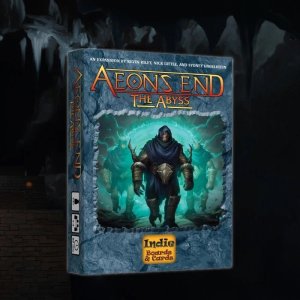
Aeon’s End: The Abyss
2024
A milestone-filled Aeon’s End expansion with new treasures, spells, and foes.
60
minutes
View expansion
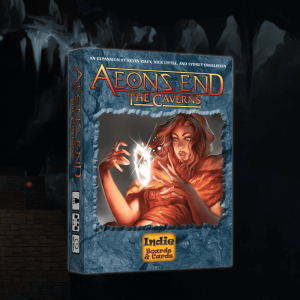
Aeon’s End: The Caverns
2024
Expand your Aeon's End collection with new mages, foes, spells, and treasures.
60
minutes
View expansion
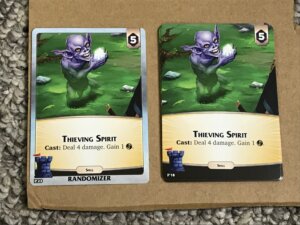
Aeon’s End: Thieving Spirit Promo Cards
2018
A 2018 promo pack featuring the Thieving Spirit spell card
60
minutes
Medium Heavy

View expansion
Aeon’s End: Echo Stone and Splinter Missile Promo
2019
Chain Echo Stones for extra aether and split Splinter Missile damage.
90
minutes
Medium Heavy
View expansion
Aeon’s End: The New Age – Promo Pack
2019
A 46-card collection of treasures, gems, relics, and spells.
60
minutes
Medium Heavy
View expansion
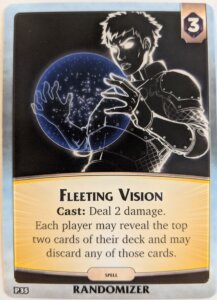
Aeon’s End: Fleeting Vision Promo
2018
A two-damage Cast lets every player reveal and discard from their deck.
60
minutes
Medium Heavy
View expansion
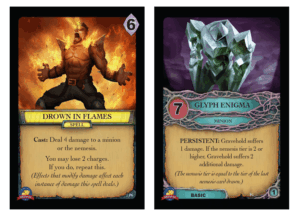
Aeon’s End: Tabletop Day 2017 Promos – Drown in Flames / Glyph Enigma
2017
A limited promo set adding a powerful spell and a punishing minion.
Medium Heavy
View expansion
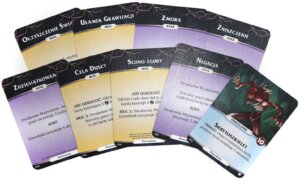
Aeon’s End: War Eternal – Promo Pack
2017
A 12-card Aeon’s End: War Eternal promo set with nine nemesis cards.
60
minutes
Medium Heavy
View expansion
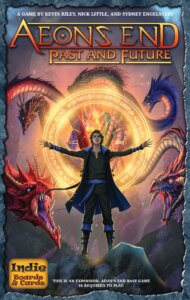
Aeon’s End: Past and Future
2023
Two interconnected campaigns span the past and a distant future.
60
minutes
Medium Heavy
View expansion
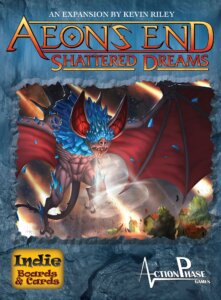
Aeon’s End: Shattered Dreams
2019
Expand the cooperative deckbuilding adventure with new cards, Nook, and a nemesis.
60
minutes
Medium
View expansion

Aeon’s End: Into the Wild
2019
A new story, fresh cards, and Mage mats for 1–4 players.
60
minutes
Medium Heavy
View expansion

Aeon’s End: Buried Secrets
2019
Expand existing Aeon’s End games with campaign-era promo content.
60
minutes
Medium
View expansion

Aeon’s End: The Void
2017
Expand your Aeon’s End collection with two nemeses and two breach mages.
Medium
View expansion
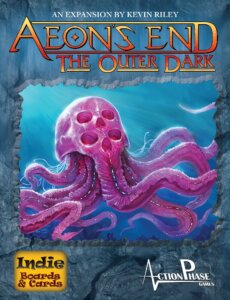
Aeon’s End: The Outer Dark
2017
Expand your Aeon's End experience with new nemeses, mages, and cards.
60
minutes
Medium Heavy
View expansion

Aeon’s End: The Depths
2016
Descend into the shadows to defend Gravehold from the awakened troggs.
60
minutes
Medium
View expansion

Aeon’s End: The Nameless
2017
Face two new nemeses in a dark cooperative deckbuilding expansion.
60
minutes
Medium
View expansion