Atlantis Rising (Second Edition)
2019
Work together, gather resources, and survive flooding locations long enough to build and power a gate before Atlantis disappears.
120
minutes
1 - 7
player(s)
10+
Medium


About this board game
Atlantis Rising (Second Edition) is a cooperative worker-placement game for 1–7 players, with approximately 120 minutes of play time. Together, you must save your people from an island that is steadily sinking beneath the waves.
Deploy citizens across Atlantis to gather the resources needed to build and power a cosmic gate. Locations closer to the shoreline offer greater rewards, but they are more likely to be flooded, causing the actions of workers placed there to be lost.
Each turn, every player draws a misfortune card. These cards can flood locations along the ever-shrinking shoreline or otherwise undermine your efforts, forcing the group to adapt while racing against the destruction of the island.
- Cooperative worker placement for solo play or groups of up to seven
- Risk-versus-reward decisions between safer inland locations and more rewarding shoreline spaces
- Resource gathering and construction focused on completing and powering the cosmic gate
- Expanded Councilor powers and a revised, expanded knowledge deck
In this edition, the former Athenians Attack phase has been replaced by the Wrath of the Gods phase. At the end of each round, players must work together to decide which set number of tiles will be flooded, adding another layer of strategic planning and urgency.
The edition also features new art and graphic design that further highlight its thematic setting. Once built, the variable gate components no longer provide one-time bonuses; instead, they create new worker-placement spots where Atlantean workers can unleash helpful actions. In Atlantis Rising, every decision matters as the waters close in.

Board Game Rules for
Atlantis Rising (Second Edition)
“BUT AFTERWARDS THERE OCCURRED VIOLENT EARTHQUAKES AND FLOODS; AND IN A SINGLE DAY AND NIGHT OF MISFORTUNE … THE ISLAND OF ATLANTIS … DISAPPEARED IN THE DEPTHS OF THE SEA.”
— PLATO
CAN YOU SAVE THE ISLAND OF ATLANTIS?
ATLANTIS RISING is a cooperative game, where players must work together as a team in order to win. You and your fellow players portray the leading citizens of Atlantis on the eve of its destruction. Send your faithful followers out to various places around the island to gather material resources and mystic energy or to use advanced Atlantean technology and mysterious ancient artifacts.
Using these resources and actions, you must work together to construct a Cosmic Gate capable of transporting the remaining population of the island to safety, before your civilization is lost forever to the sea.

OBJECT OF PLAY
To win the game, collect resources and build all the Cosmic Gate components in the Blueprint before all 37 island tiles flood.
- 37 Island Board Tiles
- 1 Cosmic Gate Board
- 20 Cosmic Gate Component Tiles and 1 Power Core Tile
- 10 Councilor Player Boards
Each of the councilors of Atlantis has a different councilor ability, explained at the top of a player’s councilor board. - 1 Wrath of the Gods Track and Wrath Counter
- 6 Mystic Barriers and Plastic Stands
- 2 Dice
- Starting Player Marker
- 67 Misfortune Cards:
- 36 Basic Misfortune
- 13 Special Misfortune
- 9 Calm Seas
- 9 Controlled Floods
- 33 Library Cards:
- 22 Basic
- 11 Artifact
- Atlantean Pieces:
- 1 Leader, 4 Followers, 1 Player Marker in green, orange, purple, & navy
- 1 Leader, 7 Followers, 1 Player Marker in red, blue, and yellow
Leaders are the representation of the councilor within the game, and are the large player pieces. Every councilor has their faithful followers. These are the smaller pieces in a player’s color.
- 8 Volunteers: Faithful Atlantean citizens who help the councilors for a short period of time.
- 1 Automaton & 1 Hologram: These special Atlanteans are for use in 1 or 2-player games (see pages 14–15).
- 24 Mystic Energy
- 12 Crystal, Meteoric Iron Ore, and Gold (acrylic gems)
- 16 Atlantium Metal (resin bars)

INTRODUCTORY GAME MODE
This setup is for playing with 4 to 7 people. If you’d like to know about the changes to setup for lower player counts, please refer to pages 14 and 15.
- Island Setup: Set up the island of Atlantis by laying out its tiles as shown.
- Supplies: Place the mystic barriers in their plastic stands. Place these, the resources (ore, Atlantium, gold, and crystal), mystic energy, and dice near the game board as a common supply.
- Library Deck: Shuffle the artifact cards separately from the other library cards and set aside 4 of them. Return all other artifact cards to the game box. Combine the set aside artifact cards with all other library cards and shuffle to create the library deck. Place this deck face down near the library peninsula of the Island.
- Misfortune Deck: Collect the number of Calm Seas and Controlled Flood cards corresponding to the desired level of difficulty. We recommend 9 Calm Seas and 3 Controlled Floods for an introductory game. Shuffle them into the misfortune deck and place it near the board. Return any remaining cards to the box. Refer to page 15 for more challenging modes of play.
- Wrath Track: Place the Wrath of the Gods track near the misfortune deck and place the wrath token on the zero (0) space.
- The Blueprint: From the component tiles, collect all 5 marked with the letter A, along with Mystic Siphon (B), Matter Converter (B), Numinous Beacon (C), and Entropy Drive (C). Place these tiles, and the Power Core, in a row near the board to form the Blueprint. Return all remaining component tiles to the box. Refer to page 15 for more challenging Blueprint setups.
- Councilors and Starting Pieces: Collect the councilor boards (on your first few plays, assign one player to be the Artificer). All remaining players choose a councilor board. Alternatively, remaining players may distribute councilor boards randomly. Each player selects a player color and takes 2 followers, the Leader, and the player token of the corresponding color. The player token is an indicator of your player color and should remain visible to all players. Each player also takes 2 mystic energy.
- Supply Area: Place 2 followers of each selected color as well as the volunteers in the supply area of the Wrath of the Gods track. Return any unused player pieces to the box.
- Cosmic Gate: Place the Cosmic Gate board near the Island board.
- Starting Player: The player who most recently went swimming becomes the starting player and takes the starting player marker.
Once everyone is comfortable with the game, you may increase the difficulty of the game by altering some or all of the setup. This includes changing the makeup of the Misfortune deck as well as different components for the Blueprint. To learn more about increasing the difficulty, refer to page 15.

GAME ROUND PHASES
The game is played over a series of rounds, with each round separated into 4 phases, as outlined below:
- PLACE ATLANTEANS
- SUFFER MISFORTUNES
- TAKE ACTIONS
- ENDURE THE WRATH OF THE GODS
PHASE 1: PLACE ATLANTEANS
As the threat of crashing waves and plunging waters looms, Atlanteans of every station rush about the island at the direction of their councilor, preparing for tasks that must be done to save their civilization.
In this phase, players will place all Atlanteans from their councilor’s pool onto empty spaces on the Island or Cosmic Gate board. There is no turn order among players.
- Players may place Atlanteans in whatever order they choose, potentially placing simultaneously or bouncing back and forth between players.
- If there is a dispute over placement order, the starting player for the round determines in which order things are placed.
- Each island tile, except the center tile, supports a limited number of Atlanteans as indicated by the number of spaces on the tile.
- With the exception of cities (see page 9), each space represents one opportunity to take the action of its corresponding tile.
- The center tile is the Mystic Power Source of Atlantis and may hold any number of Atlanteans.
- The Cosmic Gate board contains special spaces, that can each hold any number of Atlanteans, for building components (see pages 11-12). Some components, once built, also feature additional action spaces.

PHASE 2: SUFFER MISFORTUNES
Even as the councilors work to save their home, myriad misfortunes plague Atlantis, flooding the island, inciting panic in the populace, and raining other maladies upon the land. Atlanteans who see the oncoming waves ready to crash into their assigned position will flee with their task unfulfilled.
Beginning with the starting player and proceeding clockwise, each player must draw and resolve one misfortune card. Fully resolve each misfortune card before proceeding to the next, in player order.
- Some misfortunes are special misfortunes. Follow the instructions on these cards when one is drawn.
- If a misfortune card requires a choice, all players may discuss the decision, but the player who drew the misfortune has final authority.
- When a player draws a Calm Seas card, nothing happens.
Flooding
Most misfortune cards are basic misfortunes. When a basic misfortune is drawn, the current player must flood the next available tile in the peninsula depicted on the card (e.g. Forests).
- Whenever a misfortune card instructs a player to flood a tile, they must flip over the un-flooded tile that is farthest from the center on the indicated peninsula.
- Important: Any Atlanteans on a flooded tile are returned to their pool and will not be able to perform their planned actions this round.
- If a peninsula would flood but all of its tiles are already flooded, the current player must flood two tiles instead. These tiles may be from the same or two different peninsulas of the current player’s choice.
- If there are no tiles remaining in peninsulas when a tile should be flooded, the current player must flood the center tile, and the players lose the game.
PHASE 3: TAKE ACTIONS
Reeling from recent misfortunes, the remaining Atlanteans suppress their fears and perform their tasks with diligence and efficiency, knowing there is so much more to do and so little time in which to do it.
All Atlanteans still remaining after the misfortunes now take the actions associated with their placement, described in detail in the next section of the rules.
- Players should collectively decide in what order they should resolve the actions of their placed Atlanteans. If there is a dispute over which action to resolve next, the starting player decides.
- Each player has a special Atlantean called a Leader, that represents the councilor on their councilor board.
- Leaders take actions just like followers, but each also has a different special ability that can be used while performing actions. These abilities benefit nearby Atlanteans, including themselves, and are explained on the councilor boards.
- Once all actions are resolved, return all Atlanteans to the councilor’s pool of the corresponding player. To make it easier to know which actions have been performed, lay down each Atlantean after their action has been completed.
PHASE 4: ENDURE THE WRATH OF THE GODS
The gods are furious with the people of Atlantis, who have embraced technology and mysticism over worship of the divine. But the futile resistance of these mortals, who labor to save themselves, even as their home sinks beneath the waves, merely serves to enrage the gods further.
- In the Endure the Wrath of the Gods phase, the players choose and flood island tiles (similarly to when Suffering Misfortunes, except in this phase players may freely choose which tiles to flip) equal to the number shown on the current level of the Wrath of the Gods track.
- If the players cannot agree on which tile(s) to flood, the starting player chooses.
- Then, the starting player moves the Wrath counter up one level. If the wrath counter is already in the final space of the track, it does not move.
At the end of this phase, the current game round is complete. Pass the starting player marker to the next player in clockwise order.

THE WILD PENINSULAS: Mountains, Hills, and Forests
Atlantis is rich in resources: gold in the hills’ rivers, crystals hidden in forest deposits, and strange ore found in craters in the mountains. While each of these resources have been more widely extracted near the center of the island, they are largely untapped near its edges.
- Roll 1 die for each of your Atlanteans placed here; for each success, take one resource according to your Atlantean’s location:
- Mountains: ore
- Hills: gold
- Forests: crystal
- The roll is successful if the rolled number is equal to or higher than the number shown below the action space.
- Important: Regardless of how much higher the die value is, you still collect only 1 resource of that type.
Mystic energy guides the Atlantean follower, allowing them to find resources they may otherwise have missed.
- After the die is rolled for an action taken in the Forests, Hills, or Mountains, you may spend mystic energy to add 1 to the result.
- A player may spend any number of mystic energy in this way, increasing the result by 1 for each mystic energy spent.
- Only the player who rolled the die is able to spend mystic energy in this way.

THE CIVILIZED PENINSULAS: Cities, Libraries, and Forges
Cities
The citizens of Atlantis are proud and logical – they are not easily convinced that the gods will actually destroy their island; it will take the testimony of several followers to recruit them to your cause. Yet those who dwell closer to the sea can more clearly see the oncoming waves, and may be more easily convinced to join the effort to save their civilization. As destruction becomes more certain, and the wrath of the gods against Atlantis becomes more evident, Atlanteans will more readily join the cause of the resistance.
Players who use Cities spaces have an opportunity to recruit additional Atlanteans for use in future rounds. The Atlantean Cities tiles are marked by a double space, requiring two Atlanteans to activate:
- These Atlanteans may be from the same or different players.
- Roll 1 die for each Atlantean present. If multiple players share the space, they should each roll 1 die.
- Add the current value of the Wrath of the Gods track to the total of your die rolls.
- As in the Wild Peninsulas, you may spend mystic energy to increase your die’s result.
- If the result is equal to or higher than the target number for the tile, you successfully recruit one new follower.
- The new follower must be the same color as one of the Atlanteans used to activate the space.
- If two players share the space, they must decide which of them receives the new follower. That player takes an Atlantean of their color from the supply next to the Wrath of the Gods track. If all followers of their color have been recruited, they may not recruit more.

Libraries
The libraries of Atlantis are the very best in the world, containing the wisdom of an advanced civilization (and some of its most powerful artifacts as well!). While some may believe it folly to retreat into these stacks of books and scrolls when the island is sinking around them, wise councilors recognize the true value of knowledge.
For each Atlantean placed here, draw 2 ( ) library cards, then keep cards corresponding to the icon on the tile:
 Keep both cards
 Keep 1 card and:
 discard the other
 place the other card on the bottom of the deck
 Reminder: You may spend 1 mystic energy to keep the second card instead of placing it in the discard pile or on the bottom of the deck.
Rules for Library Cards:
- If you would draw from the library deck, and there are no available cards, do not reshuffle to create a new library deck. Some effects may allow you to create a new library deck.
- Players have a maximum hand limit of four library cards. If you have more than four library cards in your hand at any time you must either immediately play a card or discard until you reach your hand limit.
- You may play library cards at any time, but they may not be played to interrupt another effect or action.
Artifacts
After drawing cards, if you keep an artifact, instead of adding it to your hand, place it on the table in front of you. Each artifact provides a permanent, ongoing benefit for as long as you control that artifact. Otherwise, artifacts are treated like other library cards, including counting against your hand limit.
Forges
The forges of Atlantis are legendary. Only here can the precious alloy Atlantium be refined from the ore found in the mountains. While simple ore is useless for building the components of the Cosmic Gate, Atlantium is critical to the advanced technology of Atlantis. The smiths at the island’s center are already overworked, but those who brave the waves can command the full attention of the smiths who dwell near the island’s edge.
- For each Atlantean placed here, exchange one ore for one or more Atlantium.
- You may convert ore to Atlantium at the rate shown on the corresponding tile.
- Each Atlantean placed here may convert only one ore into Atlantium (a player with multiple Atlanteans on a Forges tile may convert multiple ore into Atlantium, one for each Atlantean present).

MYSTIC POWER SOURCE: Center Tile
The Mystic Power Source is the key to the Atlanteans’ advanced technology. Unlike other cultures, who would war amongst themselves for the right to control such a potent force, the Atlanteans have always granted free access to all citizens.
Players take 1 mystic energy for each of their Atlanteans placed here.
MYSTIC ENERGY
The power of mystic energy can guide followers to the resources they seek, turn back the oncoming waves, or even raise the land from the ocean.
Mystic energy may be spent in a number of different ways:
 Add 1 to a die you just rolled (per 1 energy)
- Keep 1 additional library card after drawing (per 1 energy)
- Place a mystic barrier during the Place Atlanteans or Take Actions phase (4 energy)
- Unflood a flooded tile (5 energy)
Multiple players may simultaneously contribute mystic energy towards placing a mystic barrier or unflooding a flooded tile. Players may not contribute mystic energy to increase another player’s die roll or allow them to keep additional library cards.
Unless indicated by the ability, card, or effect, nothing may interrupt the resolution of anything else. For example, mystic energy may not be spent to unflood a tile while resolving a misfortune card.
MYSTIC BARRIERS
The tangible manifestation of the power of mystic energy, mystic barriers can protect localized areas of the island from destruction.
- During the course of the game, players may gain access to mystic barrier tokens. Mystic barriers are usually purchased using mystic energy, but some cards or effects may award them.
- Once gained, a mystic barrier token must be placed next to any island peninsula. Each peninsula may only support one mystic barrier token at a time and only if there is still at least one tile remaining in that peninsula.
- If a tile in a peninsula would be flooded, instead discard the barrier on that peninsula. Using a mystic barrier is not optional.
Remember, Controlled Flood misfortune cards overpower mystic barriers. When one is drawn, first remove the barrier, then flood the chosen tile.
UNFLOODING
To unflood a tile, first select a peninsula then flip the flooded tile closest to the center of the island.
COSMIC GATE BOARD: Build Components
To build a gate component, players must have placed one or more Atlanteans on one of the spaces in the center of the Cosmic Gate board.
- One space on this board, and several on completed components, are marked with a ‘5+’. This means these spaces are only available when playing with 5 or more players. You may not place Atlanteans on them, or interact with them in any way, when playing with 1 to 4 players.
- When resolving a space on the Cosmic Gate board, each player with an Atlantean on the same space may spend one or more of the resources shown to build the same, single component. All then return their Atlanteans to their pools.
Remember, action spaces are resolved in any order players choose. Be sure to gather everything you need before building a component!
BUILDING COMPONENTS (CONTINUED)
- If the players contributing Atlanteans to the build do not have the necessary resources to create any component, they spend no resources and must return their Atlanteans to their pools, with their actions wasted.
- Once a component is built, take it from the Blueprint and place it on the Cosmic Gate board, flipping it from its unbuilt (parchment) side to its built (blue) side.
- Some components provide a one-time benefit when built. Others provide new action spots where Atlanteans can be placed on future rounds.
- The D components have double spaces requiring 2 Atlanteans to activate.
THE POWER CORE
The island doesn’t have much more time now. To activate the gate and save your people, leaving Atlantis behind, you must power the Cosmic Gate.
The Power Core is the most crucial component to escape and follows unique building rules including who contributes, when it can be built, and which Atlanteans must participate:
- You cannot build the Power Core until you have built all other components in the Blueprint. When completed, the other components will form a circle on the Cosmic Gate board, where the Power Core can slip inside.
- Each player must place their Leader on the same build space, and each must contribute at least one resource or mystic energy towards the building cost of the Power Core. If any player is unable to do this, the Power Core cannot be built this turn.
- When you build the Power Core all players immediately win.

VOLUNTEER ATLANTEANS
During the course of the game, abilities, cards, or components may provide volunteers. Volunteers are special workers that last for only one round and then are returned to the Atlantean supply. During that round they belong to the player who recruited them. They take actions like other Atlanteans, but are not considered Leaders or followers for effects that specify these types of Atlanteans.

RESOURCES
If an effect refers to resources, it only affects Atlantium, crystal, gold, and ore. Mystic energy is not a resource, even though it is required to build the Cosmic Gate. Resources and mystic energy are not limited by the game’s components. Should you run out, simply use replacement pieces of your choice.


PLAYING AT VARIOUS PLAYER COUNTS
4–7 players
No changes to setup or gameplay.
3 players
For a three-player game, adjust the setup and gameplay as follows:
- During setup, each player receives four Atlanteans of their color (3 followers and 1 Leader), and sets another three into the Atlantean supply. Players may control up to six total followers.
- During the Suffer Misfortunes phase, after each player has drawn and resolved a misfortune, the starting player draws and resolves an additional misfortune.
2 players
For a two-player game, vary the setup and gameplay as follows:
- During setup, each player receives five Atlanteans of their color (4 followers and 1 Leader), and sets another three into the Atlantean supply. Players may control up to seven total followers.
- During setup, the starting player takes the Hologram piece in addition to their starting followers. See below for rules for the Hologram.
- During the Suffer Misfortunes phase, the first player draws and resolves two misfortunes, one at a time, then the second player does the same.
Not all colors of player marker are available in all player counts. If playing a 1-3 player game, only RED, BLUE, and YELLOW may be chosen as player colors.
THE HOLOGRAM
During setup, shuffle and create a stack of the unused councilor boards, called the councilor stack. Each round the starting player will receive the Hologram.
- The Hologram is a special Leader that also counts as your Atlantean for the round.
- To determine the Hologram’s power for the round, the starting player reveals the top two boards of the councilor stack, chooses one to use, and discards the other, creating the councilor discard pile.
- At the end of the round, place the Hologram’s councilor board into the councilor discard pile. If the councilor stack ever runs out, reshuffle the councilor discard pile to form a new stack.
- The Hologram takes actions as normal, and has the special ability of the chosen councilor (but not of your own councilor).
- If the Hologram collects resources, mystic energy, or library cards, they are taken by the player controlling the Hologram and placed into their reserve.
SOLO VARIANT
For a one-player game, vary the setup and gameplay as follows:
- During setup, take five Atlanteans of one color (4 followers and 1 Leader), and set another three into the Atlantean supply. You may control up to seven total Atlantean followers.
- Take the Hologram and Automaton pieces and place them with the rest of your starting Atlanteans. Use the above rules for the Hologram. See the next page for rules for the Automaton.
- At the beginning of each turn (including the first), take one mystic energy. Place these on the rounds spaces of the Wrath of the Gods track as a reminder.
- During the Suffer Misfortunes phase, draw and resolve four misfortunes, one at a time.
THE AUTOMATON
The Automaton is a special worker that counts as one of your Atlanteans, but not as a follower. Unlike other Atlanteans, it does not take actions, and thus never collects resources, mystic energy, or library cards. Instead, it has the special ability of granting a +2 to the die rolls of other Atlanteans placed with it.
- The Automaton may never be placed on a tile by itself, but must always accompany at least one other Atlantean.
- It may be used to activate a double space, helping the other Atlantean take the action.
- In the Cities, players still roll two dice, but the +2 only applies once, for the other Atlantean.

ADJUSTING DIFFICULTY
To adjust the difficulty of the game, players can vary setup as shown below.
Select or randomly choose components from each of the indicated types, in addition to the Power Core. For your first game, refer to step 6 of Game Setup on page 4. More experienced gamers may wish to start at a higher difficulty level.
| Setting | Level 1 | Level 2 | Level 3 | Level 4 | Level 5 |
|---|---|---|---|---|---|
| Component Type | A B C D | A B C D | A B C D | A B C D | A B C D |
| Component Quantity | 5 2 2 0 | 3 3 3 0 | 3 3 0 3 | 3 0 3 3 | 0 3 3 3 |
| Calm Seas | 9 | 9 | 6 | 3 | 0 |
| Controlled Flood | 3 | 6 | 6 | 9 | 9 |
| Starting Mystic Energy | 2 per player | 1 per player | 1 per player | 1 per player | None |
FREQUENTLY ASKED QUESTIONS
- Q: How do effects like Ancient Atlas, Earthquake, and the Explorer’s special ability interact?
- A: Apply the effects in the order they occur. The Explorer’s special ability is applied at the time of the dice roll. Regarding Earthquake, note that it is possible for a target number to be raised above 6. If this happens, you will need to spend mystic energy or find another way to increase the value of the die roll. If a target number is reduced to below 1, your Atlantean automatically succeeds.
- Q: How do the cards Cipher of Expertise and Enigma of Alacrity work when a Leader is placed on a double space?
- A: The Leader takes its action again, as does the Atlantean with whom it has been placed, essentially activating that spot one additional time.
- Q: Spirit Seal and Soul Terraformer both refer to followers, rather than Atlanteans. Can I use volunteers or Leaders on these worker locations?
- A: Spirit Seal can only be activated using Atlantean followers. Volunteers, Leaders, the Hologram, and the Automaton cannot activate this component. For Soul Terraformer, at least one of the two activating Atlanteans, the one removed from play, must be a follower. The other may be any type of Atlantean.
- Q: If I turn in resources at the Amplification Harbor, can I keep those that are returned?
- A: Yes.
- Q: Can I use the Prediction Module to remove misfortune cards from the draw deck and the discard pile?
- A: Yes, you may remove misfortune cards from both those locations.
- Q: How does the Priest work at the Cities?
- A: If the Priest is present on a Cities tile and the action fails, the player controlling the Priest may decide to have one or both dice rerolled, but may only attempt the action one additional time.
- Q: Can the Emissary allow a third worker at the Cities?
- A: Yes, but only 2 dice are rolled. But, if three players are present in this situation, they may choose a new follower from among any of those three councilors.
- Q: How does flooding work with the Seafarer/Aquanaut?
- A: When a tile in the peninsula in which you have placed this Leader floods, flip over the next unflooded tile in that peninsula as normal. Then, treat the tile your Leader is on as though it flooded too, which generally means Atlanteans on that tile lose their actions for the turn, and are returned to their pools.
- Q: What do I do if I choose the Scholar for the Hologram?
- A: Draw two of the unused scholar artifact cards at random, and select one to assign to the Scholar for this round. If you use the Scholar for the Hologram again in a later round, you choose a new artifact each time from those not being used in the game (including any you used for the Hologram Scholar in previous rounds).
- Q: Where does the cultural imagery in Atlantis come from?
- A: We imagined our Atlantis as an advanced civilization that fell at the dawn of the historic Bronze Age (circa 3300 BCE). Located in the Atlantic Ocean, people from all over the world came there to call it home. Throughout history, whenever a civilization falls, its culture often influences the civilizations that rise in its place. In the case of our Atlantis, we drew inspiration from the ancient Minoan civilization that many scholars suspect may have been the inspiration for Plato’s Atlantis. Clothing, jewelry, art, and architecture are all largely inspired by the remains of this very real Bronze Age civilization.
For more information check out our website, www.elfcreekgames.com
CREDITS
- Original design: Galen Ciscell
- Revised edition design: Galen Ciscell and Brent Dickman
- Development and production: Brent Dickman
- Illustration: Vincent Dutrait
- Graphic design: Peter Gifford (Universal Head)
- Editing: Donny Behne, Travis D. Hill, and Sam Hillier
Elf Creek would like to thank our families and our lead playtesters and volunteers: Tom Ackerman, Miles Bensky, Kaity Bequette, Nathan Bogue, David Bostwick, Chelsie Taresh Ciscell, Molly Cooper, Amber Dickman, Andrew Dudich, Joel Fletcher, Cody Fueyo, BJ Gailey, Steven Hand, Bobbi Hardy, Mark Hardy, Mark Hewitt, Max Isenholt, Zack Kiedysz, Jason Kingsley, Michelle Kohler, Kyle McKay, Alexander Moore, David Michael Moore, Amanda Morgan, James Munger, Ben Moy, Christopher Needham, Kate Norcross, AJ Nowaczyk, John Reside, David Sanders, Andrew Stengele, Brian Suhre, Caleb Wilson, Lisa Wilson, and all the playtesters and fans of the first edition.
Introduction & Object of the Game
“BUT AFTERWARDS THERE OCCURRED VIOLENT EARTHQUAKES AND FLOODS; AND IN A SINGLE DAY AND NIGHT OF MISFORTUNE … THE ISLAND OF ATLANTIS … DISAPPEARED IN THE DEPTHS OF THE SEA.”
— PLATO
CAN YOU SAVE THE ISLAND OF ATLANTIS?
ATLANTIS RISING is a cooperative game, where players must work together as a team in order to win. You and your fellow players portray the leading citizens of Atlantis on the eve of its destruction. Send your faithful followers out to various places around the island to gather material resources and mystic energy or to use advanced Atlantean technology and mysterious ancient artifacts.
Using these resources and actions, you must work together to construct a Cosmic Gate capable of transporting the remaining population of the island to safety, before your civilization is lost forever to the sea.
OBJECT OF PLAY
To win the game, collect resources and build all the Cosmic Gate components in the Blueprint before all 37 island tiles flood.
Components
- 37 Island Board Tiles
- 1 Cosmic Gate Board
- 20 Cosmic Gate Component Tiles and 1 Power Core Tile
- 10 Councilor Player Boards
Each of the councilors of Atlantis has a different councilor ability, explained at the top of a player’s councilor board. - 1 Wrath of the Gods Track and Wrath Counter
- 6 Mystic Barriers and Plastic Stands
- 2 Dice
- Starting Player Marker
- 67 Misfortune Cards:
- 36 Basic Misfortune
- 13 Special Misfortune
- 9 Calm Seas
- 9 Controlled Floods
- 33 Library Cards:
- 22 Basic
- 11 Artifact
- Atlantean Pieces:
- 1 Leader, 4 Followers, 1 Player Marker in green, orange, purple, & navy
- 1 Leader, 7 Followers, 1 Player Marker in red, blue, and yellow
Leaders are the representation of the councilor within the game, and are the large player pieces. Every councilor has their faithful followers. These are the smaller pieces in a player’s color.
- 8 Volunteers: Faithful Atlantean citizens who help the councilors for a short period of time.
- 1 Automaton & 1 Hologram: These special Atlanteans are for use in 1 or 2-player games (see pages 14–15).
- 24 Mystic Energy
- 12 Crystal, Meteoric Iron Ore, and Gold (acrylic gems)
- 16 Atlantium Metal (resin bars)
Game Setup
INTRODUCTORY GAME MODE
This setup is for playing with 4 to 7 people. If you’d like to know about the changes to setup for lower player counts, please refer to pages 14 and 15.
- Island Setup: Set up the island of Atlantis by laying out its tiles as shown.
- Supplies: Place the mystic barriers in their plastic stands. Place these, the resources (ore, Atlantium, gold, and crystal), mystic energy, and dice near the game board as a common supply.
- Library Deck: Shuffle the artifact cards separately from the other library cards and set aside 4 of them. Return all other artifact cards to the game box. Combine the set aside artifact cards with all other library cards and shuffle to create the library deck. Place this deck face down near the library peninsula of the Island.
- Misfortune Deck: Collect the number of Calm Seas and Controlled Flood cards corresponding to the desired level of difficulty. We recommend 9 Calm Seas and 3 Controlled Floods for an introductory game. Shuffle them into the misfortune deck and place it near the board. Return any remaining cards to the box. Refer to page 15 for more challenging modes of play.
- Wrath Track: Place the Wrath of the Gods track near the misfortune deck and place the wrath token on the zero (0) space.
- The Blueprint: From the component tiles, collect all 5 marked with the letter A, along with Mystic Siphon (B), Matter Converter (B), Numinous Beacon (C), and Entropy Drive (C). Place these tiles, and the Power Core, in a row near the board to form the Blueprint. Return all remaining component tiles to the box. Refer to page 15 for more challenging Blueprint setups.
- Councilors and Starting Pieces: Collect the councilor boards (on your first few plays, assign one player to be the Artificer). All remaining players choose a councilor board. Alternatively, remaining players may distribute councilor boards randomly. Each player selects a player color and takes 2 followers, the Leader, and the player token of the corresponding color. The player token is an indicator of your player color and should remain visible to all players. Each player also takes 2 mystic energy.
- Supply Area: Place 2 followers of each selected color as well as the volunteers in the supply area of the Wrath of the Gods track. Return any unused player pieces to the box.
- Cosmic Gate: Place the Cosmic Gate board near the Island board.
- Starting Player: The player who most recently went swimming becomes the starting player and takes the starting player marker.
Once everyone is comfortable with the game, you may increase the difficulty of the game by altering some or all of the setup. This includes changing the makeup of the Misfortune deck as well as different components for the Blueprint. To learn more about increasing the difficulty, refer to page 15.
Structure of Play
GAME ROUND PHASES
The game is played over a series of rounds, with each round separated into 4 phases, as outlined below:
- PLACE ATLANTEANS
- SUFFER MISFORTUNES
- TAKE ACTIONS
- ENDURE THE WRATH OF THE GODS
PHASE 1: PLACE ATLANTEANS
As the threat of crashing waves and plunging waters looms, Atlanteans of every station rush about the island at the direction of their councilor, preparing for tasks that must be done to save their civilization.
In this phase, players will place all Atlanteans from their councilor’s pool onto empty spaces on the Island or Cosmic Gate board. There is no turn order among players.
- Players may place Atlanteans in whatever order they choose, potentially placing simultaneously or bouncing back and forth between players.
- If there is a dispute over placement order, the starting player for the round determines in which order things are placed.
- Each island tile, except the center tile, supports a limited number of Atlanteans as indicated by the number of spaces on the tile.
- With the exception of cities (see page 9), each space represents one opportunity to take the action of its corresponding tile.
- The center tile is the Mystic Power Source of Atlantis and may hold any number of Atlanteans.
- The Cosmic Gate board contains special spaces, that can each hold any number of Atlanteans, for building components (see pages 11-12). Some components, once built, also feature additional action spaces.
PHASE 2: SUFFER MISFORTUNES
Even as the councilors work to save their home, myriad misfortunes plague Atlantis, flooding the island, inciting panic in the populace, and raining other maladies upon the land. Atlanteans who see the oncoming waves ready to crash into their assigned position will flee with their task unfulfilled.
Beginning with the starting player and proceeding clockwise, each player must draw and resolve one misfortune card. Fully resolve each misfortune card before proceeding to the next, in player order.
- Some misfortunes are special misfortunes. Follow the instructions on these cards when one is drawn.
- If a misfortune card requires a choice, all players may discuss the decision, but the player who drew the misfortune has final authority.
- When a player draws a Calm Seas card, nothing happens.
Flooding
Most misfortune cards are basic misfortunes. When a basic misfortune is drawn, the current player must flood the next available tile in the peninsula depicted on the card (e.g. Forests).
- Whenever a misfortune card instructs a player to flood a tile, they must flip over the un-flooded tile that is farthest from the center on the indicated peninsula.
- Important: Any Atlanteans on a flooded tile are returned to their pool and will not be able to perform their planned actions this round.
- If a peninsula would flood but all of its tiles are already flooded, the current player must flood two tiles instead. These tiles may be from the same or two different peninsulas of the current player’s choice.
- If there are no tiles remaining in peninsulas when a tile should be flooded, the current player must flood the center tile, and the players lose the game.
PHASE 3: TAKE ACTIONS
Reeling from recent misfortunes, the remaining Atlanteans suppress their fears and perform their tasks with diligence and efficiency, knowing there is so much more to do and so little time in which to do it.
All Atlanteans still remaining after the misfortunes now take the actions associated with their placement, described in detail in the next section of the rules.
- Players should collectively decide in what order they should resolve the actions of their placed Atlanteans. If there is a dispute over which action to resolve next, the starting player decides.
- Each player has a special Atlantean called a Leader, that represents the councilor on their councilor board.
- Leaders take actions just like followers, but each also has a different special ability that can be used while performing actions. These abilities benefit nearby Atlanteans, including themselves, and are explained on the councilor boards.
- Once all actions are resolved, return all Atlanteans to the councilor’s pool of the corresponding player. To make it easier to know which actions have been performed, lay down each Atlantean after their action has been completed.
PHASE 4: ENDURE THE WRATH OF THE GODS
The gods are furious with the people of Atlantis, who have embraced technology and mysticism over worship of the divine. But the futile resistance of these mortals, who labor to save themselves, even as their home sinks beneath the waves, merely serves to enrage the gods further.
- In the Endure the Wrath of the Gods phase, the players choose and flood island tiles (similarly to when Suffering Misfortunes, except in this phase players may freely choose which tiles to flip) equal to the number shown on the current level of the Wrath of the Gods track.
- If the players cannot agree on which tile(s) to flood, the starting player chooses.
- Then, the starting player moves the Wrath counter up one level. If the wrath counter is already in the final space of the track, it does not move.
At the end of this phase, the current game round is complete. Pass the starting player marker to the next player in clockwise order.
Island Locations & Actions
THE WILD PENINSULAS: Mountains, Hills, and Forests
Atlantis is rich in resources: gold in the hills’ rivers, crystals hidden in forest deposits, and strange ore found in craters in the mountains. While each of these resources have been more widely extracted near the center of the island, they are largely untapped near its edges.
- Roll 1 die for each of your Atlanteans placed here; for each success, take one resource according to your Atlantean’s location:
- Mountains: ore
- Hills: gold
- Forests: crystal
- The roll is successful if the rolled number is equal to or higher than the number shown below the action space.
- Important: Regardless of how much higher the die value is, you still collect only 1 resource of that type.
Mystic energy guides the Atlantean follower, allowing them to find resources they may otherwise have missed.
- After the die is rolled for an action taken in the Forests, Hills, or Mountains, you may spend mystic energy to add 1 to the result.
- A player may spend any number of mystic energy in this way, increasing the result by 1 for each mystic energy spent.
- Only the player who rolled the die is able to spend mystic energy in this way.
THE CIVILIZED PENINSULAS: Cities, Libraries, and Forges
Cities
The citizens of Atlantis are proud and logical – they are not easily convinced that the gods will actually destroy their island; it will take the testimony of several followers to recruit them to your cause. Yet those who dwell closer to the sea can more clearly see the oncoming waves, and may be more easily convinced to join the effort to save their civilization. As destruction becomes more certain, and the wrath of the gods against Atlantis becomes more evident, Atlanteans will more readily join the cause of the resistance.
Players who use Cities spaces have an opportunity to recruit additional Atlanteans for use in future rounds. The Atlantean Cities tiles are marked by a double space, requiring two Atlanteans to activate:
- These Atlanteans may be from the same or different players.
- Roll 1 die for each Atlantean present. If multiple players share the space, they should each roll 1 die.
- Add the current value of the Wrath of the Gods track to the total of your die rolls.
- As in the Wild Peninsulas, you may spend mystic energy to increase your die’s result.
- If the result is equal to or higher than the target number for the tile, you successfully recruit one new follower.
- The new follower must be the same color as one of the Atlanteans used to activate the space.
- If two players share the space, they must decide which of them receives the new follower. That player takes an Atlantean of their color from the supply next to the Wrath of the Gods track. If all followers of their color have been recruited, they may not recruit more.
Libraries
The libraries of Atlantis are the very best in the world, containing the wisdom of an advanced civilization (and some of its most powerful artifacts as well!). While some may believe it folly to retreat into these stacks of books and scrolls when the island is sinking around them, wise councilors recognize the true value of knowledge.
For each Atlantean placed here, draw 2 () library cards, then keep cards corresponding to the icon on the tile:
- Keep both cards
- Keep 1 card and:
- discard the other
- place the other card on the bottom of the deck
- Reminder: You may spend 1 mystic energy to keep the second card instead of placing it in the discard pile or on the bottom of the deck.
Rules for Library Cards:
- If you would draw from the library deck, and there are no available cards, do not reshuffle to create a new library deck. Some effects may allow you to create a new library deck.
- Players have a maximum hand limit of four library cards. If you have more than four library cards in your hand at any time you must either immediately play a card or discard until you reach your hand limit.
- You may play library cards at any time, but they may not be played to interrupt another effect or action.
Artifacts
After drawing cards, if you keep an artifact, instead of adding it to your hand, place it on the table in front of you. Each artifact provides a permanent, ongoing benefit for as long as you control that artifact. Otherwise, artifacts are treated like other library cards, including counting against your hand limit.
Forges
The forges of Atlantis are legendary. Only here can the precious alloy Atlantium be refined from the ore found in the mountains. While simple ore is useless for building the components of the Cosmic Gate, Atlantium is critical to the advanced technology of Atlantis. The smiths at the island’s center are already overworked, but those who brave the waves can command the full attention of the smiths who dwell near the island’s edge.
- For each Atlantean placed here, exchange one ore for one or more Atlantium.
- You may convert ore to Atlantium at the rate shown on the corresponding tile.
- Each Atlantean placed here may convert only one ore into Atlantium (a player with multiple Atlanteans on a Forges tile may convert multiple ore into Atlantium, one for each Atlantean present).
MYSTIC POWER SOURCE: Center Tile
The Mystic Power Source is the key to the Atlanteans’ advanced technology. Unlike other cultures, who would war amongst themselves for the right to control such a potent force, the Atlanteans have always granted free access to all citizens.
Players take 1 mystic energy for each of their Atlanteans placed here.
Mystic Energy & Island Defense
MYSTIC ENERGY
The power of mystic energy can guide followers to the resources they seek, turn back the oncoming waves, or even raise the land from the ocean.
Mystic energy may be spent in a number of different ways:
- Add 1 to a die you just rolled (per 1 energy)
- Keep 1 additional library card after drawing (per 1 energy)
- Place a mystic barrier during the Place Atlanteans or Take Actions phase (4 energy)
- Unflood a flooded tile (5 energy)
Multiple players may simultaneously contribute mystic energy towards placing a mystic barrier or unflooding a flooded tile. Players may not contribute mystic energy to increase another player’s die roll or allow them to keep additional library cards.
Unless indicated by the ability, card, or effect, nothing may interrupt the resolution of anything else. For example, mystic energy may not be spent to unflood a tile while resolving a misfortune card.
MYSTIC BARRIERS
The tangible manifestation of the power of mystic energy, mystic barriers can protect localized areas of the island from destruction.
- During the course of the game, players may gain access to mystic barrier tokens. Mystic barriers are usually purchased using mystic energy, but some cards or effects may award them.
- Once gained, a mystic barrier token must be placed next to any island peninsula. Each peninsula may only support one mystic barrier token at a time and only if there is still at least one tile remaining in that peninsula.
- If a tile in a peninsula would be flooded, instead discard the barrier on that peninsula. Using a mystic barrier is not optional.
Remember, Controlled Flood misfortune cards overpower mystic barriers. When one is drawn, first remove the barrier, then flood the chosen tile.
UNFLOODING
To unflood a tile, first select a peninsula then flip the flooded tile closest to the center of the island.
The Cosmic Gate & The Power Core
COSMIC GATE BOARD: Build Components
To build a gate component, players must have placed one or more Atlanteans on one of the spaces in the center of the Cosmic Gate board.
- One space on this board, and several on completed components, are marked with a ‘5+’. This means these spaces are only available when playing with 5 or more players. You may not place Atlanteans on them, or interact with them in any way, when playing with 1 to 4 players.
- When resolving a space on the Cosmic Gate board, each player with an Atlantean on the same space may spend one or more of the resources shown to build the same, single component. All then return their Atlanteans to their pools.
Remember, action spaces are resolved in any order players choose. Be sure to gather everything you need before building a component!
BUILDING COMPONENTS (CONTINUED)
- If the players contributing Atlanteans to the build do not have the necessary resources to create any component, they spend no resources and must return their Atlanteans to their pools, with their actions wasted.
- Once a component is built, take it from the Blueprint and place it on the Cosmic Gate board, flipping it from its unbuilt (parchment) side to its built (blue) side.
- Some components provide a one-time benefit when built. Others provide new action spots where Atlanteans can be placed on future rounds.
- The D components have double spaces requiring 2 Atlanteans to activate.
THE POWER CORE
The island doesn’t have much more time now. To activate the gate and save your people, leaving Atlantis behind, you must power the Cosmic Gate.
The Power Core is the most crucial component to escape and follows unique building rules including who contributes, when it can be built, and which Atlanteans must participate:
- You cannot build the Power Core until you have built all other components in the Blueprint. When completed, the other components will form a circle on the Cosmic Gate board, where the Power Core can slip inside.
- Each player must place their Leader on the same build space, and each must contribute at least one resource or mystic energy towards the building cost of the Power Core. If any player is unable to do this, the Power Core cannot be built this turn.
- When you build the Power Core all players immediately win.
Atlanteans & Resources
VOLUNTEER ATLANTEANS
During the course of the game, abilities, cards, or components may provide volunteers. Volunteers are special workers that last for only one round and then are returned to the Atlantean supply. During that round they belong to the player who recruited them. They take actions like other Atlanteans, but are not considered Leaders or followers for effects that specify these types of Atlanteans.
RESOURCES
If an effect refers to resources, it only affects Atlantium, crystal, gold, and ore. Mystic energy is not a resource, even though it is required to build the Cosmic Gate. Resources and mystic energy are not limited by the game’s components. Should you run out, simply use replacement pieces of your choice.
Player Counts & Variants
PLAYING AT VARIOUS PLAYER COUNTS
4–7 players
No changes to setup or gameplay.
3 players
For a three-player game, adjust the setup and gameplay as follows:
- During setup, each player receives four Atlanteans of their color (3 followers and 1 Leader), and sets another three into the Atlantean supply. Players may control up to six total followers.
- During the Suffer Misfortunes phase, after each player has drawn and resolved a misfortune, the starting player draws and resolves an additional misfortune.
2 players
For a two-player game, vary the setup and gameplay as follows:
- During setup, each player receives five Atlanteans of their color (4 followers and 1 Leader), and sets another three into the Atlantean supply. Players may control up to seven total followers.
- During setup, the starting player takes the Hologram piece in addition to their starting followers. See below for rules for the Hologram.
- During the Suffer Misfortunes phase, the first player draws and resolves two misfortunes, one at a time, then the second player does the same.
Not all colors of player marker are available in all player counts. If playing a 1-3 player game, only RED, BLUE, and YELLOW may be chosen as player colors.
THE HOLOGRAM
During setup, shuffle and create a stack of the unused councilor boards, called the councilor stack. Each round the starting player will receive the Hologram.
- The Hologram is a special Leader that also counts as your Atlantean for the round.
- To determine the Hologram’s power for the round, the starting player reveals the top two boards of the councilor stack, chooses one to use, and discards the other, creating the councilor discard pile.
- At the end of the round, place the Hologram’s councilor board into the councilor discard pile. If the councilor stack ever runs out, reshuffle the councilor discard pile to form a new stack.
- The Hologram takes actions as normal, and has the special ability of the chosen councilor (but not of your own councilor).
- If the Hologram collects resources, mystic energy, or library cards, they are taken by the player controlling the Hologram and placed into their reserve.
SOLO VARIANT
For a one-player game, vary the setup and gameplay as follows:
- During setup, take five Atlanteans of one color (4 followers and 1 Leader), and set another three into the Atlantean supply. You may control up to seven total Atlantean followers.
- Take the Hologram and Automaton pieces and place them with the rest of your starting Atlanteans. Use the above rules for the Hologram. See the next page for rules for the Automaton.
- At the beginning of each turn (including the first), take one mystic energy. Place these on the rounds spaces of the Wrath of the Gods track as a reminder.
- During the Suffer Misfortunes phase, draw and resolve four misfortunes, one at a time.
THE AUTOMATON
The Automaton is a special worker that counts as one of your Atlanteans, but not as a follower. Unlike other Atlanteans, it does not take actions, and thus never collects resources, mystic energy, or library cards. Instead, it has the special ability of granting a +2 to the die rolls of other Atlanteans placed with it.
- The Automaton may never be placed on a tile by itself, but must always accompany at least one other Atlantean.
- It may be used to activate a double space, helping the other Atlantean take the action.
- In the Cities, players still roll two dice, but the +2 only applies once, for the other Atlantean.
Difficulty Settings
ADJUSTING DIFFICULTY
To adjust the difficulty of the game, players can vary setup as shown below.
Select or randomly choose components from each of the indicated types, in addition to the Power Core. For your first game, refer to step 6 of Game Setup on page 4. More experienced gamers may wish to start at a higher difficulty level.
| Setting | Level 1 | Level 2 | Level 3 | Level 4 | Level 5 |
|---|---|---|---|---|---|
| Component Type | A B C D | A B C D | A B C D | A B C D | A B C D |
| Component Quantity | 5 2 2 0 | 3 3 3 0 | 3 3 0 3 | 3 0 3 3 | 0 3 3 3 |
| Calm Seas | 9 | 9 | 6 | 3 | 0 |
| Controlled Flood | 3 | 6 | 6 | 9 | 9 |
| Starting Mystic Energy | 2 per player | 1 per player | 1 per player | 1 per player | None |
Frequently Asked Questions
FREQUENTLY ASKED QUESTIONS
- Q: How do effects like Ancient Atlas, Earthquake, and the Explorer’s special ability interact?
- A: Apply the effects in the order they occur. The Explorer’s special ability is applied at the time of the dice roll. Regarding Earthquake, note that it is possible for a target number to be raised above 6. If this happens, you will need to spend mystic energy or find another way to increase the value of the die roll. If a target number is reduced to below 1, your Atlantean automatically succeeds.
- Q: How do the cards Cipher of Expertise and Enigma of Alacrity work when a Leader is placed on a double space?
- A: The Leader takes its action again, as does the Atlantean with whom it has been placed, essentially activating that spot one additional time.
- Q: Spirit Seal and Soul Terraformer both refer to followers, rather than Atlanteans. Can I use volunteers or Leaders on these worker locations?
- A: Spirit Seal can only be activated using Atlantean followers. Volunteers, Leaders, the Hologram, and the Automaton cannot activate this component. For Soul Terraformer, at least one of the two activating Atlanteans, the one removed from play, must be a follower. The other may be any type of Atlantean.
- Q: If I turn in resources at the Amplification Harbor, can I keep those that are returned?
- A: Yes.
- Q: Can I use the Prediction Module to remove misfortune cards from the draw deck and the discard pile?
- A: Yes, you may remove misfortune cards from both those locations.
- Q: How does the Priest work at the Cities?
- A: If the Priest is present on a Cities tile and the action fails, the player controlling the Priest may decide to have one or both dice rerolled, but may only attempt the action one additional time.
- Q: Can the Emissary allow a third worker at the Cities?
- A: Yes, but only 2 dice are rolled. But, if three players are present in this situation, they may choose a new follower from among any of those three councilors.
- Q: How does flooding work with the Seafarer/Aquanaut?
- A: When a tile in the peninsula in which you have placed this Leader floods, flip over the next unflooded tile in that peninsula as normal. Then, treat the tile your Leader is on as though it flooded too, which generally means Atlanteans on that tile lose their actions for the turn, and are returned to their pools.
- Q: What do I do if I choose the Scholar for the Hologram?
- A: Draw two of the unused scholar artifact cards at random, and select one to assign to the Scholar for this round. If you use the Scholar for the Hologram again in a later round, you choose a new artifact each time from those not being used in the game (including any you used for the Hologram Scholar in previous rounds).
- Q: Where does the cultural imagery in Atlantis come from?
- A: We imagined our Atlantis as an advanced civilization that fell at the dawn of the historic Bronze Age (circa 3300 BCE). Located in the Atlantic Ocean, people from all over the world came there to call it home. Throughout history, whenever a civilization falls, its culture often influences the civilizations that rise in its place. In the case of our Atlantis, we drew inspiration from the ancient Minoan civilization that many scholars suspect may have been the inspiration for Plato’s Atlantis. Clothing, jewelry, art, and architecture are all largely inspired by the remains of this very real Bronze Age civilization.
For more information check out our website, www.elfcreekgames.com
Credits
CREDITS
- Original design: Galen Ciscell
- Revised edition design: Galen Ciscell and Brent Dickman
- Development and production: Brent Dickman
- Illustration: Vincent Dutrait
- Graphic design: Peter Gifford (Universal Head)
- Editing: Donny Behne, Travis D. Hill, and Sam Hillier
Elf Creek would like to thank our families and our lead playtesters and volunteers: Tom Ackerman, Miles Bensky, Kaity Bequette, Nathan Bogue, David Bostwick, Chelsie Taresh Ciscell, Molly Cooper, Amber Dickman, Andrew Dudich, Joel Fletcher, Cody Fueyo, BJ Gailey, Steven Hand, Bobbi Hardy, Mark Hardy, Mark Hewitt, Max Isenholt, Zack Kiedysz, Jason Kingsley, Michelle Kohler, Kyle McKay, Alexander Moore, David Michael Moore, Amanda Morgan, James Munger, Ben Moy, Christopher Needham, Kate Norcross, AJ Nowaczyk, John Reside, David Sanders, Andrew Stengele, Brian Suhre, Caleb Wilson, Lisa Wilson, and all the playtesters and fans of the first edition.
Expansions for
Atlantis Rising (Second Edition)

Atlantis Rising: Orator
2020
A new Counselor who turns successful actions into volunteer opportunities.
120
minutes
View expansion
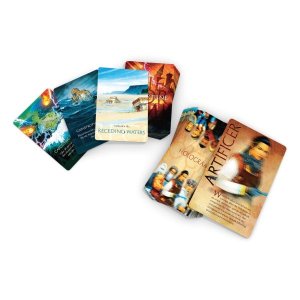
Atlantis Rising (Second Edition): Extended Difficulty Mini-Expansion
2019
A 24-card promotional preview of future expansion materials
120
minutes
Medium Heavy

View expansion
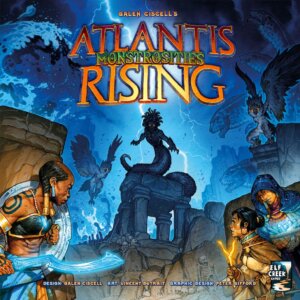
Atlantis Rising: Monstrosities
2023
Face monstrous threats and turn unexpected powers toward Atlantis’s survival.
120
minutes
Medium
View expansion