Belratti
2018
Match paintings to changing topics, outwit Belratti's fakes, and work together before too many forgeries enter your collection.
25
minutes
3 - 7
player(s)
8+
Light

About this board game
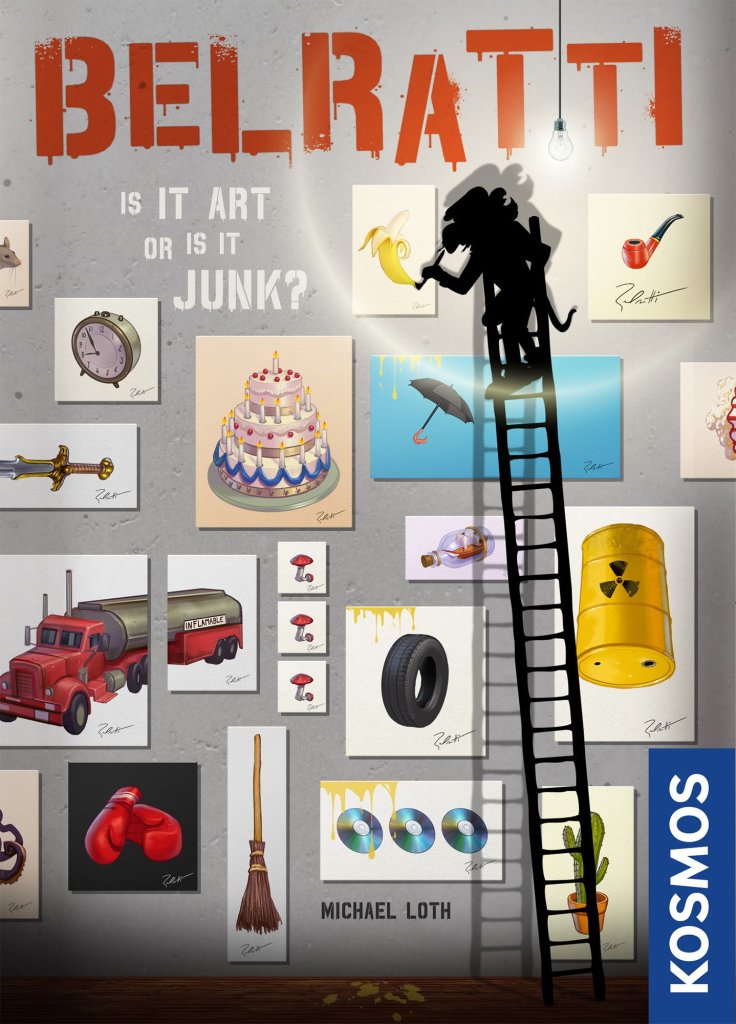
Belratti is a cooperative art-selection game for 3–7 players, played in about 25 minutes, in which buyers and painters work together to protect a museum collection from fake paintings.
Each round presents two cards as the current topics. The buyers announce how many paintings they need, creating a target that the painters must collectively meet. Painters then choose cards from their hands that they believe fit one of the topics.
But Belratti is trying to cheat forgeries into the collection. Additional cards are added as Belratti’s fakes, and all the cards are shuffled face down before being revealed. The buyers must then identify and select all the cards contributed by the painters while leaving the fake cards behind.
- Buyers: request paintings for the two current topics and decide which revealed cards are genuine.
- Painters: select cards from their hands that best match the topics and help reach the requested number.
- Belratti: adds fake paintings that challenge the buyers’ judgment.
The roles change after every round, giving everyone a chance to contribute in different ways. Players must communicate through their card choices and interpret how well each painting fits the available topics, while remembering that the most convincing-looking option may be one of Belratti’s fakes.
If the buyers purchase too many fake paintings, the players lose. With its shared target, changing roles, and simple central challenge, Belratti creates a focused test of association and deduction. The name is derived from the German art forger W. Beltracchi, fitting the game’s theme of protecting a museum from deception.

Board Game Rules for
Belratti
Game Presentation
- Number of Players: 3 to 7
- Recommended Age: 9 and up
- Playing Time: 20 to 45 minutes
- Components: 168 Picture cards, 4 Joker cards, 8 Role cards (Museum Director and Painter).
Background
For years, the forger Belratti has put his immense talent at the service of forgery, deceiving the art world by imitating the greatest masters. The Cat, head of the museum, wishes to inaugurate two new exhibition rooms and asks the Owl painter to provide selected canvases. Belratti intends to take advantage of the opportunity to secretly slip in his own fake paintings!
In this cooperative game, all participants unite against Belratti. Some take on the role of the Cat to select authentic paintings, while others play the Owl painter to deliver the requested works. Your common goal: enrich the museum’s collection with genuine paintings and uncover Belratti’s fakes before they are hung on the walls.
- Place the 4 Joker cards in the center of the play area, topped by the Belratti card.
- Shuffle all the Picture cards and deal a certain number to each player, face down:
- 3 players: 18 cards per player
- 4 or 5 players: 9 cards per player
- 6 or 7 players: 6 cards per player
- The remaining cards form the Picture card draw pile, face down.
- Distribute the Role cards among the players according to the table configuration: first give the Cat cards (Museum Directors), then the Owl cards (Painters). Each player thus takes on one of these two roles for the round. At the end of each round, these cards rotate one position clockwise so that everyone alternates roles.

At the start of the round, the museum directors draw two Picture cards from the draw pile and place them face up below the jokers. These cards form the two independent themes of the round (for example: a feather and a soccer ball).
The round is divided into 4 successive phases:
Phase 1 – Directors’ Request
The museum directors consult with each other to determine the volume of paintings the painters must provide:
- The request must be between 2 and 7 Picture cards in total.
- Important: The directors only state the total number of cards requested, without ever specifying how they should be divided between the two themes.
Phase 2 – Painting Selection by the Painters
The painters examine their secret hands of cards following these guidelines:
- They must collectively provide exactly the total number of paintings requested by the directors.
- They may discuss the quantity of cards that each commits to playing, but they are strictly forbidden from describing the content of their pictures. They may only evaluate how well their cards fit the two themes (e.g., excellent match, medium, or poor).
- Each artist secretly decides which theme they mentally associate each card they play with. A painter is completely allowed to play no cards at all if their pictures do not match the request, leaving their fellow artists to provide more paintings.
- The painters then place the selected cards face down in the center of the table.
- Finally, draw 4 additional Picture cards from the draw pile to represent Belratti’s fakes, adding them face down to the painters’ selection without looking at them.
Phase 3 – Attribution by the Directors
All the supplied cards (the painters’ canvases plus the 4 fakes) are thoroughly shuffled, then revealed face up on the table.
- The museum directors can discuss freely among themselves to assign each card to one of the two themes or reject it as a Belratti fake.
- The painters must maintain absolute silence and never intervene during these deliberations.
- Once the decision is made, the directors explicitly place the accepted cards under each of the two themes and set aside the 4 cards they believe to be fakes.
Phase 4 – Scoring and Evaluation
The painters examine the choices made by the directors and reveal the origin of each painting:
- Painter’s canvas correctly attributed: The card scores 1 point for the team. It is placed in the team’s score pile (to the left of the Belratti card).
- Painter’s canvas assigned to the wrong theme: The card is discarded without scoring points for anyone.
- Fake painting attributed to a theme: Belratti scores 1 point for each accepted forgery. These cards are stacked to the right of the Belratti card.
- Remaining cards: The theme cards and any unselected paintings are sent to the discard pile and removed from the game.
Preparing the Next Round
- Each painter replenishes their hand by drawing the required number of Picture cards to return to their initial hand size.
- The Role cards shift one position clockwise.
- Two new Theme cards are drawn and displayed face up.
- The next round begins with Phase 1.
During each round, directors and painters can call upon the corresponding Joker cards by tilting or discarding them. Players can activate multiple jokers during the same round. Each power is used at a specific time:
Jokers for the Museum Directors

- Theme Replacement: Usable before the start of Phase 1. Allows replacing one or both visible Theme cards with new cards from the draw pile. The discarded cards go to the discard pile.

- Questioning a Painting: Usable in Phase 3. The directors select any revealed Picture card and ask the painters if it comes from their selection. The painters are only permitted to answer “yes” or “no”.
Jokers for the Painters

- Order Adjustment: Usable at the start of Phase 2. Allows increasing or decreasing the total number of paintings requested by the directors by exactly 1.
- Hand Refresh: During Phase 2, a painter may exchange 6 cards from their hand for 6 newly drawn cards. The old cards go to the discard pile.
Recovering Used Jokers
At the end of a round, players can reactivate a Joker card if the team achieved a perfect round (all the artists’ cards were correctly identified and sorted under the correct theme, with no fakes accepted).
- Each joker has a number on the back (ranging from 3 to 6).
- After a perfect round, a spent Joker card can be recovered provided the number on its back is less than or equal to the total number of cards requested during that round.
- The recovered joker is flipped face up and immediately becomes usable for future rounds.
The game ends immediately after Phase 4 as soon as Belratti’s pile contains at least 6 cards.
The team’s score corresponds to the total number of cards accumulated in their own scoring pile. The team triumphs over Belratti with 15 points or more!
Rating Scale
- 30 points: Divine masterpiece!
- 25 to 29 points: Artistic perfection!
- 20 to 24 points: Great art, mastered from start to finish!
- 15 to 19 points: The essentials are there, the public approves.
- 10 to 14 points: Profitability is slow in coming…
- 0 to 9 points: A true gallery of horrors!

Game Overview
Game Presentation
- Number of Players: 3 to 7
- Recommended Age: 9 and up
- Playing Time: 20 to 45 minutes
- Components: 168 Picture cards, 4 Joker cards, 8 Role cards (Museum Director and Painter).
Background
For years, the forger Belratti has put his immense talent at the service of forgery, deceiving the art world by imitating the greatest masters. The Cat, head of the museum, wishes to inaugurate two new exhibition rooms and asks the Owl painter to provide selected canvases. Belratti intends to take advantage of the opportunity to secretly slip in his own fake paintings!
In this cooperative game, all participants unite against Belratti. Some take on the role of the Cat to select authentic paintings, while others play the Owl painter to deliver the requested works. Your common goal: enrich the museum’s collection with genuine paintings and uncover Belratti’s fakes before they are hung on the walls.
Setup
- Place the 4 Joker cards in the center of the play area, topped by the Belratti card.
- Shuffle all the Picture cards and deal a certain number to each player, face down:
- 3 players: 18 cards per player
- 4 or 5 players: 9 cards per player
- 6 or 7 players: 6 cards per player
- The remaining cards form the Picture card draw pile, face down.
- Distribute the Role cards among the players according to the table configuration: first give the Cat cards (Museum Directors), then the Owl cards (Painters). Each player thus takes on one of these two roles for the round. At the end of each round, these cards rotate one position clockwise so that everyone alternates roles.
How to Play
At the start of the round, the museum directors draw two Picture cards from the draw pile and place them face up below the jokers. These cards form the two independent themes of the round (for example: a feather and a soccer ball).
The round is divided into 4 successive phases:
Phase 1 – Directors’ Request
The museum directors consult with each other to determine the volume of paintings the painters must provide:
- The request must be between 2 and 7 Picture cards in total.
- Important: The directors only state the total number of cards requested, without ever specifying how they should be divided between the two themes.
Phase 2 – Painting Selection by the Painters
The painters examine their secret hands of cards following these guidelines:
- They must collectively provide exactly the total number of paintings requested by the directors.
- They may discuss the quantity of cards that each commits to playing, but they are strictly forbidden from describing the content of their pictures. They may only evaluate how well their cards fit the two themes (e.g., excellent match, medium, or poor).
- Each artist secretly decides which theme they mentally associate each card they play with. A painter is completely allowed to play no cards at all if their pictures do not match the request, leaving their fellow artists to provide more paintings.
- The painters then place the selected cards face down in the center of the table.
- Finally, draw 4 additional Picture cards from the draw pile to represent Belratti’s fakes, adding them face down to the painters’ selection without looking at them.
Phase 3 – Attribution by the Directors
All the supplied cards (the painters’ canvases plus the 4 fakes) are thoroughly shuffled, then revealed face up on the table.
- The museum directors can discuss freely among themselves to assign each card to one of the two themes or reject it as a Belratti fake.
- The painters must maintain absolute silence and never intervene during these deliberations.
- Once the decision is made, the directors explicitly place the accepted cards under each of the two themes and set aside the 4 cards they believe to be fakes.
Phase 4 – Scoring and Evaluation
The painters examine the choices made by the directors and reveal the origin of each painting:
- Painter’s canvas correctly attributed: The card scores 1 point for the team. It is placed in the team’s score pile (to the left of the Belratti card).
- Painter’s canvas assigned to the wrong theme: The card is discarded without scoring points for anyone.
- Fake painting attributed to a theme: Belratti scores 1 point for each accepted forgery. These cards are stacked to the right of the Belratti card.
- Remaining cards: The theme cards and any unselected paintings are sent to the discard pile and removed from the game.
Preparing the Next Round
- Each painter replenishes their hand by drawing the required number of Picture cards to return to their initial hand size.
- The Role cards shift one position clockwise.
- Two new Theme cards are drawn and displayed face up.
- The next round begins with Phase 1.
Joker Cards
During each round, directors and painters can call upon the corresponding Joker cards by tilting or discarding them. Players can activate multiple jokers during the same round. Each power is used at a specific time:
Jokers for the Museum Directors
- Theme Replacement: Usable before the start of Phase 1. Allows replacing one or both visible Theme cards with new cards from the draw pile. The discarded cards go to the discard pile.
- Questioning a Painting: Usable in Phase 3. The directors select any revealed Picture card and ask the painters if it comes from their selection. The painters are only permitted to answer “yes” or “no”.
Jokers for the Painters
- Order Adjustment: Usable at the start of Phase 2. Allows increasing or decreasing the total number of paintings requested by the directors by exactly 1.
- Hand Refresh: During Phase 2, a painter may exchange 6 cards from their hand for 6 newly drawn cards. The old cards go to the discard pile.
Recovering Used Jokers
At the end of a round, players can reactivate a Joker card if the team achieved a perfect round (all the artists’ cards were correctly identified and sorted under the correct theme, with no fakes accepted).
- Each joker has a number on the back (ranging from 3 to 6).
- After a perfect round, a spent Joker card can be recovered provided the number on its back is less than or equal to the total number of cards requested during that round.
- The recovered joker is flipped face up and immediately becomes usable for future rounds.
End of Game and Scoring
The game ends immediately after Phase 4 as soon as Belratti’s pile contains at least 6 cards.
The team’s score corresponds to the total number of cards accumulated in their own scoring pile. The team triumphs over Belratti with 15 points or more!
Rating Scale
- 30 points: Divine masterpiece!
- 25 to 29 points: Artistic perfection!
- 20 to 24 points: Great art, mastered from start to finish!
- 15 to 19 points: The essentials are there, the public approves.
- 10 to 14 points: Profitability is slow in coming…
- 0 to 9 points: A true gallery of horrors!