
La Boca
2013
Work with changing partners to recreate colorful skyline challenges from two different viewpoints while racing the clock for points.
40
minutes
3 - 6
player(s)
8+
Light

About this board game
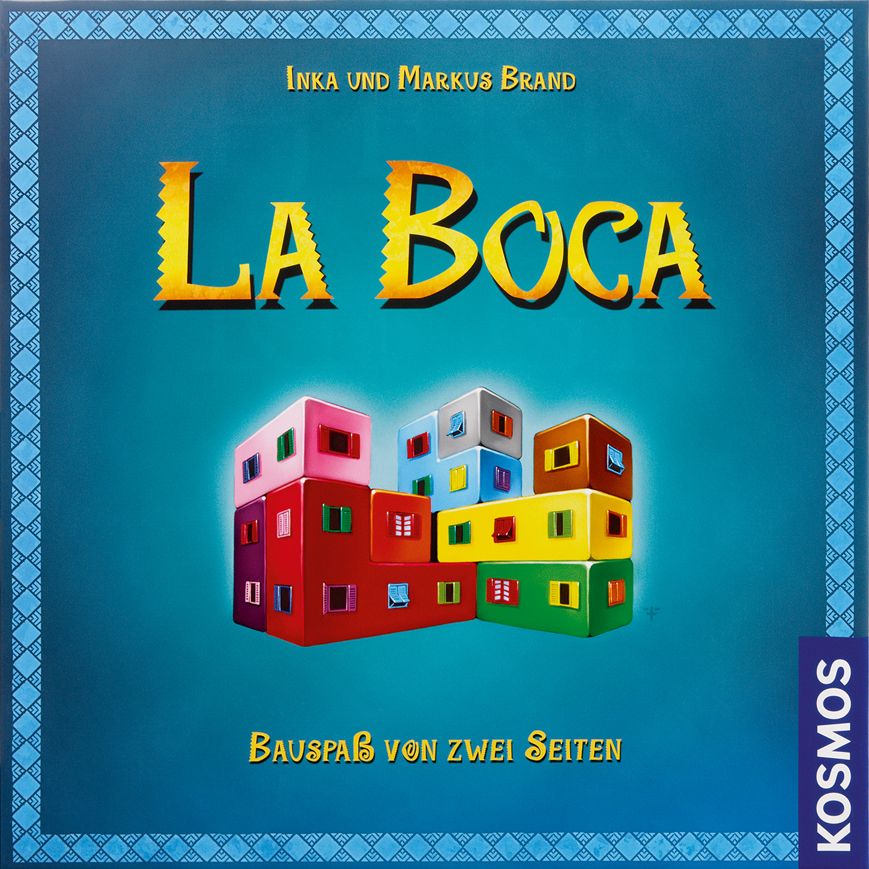
La Boca is a team-based construction game for 3–6 players, played in shifting pairs over approximately 40 minutes. Inspired by the colorful, patchwork skyline of Buenos Aires’s famous La Boca neighborhood, it challenges players to recreate striking arrangements of colored blocks.
Each round, two players sit across from one another and work together on a challenge card. The completed image looks different from each player’s viewpoint, so clear communication is essential. Players must constantly consult one another to determine where every colored block belongs.
The goal is to complete the requested skyline as quickly as possible. A timer adds pressure to each construction challenge, and faster teams score more points. Once a team finishes, the next pair takes their seats, breaks down the blocks, and begins a new build.
- For 3–6 players
- Approximately 40 minutes of play time
- Shifting teams of two
- Challenge cards with hidden information from each player’s viewpoint
- Speed-based scoring that rewards fast construction
Because both teammates see only part of the completed image, success depends on cooperation, observation, and precise explanations. The same blocks must form the correct skyline for both perspectives, making every round a shared puzzle against the clock.
After the required number of rounds, the player with the most points wins and stands atop La Boca. With its colorful building theme, changing partnerships, and lively race to complete each design, La Boca turns communication and construction into a fast-paced group challenge.

Board Game Rules for
La Boca
LA BOCA
Fast paced building fun in changing teams
for 3 to 6 players, ages 8 and up
Game Overview
The players play in changing teams of two and try together to recreate the building depicted on a card. However, each of the two partners has a different view of the building that will need to be constructed. If the team completes the task so that both sides of the object constructed matches the view on the map exactly and none of the components remain, then points are awarded according to the amount of time the team took. The faster the team builds, the more points there are.
Game Components

- Game box with Board
- 11 Building Blocks
- 1 Electronic Timer
- 6 Large Player Tiles
- 30 Small Partner Chips (5 in each color)
- 100 point-chips (25x 1, 25x 2, 25x 5, 25x 20)
- 64 task cards in two levels of difficulty (each with 2 tasks)
Game Preparation
- Before the first game, carefully remove cardboard parts from their frames.
- Each player chooses a color and takes the large player tile in their color as well as all the small Partner Chips in their color.
- Each player distributes one of their Small Partner Chips to each of the other players (give 2 chips to each of the other players in a 3 player game).
- Remove all extra Large Player Tiles and unused Small Partner Chips from the game.
- Each player turns the partners chips they have received face down, shuffles them, and puts them next to their Large Player Tile.
- Place the gameplay board in the box insert, aligning the circular hole for the timer in the gameplay board with the circular hole in the insert.
- Place the point chips in the corresponding compartments in the game insert as shown on the game board.
- Place the timer in the round compartment in between the compartments for the 1 and the 20 point chips.
- Separate the light blue and dark blue background task cards into two piles. Shuffle each pile, still keeping them separate, and place both piles on one side of the game box.
- Place the 11 building blocks on the other side of the game box.
Choosing Difficulty
The players decide before the match whether to use the cards with the light blue background (regular difficulty) or the dark blue background (higher difficulty).
Tip: The first game should be played usings the light blue task cards.
When the light blue tasks are used, the red block is set aside. Only in the game with the dark blue tasks are all 11 building blocks needed.
Practice Round
Before playing the first round, it is helpful for everyone to work together to solve one card as a group in a practice round.
- Slide the box with the playing board insert between all players, so approximately half of all players are on each side of the box.
- Insert one of the light blue task cards into the card slot on the board insert, so that only the top of the card is visible (as shown in the picture on the right). Light blue cards do not require the use of the red block, which can be removed from the game for now. The image on the task card is now built with the remaining ten components.
Tip: To raise the box in order to better see the playing card, you can place the lower portion of the box which includes the playing insert on top of the box lid.

Building Rules
- The task card shows how the components must be seen after construction. The structure must match exactly with the image. Both sides, however; show a different view of the same object.
- Players may consult each other at any time, but may only see their side of the card.
- The components may not be laid or extend beyond the 4×4 grid of the play area.
- The components may placed on top of each other, side by side, and in front of each other.
- The components do not have to stand in line. If necessary, they may also be “set back” to be built.
- Gaps cannot be created below placed blocks (as shown by the red arrow above).

- All building blocks must be used. Tip: Sometimes you will have a block which may not be visible from either side, but is “hidden” behind visible blocks.
- Building blocks may be added, removed, and re-added in any order.
- As soon as the players on both sides indicate they are finished, building ends and the structure is checked both sides to ensure it was matches the image exactly.
- The problem is solved when the view from both sides of the building corresponds to the pictures on the task card (as shown in the example below).

The Game Begins
After players are familiar with the game from the practice round, they can begin playing. Actual gameplay follows the same rules as the practice round with 2 additions:
- The game is played in pairs of 2 people each round, with one player working to complete each side of the puzzle.
- Players use the timer to see how long it takes them to complete the puzzle.
Starting Player
The oldest player starts. They reveal one of the concealed small partner-chip given to them at teh start of the game to determine their team partner for this round. Both players should sit across from each other so that each of them can clearly see one side of the task card well.
Starting the Round
The player who revealed the small chip in this turn puts the top task card in the task card pile into the task card slot, presses the start button on the timer and yells “Go”.
Completing the Task
Immediately afte the timer starts, both of the team partners begin the task. When both have indicated they are finished, the player who started the clock pressed the stop button on the timer to stop the clock.
Clean Up Between Rounds
At the end of the round, all blocks are removed from teh board and the task card used is placed at the bottom of the deck. The clock is reset to “00:00” by pressing both the minute and second buttons together.
Moving clockwise, the next player reveals a small player token to determine their partner for the round. Each round continues with the next clockwise player revealing a small player tolked to determine their partern until eventually all the small player tokens have been revealed so that each player has played 2 rounds with each of the other players as a partner (4 turns with each partner in a 3 player game).
Scoring
Points are awardeded using the point chips according to how fast the team completes the task. The table below (and also shown directly on the game board) shows how many points are distributed. Since both players have solved the problem, both players receive the same number of point-chips. Players keep their awarded point chips next to their large player marker.
If the players need more than 2 minutes or have not solved the puzzle correctly, they recieve no points for the task. If they want, they can still try to solve the problem. At this point they may ask for advice from other players to complete the task.
Possible Errors
- One or both sides of the job were not replicated correctly.
- Not all Building Blocks were used.
- One or more blocks have been placed to create a gap below the block.
| Time | Points | Time | Points |
|---|---|---|---|
| 0:01 – 0:15 | 10 | 0:51 – 1:00 | 4 |
| 0:16 – 0:20 | 9 | 1:01 – 1:20 | 3 |
| 0:21 – 0:25 | 8 | 1:21 – 1:40 | 2 |
| 0:26 – 0:30 | 7 | 1:41 – 2:00 | 1 |
| 0:31 – 0:40 | 6 | over 2 minutes | 0 |
| 0:41 – 0:50 | 5 | Error | 0 |
Clean Up [Game End]
At the end of the game each player adds up thier points. The winner is the player with the most points. In case of a point tie, the players with the most points are both declared the winners.
The Timer

- By simultaneously pressing the “minute” and the “second” button the timer is set to “00:00”
- By pressing the “start/stop” button the timer is started.
- If both team partners are finished, press the “start/stop” button to stop the timer and read the time to determine points.
- By simultaneously pressing the “minute” and the “second” button, the time is deleted. Make sure points have been accurately awardeded before deleting the time.
- The timing clock uses a 1.5-volt button battery (LR44). The timer comes with one battery already installed.
- Before the first use, pull the plastic tab from the back of the timer to activate the battery.
- If the battery becomes exhausted, remove and replace the battery.
- To change the battery, unscrew the screw on the battery cover and remove the cover.
- Insert the new battery with light pressure and with the correct polarity (negative downward) into the battery compartment. Press down with the lid and replace screw.
- Avoid a short circuit of the battery or it may explode.
- Dispose of used batteries in accordance with environmental regulations.
Environmental Notice
All electrical and electronic components of this product should not be disposed of in normal household waste, but should be recycled with other electrical and electronic appliances.
The symbols on the the products, instruction manuals, and packaging are recyclable and are marked with the appropriate recycling symbols. Please contact your appropriate local authority to find applicable recycling centers.
By recycling used products you make an important contribution to the protection of our environment.
Where does the name La Boca come from?
“La Boca” is a neighborhood in Buenos Aires, Argentina. Just like the buildling blocks in the game, colorful houses shape that part of the city.

The authors Inka and Markus Brand live with their children – Lukas and Emely – in Gummersbach, Germany. Both of them have loved to play games since their childhood. They have published numerous children’s and family games. From “Monster Falle” with which they won the “Deutscher KinderspielePreis 2011” up to “Kennerspiel des Jahres” – they are creating games for everybody.
Redaktion: TM-Spiele
Artist: Franz Vohwinkel
The authors and the publisher wish to thank all the play testers and rule readers.
© 2013 Franckh-Kosmos Verlags GmbH & Co. KG
Pfizerstraße 5-7
Tel: +49 711 2191-0
Fax: +49 711 2191-199
[email protected]
kosmos.de
Art.-Nr: 691776
Alle Rechte vorbehalten.
MADE IN GERMANY
Introduction & Components
LA BOCA
Fast paced building fun in changing teams
for 3 to 6 players, ages 8 and up
Game Overview
The players play in changing teams of two and try together to recreate the building depicted on a card. However, each of the two partners has a different view of the building that will need to be constructed. If the team completes the task so that both sides of the object constructed matches the view on the map exactly and none of the components remain, then points are awarded according to the amount of time the team took. The faster the team builds, the more points there are.
Game Components
- Game box with Board
- 11 Building Blocks
- 1 Electronic Timer
- 6 Large Player Tiles
- 30 Small Partner Chips (5 in each color)
- 100 point-chips (25x 1, 25x 2, 25x 5, 25x 20)
- 64 task cards in two levels of difficulty (each with 2 tasks)
Setup
Game Preparation
- Before the first game, carefully remove cardboard parts from their frames.
- Each player chooses a color and takes the large player tile in their color as well as all the small Partner Chips in their color.
- Each player distributes one of their Small Partner Chips to each of the other players (give 2 chips to each of the other players in a 3 player game).
- Remove all extra Large Player Tiles and unused Small Partner Chips from the game.
- Each player turns the partners chips they have received face down, shuffles them, and puts them next to their Large Player Tile.
- Place the gameplay board in the box insert, aligning the circular hole for the timer in the gameplay board with the circular hole in the insert.
- Place the point chips in the corresponding compartments in the game insert as shown on the game board.
- Place the timer in the round compartment in between the compartments for the 1 and the 20 point chips.
- Separate the light blue and dark blue background task cards into two piles. Shuffle each pile, still keeping them separate, and place both piles on one side of the game box.
- Place the 11 building blocks on the other side of the game box.
Choosing Difficulty
The players decide before the match whether to use the cards with the light blue background (regular difficulty) or the dark blue background (higher difficulty).
Tip: The first game should be played usings the light blue task cards.
When the light blue tasks are used, the red block is set aside. Only in the game with the dark blue tasks are all 11 building blocks needed.
Practice Round
Practice Round
Before playing the first round, it is helpful for everyone to work together to solve one card as a group in a practice round.
- Slide the box with the playing board insert between all players, so approximately half of all players are on each side of the box.
- Insert one of the light blue task cards into the card slot on the board insert, so that only the top of the card is visible (as shown in the picture on the right). Light blue cards do not require the use of the red block, which can be removed from the game for now. The image on the task card is now built with the remaining ten components.
Tip: To raise the box in order to better see the playing card, you can place the lower portion of the box which includes the playing insert on top of the box lid.
Building Rules
Building Rules
- The task card shows how the components must be seen after construction. The structure must match exactly with the image. Both sides, however; show a different view of the same object.
- Players may consult each other at any time, but may only see their side of the card.
- The components may not be laid or extend beyond the 4×4 grid of the play area.
- The components may placed on top of each other, side by side, and in front of each other.
- The components do not have to stand in line. If necessary, they may also be “set back” to be built.
- Gaps cannot be created below placed blocks (as shown by the red arrow above).
- All building blocks must be used. Tip: Sometimes you will have a block which may not be visible from either side, but is “hidden” behind visible blocks.
- Building blocks may be added, removed, and re-added in any order.
- As soon as the players on both sides indicate they are finished, building ends and the structure is checked both sides to ensure it was matches the image exactly.
- The problem is solved when the view from both sides of the building corresponds to the pictures on the task card (as shown in the example below).
Gameplay
The Game Begins
After players are familiar with the game from the practice round, they can begin playing. Actual gameplay follows the same rules as the practice round with 2 additions:
- The game is played in pairs of 2 people each round, with one player working to complete each side of the puzzle.
- Players use the timer to see how long it takes them to complete the puzzle.
Starting Player
The oldest player starts. They reveal one of the concealed small partner-chip given to them at teh start of the game to determine their team partner for this round. Both players should sit across from each other so that each of them can clearly see one side of the task card well.
Starting the Round
The player who revealed the small chip in this turn puts the top task card in the task card pile into the task card slot, presses the start button on the timer and yells “Go”.
Completing the Task
Immediately afte the timer starts, both of the team partners begin the task. When both have indicated they are finished, the player who started the clock pressed the stop button on the timer to stop the clock.
Clean Up Between Rounds
At the end of the round, all blocks are removed from teh board and the task card used is placed at the bottom of the deck. The clock is reset to “00:00” by pressing both the minute and second buttons together.
Moving clockwise, the next player reveals a small player token to determine their partner for the round. Each round continues with the next clockwise player revealing a small player tolked to determine their partern until eventually all the small player tokens have been revealed so that each player has played 2 rounds with each of the other players as a partner (4 turns with each partner in a 3 player game).
Scoring & Game End
Scoring
Points are awardeded using the point chips according to how fast the team completes the task. The table below (and also shown directly on the game board) shows how many points are distributed. Since both players have solved the problem, both players receive the same number of point-chips. Players keep their awarded point chips next to their large player marker.
If the players need more than 2 minutes or have not solved the puzzle correctly, they recieve no points for the task. If they want, they can still try to solve the problem. At this point they may ask for advice from other players to complete the task.
Possible Errors
- One or both sides of the job were not replicated correctly.
- Not all Building Blocks were used.
- One or more blocks have been placed to create a gap below the block.
| Time | Points | Time | Points |
|---|---|---|---|
| 0:01 – 0:15 | 10 | 0:51 – 1:00 | 4 |
| 0:16 – 0:20 | 9 | 1:01 – 1:20 | 3 |
| 0:21 – 0:25 | 8 | 1:21 – 1:40 | 2 |
| 0:26 – 0:30 | 7 | 1:41 – 2:00 | 1 |
| 0:31 – 0:40 | 6 | over 2 minutes | 0 |
| 0:41 – 0:50 | 5 | Error | 0 |
Clean Up [Game End]
At the end of the game each player adds up thier points. The winner is the player with the most points. In case of a point tie, the players with the most points are both declared the winners.
The Timer
The Timer
- By simultaneously pressing the “minute” and the “second” button the timer is set to “00:00”
- By pressing the “start/stop” button the timer is started.
- If both team partners are finished, press the “start/stop” button to stop the timer and read the time to determine points.
- By simultaneously pressing the “minute” and the “second” button, the time is deleted. Make sure points have been accurately awardeded before deleting the time.
- The timing clock uses a 1.5-volt button battery (LR44). The timer comes with one battery already installed.
- Before the first use, pull the plastic tab from the back of the timer to activate the battery.
- If the battery becomes exhausted, remove and replace the battery.
- To change the battery, unscrew the screw on the battery cover and remove the cover.
- Insert the new battery with light pressure and with the correct polarity (negative downward) into the battery compartment. Press down with the lid and replace screw.
- Avoid a short circuit of the battery or it may explode.
- Dispose of used batteries in accordance with environmental regulations.
Environmental Notice
All electrical and electronic components of this product should not be disposed of in normal household waste, but should be recycled with other electrical and electronic appliances.
The symbols on the the products, instruction manuals, and packaging are recyclable and are marked with the appropriate recycling symbols. Please contact your appropriate local authority to find applicable recycling centers.
By recycling used products you make an important contribution to the protection of our environment.
Credits & Background
Where does the name La Boca come from?
“La Boca” is a neighborhood in Buenos Aires, Argentina. Just like the buildling blocks in the game, colorful houses shape that part of the city.
The authors Inka and Markus Brand live with their children – Lukas and Emely – in Gummersbach, Germany. Both of them have loved to play games since their childhood. They have published numerous children’s and family games. From “Monster Falle” with which they won the “Deutscher KinderspielePreis 2011” up to “Kennerspiel des Jahres” – they are creating games for everybody.
Redaktion: TM-Spiele
Artist: Franz Vohwinkel
The authors and the publisher wish to thank all the play testers and rule readers.
© 2013 Franckh-Kosmos Verlags GmbH & Co. KG
Pfizerstraße 5-7
Tel: +49 711 2191-0
Fax: +49 711 2191-199
[email protected]
kosmos.de
Art.-Nr: 691776
Alle Rechte vorbehalten.
MADE IN GERMANY
