Mykerinos
2006
Excavate Egypt, enlist powerful benefactors, and compete for the most prestigious museum collection.
60
minutes
2 - 4
player(s)
10+
Medium


About this board game
Mykerinos is a 2–4-player board game released in 2006, with games lasting about 60 minutes. Set in Egypt in 1899, it casts players as teams of archaeologists searching for ancient relics on behalf of powerful benefactors.
The game unfolds over four rounds. Each round presents excavation areas made from cards, with four areas available in the first three rounds and six in the last. Every card contains six squares that may include pyramid obstacles and belong to one of five benefactors: Sir Brown, Lady Violet, Miss Blackmore, Lord Lemon, or Colonel Tangerine.
Players manage a personal pool of archaeologists and choose how to use them. They can start an excavation, expand an existing one, play a benefactor they have earned, or pass. Starting an excavation requires one archaeologist, while expanding one requires two more alongside an archaeologist already on the board.
- Area control: Once everyone passes, excavation areas are resolved according to player positions.
- Benefactor powers: Special benefits can help archaeologists move over obstacles or return to a player’s pool more quickly.
- Museum decisions: Players may claim an available card or send their position to the museum.
- Set bonuses: Collections containing one card in every benefactor colour can earn bonus points.
Turn order matters when players compete for the same area, with ties resolved according to player order. Cards provide points during the game, while visiting the museum increases the endgame value of a colour through x2, x3, or x5 multipliers.
At the end of the fourth round, the final exhibition determines the winner. In Mykerinos, the most prestige comes from collected cards, benefactor colours represented in the museum, and complete sets spanning all five colours.

Board Game Rules for
Mykerinos
Introduction
Game design by Nicolas Oury – Illustrations by Arnaud Demaegd – Layout by Cyril Demaegd
FAQ & Forum : www.ystari.com
1899. For more than a century, the European public has been fascinated by Egyptology, and the discoveries of Denon, Champollion, Petrie and others.
Seeking adventure and glory, teams of archaeologists search the sands of Egypt for hidden treasures.
Goal of the Game
The players embody archaeologists working for patrons. They excavate the land of Egypt to find precious artifacts, which will adorn the most prestigious rooms of the Museum. At the end of the game, the Museum organizes a great exhibition. The player who has earned the most prestige (by discovering things and getting advantageous places in the Museum) wins the game.
Components
- 1 game board
- 36 ‘terrain / patron’ cards
- 100 ‘archaeologist’ cubes (25 for each color: blue, red, green and white)
- 19 marker disks for the players (including 1 “first player” marker and 6 “+50” score markers)
- 5 ‘patron’ markers (1 orange, 1 black, 1 brown, 1 yellow, 1 purple)
- this booklet

- Scoring track
- Museum
- Museum wing
- Passing scale
- Patrons
Setup
- The board is placed on the table.
- Multi-colored cubes are placed next to the board. They constitute the general stock.
- Each player chooses a color, takes the corresponding two marker disks, then places one of these disks on space 0 of the score track (1), and the other one next to the passing scale (4).
- One player, chosen randomly, starts the game: they take the five ‘patron’ markers and place them randomly, one by one, in the circular spaces of the five wings of the Museum (3).
Game Principles
The game is divided in four seasons. During each season, the players excavate a region of Egypt by placing their men in the various excavation areas of the region. At the end of the season, once the excavating is done, the best ranked archaeologists may either claim a parcel of land or send their men out to prepare the final exhibition at the Museum.
Each parcel of land is placed in a patron’s tutelage. By claiming a parcel, a player earns the right to appeal to the patron and to use the patron’s specific power in the course of subsequent seasons.
The Museum is divided in several rooms of varying prestige. The players can book these rooms by sending men into the Museum. They must choose carefully among the different wings, while watching their opponents progress.
Cards
35 out of the 36 cards feature a parcel of land on the front, and a patron on the back. The last card also features a parcel, but there is no patron on its back.
Parcels
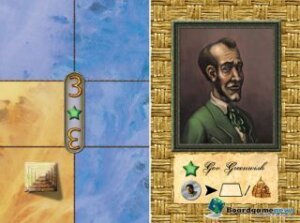
Parcels are pieces of land on which players can place their cubes to carry out excavations. Each parcel is divided in six spaces that may be empty or contain a pyramid. Spaces containing a pyramid are obstacles; players cannot place cubes on them. What is more, at the center of each parcel, there is a cartouche with information on it. The cartouche indicates the degree of prestige of the parcel: some cards have no figure on them, some have a 2, a 3 or a 5, which represent the prestige points the players will score if they own the parcel. At the center of the cartouche, a sign indicates the patron to whom the parcel is allotted.
Regions and Areas
At the beginning of each round, a new region – composed of parcels – is set up (see fig.1; also see Phase 1). The region is a game board. It is made up of areas (fig.2), which are groups of two parcels. NB: Parcels have no up and no down; they may be placed in either direction.
The various areas which make up a region may be separated by a space to make them easier to differentiate. However, areas are considered adjacent. Thus, two spaces which are side-by-side orthogonally (but not diagonally) on two different cards are considered adjacent (fig.3). What is more, cartouches are not considered as obstacles. As a consequence, two spaces separated by a cartouche are considered adjacent.


Season Structure
The game is divided into four seasons; each season is divided into three phases.
Phase 1 – New Season
At the beginning of each round, players get cubes of their color from the general stock. Each player places their cubes before them. Thus, they take:
- 11 cubes in 3-player games
- 8 cubes in 4-player games
If there are not enough cubes in the general stock, the player can only take what is left.
The cubes that were taken from the general stock make up the player’s personal stock.
Then, the first player builds up the region to be excavated during this season: the player shuffles the pile of cards and sets up the region as shown on the right (parcel sides up).
Setting up the region: in seasons 1, 2 and 3, eight parcels are arranged to form four areas (two lines with two areas per line – see the yellow cards on the diagram). In season 4, twelve parcels are arranged to form six areas (three lines with two areas per line – see the yellow cards AND the red cards on the diagram – also see fig.1 on the previous page).

Phase 2 – Excavations
Starting with the first player and going clockwise, each player may in turn choose one action among the four actions below:
A) Start a new excavation
The player takes a cube from their personal stock and places it on a free space of their choice in the region which is being excavated. It is impossible to place a cube on a space containing a pyramid.

Blue starts a new excavation. They can place their cube on spaces A or B (empty spaces), but not on C or D (which already contain cubes), nor on E or F (because of the pyramids).
B) Extend a pre-existing excavation
The player takes two cubes from their personal stock. They place the first cube on a free space, horizontally or vertically adjacent to a space already containing one of their cubes. Then the player places the second cube on a free space, horizontally or vertically adjacent to the space where they have just placed the first cube. These cubes cannot be placed on a square containing a pyramid.

Red extends one of their existing excavations (space A) by placing a red cube on B, then another one on C.
C) Pass
The player passes. They place their marker disk on the first free space of the passing scale (that is, the space with the smallest number still available). Phase 2 is over for this player. This is the only action available when a player has no cube left in their personal stock.

Green passes, by putting a marker disk on the first free space of the passing scale (here, space 1, since Green is the first to pass).
D) Appealing to a patron
This action is available from the second season on, thanks to the parcels the players will get during Phase 3 of the first season (see Phase 3).
Thanks to their financial means, the five patrons can help the players with their specific powers.
At their turn, the player tilts the card featuring the patron they are interested in. Then, the player acts as indicated (see below). A given player may only tilt one card per turn. A tilted card cannot be used again during the same season, but a player may appeal to the same patron several times in the same season (as long as the player has cards left to tilt, with the patron on them).
a) Lady Violet
The player takes a cube their color from the general stock and places it in their personal stock. Then, the player carries out action A (start a new excavation) or action B (extend a pre-existing excavation). If the player has no cubes left in the general stock, they cannot carry out this action.
b) Lord Lemon
The player may start a new excavation by taking a cube from their personal stock and placing it on a space containing a pyramid (action A), OR extend an existing excavation by placing one of the two cubes of their personal stock on a space containing a pyramid (action B).

Blue tilts a card featuring Lord Lemon. Then Blue extends one of his/her own excavations by putting a cube on A (pyramid) and B. Since A already contains a pyramid, it is impossible for Blue to place his/her second cube on space C.
c) Sir Brown
The player sends one of their men out to reserve a room in the Museum. Instead of playing in the region, they place a cube from their personal stock into the Museum (make sure you follow the Museum placing rules (see Phase 3 – Placing cubes in the Museum).
d) Mrs. Blackmore
The player may start a new excavation by placing two cubes from their personal stock instead of one. The player puts the first cube on a free space of their choice, and the second cube on a free space, horizontally or vertically adjacent to the first cube. These cubes cannot be placed on a space containing a pyramid.

Red tilts a card featuring Mrs. Blackmore, and puts one cube on A and the other one on B, which is adjacent to A.
e) Colonel Tangerine
The player may extend an existing excavation by placing three cubes from their personal stock instead of two. The player places the first cube on a free space, horizontally or vertically adjacent to a space already containing a cube their color. Then the player places the second cube on a free space, horizontally or vertically adjacent to the first one, and the third cube on a free space, horizontally or vertically adjacent to the second cube. These cubes cannot be placed on a space containing a pyramid.

White tilts a card featuring Colonel Tangerine. Then, White extends one of his/her excavations by placing three cubes on spaces A, B and C.
When there is only one player left (that is, when the other players have passed), that player may only carry out one action. Then, the game moves on to phase 3.
Phase 3 – Survey
During this phase, the players will claim parcels and book rooms in the Museum for the final exhibition.
Survey of the areas
Count areas one by one, starting with the one in the top left-hand corner of the region. Count line by line, from left to right.

Areas are counted following the order shown above.
In each area, players are ranked according to the total number of cubes they have placed. The player who has the highest number of cubes in the area comes first, the player with the second highest number comes second, and so on. Players who have placed no cubes in the area are not ranked.
Draws: If two players or more have placed the same number of cubes in the area, take a look at the passing scale to settle the draw and rank them. In this case, the player who occupies the space with the lowest figure (that is, the player who passed first) wins the draw.
The player who is ranked first in the area must choose among the following two actions:
- Take one of the two parcel cards which make up the area (see claiming a parcel).
- Book a room in the Museum by placing one of their cubes from the general stock (see Placing cubes in the Museum). This action is impossible if the player has no cubes left in the general stock.
Then, the player who is ranked second must choose among the following two actions:
- Take the remaining parcel card (if the first player has taken the other card) or one of the two parcel cards (if the first player has placed a cube in the Museum).
- Book a room in the Museum by placing one of their cubes from the general stock. This action is impossible if the player has no cubes left in the general stock.
Be careful: in rare instances a player may be alone in an area. In such a case, the player ONLY scores as the first ranked player.
If there are cards left once the first and second players have made their choice (that is, if at least one of them has booked a room in the Museum), the player who is ranked third and possibly the one who comes in the fourth position may take the remaining parcel(s). They may not go to the Museum.
Finally, discard excess cards in the area (put them back into the box). All the cubes that were played in the area are put back into the general stock. Move on to the next area.

Survey of an area: in this area Blue is ranked first with four cubes, Red and Green both have two cubes, and White has one cube. Green passed before Red, so Green occupies a better place on the passing scale, and is consequently ranked second. Red is ranked third. White comes fourth.
Blue must choose between the two cards and the Museum. He/she chooses the leftmost card, which has a value of 3, so Blue moves his/her marker up three spaces along the score track. Then, Blue places the card before him/her with the patron side up. From the next turn on, Blue will be able to activate Lord Lemon’s help.
Green may choose between the remaining card and the Museum. He/she chooses to place a cube in the Museum (see next example).
Being ranked third, Red cannot go to the Museum, so he/she takes the remaining card. Since there is no number on it, Red’s score marker does not move. Red places the card before him/her with the patron side up. From the next turn on, Red will be able to activate Mrs. Blackmore’s help.
Since there are no cards left, White earns nothing. All the cubes are put back into the general stock, and the survey of the next area starts.
Claiming a parcel
The player takes the card. If there are points on the cartouche (2, 3 or 5 points), the player immediately earns the corresponding number of prestige points, and moves the marker accordingly on the score track. Finally, they turn the card patron side up and place it in front of them.
Placing cubes in the Museum
The Museum is divided into one central room and five wings.
Each wing is composed of two rooms (a room with a ‘3’ value opening onto another room with a ‘5’ value), and is dedicated to the discoveries of a specific patron.
In between wings, there are rooms with a ‘2’ value. These rooms belong to the two wings that surround them. They open onto the ‘5’-valued rooms of these wings.
The higher the value of a room is, the more prestige points the room will yield during the final exhibition. Each room may contain no more than one cube.
Whenever a player puts a cube in the Museum, they may either:
- place it in any free ‘2’ or ‘3’ room,
- or place it in a ‘5’ room adjacent to a ‘2’ or ‘3’ room they already control.

Placing cubes in the Museum: Green places a green cube from the general stock into the Museum. It is Green’s first cube in the Museum, so rooms with a ‘5’ value are not available. It is also impossible for Green to put a cube in rooms that are already occupied, so he/she decides to place a cube in the room situated between the wings of Lord Lemon and Mrs. Blackmore.

Placing cubes in the Museum (cont’d): While surveying another area, Green chooses to place another cube in the Museum. Since there already is a green cube between Lord Lemon’s and Mrs. Blackmore’s wings, both ‘5’- valued rooms are now available. Green may also choose to put a cube in any unoccupied room with a value of 2 or 3. Finally, Green decides to place a man in Lord Lemon’s room ‘5’, which, from now on, is not available to other players.
End of the phase
When all the areas have been surveyed, the phase is over. Then:
- The last player on the passing scale becomes the first player of the next season.
- The passing scale is emptied.
- Patron cards that were tilted during phase two are set straight (so, players will be able to use them again in the next season).
A new season begins.
Players keep the cubes they have not used during this season; they will be able to use them in the next season.
End of the Game
The Game ends at the end of the fourth season. Points are counted:
Exhibition at the Museum
During the exhibition, the players earn points according to the number of cards they own in relation to the places they occupy in the Museum.
For example, the place a player occupies in Lord Lemon’s wing will affect the value of the ‘Lord Lemon’ cards they own. Thus, each card will yield from 1 to 5 prestige points.
To count points in the Museum, start with wing number 1, and through to wing number 5. For each wing, a player earns points according to the number of corresponding ‘patron’ cards they have, and according to the position of the player in the rooms:
- If the player is in room ‘5’, they earn five prestige points per card they own.
- If the player is in room ‘3’, they earn three prestige points per card they own.
- If the player is in a room adjacent to the wing (room ‘2’), they earn two prestige points per card they own.
- If the player is neither in any room of the wing, nor in any room adjacent to the wing, they only score one point per card they own.
- If the player is in several of the above rooms, for each card they own, they earn the number of points corresponding to the room with the highest figure.
Series
For each series of five different ‘patron’ cards they own, a player scores five points.
Winner & Tie-Breaker
The player who has the most prestige points wins the game. In case of draw, the player who has the most cubes in their personal stock wins. If this causes a new draw, the tied players share the win.
NB: there is a parcel card (the 5 points card) which is not affiliated to any patron. This card does not yield any museum or series points at the end of the game.


Final exhibition at the Museum: by the end of the fourth season, Blue owns the cards shown above. According to the position of his/her cubes in the Museum, Blue scores:
- Three points per ‘Lord Lemon’ card, that is six points
- Three points for his/her only ‘Mrs. Blackmore’ card
- Five points per ‘Sir Brown’ card, that is fifteen points
- Two points per ‘Colonel Tangerine’ card, that is four points
- One point for his/her ‘Lady Violet’ card.
Series: Blue has a full series of different ‘patron’ cards. Consequently, Blue score five points.
2-Player Games
The rules of the 3-player game still apply, but a neutral player is played collectively by both players. This neutral player does not score points; however, players will be able to use it to block their opponent.
At the beginning of each season (Phase 1), each player takes 11 of their own cubes and 4 cubes of a same neutral color. Choose a passing disk the same color for the neutral player and place it on space 2 of the passing scale. As a consequence, during the game, the first player who will pass will always win the draws opposing them to the other player and the neutral player, whereas the player who will not pass first, being ranked third on the scale, will always lose the draws.
During the excavation phase (Phase 2), the player plays normally, then they may use their neutral cubes to start a new neutral excavation (action A), or extend a pre-existing neutral excavation (action B), following the cube placing rules. The neutral player cannot benefit from the patrons’ powers.
During the survey phase (Phase 3), when the neutral player is ranked first or second in an area, it must automatically choose a card (in other words, it never places cubes in the Museum). The card is chosen according to the ranking in the area:
- If the neutral player is ranked first, the player who is ranked third (or the unranked player, if both players are not in the area) chooses the neutral player’s card.
- If the neutral player is ranked second, the player who is ranked first chooses the neutral player’s card.
- The cards chosen by the neutral player are permanently discarded.
- If the neutral player is alone in an area, both cards are permanently discarded.
Hints
- Manage your stock of cubes wisely: cubes that are left unused by the end of a season can be used in the next season. Thus, a player who saves up more cubes than their opponents will have more at their disposal for the next season, which will especially be useful for the fourth season, when the game region is larger.
- Do not fight uselessly: remember the first two players of each area are sure to earn something (either a parcel of a place in the Museum). Its is therefore useless to accumulate cubes in an area where you are only threatened by one opponent, or to try and beat an opponent at all cost when both parcels are interesting.
- Keep the Museum in mind: if you place no cube in the Museum, your cards will only yield one point, which is not sufficient to win the game. Try and secure an access to the Museum with a ‘Sir Brown’ card, or “sacrifice” a few parcels (even strong ones) at the right time (for instance, when there are only two players in the area, and the card you are sacrificing will not be of benefit to anyone).
- Pass carefully: if you stop placing cubes too early, you run the risk of seeing other players take your majorities. Conversely, it is useless to waste cubes if you think the situation is safe enough, all the more so since being the first to pass will make you win every draw.
Thanks
The author would like to thank Anne, Cyril, Raphi, William, Dom, Thomas, Manu, Thomas & Julia, Manu, Nicolas & Julie, Adrien & Lydie, Nathalie, and all the testers for their insightful suggestions.
Introduction & Components
Introduction
Game design by Nicolas Oury – Illustrations by Arnaud Demaegd – Layout by Cyril Demaegd
FAQ & Forum : www.ystari.com
1899. For more than a century, the European public has been fascinated by Egyptology, and the discoveries of Denon, Champollion, Petrie and others.
Seeking adventure and glory, teams of archaeologists search the sands of Egypt for hidden treasures.
Goal of the Game
The players embody archaeologists working for patrons. They excavate the land of Egypt to find precious artifacts, which will adorn the most prestigious rooms of the Museum. At the end of the game, the Museum organizes a great exhibition. The player who has earned the most prestige (by discovering things and getting advantageous places in the Museum) wins the game.
Components
- 1 game board
- 36 ‘terrain / patron’ cards
- 100 ‘archaeologist’ cubes (25 for each color: blue, red, green and white)
- 19 marker disks for the players (including 1 “first player” marker and 6 “+50” score markers)
- 5 ‘patron’ markers (1 orange, 1 black, 1 brown, 1 yellow, 1 purple)
- this booklet
- Scoring track
- Museum
- Museum wing
- Passing scale
- Patrons
Setup
Setup
- The board is placed on the table.
- Multi-colored cubes are placed next to the board. They constitute the general stock.
- Each player chooses a color, takes the corresponding two marker disks, then places one of these disks on space 0 of the score track (1), and the other one next to the passing scale (4).
- One player, chosen randomly, starts the game: they take the five ‘patron’ markers and place them randomly, one by one, in the circular spaces of the five wings of the Museum (3).
Game Concepts & Cards
Game Principles
The game is divided in four seasons. During each season, the players excavate a region of Egypt by placing their men in the various excavation areas of the region. At the end of the season, once the excavating is done, the best ranked archaeologists may either claim a parcel of land or send their men out to prepare the final exhibition at the Museum.
Each parcel of land is placed in a patron’s tutelage. By claiming a parcel, a player earns the right to appeal to the patron and to use the patron’s specific power in the course of subsequent seasons.
The Museum is divided in several rooms of varying prestige. The players can book these rooms by sending men into the Museum. They must choose carefully among the different wings, while watching their opponents progress.
Cards
35 out of the 36 cards feature a parcel of land on the front, and a patron on the back. The last card also features a parcel, but there is no patron on its back.
Parcels
Parcels are pieces of land on which players can place their cubes to carry out excavations. Each parcel is divided in six spaces that may be empty or contain a pyramid. Spaces containing a pyramid are obstacles; players cannot place cubes on them. What is more, at the center of each parcel, there is a cartouche with information on it. The cartouche indicates the degree of prestige of the parcel: some cards have no figure on them, some have a 2, a 3 or a 5, which represent the prestige points the players will score if they own the parcel. At the center of the cartouche, a sign indicates the patron to whom the parcel is allotted.
Regions and Areas
At the beginning of each round, a new region – composed of parcels – is set up (see fig.1; also see Phase 1). The region is a game board. It is made up of areas (fig.2), which are groups of two parcels. NB: Parcels have no up and no down; they may be placed in either direction.
The various areas which make up a region may be separated by a space to make them easier to differentiate. However, areas are considered adjacent. Thus, two spaces which are side-by-side orthogonally (but not diagonally) on two different cards are considered adjacent (fig.3). What is more, cartouches are not considered as obstacles. As a consequence, two spaces separated by a cartouche are considered adjacent.
Season Play: Phases 1 & 2 (New Season & Excavations)
Season Structure
The game is divided into four seasons; each season is divided into three phases.
Phase 1 – New Season
At the beginning of each round, players get cubes of their color from the general stock. Each player places their cubes before them. Thus, they take:
- 11 cubes in 3-player games
- 8 cubes in 4-player games
If there are not enough cubes in the general stock, the player can only take what is left.
The cubes that were taken from the general stock make up the player’s personal stock.
Then, the first player builds up the region to be excavated during this season: the player shuffles the pile of cards and sets up the region as shown on the right (parcel sides up).
Setting up the region: in seasons 1, 2 and 3, eight parcels are arranged to form four areas (two lines with two areas per line – see the yellow cards on the diagram). In season 4, twelve parcels are arranged to form six areas (three lines with two areas per line – see the yellow cards AND the red cards on the diagram – also see fig.1 on the previous page).
Phase 2 – Excavations
Starting with the first player and going clockwise, each player may in turn choose one action among the four actions below:
A) Start a new excavation
The player takes a cube from their personal stock and places it on a free space of their choice in the region which is being excavated. It is impossible to place a cube on a space containing a pyramid.
Blue starts a new excavation. They can place their cube on spaces A or B (empty spaces), but not on C or D (which already contain cubes), nor on E or F (because of the pyramids).
B) Extend a pre-existing excavation
The player takes two cubes from their personal stock. They place the first cube on a free space, horizontally or vertically adjacent to a space already containing one of their cubes. Then the player places the second cube on a free space, horizontally or vertically adjacent to the space where they have just placed the first cube. These cubes cannot be placed on a square containing a pyramid.
Red extends one of their existing excavations (space A) by placing a red cube on B, then another one on C.
C) Pass
The player passes. They place their marker disk on the first free space of the passing scale (that is, the space with the smallest number still available). Phase 2 is over for this player. This is the only action available when a player has no cube left in their personal stock.
Green passes, by putting a marker disk on the first free space of the passing scale (here, space 1, since Green is the first to pass).
D) Appealing to a patron
This action is available from the second season on, thanks to the parcels the players will get during Phase 3 of the first season (see Phase 3).
Thanks to their financial means, the five patrons can help the players with their specific powers.
At their turn, the player tilts the card featuring the patron they are interested in. Then, the player acts as indicated (see below). A given player may only tilt one card per turn. A tilted card cannot be used again during the same season, but a player may appeal to the same patron several times in the same season (as long as the player has cards left to tilt, with the patron on them).
a) Lady Violet
The player takes a cube their color from the general stock and places it in their personal stock. Then, the player carries out action A (start a new excavation) or action B (extend a pre-existing excavation). If the player has no cubes left in the general stock, they cannot carry out this action.
b) Lord Lemon
The player may start a new excavation by taking a cube from their personal stock and placing it on a space containing a pyramid (action A), OR extend an existing excavation by placing one of the two cubes of their personal stock on a space containing a pyramid (action B).
Blue tilts a card featuring Lord Lemon. Then Blue extends one of his/her own excavations by putting a cube on A (pyramid) and B. Since A already contains a pyramid, it is impossible for Blue to place his/her second cube on space C.
c) Sir Brown
The player sends one of their men out to reserve a room in the Museum. Instead of playing in the region, they place a cube from their personal stock into the Museum (make sure you follow the Museum placing rules (see Phase 3 – Placing cubes in the Museum).
d) Mrs. Blackmore
The player may start a new excavation by placing two cubes from their personal stock instead of one. The player puts the first cube on a free space of their choice, and the second cube on a free space, horizontally or vertically adjacent to the first cube. These cubes cannot be placed on a space containing a pyramid.
Red tilts a card featuring Mrs. Blackmore, and puts one cube on A and the other one on B, which is adjacent to A.
e) Colonel Tangerine
The player may extend an existing excavation by placing three cubes from their personal stock instead of two. The player places the first cube on a free space, horizontally or vertically adjacent to a space already containing a cube their color. Then the player places the second cube on a free space, horizontally or vertically adjacent to the first one, and the third cube on a free space, horizontally or vertically adjacent to the second cube. These cubes cannot be placed on a space containing a pyramid.
White tilts a card featuring Colonel Tangerine. Then, White extends one of his/her excavations by placing three cubes on spaces A, B and C.
When there is only one player left (that is, when the other players have passed), that player may only carry out one action. Then, the game moves on to phase 3.
Season Play: Phase 3 (Survey & The Museum)
Phase 3 – Survey
During this phase, the players will claim parcels and book rooms in the Museum for the final exhibition.
Survey of the areas
Count areas one by one, starting with the one in the top left-hand corner of the region. Count line by line, from left to right.
Areas are counted following the order shown above.
In each area, players are ranked according to the total number of cubes they have placed. The player who has the highest number of cubes in the area comes first, the player with the second highest number comes second, and so on. Players who have placed no cubes in the area are not ranked.
Draws: If two players or more have placed the same number of cubes in the area, take a look at the passing scale to settle the draw and rank them. In this case, the player who occupies the space with the lowest figure (that is, the player who passed first) wins the draw.
The player who is ranked first in the area must choose among the following two actions:
- Take one of the two parcel cards which make up the area (see claiming a parcel).
- Book a room in the Museum by placing one of their cubes from the general stock (see Placing cubes in the Museum). This action is impossible if the player has no cubes left in the general stock.
Then, the player who is ranked second must choose among the following two actions:
- Take the remaining parcel card (if the first player has taken the other card) or one of the two parcel cards (if the first player has placed a cube in the Museum).
- Book a room in the Museum by placing one of their cubes from the general stock. This action is impossible if the player has no cubes left in the general stock.
Be careful: in rare instances a player may be alone in an area. In such a case, the player ONLY scores as the first ranked player.
If there are cards left once the first and second players have made their choice (that is, if at least one of them has booked a room in the Museum), the player who is ranked third and possibly the one who comes in the fourth position may take the remaining parcel(s). They may not go to the Museum.
Finally, discard excess cards in the area (put them back into the box). All the cubes that were played in the area are put back into the general stock. Move on to the next area.
Survey of an area: in this area Blue is ranked first with four cubes, Red and Green both have two cubes, and White has one cube. Green passed before Red, so Green occupies a better place on the passing scale, and is consequently ranked second. Red is ranked third. White comes fourth.
Blue must choose between the two cards and the Museum. He/she chooses the leftmost card, which has a value of 3, so Blue moves his/her marker up three spaces along the score track. Then, Blue places the card before him/her with the patron side up. From the next turn on, Blue will be able to activate Lord Lemon’s help.
Green may choose between the remaining card and the Museum. He/she chooses to place a cube in the Museum (see next example).
Being ranked third, Red cannot go to the Museum, so he/she takes the remaining card. Since there is no number on it, Red’s score marker does not move. Red places the card before him/her with the patron side up. From the next turn on, Red will be able to activate Mrs. Blackmore’s help.
Since there are no cards left, White earns nothing. All the cubes are put back into the general stock, and the survey of the next area starts.
Claiming a parcel
The player takes the card. If there are points on the cartouche (2, 3 or 5 points), the player immediately earns the corresponding number of prestige points, and moves the marker accordingly on the score track. Finally, they turn the card patron side up and place it in front of them.
Placing cubes in the Museum
The Museum is divided into one central room and five wings.
Each wing is composed of two rooms (a room with a ‘3’ value opening onto another room with a ‘5’ value), and is dedicated to the discoveries of a specific patron.
In between wings, there are rooms with a ‘2’ value. These rooms belong to the two wings that surround them. They open onto the ‘5’-valued rooms of these wings.
The higher the value of a room is, the more prestige points the room will yield during the final exhibition. Each room may contain no more than one cube.
Whenever a player puts a cube in the Museum, they may either:
- place it in any free ‘2’ or ‘3’ room,
- or place it in a ‘5’ room adjacent to a ‘2’ or ‘3’ room they already control.
Placing cubes in the Museum: Green places a green cube from the general stock into the Museum. It is Green’s first cube in the Museum, so rooms with a ‘5’ value are not available. It is also impossible for Green to put a cube in rooms that are already occupied, so he/she decides to place a cube in the room situated between the wings of Lord Lemon and Mrs. Blackmore.
Placing cubes in the Museum (cont’d): While surveying another area, Green chooses to place another cube in the Museum. Since there already is a green cube between Lord Lemon’s and Mrs. Blackmore’s wings, both ‘5’- valued rooms are now available. Green may also choose to put a cube in any unoccupied room with a value of 2 or 3. Finally, Green decides to place a man in Lord Lemon’s room ‘5’, which, from now on, is not available to other players.
End of the phase
When all the areas have been surveyed, the phase is over. Then:
- The last player on the passing scale becomes the first player of the next season.
- The passing scale is emptied.
- Patron cards that were tilted during phase two are set straight (so, players will be able to use them again in the next season).
A new season begins.
Players keep the cubes they have not used during this season; they will be able to use them in the next season.
End of the Game & Scoring
End of the Game
The Game ends at the end of the fourth season. Points are counted:
Exhibition at the Museum
During the exhibition, the players earn points according to the number of cards they own in relation to the places they occupy in the Museum.
For example, the place a player occupies in Lord Lemon’s wing will affect the value of the ‘Lord Lemon’ cards they own. Thus, each card will yield from 1 to 5 prestige points.
To count points in the Museum, start with wing number 1, and through to wing number 5. For each wing, a player earns points according to the number of corresponding ‘patron’ cards they have, and according to the position of the player in the rooms:
- If the player is in room ‘5’, they earn five prestige points per card they own.
- If the player is in room ‘3’, they earn three prestige points per card they own.
- If the player is in a room adjacent to the wing (room ‘2’), they earn two prestige points per card they own.
- If the player is neither in any room of the wing, nor in any room adjacent to the wing, they only score one point per card they own.
- If the player is in several of the above rooms, for each card they own, they earn the number of points corresponding to the room with the highest figure.
Series
For each series of five different ‘patron’ cards they own, a player scores five points.
Winner & Tie-Breaker
The player who has the most prestige points wins the game. In case of draw, the player who has the most cubes in their personal stock wins. If this causes a new draw, the tied players share the win.
NB: there is a parcel card (the 5 points card) which is not affiliated to any patron. This card does not yield any museum or series points at the end of the game.
Final exhibition at the Museum: by the end of the fourth season, Blue owns the cards shown above. According to the position of his/her cubes in the Museum, Blue scores:
- Three points per ‘Lord Lemon’ card, that is six points
- Three points for his/her only ‘Mrs. Blackmore’ card
- Five points per ‘Sir Brown’ card, that is fifteen points
- Two points per ‘Colonel Tangerine’ card, that is four points
- One point for his/her ‘Lady Violet’ card.
Series: Blue has a full series of different ‘patron’ cards. Consequently, Blue score five points.
2-Player Variant
2-Player Games
The rules of the 3-player game still apply, but a neutral player is played collectively by both players. This neutral player does not score points; however, players will be able to use it to block their opponent.
At the beginning of each season (Phase 1), each player takes 11 of their own cubes and 4 cubes of a same neutral color. Choose a passing disk the same color for the neutral player and place it on space 2 of the passing scale. As a consequence, during the game, the first player who will pass will always win the draws opposing them to the other player and the neutral player, whereas the player who will not pass first, being ranked third on the scale, will always lose the draws.
During the excavation phase (Phase 2), the player plays normally, then they may use their neutral cubes to start a new neutral excavation (action A), or extend a pre-existing neutral excavation (action B), following the cube placing rules. The neutral player cannot benefit from the patrons’ powers.
During the survey phase (Phase 3), when the neutral player is ranked first or second in an area, it must automatically choose a card (in other words, it never places cubes in the Museum). The card is chosen according to the ranking in the area:
- If the neutral player is ranked first, the player who is ranked third (or the unranked player, if both players are not in the area) chooses the neutral player’s card.
- If the neutral player is ranked second, the player who is ranked first chooses the neutral player’s card.
- The cards chosen by the neutral player are permanently discarded.
- If the neutral player is alone in an area, both cards are permanently discarded.
Hints & Credits
Hints
- Manage your stock of cubes wisely: cubes that are left unused by the end of a season can be used in the next season. Thus, a player who saves up more cubes than their opponents will have more at their disposal for the next season, which will especially be useful for the fourth season, when the game region is larger.
- Do not fight uselessly: remember the first two players of each area are sure to earn something (either a parcel of a place in the Museum). Its is therefore useless to accumulate cubes in an area where you are only threatened by one opponent, or to try and beat an opponent at all cost when both parcels are interesting.
- Keep the Museum in mind: if you place no cube in the Museum, your cards will only yield one point, which is not sufficient to win the game. Try and secure an access to the Museum with a ‘Sir Brown’ card, or “sacrifice” a few parcels (even strong ones) at the right time (for instance, when there are only two players in the area, and the card you are sacrificing will not be of benefit to anyone).
- Pass carefully: if you stop placing cubes too early, you run the risk of seeing other players take your majorities. Conversely, it is useless to waste cubes if you think the situation is safe enough, all the more so since being the first to pass will make you win every draw.
Thanks
The author would like to thank Anne, Cyril, Raphi, William, Dom, Thomas, Manu, Thomas & Julia, Manu, Nicolas & Julie, Adrien & Lydie, Nathalie, and all the testers for their insightful suggestions.