Paths of Glory
1999
A card-driven World War I wargame where every hand forces difficult choices between movement, events, and replacements.
480
minutes
2 - 2
player(s)
14+
Medium Heavy


About this board game
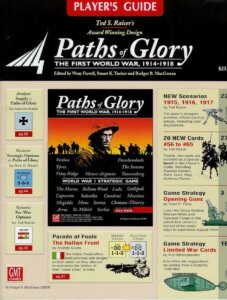
Paths of Glory is a two-player World War I wargame with an approximately 480-minute playing time, covering the conflict from its outbreak through American intervention. Designed by Ted Raicer, it places one player in command of the Central Powers and the other at the head of the Entente Powers.
The game spans Europe and the Middle East, including the Western Front, Poland, the Balkans, and Arabia. Players direct military units, resolve battles using combat results tables, and manage the strategic pressures of a war that reshaped the modern world.
At the heart of Paths of Glory is its card-driven system. Players receive a hand of Strategy Cards and play through six sub-phases in each turn. A card may be used in one of four ways:
- Operational movement
- Strategic movement
- Special events
- Replacement points
Because each card can serve only one purpose at a time, every turn creates difficult decisions. You may want to move forces, trigger an event, or restore losses, but choosing one option means giving up the others. Players can also pass, with only minimal unit movement available, making the timing and use of each card especially important.
With its blend of period detail, military units, combat tables, and strategic card play, Paths of Glory challenges both generalship and long-term planning. Its components include a full-color map of Europe and the Near East, 110 Strategy Cards, 316 die-cut counters, a rule book with a sample game replay, and player reference cards. Released in 1999, it brings the dramatic events of the Great War to the tabletop.

Board Game Rules for
Paths of Glory
Introduction
On June 28, 1914, Archduke Franz Ferdinand, heir to the Habsburg crowns of Austria and Hungary, was assassinated by Serb nationalists in Sarajevo, then the capital of Austrian controlled Bosnia-Herzogovina. The murder provided an excuse for the Austrian Army’s chief of staff, Conrad von Hotzendorff, to “settle accounts” with the Serbs. On July 23 Austria presented Serbia with a 48-hour ultimatum. Russia mobilized to protect Serbia; Germany declared war on Russia on August 1 and on France shortly after. Demanding transit through neutral Belgium to execute the Schlieffen Plan brought Britain into the war on August 4.
Over 4 years later, the war ended on November 11, 1918. The Habsburg, Romanov, and Hohenzollern dynasties collapsed. Paths of Glory: The First World War simulates this conflict for two players:
- Central Powers (CP): Seeks to use interior lines and German military quality to overcome numerical disadvantages.
- Allied (AL): Strives to bring superior numbers to bear while sustaining Russia until the United States can intervene.
Rules Note: In this edition, significant changes or new rules are flagged with a > symbol, while minor wording revisions are underlined.
Components
Paths of Glory includes:
- One 22″ × 34″ Map
- 176 5/8″ die-cut counters
- 140 1/2″ die-cut counters
- Two Player Reference Cards
- One Rules Booklet
- 110 Strategy Cards
- One 6-sided Die
The Game Map
The map uses a point-to-point system connected by lines. Adjacent spaces are connected directly by lines. Spaces indicate initial control, terrain type, port status, fort status, and Victory Point value (red names/outlines). Four Allied MEF invasion beaches and special movement restrictions (dashed lines, Sinai penalty) are marked directly on the map.
The Playing Pieces
Combat units consist of Corps (1/2″ counters, 20,000–50,000 men) and Armies (5/8″ counters, up to 300,000 men). Forts are not units. Counters are double-sided (steps): full-strength on the front and reduced-strength on the reverse.

Game Markers
Includes 13 distinct types of game markers.
The Strategy Cards
Each player commands a 55-card deck partitioned into three phases:
- Mobilization Cards: 14 cards
- Limited War Cards: 20 cards
- Total War Cards: 21 cards

Unit Abbreviations
- AH: Austro-Hungarian
- ANA: Arab Northern Army
- AoI: Army of Islam
- AUS: Australian
- BE: Belgian
- BEF: British Expeditionary Force
- BR: British
- BU: Bulgarian
- CAU: Caucasus
- CND: Canadian
- CP: Central Powers
- FR: French
- GE: German
- GR: Greek
- IT: Italian
- MEF: Mediterranean Expeditionary Force
- MN: Montenegrin
- NE: Near East
- PT: Portuguese
- RO: Romania
- RU: Russian
- SB: Serbian
- SN: Senussi Tribal
- TU: Turkish
- US: United States
- YLD: Yilderim (Lightning)
Symbols and Terminology
- * (Asterisk): If played as an Event, permanently removed from the game after the Action Round.
- Activated: An occupied space whose Activation cost has been paid for movement or combat.
- Active Player: The player taking an action in the current Action Round.
- CC (Combat Card): Played during combat. Discarded if the combat is lost or immediately after single-use. Cannot support unoccupied forts.
- Capitals: AH: Vienna & Budapest; BE: Brussels; BR: London; BU: Sofia; FR: Paris; GE: Berlin; GR: Athens; IT: Rome; MN: Cetinje; SB: Belgrade; TU: Constantinople.
- Combat Factor (CF): Measure of combat offensive/defensive capability used on Fire Tables.
- Control of Space: Controlled by Allied, Central Powers, or Neutral. Changes when enemy units enter (unless an undestroyed friendly fort exists) or during Attrition.
- DRM: Die Roll Modifier.
- Event Name (Underlined): Indicates prerequisite event with an on-map tracking counter.
- Loss Factor (LF): Combat durability requirement to absorb step losses.
- Loss Number: Fire Table combat result inflicted on opponent.
- Movement Factor (MF) & Movement Points (MP): Maximum spaces a unit can enter; all spaces cost 1 MP.
- OPS Value: Activation Points provided by a card.
- Out of Supply (OOS): Isolated from supply sources; eliminated during Attrition.
- Replacement Points (RP): Points to rebuild reduced or eliminated units.
- Strategic Redeployment (SR): Long-distance rapid transit through friendly lines.
- Victory Points (VP): Metric determining game winner.
- War Commitment Level & War Status Number: Determines available deck tiers (Mobilization, Limited War, Total War) and game progression.
Game Set-Up
- Markers: Place Game Turn on August 1914; Victory Points on 10; War Status markers on 0; Replacement markers on 0; Current CP Russian VP on 0; Mandated Offensives markers on tables; US Entry on US Neutral; Russian Capitulation on “God Save the Tsar”; Action markers near Action Round tracks.
- Units: Place units per the Set-Up Chart. Unplaced units form the Reserve Box.
- Optional Rule 4.2.4: Place one AH corps in Stanislaw and one RU corps in Lutsk from reserves.
- Cards: CP player may choose to hold Guns of August in the initial 7-card hand or draw 7 randomly. Allied player shuffles 14 Mobilization cards and draws 7.
Scenario Setup Summaries
Central Powers At-Start Setup
- Germany: Reserve: 8 Corps. Western Front: Bremen (1 Corps reduced), Aachen (1st Army), Koblenz (2nd & 3rd Armies), Metz (4th & 5th Armies, Trench 1), Strasbourg (6th Army), Mulhouse (7th Army reduced, Trench 1). Eastern Front: Konigsberg (Trench 1), Insterburg (8th Army, 1 Corps), Oppeln (1 Corps reduced).
- Austria-Hungary: Reserve: 5 Corps. Eastern Front: Cracow (1 Corps, Trench 1), Tarnow (1st Army), Przemysl (4th Army), Tarnopol (3rd Army), Czernowitz (1 Corps), Munkacs (2nd Army reduced). Serbian Front: Timisvar (1 Corps), Novi Sad (5th Army), Sarajevo (6th Army). Italian Front: Trent (Trench 1), Villach (1 Corps, Trench 1), Trieste (Trench 1).
Allied Powers At-Start Setup
- France: Reserve: 7 Corps. Sedan (5th Army), Verdun (3rd & 4th Armies, Trench 1), Nancy (1st & 2nd Armies, Trench 1), Belfort (2 Corps, Trench 1), Bar le Duc (9th Army reduced), Paris (6th Army reduced, Trench 1), Grenoble (1 Corps).
- Britain: Reserve: 1 Corps, 1 BEF Corps. Brussels: BEF Army, Trench 1. Near East: Port Said (1 Corps reduced, Trench 1), Cairo (1 Corps reduced, Trench 1), Basra (1 Corps reduced, Trench 1).
- Russia: Reserve: 6 Corps. Riga (1 Corps, Trench 1), Szawli (1 Corps), Kovno (1st Army), Grodno (1 Corps), Lomza (2nd Army), Ivangorod (4th Army), Lublin (5th Army), Dubno (3rd Army), Kamenets Podolski (8th Army), Odessa (1 Corps, Trench 1). Caucasus: Batum (1 Corps), Kars (1 Corps), Erivan (1 Corps).
- Serbia & Montenegro: Belgrade (1st Army), Valjevo (2nd Army); Reserve: 2 Corps. Montenegro: Cetinje (1 Corps).
- Belgium: Antwerp (1st Army); Reserve: 1 Corps.


Sequence of Play
Each turn follows these sequential phases:
- A. Mandated Offensive Phase: Roll 1d6 each on Mandated Offensive Table.
- B. Action Phase: Six alternating Action Rounds; CP acts first in each round.
- C. Attrition Phase: Eliminate all OOS units; unsupplied spaces convert control.
- D. Siege Phase: Roll for besieged forts (die > Fort LF destroys fort).
- E. War Status Phase: Check VP table, Automatic Victory, Armistice (Combined War Status 40+), and War Commitment Level increases.
- F. Replacement Phase: Spend accumulated RPs (Allied first, then CP).
- G. Draw Strategy Card Phase: Discard unwanted CCs, draw up to 7 cards.
- H. End of Turn: Advance turn marker.
Mandated Offensives
- Failure to launch a mandated attack results in a 1 VP penalty (shifts towards opponent).
- British/French: Must attack a German unit in France, Belgium, or Germany.
- German: Must attack Allied units in France, Belgium, or Germany (canceled after H-L Take Command).
- Turkish: Must attack Allied units (SN excluded).
- Austro-Hungarian: Attack against Italy if “AH (It)”, or against any enemy if “AH”.
- French Mutiny: Inverts French MO; any non-US-stacked French attack adds 1 VP to CP.
- Modifiers: Hoffmann (+1 CP roll), H-L Take Command (cancels GE MO), Bolshevik Revolution (cancels RU MO).
Action Phase Options
In each of the 6 Action Rounds, the active player must select exactly one action:
- Play a card for Operations (OPS).
- Play a card for Strategic Redeployment (SR) (cannot be played in consecutive rounds).
- Play a card for Replacement Points (RP) (cannot be played in consecutive rounds).
- Play a card as an Event.
- Offer Peace Terms (if VPs qualify).
- Conduct an Automatic 1 OPS action without playing a card.
Operations (OPS)
- Spend Activation Points equal to card OPS. A space costs 1 OPS per distinct nationality present to activate for either Move or Attack (not both).
- Exceptions: Belgians in Antwerp/Ostend/Calais/Amiens activate as British; ANA/BR/AUS/CND/PT activate as British; FR and US activate as one nationality in France/Germany; SN is Turkish; MN is Serbian.
- Near East Map: Allies may activate only 1 Near East space for combat per round (MEF Beachhead and British NE Army spaces excepted).
Events
- Neutrals: Only one neutral nation entry event may be played per turn across both players.
- Reinforcements: Max 1 Reinforcement card per nation per turn (none on August 1914). Corps go to Reserve Box; Armies place in supplied capitals or national supply sources.
- Combat Cards (CC): Played during combat. Attacker declares first. Victor retains applicable persistent cards; loser discards all played CCs.
Stacking
- Up to 3 combat units per space. Forts do not count. Stacking limits apply at all times except during movement transit. Overstacking results in excess units eliminated by opponent.
Movement & Trenches
- Movement: Units with MF ≥ 1 move point-to-point along valid lines (1 MP per space). Stacks move sequentially. Units cannot enter enemy-occupied spaces, unbesieged forts (unless besieging), or cross restricted dashed lines.
- Trenches (11.2): After Entrench event is played, an active army may attempt to dig in instead of moving. Roll 1d6 ≤ Army LF to place Level 1 (or upgrade to Level 2) Trench. Negated or reduced when occupied by enemy.
Strategic Redeployment (SR)
- 1 SR point moves 1 Corps; 4 SR points move 1 Army. Units move between friendly supplied spaces through uninterrupted friendly territory.
- Reserve Box: Corps may SR to and from the Reserve Box.
- Sea SR: Corps only may move between friendly port spaces. Russian units may not SR by sea or outside Russia.
Combat Resolution Sequence
- Designate Combat: Active player declares attacking units and single defending space.
- Determine Strengths: Sum CF of attacking units; defender sums CF plus Fort CF.
- Play Trench-Negating Combat Cards.
- Attempt Flank Attack: Permitted if attacking from 2+ spaces, includes an Army, and defender is not in swamp/mountain/trench/unoccupied fort. Roll 1d6 (+1 per unpinned space): succeeds on 4+, resolving attacker fire first. Failure resolves defender fire first.
- Play Combat Cards.
- Determine DRM & Fire Column: Army Table used if an Army is present; otherwise Corps/Fort Table. Apply column shifts for defender terrain and trenches.
- Determine Results: Roll 1d6 modified by DRM; cross-reference column to find Loss Number.
- Take Losses: Players absorb step losses meeting the Loss Number. Reduced armies eliminated without reserve corps are permanently lost. Attacking British/Russian CAU must obey loss priority.
- Determine Combat Winner: Higher Loss Number wins. Ties count as both losing.
- Defender Retreat: If attacker wins with remaining full-strength units, defender retreats 1 space (difference of 1) or 2 spaces (difference of 2+). Retreat may be canceled by losing an additional step in qualifying terrain/trenches.
- Attacker Advance: Full-strength victorious units may advance into vacated defender space(s).
Withdrawal Card
Allows defender to negate one Corps step loss (or Army step if no Corps lost) and execute a mandatory 1-space retreat, precluding normal combat retreats.


Supply
- Supply lines trace through friendly spaces to national supply sources (CP: Essen, Breslau, Sofia, Constantinople; Allies: London, or eastern map edge/Belgrade for RU/SB/RO).
- OOS units cannot activate, SR, or entrench, and are eliminated during Attrition. Unsupplied friendly spaces convert to enemy control during Attrition.
Forts & Sieges
- Provide defensive CF and block enemy transit until besieged.
- Besieging requires entering at least one Army or corps equal to Fort LF.
- During Siege Phase, roll 1d6 > Fort LF to destroy besieged fort (-2 DRM on Aug/Sept 1914). Destroyed forts cannot be repaired.
Replacements
Accumulated RPs spent during Replacement Phase to rebuild steps or recreate eliminated units from reserves. Captured capitals prevent RP expenditure for that nation.
War Status Progression
- War Commitment Level increases from Mobilization to Limited War (War Status 4+) and Total War (War Status 11+), unlocking new card decks. Turkey enters when CP reaches Limited War.
United States Entry
Progresses via Combined War Status 30 → Zimmermann Telegram → Over There.
Russian Capitulation
6-stage progression tracking CP-held Russian VPs: Tsar Takes Command (3+ VPs) → Fall of the Tsar (Status+VPs ≥ 33) → Bolshevik Revolution → Treaty of Brest-Litovsk.
Peace Terms
CP may offer at VP ≥ 11; Allies at VP ≤ 9. Accepted offer results in an immediate draw. Rejection triggers die roll on Peace Terms Table modifying VPs.
Determining Victory
- Automatic Victory: CP wins if VP reaches 20+; Allies win if VP reaches 0 or less during War Status segment E.2.
- Introductory Scenario (Turns 1–3): CP wins at 14+; Draw at 11–13; Allied wins at 10 or less.
- Limited War Scenario (Turns 1–10): CP wins at 17+; Draw at 13–16; Allied wins at 12 or less.
- Campaign Scenario (Ends Turn 20, Armistice, or Automatic): With Treaty of Brest-Litovsk: CP wins at 11+; Draw at 10; Allied wins at 9 or less. Without Treaty: CP wins at 13+; Draw at 10–12; Allied wins at 9 or less.
- Tournament Bidding: Players bid VPs conceded to choose desired side; adjusted at game end.
Card Notes & Historical Commentary
The rules provide detailed historical backgrounds for every event card in the game, including military figures (Von Francois, Hoffmann, Brusilov, Kemal, Allenby, Falkenhayn), technological innovations (Flamethrowers, Chlorine Gas, Royal Tank Corps, Zeppelins), and major political/diplomatic turning points (Fall of the Tsar, Brest-Litovsk, Zimmermann Telegram, 14 Points).
Extended Example of Play Summary
The manual illustrates an extensive two-turn walkthrough (August and September 1914):
- August 1914: CP opens with Guns of August, attacking Sedan and conquering Liege. Russian forces strike into Galicia against Tarnopol and Czernowitz. Allied counters at Sedan isolate German advanced elements before lines stabilize.
- September 1914: CP escalates to Limited War, bringing the Ottoman Empire into play. British 1st Army deploys to the continent. Clashes around Sedan, Nancy, and Galicia demonstrate flanking maneuvers, trench defense mechanics, and replacement point allocations.
Introduction & Components
Introduction
On June 28, 1914, Archduke Franz Ferdinand, heir to the Habsburg crowns of Austria and Hungary, was assassinated by Serb nationalists in Sarajevo, then the capital of Austrian controlled Bosnia-Herzogovina. The murder provided an excuse for the Austrian Army’s chief of staff, Conrad von Hotzendorff, to “settle accounts” with the Serbs. On July 23 Austria presented Serbia with a 48-hour ultimatum. Russia mobilized to protect Serbia; Germany declared war on Russia on August 1 and on France shortly after. Demanding transit through neutral Belgium to execute the Schlieffen Plan brought Britain into the war on August 4.
Over 4 years later, the war ended on November 11, 1918. The Habsburg, Romanov, and Hohenzollern dynasties collapsed. Paths of Glory: The First World War simulates this conflict for two players:
- Central Powers (CP): Seeks to use interior lines and German military quality to overcome numerical disadvantages.
- Allied (AL): Strives to bring superior numbers to bear while sustaining Russia until the United States can intervene.
Rules Note: In this edition, significant changes or new rules are flagged with a > symbol, while minor wording revisions are underlined.
Components
Paths of Glory includes:
- One 22″ × 34″ Map
- 176 5/8″ die-cut counters
- 140 1/2″ die-cut counters
- Two Player Reference Cards
- One Rules Booklet
- 110 Strategy Cards
- One 6-sided Die
The Game Map
The map uses a point-to-point system connected by lines. Adjacent spaces are connected directly by lines. Spaces indicate initial control, terrain type, port status, fort status, and Victory Point value (red names/outlines). Four Allied MEF invasion beaches and special movement restrictions (dashed lines, Sinai penalty) are marked directly on the map.
The Playing Pieces
Combat units consist of Corps (1/2″ counters, 20,000–50,000 men) and Armies (5/8″ counters, up to 300,000 men). Forts are not units. Counters are double-sided (steps): full-strength on the front and reduced-strength on the reverse.
Game Markers
Includes 13 distinct types of game markers.
The Strategy Cards
Each player commands a 55-card deck partitioned into three phases:
- Mobilization Cards: 14 cards
- Limited War Cards: 20 cards
- Total War Cards: 21 cards
Unit Abbreviations
- AH: Austro-Hungarian
- ANA: Arab Northern Army
- AoI: Army of Islam
- AUS: Australian
- BE: Belgian
- BEF: British Expeditionary Force
- BR: British
- BU: Bulgarian
- CAU: Caucasus
- CND: Canadian
- CP: Central Powers
- FR: French
- GE: German
- GR: Greek
- IT: Italian
- MEF: Mediterranean Expeditionary Force
- MN: Montenegrin
- NE: Near East
- PT: Portuguese
- RO: Romania
- RU: Russian
- SB: Serbian
- SN: Senussi Tribal
- TU: Turkish
- US: United States
- YLD: Yilderim (Lightning)
Symbols and Terminology
- * (Asterisk): If played as an Event, permanently removed from the game after the Action Round.
- Activated: An occupied space whose Activation cost has been paid for movement or combat.
- Active Player: The player taking an action in the current Action Round.
- CC (Combat Card): Played during combat. Discarded if the combat is lost or immediately after single-use. Cannot support unoccupied forts.
- Capitals: AH: Vienna & Budapest; BE: Brussels; BR: London; BU: Sofia; FR: Paris; GE: Berlin; GR: Athens; IT: Rome; MN: Cetinje; SB: Belgrade; TU: Constantinople.
- Combat Factor (CF): Measure of combat offensive/defensive capability used on Fire Tables.
- Control of Space: Controlled by Allied, Central Powers, or Neutral. Changes when enemy units enter (unless an undestroyed friendly fort exists) or during Attrition.
- DRM: Die Roll Modifier.
- Event Name (Underlined): Indicates prerequisite event with an on-map tracking counter.
- Loss Factor (LF): Combat durability requirement to absorb step losses.
- Loss Number: Fire Table combat result inflicted on opponent.
- Movement Factor (MF) & Movement Points (MP): Maximum spaces a unit can enter; all spaces cost 1 MP.
- OPS Value: Activation Points provided by a card.
- Out of Supply (OOS): Isolated from supply sources; eliminated during Attrition.
- Replacement Points (RP): Points to rebuild reduced or eliminated units.
- Strategic Redeployment (SR): Long-distance rapid transit through friendly lines.
- Victory Points (VP): Metric determining game winner.
- War Commitment Level & War Status Number: Determines available deck tiers (Mobilization, Limited War, Total War) and game progression.
Game Setup & Initial Deployment
Game Set-Up
- Markers: Place Game Turn on August 1914; Victory Points on 10; War Status markers on 0; Replacement markers on 0; Current CP Russian VP on 0; Mandated Offensives markers on tables; US Entry on US Neutral; Russian Capitulation on “God Save the Tsar”; Action markers near Action Round tracks.
- Units: Place units per the Set-Up Chart. Unplaced units form the Reserve Box.
- Optional Rule 4.2.4: Place one AH corps in Stanislaw and one RU corps in Lutsk from reserves.
- Cards: CP player may choose to hold Guns of August in the initial 7-card hand or draw 7 randomly. Allied player shuffles 14 Mobilization cards and draws 7.
Scenario Setup Summaries
Central Powers At-Start Setup
- Germany: Reserve: 8 Corps. Western Front: Bremen (1 Corps reduced), Aachen (1st Army), Koblenz (2nd & 3rd Armies), Metz (4th & 5th Armies, Trench 1), Strasbourg (6th Army), Mulhouse (7th Army reduced, Trench 1). Eastern Front: Konigsberg (Trench 1), Insterburg (8th Army, 1 Corps), Oppeln (1 Corps reduced).
- Austria-Hungary: Reserve: 5 Corps. Eastern Front: Cracow (1 Corps, Trench 1), Tarnow (1st Army), Przemysl (4th Army), Tarnopol (3rd Army), Czernowitz (1 Corps), Munkacs (2nd Army reduced). Serbian Front: Timisvar (1 Corps), Novi Sad (5th Army), Sarajevo (6th Army). Italian Front: Trent (Trench 1), Villach (1 Corps, Trench 1), Trieste (Trench 1).
Allied Powers At-Start Setup
- France: Reserve: 7 Corps. Sedan (5th Army), Verdun (3rd & 4th Armies, Trench 1), Nancy (1st & 2nd Armies, Trench 1), Belfort (2 Corps, Trench 1), Bar le Duc (9th Army reduced), Paris (6th Army reduced, Trench 1), Grenoble (1 Corps).
- Britain: Reserve: 1 Corps, 1 BEF Corps. Brussels: BEF Army, Trench 1. Near East: Port Said (1 Corps reduced, Trench 1), Cairo (1 Corps reduced, Trench 1), Basra (1 Corps reduced, Trench 1).
- Russia: Reserve: 6 Corps. Riga (1 Corps, Trench 1), Szawli (1 Corps), Kovno (1st Army), Grodno (1 Corps), Lomza (2nd Army), Ivangorod (4th Army), Lublin (5th Army), Dubno (3rd Army), Kamenets Podolski (8th Army), Odessa (1 Corps, Trench 1). Caucasus: Batum (1 Corps), Kars (1 Corps), Erivan (1 Corps).
- Serbia & Montenegro: Belgrade (1st Army), Valjevo (2nd Army); Reserve: 2 Corps. Montenegro: Cetinje (1 Corps).
- Belgium: Antwerp (1st Army); Reserve: 1 Corps.
Sequence of Play & Mandated Offensives
Sequence of Play
Each turn follows these sequential phases:
- A. Mandated Offensive Phase: Roll 1d6 each on Mandated Offensive Table.
- B. Action Phase: Six alternating Action Rounds; CP acts first in each round.
- C. Attrition Phase: Eliminate all OOS units; unsupplied spaces convert control.
- D. Siege Phase: Roll for besieged forts (die > Fort LF destroys fort).
- E. War Status Phase: Check VP table, Automatic Victory, Armistice (Combined War Status 40+), and War Commitment Level increases.
- F. Replacement Phase: Spend accumulated RPs (Allied first, then CP).
- G. Draw Strategy Card Phase: Discard unwanted CCs, draw up to 7 cards.
- H. End of Turn: Advance turn marker.
Mandated Offensives
- Failure to launch a mandated attack results in a 1 VP penalty (shifts towards opponent).
- British/French: Must attack a German unit in France, Belgium, or Germany.
- German: Must attack Allied units in France, Belgium, or Germany (canceled after H-L Take Command).
- Turkish: Must attack Allied units (SN excluded).
- Austro-Hungarian: Attack against Italy if “AH (It)”, or against any enemy if “AH”.
- French Mutiny: Inverts French MO; any non-US-stacked French attack adds 1 VP to CP.
- Modifiers: Hoffmann (+1 CP roll), H-L Take Command (cancels GE MO), Bolshevik Revolution (cancels RU MO).
Action Phase & Strategy Cards
Action Phase Options
In each of the 6 Action Rounds, the active player must select exactly one action:
- Play a card for Operations (OPS).
- Play a card for Strategic Redeployment (SR) (cannot be played in consecutive rounds).
- Play a card for Replacement Points (RP) (cannot be played in consecutive rounds).
- Play a card as an Event.
- Offer Peace Terms (if VPs qualify).
- Conduct an Automatic 1 OPS action without playing a card.
Operations (OPS)
- Spend Activation Points equal to card OPS. A space costs 1 OPS per distinct nationality present to activate for either Move or Attack (not both).
- Exceptions: Belgians in Antwerp/Ostend/Calais/Amiens activate as British; ANA/BR/AUS/CND/PT activate as British; FR and US activate as one nationality in France/Germany; SN is Turkish; MN is Serbian.
- Near East Map: Allies may activate only 1 Near East space for combat per round (MEF Beachhead and British NE Army spaces excepted).
Events
- Neutrals: Only one neutral nation entry event may be played per turn across both players.
- Reinforcements: Max 1 Reinforcement card per nation per turn (none on August 1914). Corps go to Reserve Box; Armies place in supplied capitals or national supply sources.
- Combat Cards (CC): Played during combat. Attacker declares first. Victor retains applicable persistent cards; loser discards all played CCs.
Movement, Stacking & Strategic Redeployment
Stacking
- Up to 3 combat units per space. Forts do not count. Stacking limits apply at all times except during movement transit. Overstacking results in excess units eliminated by opponent.
Movement & Trenches
- Movement: Units with MF ≥ 1 move point-to-point along valid lines (1 MP per space). Stacks move sequentially. Units cannot enter enemy-occupied spaces, unbesieged forts (unless besieging), or cross restricted dashed lines.
- Trenches (11.2): After Entrench event is played, an active army may attempt to dig in instead of moving. Roll 1d6 ≤ Army LF to place Level 1 (or upgrade to Level 2) Trench. Negated or reduced when occupied by enemy.
Strategic Redeployment (SR)
- 1 SR point moves 1 Corps; 4 SR points move 1 Army. Units move between friendly supplied spaces through uninterrupted friendly territory.
- Reserve Box: Corps may SR to and from the Reserve Box.
- Sea SR: Corps only may move between friendly port spaces. Russian units may not SR by sea or outside Russia.
Combat Resolution
Combat Resolution Sequence
- Designate Combat: Active player declares attacking units and single defending space.
- Determine Strengths: Sum CF of attacking units; defender sums CF plus Fort CF.
- Play Trench-Negating Combat Cards.
- Attempt Flank Attack: Permitted if attacking from 2+ spaces, includes an Army, and defender is not in swamp/mountain/trench/unoccupied fort. Roll 1d6 (+1 per unpinned space): succeeds on 4+, resolving attacker fire first. Failure resolves defender fire first.
- Play Combat Cards.
- Determine DRM & Fire Column: Army Table used if an Army is present; otherwise Corps/Fort Table. Apply column shifts for defender terrain and trenches.
- Determine Results: Roll 1d6 modified by DRM; cross-reference column to find Loss Number.
- Take Losses: Players absorb step losses meeting the Loss Number. Reduced armies eliminated without reserve corps are permanently lost. Attacking British/Russian CAU must obey loss priority.
- Determine Combat Winner: Higher Loss Number wins. Ties count as both losing.
- Defender Retreat: If attacker wins with remaining full-strength units, defender retreats 1 space (difference of 1) or 2 spaces (difference of 2+). Retreat may be canceled by losing an additional step in qualifying terrain/trenches.
- Attacker Advance: Full-strength victorious units may advance into vacated defender space(s).
Withdrawal Card
Allows defender to negate one Corps step loss (or Army step if no Corps lost) and execute a mandatory 1-space retreat, precluding normal combat retreats.
Supply, Forts & Replacements
Supply
- Supply lines trace through friendly spaces to national supply sources (CP: Essen, Breslau, Sofia, Constantinople; Allies: London, or eastern map edge/Belgrade for RU/SB/RO).
- OOS units cannot activate, SR, or entrench, and are eliminated during Attrition. Unsupplied friendly spaces convert to enemy control during Attrition.
Forts & Sieges
- Provide defensive CF and block enemy transit until besieged.
- Besieging requires entering at least one Army or corps equal to Fort LF.
- During Siege Phase, roll 1d6 > Fort LF to destroy besieged fort (-2 DRM on Aug/Sept 1914). Destroyed forts cannot be repaired.
Replacements
Accumulated RPs spent during Replacement Phase to rebuild steps or recreate eliminated units from reserves. Captured capitals prevent RP expenditure for that nation.
War Status, Politics & Russian Capitulation
War Status Progression
- War Commitment Level increases from Mobilization to Limited War (War Status 4+) and Total War (War Status 11+), unlocking new card decks. Turkey enters when CP reaches Limited War.
United States Entry
Progresses via Combined War Status 30 → Zimmermann Telegram → Over There.
Russian Capitulation
6-stage progression tracking CP-held Russian VPs: Tsar Takes Command (3+ VPs) → Fall of the Tsar (Status+VPs ≥ 33) → Bolshevik Revolution → Treaty of Brest-Litovsk.
Peace Terms
CP may offer at VP ≥ 11; Allies at VP ≤ 9. Accepted offer results in an immediate draw. Rejection triggers die roll on Peace Terms Table modifying VPs.
Victory Conditions
Determining Victory
- Automatic Victory: CP wins if VP reaches 20+; Allies win if VP reaches 0 or less during War Status segment E.2.
- Introductory Scenario (Turns 1–3): CP wins at 14+; Draw at 11–13; Allied wins at 10 or less.
- Limited War Scenario (Turns 1–10): CP wins at 17+; Draw at 13–16; Allied wins at 12 or less.
- Campaign Scenario (Ends Turn 20, Armistice, or Automatic): With Treaty of Brest-Litovsk: CP wins at 11+; Draw at 10; Allied wins at 9 or less. Without Treaty: CP wins at 13+; Draw at 10–12; Allied wins at 9 or less.
- Tournament Bidding: Players bid VPs conceded to choose desired side; adjusted at game end.
Historical Commentary & Extended Example
Card Notes & Historical Commentary
The rules provide detailed historical backgrounds for every event card in the game, including military figures (Von Francois, Hoffmann, Brusilov, Kemal, Allenby, Falkenhayn), technological innovations (Flamethrowers, Chlorine Gas, Royal Tank Corps, Zeppelins), and major political/diplomatic turning points (Fall of the Tsar, Brest-Litovsk, Zimmermann Telegram, 14 Points).
Extended Example of Play Summary
The manual illustrates an extensive two-turn walkthrough (August and September 1914):
- August 1914: CP opens with Guns of August, attacking Sedan and conquering Liege. Russian forces strike into Galicia against Tarnopol and Czernowitz. Allied counters at Sedan isolate German advanced elements before lines stabilize.
- September 1914: CP escalates to Limited War, bringing the Ottoman Empire into play. British 1st Army deploys to the continent. Clashes around Sedan, Nancy, and Galicia demonstrate flanking maneuvers, trench defense mechanics, and replacement point allocations.