Railroad Ink: Deep Blue Edition
2018
Roll shared route dice, draw roads and railways, and optimize your network in a 30-minute puzzle for 1–6 players.
30
minutes
1 - 6
player(s)
8+
Light


About this board game
Railroad Ink: Deep Blue Edition is a multiplayer puzzle game for 1–6 players that takes about 30 minutes to play. Each round, shared dice determine the roads and railway routes available to everyone, and each player draws those routes on an erasable board.
Your goal is to create transport lines that connect as many exits as possible. The more exits you connect, the more points you score at the end of the game. However, every incomplete route costs points, so each decision requires careful planning.
Use the available symbols to build an efficient network across your board. You might press your luck by extending a transportation line toward another exit, or choose a safer approach by beginning a simpler route that is easier to manage. Everyone works with the same dice results, but each player develops their own solution.
The Deep Blue Edition includes two expansions that add extra route types and special rules:
- Rivers: Add River routes to increase the difficulty.
- Lakes: Connect your networks by ferry.
These additional dice sets can change the way each game plays and feels, offering new challenges within the same core puzzle. They also give players more ways to approach their networks and connect routes.
Railroad Ink: Deep Blue Edition supports up to six players in one box. Combine multiple boxes to play with up to 12 players or more; the only limit is the number of boards available. Released in 2018, it offers a compact route-building experience for groups or solo play.
Thematics
Mechanics
Designers
Illustrator


Board Game Rules for
Railroad Ink: Deep Blue Edition
Game Overview
A game of Railroad Ink™ is played over 7 rounds. The goal is to connect as many Exits  to each other as possible by drawing Routes that can create Networks. The more Exits you connect to the same Network, the more points it will be worth. Bonus points can be earned for your Longest Railway, your Longest Highway, and by drawing on the Central Spaces of your Board.
Components

- 6 Boards
- 6 Markers
- 4 Route dice
- 2 River dice
- 2 Lake dice
Setup
- Each player takes a Board and places it in front of them.
- Each player also takes a marker.
- Place the Route dice in the middle of the table.
- The River and Lake dice are only used in the Expansions (see page 10).

Game Rounds
At the beginning of each round, the Route dice are rolled once. The results of the roll will determine which Routes all players must draw that round. After the roll, all players play simultaneously, drawing the Routes rolled on their own boards.
Rolling Dice
Take the Route dice and roll them in the middle of the table. Place the dice so they are easily visible to all players.

There are 2 kinds of Route dice.
3 dice show these 6 kinds of Routes:
- Straight Highway
- Curved Highway
- T-junction Highway
- Straight Railway
- Curved Railway
- T-junction Railway
1 die shows these 3 kinds of Routes:
- Overpass
- Straight Station
- Curved Station
Note: Stations allow you to connect a Railway Route to a Highway Route. Overpasses allow the two to cross without being connected to each other.

Hint: To more easily keep track of the Routes you have to draw, you can use the dice reference on your board to mark the available Routes, if you so desire.
Drawing Routes
After the dice roll, all players must draw the Routes on their boards at the same time. There are a few drawing rules you need to follow:
- Each Route you draw must be connected by at least one side to either one of the Exits or a preexisting Route. If you can’t connect a Route, you can’t draw it.
- You must draw all 4 Routes shown on the dice each round (if possible, and each Route showing can only be drawn once, of course).
- You can’t draw Routes in a way that directly connects Railways to Highways or vice versa (you need a Station to do that).
Important: When drawing Routes, you can freely rotate and/or reverse the pattern you see on the die.


Using Special Routes
Each player can also use 6 Special Routes, displayed in the top part of the boards, that do not appear on the Route dice. These Routes may allow you to connect different Networks together and/or make bigger Networks.
- You may draw a Special Route once per round, in addition to the Routes shown on the Route dice.
- You may use each Special Route only once per game. After you use a Special Route, you must mark it off on your board as a reminder that you can’t use it again.
- You can only use up to 3 Special Routes during the entire game (and remember, only 1 per round).

Remember: Only 1 Special Route per round, and only up to 3 per game!
End of the Round
Once all the players have drawn all of the available Routes, the round ends.
Each player must mark the spaces where they drew Routes this round by writing the number of the current round in the white boxes of each space they drew on. You can never erase the Routes you drew in a previous round.
After that, roll the Route Dice to start the next round.

End of the Game
The game ends after the 7th round. Now it’s time to count your score! Each player counts the points they earned for:
- Their connected Exits
- Their Longest Railway and Longest Highway
- The Central Spaces they drew on
Marking their points on the designated spaces of the Scoring Table on their boards. For more details, see the next page.
Then, each player must check for incomplete Routes. Each end of a Route that does not connect with any other Route or the outer edge of the board counts as an Error. Mark each one of these Errors with this symbol:  . You lose 1 point for each Error on your board. Mark these penalty points on the matching space of your Scoring Table.
Note: If you are playing with an Expansion  (see page 10), mark any additional points on the expansion space of your scoring board.
Finally, add up all the points you earned (subtracting any points from Errors) and write your total score on your Scoring Table. The player with the most points wins! In case of a tie, the winner is the player with the fewest Error marks on their board. If they’re still tied, the victory is shared.

How to Score Points
Connecting Exits
Connecting Exits is the main way to score points in Railroad Ink™. At the end of the game, each set of Exits that are connected to each other via the same Network of Routes is worth a number of points determined by the number of Exits connected together, as shown on the Network Values on your Board.
- Note: Overpasses only allow you to make two of your Networks cross each other, but they don’t create a connection between the two.
- Note: You can use Stations to connect Railway Routes and Highway Routes to each other.


Example: Dagmar’s board at the end of the game has 2 Networks. One (A) connects a total of 4 Exits and is worth 12 points. The other (B) connects 6 Exits and is worth 20 points. They score 32 points for their Networks!
Bonus Points
While the points you get for connecting Exits may end up being the bulk of your score when you add up points at the end of the game, do not underestimate the importance of the bonus points you can earn from your Longest Highway, Longest Railway, and Central Spaces.
- Longest Highway: Your Longest Highway is the longest unbroken streak of adjacent spaces where you drew Highway Routes that are connected to each other (not counting any loops or branches), such as the route marked in blue to the right. You score 1 point for each space that makes up your single longest Highway branch. Stations do not interrupt your Highway. This example shows a Longest Highway of 8 spaces.
- Longest Railway: Your Longest Railway is determined the same way as the Longest Highway, only counting Railway Routes instead of Highway Routes, like the one marked in red to the right (worth 5 points).
- Central Spaces: Your Central Spaces are the 9 spaces in the middle of your board. You score 1 point for each Central Space you drew anything on.
If you have two Longest Routes (with the same number of spaces), only 1 counts towards your final score.


Expansions
Once you feel confident enough with the ins and outs of Railroad Ink™, you can spice things up by using 1 of the 2 optional Expansions included in this box.
If you play with an expansion , you must roll the respective Expansion dice along with the 4 Route dice at the beginning of each round. In addition, the Expansion may change the number of rounds you must play and give you new ways to score points.
During the game, follow the same rules as the regular game with a few changes, as described on the following pages.
At the end of the game, when you add up your score, remember to count the points you earned from the Expansion you’re using, and mark them in the designated space of your scoring table.


River Dice (6 Rounds)
Rivers are a third kind of Route. Sort of. They can’t be used to connect Exits, but they can be connected to each other to create a River. Rivers can’t be crossed by Highways or Railways, unless a Bridge face on a River die allows you to do so. The additional goal is to make the Longest River possible. When playing with the River Expansion , apply these changes to the regular game rules:
- The game only lasts 6 rounds.
- When you draw Routes, you do not have to draw any of the River dice if you don’t want to (you still have to use all 4 Route dice).
- The Rivers you draw don’t have to be connected to preexisting Routes and/or other Rivers.
- You can’t connect River Routes with other kinds of Routes (nor Exits ).
- When checking for Errors, each end of a River that does not connect to another River or the outer edge of the Board counts as an Error.
- At the end of the game, choose 1 of your Rivers. You gain 1 point for each space the River runs through. If both ends of the River are connected to the outer edge of the board, you get 3 additional points.


Example: Diana created 2 River Routes. The longest would be worth 7 points, but its ends are not connected to the edges of the Board. Instead, the shortest one is worth 8 points: 5 for its length plus 3 extra points for having both ends connected to the edges of the Board, so she chooses to score points for that River.
Lake Dice (6 Rounds)
Lakes have two advantages. First of all, they allow you to create bigger Networks by connecting your Routes to a Lake with the Pier faces on the Lake dice. You also score additional points for the Smallest Lake on your Board. When playing with the Lake expansion , apply these changes to the regular game rules:
- The game only lasts for 6 rounds.
- When you draw Routes, you do not have to draw any of the Lake dice, if you don’t want to (you still have to use all 4 Route dice).
- The Lakes you draw don’t need to be connected to pre-existing Routes and/or other Lakes.
- If a space has 3 sides adjacent to the open sides of Lakes, it must be completely filled with water immediately.
- Open Lake sides do not count as Errors at the end of the game.
- Networks connected to the same Lake (by Piers) are also connected to each other.
- At the end of the game, you get 1 point for each space occupied by your Smallest Lake.


Example: The bigger Lake would be worth 7 points, but since Harry also made a smaller one, he only gets 3 points. At the same time, the Smallest Lake allowed him to join two small Networks into a single one with 4 Exits, which is worth 12 points!

Print & Play

Scan the QR code to download a print-and-play game board!
Credits
Design: Hjalmar Hach, Lorenzo Silva
Artwork: Marta Tranquilli
Graphic Design: Rita Ottolini, Noa Vassalli
Project Manager: Lorenzo Silva
Production Manager: Alessandro Pra’
Rulebook: Alessandro Pra’
English Revision: William Niebling
© 2018 Horrible Games. All rights reserved.
www.horrible-games.com
Overview & Setup
Game Overview
A game of Railroad Ink™ is played over 7 rounds. The goal is to connect as many Exits to each other as possible by drawing Routes that can create Networks. The more Exits you connect to the same Network, the more points it will be worth. Bonus points can be earned for your Longest Railway, your Longest Highway, and by drawing on the Central Spaces of your Board.
Components
- 6 Boards
- 6 Markers
- 4 Route dice
- 2 River dice
- 2 Lake dice
Setup
- Each player takes a Board and places it in front of them.
- Each player also takes a marker.
- Place the Route dice in the middle of the table.
- The River and Lake dice are only used in the Expansions (see page 10).
How to Play
Game Rounds
At the beginning of each round, the Route dice are rolled once. The results of the roll will determine which Routes all players must draw that round. After the roll, all players play simultaneously, drawing the Routes rolled on their own boards.
Rolling Dice
Take the Route dice and roll them in the middle of the table. Place the dice so they are easily visible to all players.
There are 2 kinds of Route dice.
3 dice show these 6 kinds of Routes:
- Straight Highway
- Curved Highway
- T-junction Highway
- Straight Railway
- Curved Railway
- T-junction Railway
1 die shows these 3 kinds of Routes:
- Overpass
- Straight Station
- Curved Station
Note: Stations allow you to connect a Railway Route to a Highway Route. Overpasses allow the two to cross without being connected to each other.
Hint: To more easily keep track of the Routes you have to draw, you can use the dice reference on your board to mark the available Routes, if you so desire.
Drawing Routes
After the dice roll, all players must draw the Routes on their boards at the same time. There are a few drawing rules you need to follow:
- Each Route you draw must be connected by at least one side to either one of the Exits or a preexisting Route. If you can’t connect a Route, you can’t draw it.
- You must draw all 4 Routes shown on the dice each round (if possible, and each Route showing can only be drawn once, of course).
- You can’t draw Routes in a way that directly connects Railways to Highways or vice versa (you need a Station to do that).
Important: When drawing Routes, you can freely rotate and/or reverse the pattern you see on the die.
Using Special Routes
Each player can also use 6 Special Routes, displayed in the top part of the boards, that do not appear on the Route dice. These Routes may allow you to connect different Networks together and/or make bigger Networks.
- You may draw a Special Route once per round, in addition to the Routes shown on the Route dice.
- You may use each Special Route only once per game. After you use a Special Route, you must mark it off on your board as a reminder that you can’t use it again.
- You can only use up to 3 Special Routes during the entire game (and remember, only 1 per round).
Remember: Only 1 Special Route per round, and only up to 3 per game!
End of the Round
Once all the players have drawn all of the available Routes, the round ends.
Each player must mark the spaces where they drew Routes this round by writing the number of the current round in the white boxes of each space they drew on. You can never erase the Routes you drew in a previous round.
After that, roll the Route Dice to start the next round.
Scoring & Game End
End of the Game
The game ends after the 7th round. Now it’s time to count your score! Each player counts the points they earned for:
- Their connected Exits
- Their Longest Railway and Longest Highway
- The Central Spaces they drew on
Marking their points on the designated spaces of the Scoring Table on their boards. For more details, see the next page.
Then, each player must check for incomplete Routes. Each end of a Route that does not connect with any other Route or the outer edge of the board counts as an Error. Mark each one of these Errors with this symbol: . You lose 1 point for each Error on your board. Mark these penalty points on the matching space of your Scoring Table.
Note: If you are playing with an Expansion (see page 10), mark any additional points on the expansion space of your scoring board.
Finally, add up all the points you earned (subtracting any points from Errors) and write your total score on your Scoring Table. The player with the most points wins! In case of a tie, the winner is the player with the fewest Error marks on their board. If they’re still tied, the victory is shared.
How to Score Points
Connecting Exits
Connecting Exits is the main way to score points in Railroad Ink™. At the end of the game, each set of Exits that are connected to each other via the same Network of Routes is worth a number of points determined by the number of Exits connected together, as shown on the Network Values on your Board.
- Note: Overpasses only allow you to make two of your Networks cross each other, but they don’t create a connection between the two.
- Note: You can use Stations to connect Railway Routes and Highway Routes to each other.
Example: Dagmar’s board at the end of the game has 2 Networks. One (A) connects a total of 4 Exits and is worth 12 points. The other (B) connects 6 Exits and is worth 20 points. They score 32 points for their Networks!
Bonus Points
While the points you get for connecting Exits may end up being the bulk of your score when you add up points at the end of the game, do not underestimate the importance of the bonus points you can earn from your Longest Highway, Longest Railway, and Central Spaces.
- Longest Highway: Your Longest Highway is the longest unbroken streak of adjacent spaces where you drew Highway Routes that are connected to each other (not counting any loops or branches), such as the route marked in blue to the right. You score 1 point for each space that makes up your single longest Highway branch. Stations do not interrupt your Highway. This example shows a Longest Highway of 8 spaces.
- Longest Railway: Your Longest Railway is determined the same way as the Longest Highway, only counting Railway Routes instead of Highway Routes, like the one marked in red to the right (worth 5 points).
- Central Spaces: Your Central Spaces are the 9 spaces in the middle of your board. You score 1 point for each Central Space you drew anything on.
If you have two Longest Routes (with the same number of spaces), only 1 counts towards your final score.
Expansions
Expansions
Once you feel confident enough with the ins and outs of Railroad Ink™, you can spice things up by using 1 of the 2 optional Expansions included in this box.
If you play with an expansion , you must roll the respective Expansion dice along with the 4 Route dice at the beginning of each round. In addition, the Expansion may change the number of rounds you must play and give you new ways to score points.
During the game, follow the same rules as the regular game with a few changes, as described on the following pages.
At the end of the game, when you add up your score, remember to count the points you earned from the Expansion you’re using, and mark them in the designated space of your scoring table.
River Dice (6 Rounds)
Rivers are a third kind of Route. Sort of. They can’t be used to connect Exits, but they can be connected to each other to create a River. Rivers can’t be crossed by Highways or Railways, unless a Bridge face on a River die allows you to do so. The additional goal is to make the Longest River possible. When playing with the River Expansion , apply these changes to the regular game rules:
- The game only lasts 6 rounds.
- When you draw Routes, you do not have to draw any of the River dice if you don’t want to (you still have to use all 4 Route dice).
- The Rivers you draw don’t have to be connected to preexisting Routes and/or other Rivers.
- You can’t connect River Routes with other kinds of Routes (nor Exits ).
- When checking for Errors, each end of a River that does not connect to another River or the outer edge of the Board counts as an Error.
- At the end of the game, choose 1 of your Rivers. You gain 1 point for each space the River runs through. If both ends of the River are connected to the outer edge of the board, you get 3 additional points.
Example: Diana created 2 River Routes. The longest would be worth 7 points, but its ends are not connected to the edges of the Board. Instead, the shortest one is worth 8 points: 5 for its length plus 3 extra points for having both ends connected to the edges of the Board, so she chooses to score points for that River.
Lake Dice (6 Rounds)
Lakes have two advantages. First of all, they allow you to create bigger Networks by connecting your Routes to a Lake with the Pier faces on the Lake dice. You also score additional points for the Smallest Lake on your Board. When playing with the Lake expansion , apply these changes to the regular game rules:
- The game only lasts for 6 rounds.
- When you draw Routes, you do not have to draw any of the Lake dice, if you don’t want to (you still have to use all 4 Route dice).
- The Lakes you draw don’t need to be connected to pre-existing Routes and/or other Lakes.
- If a space has 3 sides adjacent to the open sides of Lakes, it must be completely filled with water immediately.
- Open Lake sides do not count as Errors at the end of the game.
- Networks connected to the same Lake (by Piers) are also connected to each other.
- At the end of the game, you get 1 point for each space occupied by your Smallest Lake.
Example: The bigger Lake would be worth 7 points, but since Harry also made a smaller one, he only gets 3 points. At the same time, the Smallest Lake allowed him to join two small Networks into a single one with 4 Exits, which is worth 12 points!
Credits & Extras
Print & Play
Scan the QR code to download a print-and-play game board!
Credits
Design: Hjalmar Hach, Lorenzo Silva
Artwork: Marta Tranquilli
Graphic Design: Rita Ottolini, Noa Vassalli
Project Manager: Lorenzo Silva
Production Manager: Alessandro Pra’
Rulebook: Alessandro Pra’
English Revision: William Niebling
© 2018 Horrible Games. All rights reserved.
www.horrible-games.com
Expansions for
Railroad Ink: Deep Blue Edition

Railroad Ink: Promo Board #1 – Blue Train
2018
A special blue train board for expanding Railroad Ink to more players.
30
minutes
View expansion

Railroad Ink: Promo Board #2 – Red Train
2018
Add a red train and Essen Spiel artwork to your Railroad Ink collection.
30
minutes
View expansion
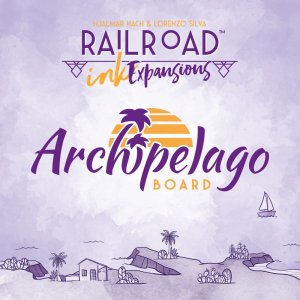
Railroad Ink: Archipelago Boards Set
2023
Connect four islands, bridge the gaps, and store routes for later.
30
minutes
View expansion
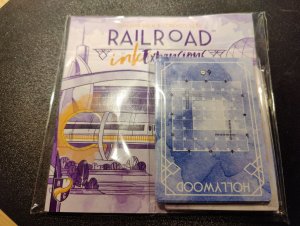
Railroad Ink: Additional Cards Pack
2021
Add new goals and challenging starting conditions to Railroad Ink
30
minutes
View expansion
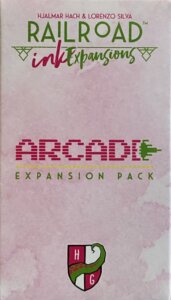
Railroad Ink: Arcade Expansion Pack
2021
Add four themed dice and discover inventive new ways to score.
30
minutes
Medium

View expansion

Railroad Ink: Futuristic Expansion Pack
2021
Build bold networks with wild routes, buildings, farms, and UFOs
30
minutes
Medium
View expansion

Railroad Ink: Electricity Expansion Pack
2021
Light your board and multiply bonus points with special electricity dice.
30
minutes
Medium
View expansion
Railroad Ink: Underground Expansion Pack
2021
Build underground Subway Routes and Water Pipes in a new Railroad Ink puzzle.
30
minutes
Medium
View expansion

Railroad Ink: Sky Expansion Pack
2021
Take your Railroad Ink networks into the sky with weather and air routes.
30
minutes
Medium
View expansion
Railroad Ink: Eldritch Expansion Pack
2021
Expand your network with portals, rituals, tentacles, and clues.
30
minutes
Medium
View expansion

Railroad Ink: Engineer Expansion Pack
2021
Restructure networks and discover new ways to score with four special dice.
30
minutes
Medium
View expansion