
Mandala
2019
A two-player card game of shared mandalas, evolving color values, and careful timing as you build your river and cup.
20
minutes
2 - 2
player(s)
10+
Medium Light

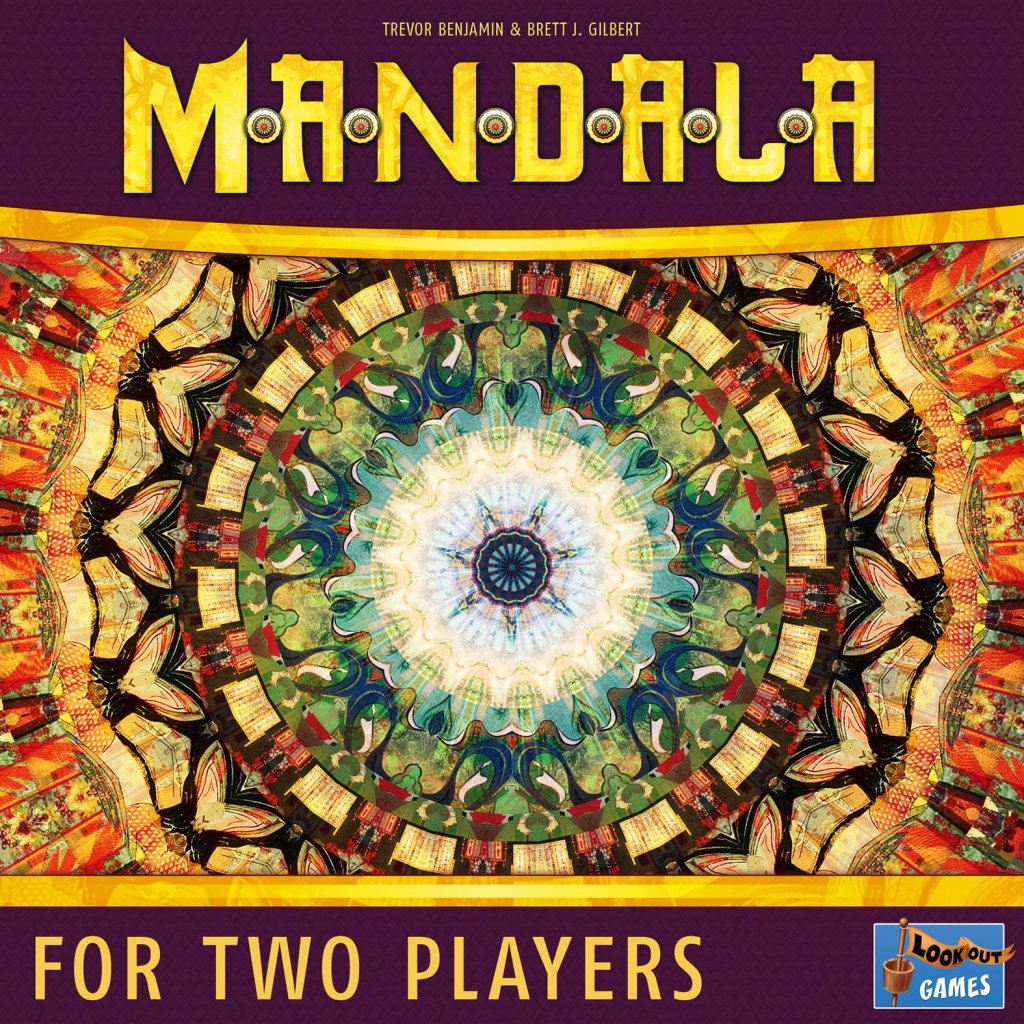
About this board game
Mandala is a two-player card game played in around 20 minutes, in which players build colorful mandalas and compete to collect the most valuable cards.
Cards are played into two shared mandalas, either in the central mountain or in your own field. The Rule of Color shapes every decision: once a color appears in one of a mandala’s three areas, later cards of that color must stay in that same area. You can play a single card into a mountain, or one or more matching cards into your field.
When a mandala contains all six colors, it is destroyed. Players take turns choosing colors from the mountain and claiming those cards. The player with more cards in their field chooses first, while the player who did not complete the mandala chooses first in a tie.
Your first card of each claimed color goes into the next empty space of your face-up river; the remaining cards enter your face-down cup. The order of colors in your river determines their value, from 1 point for the first color claimed to 6 points for the sixth. This scoring information develops throughout the game, so the value of your collected cards is not known at the beginning.
- Players: 2
- Play time: 20 minutes
- Contents: linen playmat, 108 mandala cards, and 2 reference cards
The game ends when the deck is exhausted or a player adds a sixth color to their river. Both players then score the cards in their cups according to their river positions, and the higher total wins. With two circular mandalas and six colors of cards, Mandala presents a compact contest of placement, collection, and changing card values.
Thematics
Designers
Illustrator


Board Game Rules for
Mandala
A tactical card game for 2 players aged 10 and up, playing time: 30 minutes
The Mandala: the symbol of an ancient and sacred ritual. Colored sand is laid to create a symbolic map of the world, before the pattern is ceremonially destroyed and the sand cast into the river—an ever repeating cycle of life, death, and rebirth.
Object of the Game
You play colored sand cards into two Mandalas: in the middle—to draw new cards, or on your side—to strengthen your control over that Mandala. When all six colors are present in a Mandala, you take turns to claim the cards in the middle based on the number of cards on your sides, adding them to your collection. At the end of the game, the player who has more points in their collection wins.
Components
- 1 play mat
- 110 playing cards:
- 18 sand cards in each of 6 colors
- 2 action overview cards


- Place the play mat in the middle of the play area, between the two of you.
- Shuffle the sand cards very thoroughly and place them face down beside the play mat as the draw deck. Leave space beside it for a face-up discard pile.
- For each of the two Mandalas on the play mat, draw 2 cards from the deck and place them face up in the Mountain (see illustration).
- Set up your play areas:
- a. Place an action overview card in front of you.
- b. Draw 6 cards from the deck and put them into your hand.
- c. Draw 2 cards from the deck and place them face down in your Cup.
Note: You may look at the cards in your hand and Cup at any time but keep them hidden from your opponent.
- Determine who goes first (e.g., the oldest player).
About the Play Mat
In the center of the play mat, there are two Mandalas; each Mandala is split into three areas: a central Mountain and two Fields. Each player has a space on the play mat for a face-down stack, the Cup, and spaces (numbered 1-6) for up to six face-up cards laid beside it, the River.

Beginning with the first player, you alternate taking turns until the end of the game. On your turn, you must take one of the following three actions, which will be explained in detail on the following pages:
- A — BUILD MOUNTAIN & DRAW
- Play exactly 1 card into a Mountain.
- Then draw up to 3 cards.
- Check if you completed that Mandala.
- or
- B — GROW FIELD & NO DRAW
- Play cards of one color into one of your Fields.
- Do not draw any cards this turn.
- Check if you completed that Mandala.
- or
- C — DISCARD & REDRAW
- Place cards of one color in the discard pile.
- Then draw an equal number of cards from the deck.
The Rule of Color
When playing a card into a Mountain or Field (actions A and B), you must respect the Rule of Color:
Each of the 6 sand colors may only appear in exactly one of the three areas within an individual Mandala.
The Rule of Color means that you cannot play into a Mountain any cards of a color that already appears in either of that Mandala’s Fields. Similarly, you cannot play a color into your Field that is already present in either the Mountain or your opponent’s Field.
However, you may always play into a specific area additional cards of a color that is already present there.

Example: It is your turn. You cannot play any green cards into this Mandala because there is green in your opponent’s Field. Your choices are: play 1 yellow, purple, or black card into the Mountain, or any number of orange, red, or black cards into your Field.
Action A — BUILD MOUNTAIN & DRAW
Cards in the Mountain will be claimed when a Mandala is completed, and added to your Rivers and Cups to earn points at the end of the game.
When you choose this action, do the following in this order:
- Choose exactly 1 card from your hand and place it face up in one of the two Mountains. You must respect the Rule of Color for that Mandala (see page 3). Spread out the Mountain cards so that all of them are easy to see.
- Draw up to 3 cards from the top of the deck and add them to your hand, to a maximum of 8 cards in hand. (If you have 7 cards in hand, draw only 1 card; if you have 6 cards in hand, draw 2 cards; otherwise draw 3 cards.)
Important: The hand size of 8 cards is a hard limit. You may never have more than 8 cards in hand. In particular, you may not draw 3 cards and discard the excess. - Check if you completed that Mandala: A Mandala is complete as soon as cards of all six colors are present (consider the cards in its Mountain and its two Fields). A completed Mandala must be destroyed (see next page); this may cause the end of the game (see page 6).
Action B — GROW FIELD & NO DRAW
The total number of cards played into a Field will determine which player will claim cards from the Mountain first once the Mandala is complete.
When you choose this action, do the following in this order:
- Choose 1 or more cards of one color from your hand and place them face up in one of your two Fields. You must respect the Rule of Color for that Mandala (see page 3). Spread out the cards in your Field so that all of them are easy to see. You must keep at least 1 card in hand.
- You do not draw any cards this turn!
Important: You may not end your turn with no cards in hand. Even if all cards in your hand are of the same color, you may not play all of them during step 1 of this action. - Check if you completed that Mandala: A Mandala is complete as soon as cards of all six colors are present (consider the cards in its Mountain and its two Fields). A completed Mandala must be destroyed (see next page); this may cause the end of the game (see page 6).
Action C — DISCARD & REDRAW
If you cannot or do not want to play cards, you can instead discard cards from your hand and replace them with cards from the draw deck.
When you choose this action, do the following in this order:
- Choose 1 or more cards of one color from your hand and place them face up in the discard pile. (The Rule of Color has no meaning here.)
- Draw an equal number of cards from the deck and add them to your hand.
- End your turn: You do not play into the Mountain or Field of either Mandala this turn.
Completing a Mandala
As soon as cards of all 6 colors have been played into a Mandala (consider the cards in its Mountain and its two Fields), the Mandala is complete and must be destroyed at the end of that turn; this may cause the game to end (see next page).
DESTROYING A MANDALA
Starting with the player who played the most cards in their Field, the players take alternating turns to choose one of the colors present in the Mountain of the just-completed Mandala. If both players have the same number of cards in their Field, the player who did not play the last card into the Mandala chooses first.
When you choose a color in the Mountain, claim all the cards of that color from the Mountain, then add them to your River and Cup as follows:
a) If you claim cards of a new color, not present in your River:
- Place exactly one of these cards face up in the first empty space in your River (from the left). When you add the first card to your River, place it on the leftmost space, numbered 1. Each time you add a card of a new color, place it on the next highest numbered space next to the other cards in your River. You cannot move the cards in your River, and must place each new card beside the previous one, without leaving any gaps.
- Place all the remaining cards, if any, face down in your Cup.
b) If you claim cards of a color that is already present in your River:
Simply place all the cards face down in your Cup.
Continue taking turns until all the colors in the Mountain have been claimed. Then, place all of the cards in both of the Mandala’s Fields in the discard pile so that no cards remain in the Mandala.
Finally, unless the game is over (see next page), draw 2 cards from the deck and place them face up in the Mountain of the empty Mandala (just as you did during setup). Then proceed with the game as normal.

Example: This Mandala now contains cards of all 6 colors—it is complete and must be destroyed. Anna (top) and Beth (bottom) will take turns to claim cards from the Mountain. Beth has played more cards in her Field (4 cards vs 3 cards) so will be the first to choose cards.
No cards in a Field
If one player has no cards in their Field when a Mandala completes, both players still take turns to choose colors in the Mountain as usual, but the player with no cards in their Field must place all of the cards they claim in the discard pile. They do not add any of these cards to their River or Cup.
End of the game
The end of the game is triggered when the draw deck is exhausted or one of you adds a 6th card to their River.
Exhausting the Deck
If the draw deck is exhausted, reshuffle the discard pile to create a new draw deck. Then continue playing until the next time a Mandala is completed. The game ends immediately after that Mandala is destroyed and all the cards in its Mountain have been claimed.
Adding a 6th Card to a River
If one player adds a 6th color to their River, the game ends once all the cards in the Mountain of the Mandala that is being destroyed have been claimed.
At the end of the game, any cards remaining in your hands and in the incomplete Mandala are discarded. Do not add any of these cards to your Rivers.
Scoring
Now reveal the cards in your Cups and sort them below your River cards. Every card in your Cup is worth 1, 2, 3, 4, 5, or 6 points depending on which of the cards in your River it matches. For your convenience, the numbers below the River spaces show how much each color is worth.
Note: Do not score points for the cards in your River, only for the cards in your Cup that match those in your River. Any card in your Cup that does not match a card in your River is worth 0 points.
The player with the highest total wins. In case of a tie, the player who had the fewest cards in their Cup wins.

Example: Anna ended the game by adding the 6th color to her River. The cards in her Cup are displayed below her River and are worth a total of 53 points:
- 4 cards each worth 1 point = 4
- 5 cards each worth 2 points = 10
- 6 cards each worth 3 points = 18
- 0 cards = 0
- 3 cards each worth 5 points = 15
- 1 card worth 6 points = 6
- 4 + 10 + 18 + 0 + 15 + 6 = 53
Introduction & Components
A tactical card game for 2 players aged 10 and up, playing time: 30 minutes
The Mandala: the symbol of an ancient and sacred ritual. Colored sand is laid to create a symbolic map of the world, before the pattern is ceremonially destroyed and the sand cast into the river—an ever repeating cycle of life, death, and rebirth.
Object of the Game
You play colored sand cards into two Mandalas: in the middle—to draw new cards, or on your side—to strengthen your control over that Mandala. When all six colors are present in a Mandala, you take turns to claim the cards in the middle based on the number of cards on your sides, adding them to your collection. At the end of the game, the player who has more points in their collection wins.
Components
- 1 play mat
- 110 playing cards:
- 18 sand cards in each of 6 colors
- 2 action overview cards
Setup
- Place the play mat in the middle of the play area, between the two of you.
- Shuffle the sand cards very thoroughly and place them face down beside the play mat as the draw deck. Leave space beside it for a face-up discard pile.
- For each of the two Mandalas on the play mat, draw 2 cards from the deck and place them face up in the Mountain (see illustration).
- Set up your play areas:
- a. Place an action overview card in front of you.
- b. Draw 6 cards from the deck and put them into your hand.
- c. Draw 2 cards from the deck and place them face down in your Cup.
Note: You may look at the cards in your hand and Cup at any time but keep them hidden from your opponent.
- Determine who goes first (e.g., the oldest player).
About the Play Mat
In the center of the play mat, there are two Mandalas; each Mandala is split into three areas: a central Mountain and two Fields. Each player has a space on the play mat for a face-down stack, the Cup, and spaces (numbered 1-6) for up to six face-up cards laid beside it, the River.
How to Play
Beginning with the first player, you alternate taking turns until the end of the game. On your turn, you must take one of the following three actions, which will be explained in detail on the following pages:
- A — BUILD MOUNTAIN & DRAW
- Play exactly 1 card into a Mountain.
- Then draw up to 3 cards.
- Check if you completed that Mandala.
- or
- B — GROW FIELD & NO DRAW
- Play cards of one color into one of your Fields.
- Do not draw any cards this turn.
- Check if you completed that Mandala.
- or
- C — DISCARD & REDRAW
- Place cards of one color in the discard pile.
- Then draw an equal number of cards from the deck.
The Rule of Color
When playing a card into a Mountain or Field (actions A and B), you must respect the Rule of Color:
Each of the 6 sand colors may only appear in exactly one of the three areas within an individual Mandala.
The Rule of Color means that you cannot play into a Mountain any cards of a color that already appears in either of that Mandala’s Fields. Similarly, you cannot play a color into your Field that is already present in either the Mountain or your opponent’s Field.
However, you may always play into a specific area additional cards of a color that is already present there.
Example: It is your turn. You cannot play any green cards into this Mandala because there is green in your opponent’s Field. Your choices are: play 1 yellow, purple, or black card into the Mountain, or any number of orange, red, or black cards into your Field.
Action A — BUILD MOUNTAIN & DRAW
Cards in the Mountain will be claimed when a Mandala is completed, and added to your Rivers and Cups to earn points at the end of the game.
When you choose this action, do the following in this order:
- Choose exactly 1 card from your hand and place it face up in one of the two Mountains. You must respect the Rule of Color for that Mandala (see page 3). Spread out the Mountain cards so that all of them are easy to see.
- Draw up to 3 cards from the top of the deck and add them to your hand, to a maximum of 8 cards in hand. (If you have 7 cards in hand, draw only 1 card; if you have 6 cards in hand, draw 2 cards; otherwise draw 3 cards.)
Important: The hand size of 8 cards is a hard limit. You may never have more than 8 cards in hand. In particular, you may not draw 3 cards and discard the excess. - Check if you completed that Mandala: A Mandala is complete as soon as cards of all six colors are present (consider the cards in its Mountain and its two Fields). A completed Mandala must be destroyed (see next page); this may cause the end of the game (see page 6).
Action B — GROW FIELD & NO DRAW
The total number of cards played into a Field will determine which player will claim cards from the Mountain first once the Mandala is complete.
When you choose this action, do the following in this order:
- Choose 1 or more cards of one color from your hand and place them face up in one of your two Fields. You must respect the Rule of Color for that Mandala (see page 3). Spread out the cards in your Field so that all of them are easy to see. You must keep at least 1 card in hand.
- You do not draw any cards this turn!
Important: You may not end your turn with no cards in hand. Even if all cards in your hand are of the same color, you may not play all of them during step 1 of this action. - Check if you completed that Mandala: A Mandala is complete as soon as cards of all six colors are present (consider the cards in its Mountain and its two Fields). A completed Mandala must be destroyed (see next page); this may cause the end of the game (see page 6).
Action C — DISCARD & REDRAW
If you cannot or do not want to play cards, you can instead discard cards from your hand and replace them with cards from the draw deck.
When you choose this action, do the following in this order:
- Choose 1 or more cards of one color from your hand and place them face up in the discard pile. (The Rule of Color has no meaning here.)
- Draw an equal number of cards from the deck and add them to your hand.
- End your turn: You do not play into the Mountain or Field of either Mandala this turn.
Completing & Destroying a Mandala
Completing a Mandala
As soon as cards of all 6 colors have been played into a Mandala (consider the cards in its Mountain and its two Fields), the Mandala is complete and must be destroyed at the end of that turn; this may cause the game to end (see next page).
DESTROYING A MANDALA
Starting with the player who played the most cards in their Field, the players take alternating turns to choose one of the colors present in the Mountain of the just-completed Mandala. If both players have the same number of cards in their Field, the player who did not play the last card into the Mandala chooses first.
When you choose a color in the Mountain, claim all the cards of that color from the Mountain, then add them to your River and Cup as follows:
a) If you claim cards of a new color, not present in your River:
- Place exactly one of these cards face up in the first empty space in your River (from the left). When you add the first card to your River, place it on the leftmost space, numbered 1. Each time you add a card of a new color, place it on the next highest numbered space next to the other cards in your River. You cannot move the cards in your River, and must place each new card beside the previous one, without leaving any gaps.
- Place all the remaining cards, if any, face down in your Cup.
b) If you claim cards of a color that is already present in your River:
Simply place all the cards face down in your Cup.
Continue taking turns until all the colors in the Mountain have been claimed. Then, place all of the cards in both of the Mandala’s Fields in the discard pile so that no cards remain in the Mandala.
Finally, unless the game is over (see next page), draw 2 cards from the deck and place them face up in the Mountain of the empty Mandala (just as you did during setup). Then proceed with the game as normal.
Example: This Mandala now contains cards of all 6 colors—it is complete and must be destroyed. Anna (top) and Beth (bottom) will take turns to claim cards from the Mountain. Beth has played more cards in her Field (4 cards vs 3 cards) so will be the first to choose cards.
No cards in a Field
If one player has no cards in their Field when a Mandala completes, both players still take turns to choose colors in the Mountain as usual, but the player with no cards in their Field must place all of the cards they claim in the discard pile. They do not add any of these cards to their River or Cup.
End of Game & Scoring
End of the game
The end of the game is triggered when the draw deck is exhausted or one of you adds a 6th card to their River.
Exhausting the Deck
If the draw deck is exhausted, reshuffle the discard pile to create a new draw deck. Then continue playing until the next time a Mandala is completed. The game ends immediately after that Mandala is destroyed and all the cards in its Mountain have been claimed.
Adding a 6th Card to a River
If one player adds a 6th color to their River, the game ends once all the cards in the Mountain of the Mandala that is being destroyed have been claimed.
At the end of the game, any cards remaining in your hands and in the incomplete Mandala are discarded. Do not add any of these cards to your Rivers.
Scoring
Now reveal the cards in your Cups and sort them below your River cards. Every card in your Cup is worth 1, 2, 3, 4, 5, or 6 points depending on which of the cards in your River it matches. For your convenience, the numbers below the River spaces show how much each color is worth.
Note: Do not score points for the cards in your River, only for the cards in your Cup that match those in your River. Any card in your Cup that does not match a card in your River is worth 0 points.
The player with the highest total wins. In case of a tie, the player who had the fewest cards in their Cup wins.
Example: Anna ended the game by adding the 6th color to her River. The cards in her Cup are displayed below her River and are worth a total of 53 points:
- 4 cards each worth 1 point = 4
- 5 cards each worth 2 points = 10
- 6 cards each worth 3 points = 18
- 0 cards = 0
- 3 cards each worth 5 points = 15
- 1 card worth 6 points = 6
- 4 + 10 + 18 + 0 + 15 + 6 = 53
