Pagan: Fate of Roanoke
2022
Unmask the witch or complete a ritual of renaturation in this asymmetrical, card-driven deduction game for two.
60
minutes
2 - 2
player(s)
12+
Medium Heavy

About this board game
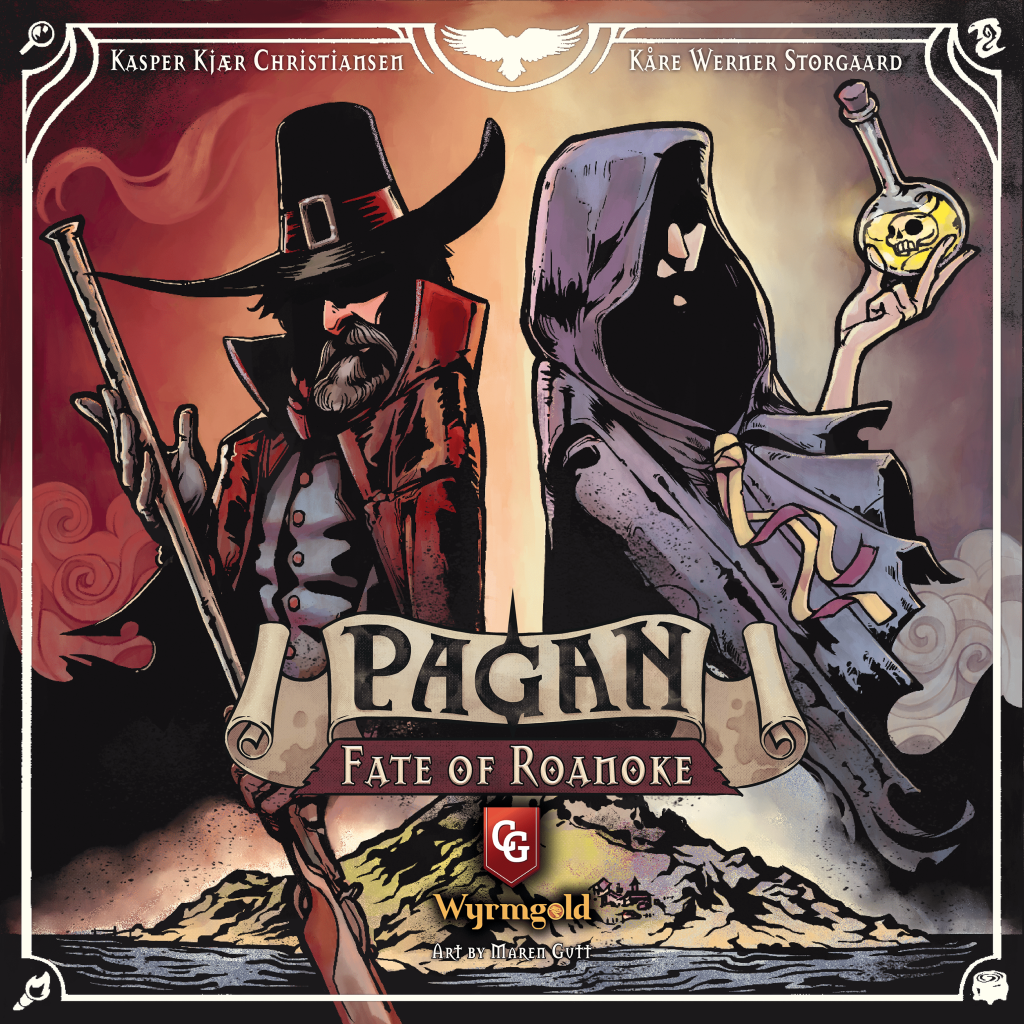
Pagan: Fate of Roanoke is an asymmetrical deduction card game for two players, with games lasting about 60 minutes. Set in colonial America in 1587, it pits a witch against a witch hunter in a struggle for the fate of the island.
The witch must remain hidden among nine villagers while gathering enough secrets to complete a powerful ritual of renaturation. If successful, the entire region will fall under her spell and Mother Nature will reclaim the island. The witch hunter, meanwhile, must discover her true identity and bring her to justice before the fatal ritual comes to fruition.
Each turn, both players use their action pawns on active villagers to draw cards, play cards, and gain influence. Every side has its own variable card deck of fifty cards, creating two distinct approaches to the same tense contest.
- Witch: Brew powerful potions, improve your familiar, and cast enchantments and charms.
- Witch hunter: Enlist allies, claim strategic locations, and ruthlessly investigate the villagers.
- Core challenge: Conceal the witch’s identity or expose it before the ritual is complete.
With its hidden-identity tension, asymmetric objectives, and card-driven actions, Pagan: Fate of Roanoke turns every villager into a potential clue and every decision into part of a larger struggle. The game is expandable, offering a foundation for further card-based play.
The prototype won the Danish design award Otto at Fastaval in 2018 for Best Game of Show.
Thematics
Mechanics
Designers
Illustrator


Board Game Rules for
Pagan: Fate of Roanoke


To Mayor Biggs,
In reference to your letter concerning the emergence of a witch in the village of Roanoke, I hereby accept the task offered to me.
If your conviction – that Suspects number less than a dozen – holds true, my recommended cause of action is to submit them all to the trials of justice. In a situation like this, a certain collateral damage is to be expected. However, I shall honor your wish that the truly innocent will be spared – if at all possible.
What a powerful witch, such as you are portraying, is doing in a place like Roanoke is beyond me. Nevertheless, I assure you, its days are numbered. In trusting that your every resource is at my disposal,
Yours truly,
Samuel Crowe, Witch Hunter
Anno Domini 1587, August 20th
Game Overview
Pagan: The Fate of Roanoke is an asymmetrical card game for two players respectively taking on the roles of Witch or Witch hunter. The Witch tries to carry out a ritual of renaturation before being exposed and eliminated by the Witch hunter.
Nine villagers are under suspicion and only the Witch player knows who the real witch is. Each turn the two players use their action pawns on active villagers to draw cards, play cards, and gain influence.
Moreover, the Witch can brew powerful potions, improve their familiar, and cast enchantments and charms, while the Witch hunter enlists allies, claim strategic locations, and ruthlessly investigates the villagers.
Object of the Game
In Pagan, two players compete to be the first to complete their individual objective.
- As the Witch, your objective is to collect enough secrets to perform a ritual so potent, that the entire region will fall under your spell and Mother Nature will reclaim the colony.
- As the Hunter, you gather all the allies and support you can muster, to bring the Witch to justice before its fatal ritual comes to fruition.
Disclaimer
Wyrmgold wants to make it abundantly clear that we as a company and as persons do not condone violence against people, witches or animals of any kind. This is a work of fiction and not meant to be disrespectful of any historical figure, ethnical or religious group.

All tokens are limited to the amount in the box. If you are about to receive or place a token, and there is none left in the supply, don’t place the token. You are, however, allowed to move a token of the same type already in play.
Hunter Components
- 50 Cards (4 different types):
- Events (
 )
- Allies (
 )
- Locations (
 )
- Investigation (
 )
- Events (
- Hunter Tokens:
- 30 Clues (
 small red discs)
- 9 Evidence (
 large red tiles)
- 3 Action pawns (
 )
- 30 Clues (
Witch Components
- 50 Cards (4 different types):
- Charms (
 )
- Brews (
 )
- Familiar skill (
 )
- Enchantments (
 )
- Charms (
- Witch Tokens:
- 30 Secrets (
 small purple discs)
- 20 Favors (
 large purple tiles)
- 2 Action pawns (
 )
- 1 Familiar action pawn (
 )
- 30 Secrets (

Influence Discs & Other Components
- 2 Influence discs with values 1–20
- 2 Player aid cards
- 2 Scenario cards
Important: Influence is not limited. In the unlikely case where you need more than 20, place a marker next to the disc for every 21 Influence. If your Influence reaches 0, turn over the disc until you gain more Influence again.

Village and Enchantment Board
- 3-part village board
- 1 Enchantment board

Villager and Suspect Cards
- 3 red, 3 blue & 3 green Villagers
- 9 corresponding Suspects
- 3 Villager overview cards

Player Boards
Hunter Board: On the left side you can find a list of all Hunter Actions. Locations as well as Allies must be placed on the designated spaces on the right.
Witch Board: On the left side you can find a list of all Witch Actions. Brews as well as Familiars must be placed on the designated spaces on the right.

- Decide who will play as the Witch and who will play as the Hunter.
- The Witch receives 3 Action pawns (2 and 1 ), the Witch player board as well as the green Influence disc.
- The Hunter takes 3 Action pawns (), the Hunter player board and the red Influence disc.
- Place the 3 part village board at the center of the table (1st, 2nd, 3rd) and put the Enchantment board to one side of it.
- Place the 9 villagers on the village board corresponding to their symbol and coloring (red, green, blue). (You will find them on the back of the cards.)
- Shuffle the 9 Suspects, matching the villagers on the village board, to form the Suspect deck.
- The Witch now draws the top card of the Suspect deck, keeping it secret from the Hunter. This Suspect indicates the true identity of the Witch for the remainder of this game.
- Both players shuffle their 50 cards building their respective decks.
- The remaining tokens (Clues, Evidence, Secrets and Favors) are put in the general supply.
- Both players draw 3 hand cards from their respective decks and set their Influence disc to 2.
Note: If you are playing for the first time, you should place 1 player aid card next to your board.

Round Structure
The players take turns being the active player. The Witch takes the first turn. Each turn consists of two phases:
- An Upkeep phase where you return your Action pawns to your supply and possibly use card effects and/or pay Upkeep, followed by…
- An Action phase where you take 3 Actions by placing Action pawns on cards or boards.

Upkeep Phase
During the Upkeep phase, perform the following steps in order:
- Return your Action pawns to your supply.
- Perform any “at the start of Upkeep” effects on cards in play.
- Perform obligatory (i.e. must) “during Upkeep” effects on cards in play as well as any voluntary (i.e. may) “during Upkeep” effects that you want to resolve in any order.
- Hunter only: Pay Upkeep for your Allies in play, by paying an amount of Influence equal to the total Upkeep of all Allies. Discard any Ally you do not pay the Upkeep for.
- Perform any “at the end of Upkeep” effects on cards in play.
- If you have more than 7 cards in your hand, discard down to 7 cards.
Action Phase Overview
During the Action phase, perform 3 Actions by placing your Action pawns, one at a time, on available action spots to carry out the corresponding action.
Note: In the first turn of the game the Witch only has 2 regular Action pawns which they must use to visit villagers of the same faction. Starting from the second turn they use all 3 Action pawns.
There are two main types of actions:
A. Villager Action
Place an Action pawn on a ready villager on the village board. Important: a villager is ready, if they have no Action pawns on them.
B. Player Board Action
Place an Action pawn on one of the action spots on your player board (same action spot can be used multiple times) or on a ready Location.

Visiting a Villager
Place an Action pawn on a ready villager, to distribute Secrets for the Witch or Clues for the Hunter and use the villager’s skill. This action has different steps for the Witch and the Hunter players, carried out in the following order:
1. Trigger Investigation Card
If there is an Investigation on your side of the visited villager, it triggers and its effect is applied.
2. Convert Secrets (Witch) / Gain Evidence Tokens (Hunter)
- Witch: If you have 3 or more Secrets on the visited villager, you may convert 3 Secrets to 1 Favor up to 2 times.
- Hunter: If the visited villager has at least 3 Clues assigned to it, you gain exactly 1 Evidence from the supply to your collection. Important: The Clues remain on the villager.


3. Distribute Assets
Distribute assets equal to the asset value shown on the visited villager, to villagers matching the color shown. The assets are Clues, if you are the Hunter and Secrets, if you are the Witch. If you distribute more than 1 asset token, you may split them between legal targets as you wish. If you are the Witch, Brews always count as legal targets.
Note: The Hunter places asset tokens on the Hunter’s side of the villager and the Witch on the Witch’s side.

4. Use Villager Skill
Use the visited villager’s skill. The villager skills generally consist of one of the three basic actions: gain Influence, draw card(s) or play card(s).
- Witch: If the visited villager has at least 2 Favors on it, you may use the villager skill one additional time.
- Hunter: Executes the skill once.

5. Familiar Action (Witch)
The Witch has 2 regular and 1 Familiar Action pawns. The Familiar action pawn works like any other Action pawn, except that the action may be augmented by a Familiar.
When using the Familiar action pawn, you may select one Familiar in play and use its effect to augment the action. You may only use one Familiar during your turn.
You may further improve your Familiar by using an Empowered version of the skill. To Empower the Familiar action, you must pay the resources listed in parenthesis on the Familiar.

Common Board Actions

Basic Actions
Though you are usually better off using a “Visit a Villager” action, sometimes this is not possible. Instead, there are 3 basic Actions:
- Gain 2 Influence: Add 2 Influence on your Influence disc.
- Draw a Card: Draw the topmost card of your deck.
- Play a Card: Play a card from your hand by paying the Influence cost of the card from your Influence wheel. If you don’t have enough Influence available, you may not play the card.
Ready a Villager
Place an Action pawn on the “Ready a Villager” spot of the player board, to remove all Action pawns from a target villager. Hand them back to their owner.
You must remove 1 of your Secrets or Clues from that villager. If you can’t do this, you may not perform this action.
Note: You may never remove your own Action pawn(s) to ready a villager.
Witch Actions
As Witch, you have 2 additional actions available through your player board. These are Consume Brew and Perform Ritual.
Consume Brew
Consuming a completed Brew doesn’t cost an Action pawn. To use a Brew, you must have enough Secrets on it to satisfy its Secrets requirement. When consumed, apply the effect of the Brew, return all Secrets on the Brew to your supply and then discard the Brew. Brews can only be consumed during your turn but may also be consumed during the Upkeep phase.

Perform Ritual
Place one of your Action pawns on a ready villager that is the true witch and has at least 3 Favors on it. Show the matching Suspect to commence the ritual and win the game.

Hunter Actions
As the Hunter, you have 5 additional Actions available through your player board.
Activate Location
You may activate any ready Location on your player board by placing an Action pawn on the Location. Some Locations require that you pay a cost for the activation to take effect. If you can’t pay the cost, you may not perform this action.

Lift Enchantment
If there are Enchantments in play on the Enchantment board, you may spend an action to lift an Enchantment. To do so, place one of your Action pawns on the “Lift Enchantment” spot and pay the cost listed next to the action symbol on the Enchantment. Then discard the Enchantment and slide any Enchantments left on the village board towards the left side if possible.


Exonerate Villager
Place an Action pawn on the “Exonerate Villager” spot and pay 3 Evidence to draw the top card of the Suspect deck. Keep the drawn card secret from the Witch. You win the game if you have drawn all 8 remaining Suspect cards.
Raid Villager
You may place an Action pawn on a ready villager and pay 3 Clues from villagers of the same color as that villager (including the target villager) to remove 1 Favor OR all Secrets from that villager.
Important: If you don’t have at least 3 Clues on like-colored villagers, you may not perform this action.

Eliminate Villager
Place an Action pawn on the Eliminate Villager action to eliminate a ready villager. The villager must have at least 3 Clues on it and every other living villager must have at least 1 Clue on them.
Important Consequences of Elimination:
- When a villager is eliminated, the Witch must announce if the villager was indeed the true witch.
- If it was the Witch, the Hunter wins the game.
- If the villager was innocent, turn the eliminated villager card face down and return all tokens on it, as well as all Clues from all villagers to the supply. That villager won’t be available for the rest of the game.
- If 3 innocent villagers have been eliminated, the Witch wins the game.
General Card Rules
Pagan includes a variety of card types. You play cards by visiting a villager with a “play” action or by using a “play” effect of another card or board item.
- One-time effects: When you play a card with a one-time effect – i.e. Charms or Events, apply the card effect immediately. Then place the card in your discard pile.
- Lasting effects: When you play a card with a lasting effect, you place it on an appropriate spot on your player board or the village board. If there is no available spot, you must remove a card of the same type as the card you played to make room for the new card. You cannot voluntarily remove a card of your origin to make room for another card.
If you ever have to draw cards, but none are left, you simply reshuffle the cards from your discard pile to form a new deck.
- Brews and Familiars are placed on the Witch player board.
- Allies and Locations go on the Hunter player board.
- Enchantments are placed on the Enchantment board.
- Investigations are placed on the village board.
Anatomy of a Card
Every action card has a type, a name, Influence cost, a picture, an effect, a version and a card number. You may never have more than 2 cards with the same name in your deck.
- Ally:
- Event:
- Investigation:
- Location:
- Brew:
- Charm:
- Enchantment:
- Familiar:

Villagers and Suspects
Villager Cards
There are 9 villagers in a game of Pagan. The villagers are located on the village board and consist of 3 blue villagers, 3 red villagers and 3 green villagers. A villager is either ready, occupied or eliminated.
A villager is occupied if an Action pawn is blocking it.
Suspect Cards
Each Suspect card corresponds to a villager on the village board. During setup, the Witch draws the top card of the Suspect deck. The drawn Suspect is the true witch for the game. During the game, the Hunter draws Suspects from the deck to narrow their search for the Witch.


Hunter Cards & Hunter Board

The Hunter board offers several action spots for the Hunter’s Action pawns as well as card spots for Locations and Allies:
- Location spots: The Hunter may place Locations here.
- Ally spots: The Hunter may place Allies here.
- Actions: The Hunter may place their Action pawns on any of these to activate the according action.
Ally ()
An Ally assists you while they are alive. But this help costs you Influence every turn as well. If you can’t afford it, you must discard the Ally from your board to the discard pile.
Location ()
A Location offers you a new action. If you place one of your Action pawns onto a Location, the effect of this card will be carried out.


Example: The Hunter plays the “Clerk” Ally for 2 Influence and places it on a free Ally spot on the Hunter Board. In their next Upkeep the Hunter discards 1 card and gains 3 Influence and pays the Upkeep cost of 1 Influence to keep the “Clerk”.
Example: The Hunter plays an “Armory” Location. They place it on one of the free Location spots on the Hunter Board. They then use one of their remaining Action pawns to activate it by placing the Action pawn on the Pawn spot of the Location. The activated “Armory” now removes 2 Secrets from up to 2 villagers. They take 2 Secrets away from “Beau Johnson”.
Event ()
An Event is an unexpected and sudden change. It is played and handled instantly and then goes to the discard pile.
Investigation ()
When you play an Investigation, place it on the village board on a target villager.
- If an Investigation affects the Witch, place it on the Witch’s side of the village board (showing a
 or ).
- If it affects the Hunter, place it on the Hunter’s side (showing an
 ).
There can only be one Investigation on any given villager at a time.


Example: The Hunter plays “Persuasion” on Stranger Sue (1.), which gives the Hunter an Evidence every time they visited the villager. Since this benefits the Hunter, the card is placed on the Hunter’s side of the board.
Later, the Hunter plays “Lock-down” on Preacher Wulfric (2.), which forces the Witch to use 2 Action pawns to visit this villager. Since this affects the Witch, it’s placed on the Witch’s side of the board.
Witch Cards & Witch Board

The Witch board offers several action spots for the Witch’s Action pawns as well as card spots for Brews and Familiars:
- Brew spots: The Witch may place Brews here.
- Familiar spots: The Witch may place Familiars here.
- Actions: The Witch may place their Action pawns on any of these to activate the according action.
Brew ()
The Witch can craft powerful Brews. The effect cannot be carried out until enough Secrets have been added. Only then the effect of the card can be carried out and the Brew discarded. You can save a Brew for an opportune moment.
Familiar ()
Through the help of a Familiar the player can activate powerful effects to strengthen their own position. By discarding a certain amount of hand cards or Influence this effect can even be Empowered ( ) by paying the shown amount.

Example (Brew): The Witch plays a “Surplus Elixir” for 2 Influence and places it on an empty Brew spot. The Witch then visits the villager “Preacher Wulfric” and distributes 2 Secrets to the Brew instead of the red villagers. After the Witch puts another 2 Secrets in the Brew it is now completed and can be used anytime within their own turn as a free action. The Witch uses it and every villager gets an additional Secret. The Witch then discards the Brew.
Example (Familiar): The Witch plays the “Qualm” Familiar for 2 Influence and puts it on the Familiar spot on the Witch board. The Familiar is now ready to use with the Familiar action pawn. The Witch uses the Familiar when visiting “Beau Johnson” and moves the Investigation “Random Tidings” to “Preacher Wulfric”. They could have paid another 2 Influence to force it back to the Hunter’s hand.
Enchantment ()
Enchantments are powerful effects that will greatly benefit the Witch or hinder the Witch hunter. Once cast they can only be removed if the Witch hunter uses one whole action and pays the resources shown.
When you play an Enchantment, place it on the leftmost space on the Enchantment board. Enchantments cost 1 additional Influence to play for each other Enchantment already in play. You can see the numbers on the Enchantment board to remind you of this.
If there are already 3 Enchantments, you can discard one to make space for a new Enchantment. Slide the remaining Enchantments to the left if possible.
Charm ()
A Charm is a good tool to manipulate the village board as it can change a situation drastically. It is played and handled instantly.


Example: The Witch plays the “Entranced” Enchantment. Since there already is one Enchantment present on the village board, the cost is increased by 1 as indicated on the board. The Witch pays 4 Influence (3 for the card and 1 extra) and places the Enchantment on the second spot.
Victory Conditions
The Witch and the Witch hunter will have to take actions helping them reach their individual victory conditions:
- The Witch wins by placing 3 or more Favor tokens on the villager who represents the true Witch and then using the action Perform ritual. Alternatively, the Witch wins if the Hunter eliminates 3 innocent villagers.
- The Hunter wins by either eliminating the true Witch or by exonerating the remaining 8 innocent villagers.
The game ends immediately when one of the following conditions is met:
- The Witch successfully performs the ritual. → Witch player wins
- The Hunter eliminates the third innocent villager. → Witch player wins
- The Hunter successfully eliminates the true witch. → Hunter player wins
- The Hunter has gathered all 8 Suspect cards. → Hunter player wins
… Let the hunt begin

Hunter’s Turn (Howard plays the Hunter)
- It is Howard’s turn. First, he takes back the 3 Action pawns.
- Now he pays 1 Influence Upkeep to keep the “Clerk” Ally in play.
- With his first action he wants to ready the “Native Pamuy”. To do that he must pay 1 Clue from the “Native Pamuy”. He may then remove Wilma’s Action pawn from the villager.
- He can put the second Action pawn on the villager, get an Evidence for free (due to the Investigation), and may distribute 1 Clue to a red villager. He puts it on “Native Pamuy”.
- The villager skill allows him to play one card at 1 lower Influence cost. The Location “Armory” comes in handy as it does not cost anything now and can be placed on a free Location spot.
- Finally Howard puts the 3rd Action pawn on the “Exonerate Villager” and pays 3 Evidence for it. He gets the Suspect card “Stranger Sue” and knows now that the 2 Favor on her was a ruse all along.
Witch’s Turn (Wilma plays the Witch)
- Wilma’s turn begins. First, she takes back the 3 Action pawns.
- She decides to visit “Doctor Annie” with her first Action pawn. She now may distribute 2 Secrets to blue villagers. But she decides to put them both on the Brew “Surplus Elixir” residing on her Brew spot.
- She may now draw a card while visiting “Doctor Annie” (the card being the Enchantment “Entranced”).
- She consumes the Brew “Surplus Elixir” as a free action, discarding it and putting 1 Secret on every villager.
- Now she wants to play the newly drawn Enchantment and decides to spend the 2nd Action pawn for visiting “Preacher Wulfric”.
- Since the villager already has 3 Secrets on it, she converts these 3 Secrets into 1 Favor.
- She can now play the Enchantment for 4 Influence (3 + 1 extra for the 2nd Enchantment spot).
- The Enchantment is now active. Since Wulfric has 2 Favors, Wilma uses Wulfric’s skill again, playing another card from her hand.
- She plays the Familiar “Learn Secrets” and puts the card on a free Familiar spot.
- With her last Action pawn she uses the Familiar action pawn on “Nestling Mia” distributing 1 Secret on a green villager.
- The villager skill gives her 3 highly needed Influence back, but Howard also gains 1 Influence.
- Activating the Familiar “Learn Secrets” would grant Wilma 1 Influence, but Empowering the Familiar by discarding 1 hand card turns this into 3 Influence. Totaling her Influence at 6 again.
Villager Set / Factions & Scenario Cards
Besides the 50-card deck, each player also selects one of the factions for the game. A faction consists of three like-colored villagers that share a common faction name and can be easily identified with the Villager Overview Cards.
- The Witch selects the Red Faction.
- The Witch Hunter selects the Blue Faction.
- The Green Faction is determined by the Scenario used for the game.
Note: Since you will select one-third of the villagers for the game, you should make sure that your deck interacts well with their skills.
If you are not playing a scenario both players should agree on a Green Faction to use. If there is no unanimous decision play with the “Caretakers” from the base game.
Scenario Cards
Scenarios are optional additions to a game of Pagan: Fate of Roanoke. They change the premise and/or goals of the game. Scenario cards come in three main categories:
- Scenarios that change some rules for each player
- Scenarios with objectives for each player that, when completed, greatly benefit the player for the rest of the game.
- Scenarios with new victory conditions (the rarest kind).
When using a scenario card, use the Green Faction listed on the scenario card, and follow the unique rules associated with the scenario. Scenario rules supersede the standard rules where applicable.

Deckbuilding
The decks included in the base game are constructed to interact well with each other, and to provide a balanced game for beginners and experienced players alike.
Pagan: Fate of Roanoke has been designed as an expandable game with new cards and other content added through expansions. Each of these expansions will feature recommended decks that can be assembled using only cards from that particular expansion and the base game.
If you enjoy a custom game experience where you tailor a deck to suit a particular playstyle or to enable specific combination, then you can construct your own decks as long as they follow the deckbuilding rules as outlined below.
Rules
- Each deck must consist of exactly 50 cards.
- The deck may contain no more than 2 copies of any given card.
- The deck must contain at least 10 cards of each card-type available to the player.
- The remaining 10 cards of each deck can be of any combination of the respective four types available to the player.
Hunter Deck Requirements:
- At least 10 Locations ()
- At least 10 Allies ()
- At least 10 Events ()
- At least 10 Investigations ()
Witch Deck Requirements:
- At least 10 Brews ()
- At least 10 Charms ()
- At least 10 Enchantments ()
- At least 10 Familiars ()
These starter decks are used for Scenario 1 – Welcome to Roanoke. It provides a simple and fast way to enjoy a full game of Pagan with the added bonus of being short and showing you the basics. Since it is very fast, expert players may enjoy it for its unforgiving nature. The starter set only needs 30 cards instead of the normally required 50.
Hunter Starter Deck (30 cards)
- Headquarters – Location () – 0021 – Count: 2
- Main Hall – Location () – 0020 – Count: 2
- Study – Location () – 0022 – Count: 2
- Persuasion – Investigation () – 0017 – Count: 2
- Quarantine – Investigation () – 0015 – Count: 2
- Gossip – Investigation () – 0013 – Count: 2
- Harsh Treatment – Investigation () – 0019 – Count: 2
- Ransack – Event () – 0011 – Count: 2
- Rapid Decay – Event () – 0009 – Count: 2
- On the Trail – Event () – 0010 – Count: 2
- Bribe – Event () – 0007 – Count: 2
- Thug – Ally () – 0005 – Count: 2
- Native Guide – Ally () – 0001 – Count: 2
- Operative – Ally () – 0004 – Count: 2
- Clerk – Ally () – 0002 – Count: 2
Witch Starter Deck (30 cards)
- Allure – Charm () – 0038 – Count: 2
- Suggestion – Charm () – 0037 – Count: 2
- Discredit – Charm () – 0034 – Count: 2
- Misdirection – Charm () – 0035 – Count: 2
- Assist – Familiar () – 0045 – Count: 2
- Learn Secrets – Familiar () – 0048 – Count: 2
- Qualm – Familiar () – 0049 – Count: 2
- Gather – Familiar () – 0047 – Count: 2
- Hypnotism – Enchantment () – 0040 – Count: 2
- Witch’s Mark – Enchantment () – 0043 – Count: 2
- Obscuring Mist – Enchantment () – 0041 – Count: 2
- Surplus Elixir – Brew () – 0030 – Count: 2
- Potion of Knowledge – Brew () – 0029 – Count: 2
- Blend of Nature – Brew () – 0028 – Count: 2
- Flagon of Oblivion – Brew () – 0026 – Count: 2
- Add: Adding the specified tokens or cards to what is already present.
- Blank: Treating a specific part of a card as if it wasn’t there. Everything else still applies. E.g. When the text box of an Ally is treated as blank, the Hunter would still have to pay the Upkeep cost, to keep the Ally in play.
- Consume: The act of using a brew that has sufficient Secrets on it. Discard the brew after applying the consume effect.
- Cost: Refers to the cost in Influence, printed in the top right corner of an action card.
- Discard: Moving a card not in play to the discard pile.
- Draw: Drawing cards from a deck. Always draw from the top of the deck, and 1 at a time.
- Exonerate (a villager): Refers to the Hunter drawing the top card of the Suspect deck.
- Faction: All villagers sharing a color. A faction will usually consist of 3 villagers, but it can be less if 1 or more of the villagers have been eliminated.
- Gain: Attaining something that is not added to a card or board. E.g. gaining Evidence from the supply or gaining Influence on the influence disc.
- Here: Refers to the card itself. E.g. if you are instructed to add a Clue here, you add the Clue to the card.
- If possible: The part of an effect that must be carried out, but only if it is possible to do so. The rest of the effect will be carried out in either case.
- In play: Refers to cards that are currently present on – or connected to – a game board. Cards in hand are not considered in play.
- Look at: Refers to looking at cards without having to reveal them to your opponent.
- Move: Refers to moving something already in play to another target also in play.
- Permanently reveal: Refers to revealing a card that will stay face up on the table for the rest of the game. It is not considered to be in play or in hand.
- Play: Refers to playing 1 or more cards. The cards must come from your hand.
- Present: Refers to something available on the card.
- Ready (state): Refers to villagers with no Action pawns on them.
- Ready (action): Refers to the action of removing an opponent’s action pawn or action pawns from a target villager.
- Remove: Refers to removing something (e.g. card or token) in play. Tokens go to the supply, cards go to the owner’s discard pile.
- Reveal: Refers to showing card(s) to your opponent. Unless otherwise stated, revealed cards return to where they came from after being revealed.
- Skip: Refers to completely ignoring the specified step of a turn or action.
- Supply: Refers to tokens not in play or gained by a player.
- Target: Refers to an entity designated by the player while performing an action. E.g. a card or a faction. All instances of the word “target” on a card will refer to the same entity.
- Visit: Refers to the “visit a villager” action. Other actions like “ready a villager”, “raid a villager” or “eliminate a villager” are not visits.
Expand the Possibilities
Pagan: Beyond the Palisades
The colony has been troubled from get-go. Even without the disconcerting witchery within the village, settling new frontiers has proven remarkably difficult. Nonetheless, the colony must turn its attention to the wild lands beyond the palisades. Its resources are key to survival. Though teeming with wildlife and rich in resources, the surrounding swampland is covered in a constant mist. Attempts to expand the husbandry have met with failure. The cattle grow weak, their milk sour, while eggs are laid in various shades of green. Is the witchcraft going on within the small community only a symptom of a grander, unnatural phenomenon? Can the countryside be cleansed to turn the colony into a thriving colonial foothold?
This first expansion features a new resource called Gloom and 100 cards for Witch and Hunter players to enjoy.
Trials of Old, Close Encounters & Mind Games
These 3 content packs feature 32 cards each strengthening Hunter & Witch alike while bringing new and exciting layers to the deck building aspect of Pagan. All content packs are compatible with Pagan: Fate of Roanoke and Pagan: Beyond the Palisades.

Kickstarter Backers
A special Thank you! to our more than 2000 backers
No Kickstarter project is possible without an amazing and supportive community. We want to thank all of you wonderful backers without whom this whole game would not have been achieved. These pages in our rulebook are dedicated to you!
King of Backers
Daniel featured on his very own box cover of Pagan as “the Witch”.
Additional Villagers
- Kinue-san appearing as “Peddler Kinue”.
- Daniel demonstrating skills as “Artisan Daniel”.
- Ryan masterfully crafting as “Ship Carver Ryan”.
- Harald featuring as “Barrister Harry”.
- Cedric becoming his alter ego “Militioneer Cedric”.
- Jutta showing her skills as “Housekeeper Jutta”.
- Simon working with style as “Tailor Simon”.
- Tina producing beverages as “Apothecary Tina”.
- Mario posing as “Harbourmaster Mario”.
- Lionel becoming the honored “Bellman Lionel”.
- Thanassis seeing afar as the “Lookout Thanassis”.
Community Villagers
- Jan snuck in as “Journeyman Jan”.
- Jana makes her entrance as “Madame Canard”.
- Sarah aiding the village as “Herbalist Sarah”.
- Markus supervising the village as “Bailiff Black”.
- “Carpenter Doe” being played by Niemand.
Team Villagers
- Maren longing to be the Berlin born “Pilgrim Margret”.
- “Navigator Warren” shows designer Kåre.
- Kasper appears as “Purser Kacey”.
- “Hawker Andy” is our very own Andreas.
- Alexander playing “Pawnbroker Alex”.

Action Heroes
- Masami helping the Witch hunter on card “March at Dawn” (0057).
- Alex judging everyone on card “Juror” (0101).
- Andreas helping the Hunter sniff out the Witch on card “Triangulate” (0067).
- Scott being pious on card “Church” (0124).
- Joan reading secret messages on card “Erudition” (0112).
- Jan being cunning on card “Shady Methods” (0122).
- Ralf selling you the wrong ingredients on card “Quack” (0118).
- Sam sending his wife to Roanoke on card “Advisor” (0133).
- Carsten looking for evidence on card “Investigator” (0102).
- Lena being in the center of all communication on card “Information Broker” (0134).
- Thomas’ girlfriend spreads news on card “Informant” (0137).
- Markus looks pleased seeing his love appearing on the card “Notary” (0117).
Sponsored Pets
- Cats “Floki & Miko” bringing stuff back on card “Facilitate” (0131) by owner Jana.
- Cat “Tyga” hunting skill featured on card “Blur” (0095) by owner Sarah.
- Dog “Louis” has a ghostly appearance on card “Lost in Plain Sight” (0083) by owner Ursula.
- Dog “Squidge” bravely immortalized on card “Captivation” (0099) by owner Amanda.
- Dog “Kauka” sniffing out the Witch on card “Portent” (0143) thanks to owner Martin.
- Cat “Jack” getting sleepy after crazy chases on card “Lethargy” (0114), thanks to his sponsor Jérémy.
- Dog “Easy” made happy with card “Trail” (0066) by owner Lukas.
- Dog “Bernard” fetching the magic Hunter doll back on “Reclaim” (0136) sponsored by owner Travis.
Community Action Cards
- Andreas appearing as “Tactician” (0056).
- Ross investigates on “Intense Scrutiny” (0065).
- Nils showing his skills as a “Frontiers Man” (0055).
- The Gamelanders crew being the best “Support” team (0097).

Publisher & Credits
Wyrmgold
- Principal Office: Meine, Niedersachsen, HRG 206196
- Executive Director: Alexander Ommer
- Designers: Kasper Kjær Christiansen & Kåre Werner Storgaard
- Illustrations: Maren Gutt
- Layout: Alexander Ommer & Maren Gutt
- Editing: Alexander Ommer & Matthias Leo Webel
- Sales & Licensing: Andreas Fuchs
- Production Prototype: Pik7, Christoph Hahn
- Production: Long Pack Games, CN
Special Thanks to…
Kinue-san, Masami, Yulius, Lui & Constantin Tanaka, Daniel Weinand, Benjamin Törck of Brettspielblog.net, Benni of Pottgamer, Kaddy aka “Spielefritte”, Suzanne (Dicetower), Carsten Lauber, Rocky Bogdanski, Steen Moldrup Thomsen, Thomas Laursen, Kåre Murmann Kjær, Judges and coordinators at Fastaval, David Ross Coughanour II, Michael Schmitt, Patrick Lagao, Holger Herrmann, Linus Galan Garcia, Nils Herzmann, Andreas Emgels, Karl-Heinz Zapf, Erik Haffner, Nico Wagner, Inga Keutmann, Timo Hiepler, Josette Ommer, Ursula Reinecke & Gabi Baumgärtel, Jens Roder, Dennis “Raumschiffspiel” Washausen, Jonas Egel, Jana & Sarah, SoldierCadian and Maixe as well as all other testers and helpers.


Introduction & Overview
To Mayor Biggs,
In reference to your letter concerning the emergence of a witch in the village of Roanoke, I hereby accept the task offered to me.
If your conviction – that Suspects number less than a dozen – holds true, my recommended cause of action is to submit them all to the trials of justice. In a situation like this, a certain collateral damage is to be expected. However, I shall honor your wish that the truly innocent will be spared – if at all possible.
What a powerful witch, such as you are portraying, is doing in a place like Roanoke is beyond me. Nevertheless, I assure you, its days are numbered. In trusting that your every resource is at my disposal,
Yours truly,
Samuel Crowe, Witch Hunter
Anno Domini 1587, August 20th
Game Overview
Pagan: The Fate of Roanoke is an asymmetrical card game for two players respectively taking on the roles of Witch or Witch hunter. The Witch tries to carry out a ritual of renaturation before being exposed and eliminated by the Witch hunter.
Nine villagers are under suspicion and only the Witch player knows who the real witch is. Each turn the two players use their action pawns on active villagers to draw cards, play cards, and gain influence.
Moreover, the Witch can brew powerful potions, improve their familiar, and cast enchantments and charms, while the Witch hunter enlists allies, claim strategic locations, and ruthlessly investigates the villagers.
Object of the Game
In Pagan, two players compete to be the first to complete their individual objective.
- As the Witch, your objective is to collect enough secrets to perform a ritual so potent, that the entire region will fall under your spell and Mother Nature will reclaim the colony.
- As the Hunter, you gather all the allies and support you can muster, to bring the Witch to justice before its fatal ritual comes to fruition.
Disclaimer
Wyrmgold wants to make it abundantly clear that we as a company and as persons do not condone violence against people, witches or animals of any kind. This is a work of fiction and not meant to be disrespectful of any historical figure, ethnical or religious group.
Component Overview
All tokens are limited to the amount in the box. If you are about to receive or place a token, and there is none left in the supply, don’t place the token. You are, however, allowed to move a token of the same type already in play.
Hunter Components
- 50 Cards (4 different types):
- Events ()
- Allies ()
- Locations ()
- Investigation ()
- Events (
- Hunter Tokens:
- 30 Clues ( small red discs)
- 9 Evidence ( large red tiles)
- 3 Action pawns ()
- 30 Clues (
Witch Components
- 50 Cards (4 different types):
- Charms ()
- Brews ()
- Familiar skill ()
- Enchantments ()
- Charms (
- Witch Tokens:
- 30 Secrets ( small purple discs)
- 20 Favors ( large purple tiles)
- 2 Action pawns ()
- 1 Familiar action pawn ()
- 30 Secrets (
Influence Discs & Other Components
- 2 Influence discs with values 1–20
- 2 Player aid cards
- 2 Scenario cards
Important: Influence is not limited. In the unlikely case where you need more than 20, place a marker next to the disc for every 21 Influence. If your Influence reaches 0, turn over the disc until you gain more Influence again.
Village and Enchantment Board
- 3-part village board
- 1 Enchantment board
Villager and Suspect Cards
- 3 red, 3 blue & 3 green Villagers
- 9 corresponding Suspects
- 3 Villager overview cards
Player Boards
Hunter Board: On the left side you can find a list of all Hunter Actions. Locations as well as Allies must be placed on the designated spaces on the right.
Witch Board: On the left side you can find a list of all Witch Actions. Brews as well as Familiars must be placed on the designated spaces on the right.
Game Setup
- Decide who will play as the Witch and who will play as the Hunter.
- The Witch receives 3 Action pawns (2 and 1 ), the Witch player board as well as the green Influence disc.
- The Hunter takes 3 Action pawns (), the Hunter player board and the red Influence disc.
- Place the 3 part village board at the center of the table (1st, 2nd, 3rd) and put the Enchantment board to one side of it.
- Place the 9 villagers on the village board corresponding to their symbol and coloring (red, green, blue). (You will find them on the back of the cards.)
- Shuffle the 9 Suspects, matching the villagers on the village board, to form the Suspect deck.
- The Witch now draws the top card of the Suspect deck, keeping it secret from the Hunter. This Suspect indicates the true identity of the Witch for the remainder of this game.
- Both players shuffle their 50 cards building their respective decks.
- The remaining tokens (Clues, Evidence, Secrets and Favors) are put in the general supply.
- Both players draw 3 hand cards from their respective decks and set their Influence disc to 2.
Note: If you are playing for the first time, you should place 1 player aid card next to your board.
Turn Structure
Round Structure
The players take turns being the active player. The Witch takes the first turn. Each turn consists of two phases:
- An Upkeep phase where you return your Action pawns to your supply and possibly use card effects and/or pay Upkeep, followed by…
- An Action phase where you take 3 Actions by placing Action pawns on cards or boards.
Upkeep Phase
During the Upkeep phase, perform the following steps in order:
- Return your Action pawns to your supply.
- Perform any “at the start of Upkeep” effects on cards in play.
- Perform obligatory (i.e. must) “during Upkeep” effects on cards in play as well as any voluntary (i.e. may) “during Upkeep” effects that you want to resolve in any order.
- Hunter only: Pay Upkeep for your Allies in play, by paying an amount of Influence equal to the total Upkeep of all Allies. Discard any Ally you do not pay the Upkeep for.
- Perform any “at the end of Upkeep” effects on cards in play.
- If you have more than 7 cards in your hand, discard down to 7 cards.
Action Phase Overview
During the Action phase, perform 3 Actions by placing your Action pawns, one at a time, on available action spots to carry out the corresponding action.
Note: In the first turn of the game the Witch only has 2 regular Action pawns which they must use to visit villagers of the same faction. Starting from the second turn they use all 3 Action pawns.
There are two main types of actions:
A. Villager Action
Place an Action pawn on a ready villager on the village board. Important: a villager is ready, if they have no Action pawns on them.
B. Player Board Action
Place an Action pawn on one of the action spots on your player board (same action spot can be used multiple times) or on a ready Location.
Actions in Detail
Visiting a Villager
Place an Action pawn on a ready villager, to distribute Secrets for the Witch or Clues for the Hunter and use the villager’s skill. This action has different steps for the Witch and the Hunter players, carried out in the following order:
1. Trigger Investigation Card
If there is an Investigation on your side of the visited villager, it triggers and its effect is applied.
2. Convert Secrets (Witch) / Gain Evidence Tokens (Hunter)
- Witch: If you have 3 or more Secrets on the visited villager, you may convert 3 Secrets to 1 Favor up to 2 times.
- Hunter: If the visited villager has at least 3 Clues assigned to it, you gain exactly 1 Evidence from the supply to your collection. Important: The Clues remain on the villager.
3. Distribute Assets
Distribute assets equal to the asset value shown on the visited villager, to villagers matching the color shown. The assets are Clues, if you are the Hunter and Secrets, if you are the Witch. If you distribute more than 1 asset token, you may split them between legal targets as you wish. If you are the Witch, Brews always count as legal targets.
Note: The Hunter places asset tokens on the Hunter’s side of the villager and the Witch on the Witch’s side.
4. Use Villager Skill
Use the visited villager’s skill. The villager skills generally consist of one of the three basic actions: gain Influence, draw card(s) or play card(s).
- Witch: If the visited villager has at least 2 Favors on it, you may use the villager skill one additional time.
- Hunter: Executes the skill once.
5. Familiar Action (Witch)
The Witch has 2 regular and 1 Familiar Action pawns. The Familiar action pawn works like any other Action pawn, except that the action may be augmented by a Familiar.
When using the Familiar action pawn, you may select one Familiar in play and use its effect to augment the action. You may only use one Familiar during your turn.
You may further improve your Familiar by using an Empowered version of the skill. To Empower the Familiar action, you must pay the resources listed in parenthesis on the Familiar.
Common Board Actions
Basic Actions
Though you are usually better off using a “Visit a Villager” action, sometimes this is not possible. Instead, there are 3 basic Actions:
- Gain 2 Influence: Add 2 Influence on your Influence disc.
- Draw a Card: Draw the topmost card of your deck.
- Play a Card: Play a card from your hand by paying the Influence cost of the card from your Influence wheel. If you don’t have enough Influence available, you may not play the card.
Ready a Villager
Place an Action pawn on the “Ready a Villager” spot of the player board, to remove all Action pawns from a target villager. Hand them back to their owner.
You must remove 1 of your Secrets or Clues from that villager. If you can’t do this, you may not perform this action.
Note: You may never remove your own Action pawn(s) to ready a villager.
Witch Actions
As Witch, you have 2 additional actions available through your player board. These are Consume Brew and Perform Ritual.
Consume Brew
Consuming a completed Brew doesn’t cost an Action pawn. To use a Brew, you must have enough Secrets on it to satisfy its Secrets requirement. When consumed, apply the effect of the Brew, return all Secrets on the Brew to your supply and then discard the Brew. Brews can only be consumed during your turn but may also be consumed during the Upkeep phase.
Perform Ritual
Place one of your Action pawns on a ready villager that is the true witch and has at least 3 Favors on it. Show the matching Suspect to commence the ritual and win the game.
Hunter Actions
As the Hunter, you have 5 additional Actions available through your player board.
Activate Location
You may activate any ready Location on your player board by placing an Action pawn on the Location. Some Locations require that you pay a cost for the activation to take effect. If you can’t pay the cost, you may not perform this action.
Lift Enchantment
If there are Enchantments in play on the Enchantment board, you may spend an action to lift an Enchantment. To do so, place one of your Action pawns on the “Lift Enchantment” spot and pay the cost listed next to the action symbol on the Enchantment. Then discard the Enchantment and slide any Enchantments left on the village board towards the left side if possible.
Exonerate Villager
Place an Action pawn on the “Exonerate Villager” spot and pay 3 Evidence to draw the top card of the Suspect deck. Keep the drawn card secret from the Witch. You win the game if you have drawn all 8 remaining Suspect cards.
Raid Villager
You may place an Action pawn on a ready villager and pay 3 Clues from villagers of the same color as that villager (including the target villager) to remove 1 Favor OR all Secrets from that villager.
Important: If you don’t have at least 3 Clues on like-colored villagers, you may not perform this action.
Eliminate Villager
Place an Action pawn on the Eliminate Villager action to eliminate a ready villager. The villager must have at least 3 Clues on it and every other living villager must have at least 1 Clue on them.
Important Consequences of Elimination:
- When a villager is eliminated, the Witch must announce if the villager was indeed the true witch.
- If it was the Witch, the Hunter wins the game.
- If the villager was innocent, turn the eliminated villager card face down and return all tokens on it, as well as all Clues from all villagers to the supply. That villager won’t be available for the rest of the game.
- If 3 innocent villagers have been eliminated, the Witch wins the game.
Cards & Boards
General Card Rules
Pagan includes a variety of card types. You play cards by visiting a villager with a “play” action or by using a “play” effect of another card or board item.
- One-time effects: When you play a card with a one-time effect – i.e. Charms or Events, apply the card effect immediately. Then place the card in your discard pile.
- Lasting effects: When you play a card with a lasting effect, you place it on an appropriate spot on your player board or the village board. If there is no available spot, you must remove a card of the same type as the card you played to make room for the new card. You cannot voluntarily remove a card of your origin to make room for another card.
If you ever have to draw cards, but none are left, you simply reshuffle the cards from your discard pile to form a new deck.
- Brews and Familiars are placed on the Witch player board.
- Allies and Locations go on the Hunter player board.
- Enchantments are placed on the Enchantment board.
- Investigations are placed on the village board.
Anatomy of a Card
Every action card has a type, a name, Influence cost, a picture, an effect, a version and a card number. You may never have more than 2 cards with the same name in your deck.
- Ally:
- Event:
- Investigation:
- Location:
- Brew:
- Charm:
- Enchantment:
- Familiar:
Villagers and Suspects
Villager Cards
There are 9 villagers in a game of Pagan. The villagers are located on the village board and consist of 3 blue villagers, 3 red villagers and 3 green villagers. A villager is either ready, occupied or eliminated.
A villager is occupied if an Action pawn is blocking it.
Suspect Cards
Each Suspect card corresponds to a villager on the village board. During setup, the Witch draws the top card of the Suspect deck. The drawn Suspect is the true witch for the game. During the game, the Hunter draws Suspects from the deck to narrow their search for the Witch.
Hunter Cards & Hunter Board
The Hunter board offers several action spots for the Hunter’s Action pawns as well as card spots for Locations and Allies:
- Location spots: The Hunter may place Locations here.
- Ally spots: The Hunter may place Allies here.
- Actions: The Hunter may place their Action pawns on any of these to activate the according action.
Ally ()
An Ally assists you while they are alive. But this help costs you Influence every turn as well. If you can’t afford it, you must discard the Ally from your board to the discard pile.
Location ()
A Location offers you a new action. If you place one of your Action pawns onto a Location, the effect of this card will be carried out.
Example: The Hunter plays the “Clerk” Ally for 2 Influence and places it on a free Ally spot on the Hunter Board. In their next Upkeep the Hunter discards 1 card and gains 3 Influence and pays the Upkeep cost of 1 Influence to keep the “Clerk”.
Example: The Hunter plays an “Armory” Location. They place it on one of the free Location spots on the Hunter Board. They then use one of their remaining Action pawns to activate it by placing the Action pawn on the Pawn spot of the Location. The activated “Armory” now removes 2 Secrets from up to 2 villagers. They take 2 Secrets away from “Beau Johnson”.
Event ()
An Event is an unexpected and sudden change. It is played and handled instantly and then goes to the discard pile.
Investigation ()
When you play an Investigation, place it on the village board on a target villager.
- If an Investigation affects the Witch, place it on the Witch’s side of the village board (showing a or ).
- If it affects the Hunter, place it on the Hunter’s side (showing an ).
There can only be one Investigation on any given villager at a time.
Example: The Hunter plays “Persuasion” on Stranger Sue (1.), which gives the Hunter an Evidence every time they visited the villager. Since this benefits the Hunter, the card is placed on the Hunter’s side of the board.
Later, the Hunter plays “Lock-down” on Preacher Wulfric (2.), which forces the Witch to use 2 Action pawns to visit this villager. Since this affects the Witch, it’s placed on the Witch’s side of the board.
Witch Cards & Witch Board
The Witch board offers several action spots for the Witch’s Action pawns as well as card spots for Brews and Familiars:
- Brew spots: The Witch may place Brews here.
- Familiar spots: The Witch may place Familiars here.
- Actions: The Witch may place their Action pawns on any of these to activate the according action.
Brew ()
The Witch can craft powerful Brews. The effect cannot be carried out until enough Secrets have been added. Only then the effect of the card can be carried out and the Brew discarded. You can save a Brew for an opportune moment.
Familiar ()
Through the help of a Familiar the player can activate powerful effects to strengthen their own position. By discarding a certain amount of hand cards or Influence this effect can even be Empowered () by paying the shown amount.
Example (Brew): The Witch plays a “Surplus Elixir” for 2 Influence and places it on an empty Brew spot. The Witch then visits the villager “Preacher Wulfric” and distributes 2 Secrets to the Brew instead of the red villagers. After the Witch puts another 2 Secrets in the Brew it is now completed and can be used anytime within their own turn as a free action. The Witch uses it and every villager gets an additional Secret. The Witch then discards the Brew.
Example (Familiar): The Witch plays the “Qualm” Familiar for 2 Influence and puts it on the Familiar spot on the Witch board. The Familiar is now ready to use with the Familiar action pawn. The Witch uses the Familiar when visiting “Beau Johnson” and moves the Investigation “Random Tidings” to “Preacher Wulfric”. They could have paid another 2 Influence to force it back to the Hunter’s hand.
Enchantment ()
Enchantments are powerful effects that will greatly benefit the Witch or hinder the Witch hunter. Once cast they can only be removed if the Witch hunter uses one whole action and pays the resources shown.
When you play an Enchantment, place it on the leftmost space on the Enchantment board. Enchantments cost 1 additional Influence to play for each other Enchantment already in play. You can see the numbers on the Enchantment board to remind you of this.
If there are already 3 Enchantments, you can discard one to make space for a new Enchantment. Slide the remaining Enchantments to the left if possible.
Charm ()
A Charm is a good tool to manipulate the village board as it can change a situation drastically. It is played and handled instantly.
Example: The Witch plays the “Entranced” Enchantment. Since there already is one Enchantment present on the village board, the cost is increased by 1 as indicated on the board. The Witch pays 4 Influence (3 for the card and 1 extra) and places the Enchantment on the second spot.
Winning the Game
Victory Conditions
The Witch and the Witch hunter will have to take actions helping them reach their individual victory conditions:
- The Witch wins by placing 3 or more Favor tokens on the villager who represents the true Witch and then using the action Perform ritual. Alternatively, the Witch wins if the Hunter eliminates 3 innocent villagers.
- The Hunter wins by either eliminating the true Witch or by exonerating the remaining 8 innocent villagers.
The game ends immediately when one of the following conditions is met:
- The Witch successfully performs the ritual. → Witch player wins
- The Hunter eliminates the third innocent villager. → Witch player wins
- The Hunter successfully eliminates the true witch. → Hunter player wins
- The Hunter has gathered all 8 Suspect cards. → Hunter player wins
… Let the hunt begin
Example of Play
Hunter’s Turn (Howard plays the Hunter)
- It is Howard’s turn. First, he takes back the 3 Action pawns.
- Now he pays 1 Influence Upkeep to keep the “Clerk” Ally in play.
- With his first action he wants to ready the “Native Pamuy”. To do that he must pay 1 Clue from the “Native Pamuy”. He may then remove Wilma’s Action pawn from the villager.
- He can put the second Action pawn on the villager, get an Evidence for free (due to the Investigation), and may distribute 1 Clue to a red villager. He puts it on “Native Pamuy”.
- The villager skill allows him to play one card at 1 lower Influence cost. The Location “Armory” comes in handy as it does not cost anything now and can be placed on a free Location spot.
- Finally Howard puts the 3rd Action pawn on the “Exonerate Villager” and pays 3 Evidence for it. He gets the Suspect card “Stranger Sue” and knows now that the 2 Favor on her was a ruse all along.
Witch’s Turn (Wilma plays the Witch)
- Wilma’s turn begins. First, she takes back the 3 Action pawns.
- She decides to visit “Doctor Annie” with her first Action pawn. She now may distribute 2 Secrets to blue villagers. But she decides to put them both on the Brew “Surplus Elixir” residing on her Brew spot.
- She may now draw a card while visiting “Doctor Annie” (the card being the Enchantment “Entranced”).
- She consumes the Brew “Surplus Elixir” as a free action, discarding it and putting 1 Secret on every villager.
- Now she wants to play the newly drawn Enchantment and decides to spend the 2nd Action pawn for visiting “Preacher Wulfric”.
- Since the villager already has 3 Secrets on it, she converts these 3 Secrets into 1 Favor.
- She can now play the Enchantment for 4 Influence (3 + 1 extra for the 2nd Enchantment spot).
- The Enchantment is now active. Since Wulfric has 2 Favors, Wilma uses Wulfric’s skill again, playing another card from her hand.
- She plays the Familiar “Learn Secrets” and puts the card on a free Familiar spot.
- With her last Action pawn she uses the Familiar action pawn on “Nestling Mia” distributing 1 Secret on a green villager.
- The villager skill gives her 3 highly needed Influence back, but Howard also gains 1 Influence.
- Activating the Familiar “Learn Secrets” would grant Wilma 1 Influence, but Empowering the Familiar by discarding 1 hand card turns this into 3 Influence. Totaling her Influence at 6 again.
Advanced Rules & Deckbuilding
Villager Set / Factions & Scenario Cards
Besides the 50-card deck, each player also selects one of the factions for the game. A faction consists of three like-colored villagers that share a common faction name and can be easily identified with the Villager Overview Cards.
- The Witch selects the Red Faction.
- The Witch Hunter selects the Blue Faction.
- The Green Faction is determined by the Scenario used for the game.
Note: Since you will select one-third of the villagers for the game, you should make sure that your deck interacts well with their skills.
If you are not playing a scenario both players should agree on a Green Faction to use. If there is no unanimous decision play with the “Caretakers” from the base game.
Scenario Cards
Scenarios are optional additions to a game of Pagan: Fate of Roanoke. They change the premise and/or goals of the game. Scenario cards come in three main categories:
- Scenarios that change some rules for each player
- Scenarios with objectives for each player that, when completed, greatly benefit the player for the rest of the game.
- Scenarios with new victory conditions (the rarest kind).
When using a scenario card, use the Green Faction listed on the scenario card, and follow the unique rules associated with the scenario. Scenario rules supersede the standard rules where applicable.
Deckbuilding
The decks included in the base game are constructed to interact well with each other, and to provide a balanced game for beginners and experienced players alike.
Pagan: Fate of Roanoke has been designed as an expandable game with new cards and other content added through expansions. Each of these expansions will feature recommended decks that can be assembled using only cards from that particular expansion and the base game.
If you enjoy a custom game experience where you tailor a deck to suit a particular playstyle or to enable specific combination, then you can construct your own decks as long as they follow the deckbuilding rules as outlined below.
Rules
- Each deck must consist of exactly 50 cards.
- The deck may contain no more than 2 copies of any given card.
- The deck must contain at least 10 cards of each card-type available to the player.
- The remaining 10 cards of each deck can be of any combination of the respective four types available to the player.
Hunter Deck Requirements:
- At least 10 Locations ()
- At least 10 Allies ()
- At least 10 Events ()
- At least 10 Investigations ()
Witch Deck Requirements:
- At least 10 Brews ()
- At least 10 Charms ()
- At least 10 Enchantments ()
- At least 10 Familiars ()
Starter Decks
These starter decks are used for Scenario 1 – Welcome to Roanoke. It provides a simple and fast way to enjoy a full game of Pagan with the added bonus of being short and showing you the basics. Since it is very fast, expert players may enjoy it for its unforgiving nature. The starter set only needs 30 cards instead of the normally required 50.
Hunter Starter Deck (30 cards)
- Headquarters – Location () – 0021 – Count: 2
- Main Hall – Location () – 0020 – Count: 2
- Study – Location () – 0022 – Count: 2
- Persuasion – Investigation () – 0017 – Count: 2
- Quarantine – Investigation () – 0015 – Count: 2
- Gossip – Investigation () – 0013 – Count: 2
- Harsh Treatment – Investigation () – 0019 – Count: 2
- Ransack – Event () – 0011 – Count: 2
- Rapid Decay – Event () – 0009 – Count: 2
- On the Trail – Event () – 0010 – Count: 2
- Bribe – Event () – 0007 – Count: 2
- Thug – Ally () – 0005 – Count: 2
- Native Guide – Ally () – 0001 – Count: 2
- Operative – Ally () – 0004 – Count: 2
- Clerk – Ally () – 0002 – Count: 2
Witch Starter Deck (30 cards)
- Allure – Charm () – 0038 – Count: 2
- Suggestion – Charm () – 0037 – Count: 2
- Discredit – Charm () – 0034 – Count: 2
- Misdirection – Charm () – 0035 – Count: 2
- Assist – Familiar () – 0045 – Count: 2
- Learn Secrets – Familiar () – 0048 – Count: 2
- Qualm – Familiar () – 0049 – Count: 2
- Gather – Familiar () – 0047 – Count: 2
- Hypnotism – Enchantment () – 0040 – Count: 2
- Witch’s Mark – Enchantment () – 0043 – Count: 2
- Obscuring Mist – Enchantment () – 0041 – Count: 2
- Surplus Elixir – Brew () – 0030 – Count: 2
- Potion of Knowledge – Brew () – 0029 – Count: 2
- Blend of Nature – Brew () – 0028 – Count: 2
- Flagon of Oblivion – Brew () – 0026 – Count: 2
Glossary
- Add: Adding the specified tokens or cards to what is already present.
- Blank: Treating a specific part of a card as if it wasn’t there. Everything else still applies. E.g. When the text box of an Ally is treated as blank, the Hunter would still have to pay the Upkeep cost, to keep the Ally in play.
- Consume: The act of using a brew that has sufficient Secrets on it. Discard the brew after applying the consume effect.
- Cost: Refers to the cost in Influence, printed in the top right corner of an action card.
- Discard: Moving a card not in play to the discard pile.
- Draw: Drawing cards from a deck. Always draw from the top of the deck, and 1 at a time.
- Exonerate (a villager): Refers to the Hunter drawing the top card of the Suspect deck.
- Faction: All villagers sharing a color. A faction will usually consist of 3 villagers, but it can be less if 1 or more of the villagers have been eliminated.
- Gain: Attaining something that is not added to a card or board. E.g. gaining Evidence from the supply or gaining Influence on the influence disc.
- Here: Refers to the card itself. E.g. if you are instructed to add a Clue here, you add the Clue to the card.
- If possible: The part of an effect that must be carried out, but only if it is possible to do so. The rest of the effect will be carried out in either case.
- In play: Refers to cards that are currently present on – or connected to – a game board. Cards in hand are not considered in play.
- Look at: Refers to looking at cards without having to reveal them to your opponent.
- Move: Refers to moving something already in play to another target also in play.
- Permanently reveal: Refers to revealing a card that will stay face up on the table for the rest of the game. It is not considered to be in play or in hand.
- Play: Refers to playing 1 or more cards. The cards must come from your hand.
- Present: Refers to something available on the card.
- Ready (state): Refers to villagers with no Action pawns on them.
- Ready (action): Refers to the action of removing an opponent’s action pawn or action pawns from a target villager.
- Remove: Refers to removing something (e.g. card or token) in play. Tokens go to the supply, cards go to the owner’s discard pile.
- Reveal: Refers to showing card(s) to your opponent. Unless otherwise stated, revealed cards return to where they came from after being revealed.
- Skip: Refers to completely ignoring the specified step of a turn or action.
- Supply: Refers to tokens not in play or gained by a player.
- Target: Refers to an entity designated by the player while performing an action. E.g. a card or a faction. All instances of the word “target” on a card will refer to the same entity.
- Visit: Refers to the “visit a villager” action. Other actions like “ready a villager”, “raid a villager” or “eliminate a villager” are not visits.
Expansions, Backers & Credits
Expand the Possibilities
Pagan: Beyond the Palisades
The colony has been troubled from get-go. Even without the disconcerting witchery within the village, settling new frontiers has proven remarkably difficult. Nonetheless, the colony must turn its attention to the wild lands beyond the palisades. Its resources are key to survival. Though teeming with wildlife and rich in resources, the surrounding swampland is covered in a constant mist. Attempts to expand the husbandry have met with failure. The cattle grow weak, their milk sour, while eggs are laid in various shades of green. Is the witchcraft going on within the small community only a symptom of a grander, unnatural phenomenon? Can the countryside be cleansed to turn the colony into a thriving colonial foothold?
This first expansion features a new resource called Gloom and 100 cards for Witch and Hunter players to enjoy.
Trials of Old, Close Encounters & Mind Games
These 3 content packs feature 32 cards each strengthening Hunter & Witch alike while bringing new and exciting layers to the deck building aspect of Pagan. All content packs are compatible with Pagan: Fate of Roanoke and Pagan: Beyond the Palisades.
Kickstarter Backers
A special Thank you! to our more than 2000 backers
No Kickstarter project is possible without an amazing and supportive community. We want to thank all of you wonderful backers without whom this whole game would not have been achieved. These pages in our rulebook are dedicated to you!
King of Backers
Daniel featured on his very own box cover of Pagan as “the Witch”.
Additional Villagers
- Kinue-san appearing as “Peddler Kinue”.
- Daniel demonstrating skills as “Artisan Daniel”.
- Ryan masterfully crafting as “Ship Carver Ryan”.
- Harald featuring as “Barrister Harry”.
- Cedric becoming his alter ego “Militioneer Cedric”.
- Jutta showing her skills as “Housekeeper Jutta”.
- Simon working with style as “Tailor Simon”.
- Tina producing beverages as “Apothecary Tina”.
- Mario posing as “Harbourmaster Mario”.
- Lionel becoming the honored “Bellman Lionel”.
- Thanassis seeing afar as the “Lookout Thanassis”.
Community Villagers
- Jan snuck in as “Journeyman Jan”.
- Jana makes her entrance as “Madame Canard”.
- Sarah aiding the village as “Herbalist Sarah”.
- Markus supervising the village as “Bailiff Black”.
- “Carpenter Doe” being played by Niemand.
Team Villagers
- Maren longing to be the Berlin born “Pilgrim Margret”.
- “Navigator Warren” shows designer Kåre.
- Kasper appears as “Purser Kacey”.
- “Hawker Andy” is our very own Andreas.
- Alexander playing “Pawnbroker Alex”.
Action Heroes
- Masami helping the Witch hunter on card “March at Dawn” (0057).
- Alex judging everyone on card “Juror” (0101).
- Andreas helping the Hunter sniff out the Witch on card “Triangulate” (0067).
- Scott being pious on card “Church” (0124).
- Joan reading secret messages on card “Erudition” (0112).
- Jan being cunning on card “Shady Methods” (0122).
- Ralf selling you the wrong ingredients on card “Quack” (0118).
- Sam sending his wife to Roanoke on card “Advisor” (0133).
- Carsten looking for evidence on card “Investigator” (0102).
- Lena being in the center of all communication on card “Information Broker” (0134).
- Thomas’ girlfriend spreads news on card “Informant” (0137).
- Markus looks pleased seeing his love appearing on the card “Notary” (0117).
Sponsored Pets
- Cats “Floki & Miko” bringing stuff back on card “Facilitate” (0131) by owner Jana.
- Cat “Tyga” hunting skill featured on card “Blur” (0095) by owner Sarah.
- Dog “Louis” has a ghostly appearance on card “Lost in Plain Sight” (0083) by owner Ursula.
- Dog “Squidge” bravely immortalized on card “Captivation” (0099) by owner Amanda.
- Dog “Kauka” sniffing out the Witch on card “Portent” (0143) thanks to owner Martin.
- Cat “Jack” getting sleepy after crazy chases on card “Lethargy” (0114), thanks to his sponsor Jérémy.
- Dog “Easy” made happy with card “Trail” (0066) by owner Lukas.
- Dog “Bernard” fetching the magic Hunter doll back on “Reclaim” (0136) sponsored by owner Travis.
Community Action Cards
- Andreas appearing as “Tactician” (0056).
- Ross investigates on “Intense Scrutiny” (0065).
- Nils showing his skills as a “Frontiers Man” (0055).
- The Gamelanders crew being the best “Support” team (0097).
Publisher & Credits
Wyrmgold
- Principal Office: Meine, Niedersachsen, HRG 206196
- Executive Director: Alexander Ommer
- Designers: Kasper Kjær Christiansen & Kåre Werner Storgaard
- Illustrations: Maren Gutt
- Layout: Alexander Ommer & Maren Gutt
- Editing: Alexander Ommer & Matthias Leo Webel
- Sales & Licensing: Andreas Fuchs
- Production Prototype: Pik7, Christoph Hahn
- Production: Long Pack Games, CN
Special Thanks to…
Kinue-san, Masami, Yulius, Lui & Constantin Tanaka, Daniel Weinand, Benjamin Törck of Brettspielblog.net, Benni of Pottgamer, Kaddy aka “Spielefritte”, Suzanne (Dicetower), Carsten Lauber, Rocky Bogdanski, Steen Moldrup Thomsen, Thomas Laursen, Kåre Murmann Kjær, Judges and coordinators at Fastaval, David Ross Coughanour II, Michael Schmitt, Patrick Lagao, Holger Herrmann, Linus Galan Garcia, Nils Herzmann, Andreas Emgels, Karl-Heinz Zapf, Erik Haffner, Nico Wagner, Inga Keutmann, Timo Hiepler, Josette Ommer, Ursula Reinecke & Gabi Baumgärtel, Jens Roder, Dennis “Raumschiffspiel” Washausen, Jonas Egel, Jana & Sarah, SoldierCadian and Maixe as well as all other testers and helpers.
Expansions for
Pagan: Fate of Roanoke

Pagan: Until Proven Guilty
2024
A card pack of mistrust, suspicion, and unraveling social bonds
60
minutes
Medium Heavy
View expansion

Pagan: Behind the Veil
2024
Uncover Roanoke’s forgotten rites in a struggle between witch and hunter.
60
minutes
Medium Heavy
View expansion

Pagan: Through the Mist
2024
A dark expansion where mist conceals clues and reshapes the hunt.
60
minutes
Medium Heavy
View expansion
Pagan: Kickstarter Exclusive Content
2022
Exclusive cards, wooden tokens, action pawns, and more for two-player play.
60
minutes
View expansion
Pagan: Ancestors
2023
Shift the focus to unpredictable villagers and their powerful skills.
Medium

View expansion
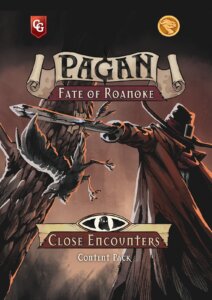
Pagan: Close Encounters
2022
Shift village sentiment with subtle influence in this 2022 content pack.
Medium Heavy
View expansion
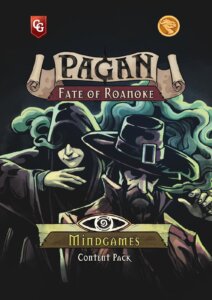
Pagan: Mindgames
2022
Add fresh twists, challenges, and mind games for both Hunter and Witch.
Medium Heavy
View expansion
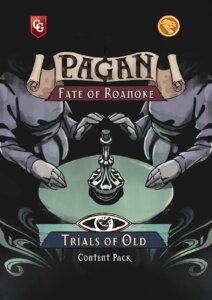
Pagan: Trials of Old
2022
A focused content pack of scrutiny, deception, and ritual acceleration
Medium Heavy
View expansion
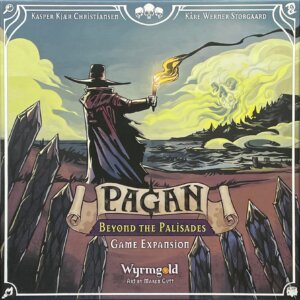
Pagan: Beyond the Palisades
2022
Bring Gloom and Cleanse mechanics to Pagan’s deadly Witch-versus-hunter duel.
75
minutes
Medium Heavy
View expansion