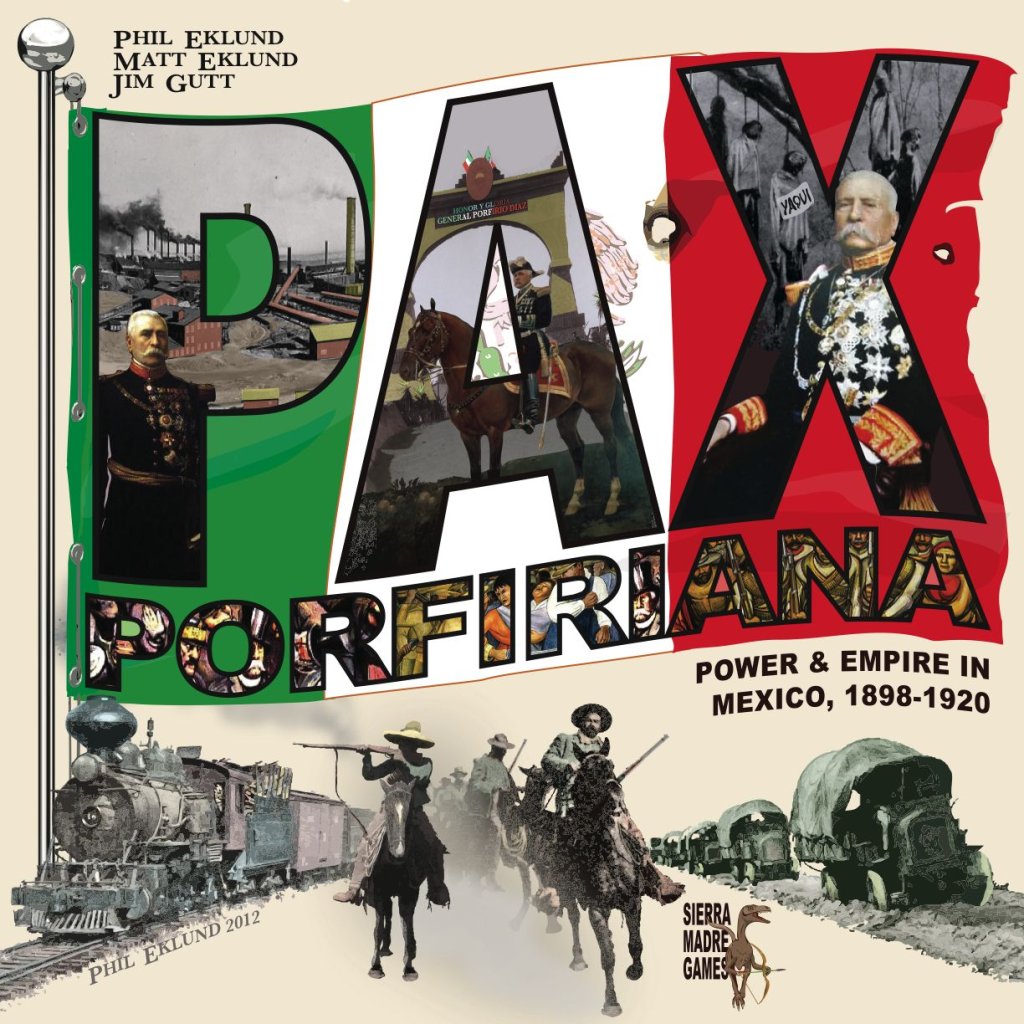
Pax Porfiriana
2012
Build ranches, mines, railways, banks, and troops while navigating revolutions, coups, lawsuits, and shifting governments.
120
minutes
1 - 6
player(s)
12+
Medium Heavy

About this board game
Pax Porfiriana is a strategic card game for 1–6 players, played in about 120 minutes, set in the turbulent pre-revolutionary borderlands of the United States and Mexico.
As a wealthy Hacendado, you compete to build a powerful business empire during Porfirio Díaz’s 33-year rule. Develop ranches, mines, railways, troops, and banks, while using bandidos, Native Americans, and lawsuits to undermine your opponents.
Each turn includes three actions. You can play cards, acquire cards from the market, speculate on market cards, buy land, or redeploy troops. Headlines that reach the leftmost market position are discarded, the market is restored to twelve cards, and then players collect income.
- Collect one gold for each Income, Extortion, and Connection Cube in play.
- During Depression, pay one gold for every card in play, including Partners, Enterprises in your Row, and all your Troops.
- Use the changing form of government to influence production values, including how much mines produce.
Four scoring cards, known as Topplings, determine their effects according to the current government. Troops and other cards can change that government, creating a shifting political landscape throughout the game.
Players win by toppling Díaz through a coup, succession, revolution, or the annexation of Mexico by the United States. If Díaz remains firmly seated, the player with the most gold wins instead.
Although Pax Porfiriana includes 220 cards, only fifty cards plus ten for each player are used in a game. That changing selection ensures that no two games will be the same.

Board Game Rules for
Pax Porfiriana
Pax Porfiriana Living Rules
Power and Empire in Mexico, 1898 – 1920
Based on Lords of the Sierra Madre
All Editions, Version Jul 3, 2016 – [email protected]
Copyright © 2015 Sierra Madre Games.
Introduction
Rules Summary by Paul-Michael Agapow and Martin Griffiths
Pax Porfiriana is Latin for “The Porfirian Peace”, the 33-year reign of dictator Porfirio Díaz, who ruled Mexico with an iron hand until toppled by the 1910 Revolution.
You are a Hacendado (rich businessman) in the pre-revolutionary borderlands of the U.S. and Mexico. Your aim is to accumulate sufficient backers and justification (Prestige) to seize power during one of the periodic regime changes (Topples). To do this, you will build a tableau of:
- Enterprises: businesses that earn income gold to spend on other efforts.
- Partners: allies with useful powers or influence.
- Troops: military forces that can extort gold from enterprises or protect them from extortion.
- You can also foment Unrest (to paralyze enterprises), perform Assassinations (neutralizing partners), and capitalize upon Headlines (external and random events).
Number of Players: This game is for 2 to 6 players, with a special solitaire variant in Part L and Part M.
Components
- 220 Cards: 1 Play Aid, 6 double-sided Hacendado Cards, 4 double-sided Regime Cards, 58 tan Enterprise Cards, 42 Partner Cards (including 2 Public Cards), 30 Troop Cards, 23 Black Cards, 23 Orange Cards, 29 yellow Headline Cards, 4 yellow Topple Cards.
- 1 Double-Sided Board: Pax Porfiriana side (slots for Market, Decks, Regimes, Public Cards, Discards).
- 60 Disks (Gold/Tokens): 35 white (1 gold), 15 red (5 gold / unrest), 10 blue (10 gold / jailed).
- 90 Cubes: 15 each in red, yellow, orange, green, white, and black (Income, Prestige, Connection, Extortion, Speculation).
Setup Instructions
- Separate the 13 double-sided cards (1 Play Aid, 6 Hacendados, 4 Regimes, 2 Public Cards).
- Build the Play Deck: remove the 4 Topple cards; count 50 cards + 10 per player; divide into 6 stacks; shuffle 1 Topple into 4 of the stacks; stack them with the 2 non-Topple stacks on top.
- Deal 12 cards face-up in two rows of 6 to form the Market (in 5–6 player games, draw market cards from unused cards).
- Place Public Cards (Church and Roosevelt) and Regimes in their spots, with “Pax Porfiriana” on top.
- Deal 1 Hacendado card to each player (loyalist side up).
- Each player takes 15 cubes of their color and places 2 on their Hacendado card as starting Income Cubes.
- Determine start player randomly. Player 1 receives 4 gold, player 2 receives 5 gold, player 3 receives 6 gold, etc.
Turn Structure
Each turn consists of four sequential phases:
- 1. Action Phase: Perform up to 3 actions (limited to 2 actions if in Jail).
- 2. Discard Headlines: Discard any Headlines in the 0-cost column into the Bull-Bear discard pile without effect. Check for Depression (two consecutive bears) or end of Depression (two consecutive bulls).
- 3. Restore Market: Slide market cards toward the 0-cost column and deal new cards from the draw deck to fill empty slots at the expensive end.
- 4. Income Phase: Collect 1 gold per active cube of your color in play (Income, Extortion, Connection). During a Depression, pay 1 gold per card in play (excluding Hacendado and Grudge Pile) or discard unpaid cards.
Deal-Making
Deal-making: Players may make any non-binding deals, but may never directly transfer cards or gold.
Available Actions
During the Action Phase, spend up to 3 actions choosing from:
- 1. Play Card Action: Pay card cost in gold.
- Orange Cards: target an enterprise, place Unrest, steal gold, and award to victim’s Grudge Pile.
- Black Cards: attack an opponent (costs 2 actions unless matching current Regime); victim receives prestige into Grudge Pile.
- Enterprises / Partners: placed into your tableau.
- Troops: played to an enterprise or flipped Hacendado; pay connection transport cost.
- 2. Buy Market Card Action: Pay column price (0, 1, 2, 4, 8, 16). Buying a second market card costs 2 actions. Hand limit is 5 cards. Headlines and Public Cards play immediately.
- 3. Buy Public Card Action: Buy Teddy Roosevelt or Catholic Church for listed price and play immediately to tableau.
- 4. Sell Card Action: Discard a card from hand or in-play to gain gold equal to the current Economy value.
- 5. Redeploy Troop Action: Move a troop to another enterprise within its jurisdiction (or redeploy in place for free to remove Unrest equal to Firepower).
- 6. Buy Land Action (2 Actions): Add 1 Income Cube to a ranch or plantation, paying gold equal to the current number of cubes on the card.
- 7. Upgrade Connection Action: Pay cost on an empty Connection oval to place a Connection Cube (+1 income, upgrades transport).
- 8. Police Action: Spend 3 gold (0 under Martial Law or if troops present) to remove 1 Unrest, or spend 3 gold to get out of Jail.
- 9. Speculation Action: Place a cube on any market card (except 4th Topple) to receive payment when bought, or manage cube limits.
Buying, Selling, and Speculating in the Market
- On your turn you have 3 actions. Buying a market card costs 1 action; buying a second market card costs 2 actions.
- The Market consists of two rows of six cards. Costs from front to back are 0, 1, 2, 4, 8, and 16 gold. Cards slide forward to fill cheaper slots, restocking at the expensive end.
- Selling a card from your hand to the discard pile earns gold equal to the Economy value of the current Regime.
- You can speculate on a market card by placing a cube of your color on it. If another player buys it, they pay you instead of the bank.
Enterprises
Running an Enterprise: Income and Buying Land
Enterprises are played into your tableau via the “Play Card” action by paying their gold cost. Types of enterprise income include:
- Fixed: income equals unmarked cubes shown.
- Improvable: cubes marked “start income”, can be upgraded via Buy Land.
- Economy: banks, income equals the Economy value of the current Regime.
- Mines: income equals the Mining value of the current Regime.
Extracting more gold:
- Buy Land (Improvable Enterprise): takes 2 actions, costs gold equal to cubes already on the card, adds 1 Income Cube.
- Improve Connection: pay the cost shown in a Connection oval (boot, burro, train, boat) to place a Connection Cube, providing +1 income and upgrading transport access for deploying troops.
Troops and Jurisdictions
Locations and Jurisdictions
Three Jurisdictions exist: Sonora, Chihuahua, and America (U.S.). Troops may only deploy to enterprises in their matching jurisdiction, and certain card effects target specific districts.
Playing and Redeploying Troops
- Troops require destination matching their Jurisdiction (Sonora, Chihuahua, America), unless Anarchy or Chain Railroad applies.
- Pay transport costs based on the connection used.
- Battle: An enterprise can hold only one troop. To displace an existing troop, the incoming troop must have strictly higher Firepower.
- Extortion: When played to an opponent’s enterprise, replace 1 income cube with an Extortion Cube of your color.
- Sacking: If an extorted enterprise loses all its income cubes, it is sacked and returned to the owner’s hand; the extorting troop retreats or discards.
- Private Army: Troops deployed to your flipped Hacendado must match its faction color.
Partners, Attacks, and Unrest
Partners and Killing Them
- Partners are played into your tableau for their gold cost, granting abilities or market discounts.
- Public Cards: Teddy Roosevelt and the Catholic Church sit outside the deck and are double-sided.
- Assassinations: Black cards used to eliminate partners. The victim receives the Prestige Point on the assassin into their Grudge Pile.
Ruining an Enterprise: Unrest
- Unrest (Red Disks): placed by certain cards, steals gold from the owner and neutralizes the enterprise (loses income and abilities).
- Removing Unrest: perform a Police Action (costs 3 gold, removes 1 Unrest; 0 gold under Martial Law) or deploy troops (removes Unrest equal to the troop’s Firepower).
The Straw Man Play
Players may deliberately target their own enterprises or partners with Orange or Black cards to gain the Victim-Awarded Prestige Points into their Grudge Pile (e.g., assassinating your own partner for Outrage, or inciting a strike on your own plantation for a Slave Revolt).
Earning Gold
- Collect 1 gold per cube in play during Phase 4 (Hacendado loyalist cubes, ranches, plantations, mines, banks, upgraded connections, extortions).
- Unrest deactivates an enterprise: no cubes on it earn gold.
- Pax Porfiriana Regime provides Prestige Cubes (+1 income each) on all Loyalty points.
- Other income sources: card sales, gun stores (+2 gold per orange card played), extortion, and monopolies.
The Four Regimes
- Pax Porfiriana (Mines = 2, Economy = 3): Topple Prestige is Loyalty (Díaz Retirement). Loyalty points get +1 Prestige Cube for income.
- U.S. Intervention (Mines = 3, Economy = 2): Topple Prestige is Outrage (U.S. Annexation). U.S. troops can enter Mexican districts ignoring jurisdiction.
- Martial Law (Mines = 2, Economy = 2): Topple Prestige is Command (Coup d’État). Police actions cost 0 gold.
- Anarchy (Mines = 1, Economy = 1): Topple Prestige is Revolution (Free Elections). All troops ignore jurisdiction restrictions.
- Regime Change: Triggered whenever a card with the swirl-arrow icon is played. Update Economy, Mine values, and cubes immediately.
The Economy and Depressions
- Bank earnings and card sell values equal Economy; mine earnings equal Mine Value.
- Depression: Triggered when two bear cards appear consecutively in the Bull-Bear discard pile. Mine and Economy values drop to 0, and players must pay 1 gold per tableau card during the income phase or discard it. Mines and Banks produce 0 income, and all their Income and Extortion cubes are removed (causing extorted enterprises to be sacked).
- Ending a Depression: Ended immediately when two bull cards are discarded consecutively.
Headlines, Factions, and Strife
- Headlines are played immediately upon purchase as a single action, choosing either “Event” or “Status Quo” orientation.
- If a Headline reaches the 0-cost column, it is discarded without effect during the Discard Headlines phase.
- The four Factions are: Blue (U.S.), Green (Mexican Federal), White (Mexican Local), and Red (Rebel).
- Strife: forces players who possess cards in both fighting factions to discard all cards of one of those factions.
Winning the Game
Winning the Game During a Topple
To win, accumulate enough Loyalty, Outrage, Command, or Revolution points to topple Díaz, either by succession, Mexican annexation, coup, or popular revolt. If Díaz remains firmly seated at the fourth and final Topple, the player with the most gold disks wins.
- During a Topple, only one of the four Prestige Points counts for victory, determined by the current Regime Card.
- Extra Prestige can be gained by flipping your Hacendado to declare allegiance to one of two causes on the card back (permanent once flipped).
Toppling Díaz for the Win
When a Topple card is purchased, the game pauses immediately for a Toppling Showdown:
- 1. Orientation: Purchaser chooses “Event” (triggers Achilles Heel penalty to Díaz) or “Status Quo”.
- 2. Topple Showdown: In clockwise order starting left of purchaser, each player may:
- Issue Manifesto: Flip unflipped Hacendado to gain its Prestige Point.
- Election Fraud: Discard “During Toppling” cards (e.g., Spies) to modify Díaz’s defense for all players.
- Player Assassination: Spend 3 gold (+3 per troop in Private Army) and an Assassination card to assassinate a flipped Hacendado, returning them to their loyalist side.
- 3. Toppling Success: Each player compares their relevant Prestige points against their Tripartite (Díaz base defense of 2 points, plus the two opponents with the lowest score in that Prestige). To win, your Prestige must strictly exceed your Tripartite total.
- 4. Victory: If multiple players qualify, the one with the most gold wins (Gold Victory). If no player topples Díaz by the 4th Topple, the wealthiest player wins.
Solitaire Variants
Solitaire Variant (vs. Díaz)
Play against automated Díaz using 2 dice rolls per turn to determine market purchases across both rows. Díaz starts with 6 Outrage and 4 in all other Prestige points.
The Pax-o-matic (Diceless 3P Solo by Colin Taylor)
Automated flowchart robot simulating two AI opponents against one human player, executing priority rules for removals, purchases, topples, and military deployments.
Strategic Approaches to Victory
- The Loyalist: Accumulate Loyalty via enterprises and partners under Pax Porfiriana; lucrative economy easily transitions to Gold Victory.
- The Revolutionary: Foster Anarchy and Slave Revolts on Sonoran plantations; utilize Straw Man attacks to gain Revolution prestige.
- The Commander: Dominate military forces, stockpile Command points, and initiate a Coup d’État under Martial Law.
- The Yankee: Trigger U.S. Intervention and pile up Outrage points through victim-awards and manufactured crises.
- The Entrepreneur: Accumulate pure wealth, sabotage Topple attempts via spies and courts, and force a Gold Victory on the 4th Topple.
Glossary of Key Terms
- Actions: Normally 3 per turn; reduced to 2 when Jailed.
- Assassination: Black card used to kill partners or flipped Hacendados; awarded to victim’s Grudge pile.
- Chain Railroad: Allows building connections on any card for 1 gold and lifts jurisdiction limits on Federal troops.
- Command Point: White oval icon representing military force for Coup d’État victories.
- Depression: Economic crash caused by two bear cards in discard; renders mines and banks worthless.
- Extortion: Troop deployed to enemy business diverting 1 income cube to its owner.
- Firepower: Troop combat strength (1 = bow, 2 = rifle, 3 = machine gun). Machine guns cannot be defeated.
- Grudge Pile: Collection of victim-awarded cards providing active Prestige points.
- Jailed: Penalty from certain attacks; reduces actions to 2 until cleared via Police action or immunity.
- Loyalty Point: Green oval icon; relevant for succession under Pax Porfiriana.
- Outrage Point: Blue oval icon; relevant for annexation under U.S. Intervention.
- Revolution Point: Red oval icon; relevant for popular elections under Anarchy.
- Sack: An extorted enterprise losing all income cubes returns to owner’s hand.
- Slave Revolt: Triggered on Yaqui slave plantations when Unrest exceeds cubes; grants Revolution point to liberator.
- Strife: Conflict between two faction colors forcing players to discard all cards of one color.
- Tripartite: The defensive threshold to beat during a Topple (Díaz + lowest two opponents).
Historical Context
Explores the socio-economic dynamics of Porfirian Mexico from 1898 to 1920, examining the tension between “Makers vs. Takers”, land privatization and municipal laws, the exploitation of Yaqui labor, the rise of the Creel-Terrazas oligarchies, rail subsidies, and the ideological factions that ignited the Mexican Revolution.
Game Credits
- Original Design & Cover: Phil Eklund
- Card Version: Jim Gutt and Matt Eklund
- Rules Summary & Analysis: Paul-Michael Agapow, Martin Griffiths, Pablo Klinkisch, Allan Rothberg
- Solitaire Design: Colin Taylor
- Copyright: © 2015 Sierra Madre Games
Game Overview & Components
Pax Porfiriana Living Rules
Power and Empire in Mexico, 1898 – 1920
Based on Lords of the Sierra Madre
All Editions, Version Jul 3, 2016 – [email protected]
Copyright © 2015 Sierra Madre Games.
Introduction
Rules Summary by Paul-Michael Agapow and Martin Griffiths
Pax Porfiriana is Latin for “The Porfirian Peace”, the 33-year reign of dictator Porfirio Díaz, who ruled Mexico with an iron hand until toppled by the 1910 Revolution.
You are a Hacendado (rich businessman) in the pre-revolutionary borderlands of the U.S. and Mexico. Your aim is to accumulate sufficient backers and justification (Prestige) to seize power during one of the periodic regime changes (Topples). To do this, you will build a tableau of:
- Enterprises: businesses that earn income gold to spend on other efforts.
- Partners: allies with useful powers or influence.
- Troops: military forces that can extort gold from enterprises or protect them from extortion.
- You can also foment Unrest (to paralyze enterprises), perform Assassinations (neutralizing partners), and capitalize upon Headlines (external and random events).
Number of Players: This game is for 2 to 6 players, with a special solitaire variant in Part L and Part M.
Components
- 220 Cards: 1 Play Aid, 6 double-sided Hacendado Cards, 4 double-sided Regime Cards, 58 tan Enterprise Cards, 42 Partner Cards (including 2 Public Cards), 30 Troop Cards, 23 Black Cards, 23 Orange Cards, 29 yellow Headline Cards, 4 yellow Topple Cards.
- 1 Double-Sided Board: Pax Porfiriana side (slots for Market, Decks, Regimes, Public Cards, Discards).
- 60 Disks (Gold/Tokens): 35 white (1 gold), 15 red (5 gold / unrest), 10 blue (10 gold / jailed).
- 90 Cubes: 15 each in red, yellow, orange, green, white, and black (Income, Prestige, Connection, Extortion, Speculation).
Setup
Setup Instructions
- Separate the 13 double-sided cards (1 Play Aid, 6 Hacendados, 4 Regimes, 2 Public Cards).
- Build the Play Deck: remove the 4 Topple cards; count 50 cards + 10 per player; divide into 6 stacks; shuffle 1 Topple into 4 of the stacks; stack them with the 2 non-Topple stacks on top.
- Deal 12 cards face-up in two rows of 6 to form the Market (in 5–6 player games, draw market cards from unused cards).
- Place Public Cards (Church and Roosevelt) and Regimes in their spots, with “Pax Porfiriana” on top.
- Deal 1 Hacendado card to each player (loyalist side up).
- Each player takes 15 cubes of their color and places 2 on their Hacendado card as starting Income Cubes.
- Determine start player randomly. Player 1 receives 4 gold, player 2 receives 5 gold, player 3 receives 6 gold, etc.
Sequence of Play
Turn Structure
Each turn consists of four sequential phases:
- 1. Action Phase: Perform up to 3 actions (limited to 2 actions if in Jail).
- 2. Discard Headlines: Discard any Headlines in the 0-cost column into the Bull-Bear discard pile without effect. Check for Depression (two consecutive bears) or end of Depression (two consecutive bulls).
- 3. Restore Market: Slide market cards toward the 0-cost column and deal new cards from the draw deck to fill empty slots at the expensive end.
- 4. Income Phase: Collect 1 gold per active cube of your color in play (Income, Extortion, Connection). During a Depression, pay 1 gold per card in play (excluding Hacendado and Grudge Pile) or discard unpaid cards.
Deal-Making
Deal-making: Players may make any non-binding deals, but may never directly transfer cards or gold.
Actions
Available Actions
During the Action Phase, spend up to 3 actions choosing from:
- 1. Play Card Action: Pay card cost in gold.
- Orange Cards: target an enterprise, place Unrest, steal gold, and award to victim’s Grudge Pile.
- Black Cards: attack an opponent (costs 2 actions unless matching current Regime); victim receives prestige into Grudge Pile.
- Enterprises / Partners: placed into your tableau.
- Troops: played to an enterprise or flipped Hacendado; pay connection transport cost.
- 2. Buy Market Card Action: Pay column price (0, 1, 2, 4, 8, 16). Buying a second market card costs 2 actions. Hand limit is 5 cards. Headlines and Public Cards play immediately.
- 3. Buy Public Card Action: Buy Teddy Roosevelt or Catholic Church for listed price and play immediately to tableau.
- 4. Sell Card Action: Discard a card from hand or in-play to gain gold equal to the current Economy value.
- 5. Redeploy Troop Action: Move a troop to another enterprise within its jurisdiction (or redeploy in place for free to remove Unrest equal to Firepower).
- 6. Buy Land Action (2 Actions): Add 1 Income Cube to a ranch or plantation, paying gold equal to the current number of cubes on the card.
- 7. Upgrade Connection Action: Pay cost on an empty Connection oval to place a Connection Cube (+1 income, upgrades transport).
- 8. Police Action: Spend 3 gold (0 under Martial Law or if troops present) to remove 1 Unrest, or spend 3 gold to get out of Jail.
- 9. Speculation Action: Place a cube on any market card (except 4th Topple) to receive payment when bought, or manage cube limits.
Buying, Selling, and Speculating in the Market
- On your turn you have 3 actions. Buying a market card costs 1 action; buying a second market card costs 2 actions.
- The Market consists of two rows of six cards. Costs from front to back are 0, 1, 2, 4, 8, and 16 gold. Cards slide forward to fill cheaper slots, restocking at the expensive end.
- Selling a card from your hand to the discard pile earns gold equal to the Economy value of the current Regime.
- You can speculate on a market card by placing a cube of your color on it. If another player buys it, they pay you instead of the bank.
Enterprises, Troops, and Operations
Enterprises
Running an Enterprise: Income and Buying Land
Enterprises are played into your tableau via the “Play Card” action by paying their gold cost. Types of enterprise income include:
- Fixed: income equals unmarked cubes shown.
- Improvable: cubes marked “start income”, can be upgraded via Buy Land.
- Economy: banks, income equals the Economy value of the current Regime.
- Mines: income equals the Mining value of the current Regime.
Extracting more gold:
- Buy Land (Improvable Enterprise): takes 2 actions, costs gold equal to cubes already on the card, adds 1 Income Cube.
- Improve Connection: pay the cost shown in a Connection oval (boot, burro, train, boat) to place a Connection Cube, providing +1 income and upgrading transport access for deploying troops.
Troops and Jurisdictions
Locations and Jurisdictions
Three Jurisdictions exist: Sonora, Chihuahua, and America (U.S.). Troops may only deploy to enterprises in their matching jurisdiction, and certain card effects target specific districts.
Playing and Redeploying Troops
- Troops require destination matching their Jurisdiction (Sonora, Chihuahua, America), unless Anarchy or Chain Railroad applies.
- Pay transport costs based on the connection used.
- Battle: An enterprise can hold only one troop. To displace an existing troop, the incoming troop must have strictly higher Firepower.
- Extortion: When played to an opponent’s enterprise, replace 1 income cube with an Extortion Cube of your color.
- Sacking: If an extorted enterprise loses all its income cubes, it is sacked and returned to the owner’s hand; the extorting troop retreats or discards.
- Private Army: Troops deployed to your flipped Hacendado must match its faction color.
Partners, Attacks, and Unrest
Partners and Killing Them
- Partners are played into your tableau for their gold cost, granting abilities or market discounts.
- Public Cards: Teddy Roosevelt and the Catholic Church sit outside the deck and are double-sided.
- Assassinations: Black cards used to eliminate partners. The victim receives the Prestige Point on the assassin into their Grudge Pile.
Ruining an Enterprise: Unrest
- Unrest (Red Disks): placed by certain cards, steals gold from the owner and neutralizes the enterprise (loses income and abilities).
- Removing Unrest: perform a Police Action (costs 3 gold, removes 1 Unrest; 0 gold under Martial Law) or deploy troops (removes Unrest equal to the troop’s Firepower).
The Straw Man Play
Players may deliberately target their own enterprises or partners with Orange or Black cards to gain the Victim-Awarded Prestige Points into their Grudge Pile (e.g., assassinating your own partner for Outrage, or inciting a strike on your own plantation for a Slave Revolt).
Economy, Regimes, and Events
Earning Gold
- Collect 1 gold per cube in play during Phase 4 (Hacendado loyalist cubes, ranches, plantations, mines, banks, upgraded connections, extortions).
- Unrest deactivates an enterprise: no cubes on it earn gold.
- Pax Porfiriana Regime provides Prestige Cubes (+1 income each) on all Loyalty points.
- Other income sources: card sales, gun stores (+2 gold per orange card played), extortion, and monopolies.
The Four Regimes
- Pax Porfiriana (Mines = 2, Economy = 3): Topple Prestige is Loyalty (Díaz Retirement). Loyalty points get +1 Prestige Cube for income.
- U.S. Intervention (Mines = 3, Economy = 2): Topple Prestige is Outrage (U.S. Annexation). U.S. troops can enter Mexican districts ignoring jurisdiction.
- Martial Law (Mines = 2, Economy = 2): Topple Prestige is Command (Coup d’État). Police actions cost 0 gold.
- Anarchy (Mines = 1, Economy = 1): Topple Prestige is Revolution (Free Elections). All troops ignore jurisdiction restrictions.
- Regime Change: Triggered whenever a card with the swirl-arrow icon is played. Update Economy, Mine values, and cubes immediately.
The Economy and Depressions
- Bank earnings and card sell values equal Economy; mine earnings equal Mine Value.
- Depression: Triggered when two bear cards appear consecutively in the Bull-Bear discard pile. Mine and Economy values drop to 0, and players must pay 1 gold per tableau card during the income phase or discard it. Mines and Banks produce 0 income, and all their Income and Extortion cubes are removed (causing extorted enterprises to be sacked).
- Ending a Depression: Ended immediately when two bull cards are discarded consecutively.
Headlines, Factions, and Strife
- Headlines are played immediately upon purchase as a single action, choosing either “Event” or “Status Quo” orientation.
- If a Headline reaches the 0-cost column, it is discarded without effect during the Discard Headlines phase.
- The four Factions are: Blue (U.S.), Green (Mexican Federal), White (Mexican Local), and Red (Rebel).
- Strife: forces players who possess cards in both fighting factions to discard all cards of one of those factions.
Toppling Díaz & Victory Conditions
Winning the Game
Winning the Game During a Topple
To win, accumulate enough Loyalty, Outrage, Command, or Revolution points to topple Díaz, either by succession, Mexican annexation, coup, or popular revolt. If Díaz remains firmly seated at the fourth and final Topple, the player with the most gold disks wins.
- During a Topple, only one of the four Prestige Points counts for victory, determined by the current Regime Card.
- Extra Prestige can be gained by flipping your Hacendado to declare allegiance to one of two causes on the card back (permanent once flipped).
Toppling Díaz for the Win
When a Topple card is purchased, the game pauses immediately for a Toppling Showdown:
- 1. Orientation: Purchaser chooses “Event” (triggers Achilles Heel penalty to Díaz) or “Status Quo”.
- 2. Topple Showdown: In clockwise order starting left of purchaser, each player may:
- Issue Manifesto: Flip unflipped Hacendado to gain its Prestige Point.
- Election Fraud: Discard “During Toppling” cards (e.g., Spies) to modify Díaz’s defense for all players.
- Player Assassination: Spend 3 gold (+3 per troop in Private Army) and an Assassination card to assassinate a flipped Hacendado, returning them to their loyalist side.
- 3. Toppling Success: Each player compares their relevant Prestige points against their Tripartite (Díaz base defense of 2 points, plus the two opponents with the lowest score in that Prestige). To win, your Prestige must strictly exceed your Tripartite total.
- 4. Victory: If multiple players qualify, the one with the most gold wins (Gold Victory). If no player topples Díaz by the 4th Topple, the wealthiest player wins.
Solitaire Variants & Strategy
Solitaire Variants
Solitaire Variant (vs. Díaz)
Play against automated Díaz using 2 dice rolls per turn to determine market purchases across both rows. Díaz starts with 6 Outrage and 4 in all other Prestige points.
The Pax-o-matic (Diceless 3P Solo by Colin Taylor)
Automated flowchart robot simulating two AI opponents against one human player, executing priority rules for removals, purchases, topples, and military deployments.
Strategic Approaches to Victory
- The Loyalist: Accumulate Loyalty via enterprises and partners under Pax Porfiriana; lucrative economy easily transitions to Gold Victory.
- The Revolutionary: Foster Anarchy and Slave Revolts on Sonoran plantations; utilize Straw Man attacks to gain Revolution prestige.
- The Commander: Dominate military forces, stockpile Command points, and initiate a Coup d’État under Martial Law.
- The Yankee: Trigger U.S. Intervention and pile up Outrage points through victim-awards and manufactured crises.
- The Entrepreneur: Accumulate pure wealth, sabotage Topple attempts via spies and courts, and force a Gold Victory on the 4th Topple.
Glossary, History & Credits
Glossary of Key Terms
- Actions: Normally 3 per turn; reduced to 2 when Jailed.
- Assassination: Black card used to kill partners or flipped Hacendados; awarded to victim’s Grudge pile.
- Chain Railroad: Allows building connections on any card for 1 gold and lifts jurisdiction limits on Federal troops.
- Command Point: White oval icon representing military force for Coup d’État victories.
- Depression: Economic crash caused by two bear cards in discard; renders mines and banks worthless.
- Extortion: Troop deployed to enemy business diverting 1 income cube to its owner.
- Firepower: Troop combat strength (1 = bow, 2 = rifle, 3 = machine gun). Machine guns cannot be defeated.
- Grudge Pile: Collection of victim-awarded cards providing active Prestige points.
- Jailed: Penalty from certain attacks; reduces actions to 2 until cleared via Police action or immunity.
- Loyalty Point: Green oval icon; relevant for succession under Pax Porfiriana.
- Outrage Point: Blue oval icon; relevant for annexation under U.S. Intervention.
- Revolution Point: Red oval icon; relevant for popular elections under Anarchy.
- Sack: An extorted enterprise losing all income cubes returns to owner’s hand.
- Slave Revolt: Triggered on Yaqui slave plantations when Unrest exceeds cubes; grants Revolution point to liberator.
- Strife: Conflict between two faction colors forcing players to discard all cards of one color.
- Tripartite: The defensive threshold to beat during a Topple (Díaz + lowest two opponents).
Historical Context
Explores the socio-economic dynamics of Porfirian Mexico from 1898 to 1920, examining the tension between “Makers vs. Takers”, land privatization and municipal laws, the exploitation of Yaqui labor, the rise of the Creel-Terrazas oligarchies, rail subsidies, and the ideological factions that ignited the Mexican Revolution.
Game Credits
- Original Design & Cover: Phil Eklund
- Card Version: Jim Gutt and Matt Eklund
- Rules Summary & Analysis: Paul-Michael Agapow, Martin Griffiths, Pablo Klinkisch, Allan Rothberg
- Solitaire Design: Colin Taylor
- Copyright: © 2015 Sierra Madre Games