
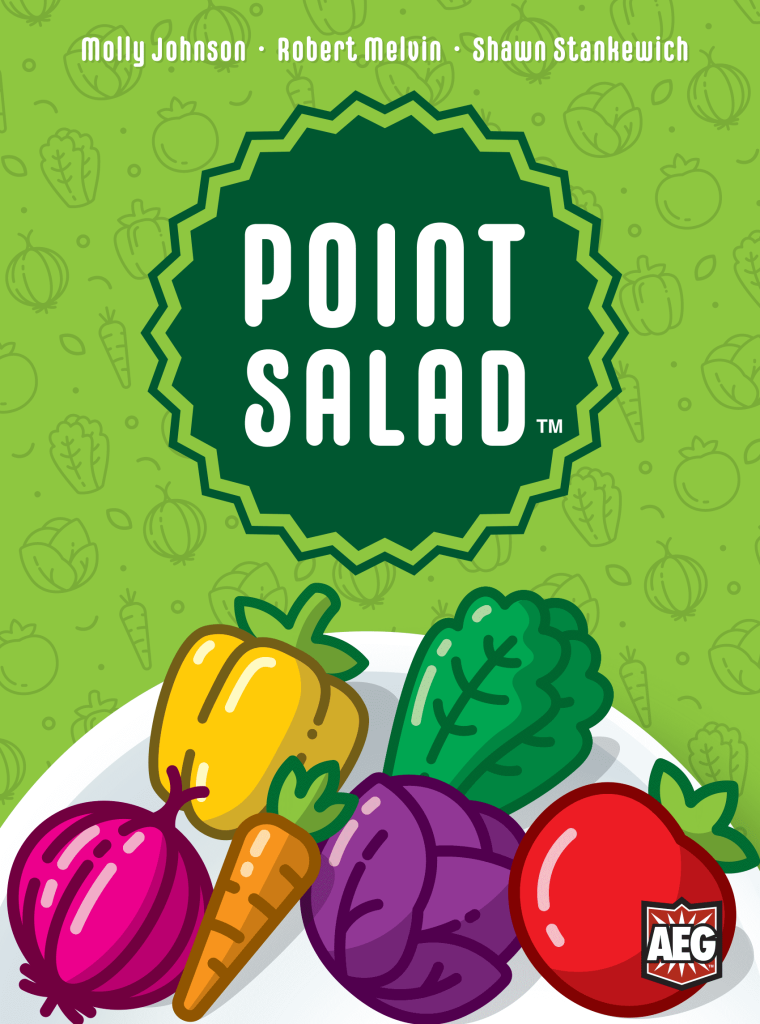
Point Salad
2019
Draft colorful vegetable cards and clever scoring methods, choosing combinations that help your strategy thrive in every unique game.
30
minutes
2 - 6
player(s)
10+
Light

About this board game
Point Salad is a fast card-drafting game for 2–6 players that plays in about 30 minutes. Designed for the whole family, it offers more than 100 ways to score points, making every game a fresh strategic challenge.
The game features cards in six different types of vegetables. Each card has a vegetable on one side and a scoring method on the other, giving players meaningful choices as they build their collection.
On your turn, draft combinations of vegetable cards and point cards that support your chosen strategy. A scoring method might award 2 points for every carrot you have while deducting 1 point for every onion, so the cards you select can work together—or create difficult trade-offs.
- 2–6 players
- Approximately 30 minutes per game
- Six types of vegetables
- Over 100 scoring methods
Because players can pursue a variety of scoring strategies, no two games need to unfold the same way. The best approach depends on the scoring cards available and the vegetable combinations you manage to draft.
First released in 2019, Point Salad combines accessible family gameplay with plenty of room for tactical decisions. Gather the right vegetables, make your scoring cards work together, and aim to amass the most points.
Thematic
Illustrator


Board Game Rules for
Point Salad
Overview
Point Salad is a card-drafting and tableau-building game for 2–6 players. Players take turns building a salad of veggies and collecting point cards in order to score the most points for the ingredients in their salad!
Components
- 108 double-sided veggie/point cards
- 1 Rulebook
Double-sided cards feature 18 each of 6 different veggies with 108 unique scoring conditions on their point card backs.

Game Setup
- Based on the number of players, count out or remove the following number of each of the 6 veggie cards from the game (without looking at the point card backs):
- 2 Players: Count out 6 of each veggie (36 total)
- 3 Players: Count out 9 of each veggie (54 total)
- 4 Players: Remove 6 of each veggie (72 total)
- 5 Players: Remove 3 of each veggie (90 total)
- 6 Players: Use the entire deck
Place any removed cards back inside the box so that players do not see which point cards have been removed.
- Shuffle all remaining cards and create three roughly equal draw piles with point card sides face up.
- Flip over two cards from each draw pile and place them in a column below the pile. This creates a veggie market below the piles (see page 5).
- Randomly choose a start player.

Note: Since Point Salad is so quick-playing, you may decide to play multiple rounds! You may keep track of scores over multiple rounds and declare a winner at the end. For 2 players, we suggest splitting the deck into 3 equal rounds of 36 cards each (see above), or for 3 players, 2 equal rounds of 54 cards each. This will allow you to use the full deck through multiple rounds and spend less time sorting the cards!
Drafting Cards
On your turn you draft one or more cards. You may draft either:
- (1) one point card from the top of any of the draw piles, or
- (2) two veggie cards from those available in the market.
After you select your card(s), add them to a face-up tableau in front of yourself, then your turn is complete.
Optional Free Action
Optional free action: Once per turn, you may choose to flip over any one of your point cards (either drafted this turn, or on a previous turn) and turn it into a veggie card (but you cannot flip a veggie card into a point card).
Note: The veggie type is indicated in the corners of the card.
Turn End & Market Refill
Once you have drafted your card(s), refill the veggie market by drawing cards from corresponding draw piles in each column, filling any empty slots. Flip the cards over from the point side to the veggie side as they enter the market. If one of the draw piles of point cards runs out, split the largest pile roughly in half, and move the bottom half to replace the empty pile (ensuring the point card on top of the largest pile does not move). Once the market refill has been completed, play continues with the next player to the left.

Game End
The game ends when all cards from both the point card piles and veggie market have been drafted. The player with the most points is the winner.
Scoring Rules
Players tabulate their victory points by counting how many points each of their own point cards are worth and adding these scores together to obtain their final score. If two players are tied in total victory points, then the player who played later in the turn order is the winner. When tabulating a point card, a player’s full tableau of veggie cards are considered for each point card, meaning that each veggie card is used to score each point card. Players may score a point card multiple times, and they may also use the same veggie card to score multiple point cards. If two players are tied for a scoring condition on a card (e.g., most onions), then the player with the point card scores the victory points.
Scoring Example

Note: Veggies that do not match scoring conditions on point cards are not scored (e.g., cabbage).
- 8 points for each combination of tomato, lettuce, and carrot: 8pts × 2 = 16pts
- 5 points for each pair of carrots: 5pts × 2 = 10pts
- 3 points for each carrot, -2 points for each onion: (3pts × 5) + (-2pts × 3) = 9pts
- 10 points for having the most (or tied for the most) onions of all players: if it is the most = 10pts
- 5 points per veggie type with at least 3: 5pts × 3 = 15pts
TOTAL SCORE = 16 + 10 + 9 + 10 + 15 = 60 pts
A game for 2 to 6 players, ages 14+ by Flatout Games
Credits
- Game Design: Shawn Stankewich, Molly Johnson and Robert Melvin
- Director of Projects: Nicolas Bongiu
- Production: Dave Lepore
- Development Lead: Todd Rowland
- Creative Direction: Shawn Stankewich, Molly Johnson and Robert Melvin
- Graphic Design: Dylan Mangini and Flatout Games
- Editing: Todd Rowland, Edward Bolme
Special Thanks
Nicolas Bongiu, Joseph Chen, John D Clair, Ryan Dancey, Alastair Hulme, Fiona Hulme, Paul Hulme, Chad Martinell, Jan Martinell, Lee Nicol, Vladimir Orellana, Sarah Reed, Will Reed, Kathy Rowland, Seattle Tabletop Designers, Josh Wood and John Zinser
© 2019 Alderac Entertainment Group.
Point Salad and all related marks are ™ and © Alderac Entertainment Group, Inc.
555 N El Camino Real #A393, San Clemente, CA 92672 USA.
All rights reserved. Printed in China.
Warning: Choking Hazard! Not for use by children under 3 years of age.
Overview & Components
Overview
Point Salad is a card-drafting and tableau-building game for 2–6 players. Players take turns building a salad of veggies and collecting point cards in order to score the most points for the ingredients in their salad!
Components
- 108 double-sided veggie/point cards
- 1 Rulebook
Double-sided cards feature 18 each of 6 different veggies with 108 unique scoring conditions on their point card backs.
Setup
Game Setup
- Based on the number of players, count out or remove the following number of each of the 6 veggie cards from the game (without looking at the point card backs):
- 2 Players: Count out 6 of each veggie (36 total)
- 3 Players: Count out 9 of each veggie (54 total)
- 4 Players: Remove 6 of each veggie (72 total)
- 5 Players: Remove 3 of each veggie (90 total)
- 6 Players: Use the entire deck
Place any removed cards back inside the box so that players do not see which point cards have been removed.
- Shuffle all remaining cards and create three roughly equal draw piles with point card sides face up.
- Flip over two cards from each draw pile and place them in a column below the pile. This creates a veggie market below the piles (see page 5).
- Randomly choose a start player.
Note: Since Point Salad is so quick-playing, you may decide to play multiple rounds! You may keep track of scores over multiple rounds and declare a winner at the end. For 2 players, we suggest splitting the deck into 3 equal rounds of 36 cards each (see above), or for 3 players, 2 equal rounds of 54 cards each. This will allow you to use the full deck through multiple rounds and spend less time sorting the cards!
How to Play
Drafting Cards
On your turn you draft one or more cards. You may draft either:
- (1) one point card from the top of any of the draw piles, or
- (2) two veggie cards from those available in the market.
After you select your card(s), add them to a face-up tableau in front of yourself, then your turn is complete.
Optional Free Action
Optional free action: Once per turn, you may choose to flip over any one of your point cards (either drafted this turn, or on a previous turn) and turn it into a veggie card (but you cannot flip a veggie card into a point card).
Note: The veggie type is indicated in the corners of the card.
Turn End & Market Refill
Once you have drafted your card(s), refill the veggie market by drawing cards from corresponding draw piles in each column, filling any empty slots. Flip the cards over from the point side to the veggie side as they enter the market. If one of the draw piles of point cards runs out, split the largest pile roughly in half, and move the bottom half to replace the empty pile (ensuring the point card on top of the largest pile does not move). Once the market refill has been completed, play continues with the next player to the left.
End of Game & Scoring
Game End
The game ends when all cards from both the point card piles and veggie market have been drafted. The player with the most points is the winner.
Scoring Rules
Players tabulate their victory points by counting how many points each of their own point cards are worth and adding these scores together to obtain their final score. If two players are tied in total victory points, then the player who played later in the turn order is the winner. When tabulating a point card, a player’s full tableau of veggie cards are considered for each point card, meaning that each veggie card is used to score each point card. Players may score a point card multiple times, and they may also use the same veggie card to score multiple point cards. If two players are tied for a scoring condition on a card (e.g., most onions), then the player with the point card scores the victory points.
Scoring Example
Note: Veggies that do not match scoring conditions on point cards are not scored (e.g., cabbage).
- 8 points for each combination of tomato, lettuce, and carrot: 8pts × 2 = 16pts
- 5 points for each pair of carrots: 5pts × 2 = 10pts
- 3 points for each carrot, -2 points for each onion: (3pts × 5) + (-2pts × 3) = 9pts
- 10 points for having the most (or tied for the most) onions of all players: if it is the most = 10pts
- 5 points per veggie type with at least 3: 5pts × 3 = 15pts
TOTAL SCORE = 16 + 10 + 9 + 10 + 15 = 60 pts
Credits
A game for 2 to 6 players, ages 14+ by Flatout Games
Credits
- Game Design: Shawn Stankewich, Molly Johnson and Robert Melvin
- Director of Projects: Nicolas Bongiu
- Production: Dave Lepore
- Development Lead: Todd Rowland
- Creative Direction: Shawn Stankewich, Molly Johnson and Robert Melvin
- Graphic Design: Dylan Mangini and Flatout Games
- Editing: Todd Rowland, Edward Bolme
Special Thanks
Nicolas Bongiu, Joseph Chen, John D Clair, Ryan Dancey, Alastair Hulme, Fiona Hulme, Paul Hulme, Chad Martinell, Jan Martinell, Lee Nicol, Vladimir Orellana, Sarah Reed, Will Reed, Kathy Rowland, Seattle Tabletop Designers, Josh Wood and John Zinser
© 2019 Alderac Entertainment Group.
Point Salad and all related marks are ™ and © Alderac Entertainment Group, Inc.
555 N El Camino Real #A393, San Clemente, CA 92672 USA.
All rights reserved. Printed in China.
Warning: Choking Hazard! Not for use by children under 3 years of age.