
The Climbers
2008
Move and rotate colorful blocks, use ladders, and block key routes as you race to reach the highest level.
45
minutes
2 - 5
player(s)
8+
Medium Light

About this board game
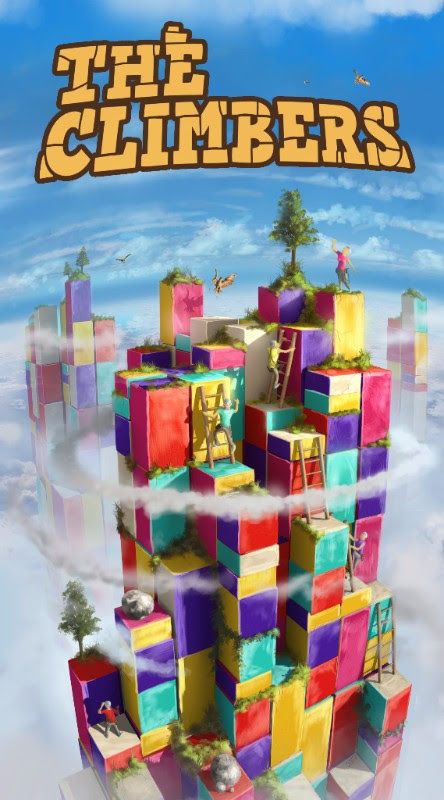
The Climbers is a board game for 2–5 players with a playing time of approximately 45 minutes. Released in 2008, it challenges players to climb a large structure of colorful blocks and reach the highest level possible.
Every move can change the shape of the climb. Players may move and rotate blocks to help create a path upward, but getting to the top is more difficult than it first appears. Only one climber will ultimately make it to the highest point.
Ladders provide a way to cover large distances during the ascent. They can help a climber rise quickly, making them an important tool when planning how to reach the upper levels of the structure.
- Climb a structure made from colorful blocks.
- Move and rotate blocks to support your ascent.
- Use ladders to climb large distances.
- Place your blocking disk to prevent other players from using a specific block.
The blocking disk adds another way to affect the climb. By preventing other players from using a particular block, it can interfere with their route and make the available paths more challenging.
Success in The Climbers depends on using your tools wisely and at the right time. Decide when to change the structure, when to use a ladder, and when to block a key position as you compete to be the climber who reaches the top.

Board Game Rules for
The Climbers
The Climbers gaze at the enormous mountain of colorful blocks towering before them. The goal is simple: climb to the highest level they can. However, getting there looks to be more challenging than originally thought. Only one Climber will come out on top. Will it be you?
Your goal is to be at a higher level than all other Climbers at the end of the game. As you climb, you may move and rotate blocks. Ladders help you scale large distances. Blocking disks prevent others from using a specific block. Use your tools wisely—and at the right time—to make the best possible moves in your climb towards victory!
Components
- 35 blocks:
- 12 Size 1 blocks – half-cubes
- 12 Size 2 blocks – cubes
- 9 Size 4 blocks – double cubes
- 2 large neutral blocks – triple cubes
All blocks except the 2 neutral blocks have the following colors on opposing sides:
- Teal / Purple
- Yellow / Red
- Pink / Neutral
- 5 Climbers (1 in each player color)
- 5 blocking disks (1 in each player color)
- 5 short ladders
- 5 tall ladders

Preparation
- Place the 2 large neutral blocks vertically next to each other in the middle of the table.

- Place all of the remaining blocks around the two neutral ones so that both neutral blocks are completely hidden. Blocks may be placed in any direction, but the bottom side of each block must have full contact with the block(s) underneath. There cannot be any holes or overhanging blocks.
All players should join together in building the structure! We recommend placing the larger blocks closer to the bottom and the smaller blocks towards the top.

- Each player chooses a Climber and takes one short ladder, one tall ladder, and the corresponding blocking disk. Return all remaining Climbers, blocking disks, and ladders to the box.

- Place all Climbers on the table near the structure.

- The player who most recently climbed a mountain goes first. Otherwise, randomly determine the starting player.
Beginning with the starting player and continuing clockwise, players take turns moving their Climbers if possible, moving and/or rotating one block if desired, and utilizing ladders or blocking disks to reach the top.
Player Turn Sequence
- You may optionally move your Climber across and/or up the structure as far as legally possible.
- You may optionally move and/or rotate an unoccupied, free block.
- You may optionally move your Climber across and/or up the structure as far as legally possible again.
- You may optionally place your blocking disk on an unoccupied block.
- In turn order and beginning to the left of the active player, each player may optionally move their Climber across and/or up the structure as far as legally possible.
- Play passes to the left.
Moving Your Climber
When moving, you may move across and/or up as many blocks as legally possible, crossing multiple blocks at a time. You can only move onto a neutral block or a block of your own color. Therefore, all blocks—except neutral ones—can only be occupied by one Climber. Multiple Climbers can occupy the same neutral surface if there is enough space.

Movement Constraints
Any time when moving across blocks, you must follow these rules:
- You must move onto your own color or onto a neutral block.
- You may freely move upwards to a higher block if it is the same height of your Climber (equal to the height of a horizontal Size 1 block). If the height is taller than your Climber, you must use a ladder.
- If two blocks only touch at their corners, you cannot move diagonally between them.
- You must always move horizontally or upwards. You cannot move downwards to another block—even if you end up at the same or a higher level from where you originated.
- You cannot move onto a block that would then exceed the limit of allowable Climbers.
- You may use one or both of your ladders on the same turn.


All About Blocks
Blocks are divided into smaller, imaginary squares. They show how many Climbers can occupy the same neutral block and where other blocks can be placed when moving them on top.

Size 1 blocks
Size 1 blocks can be placed horizontally (laying down) or vertically (standing up).
- Laying down: the block is at eye-level with the Climber. You may move up and onto a horizontal Size 1 block without a ladder. Up to 4 Climbers can occupy a neutral Size 1 block.
- Standing up: the height of the block is 2. You may not move up and onto a vertical Size 1 block without a ladder. Up to 2 Climbers can occupy a neutral Size 1 block.

Size 2 blocks
Size 2 blocks are cubes. These blocks have a height of 2. You may not move up the full height of a Size 2 block without a ladder. Up to 4 Climbers can occupy the neutral side of a Size 2 block.


The neutral surface is fully occupied – the teal Climber cannot climb to the neutral surface!
Size 4 blocks
Size 4 blocks can be placed horizontally (laying down) or vertically (standing up).
- Laying down: Size 4 blocks have a height of 2. You may not move up the full height of a horizontal Size 4 block without a ladder. Laying down, all Climbers can occupy a neutral Size 4 block.
- Standing up: the height of the block is 4. You may not move up the full height of a vertical Size 4 block without a tall ladder. Standing up, up to 4 Climbers can occupy a neutral Size 4 block.


When moving a block, you must follow these rules:
- Any block unoccupied by a Climber or a blocking disk, including the large neutral blocks, may be moved if no other block is on top of or partially on top of it.
- You may not move the block that the previous player before you just moved.
- You must place blocks with at least one of its sides touching the structure.
- Blocks may be rotated and placed back in the same spot.
- You may pick up and examine all sides of a block before moving it. If you return the block back to its original space without moving or rotating it, you may examine and move another block.
- The bottom side of each block must have full contact with the block(s) underneath. There cannot be any holes or overhanging blocks.
- It is possible to split the structure into separate parts.
- You may place a block on another block occupied by one or more Climbers by pushing the Climbers to make room for the block. You must follow the imaginary grid lines. Climbers may not be displaced from the block they occupy when placing the block.


Holes and overhanging blocks are not allowed! The bottom side of each block must have full contact with the block(s) underneath.

This Size 1 block displays the minimum requirements for placing a block: One of its imaginary squares touches another on the main structure.
The Ladders
In general, any height taller than the height of your Climber requires the use of a ladder:
- Short ladders: can be used for a height of 2.

- Tall ladders: can be used for a height of 2, 3, or 4.

- Ladders may only be used to climb the sides of a block. Ladders may not be used to climb diagonally or as bridges across gaps.
- Both ladders may be used on the same turn. However, the Climber must reach a surface in between using both ladders. Therefore, both ladders may not be combined into a single, very tall ladder.
- Once used, the ladder is immediately removed from the game.
The Blocking Disks
Before your turn is complete, you may want to place your blocking disk on any unoccupied surface. The surface of this block is now blocked for the next round. The block cannot be occupied, crossed, or moved. Other blocks may not be moved on top of this block. A blocking disk may be placed on any block color, including neutral. After one round, when play returns to the player who originally placed the blocking disk, the disk is permanently removed from the game.

Blocks with blocking disks may not be moved or occupied by any Climber for one round.
End of the Game
Play continues until each player consecutively fails to move their Climber upward on their turn. The winner is the player with the Climber who is on a higher level than all others. If more than one Climber is at the same height, the Climber who first reached that height wins.
Playing with 2 Players
When playing with 2 players, the end of the game is triggered when both players do not move their Climber upward for two consecutive turns.
Credits
- Designer: Holger Lanz
- Graphics: Konstantin Vohwinkel
- Rulebook: Rafaël Theunis & Travis D. Hill
- Development: Clay Ross
- Publisher: Capstone Games, 339 Smith Drive, Clayton, OH 45315
- Website: www.capstone-games.com
- Social: Facebook.com/CapstoneGames | @Capstone_Games | #TheClimbers
- © 2018 Capstone Games – All rights reserved.
Introduction & Components
The Climbers gaze at the enormous mountain of colorful blocks towering before them. The goal is simple: climb to the highest level they can. However, getting there looks to be more challenging than originally thought. Only one Climber will come out on top. Will it be you?
Your goal is to be at a higher level than all other Climbers at the end of the game. As you climb, you may move and rotate blocks. Ladders help you scale large distances. Blocking disks prevent others from using a specific block. Use your tools wisely—and at the right time—to make the best possible moves in your climb towards victory!
Components
- 35 blocks:
- 12 Size 1 blocks – half-cubes
- 12 Size 2 blocks – cubes
- 9 Size 4 blocks – double cubes
- 2 large neutral blocks – triple cubes
All blocks except the 2 neutral blocks have the following colors on opposing sides:
- Teal / Purple
- Yellow / Red
- Pink / Neutral
- 5 Climbers (1 in each player color)
- 5 blocking disks (1 in each player color)
- 5 short ladders
- 5 tall ladders
Setup
Preparation
- Place the 2 large neutral blocks vertically next to each other in the middle of the table.
- Place all of the remaining blocks around the two neutral ones so that both neutral blocks are completely hidden. Blocks may be placed in any direction, but the bottom side of each block must have full contact with the block(s) underneath. There cannot be any holes or overhanging blocks.
All players should join together in building the structure! We recommend placing the larger blocks closer to the bottom and the smaller blocks towards the top.
- Each player chooses a Climber and takes one short ladder, one tall ladder, and the corresponding blocking disk. Return all remaining Climbers, blocking disks, and ladders to the box.
- Place all Climbers on the table near the structure.
- The player who most recently climbed a mountain goes first. Otherwise, randomly determine the starting player.
Turn Structure
Beginning with the starting player and continuing clockwise, players take turns moving their Climbers if possible, moving and/or rotating one block if desired, and utilizing ladders or blocking disks to reach the top.
Player Turn Sequence
- You may optionally move your Climber across and/or up the structure as far as legally possible.
- You may optionally move and/or rotate an unoccupied, free block.
- You may optionally move your Climber across and/or up the structure as far as legally possible again.
- You may optionally place your blocking disk on an unoccupied block.
- In turn order and beginning to the left of the active player, each player may optionally move their Climber across and/or up the structure as far as legally possible.
- Play passes to the left.
Climber Movement & Block Types
Moving Your Climber
When moving, you may move across and/or up as many blocks as legally possible, crossing multiple blocks at a time. You can only move onto a neutral block or a block of your own color. Therefore, all blocks—except neutral ones—can only be occupied by one Climber. Multiple Climbers can occupy the same neutral surface if there is enough space.
Movement Constraints
Any time when moving across blocks, you must follow these rules:
- You must move onto your own color or onto a neutral block.
- You may freely move upwards to a higher block if it is the same height of your Climber (equal to the height of a horizontal Size 1 block). If the height is taller than your Climber, you must use a ladder.
- If two blocks only touch at their corners, you cannot move diagonally between them.
- You must always move horizontally or upwards. You cannot move downwards to another block—even if you end up at the same or a higher level from where you originated.
- You cannot move onto a block that would then exceed the limit of allowable Climbers.
- You may use one or both of your ladders on the same turn.
All About Blocks
Blocks are divided into smaller, imaginary squares. They show how many Climbers can occupy the same neutral block and where other blocks can be placed when moving them on top.
Size 1 blocks
Size 1 blocks can be placed horizontally (laying down) or vertically (standing up).
- Laying down: the block is at eye-level with the Climber. You may move up and onto a horizontal Size 1 block without a ladder. Up to 4 Climbers can occupy a neutral Size 1 block.
- Standing up: the height of the block is 2. You may not move up and onto a vertical Size 1 block without a ladder. Up to 2 Climbers can occupy a neutral Size 1 block.
Size 2 blocks
Size 2 blocks are cubes. These blocks have a height of 2. You may not move up the full height of a Size 2 block without a ladder. Up to 4 Climbers can occupy the neutral side of a Size 2 block.
The neutral surface is fully occupied – the teal Climber cannot climb to the neutral surface!
Size 4 blocks
Size 4 blocks can be placed horizontally (laying down) or vertically (standing up).
- Laying down: Size 4 blocks have a height of 2. You may not move up the full height of a horizontal Size 4 block without a ladder. Laying down, all Climbers can occupy a neutral Size 4 block.
- Standing up: the height of the block is 4. You may not move up the full height of a vertical Size 4 block without a tall ladder. Standing up, up to 4 Climbers can occupy a neutral Size 4 block.
Moving a Block
When moving a block, you must follow these rules:
- Any block unoccupied by a Climber or a blocking disk, including the large neutral blocks, may be moved if no other block is on top of or partially on top of it.
- You may not move the block that the previous player before you just moved.
- You must place blocks with at least one of its sides touching the structure.
- Blocks may be rotated and placed back in the same spot.
- You may pick up and examine all sides of a block before moving it. If you return the block back to its original space without moving or rotating it, you may examine and move another block.
- The bottom side of each block must have full contact with the block(s) underneath. There cannot be any holes or overhanging blocks.
- It is possible to split the structure into separate parts.
- You may place a block on another block occupied by one or more Climbers by pushing the Climbers to make room for the block. You must follow the imaginary grid lines. Climbers may not be displaced from the block they occupy when placing the block.
Holes and overhanging blocks are not allowed! The bottom side of each block must have full contact with the block(s) underneath.
This Size 1 block displays the minimum requirements for placing a block: One of its imaginary squares touches another on the main structure.
Tools: Ladders & Blocking Disks
The Ladders
In general, any height taller than the height of your Climber requires the use of a ladder:
- Short ladders: can be used for a height of 2.
- Tall ladders: can be used for a height of 2, 3, or 4.
- Ladders may only be used to climb the sides of a block. Ladders may not be used to climb diagonally or as bridges across gaps.
- Both ladders may be used on the same turn. However, the Climber must reach a surface in between using both ladders. Therefore, both ladders may not be combined into a single, very tall ladder.
- Once used, the ladder is immediately removed from the game.
The Blocking Disks
Before your turn is complete, you may want to place your blocking disk on any unoccupied surface. The surface of this block is now blocked for the next round. The block cannot be occupied, crossed, or moved. Other blocks may not be moved on top of this block. A blocking disk may be placed on any block color, including neutral. After one round, when play returns to the player who originally placed the blocking disk, the disk is permanently removed from the game.
Blocks with blocking disks may not be moved or occupied by any Climber for one round.
End of the Game & Two-Player Rules
End of the Game
Play continues until each player consecutively fails to move their Climber upward on their turn. The winner is the player with the Climber who is on a higher level than all others. If more than one Climber is at the same height, the Climber who first reached that height wins.
Playing with 2 Players
When playing with 2 players, the end of the game is triggered when both players do not move their Climber upward for two consecutive turns.
Credits
Credits
- Designer: Holger Lanz
- Graphics: Konstantin Vohwinkel
- Rulebook: Rafaël Theunis & Travis D. Hill
- Development: Clay Ross
- Publisher: Capstone Games, 339 Smith Drive, Clayton, OH 45315
- Website: www.capstone-games.com
- Social: Facebook.com/CapstoneGames | @Capstone_Games | #TheClimbers
- © 2018 Capstone Games – All rights reserved.
