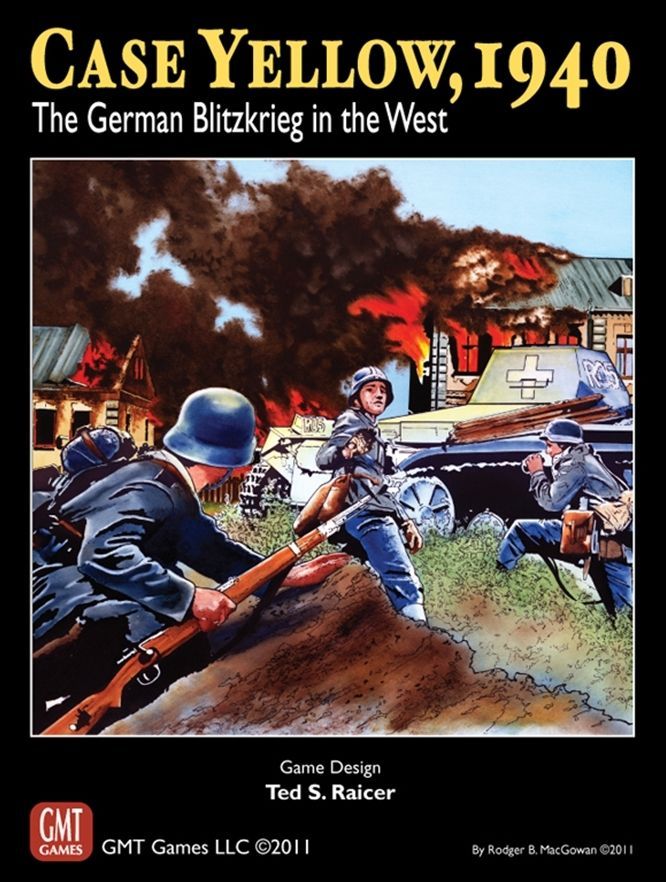
Case Yellow, 1940: The German Blitzkrieg in the West
2011
Recreate the six-week German victory in 1940 through initiative, armor, air support, and a race against Allied command delays.
180
minutes
2 - 2
player(s)
Medium Heavy

About this board game
Case Yellow, 1940: The German Blitzkrieg in the West is a two-player wargame with an approximately 180-minute playing time, simulating Germany’s six-week campaign against the western Allies in 1940.
Germany’s advantage lies not simply in tanks or manpower, but in operational speed and command. The German player usually has the initiative, while the Allied player must contend with a creaky command structure that can make the right action unavailable at the crucial moment.
Each turn is divided into eight action segments. Players use action chits for movement and combat, with the first chit selected by the initiative player and the remaining chits drawn randomly from an opaque cup. German actions require a balance of two movement chits and two combat chits, while Allied movement and combat chits can produce frustrating uncertainty.
- Motorized warfare: superior German Troop Quality can enable movement, attacks, retreats, and exploitation through enemy zones of control.
- Infantry zones of control: infantry must stop when entering enemy control, while larger attacks can draw adjacent enemy units into the defense.
- Air support: Luftwaffe and Allied air assets provide combat-table column shifts, with Germany holding far more effective support markers.
German panzer and motorized formations can concentrate rapidly, attack from unexpected directions, and exploit gaps before a traditional defensive response forms. Allied forces may possess comparable or superior individual tanks and soldiers, but coordination and timing are critical.
In Case Yellow, the campaign becomes a contest between German operational momentum and Allied attempts to organize a defense before the front collapses. Its streamlined system focuses on the command delays, armored breakthroughs, infantry limitations, and air-ground coordination that shaped the historic campaign.
/pic7182955.jpg)
