
4 Player Chess
1881
Play classic chess across a four-sided board, choosing partnerships, shifting alliances, or a fully competitive battle for four.
45
minutes
2 - 4
player(s)
8+
Medium

About this board game
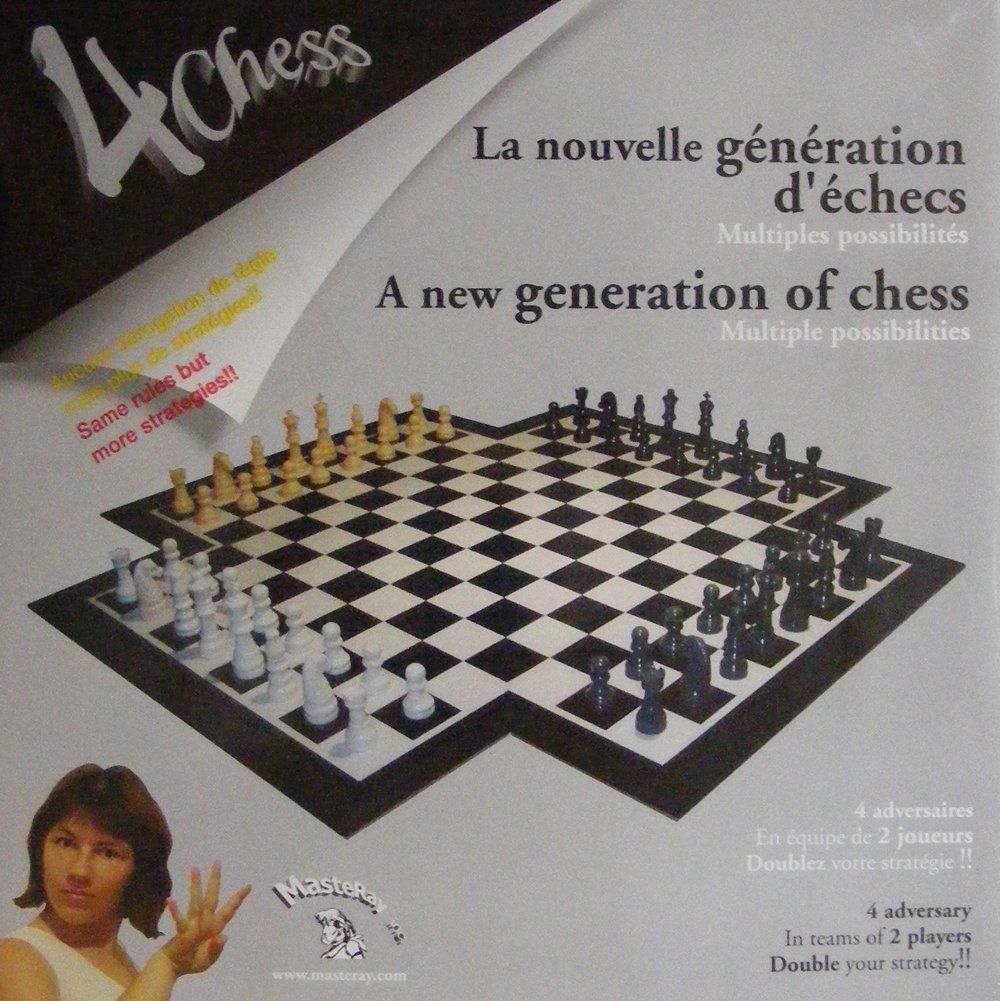
4 Player Chess is a four-player chess variant for 2–4 players, with games lasting around 45 minutes and a release year of 1881. It expands the familiar two-player format onto a four-sided board, bringing four complete sets of chessmen in different colors into play.
Often called Four-handed chess, Chess-4, or 4-Chess, the game is frequently credited to Capt Charles Verney, who documented it in England in 1881. Four-player forms of chess may have existed in various forms for hundreds of years before then.
Verney’s board added three rows to each side of a standard two-player chessboard. His original version was a partnership game: teammates aimed to checkmate both opposing partners at the same time. Modern versions can instead support partnerships, temporary alliances, or a cutthroat format in which every player competes independently.
For much of the game, players can follow the normal rules of two-player chess, but variations are common. Depending on the chosen rules, castling may be allowed, a king may need to be captured to eliminate a player, and pawns may have different movement or promotion requirements.
- Partnership play: cooperate with a teammate against two opposing players.
- Cutthroat play: compete independently, with alliances potentially forming and dissolving.
- Custom rules: experiment with castling, king capture, pawn movement, and promotion.
Starting configuration matters because the usual queen-facing-queen setup is biased on a four-player board. Two axes of symmetry are needed for fairness; suggested unbiased arrangements include placing all queens on squares of the same color or positioning them all to the same side of their kings.
There are no universally official rules, and the Chess Federation does not recognize four-player chess in any form. That leaves 4 Player Chess open to house rules and varied approaches to this unusual chess experience.
Designer
Useful links
/pic7182955.jpg) View board game on
View board game onBoard Game Geek
