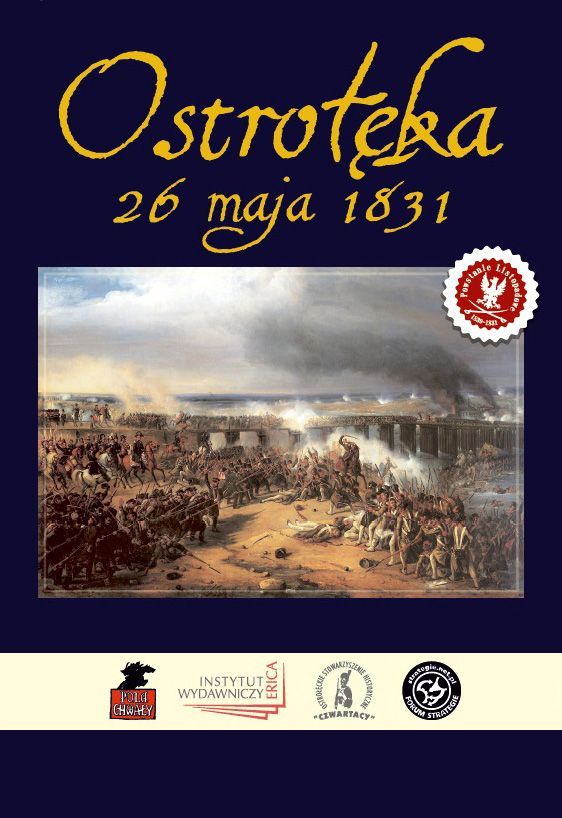
Ostroleka 26 maja 1831
2015
Command Polish or Russian forces across three scenarios in a detailed Napoleonic-era battle simulation.
600
minutes
2 - 4
player(s)
16+
Medium Heavy

About this board game
Ostroleka 26 maja 1831 is a detailed historical wargame for 2–4 players, with a listed play time of 600 minutes. It recreates the Battle of Ostroleka during Poland’s November Uprising, where Polish and Russian armies fought for control of the Narew River crossings.
The battle unfolds across two banks and the town of Ostroleka. Polish forces must slow the Russian advance, withdraw across the bridges, and challenge a Russian bridgehead while Russian artillery supports operations from the higher eastern bank. The game includes three scenarios: an introductory scenario and two historical scenarios covering the battle’s two principal phases.
Its core system uses an Igo/Ugo-style sequence, with separate movement and combat phases for cavalry and infantry. Horse artillery is generally attached to cavalry, while foot artillery operates with infantry. Non-active players also have numerous opportunities to react during the opposing player’s phase, keeping the battlefield active throughout the turn.
- Simulates cooperation between infantry, cavalry, and artillery.
- Includes formations such as column, line, square, and skirmish, plus building defense.
- Uses a modified odds-ratio combat calculation system.
- Offers scenarios lasting from 2–3 hours to a full day, depending on the scenario and players.
The climactic action includes the famous charge of Polish horse artillery commanded by Lieutenant Colonel J. Bem, while the broader battle reflects the uncertainty, artillery support, bridgehead assaults, and shifting coordination of the historical engagement. Ostroleka 26 maja 1831 is designed to present the tactics of the Napoleonic and post-Napoleonic period in a complex but reasonably accessible system.
The game contains a 96 × 68 cm map, 978 counters across nine die-cut sheets, additional counters, a combined rulebook and scenario book, three six-sided dice, player aids, and unit tables.
/pic7182955.jpg)