
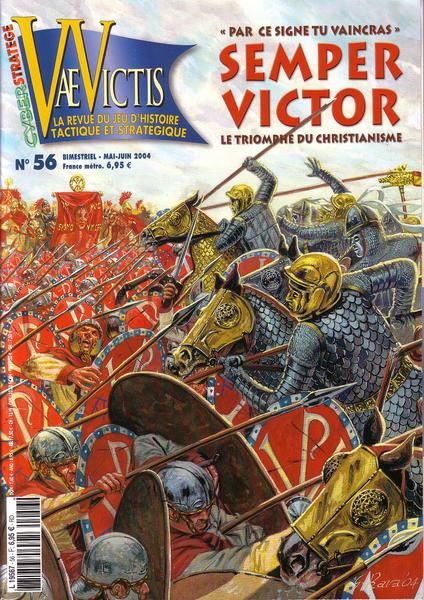
Semper Victor
2004
Command Roman leaders, barbarian allies, and rival emperors across a variable-length campaign set in the turbulent Fourth Century.
1200
minutes
2 - 2
player(s)
12+
Medium

About this board game
Semper Victor is a two-player grand strategy game, released in 2004, with a play time of up to 1,200 minutes. It presents the Fourth Century Roman Empire from Diocletian’s abdication in 305 A.D. to the death of Julian the Apostate, with scenarios covering shorter conflicts such as the war between Constantine the Great and Licinius.
The map shows the Roman Empire divided into zones and twelve Dioceses, surrounded by barbarian peoples and the rival Persian Empire. Each turn represents one year, while Roman units are measured in Strength Points representing roughly 1,000 men each. Ripenses are tied to their home Diocese, Pseudo-Comitatenses have limited reach, and Comitatenses can operate throughout the Empire and beyond.
Players command opposing political camps: Primus, representing the senior Emperor and his allies, and Secundus, with a competing group of Augusti, Caesars, generals, and non-Roman forces. Every Augustus and Caesar requires a separate capital, creating a constant struggle over the limited capitals available at the start of the game. Constantinople may be built, though its appearance is not guaranteed.
- Use historical Roman leaders with political, strategic, command, and tactical abilities.
- Play stratagems to attempt usurpations, assassinations, plagues, barbarian uprisings, pacification, or desertions.
- Fight battles, maneuver armies, and compete for Victory Points through territorial control and military achievements.
The number of movement and combat phases varies according to the abilities of the current leaders, making the pace of each year dependent on political and military talent. Players can even exchange Primus and Secundus roles through usurpation or succession crises. With its long campaign, historical cast, and shifting imperial hierarchy, Semper Victor offers an unusually detailed struggle for control of late Roman power.
/pic7182955.jpg)
