
Concept
2013
Use icons, colors, and sub-concepts to guide your fellow players toward hidden words and phrases in a clever team guessing game.
40
minutes
4 - 12
player(s)
10+
Light


About this board game
Concept is an icon-association guessing game for 4–12 players, with each game taking about 40 minutes. Teams of two players work together to help everyone else discover a hidden word or phrase.
On each turn, the team chooses what to clue and places pieces on icons across the game board. One main question mark identifies the central concept, while matching cubes can highlight related ideas and details.
For example, the team might clue “milk” by connecting the main concept to liquid, then adding cubes to icons representing food/drink and white. More complicated answers can use sub-concepts to point toward several connected clues.
- Choose a word or phrase for the other players to guess.
- Combine a main concept with matching cubes and sub-concepts.
- Earn points for discovering answers and for providing the clues.
A clue for “Leonardo DiCaprio,” for instance, can indicate that the answer is an actor or director, then use additional sub-concepts to suggest films such as “Titanic” or “Inception.” The team’s challenge is to communicate through associations rather than directly stating the answer.
The first player to discover the word or phrase receives 2 victory points, while the clue-giving team also earns points. After the game, the player with the most points wins. Released in 2013, Concept turns familiar icons into a flexible language for collaborative clue-building and deduction.
Thematics
Designers
Illustrators
/pic7182955.jpg)

Board Game Rules for
Concept
Game Overview
In Concept, your goal is to guess words through the association of icons. A team of two players – neighbors at the table – choose a word or phrase that the other players need to guess. Acting together, they place pieces judiciously on the available icons on the game board. The first player to discover the word or phrase receives 2 victory points, the team receives points as well, and the player who ends up with the most points wins.
Components
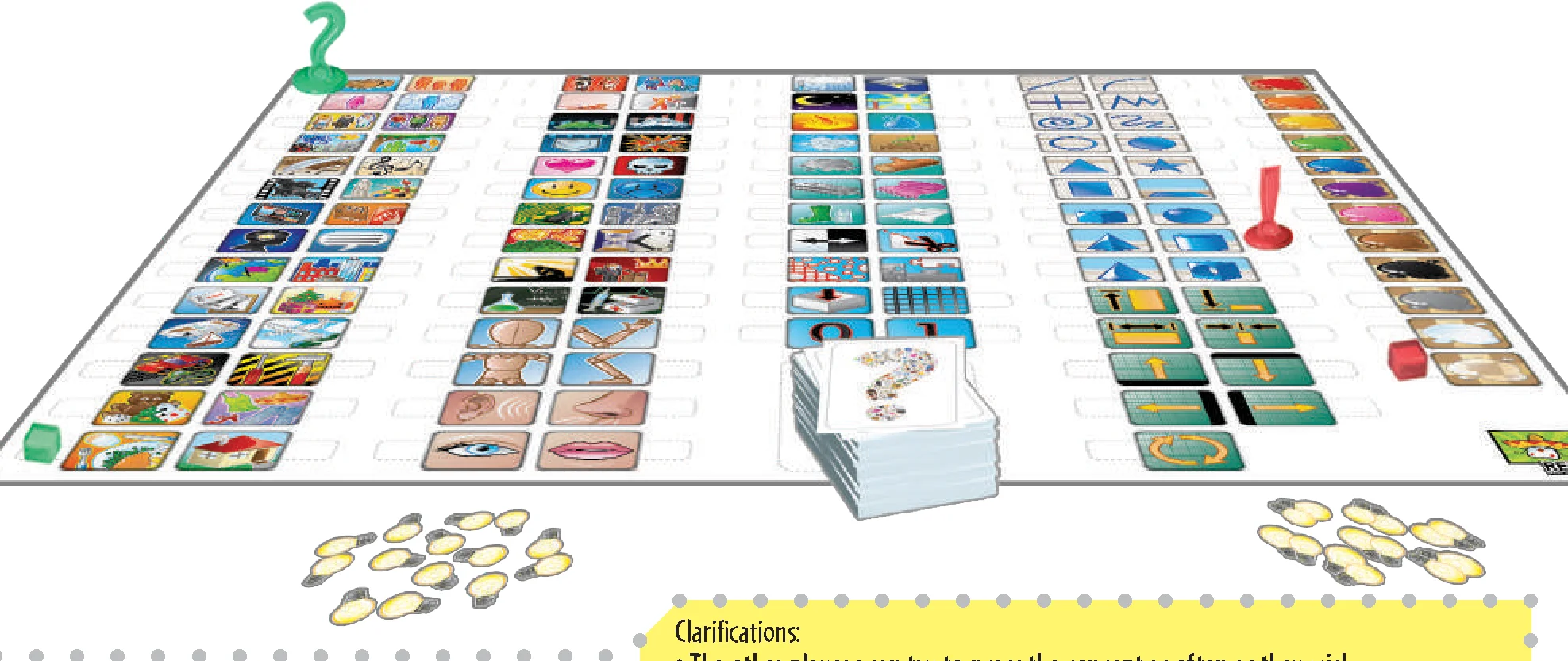
- 1 game board with universal icons
- 5 sets of pawns and cubes:
- 1 green set consisting of the main concept pawn (the large question mark) and 10 cubes
- 4 sets (blue, red, yellow, black) that each consist of a sub-concept pawn (the exclamation mark) and 8 cubes
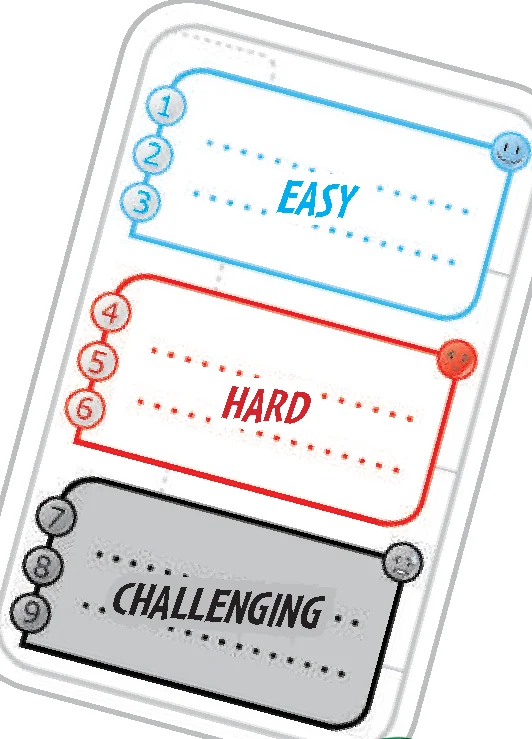
- 110 Concept cards, each with 9 words/phrases in three categories of difficulty: Easy, Hard, and Challenging.
- Tokens for Single and Double victory point tokens (Single are worth 1 VP, while Double are worth 2 VP)
- 2 player aids
- 1 bowl for storage

You may have noticed that so far we have used a pawn and cubes of only one color. By adding pawns and cubes in different colors, you can add sub-concepts to clarify the main concept being sought.
Game Set-Up
- Place the icon game board in the center of the table so that all players can easily see and access it.
- Shuffle the deck of Concept cards and place it face down.
- Create a pile of 12 Double VP tokens and lots of Single VP tokens.
- Place the pawns and cubes in the bowl: They are valuable tools for guessing the words!
- Now determine in some manner the two neighbors at the table who will form the first team.
Game Round
The team draws a Concept card and selects a word or phrase from the list that the other players will guess. For your first few games, we recommend that you choose an Easy word.
Note that Challenging words require mastery of the game by all players.
Place the main concept pawn first to represent the word to be guessed, then place cubes of the same color to clarify this main concept. Then if needed or desired, develop sub-concepts by placing additional pawns and their correspondingly colored cubes (see examples).
The first player to find the solution wins 1 Double token (worth 2 VPs) while each member of the team whose word was guessed wins 1 Single token (worth 1 VP). Then the next two players clockwise around the table take a new card to choose a word for others to guess.
Clarifications
- The other players can try to guess the concept as often as they wish.
- The team members can say “yes” when others give a good answer or are following the correct line of thought, but they cannot otherwise communicate directly with the other players.
- The order in which the team members place cubes on the board can be important. Don’t hesitate to remove the cubes and place them again to emphasize the order in which they appear.
- The team members should talk and consult with one another discreetly as they might not be thinking along the same lines when it comes to giving clues!
- The team members are free to place the cubes as they wish; they are NOT obliged to take turns when doing so.
- The team members can use as many pawns and cubes as they want to aid others in guessing the word, but they should be careful not to confuse the other players with too much information. There are no limits or penalties for the number of pieces used!
- After some time, if no one guesses the word, the team members choose a third player to assist them. If despite this helping hand, no one can guess correctly, the players abandon the word and no one scores any points this round.
- The player aids contain a non-exhaustive list of meanings for the universal icons. Feel free to read the descriptions to discover the wealth of possible meanings.
- If the other players are lost, the team members can choose to wipe the board clean of pawns and cubes, then restart their clue-giving along a different path.
Game End
Once the 12 Double VP tokens have been claimed, the game ends. The player or players who have scored the most VPs win the game.
Editor’s Note
- During our extensive testing, we eventually abandoned the points system and kept only the pleasure of guessing and being guessed. Feel free to do the same as your enjoyment of the experience will be just as large!
- With regard to the level of difficulty, we decided not to grant more points for those who guess words in the Hard or Challenging categories. If you like, you can reward this level of difficulty by giving 1 or 2 additional VPs to the team and to the player who guessed the word.
Introductory Examples

A white liquid that’s something you eat? Obviously this is milk.

Now a red liquid instead of white? Ketchup, perhaps, or red wine.
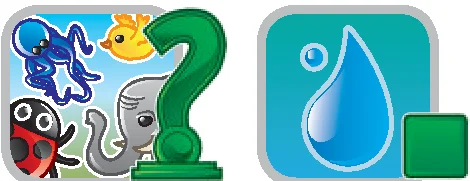
Here we’re searching for an animal that’s associated with water. What first comes to mind? A fish.
Concept contains more to discover than food and animals. If I indicate to you:
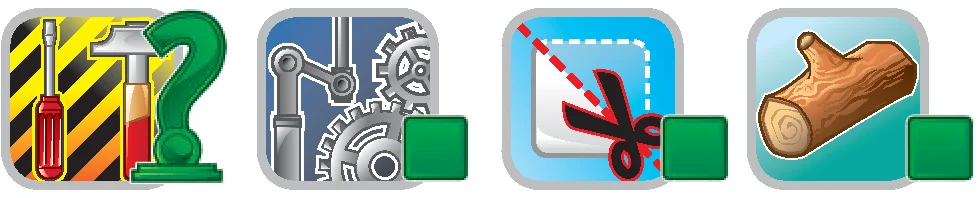
This is a chainsaw, that is, a mechanical tool that cuts wood.
Concept is not limited to simple words as it’s also possible to guess famous personalities:

A man of the arts with a cut ear? Have you guessed? It’s Vincent van Gogh, of course!

Here we’re searching for a metallic building located in a place or country associated with the colors blue, white and red (and not a building that’s blue, white and red). Seems like we’re looking for the Eiffel Tower.
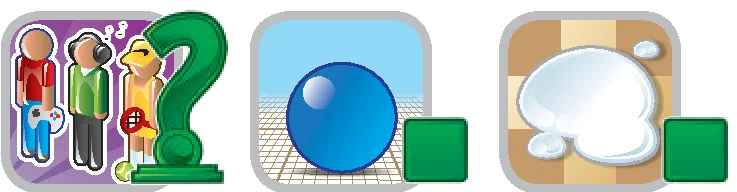
We’re searching for an activity or a sport that uses a white ball. Let’s add a sub-concept to narrow the possibilities:

Hmm, this activity or sport also uses a cylindrical wooden tool. Now add another sub-concept:

The country is the United States, so we’re talking about baseball!
Note that we’ve been designating the main concept with the green pawn, then bringing one or more sub-concepts into play to clarify the main one.
You can find more examples at the end of these rules.
Additional Examples
Concept is a game that can be tamed and customized. Use the material as you see fit! All ideas, even crazy ones, can work – as long as the other players can understand you. Here are more examples:
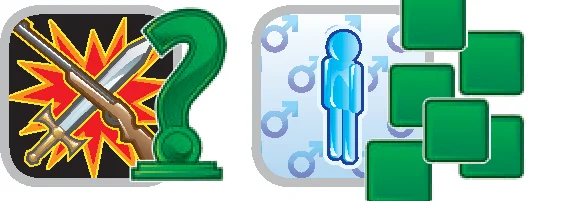
A conflict and a multitude of pieces on man? This is war!
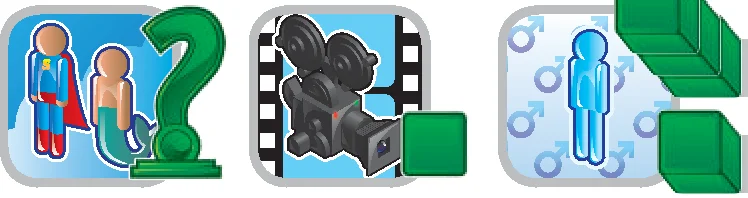
A fictional movie with two men of different sizes? You still haven’t found an answer? Let’s add a sub-concept.

Ah, the movie is black-and-white. Must be Laurel and Hardy.
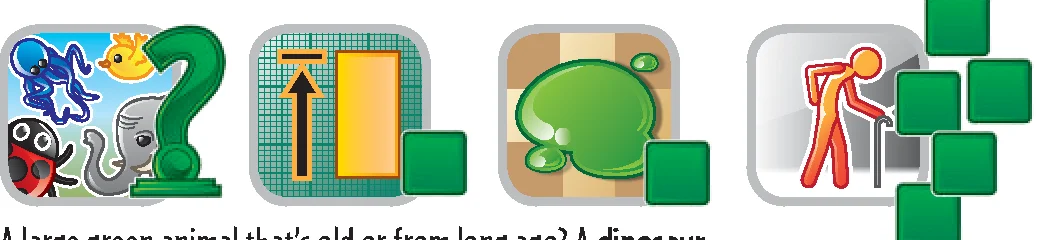
A large green animal that’s old or from long ago? A dinosaur.
The universal icons have several similar but different meanings that can be used to great effect:

An ice cube, with “cold” here being used to indicate temperature.

Here “cold” indicates the winter season, aiding players in guessing Christmas, a holiday or event that often features toys.
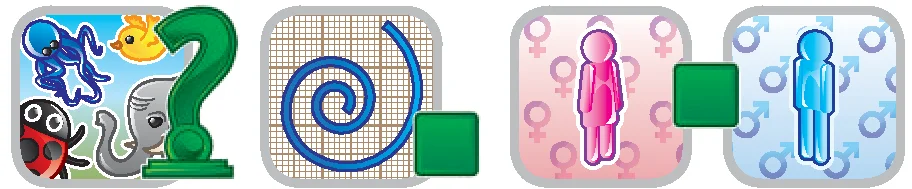
This set of clues indicates a snail, which everyone knows is a hermaphrodite.

We’re searching for a man whose work involves fighting. A boxer? Someone in the military? Let’s add a sub-concept.

We recognize the flag of Japan, but are still in the dark. Add another sub-concept.
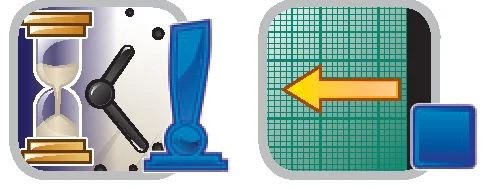
Ah, it’s a fighter from the past – a samurai!

So we have a masculine job of some sort. Tell me more.

A large, brown speedy animal is now part of the concept, but how?

The man is on top of or above or higher than the animal. Hmm…

The country is the United States, so this is a cowboy!

Most likely an actor or director.

A ship is going down – it’s sinking, and there’s lots of death. Must be the Titanic, so it’s Leonardo DiCaprio!

What’s a yellow drink at parties that makes your head spin? Champagne!

A comic book, no doubt. What’s next?

A small male character who’s thoughtful or clever.

A wide male character with blue and white clothing.

A small white house pet.
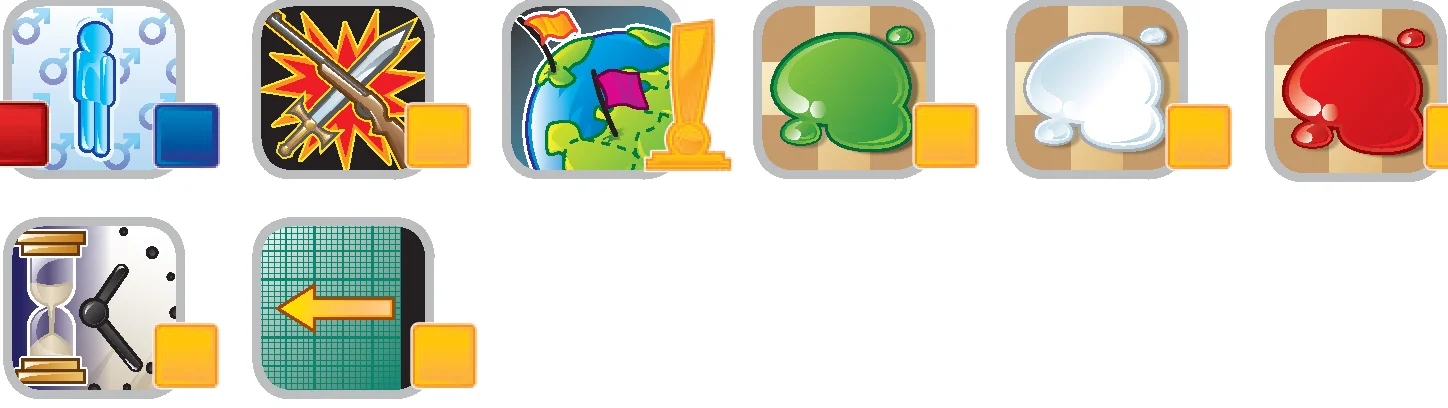
And the two men fight Italians in early time? Roman times! Asterix and Obelix!
Game Credits
Authors: Alain Rivollet & Gaëtan Beaujannot
Development: “The Belgians with Sombreros“ a.k.a. Cédrick Caumont & Thomas Provoost
Art and DTP: Éric Azagury & Cédric Chevalier
DTP director: Alexis Vanmeerbeeck
Production manager: Guillaume Pilon
Rules proofreading: Ann Pichot, Axel Koszo
Translation: W. Eric Martin & Éric Harlaux
Thanks to: Yannick Mescam & Emilie Fleuret, Denise Stallings, participants of the Belgoludique and the Gathering of Friends.
Concept is a game from REPOS PRODUCTION.
Rue Lambert Vandervelde, 7 • 1170 Brussels – Belgium
www.rprod.com • +32 471 95 41 32
© REPOS PRODUCTION 2013. ALL RIGHTS RESERVED.
The material in this game uses certain trade names and trademarks, whether registered or not, that are the property of their respective owners. This game and the use of this material is in no way sponsored, supported, commissioned or approved by the holders of these brands, including all rights reserved. This material may be used only for personal and private amusement.
Overview & Components
Game Overview
In Concept, your goal is to guess words through the association of icons. A team of two players – neighbors at the table – choose a word or phrase that the other players need to guess. Acting together, they place pieces judiciously on the available icons on the game board. The first player to discover the word or phrase receives 2 victory points, the team receives points as well, and the player who ends up with the most points wins.
Components
- 1 game board with universal icons
- 5 sets of pawns and cubes:
- 1 green set consisting of the main concept pawn (the large question mark) and 10 cubes
- 4 sets (blue, red, yellow, black) that each consist of a sub-concept pawn (the exclamation mark) and 8 cubes
- 110 Concept cards, each with 9 words/phrases in three categories of difficulty: Easy, Hard, and Challenging.
- Tokens for Single and Double victory point tokens (Single are worth 1 VP, while Double are worth 2 VP)
- 2 player aids
- 1 bowl for storage
You may have noticed that so far we have used a pawn and cubes of only one color. By adding pawns and cubes in different colors, you can add sub-concepts to clarify the main concept being sought.
Setup
Game Set-Up
- Place the icon game board in the center of the table so that all players can easily see and access it.
- Shuffle the deck of Concept cards and place it face down.
- Create a pile of 12 Double VP tokens and lots of Single VP tokens.
- Place the pawns and cubes in the bowl: They are valuable tools for guessing the words!
- Now determine in some manner the two neighbors at the table who will form the first team.
How to Play
Game Round
The team draws a Concept card and selects a word or phrase from the list that the other players will guess. For your first few games, we recommend that you choose an Easy word.
Note that Challenging words require mastery of the game by all players.
Place the main concept pawn first to represent the word to be guessed, then place cubes of the same color to clarify this main concept. Then if needed or desired, develop sub-concepts by placing additional pawns and their correspondingly colored cubes (see examples).
The first player to find the solution wins 1 Double token (worth 2 VPs) while each member of the team whose word was guessed wins 1 Single token (worth 1 VP). Then the next two players clockwise around the table take a new card to choose a word for others to guess.
Clarifications
- The other players can try to guess the concept as often as they wish.
- The team members can say “yes” when others give a good answer or are following the correct line of thought, but they cannot otherwise communicate directly with the other players.
- The order in which the team members place cubes on the board can be important. Don’t hesitate to remove the cubes and place them again to emphasize the order in which they appear.
- The team members should talk and consult with one another discreetly as they might not be thinking along the same lines when it comes to giving clues!
- The team members are free to place the cubes as they wish; they are NOT obliged to take turns when doing so.
- The team members can use as many pawns and cubes as they want to aid others in guessing the word, but they should be careful not to confuse the other players with too much information. There are no limits or penalties for the number of pieces used!
- After some time, if no one guesses the word, the team members choose a third player to assist them. If despite this helping hand, no one can guess correctly, the players abandon the word and no one scores any points this round.
- The player aids contain a non-exhaustive list of meanings for the universal icons. Feel free to read the descriptions to discover the wealth of possible meanings.
- If the other players are lost, the team members can choose to wipe the board clean of pawns and cubes, then restart their clue-giving along a different path.
Game End & Variants
Game End
Once the 12 Double VP tokens have been claimed, the game ends. The player or players who have scored the most VPs win the game.
Editor’s Note
- During our extensive testing, we eventually abandoned the points system and kept only the pleasure of guessing and being guessed. Feel free to do the same as your enjoyment of the experience will be just as large!
- With regard to the level of difficulty, we decided not to grant more points for those who guess words in the Hard or Challenging categories. If you like, you can reward this level of difficulty by giving 1 or 2 additional VPs to the team and to the player who guessed the word.
Examples of Play
Introductory Examples
A white liquid that’s something you eat? Obviously this is milk.
Now a red liquid instead of white? Ketchup, perhaps, or red wine.
Here we’re searching for an animal that’s associated with water. What first comes to mind? A fish.
Concept contains more to discover than food and animals. If I indicate to you:
This is a chainsaw, that is, a mechanical tool that cuts wood.
Concept is not limited to simple words as it’s also possible to guess famous personalities:
A man of the arts with a cut ear? Have you guessed? It’s Vincent van Gogh, of course!
Here we’re searching for a metallic building located in a place or country associated with the colors blue, white and red (and not a building that’s blue, white and red). Seems like we’re looking for the Eiffel Tower.
We’re searching for an activity or a sport that uses a white ball. Let’s add a sub-concept to narrow the possibilities:
Hmm, this activity or sport also uses a cylindrical wooden tool. Now add another sub-concept:
The country is the United States, so we’re talking about baseball!
Note that we’ve been designating the main concept with the green pawn, then bringing one or more sub-concepts into play to clarify the main one.
You can find more examples at the end of these rules.
Additional Examples
Concept is a game that can be tamed and customized. Use the material as you see fit! All ideas, even crazy ones, can work – as long as the other players can understand you. Here are more examples:
A conflict and a multitude of pieces on man? This is war!
A fictional movie with two men of different sizes? You still haven’t found an answer? Let’s add a sub-concept.
Ah, the movie is black-and-white. Must be Laurel and Hardy.
A large green animal that’s old or from long ago? A dinosaur.
The universal icons have several similar but different meanings that can be used to great effect:
An ice cube, with “cold” here being used to indicate temperature.
Here “cold” indicates the winter season, aiding players in guessing Christmas, a holiday or event that often features toys.
This set of clues indicates a snail, which everyone knows is a hermaphrodite.
We’re searching for a man whose work involves fighting. A boxer? Someone in the military? Let’s add a sub-concept.
We recognize the flag of Japan, but are still in the dark. Add another sub-concept.
Ah, it’s a fighter from the past – a samurai!
So we have a masculine job of some sort. Tell me more.
A large, brown speedy animal is now part of the concept, but how?
The man is on top of or above or higher than the animal. Hmm…
The country is the United States, so this is a cowboy!
Most likely an actor or director.
A ship is going down – it’s sinking, and there’s lots of death. Must be the Titanic, so it’s Leonardo DiCaprio!
What’s a yellow drink at parties that makes your head spin? Champagne!
A comic book, no doubt. What’s next?
A small male character who’s thoughtful or clever.
A wide male character with blue and white clothing.
A small white house pet.
And the two men fight Italians in early time? Roman times! Asterix and Obelix!
Credits
Game Credits
Authors: Alain Rivollet & Gaëtan Beaujannot
Development: “The Belgians with Sombreros“ a.k.a. Cédrick Caumont & Thomas Provoost
Art and DTP: Éric Azagury & Cédric Chevalier
DTP director: Alexis Vanmeerbeeck
Production manager: Guillaume Pilon
Rules proofreading: Ann Pichot, Axel Koszo
Translation: W. Eric Martin & Éric Harlaux
Thanks to: Yannick Mescam & Emilie Fleuret, Denise Stallings, participants of the Belgoludique and the Gathering of Friends.
Concept is a game from REPOS PRODUCTION.
Rue Lambert Vandervelde, 7 • 1170 Brussels – Belgium
www.rprod.com • +32 471 95 41 32
© REPOS PRODUCTION 2013. ALL RIGHTS RESERVED.
The material in this game uses certain trade names and trademarks, whether registered or not, that are the property of their respective owners. This game and the use of this material is in no way sponsored, supported, commissioned or approved by the holders of these brands, including all rights reserved. This material may be used only for personal and private amusement.
