
Trajan
2011
Build influence, trade, command armies, and pursue victory points through a distinctive Mancala-style action system.
120
minutes
2 - 4
player(s)
12+
Medium Heavy


About this board game
Trajan is a development game for 2–4 players set in ancient Rome, with a listed playing time of 120 minutes, or about 30 minutes per player. Players seek victory points by expanding their influence across political, commercial, military, and cultural areas of Roman life.
At the heart of the game is a clever system inspired by Mancala and other pit-and-pebbles games. Each player begins with two differently colored pieces in each of six bowls on their tableau. On a turn, a player selects one bowl, distributes its pieces clockwise one at a time, and activates the action associated with the bowl receiving the final piece.
The six available actions give players several ways to develop their position:
- Build structures
- Trade goods
- Take tiles from the Forum
- Use the military to control regions in Europe
- Influence the Senate and acquire votes on laws
- Place Trajan tiles on the tableau for additional actions
Trajan tiles add another layer of planning. When the colored pieces in the activated bowl match the colors shown on the adjacent tile, the player also performs that tile’s additional action. Choosing where to begin and where the final piece lands can therefore shape both your immediate move and your broader plans.
Players must also anticipate public demands at the Forum, where failing to supply what is wanted can bring a penalty. In the Senate, influence can translate into votes on victory-point-related laws, while military expansion rewards control of regions in Europe, with regions farther from Rome earning more points.
With language-neutral components and multiple routes toward victory, Trajan combines tactical timing with long-term development in a distinctly Roman setting.
/pic7182955.jpg)
Board Game Rules for
Trajan
110 AD – the Roman Empire is at its height of glory, ruled by the Emperor „optimus princeps“ Trajan. All borders are secured and people can focus their attention again on the empire’s internal matters – ROME.
Take your chances and boost your power! With proper tactics, you may outmanoeuvre your opponents and eventually claim victory.
Object of the Game
The players try to gain victory points, smartly taking their chances offered by the tactical facilities of six different actions.
The key to success is the canny allocation of action markers to the trays of the action circle. Players try to catch the best time for certain actions. On the one hand, it is important to make use of sudden chances (e.g. to get hold of attractive tiles); on the other hand, players must not neglect to give other players a hard time in crucial situations. Additionally, players may scheme relevant actions a few turns in advance.
Regardless of the outcome of your first game, you will become more experienced with each subsequent game and always learn new refinements.
Components
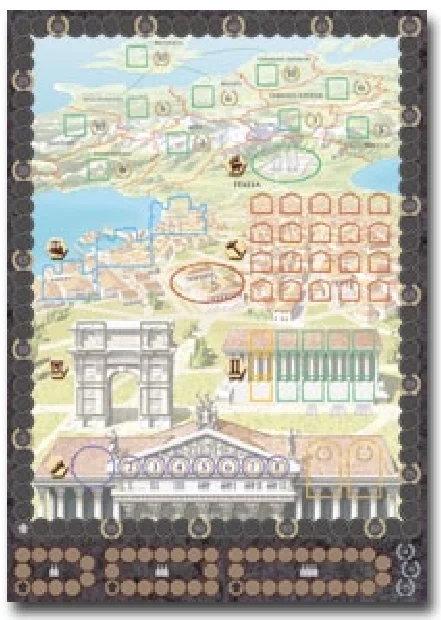


- 1 game board – showing parts of the Roman Empire, starting from Rome’s senate via the Arch of Trajan, the forum and the seaport up to the far-away provinces of Britannia and Germania. The board consists of 6 areas; a specific action is assigned to each area.
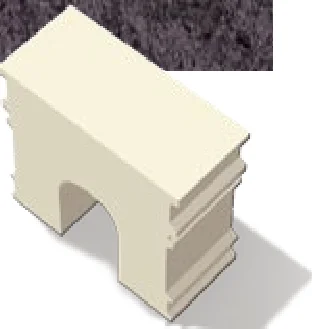
- 4 Arches of Trajan – one for each player. It marks the slot on the player mats for a new Trajan tile.
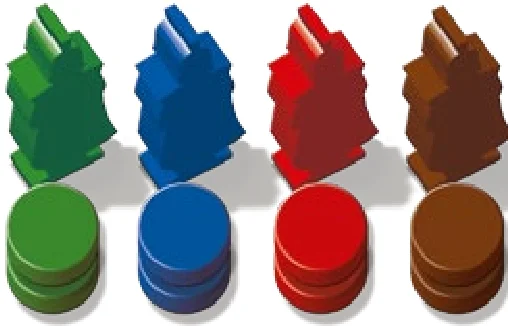
- 60 small player tokens – 15 each in the player colors red, green, dark blue, and brown. They represent the players’ legionnaires or workers.
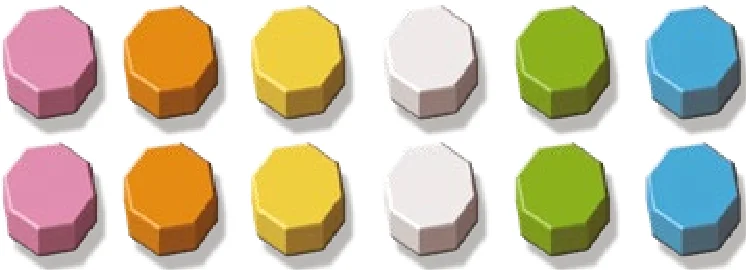
- 4 sets of octagonal action markers – each set consists of 12 markers in the following colors: 2 each of yellow, orange, light green, white, pink and blue. Players place these markers on the troughs of their action circle.
- 4 military leader tokens and 8 discs – in 4 player colors. The military leaders occupy provinces with their legionnaires. Players use their discs as victory points marker and vote marker in the Senate.
- 1 time marker – used for recording the elapsed playing time.
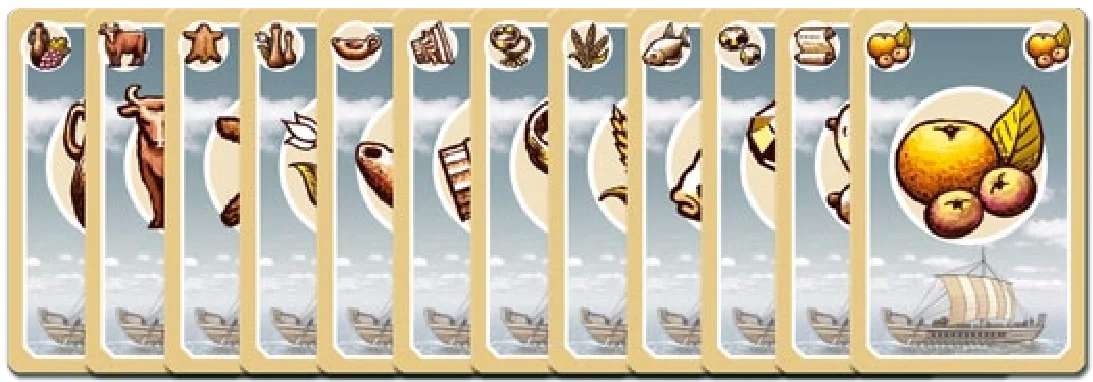
- 60 commodity cards – 12 commodities, 5 cards of each.
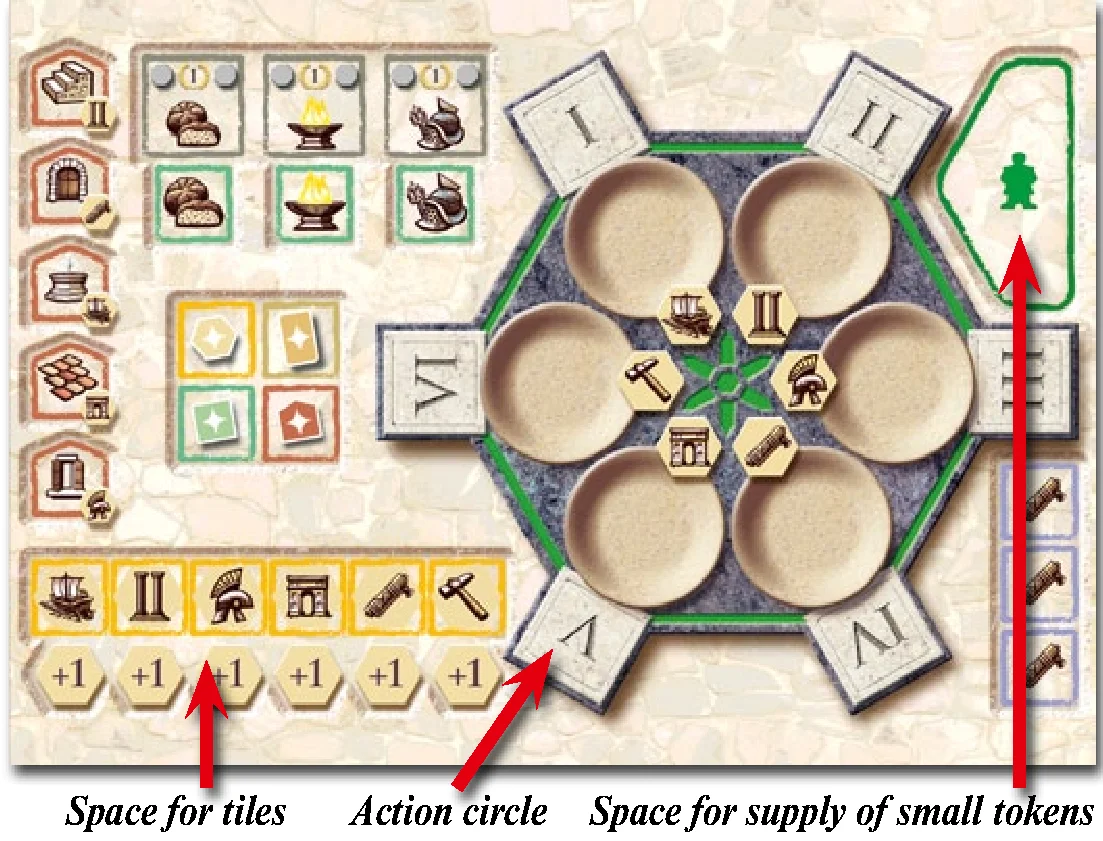
- 4 player mats in the player colors – showing the action circle with 6 trays and providing space for the players’ various collected tiles.
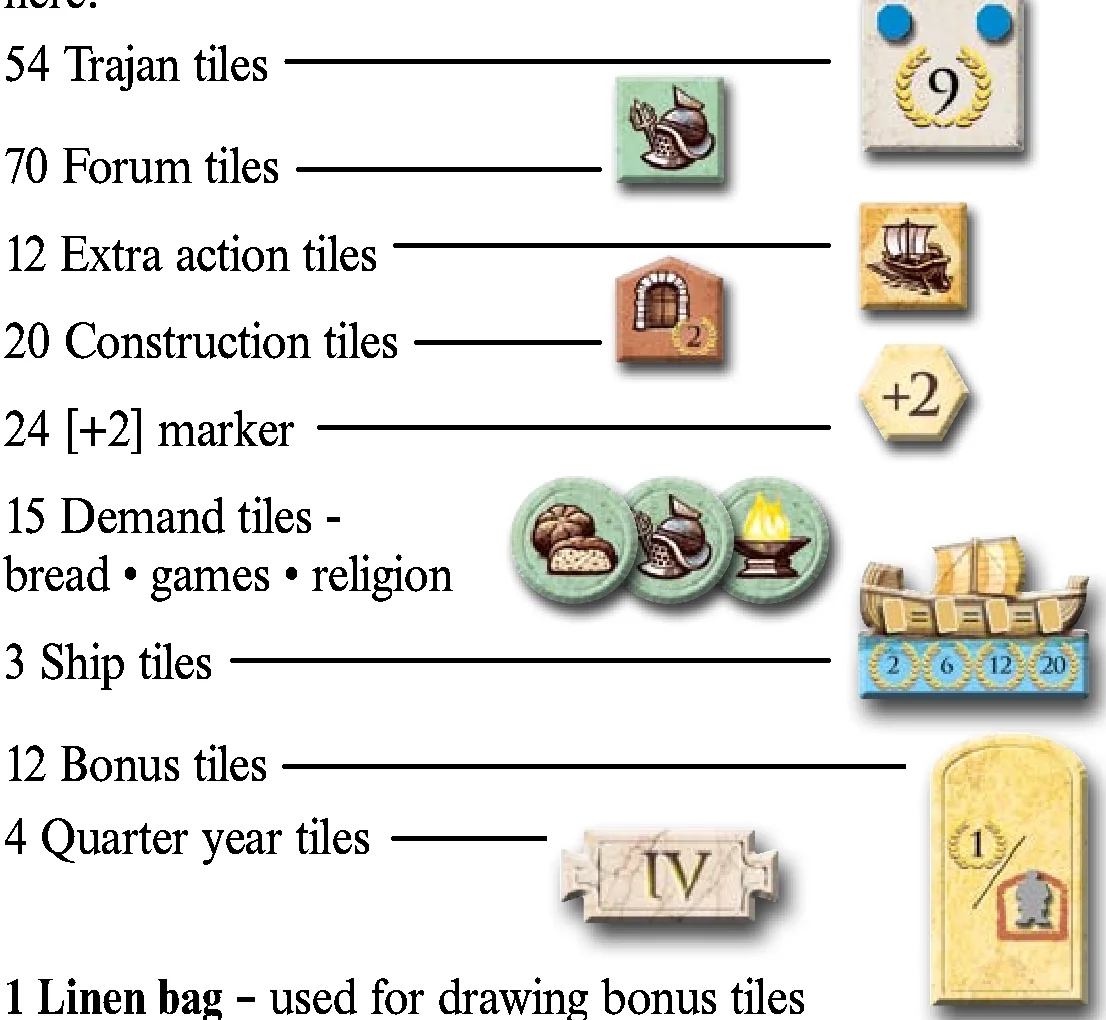
9 different types of tiles:
- 54 Trajan tiles
- 70 Forum tiles
- 12 Extra action tiles
- 20 Construction tiles
- 24 [+2] markers
- 15 Demand tiles (bread • games • religion)
- 3 Ship tiles
- 12 Bonus tiles
- 4 Quarter year tiles
- 1 Linen bag – used for drawing bonus tiles
- 2 Rulebooks – German and English
Board and Player Setup
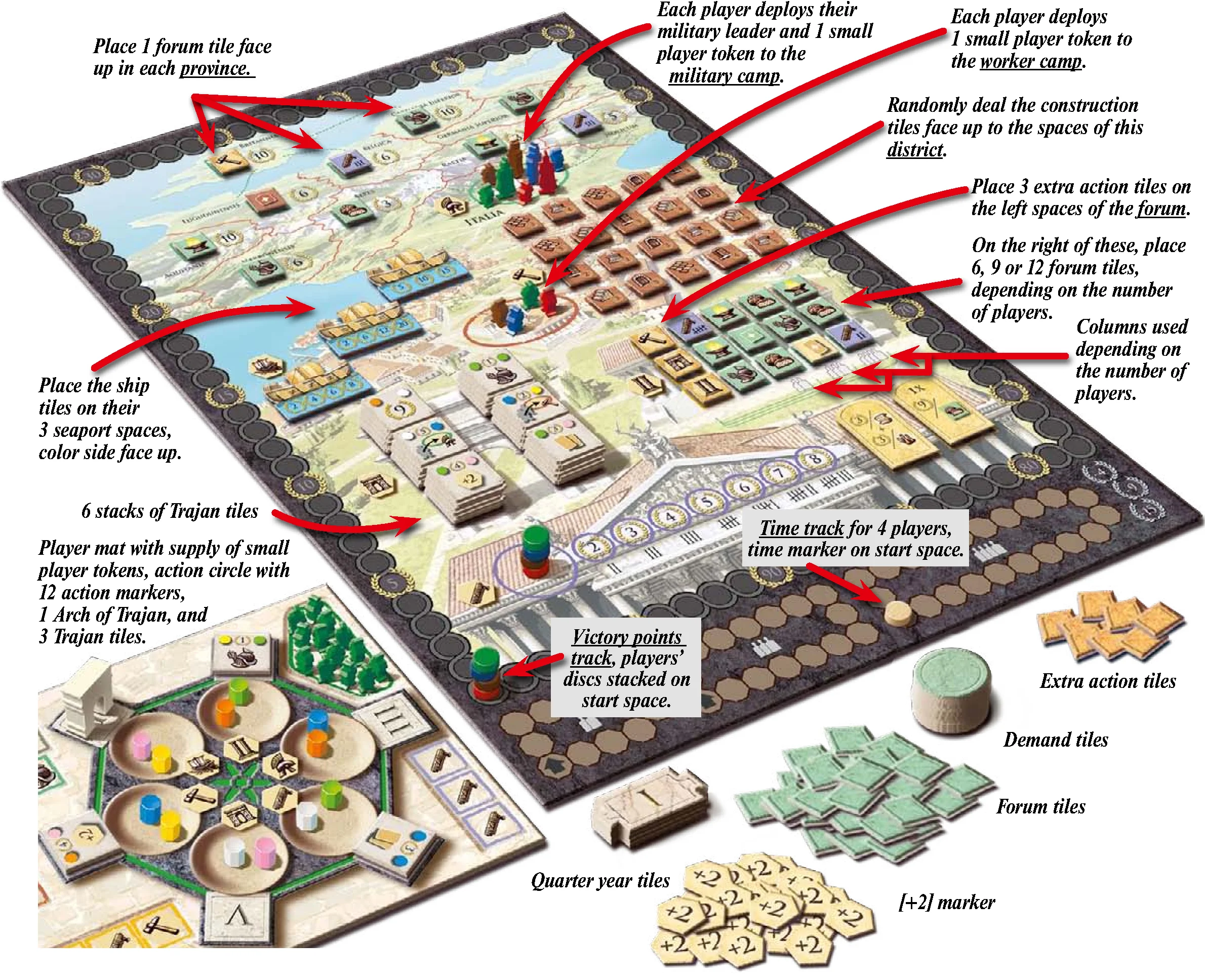
- Game board: Unfold the game board in the center of the playing area.
- Player components: Give each player in their chosen player color:
- 1 player mat
- 1 military leader token
- 15 small player tokens
- 2 discs (to record victory points and position in the senate)
- 1 Arch of Trajan
- 12 action markers (2 each of blue, yellow, light green, orange, pink, and white)
- Extra action and forum tiles: Sort the extra action and forum tiles by their back sides, shuffle them separately, and place them as face-down piles next to the game board.
- Demand tiles: Shuffle the demand tiles face down and randomly remove 3 of them from the game. Place the remaining demand tiles face down next to the game board.
- Placing forum tiles: Randomly draw the following tiles and place them face up on the game board:
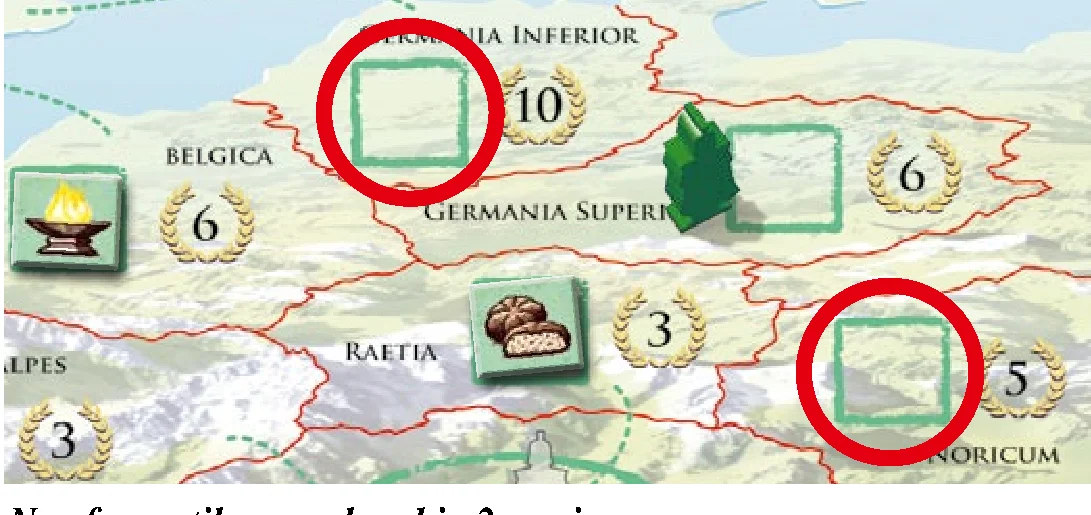
- 10 forum tiles in the provinces (1 in each province).
- Designated forum spaces: 6 tiles (2 players), 9 tiles (3 players), or 12 tiles (4 players).
- Place 3 extra action tiles on the yellow spaces of the forum.
- Construction district: Fill all 20 spaces of the construction district with 1 construction tile each.
- Time marker: Place the time marker on the start space of the time cycle apt to the number of players.
- Initial deployment: All players deploy:
- 1 military leader token and 1 small player token to the military camp.
- 1 small player token to the worker camp.
- Keep the remaining 13 small player tokens on the specified area of their player mat.
- Place their Arch of Trajan on the slot marked „I“ of their player mat.
- Action markers setup: Prior to drawing Trajan tiles, players allocate their action markers to the trays of their player mat, filling each tray with 2 markers of any color.
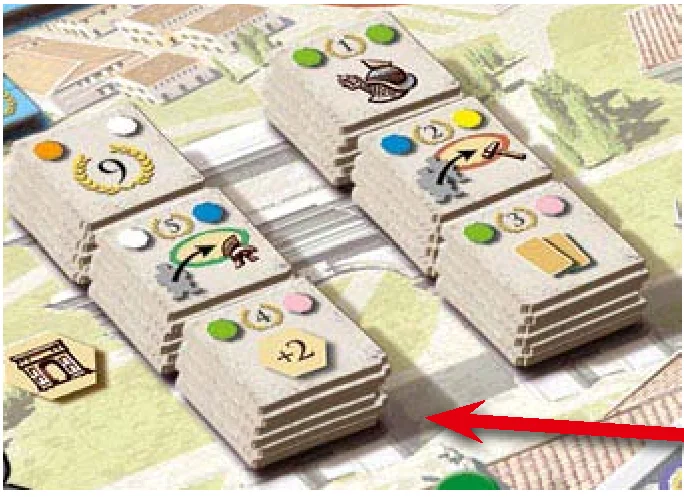
- Trajan tiles: Sort the Trajan tiles by category (icons), shuffle each pile, and allocate the stacks to their 6 spaces on the game board.
Preparing to Play the Game
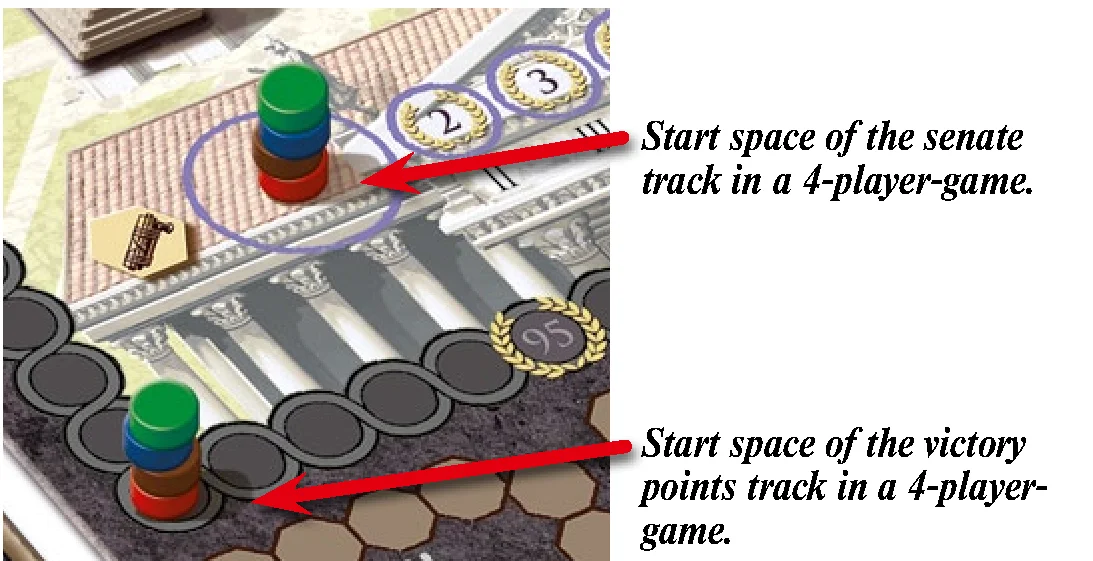
- Start player & Senate track: Players determine a start player by any method they like. The start player places one of their discs on the start space of the senate track. In clockwise direction, the other players pile up their discs atop the other discs, creating a small stack.
(Note: The stacking order is important, because ties are broken in favor of the disc higher up in the stack.) - Victory points track: The players stack their other discs on the start space of the victory points track (the order of discs in this stack does not matter!).
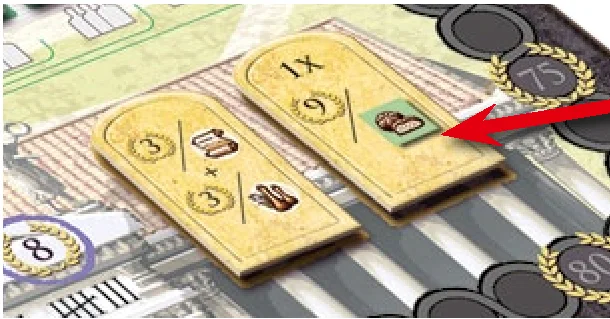
- Bonus tiles: Each player draws one bonus tile from the bag and places it in front of themselves, yellow side face up. Then, draw 2 more bonus tiles and place them on the game board to the right of the senate track, yellow side face up. Keep the bag with the remaining bonus tiles within easy reach.
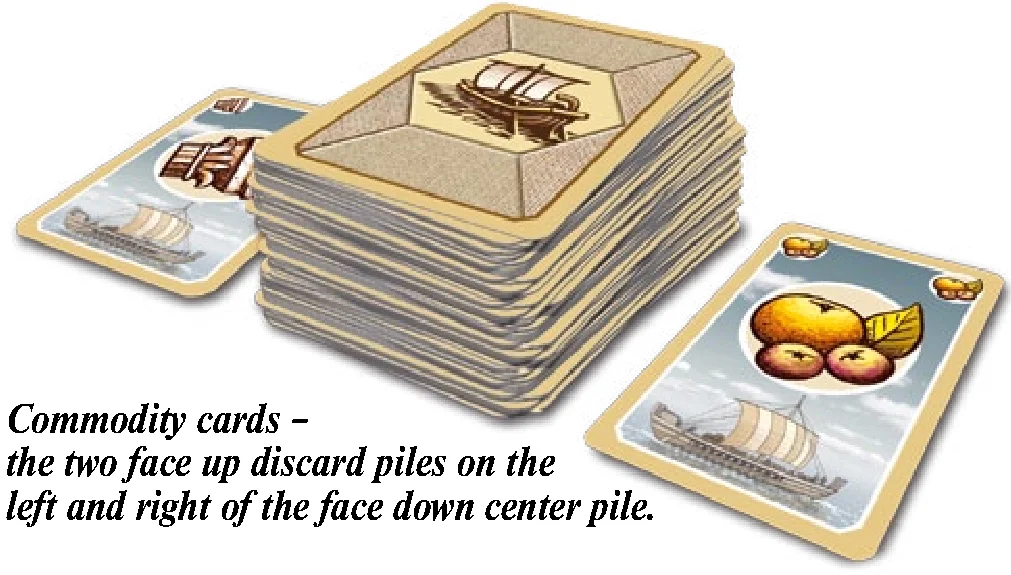
- Commodity cards: Shuffle the commodity cards and place the pile face down next to the game board. Reveal the top card and place it face up on one side of the pile, creating a discard pile. Then, reveal the next card from the pile and place it face up at the other side of the pile, creating a second discard pile. Beginning with the start player and continuing in player order, each player draws 3 commodity cards into their hand. Players may take cards from any pile in any combination; whenever a discard pile is empty, fill it with the top card from the face-down pile.
- Select Trajan tiles: During the final step, in player order, all players select 3 Trajan tiles. Each player puts their tiles on the slots marked II, IV and VI of their player mat, in any order they like. At this point, players may not take more than 1 Trajan tile of each category.
The game is played over four quarters of a year. Each quarter consists of 4 game rounds; each round lasts as long as one complete cycle of the time marker on the time track. The number of player turns may differ from round to round.
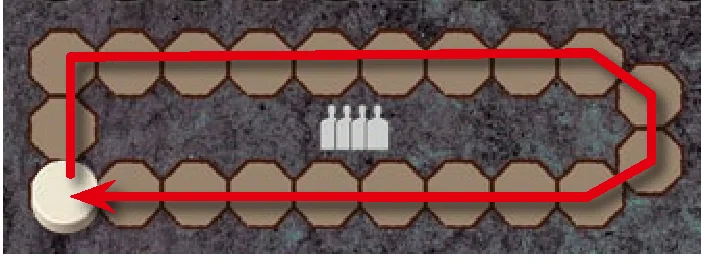
A player’s turn consists of the following steps, which the active player performs in this order:
- Rearrange action markers and move time marker (mandatory)
- Accomplish Trajan tile (if possible)
- Perform one action (optional)
After a player has completed their turn, the next player in clockwise direction performs their turn.
Step 1: Rearrange Action Markers (Mandatory)
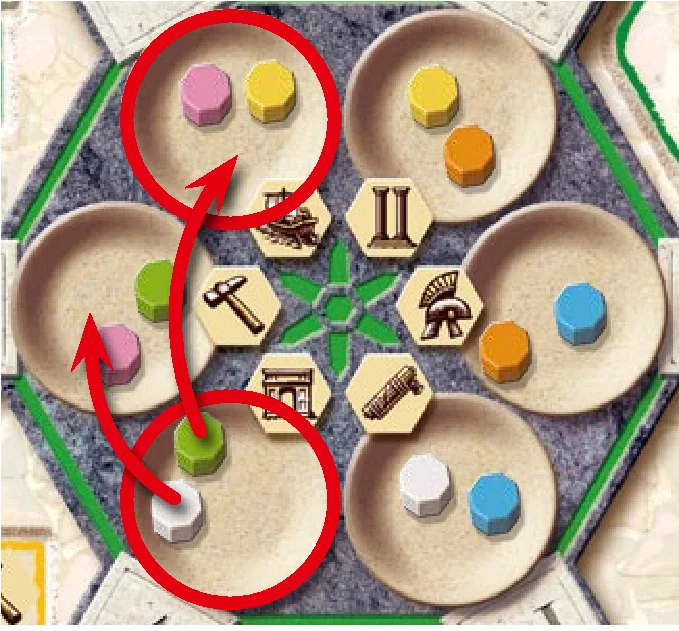
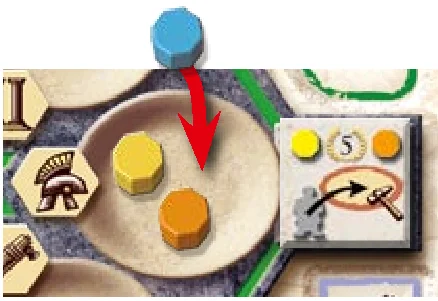
- The player chooses one tray of their player mat and takes all action markers from that tray, announcing their number aloud (see “Move time marker”). The chosen tray must contain at least 1 marker.
- Next, the player allocates the action markers one by one to the next trays in clockwise direction. The player puts one marker in each tray and continues to do so until they have allocated all markers from the chosen tray.
- It is the player’s choice which marker (color) they put in what tray.
- The tray where the player puts the last action marker is the target tray.
Note: If there are more than 6 action markers in the chosen source tray, the player puts two (or more) markers in some of the trays.
Hint: A player influences the playing time of a game round by the number of action markers of the tray they choose as their starting tray.
Move Time Marker (Mandatory)
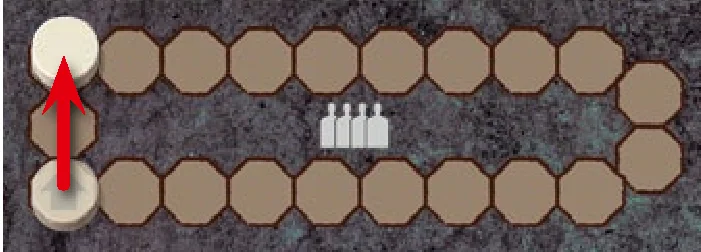
After the active player has announced the number of their selected action markers, their right neighbor advances the time marker that many spaces on the time track in clockwise direction.
End of a Game Round Trigger
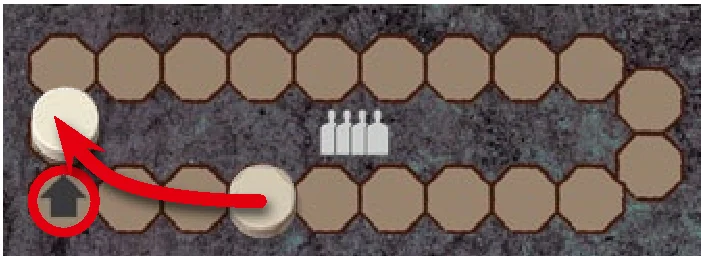
As soon as the time marker arrives at or crosses its start space, the current game round ends after the active player has completed their turn. A quarter of a year ends after 4 game rounds; the game ends after 4 quarters.
In case it is the end of a round, end of a quarter or end of the game, certain activities must be performed before the next player’s turn begins (see comments on pages 8 & 9).
Step 2: Accomplish Trajan Tile (If Possible)
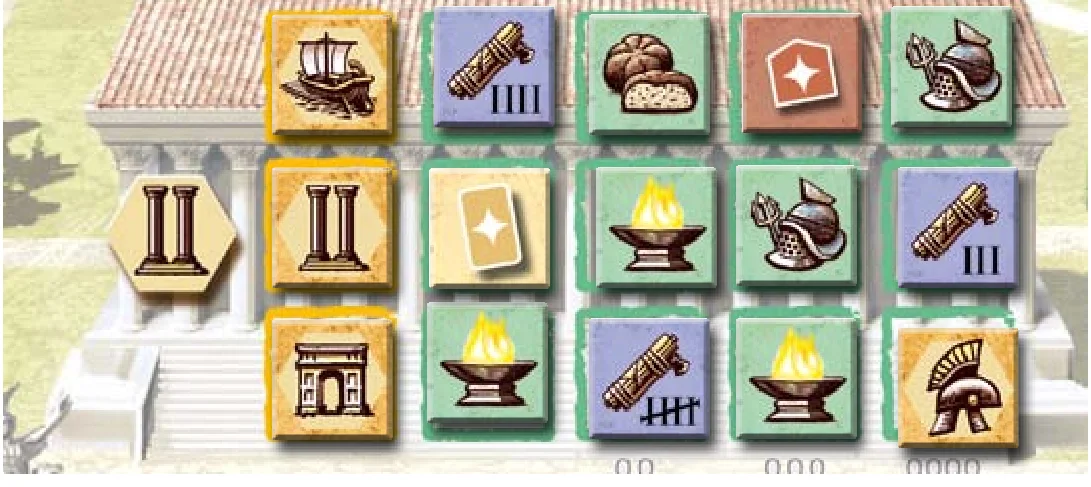
If a Trajan tile lies next to the target tray and if there are action markers in the tray matching the colors shown on the tile, the player removes the tile from their player mat, gains the corresponding victory points and may perform the appropriate special action.
The number of action markers in the target tray does not matter and it is of no concern for how long they may be there already.
Note: It does not matter if the target tray contains more markers than just those of the matching color combination.
After the player has performed their special action, that Trajan tile is removed from the game.
Exception: The player collects any Trajan tiles with the icons bread, helmet or flame on their player mat and these tiles are effective until the end of the game. (See “Extra action tiles” on page 11.)
Step 3: Perform One Action (Optional)
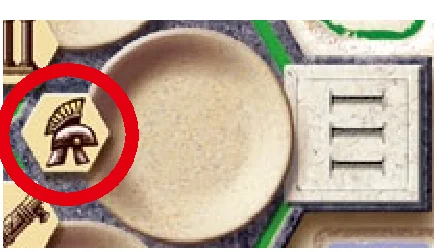
Regardless if the player had accomplished a Trajan tile or not they may now perform the action assigned to the target tray. A unique action is assigned to each tray of the action circle.
 Seaport Action
The player must choose one of four options:
- Draw 2 cards, discard 1: The player may draw 2 commodity cards from the face-down pile and add them to their hand. Then, they must discard 1 card of their choice from their hand and place it face up on top of one of the two discard piles.
- Take from discard: The player may pick up the top commodity card from one of the two discard piles and add it to their hand.
- Display 1 or 2 cards: The player may play 1 or 2 cards from their hand face up in front of themselves. This is the player’s personal display, which could be worth some extra victory points at the end of the game due to certain bonus cards. The player refills their hand by drawing the same number of cards from the face-down draw pile as they had played.
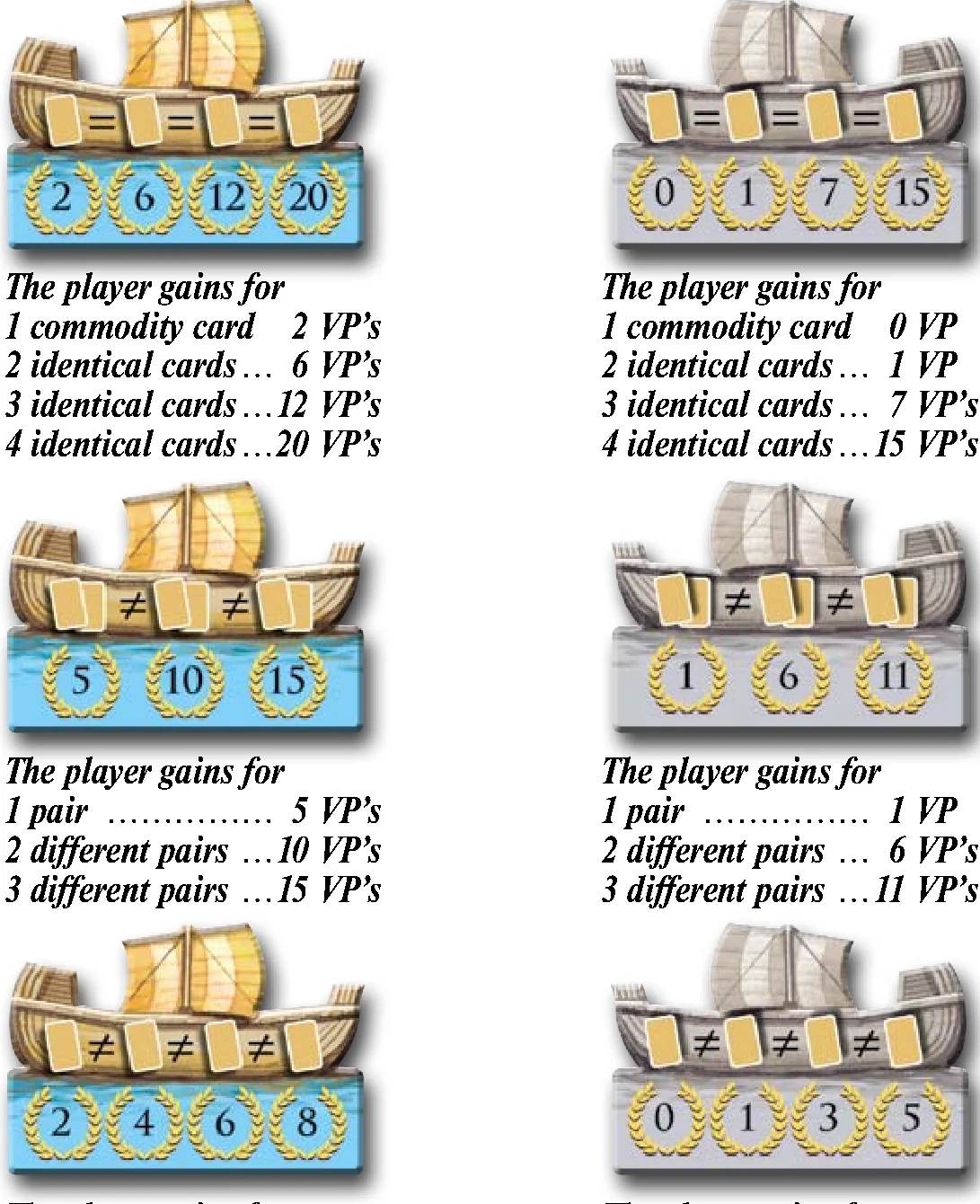
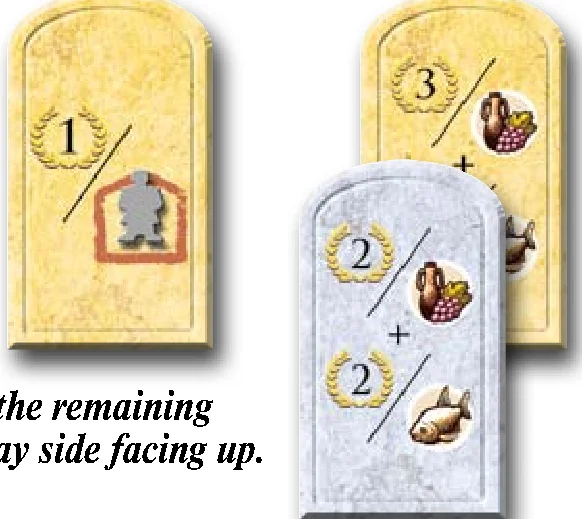
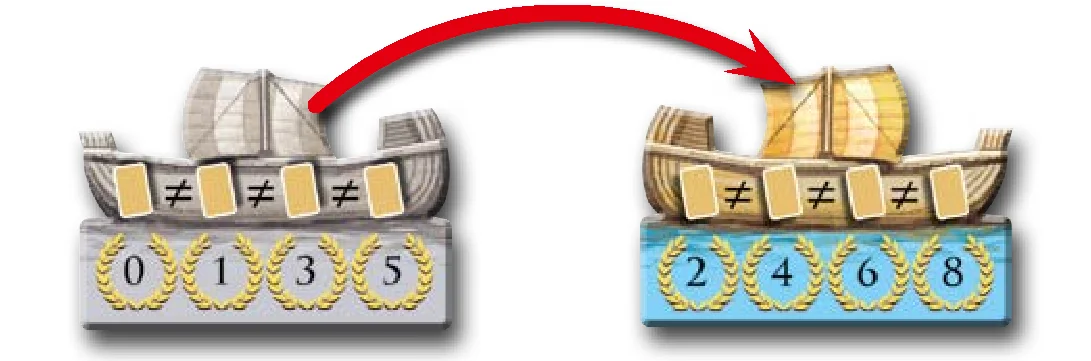
- Ship commodities: The player may ship commodities aboard one of the three ships by playing a combination of cards from their hand in front of themselves. This combination must match the requirement of one of the ship tiles, and the player gains that many victory points (see tables below). If the ship’s colored front side is visible, the player flips it to its gray back side – otherwise they leave it as it is! The played cards are added to the player’s personal display.
 Forum Action
The player takes any one tile of their choice from the forum and places it face up on its designated space of their player mat.
Hint: If necessary (due to lack of space), players may pile up the tiles of their display.
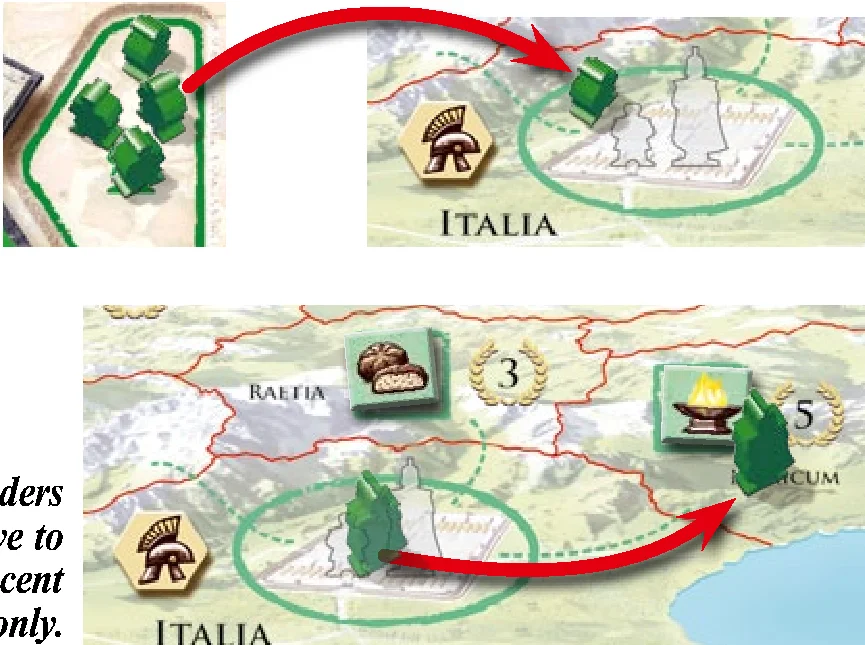
 Military Action
The player must choose one of three options:
- Recruit legionnaire: The player relocates one of their small player tokens from their personal supply on their player mat to the military camp on the game board. Thus, this token turns into a legionnaire until the end of the game.
- Move leader: The player moves their leader to an adjacent province. If they encounter a tile in that province, they simply seize it and place it on their player mat. The military camp is adjacent to three provinces, same as the province of Britannia (dotted green lines).
- Deploy legionnaire: The player relocates one of their legionnaires from the military camp to the current province of their leader, if there is none of their own legionnaires yet. The player immediately gains as many victory points from that province as shown if there are no legionnaires of other players in that province. However, if there are other players’ legionnaires in that province, the number of victory points is reduced by three points for each other legionnaire.
Important: Only one of each player’s legionnaires is allowed in each province.
Please note: Legionnaires do not move from province to province; they go straight to the province of their leader.
Please note: Players never gain less than 0 victory points for a province.
 Trajan Action
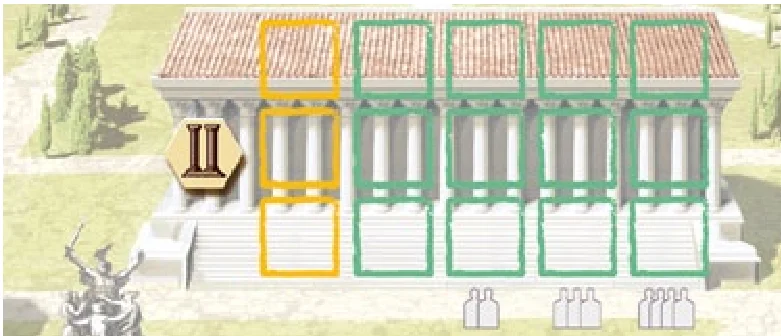
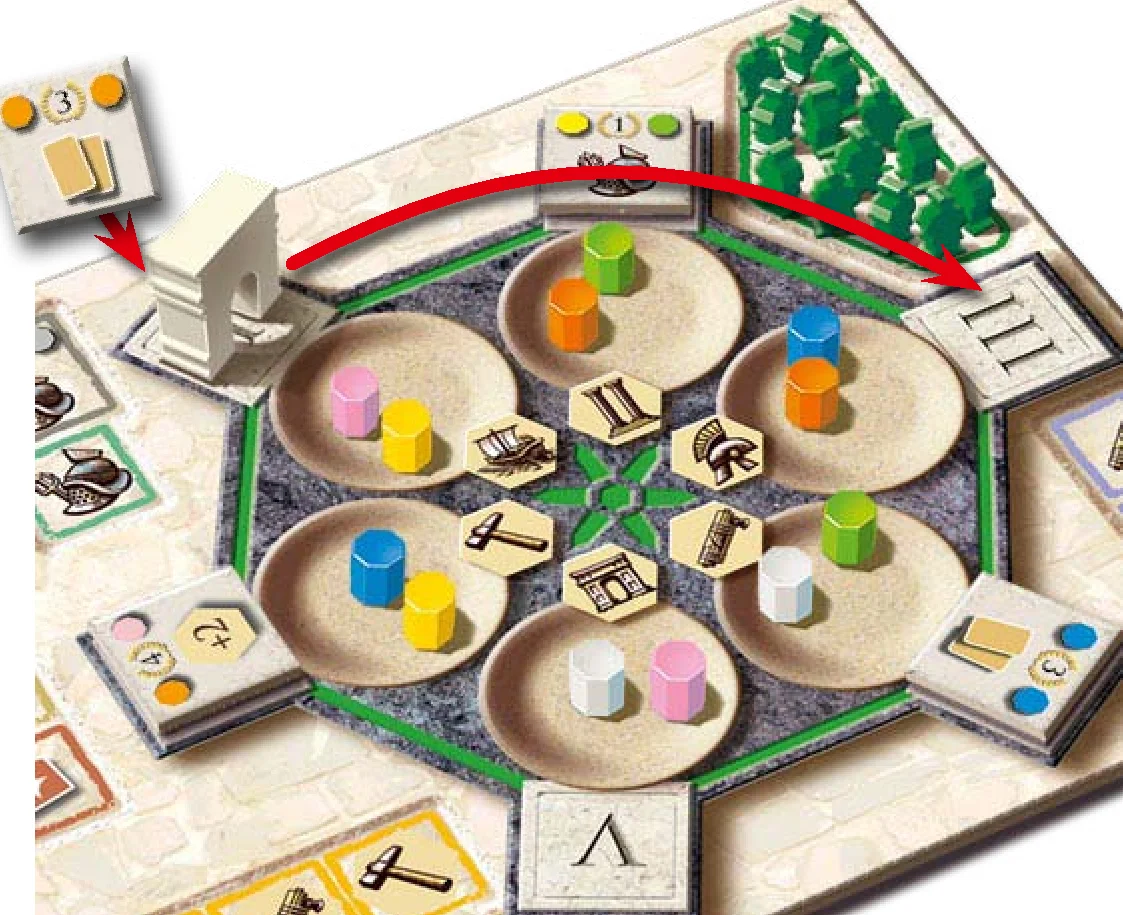
- The player takes the top face-up tile from one of the six stacks of Trajan tiles and puts it on that slot of their player mat currently occupied by their Arch of Trajan.
- Then, they slide the Arch of Trajan to the next free slot in clockwise direction.
- If all slots are occupied by Trajan tiles (i.e. there is no more free slot for the Arch of Trajan), the Arch is placed in the center of the action circle. As soon as they accomplish one of their Trajan tiles, the player moves the Arch to that free slot next to the tray.
- While all possible slots for the Arch of Trajan on a player’s mat are occupied by Trajan tiles, the player cannot perform the Trajan action.
 Senate Action
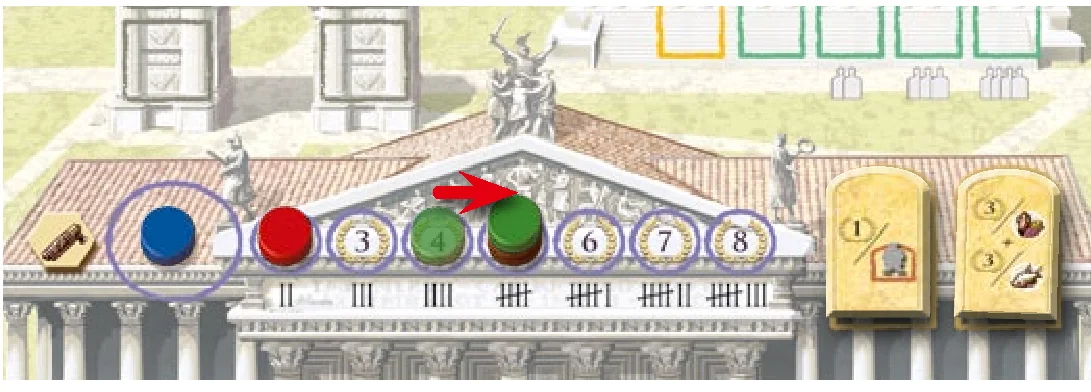
- The player advances their disc on the senate track of the game board by 1 space and gains as many victory points as shown for that new space.
- The active player places their disc on top of any existing markers on that space.
- Once having reached the 8 victory points space, the player cannot perform this action during the current quarter year anymore.
 Construction Action
The player must choose one of two options:
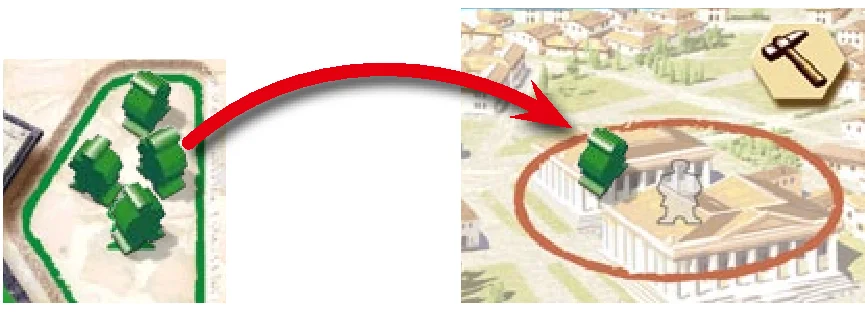
- Recruit worker: The player relocates one of their small player tokens from their personal supply of their player mat to the worker camp on the game board. Thus, this token turns into a worker until the end of the game.
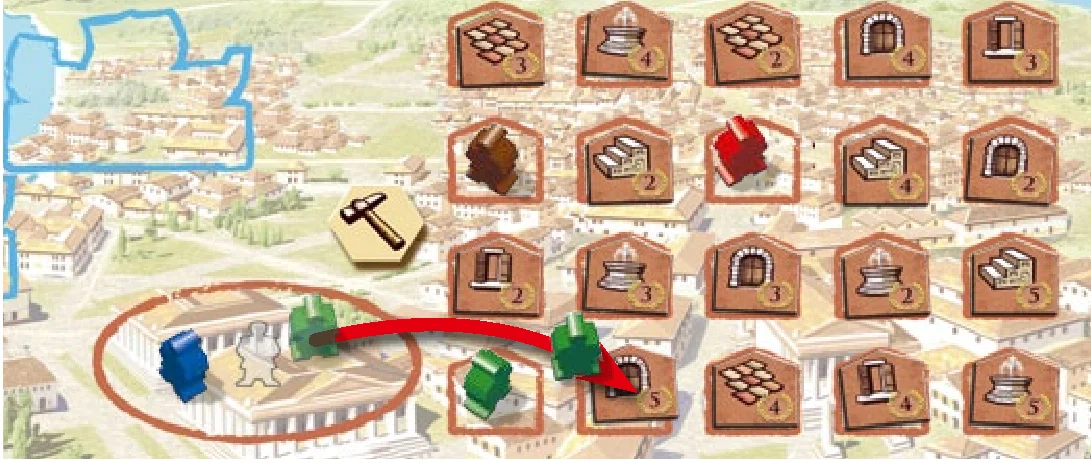
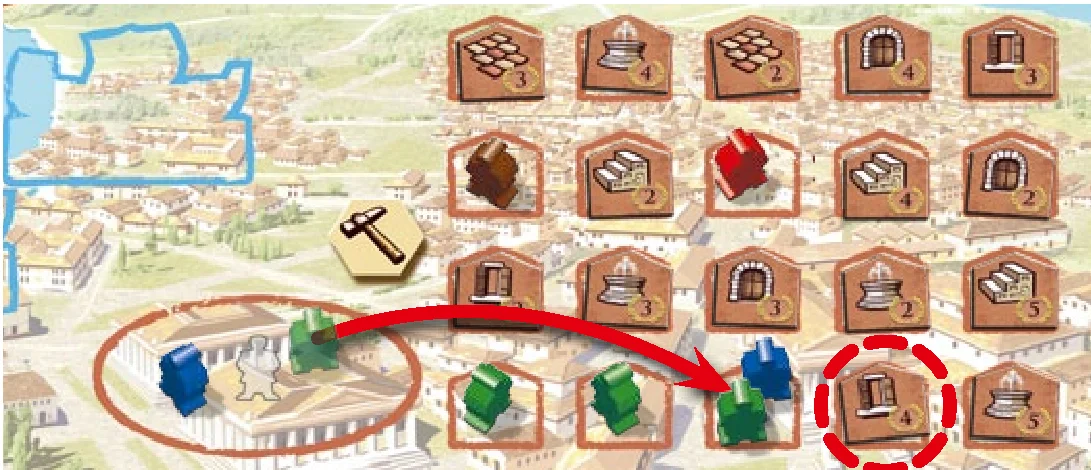
- Deploy worker: The player relocates one of their workers from the worker camp to a construction site:
- If this is their first construction site, they may choose any space in the district. They must place any additional own workers horizontally or vertically adjacent to at least one of their own workers.
- Collecting a tile: In case there is a construction tile on that space, the player places it on the corresponding slot of their player mat and gains the victory points shown on that tile.
- Additional action: If this is the player’s first construction tile of that type, they immediately perform the assigned action, in addition to their ordinary turn. The player is granted this additional action only for each of their first construction tile of its type.
- Building on occupied spaces: A player may deploy their worker to a construction site where workers of other players are working already. This way they do not collect a construction tile, but it helps them to close gaps if they want to approach more lucrative construction sites.
Extra Actions & [+2] Markers
![Extra action tiles and [+2] marker](https://board-game-rules.com/wp-content/uploads/2025/01/extra-action-tiles-and-2-marker.webp)
After performing their action, a player may repeat this action by discarding an extra tile showing the same action icon. If they have a [+2] marker assigned to this action, they may repeat it even a second time.
When used, the tile is removed from the game, but the players keeps their [+2] markers.
Each player may perform only 1 extra action during their turn.
End of a Game Round
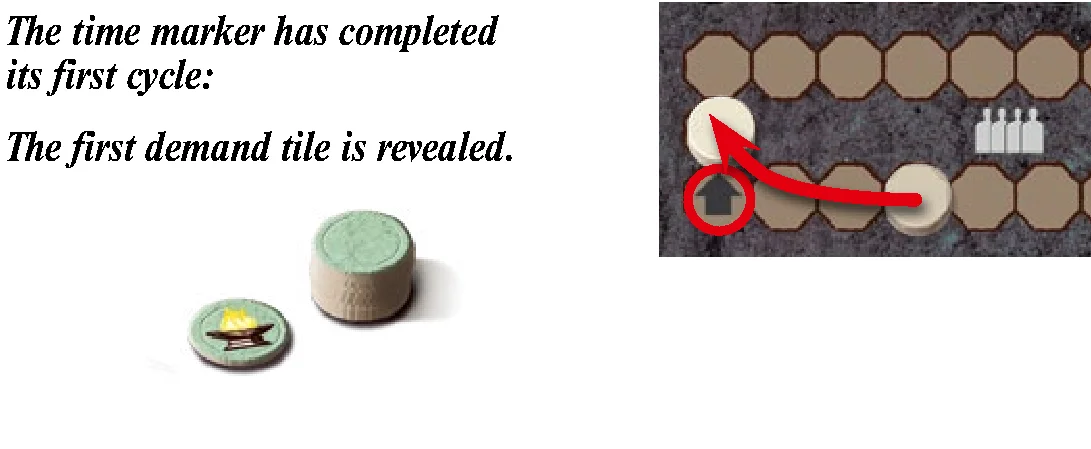
- The current game round ends after the active player’s turn, if the time marker arrives at its start space of the time track or crosses it.
- Reveal a demand tile and place it in good view of all players next to the game board.
- The next player in clockwise direction proceeds with the next game round. The time marker does not change its position at the end of a game round, it simply moves on from its current position.
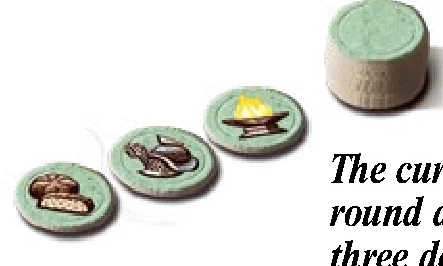
- If there are 3 demand tiles next to the game board at this point (i.e. after four cycles on the time track), this quarter ends. Instead of revealing another demand tile, scoring for this quarter takes place now.
End of a Quarter Year
1. Meeting the People’s Demands
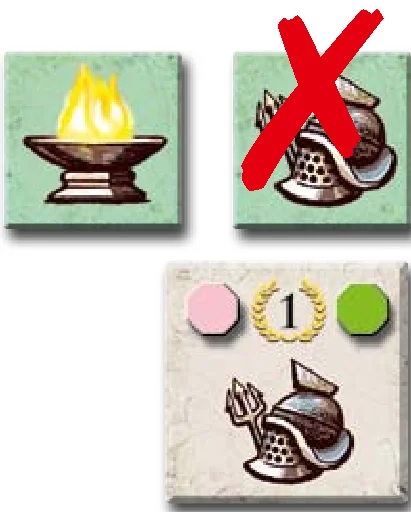
First, each player must meet the people’s demands. The people have voiced three demands and these must be met.
- In order to meet these demands each player has to spend one matching forum tile for each revealed demand tile.
- Also, players may meet a demand by a Trajan tile showing the required demand icon. Each player may use each of their Trajan tiles only once during a quarterly scoring.
- All forum tiles used to meet the people’s demands will be removed from the game later, while players keep the Trajan tiles they had used for this purpose on their mats.
- Important: If a player can meet a demand, they must do so. It is not allowed to forgo meeting a demand voluntarily, thus willfully losing victory points.
If a player cannot meet one or more demands, they lose victory points as follows:
- 1 unmet demand: -4 VP’s
- 2 unmet demands: -9 VP’s
- 3 unmet demands: -15 VP’s
Please note: If a player’s victory marker drops behind the start space of the victory points track, each space up to the start space counts -1 VP.
2. Balance of Power in the Senate
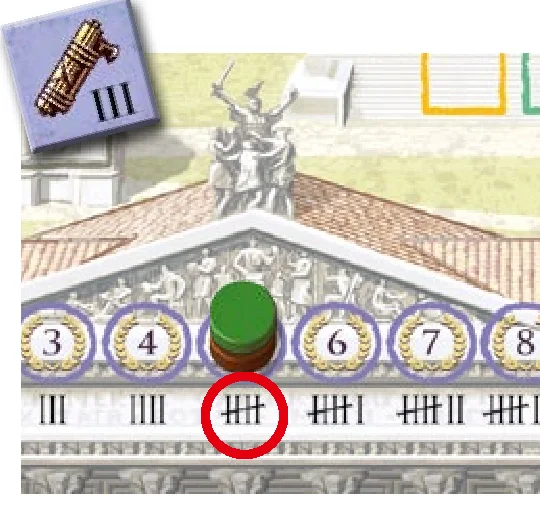
Now all players resolve their influence on the senate, based on the number of their votes. Each player totals:
- the number of votes according to their current position on the senate track
- the number of votes of all senate tiles they have on their mat
Awards:
- Consul: The player controlling the most votes is appointed consul and chooses one of the two bonus tiles on the right of the senate track. They place the chosen tile in front of themselves, yellow side face up.
- Vice Consul: The player controlling the second most votes is appointed vice consul and takes the other bonus tile, which they place with the gray side face up in front of themselves.
- Ties: Ties are broken in favor of the player with the higher position on the senate track; in case of the same position, in favor of that player whose disc is higher up in the stack.
Resetting Senate: Next, remove the vote markers (discs) of all players from the senate track and stack them on the senate start space. Put the disc of the player with the fewest votes at the bottom of the stack and finally the consul’s disc on top.
3. Remove Tiles and Refill Game Board Spaces
First, remove the following tiles from the game:
- All forum tiles that were used to meet the people’s demands.
- All senate tiles, no matter if they were used or not.
- All tiles from the forum (including any extra action tiles).
Then, the following tiles enter the game or are revealed:
- Draw 2 new bonus tiles and place them on their designated spaces in the senate, yellow side face up.
- Place a new forum tile in each province containing neither a military leader nor a legionnaire.
- Refill all forum spaces with new forum tiles; refill the 3 yellow spaces with 3 new extra action tiles. Draw all these tiles randomly and place them face up.
- Turn the ship tiles back to their colored front side.
- Finally, remove the quarter year indicator from the top of the quarter year tiles. The game progresses with the next quarter year and the next player in clockwise direction performs their turn.
If the last quarter year tile was removed, the game ends and a final scoring takes place.
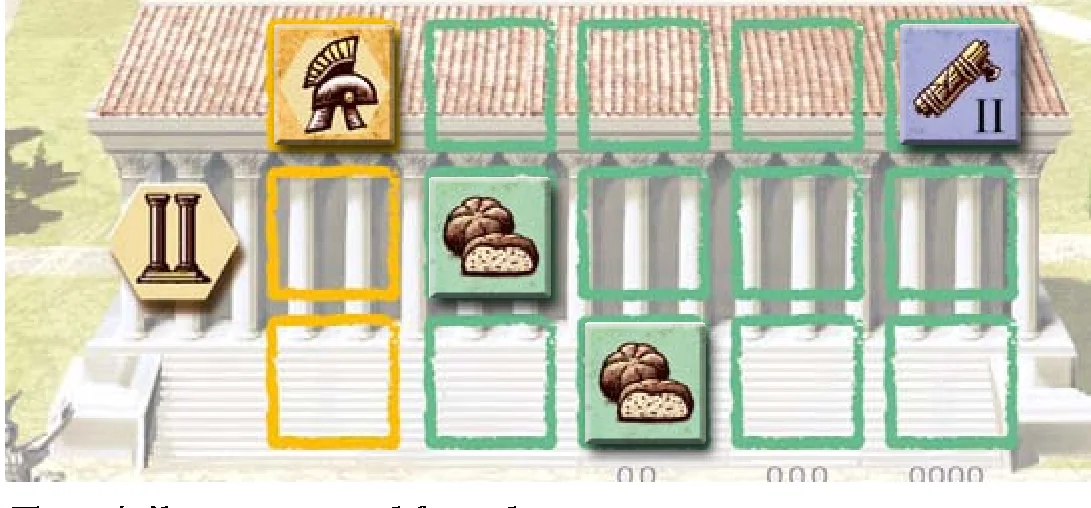
After scoring the final quarter year, a final scoring takes place and the players can gain even more victory points as follows:
- Each commodity card on a player’s hand: 1 VP
- Each worker in the worker camp: 1 VP
- Each legionnaire in the military camp: 1 VP
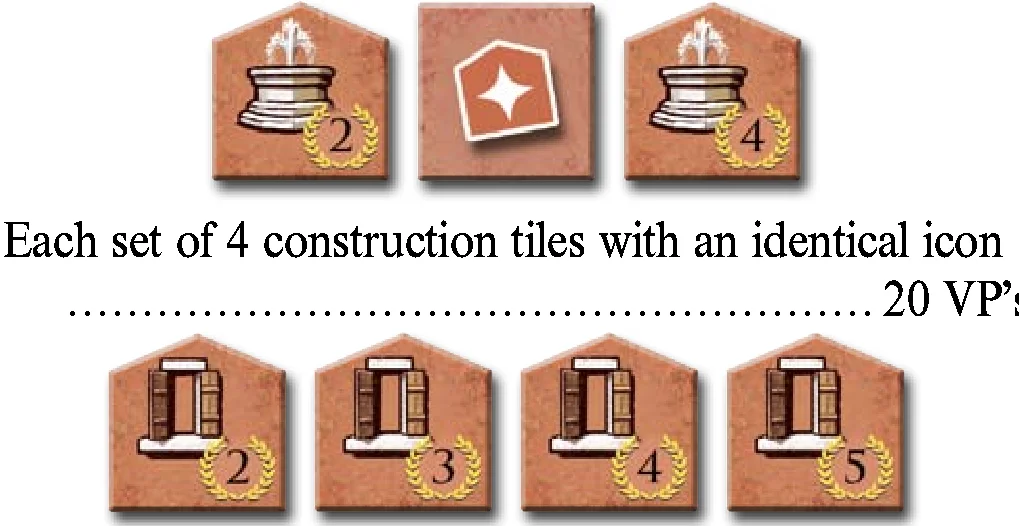
- Each set of 3 construction tiles with an identical icon: 10 VP’s
- Each set of 4 construction tiles with an identical icon: 20 VP’s
- Each bonus tile: see illustrations below
After all players have marked their victory points total, the player with the most victory points is the winner of the game.
A tie for the most victory points is broken in favor of the player occupying the higher position in the senate.
The Bonus Tiles Scoring Reference
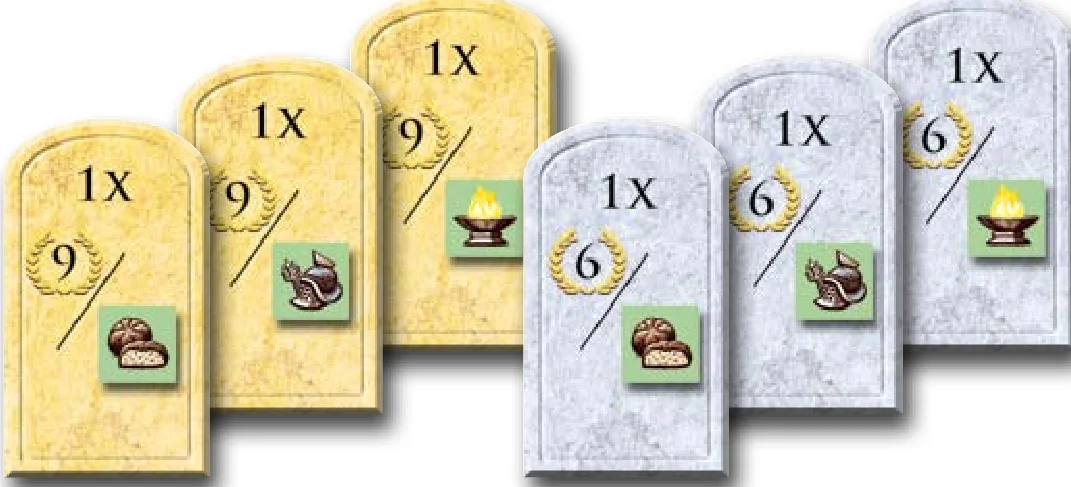
Demand icon bonus tiles (bread, helmet, flame):
- Front (yellow): A player gains 9 VP’s if they own at least 1 forum tile with this icon. Forum tiles must not be confused with Trajan tiles.
- Back (gray): Similar to front, but the player gains 6 VP’s only.
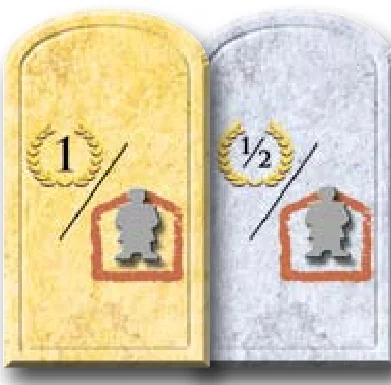
Workers in construction district bonus tile:
- Front (yellow): A player gains 1 VP for each of their own workers in the construction district.
- Back (gray): Similar to front, but the player gains 1/2 VP only (rounded up).
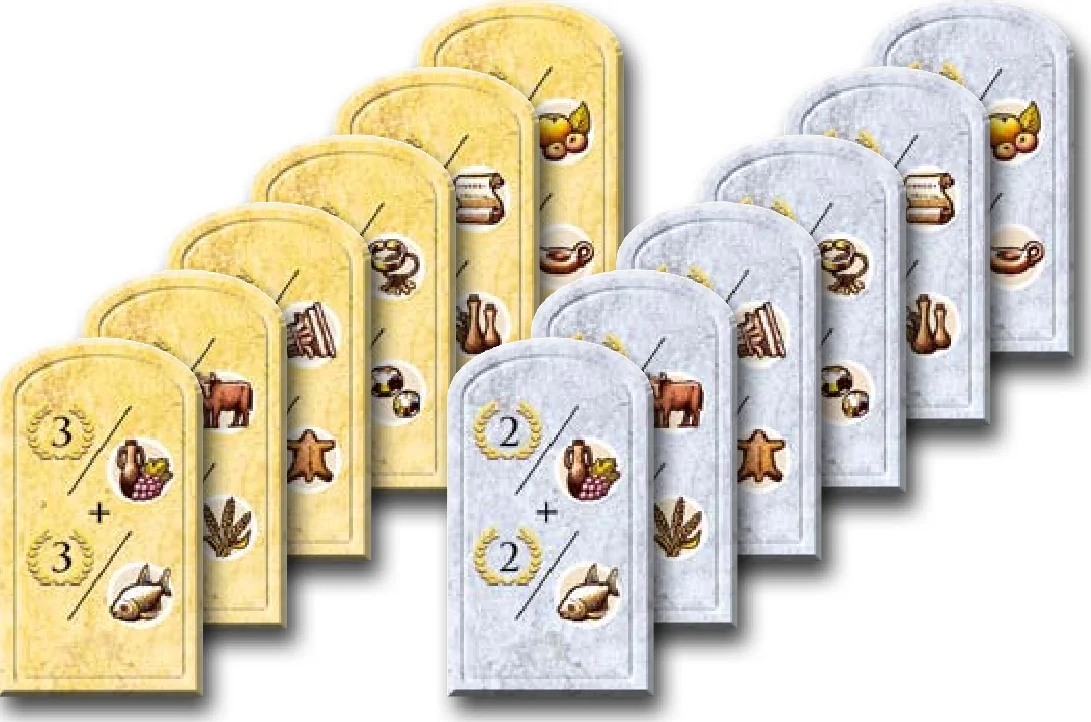
Commodity display bonus tiles:
- Front (yellow): A player gains 3 VP’s for each of these commodity cards of their personal display.
- Back (gray): Similar to front, but the player gains 2 VP’s only.
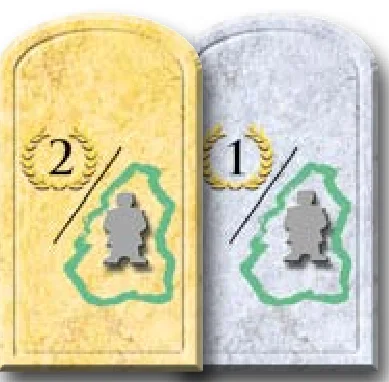
Legionnaires in province bonus tile:
- Front (yellow): A player gains 2 VP’s for each of their own legionnaires in a province.
- Back (gray): Similar to front, but the player gains 1 VP only.
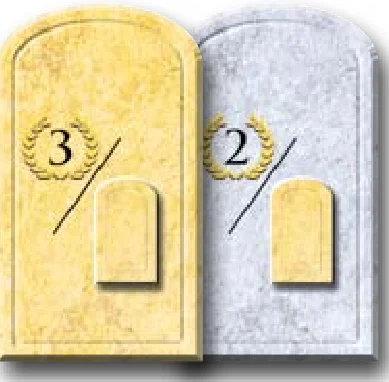
Yellow bonus tiles bonus tile:
- Front (yellow): A player gains 3 VP’s for each of their own yellow bonus tiles.
- Back (gray): Similar to front, but the player gains 2 VP’s only (again, for their yellow bonus tiles).
The Forum Tiles
The back of all forum tile types is identical.
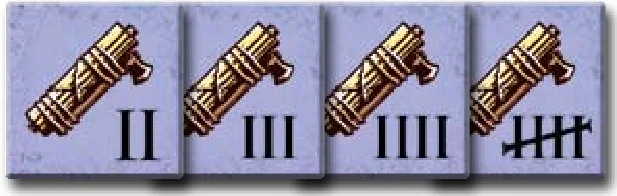
Senate tiles: These give 2 to 5 votes for the balance of power in the senate. All face-up senate tiles are removed from the game at the end of a quarter year.
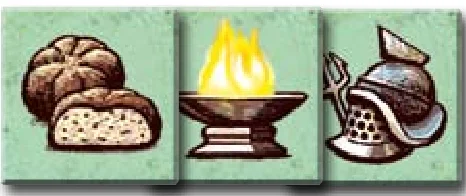
Tiles needed to meet the people’s demands: Each tile shows one icon corresponding to the people’s demands. Once used, the tiles are removed from the game. Players keep their tiles until they use them.
Wild Card Forum Tiles

- Commodity wild card: This wild card is a substitute for any commodity card. It is removed from the game after it has been used. If not used during the game, it may still be used during final scoring (bonus tiles).
- Demand wild card: This wild card is a substitute for any tile needed to meet the people’s demands.
- Construction tile wild card: This wild card is a substitute for any construction tile needed to complete a set during final scoring.
- Extra action wild card: This wild card is a substitute for any extra action tile and is removed from the game subsequently.
Trajan Tiles Special Actions
The following Trajan tiles are removed from the game after the player has performed the corresponding special action (besides gaining victory points as shown):
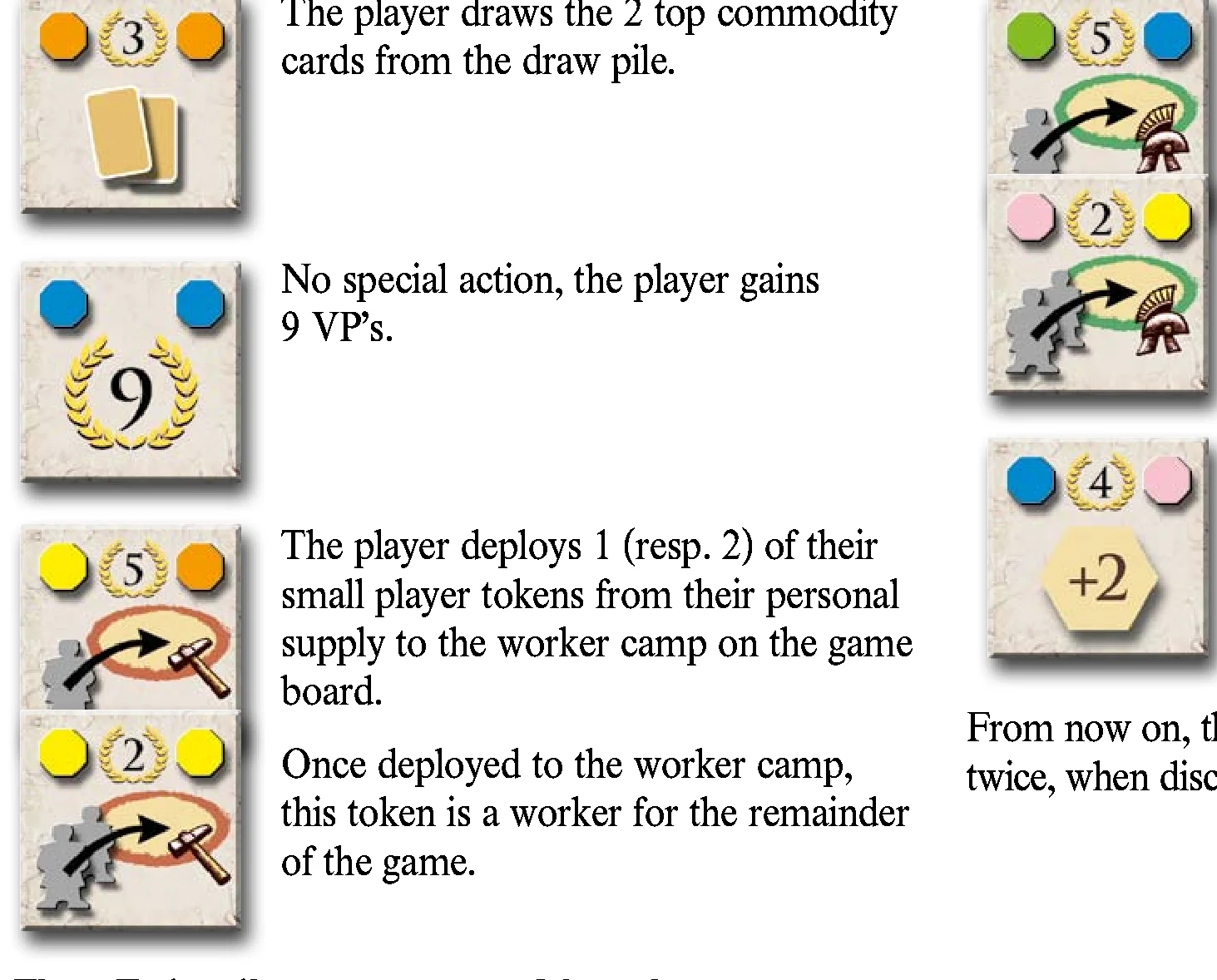
- Draw commodity cards: The player draws the 2 top commodity cards from the draw pile.
- 9 Victory Points: No special action, the player gains 9 VP’s.
- Deploy workers: The player deploys 1 (resp. 2) of their small player tokens from their personal supply to the worker camp on the game board. Once deployed to the worker camp, this token is a worker for the remainder of the game.
- Deploy legionnaires: The player deploys 1 (resp. 2) of their small player tokens from their personal supply to the military camp on the game board. Once deployed to the military camp, this token is a legionnaire for the remainder of the game.
- [+2] marker: The player receives a [+2] marker and assigns it to one of the 6 extra action tile spaces. From now on, the player may perform this extra action twice, when discarding the extra action tile.
Permanent Trajan Demand Tiles
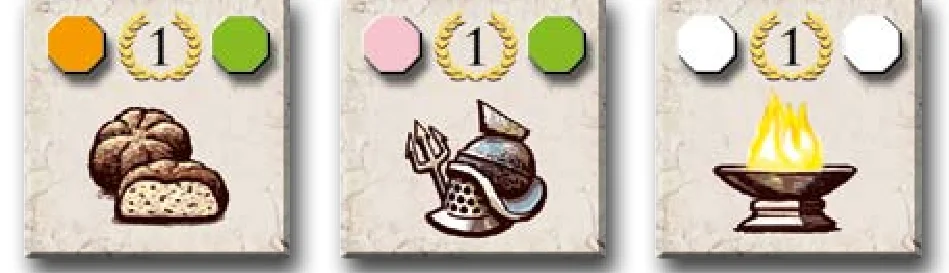
These Trajan tiles are not removed from the game. With these tiles, the player meets the corresponding people’s demands (bread, games, religion) at the end of a quarter year.
Summary of the Game
Length of the Game
The game lasts for 4 quarters of a year.
1 quarter = 4 game rounds
1 game round = 1 cycle of the time marker
Player Turn
- Rearrange action markers (mandatory)
- choose source tray
- resolve target tray
- move time marker
- Accomplish Trajan tile (if possible)
- gain victory points
- special action (optional)
- Perform one action* (optional) (* plus possibly extra action)
- one of 6 actions, depending on the target tray: seaport, forum, Trajan, senate, construction** (** additional action possible), military
End of a Game Round
The time marker arrives at its start space or crosses it:
- reveal demand tile
- no demand tile after 4th round, instead proceed to end of quarter
End of a Quarter Year
- meet people’s demands (possible loss of victory points)
- resolving senate (bonus tile for majority of votes)
- remove tiles and refill tiles of: provinces, forum, senate
- flip gray ship tiles
- remove quarter year tile
End of the Game
Final scoring after 4th quarter. Assign victory points for each:
- commodity card on hand (1 VP)
- worker in worker camp (1 VP)
- legionnaire in military camp (1 VP)
- set of 3 construction tiles (10 VP’s)
- set of 4 construction tiles (20 VP’s)
- bonus tile as shown
Credits
Game designer: Stefan Feld
Graphic design and illustrations: Jo Hartwig
Realization: Bernd Dietrich
English rules: Ferdinand Köther
The designer wants to thank all test players, in particular: Frieder Benzing, Susanne Feld, Jonathan Feld, Benjamin Fleck, Thomas Koslowski, Denis Leonhard, Roland Lurk, Michael Schmitt, Aiko Schuhmann, Christoph Toussaint, Andreas Zimmermann, and the Offenburger-Spiele-Freunden.
The publisher especially wants to thank his many friends for their contribution towards development and publication of Trajan: Meike Baczewski, Thomas Baczewski, Richard Breese, Markus Bungartz, Barbara Dauenhauer, Kai Eimer, Andreas Hoffmann, Hans-Joachim Hönicke, Mathias Jäger, Jürgen Janik, Mary Kandels, Lothar Kothe, Stephan Lies, Sabine Neumann, René Parrot, Ronald Powroznik, Axel Schubien and Stephan Weidemann.
© Copyright 2011 Ammonit, D-68259 Mannheim, Germany
Introduction & Components
110 AD – the Roman Empire is at its height of glory, ruled by the Emperor „optimus princeps“ Trajan. All borders are secured and people can focus their attention again on the empire’s internal matters – ROME.
Take your chances and boost your power! With proper tactics, you may outmanoeuvre your opponents and eventually claim victory.
Object of the Game
The players try to gain victory points, smartly taking their chances offered by the tactical facilities of six different actions.
The key to success is the canny allocation of action markers to the trays of the action circle. Players try to catch the best time for certain actions. On the one hand, it is important to make use of sudden chances (e.g. to get hold of attractive tiles); on the other hand, players must not neglect to give other players a hard time in crucial situations. Additionally, players may scheme relevant actions a few turns in advance.
Regardless of the outcome of your first game, you will become more experienced with each subsequent game and always learn new refinements.
Components
- 1 game board – showing parts of the Roman Empire, starting from Rome’s senate via the Arch of Trajan, the forum and the seaport up to the far-away provinces of Britannia and Germania. The board consists of 6 areas; a specific action is assigned to each area.
- 4 Arches of Trajan – one for each player. It marks the slot on the player mats for a new Trajan tile.
- 60 small player tokens – 15 each in the player colors red, green, dark blue, and brown. They represent the players’ legionnaires or workers.
- 4 sets of octagonal action markers – each set consists of 12 markers in the following colors: 2 each of yellow, orange, light green, white, pink and blue. Players place these markers on the troughs of their action circle.
- 4 military leader tokens and 8 discs – in 4 player colors. The military leaders occupy provinces with their legionnaires. Players use their discs as victory points marker and vote marker in the Senate.
- 1 time marker – used for recording the elapsed playing time.
- 60 commodity cards – 12 commodities, 5 cards of each.
- 4 player mats in the player colors – showing the action circle with 6 trays and providing space for the players’ various collected tiles.
9 different types of tiles:
- 54 Trajan tiles
- 70 Forum tiles
- 12 Extra action tiles
- 20 Construction tiles
- 24 [+2] markers
- 15 Demand tiles (bread • games • religion)
- 3 Ship tiles
- 12 Bonus tiles
- 4 Quarter year tiles
- 1 Linen bag – used for drawing bonus tiles
- 2 Rulebooks – German and English
Setup & Game Preparation
Board and Player Setup
- Game board: Unfold the game board in the center of the playing area.
- Player components: Give each player in their chosen player color:
- 1 player mat
- 1 military leader token
- 15 small player tokens
- 2 discs (to record victory points and position in the senate)
- 1 Arch of Trajan
- 12 action markers (2 each of blue, yellow, light green, orange, pink, and white)
- Extra action and forum tiles: Sort the extra action and forum tiles by their back sides, shuffle them separately, and place them as face-down piles next to the game board.
- Demand tiles: Shuffle the demand tiles face down and randomly remove 3 of them from the game. Place the remaining demand tiles face down next to the game board.
- Placing forum tiles: Randomly draw the following tiles and place them face up on the game board:
- 10 forum tiles in the provinces (1 in each province).
- Designated forum spaces: 6 tiles (2 players), 9 tiles (3 players), or 12 tiles (4 players).
- Place 3 extra action tiles on the yellow spaces of the forum.
- Construction district: Fill all 20 spaces of the construction district with 1 construction tile each.
- Time marker: Place the time marker on the start space of the time cycle apt to the number of players.
- Initial deployment: All players deploy:
- 1 military leader token and 1 small player token to the military camp.
- 1 small player token to the worker camp.
- Keep the remaining 13 small player tokens on the specified area of their player mat.
- Place their Arch of Trajan on the slot marked „I“ of their player mat.
- Action markers setup: Prior to drawing Trajan tiles, players allocate their action markers to the trays of their player mat, filling each tray with 2 markers of any color.
- Trajan tiles: Sort the Trajan tiles by category (icons), shuffle each pile, and allocate the stacks to their 6 spaces on the game board.
Preparing to Play the Game
- Start player & Senate track: Players determine a start player by any method they like. The start player places one of their discs on the start space of the senate track. In clockwise direction, the other players pile up their discs atop the other discs, creating a small stack.
(Note: The stacking order is important, because ties are broken in favor of the disc higher up in the stack.) - Victory points track: The players stack their other discs on the start space of the victory points track (the order of discs in this stack does not matter!).
- Bonus tiles: Each player draws one bonus tile from the bag and places it in front of themselves, yellow side face up. Then, draw 2 more bonus tiles and place them on the game board to the right of the senate track, yellow side face up. Keep the bag with the remaining bonus tiles within easy reach.
- Commodity cards: Shuffle the commodity cards and place the pile face down next to the game board. Reveal the top card and place it face up on one side of the pile, creating a discard pile. Then, reveal the next card from the pile and place it face up at the other side of the pile, creating a second discard pile. Beginning with the start player and continuing in player order, each player draws 3 commodity cards into their hand. Players may take cards from any pile in any combination; whenever a discard pile is empty, fill it with the top card from the face-down pile.
- Select Trajan tiles: During the final step, in player order, all players select 3 Trajan tiles. Each player puts their tiles on the slots marked II, IV and VI of their player mat, in any order they like. At this point, players may not take more than 1 Trajan tile of each category.
Sequence of Play & Turn Structure
The game is played over four quarters of a year. Each quarter consists of 4 game rounds; each round lasts as long as one complete cycle of the time marker on the time track. The number of player turns may differ from round to round.
A player’s turn consists of the following steps, which the active player performs in this order:
- Rearrange action markers and move time marker (mandatory)
- Accomplish Trajan tile (if possible)
- Perform one action (optional)
After a player has completed their turn, the next player in clockwise direction performs their turn.
Step 1: Rearrange Action Markers (Mandatory)
- The player chooses one tray of their player mat and takes all action markers from that tray, announcing their number aloud (see “Move time marker”). The chosen tray must contain at least 1 marker.
- Next, the player allocates the action markers one by one to the next trays in clockwise direction. The player puts one marker in each tray and continues to do so until they have allocated all markers from the chosen tray.
- It is the player’s choice which marker (color) they put in what tray.
- The tray where the player puts the last action marker is the target tray.
Note: If there are more than 6 action markers in the chosen source tray, the player puts two (or more) markers in some of the trays.
Hint: A player influences the playing time of a game round by the number of action markers of the tray they choose as their starting tray.
Move Time Marker (Mandatory)
After the active player has announced the number of their selected action markers, their right neighbor advances the time marker that many spaces on the time track in clockwise direction.
End of a Game Round Trigger
As soon as the time marker arrives at or crosses its start space, the current game round ends after the active player has completed their turn. A quarter of a year ends after 4 game rounds; the game ends after 4 quarters.
In case it is the end of a round, end of a quarter or end of the game, certain activities must be performed before the next player’s turn begins (see comments on pages 8 & 9).
Step 2: Accomplish Trajan Tile (If Possible)
If a Trajan tile lies next to the target tray and if there are action markers in the tray matching the colors shown on the tile, the player removes the tile from their player mat, gains the corresponding victory points and may perform the appropriate special action.
The number of action markers in the target tray does not matter and it is of no concern for how long they may be there already.
Note: It does not matter if the target tray contains more markers than just those of the matching color combination.
After the player has performed their special action, that Trajan tile is removed from the game.
Exception: The player collects any Trajan tiles with the icons bread, helmet or flame on their player mat and these tiles are effective until the end of the game. (See “Extra action tiles” on page 11.)
Step 3: Perform One Action (Optional)
Regardless if the player had accomplished a Trajan tile or not they may now perform the action assigned to the target tray. A unique action is assigned to each tray of the action circle.
The Six Actions
Seaport Action
The player must choose one of four options:
- Draw 2 cards, discard 1: The player may draw 2 commodity cards from the face-down pile and add them to their hand. Then, they must discard 1 card of their choice from their hand and place it face up on top of one of the two discard piles.
- Take from discard: The player may pick up the top commodity card from one of the two discard piles and add it to their hand.
- Display 1 or 2 cards: The player may play 1 or 2 cards from their hand face up in front of themselves. This is the player’s personal display, which could be worth some extra victory points at the end of the game due to certain bonus cards. The player refills their hand by drawing the same number of cards from the face-down draw pile as they had played.
- Ship commodities: The player may ship commodities aboard one of the three ships by playing a combination of cards from their hand in front of themselves. This combination must match the requirement of one of the ship tiles, and the player gains that many victory points (see tables below). If the ship’s colored front side is visible, the player flips it to its gray back side – otherwise they leave it as it is! The played cards are added to the player’s personal display.
Forum Action
The player takes any one tile of their choice from the forum and places it face up on its designated space of their player mat.
Hint: If necessary (due to lack of space), players may pile up the tiles of their display.
Military Action
The player must choose one of three options:
- Recruit legionnaire: The player relocates one of their small player tokens from their personal supply on their player mat to the military camp on the game board. Thus, this token turns into a legionnaire until the end of the game.
- Move leader: The player moves their leader to an adjacent province. If they encounter a tile in that province, they simply seize it and place it on their player mat. The military camp is adjacent to three provinces, same as the province of Britannia (dotted green lines).
- Deploy legionnaire: The player relocates one of their legionnaires from the military camp to the current province of their leader, if there is none of their own legionnaires yet. The player immediately gains as many victory points from that province as shown if there are no legionnaires of other players in that province. However, if there are other players’ legionnaires in that province, the number of victory points is reduced by three points for each other legionnaire.
Important: Only one of each player’s legionnaires is allowed in each province.
Please note: Legionnaires do not move from province to province; they go straight to the province of their leader.
Please note: Players never gain less than 0 victory points for a province.
Trajan Action
- The player takes the top face-up tile from one of the six stacks of Trajan tiles and puts it on that slot of their player mat currently occupied by their Arch of Trajan.
- Then, they slide the Arch of Trajan to the next free slot in clockwise direction.
- If all slots are occupied by Trajan tiles (i.e. there is no more free slot for the Arch of Trajan), the Arch is placed in the center of the action circle. As soon as they accomplish one of their Trajan tiles, the player moves the Arch to that free slot next to the tray.
- While all possible slots for the Arch of Trajan on a player’s mat are occupied by Trajan tiles, the player cannot perform the Trajan action.
Senate Action
- The player advances their disc on the senate track of the game board by 1 space and gains as many victory points as shown for that new space.
- The active player places their disc on top of any existing markers on that space.
- Once having reached the 8 victory points space, the player cannot perform this action during the current quarter year anymore.
Construction Action
The player must choose one of two options:
- Recruit worker: The player relocates one of their small player tokens from their personal supply of their player mat to the worker camp on the game board. Thus, this token turns into a worker until the end of the game.
- Deploy worker: The player relocates one of their workers from the worker camp to a construction site:
- If this is their first construction site, they may choose any space in the district. They must place any additional own workers horizontally or vertically adjacent to at least one of their own workers.
- Collecting a tile: In case there is a construction tile on that space, the player places it on the corresponding slot of their player mat and gains the victory points shown on that tile.
- Additional action: If this is the player’s first construction tile of that type, they immediately perform the assigned action, in addition to their ordinary turn. The player is granted this additional action only for each of their first construction tile of its type.
- Building on occupied spaces: A player may deploy their worker to a construction site where workers of other players are working already. This way they do not collect a construction tile, but it helps them to close gaps if they want to approach more lucrative construction sites.
Extra Actions & [+2] Markers
After performing their action, a player may repeat this action by discarding an extra tile showing the same action icon. If they have a [+2] marker assigned to this action, they may repeat it even a second time.
When used, the tile is removed from the game, but the players keeps their [+2] markers.
Each player may perform only 1 extra action during their turn.
End of Round & Quarter Scoring
End of a Game Round
- The current game round ends after the active player’s turn, if the time marker arrives at its start space of the time track or crosses it.
- Reveal a demand tile and place it in good view of all players next to the game board.
- The next player in clockwise direction proceeds with the next game round. The time marker does not change its position at the end of a game round, it simply moves on from its current position.
- If there are 3 demand tiles next to the game board at this point (i.e. after four cycles on the time track), this quarter ends. Instead of revealing another demand tile, scoring for this quarter takes place now.
End of a Quarter Year
1. Meeting the People’s Demands
First, each player must meet the people’s demands. The people have voiced three demands and these must be met.
- In order to meet these demands each player has to spend one matching forum tile for each revealed demand tile.
- Also, players may meet a demand by a Trajan tile showing the required demand icon. Each player may use each of their Trajan tiles only once during a quarterly scoring.
- All forum tiles used to meet the people’s demands will be removed from the game later, while players keep the Trajan tiles they had used for this purpose on their mats.
- Important: If a player can meet a demand, they must do so. It is not allowed to forgo meeting a demand voluntarily, thus willfully losing victory points.
If a player cannot meet one or more demands, they lose victory points as follows:
- 1 unmet demand: -4 VP’s
- 2 unmet demands: -9 VP’s
- 3 unmet demands: -15 VP’s
Please note: If a player’s victory marker drops behind the start space of the victory points track, each space up to the start space counts -1 VP.
2. Balance of Power in the Senate
Now all players resolve their influence on the senate, based on the number of their votes. Each player totals:
- the number of votes according to their current position on the senate track
- the number of votes of all senate tiles they have on their mat
Awards:
- Consul: The player controlling the most votes is appointed consul and chooses one of the two bonus tiles on the right of the senate track. They place the chosen tile in front of themselves, yellow side face up.
- Vice Consul: The player controlling the second most votes is appointed vice consul and takes the other bonus tile, which they place with the gray side face up in front of themselves.
- Ties: Ties are broken in favor of the player with the higher position on the senate track; in case of the same position, in favor of that player whose disc is higher up in the stack.
Resetting Senate: Next, remove the vote markers (discs) of all players from the senate track and stack them on the senate start space. Put the disc of the player with the fewest votes at the bottom of the stack and finally the consul’s disc on top.
3. Remove Tiles and Refill Game Board Spaces
First, remove the following tiles from the game:
- All forum tiles that were used to meet the people’s demands.
- All senate tiles, no matter if they were used or not.
- All tiles from the forum (including any extra action tiles).
Then, the following tiles enter the game or are revealed:
- Draw 2 new bonus tiles and place them on their designated spaces in the senate, yellow side face up.
- Place a new forum tile in each province containing neither a military leader nor a legionnaire.
- Refill all forum spaces with new forum tiles; refill the 3 yellow spaces with 3 new extra action tiles. Draw all these tiles randomly and place them face up.
- Turn the ship tiles back to their colored front side.
- Finally, remove the quarter year indicator from the top of the quarter year tiles. The game progresses with the next quarter year and the next player in clockwise direction performs their turn.
If the last quarter year tile was removed, the game ends and a final scoring takes place.
End of the Game & Final Scoring
After scoring the final quarter year, a final scoring takes place and the players can gain even more victory points as follows:
- Each commodity card on a player’s hand: 1 VP
- Each worker in the worker camp: 1 VP
- Each legionnaire in the military camp: 1 VP
- Each set of 3 construction tiles with an identical icon: 10 VP’s
- Each set of 4 construction tiles with an identical icon: 20 VP’s
- Each bonus tile: see illustrations below
After all players have marked their victory points total, the player with the most victory points is the winner of the game.
A tie for the most victory points is broken in favor of the player occupying the higher position in the senate.
The Bonus Tiles Scoring Reference
Demand icon bonus tiles (bread, helmet, flame):
- Front (yellow): A player gains 9 VP’s if they own at least 1 forum tile with this icon. Forum tiles must not be confused with Trajan tiles.
- Back (gray): Similar to front, but the player gains 6 VP’s only.
Workers in construction district bonus tile:
- Front (yellow): A player gains 1 VP for each of their own workers in the construction district.
- Back (gray): Similar to front, but the player gains 1/2 VP only (rounded up).
Commodity display bonus tiles:
- Front (yellow): A player gains 3 VP’s for each of these commodity cards of their personal display.
- Back (gray): Similar to front, but the player gains 2 VP’s only.
Legionnaires in province bonus tile:
- Front (yellow): A player gains 2 VP’s for each of their own legionnaires in a province.
- Back (gray): Similar to front, but the player gains 1 VP only.
Yellow bonus tiles bonus tile:
- Front (yellow): A player gains 3 VP’s for each of their own yellow bonus tiles.
- Back (gray): Similar to front, but the player gains 2 VP’s only (again, for their yellow bonus tiles).
Tiles Reference & Special Actions
The Forum Tiles
The back of all forum tile types is identical.
Senate tiles: These give 2 to 5 votes for the balance of power in the senate. All face-up senate tiles are removed from the game at the end of a quarter year.
Tiles needed to meet the people’s demands: Each tile shows one icon corresponding to the people’s demands. Once used, the tiles are removed from the game. Players keep their tiles until they use them.
Wild Card Forum Tiles
- Commodity wild card: This wild card is a substitute for any commodity card. It is removed from the game after it has been used. If not used during the game, it may still be used during final scoring (bonus tiles).
- Demand wild card: This wild card is a substitute for any tile needed to meet the people’s demands.
- Construction tile wild card: This wild card is a substitute for any construction tile needed to complete a set during final scoring.
- Extra action wild card: This wild card is a substitute for any extra action tile and is removed from the game subsequently.
Trajan Tiles Special Actions
The following Trajan tiles are removed from the game after the player has performed the corresponding special action (besides gaining victory points as shown):
- Draw commodity cards: The player draws the 2 top commodity cards from the draw pile.
- 9 Victory Points: No special action, the player gains 9 VP’s.
- Deploy workers: The player deploys 1 (resp. 2) of their small player tokens from their personal supply to the worker camp on the game board. Once deployed to the worker camp, this token is a worker for the remainder of the game.
- Deploy legionnaires: The player deploys 1 (resp. 2) of their small player tokens from their personal supply to the military camp on the game board. Once deployed to the military camp, this token is a legionnaire for the remainder of the game.
- [+2] marker: The player receives a [+2] marker and assigns it to one of the 6 extra action tile spaces. From now on, the player may perform this extra action twice, when discarding the extra action tile.
Permanent Trajan Demand Tiles
These Trajan tiles are not removed from the game. With these tiles, the player meets the corresponding people’s demands (bread, games, religion) at the end of a quarter year.
Summary of the Game & Credits
Summary of the Game
Length of the Game
The game lasts for 4 quarters of a year.
1 quarter = 4 game rounds
1 game round = 1 cycle of the time marker
Player Turn
- Rearrange action markers (mandatory)
- choose source tray
- resolve target tray
- move time marker
- Accomplish Trajan tile (if possible)
- gain victory points
- special action (optional)
- Perform one action* (optional) (* plus possibly extra action)
- one of 6 actions, depending on the target tray: seaport, forum, Trajan, senate, construction** (** additional action possible), military
End of a Game Round
The time marker arrives at its start space or crosses it:
- reveal demand tile
- no demand tile after 4th round, instead proceed to end of quarter
End of a Quarter Year
- meet people’s demands (possible loss of victory points)
- resolving senate (bonus tile for majority of votes)
- remove tiles and refill tiles of: provinces, forum, senate
- flip gray ship tiles
- remove quarter year tile
End of the Game
Final scoring after 4th quarter. Assign victory points for each:
- commodity card on hand (1 VP)
- worker in worker camp (1 VP)
- legionnaire in military camp (1 VP)
- set of 3 construction tiles (10 VP’s)
- set of 4 construction tiles (20 VP’s)
- bonus tile as shown
Credits
Game designer: Stefan Feld
Graphic design and illustrations: Jo Hartwig
Realization: Bernd Dietrich
English rules: Ferdinand Köther
The designer wants to thank all test players, in particular: Frieder Benzing, Susanne Feld, Jonathan Feld, Benjamin Fleck, Thomas Koslowski, Denis Leonhard, Roland Lurk, Michael Schmitt, Aiko Schuhmann, Christoph Toussaint, Andreas Zimmermann, and the Offenburger-Spiele-Freunden.
The publisher especially wants to thank his many friends for their contribution towards development and publication of Trajan: Meike Baczewski, Thomas Baczewski, Richard Breese, Markus Bungartz, Barbara Dauenhauer, Kai Eimer, Andreas Hoffmann, Hans-Joachim Hönicke, Mathias Jäger, Jürgen Janik, Mary Kandels, Lothar Kothe, Stephan Lies, Sabine Neumann, René Parrot, Ronald Powroznik, Axel Schubien and Stephan Weidemann.
© Copyright 2011 Ammonit, D-68259 Mannheim, Germany
