
Gandhi: The Decolonization of British India, 1917 – 1947
2019
A card-assisted COIN game of resistance, colonial policy, communal tension, and India’s struggle for independence.
240
minutes
1 - 4
player(s)
14+
Heavy

About this board game
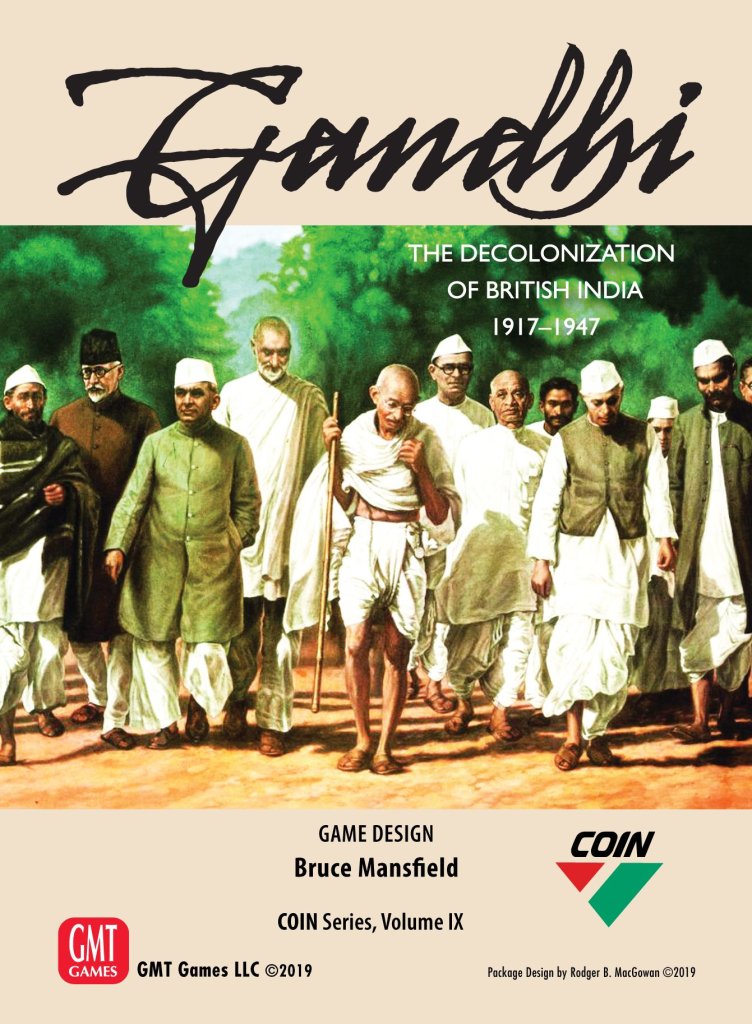
Gandhi: The Decolonization of British India, 1917–1947 is a 2019 historical strategy game for 1–4 players, with play lasting about 240 minutes. As Volume IX in GMT’s COIN Series, it explores the final decades of the British Raj and the struggle to determine India’s future.
Players compete to shape the transition to home rule. Will it be peaceful, lead to partition or civil war, or leave India firmly under imperial control? The game retains the COIN Series’ multi-faction, asymmetrical, card-assisted system while introducing a new Nonviolent faction.
Gandhi is the game’s sole leader piece, while nonviolent activists remain active and are generally immune to Raj actions until they engage in protests or become caught up in post-terror reprisals. Protests can erode support, but they also leave activists vulnerable to arrest by Raj forces.
- A Hindu-Muslim Unity track measures tensions between the two communities and affects resources, operations, and victory.
- A British Rule track reflects changes in colonial policy, from resolve to restraint, altering the cost of several actions.
- British Viceroys change with each passing campaign and provide unique effects for every faction.
- Jail holds nonviolent forces arrested during martial law, while Independent Princely States offer havens to violent and nonviolent insurgents.
Short and medium-length scenarios support the study of different periods of the struggle against British rule. Solitaire, two-player, three-player, and four-player options make Gandhi a flexible examination of civil disobedience, non-cooperation, negotiation, agitation, boycotts, terror, assassination, persuasion, martial law, and constructive programme.
With its blend of historical, political, and cultural themes, Gandhi presents difficult choices about resistance, repression, unity, and decolonization.
/pic7182955.jpg)
