
King of the Dice
2017
Fulfill card requirements with three dice rolls, attract the best citizens, and avoid scoundrels and dragons to become the winning king.
30
minutes
2 - 5
player(s)
8+
Light

About this board game
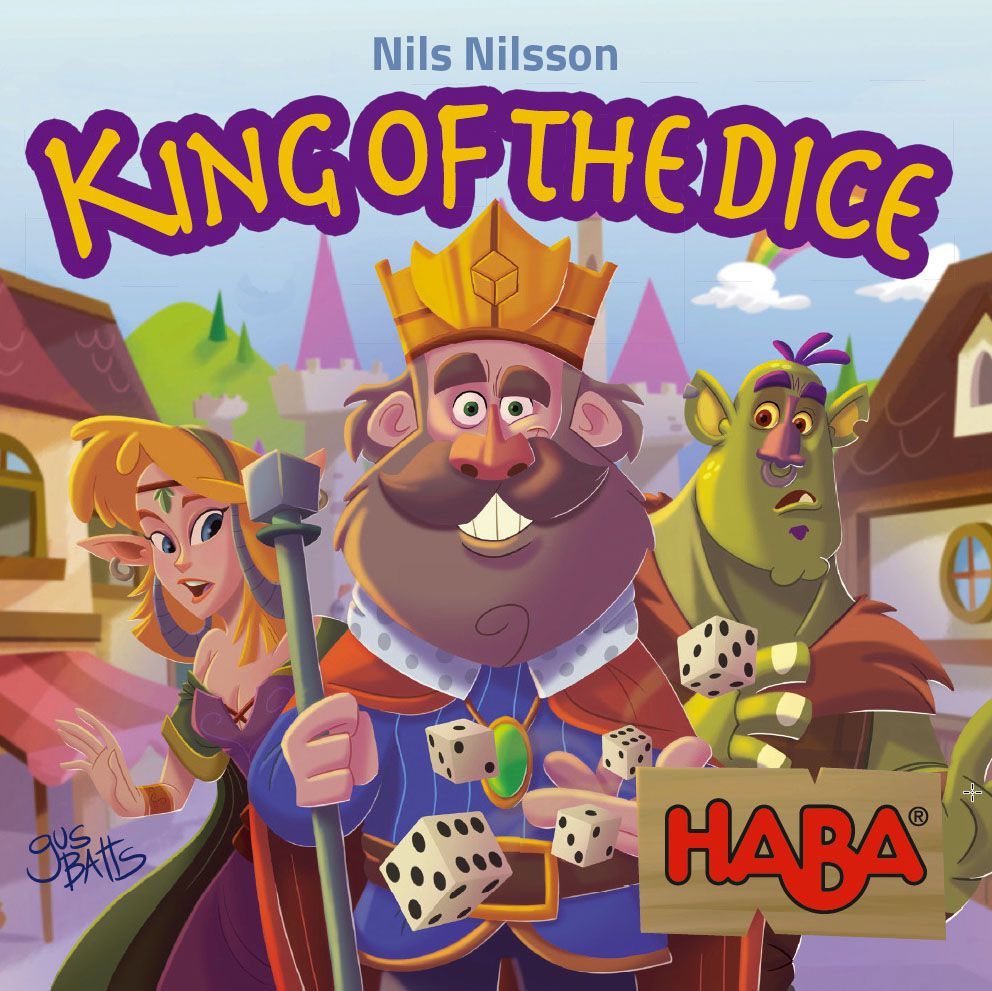
King of the Dice is a dice-driven kingdom-building game for 2–5 players, with games lasting about 30 minutes. You are a newly crowned king with a beautiful realm, but your kingdom needs citizens to truly thrive.
Announce the merits of your kingdom and compete with rival kings for the inhabitants of the land. Cities, gnomes, dwarves, orcs, fairies, and sorcerer’s apprentices may all be drawn to your kingdom, but they will not be won over easily.
To gain new citizens, players must fulfill the requirements shown on various cards using three rolls of the dice. Skill and luck work together as you attempt to secure the most valuable citizens for your growing realm.
- Roll and recruit: Use three dice rolls to meet the requirements on available cards.
- Use special cards: Gain helpful benefits while watching out for troublesome scoundrels and dragons.
- Compare your citizens: At the end of the game, the player with the best citizens wins.
Special cards can support your plans, but dangers may undermine your progress. If you are not careful, a thriving kingdom can quickly become a wretched wasteland, leaving another player to claim the title of King of the Dice.
With its colorful fantasy setting and straightforward dice-and-card challenge, King of the Dice invites players to balance opportunity, luck, and careful choices while building the strongest kingdom. Recruit wisely and make your kingdom thrive.
/pic7182955.jpg)
Board Game Rules for
King of the Dice
A tricky dice game for 2 – 5 players for 8 years and up
By Nils Nilsson
You’re finally a king! All your dreams have been fulfilled. You sit content in your castle and look out over your wonderful kingdom. Green meadows, rolling fields, high mountains and clear rivers stretch as far as your eyes can see… but one thing is missing from your kingdom: citizens! So you announce the merits of the kingdom all over the country – in the rich cities, to the crazy gnomes in their workshops, to the dwarves in their deep mines, and also to the orcs, fairies and the sorcerer’s apprentices.
But the citizens aren’t easily convinced; after all there are also other kings trying to win them over. That’s why you need skill and luck with the dice to entice the best citizens to your kingdom. But watch out for scoundrels and dragons. Otherwise your thriving kingdom will soon be a wretched wasteland, and you’ll have to watch as someone else is crowned King of the Dice.
Contents
- 6 dice
- 65 game cards (15 village cards, 10 penalty cards and 40 citizen cards)
- 1 set of instructions
Sort the game cards into village, penalty and citizen cards. The different game cards have different backs. This makes them easier to sort.

- Sort the village cards into 5 stacks according to the color on the front. In each of these stacks the card with the number value 4 should be on the bottom, then the card with 3 and on top the card with 2. Now the village cards must be sorted according to the sequence shown:
city, mine, workshop, orc village, enchanted forest

- Shuffle all the citizen cards and place them as a face-down draw pile to the bottom left of the row of village cards. Take the first five citizen cards from the draw pile and place them face-up from left to right underneath the village cards.
- Shuffle the penalty cards and place them a little further away as a face-up pile to the right of the citizen cards. To the left of the penalty cards there is space for the discard pile. Get the dice ready.

Play in a clockwise direction. The oldest king has the honor of being the starting player.
A player’s turn consists of 3 steps:
- Roll the dice
- Acquire new citizens (+ possibly establish a new village) OR Take a penalty card
- Fill up the row of cards
1. Roll the dice
Take the six dice and try to roll them to claim one of the face-up citizen cards – ideally one with the highest possible number of victory points. The victory points that a card is worth are listed in the top left corner of the card. The following rules apply when rolling the dice:
- You may roll a maximum of three times.
- After each roll you may put as many dice as you like aside and roll again with the remaining dice.
- You may also decide to reroll dice that were set aside earlier.
- After the third roll the number of points will be added together. You may stop and count the number of points earlier if desired.
2. Take Cards
2a. Acquire new citizens
If you can fulfil the conditions of one of the face-up citizen cards with your dice result then you may take this card. If you can fulfil the conditions of multiple cards then you must decide on one of them. The cards that you collect during the game are collected face-up in front of you, in your kingdom pile.
The requirements of all citizen cards can be found in the card overview at the end of the instructions.

Establish a new village
For your kingdom to be successful you not only need to attract lots of citizens, but also establish new villages. If there is a citizen card that you can fulfil the requirements for underneath a village card of the same color then you can take the top village card as well as the citizen card. Both are placed face-up on your kingdom pile. The village card is placed under the citizen card.

2b. Take penalty card (Scoundrel)
Does your dice result not let you fulfil the requirements of any of the face-up citizen cards? Then you need to take the top penalty card and place it on your kingdom pile. The minus points listed on the scoundrel will be deducted from your victory points at the end of the game. You must also place the right-most face-up citizen card face-down on the discard pile.

3. Fill up the row of cards
There is now one empty space in the row of face-up citizen cards. Move all cards left of the empty space one spot to the right, so that the empty space is now under the first village card pile. Place a new citizen card from the draw pile face-up in this space.

Warning: If you took a hypnotist (see description of the hypnotist) and an additional citizen card then the row of cards must be filled up with two new citizen cards.
You then pass the dice to the next player and your turn is over.
The game ends as soon as one of you takes the last card from one of the following card stacks:
- Citizen draw pile
- Stack of penalty cards, or
- One of the stacks of village cards
Each player takes their kingdom pile and adds together their victory points. The appropriate minus points are deducted for scoundrels and dragons.
The person with the most victory points wins the game. If there is a tie the player with the least minus points on their cards wins.

Rich snob
All six dice must show either even ( ) or odd (
 ) numbers.

Arrogant elf
You must be able to create a run of numbers, on as many dice as pictured, i.e. the numbers rolled must be consecutive.
Effect: When it is your turn again and this card is on top of your kingdom pile then in this turn you may roll the dice four times instead of only three times. At the latest after the fourth roll, the number of points will be added together.

Grumpy dwarf
The number of dice pictured on the card needs to show the pictured number.

Crazy gnome
The number of dice on the card needs to show the pictured color.

Cuddly orc
With your dice result you need to create the number pairs or groups: each symbol stands for a number of your choice. It should be noted that the different symbols may not be the same number. You can decide which number is represented by each symbol. The number of dice on the card show how many dice are needed.

Strange mushroom goblin
The number of dice on the card needs to show the pictured color. The player decides on the color. They do not need to decide on the color in advance.

Talented sorcerer’s apprentice
The number of dice on the card needs to show the pictured colors.
Effect: If you get this card you may take another turn once your turn is completed.

Busy fairy
The number of dice on the card needs to show the pictured colors.
Special points: The more fairy cards you collect, the more victory points you receive for each fairy card at the end of the game. For one fairy card you receive one victory point, for two fairy cards you receive two victory points per fairy card, and so on.

The hypnotist
The sum of all the dice may not add up to more than 12.
Effect: If you can take this card then as a bonus you may also take the citizen card (including the matching village card if applicable) that is located to the right of the hypnotist. If the hypnotist is to the very right of the row you do not receive an additional card.

Dragon
The sum of all 6 dice must be equal to or greater than the stated value.
Effect: If you take this card you must give it to one of the other players. They must place it face-up on their kingdom pile. At the end of the game the minus points will be deducted from this player’s score.
Author: Nils Nilsson
Illustrator: Gus Batts
Redaction: Tim Rogasch
© HABA-Spiele Bad Rodach 2017, Art.-Nr. 303590
Introduction & Components
A tricky dice game for 2 – 5 players for 8 years and up
By Nils Nilsson
You’re finally a king! All your dreams have been fulfilled. You sit content in your castle and look out over your wonderful kingdom. Green meadows, rolling fields, high mountains and clear rivers stretch as far as your eyes can see… but one thing is missing from your kingdom: citizens! So you announce the merits of the kingdom all over the country – in the rich cities, to the crazy gnomes in their workshops, to the dwarves in their deep mines, and also to the orcs, fairies and the sorcerer’s apprentices.
But the citizens aren’t easily convinced; after all there are also other kings trying to win them over. That’s why you need skill and luck with the dice to entice the best citizens to your kingdom. But watch out for scoundrels and dragons. Otherwise your thriving kingdom will soon be a wretched wasteland, and you’ll have to watch as someone else is crowned King of the Dice.
Contents
- 6 dice
- 65 game cards (15 village cards, 10 penalty cards and 40 citizen cards)
- 1 set of instructions
Setup
Sort the game cards into village, penalty and citizen cards. The different game cards have different backs. This makes them easier to sort.
- Sort the village cards into 5 stacks according to the color on the front. In each of these stacks the card with the number value 4 should be on the bottom, then the card with 3 and on top the card with 2. Now the village cards must be sorted according to the sequence shown:
city, mine, workshop, orc village, enchanted forest
- Shuffle all the citizen cards and place them as a face-down draw pile to the bottom left of the row of village cards. Take the first five citizen cards from the draw pile and place them face-up from left to right underneath the village cards.
- Shuffle the penalty cards and place them a little further away as a face-up pile to the right of the citizen cards. To the left of the penalty cards there is space for the discard pile. Get the dice ready.
How to Play
Play in a clockwise direction. The oldest king has the honor of being the starting player.
A player’s turn consists of 3 steps:
- Roll the dice
- Acquire new citizens (+ possibly establish a new village) OR Take a penalty card
- Fill up the row of cards
1. Roll the dice
Take the six dice and try to roll them to claim one of the face-up citizen cards – ideally one with the highest possible number of victory points. The victory points that a card is worth are listed in the top left corner of the card. The following rules apply when rolling the dice:
- You may roll a maximum of three times.
- After each roll you may put as many dice as you like aside and roll again with the remaining dice.
- You may also decide to reroll dice that were set aside earlier.
- After the third roll the number of points will be added together. You may stop and count the number of points earlier if desired.
2. Take Cards
2a. Acquire new citizens
If you can fulfil the conditions of one of the face-up citizen cards with your dice result then you may take this card. If you can fulfil the conditions of multiple cards then you must decide on one of them. The cards that you collect during the game are collected face-up in front of you, in your kingdom pile.
The requirements of all citizen cards can be found in the card overview at the end of the instructions.
Establish a new village
For your kingdom to be successful you not only need to attract lots of citizens, but also establish new villages. If there is a citizen card that you can fulfil the requirements for underneath a village card of the same color then you can take the top village card as well as the citizen card. Both are placed face-up on your kingdom pile. The village card is placed under the citizen card.
2b. Take penalty card (Scoundrel)
Does your dice result not let you fulfil the requirements of any of the face-up citizen cards? Then you need to take the top penalty card and place it on your kingdom pile. The minus points listed on the scoundrel will be deducted from your victory points at the end of the game. You must also place the right-most face-up citizen card face-down on the discard pile.
3. Fill up the row of cards
There is now one empty space in the row of face-up citizen cards. Move all cards left of the empty space one spot to the right, so that the empty space is now under the first village card pile. Place a new citizen card from the draw pile face-up in this space.
Warning: If you took a hypnotist (see description of the hypnotist) and an additional citizen card then the row of cards must be filled up with two new citizen cards.
You then pass the dice to the next player and your turn is over.
End of the Game
The game ends as soon as one of you takes the last card from one of the following card stacks:
- Citizen draw pile
- Stack of penalty cards, or
- One of the stacks of village cards
Each player takes their kingdom pile and adds together their victory points. The appropriate minus points are deducted for scoundrels and dragons.
The person with the most victory points wins the game. If there is a tie the player with the least minus points on their cards wins.
Card Overview
Rich snob
All six dice must show either even () or odd () numbers.
Arrogant elf
You must be able to create a run of numbers, on as many dice as pictured, i.e. the numbers rolled must be consecutive.
Effect: When it is your turn again and this card is on top of your kingdom pile then in this turn you may roll the dice four times instead of only three times. At the latest after the fourth roll, the number of points will be added together.
Grumpy dwarf
The number of dice pictured on the card needs to show the pictured number.
Crazy gnome
The number of dice on the card needs to show the pictured color.
Cuddly orc
With your dice result you need to create the number pairs or groups: each symbol stands for a number of your choice. It should be noted that the different symbols may not be the same number. You can decide which number is represented by each symbol. The number of dice on the card show how many dice are needed.
Strange mushroom goblin
The number of dice on the card needs to show the pictured color. The player decides on the color. They do not need to decide on the color in advance.
Talented sorcerer’s apprentice
The number of dice on the card needs to show the pictured colors.
Effect: If you get this card you may take another turn once your turn is completed.
Busy fairy
The number of dice on the card needs to show the pictured colors.
Special points: The more fairy cards you collect, the more victory points you receive for each fairy card at the end of the game. For one fairy card you receive one victory point, for two fairy cards you receive two victory points per fairy card, and so on.
The hypnotist
The sum of all the dice may not add up to more than 12.
Effect: If you can take this card then as a bonus you may also take the citizen card (including the matching village card if applicable) that is located to the right of the hypnotist. If the hypnotist is to the very right of the row you do not receive an additional card.
Dragon
The sum of all 6 dice must be equal to or greater than the stated value.
Effect: If you take this card you must give it to one of the other players. They must place it face-up on their kingdom pile. At the end of the game the minus points will be deducted from this player’s score.
Author: Nils Nilsson
Illustrator: Gus Batts
Redaction: Tim Rogasch
© HABA-Spiele Bad Rodach 2017, Art.-Nr. 303590
