
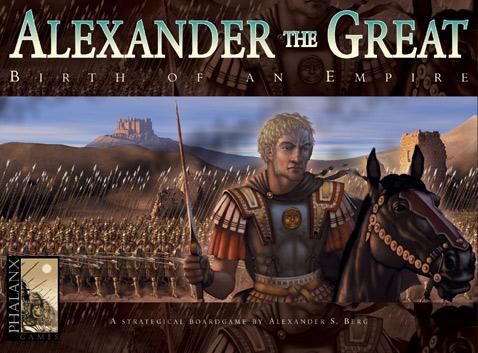
Alexander the Great: Birth of an Empire
2005
Use hidden cube allocations to control turn order, move armies, build temples, and found cities in a tense majority-scoring contest.
75
minutes
2 - 5
player(s)
10+
Medium

About this board game
Alexander the Great: Birth of an Empire is a strategy board game for 2–5 players, with an average playing time of 75 minutes. Players follow the path of Alexander’s army, occupying provinces, building temples, founding cities, and competing for majorities across the ancient world.
Each round, players secretly distribute 15 tiny wooden cubes across four sections of a hidden plan. These choices determine turn order, army size, temple building, and city building. Once the plans are revealed, players must turn their allocations into a coherent campaign while watching how their opponents have spent their cubes.
- The player with the most cubes in the turn-order section chooses when to act.
- Cubes assigned to armies place forces on the board, with provincial majorities scoring points during the game.
- Army movement costs cubes, which are taken from the temple and city sections.
- Temples and cities can be built where your soldiers are present, but competing players must outbid one another.
When players compete for the same opportunity, the highest bidder succeeds but pays one more cube than the second-highest bidder. Unspent cubes can carry into the next round when players face little opposition, creating opportunities for carefully timed expansion.
Players score points throughout the game for controlling armies, building temples, and founding cities. During the rounds, temples are worth 3 points and cities are worth 5 points. When the final region is conquered, end-game scoring rewards majorities of temples and cities in each region and across the entire game; at that stage, cities are worth 10 points and temples are worth 15.
With five regions in the full game—and regions 2 through 4 available for a shorter game—Alexander the Great: Birth of an Empire combines planning, bluffing, tactics, and group judgment in a clever majority contest.
/pic7182955.jpg)
