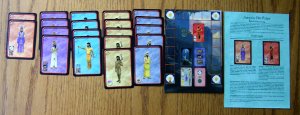
Amyitis
2007
Recruit craftsmen, move the caravan, trade, and develop gardens, irrigation, temples, and palaces to become Babylon’s most prestigious architect.
120
minutes
2 - 4
player(s)
12+
Medium Heavy


About this board game
Amyitis is a strategy board game for 2–4 players, with a playing time of about 120 minutes, in which rival architects compete to build the Hanging Gardens of Babylon and earn the most prestige.
Players take the roles of noble Babylonians seeking to raise their status through garden construction, irrigation, trade, and recruitment. They can acquire plants, hire craftsmen, develop irrigation, trade with ancient cities, build their palace, and seek control of the temples.
Each turn, a player chooses one of three actions. Recruiting a craftsman grants an action connected to a priest, resource, irrigation, or camel. Moving the caravan allows the player to purchase a plant or court card, or to trade. Passing can potentially provide income.
- Build gardens and expand the irrigation network.
- Recruit craftsmen to gain useful actions.
- Move the caravan to purchase plants, acquire court cards, or trade.
- Gain prestige through gardens, the palace, and control of temples.
The game is inspired by the story of Amyitis, whose homesickness for the forested mountains of the Median Empire is said to have led King Nebuchadnezzar II to create the Hanging Gardens of Babylon for her. Against this historical and mythical backdrop, players compete to shape the city and elevate their own standing.
Amyitis is an interactive contest in which one player’s choices directly affect the others. Careful timing, development, trading, and recruitment all contribute to the final struggle for prestige, with victory going to the player who has earned the most by the end of the game.
Thematics
Designer
Illustrator


Board Game Rules for
Amyitis
Amyitis
Game design by Cyril Demaegd – Illustrations by Arnaud demaegd – Layout by Cyril Demaegd
FAQ & forum : http://www.ystari.com
We would like to thank the whole team for their valuable help. Special thanks to William for his incisive advice, Thomas for his legendary obstinacy, and his endless cube stocking, Thibaut and Manu for the endless testing and the final touches which make a difference, Manu for his enthusiasm and Elvire for letting him play! Thanks to all the others (Dim and Anne-Cath, Adrien, Dom, Fabien, Thomas, Raphi, Nath and Renaud, Seb and Malcolm…), I don’t forget you – without you the game couldn’t possibly have seen the light of day!
Finally, Cyril and Arnaud would especially like to dedicate the fruit of their toil to Arthur!
Once upon a time…
590BC. Nebuchadnezzar, the king of Babylon, marries the magnificent Amyitis, the king of Media’s daughter. But the beauty languishes for the lush vegetation of her land. Nebuchadnezzar wants to have splendid hanging gardens built for her. Now, the city is getting ready to take up the tremendous challenge which will leave an indelible mark for the centuries to come…
Goal of the game
The players embody noble Babylonians in quest of prestige. All along the game, they strive to raise their status by building gardens and their irrigation network, and by trading and recruiting. At the end of the game, the player with the highest prestige is the winner.
Symbols
 These symbols indicate the quality of a plant (1, 2 or 3).
- Round symbols represent a token. Here : a resource (any kind)
 , a camel
 and a talent
 .
- Framed symbols indicate a Court card: here, a Caravaneer
 and a Banker
 .
- This symbol indicates a Court card chosen by a player: a Banker, a Caravaneer, the Palace or a Gardener:
 .
Contents
- 1 Babylon board and 1 Mesopotamia board
- 20 Garden tiles
- approximately 135 cubes in 5 colors: blue, red, black, white, and grey (neutral cubes)
- 4 score markers in 4 colors: blue, red, black, and white
- 35 resource tokens belonging to 5 types: Barley, Dates, Salt, Palm, and Wine
- 14 camel tokens
- 30 silver coins (Talents)
- 56 cards (18 Craft cards, 4 Plant cards, 31 Court cards, 2 Amyitis cards, 1 First player card)
- this booklet
Game Principles
- Babylon board: this board represents the hanging gardens of Babylon. They are divided into sixteen squares to be planted with gardens (A), as well as areas to be irrigated (B1). The gardens are laid out on four floors (V-shaped). The highest floors are better to gain prestige, but they are harder to irrigate (B2) and must be planted with plants of better quality (C). The board also features fields (D) that enable the players to produce resources by recruiting peasants, as well as three temples dedicated to Ishtar (E1), Marduk (E2) and Tammouz (E3) that yield bonuses to the most zealous priests, a ‘Pass’ square (F) and a scoring track (G) to measure out the players’ prestige during the game.
- Mesopotamia: this board represents Mesopotamia, and the cities which trade with Babylon. By spending camels, the players move the Caravan (H) from one city to the next, clockwise. Upon arriving in a city, they spend their resources to acquire upgrades (I) or plants (J) for the gardens. High quality plants (K) are more expensive, but they grant you access to the top floors of the gardens, for queen Amyitis is hard to please!
- Recruitment: to develop in the game, the players must recruit characters on each turn. They spend talents to hire peasants (L) who harvest the fields, priests (M) who pray in the temples, engineers (N) who irrigate the gardens, and merchants (O) who supply camels.
- Player stock: A player’s stock comprises a set of cubes of his chosen color. Cubes can be used to irrigate, harvest the fields and place priests in the temples. As the game moves forward, the player accumulates camels, resources and talents. Finally, each player may own (if they choose to acquire them) three kinds of Court cards representing the player’s level in several domains:
- The Banker (P): indicates the player’s income at the start of the turn.
- The Caravaneer (Q): indicates the player’s bonus to move the Caravan, as well as the number of tokens he is allowed to stock at the end of the turn.
NB: all the players start the game with a level ‘0’ Caravaneer card. - The Palace (R): which represents the impressiveness of the player’s palace (by earning him prestige).
During the game, the players can progress in each domain by acquiring cards with higher values (S). They may also hire Gardeners (T) to improve the quality of their plants. However, Court cards are in limited supply in the general stock, so all the players do not have access to the same advantages!
Setup
NB: In three-player games, put the Craft and Court cards with a ‘4 players’ sign back into the box. In two-player games, put the Craft and Court cards with a ‘3 players’ or a ‘4 players’ sign back into the box. These cards will not be used in the game. Other adjustments concerning the number of players will be explained in the corresponding parts of the rules.
- The boards are placed as shown on the next page. A camel token is placed on the ‘Babylon’ square of the Mesopotamia board. The Amyitis card corresponding to the number of players is placed next to the game boards.
- Talents, camels, neutral cubes and products are sorted out and kept within reach: this is the general stock.
- The Plant card with a 2 quality figure on each face is placed on the city of Khorsabad (on any face), and then the other three Plant cards are placed randomly on the cities of Eshnunna, Ur and Mari on the face representing a plant of quality 1 (see next page). Craft cards are shuffled and placed in a pile next to the game board face down. Court cards are sorted out and placed next to the game board, face up. One Wine token is placed on each level ‘2’ Caravaneer.
- Garden tiles are sorted out by type and shuffled. Seven quality 1 tiles are placed randomly on the first floor of the Gardens. Five quality 2 tiles are placed randomly on the second floor. The quality 3 tile with a ‘10’ value is placed on the last floor. Finally, three quality 3 tiles are placed randomly on the third floor. Remaining tiles are placed back into the box; they will not be used in the game.
- 2 players: three squares (marked with a * on the following page) are not used. No Garden tiles are placed on these three squares.
- Each player chooses a color and takes all the corresponding cubes, 4 talents and one camel, plus one level ‘0’ Caravaneer card. The players put their markers on square 0 of the scoring track. Draw lots to decide who is going to play first. That player takes the First player card.


Progress of the Game
The game is divided into turns. Each turn is divided into three phases:
- Setup
- Players’ actions
- End of the turn
Phase I – Setup
1) Crafts
The first player takes all the Craft cards, shuffles them, and lays them out in groups of three, face up, according to the number of players:
- 2 players: 2 groups of three cards
- 3 players: 3 groups of three cards
- 4 players: 4 groups of three cards
Remaining cards are set aside close to the game board and will not be used during this turn.

2) Income
Each player takes from the stock a number of talents (and possibly a number of prestige points) corresponding to the figure showing on his Banker card. A player with no banker card gets no income.

Phase II – Players’ actions
Each player, going clockwise, may perform an action in turn. The players continue performing actions in turn until everyone has passed.
Possible actions
- Pass
- Recruit
- Move the Caravan
Action A – Pass
The player places a pawn on the ‘Pass’ square, and may consequently not choose to perform another action in the course of this game turn. From now on, each time it is his turn to perform an action (that is, as long as there are players who have not passed, and at the moment when the player is supposed to act), the player takes one talent from the stock.

Action B – Recruit
The player selects one of the Craft cards in one of the card groups, and gives the stock the number of talents equal to the number of cards in the group which have been turned face down:
- the first card chosen in the group is free,
- the second card chosen in the group costs one talent,
- the third card chose in the group costs two talents.
The player then flips the chosen card (so the ‘Talent’ face is now face up) and takes the action of the craft.

1) Peasant
The player places one of the cubes from their stock in an available field and takes from the general stock a resource token of the type corresponding to the field. The token is placed in the player’s stock.
Available fields:
The fields are made of two lines to be filled from left to right. The only available fields for the player to place a peasant are the leftmost empty ones. The cubes remain on a line until the line is full.
Full line:
When a line is totally occupied, the player with the most pawns on the line gains a Gardener card, if there is one left in the stock. If players are tied, no-one gains the card. In any case, the line is emptied, and each player gets their cubes back in their stock.
Wine:
In this game, Wine is a wild ressource. A wine token can replace any other ressource (this does not include camels and talents).

2) Priest
The player places one of the cubes from their stock into a temple.
Available places:
Each temple is represented by a line divided into four squares, to be filled from left to right. Whenever a player places a cube in a temple, he places it in the leftmost square and shifts whatever pawns were already in the temple by one square to the right. If the fourth square is already filled by a cube before the shift occurs, the rightmost cube is expelled from the temple and its owner gets it back (it goes back into the player’s stock).
The temples will yield bonuses to players with majorities during phase III (see below).

3) Engineer
The player places one cube from his stock in one of the available irrigation areas in the garden, and scores two prestige points. This area is now irrigated; from now on, it is impossible to place another cube in it.
Irrigation areas:
Irrigation areas are indicated by little blue waves situated between two Garden tiles. On higher floors, there are two wave symbols next to one another. They represent two distinct areas.
Available areas:
The gardens have the shape of a square. Two sides of that square are watered by the river (the blue line on the board). In order to be allowed to put a pawn on an irrigation area, a player must be able to draw a path composed of irrigated areas, starting at the player’s cube and leading to the river, without crossing empty areas. The path may be composed in part or fully of irrigated areas belonging to other players.
NB: Non-irrigated areas on the edge of the river are always available.

4) Merchant
The player takes a camel token from the general stock and puts it in his personal stock.

Action C – Move the Caravan
The Caravan moves clockwise. The player may move it by one square per camel he spends. What is more, the player may have additional movement squares, depending on his Caravaneer level:
- Level ‘0’ (+0): the player moves the Caravan by a number of squares equal to the number of camels he spends.
- Level ‘1’ (+2): the player may add up to two squares to the number of camels he spends.
- Level ‘2’ (+4): the player may add up to four squares to the number of camels he spends.
Movement:
Whenever a player chooses to move the Caravan, he must move it by at least one square (it is forbidden to remain on the same square). What is more, no matter what the player’s Caravaneer level is, he must spend at least one camel to move the Caravan.

Trade:
The player must act on the very square where the Caravan ends its movement. Thus, moving the Caravan is impossible if you do not satisfy the conditions below.
a) Sale in Babylon
The player sells resource tokens (of one or several types) to the stock to earn prestige points and place a free irrigation (without scoring additional points for this irrigation). Placing the irrigation is compulsory.
- 1 resource ► 3 prestige points plus one irrigation
- 2 resources ► 6 prestige points plus one irrigation
b) Buying Court cards
The player buys the card shown on the square where the Caravan’s move has ended. To do so, the player gives the stock one token of the resource asked for by the city in which the Caravan has stopped, and then chooses one of the two types of cards available in the city:
- If the player does not own any Court card of the chosen type, he takes the corresponding level ‘1’ card.
- If the player already owns a Court card of the chosen type, he takes the card which is one level higher than the one he owns; the previous card is covered with the new one which is now active.
Notes: when a player buys the level ‘2’ Caravaneer card, he takes the Wine token which is on it and adds it to his personnal stock. When a player buys a Palace card, he scores the prestige points indicated on it immediately.
If the Court card with the right value is not available anymore, the player is not able to progress in the corresponding field for the rest of the game.

c) Buying plants
The player buys the plant shown on the square where the Caravan’s move has ended. To do so, the player gives the stock one token of the resource asked for by the city in which the Caravan has stopped, plus the token which may be represented on the card (in the case of a quality ‘2’ plant). Then, the plant is immediately planted in the garden (see ‘Planting’).
The Plant card is then turned over to the other side.

Planting
The gardens are composed of sixteen squares laid out in four floors. On these squares, the players ‘plant’ the cards they have bought on the Mesopotamia board. The action of planting is performed by choosing and removing a Garden tile (the Plant card remains on the Mesopotamia board).
To be able to plant, the player must satisfy several criteria:
- Irrigation: To choose a square, at least one of its sides must be fully irrigated. Thus, for squares which have sides with two irrigation areas, both areas must be filled for the square to be considered as fully irrigated.
NB: The plants on the lowest floor of the gardens are not considered as irrigated by the river. - Plant quality: To choose a square, the quality of the plant to be planted must be at least as high as the quality of the floor. For instance, it is impossible to place a quality ‘1’ plant on the third floor. However, it is possible to place a quality ‘2’ plant on the first floor.
NB: The fourth floor of the gardens has a quality of ‘3’. - Gardeners: The player may spend Gardener cards to improve the quality of the plants they place. Each discarded Gardener improves the quality of a plant by one. Thus, a player who spends a Gardener may, for example, place a level ‘2’ card on the third floor. Gardener cards used this way go back into the stock.
NB: You may spend two Gardener cards to place a level ‘1’ plant on the third floor.

- Planting: The player selects a valid square (which implies a square with at least one of its sides fully irrigated and a valid plant quality level), takes the Garden tile and earns immediately the prestige points and the other bonuses indicated on it. From now on, no other plant may be placed on this square.
- Irrigation bonus: Once the tile has been removed, the player counts the irrigation cubes around it. The player with the most cubes scores a number of prestige points equal to the quality of the plant which has just been planted (its quality is indicated by the figure on the Plant card). In case of draw, no-one scores.
NB: Gardener cards spent by the player do not affect the irrigation bonus. The bonus is attributed according to the intrinsic quality of the plant.

- Automatic irrigation: Once the tile has been removed, see if it touches one or several plants previously planted. In that case, use neutral cubes to irrigate all the unoccupied irrigation areas between the concerned plants.
NB: Afterwards, irrigation can be spread (by recruiting an engineer or by selling resources in Babylon) from a neutral cube.

Phase III – End of the turn
This phase begins once all the players have passed in phase II. Go through the following actions:
1) Procession
The last player in the turn order places one of the cubes from their personal stock into a temple of their choice (following priest placing rules). Then, the player places one neutral cube in each of the other two temples (following priest placing rules).

2) Temples
Count each player’s cubes in each temple. Players with a majority in a temple are rewarded.
NB: Neutral pawns are not counted to determine majorities. Also, if a player is alone in a temple, he only gets the reward for the first place.
- Ishtar: the reward for the first place is one camel or one talent from the stock; the other element is the reward for the second place.
- Marduk: two points for the first place, one point for the second place.
- Tammouz: the player with the majority places one pawn in one of the two fields and takes the corresponding token from the stock (see Peasant). The player in the second place may exchange one of their resource tokens with a token from the general stock. However, the player may not take wine (purple token).
NB: If one of the lines is completed through the action of the player in the first place, the Gardener card is attributed as usual, and the field squares are emptied.
Draws in the temples: If two players are tied for the reward in a temple, the tied player with the right-most cube wins the draw.
2 players: the player with the majority wins the reward for the first place. The other player does not win anything.


3) Stock
Now the players adjust their resource stock according to their Caravaneer level:
- Level ‘0’ & ‘1’: The player may keep a maximum stock of 2 resource tokens.
- Level ‘2’: The player may keep a maximum stock of 4 resource tokens.
Excess cubes go back into the general stock. Following the turn order, players choose which cubes they want to get rid of (camels and talents are not limited).
4) First player
The First player card goes to the next player, going clockwise.
End of the Game
The game stops at the end of the turn when:
- 2 players: as soon as there are 3 Garden tiles or less left to plant.
- 3 & 4 players: as soon as there are 4 Garden tiles or less left to plant.
Final Scoring
Then, Amyitis’ favor is granted according to the number of Garden tiles the players have:
- 2 players:
- 5 or 6 tiles ► 5 points
- 7 tiles & more ► 10 points
- 3 players:
- 4 or 5 tiles ► 5 points
- 6 tiles & more ► 10 points
- 4 players:
- 3 or 4 tiles ► 5 points
- 5 tiles & more ► 10 points
NB: These bonuses are non-cumulative.
Finally, each player scores 1 point for each resource token remaining in his stock (nothing for the camels and the talents).
The player with most prestige points wins the game. In case of a tie for the first place, all the tied players win.
Introduction & Overview
Amyitis
Game design by Cyril Demaegd – Illustrations by Arnaud demaegd – Layout by Cyril Demaegd
FAQ & forum : http://www.ystari.com
We would like to thank the whole team for their valuable help. Special thanks to William for his incisive advice, Thomas for his legendary obstinacy, and his endless cube stocking, Thibaut and Manu for the endless testing and the final touches which make a difference, Manu for his enthusiasm and Elvire for letting him play! Thanks to all the others (Dim and Anne-Cath, Adrien, Dom, Fabien, Thomas, Raphi, Nath and Renaud, Seb and Malcolm…), I don’t forget you – without you the game couldn’t possibly have seen the light of day!
Finally, Cyril and Arnaud would especially like to dedicate the fruit of their toil to Arthur!
Once upon a time…
590BC. Nebuchadnezzar, the king of Babylon, marries the magnificent Amyitis, the king of Media’s daughter. But the beauty languishes for the lush vegetation of her land. Nebuchadnezzar wants to have splendid hanging gardens built for her. Now, the city is getting ready to take up the tremendous challenge which will leave an indelible mark for the centuries to come…
Goal of the game
The players embody noble Babylonians in quest of prestige. All along the game, they strive to raise their status by building gardens and their irrigation network, and by trading and recruiting. At the end of the game, the player with the highest prestige is the winner.
Symbols
- These symbols indicate the quality of a plant (1, 2 or 3).
- Round symbols represent a token. Here : a resource (any kind) , a camel and a talent .
- Framed symbols indicate a Court card: here, a Caravaneer and a Banker .
- This symbol indicates a Court card chosen by a player: a Banker, a Caravaneer, the Palace or a Gardener: .
Components & Game Principles
Contents
- 1 Babylon board and 1 Mesopotamia board
- 20 Garden tiles
- approximately 135 cubes in 5 colors: blue, red, black, white, and grey (neutral cubes)
- 4 score markers in 4 colors: blue, red, black, and white
- 35 resource tokens belonging to 5 types: Barley, Dates, Salt, Palm, and Wine
- 14 camel tokens
- 30 silver coins (Talents)
- 56 cards (18 Craft cards, 4 Plant cards, 31 Court cards, 2 Amyitis cards, 1 First player card)
- this booklet
Game Principles
- Babylon board: this board represents the hanging gardens of Babylon. They are divided into sixteen squares to be planted with gardens (A), as well as areas to be irrigated (B1). The gardens are laid out on four floors (V-shaped). The highest floors are better to gain prestige, but they are harder to irrigate (B2) and must be planted with plants of better quality (C). The board also features fields (D) that enable the players to produce resources by recruiting peasants, as well as three temples dedicated to Ishtar (E1), Marduk (E2) and Tammouz (E3) that yield bonuses to the most zealous priests, a ‘Pass’ square (F) and a scoring track (G) to measure out the players’ prestige during the game.
- Mesopotamia: this board represents Mesopotamia, and the cities which trade with Babylon. By spending camels, the players move the Caravan (H) from one city to the next, clockwise. Upon arriving in a city, they spend their resources to acquire upgrades (I) or plants (J) for the gardens. High quality plants (K) are more expensive, but they grant you access to the top floors of the gardens, for queen Amyitis is hard to please!
- Recruitment: to develop in the game, the players must recruit characters on each turn. They spend talents to hire peasants (L) who harvest the fields, priests (M) who pray in the temples, engineers (N) who irrigate the gardens, and merchants (O) who supply camels.
- Player stock: A player’s stock comprises a set of cubes of his chosen color. Cubes can be used to irrigate, harvest the fields and place priests in the temples. As the game moves forward, the player accumulates camels, resources and talents. Finally, each player may own (if they choose to acquire them) three kinds of Court cards representing the player’s level in several domains:
- The Banker (P): indicates the player’s income at the start of the turn.
- The Caravaneer (Q): indicates the player’s bonus to move the Caravan, as well as the number of tokens he is allowed to stock at the end of the turn.
NB: all the players start the game with a level ‘0’ Caravaneer card. - The Palace (R): which represents the impressiveness of the player’s palace (by earning him prestige).
During the game, the players can progress in each domain by acquiring cards with higher values (S). They may also hire Gardeners (T) to improve the quality of their plants. However, Court cards are in limited supply in the general stock, so all the players do not have access to the same advantages!
Setup
Setup
NB: In three-player games, put the Craft and Court cards with a ‘4 players’ sign back into the box. In two-player games, put the Craft and Court cards with a ‘3 players’ or a ‘4 players’ sign back into the box. These cards will not be used in the game. Other adjustments concerning the number of players will be explained in the corresponding parts of the rules.
- The boards are placed as shown on the next page. A camel token is placed on the ‘Babylon’ square of the Mesopotamia board. The Amyitis card corresponding to the number of players is placed next to the game boards.
- Talents, camels, neutral cubes and products are sorted out and kept within reach: this is the general stock.
- The Plant card with a 2 quality figure on each face is placed on the city of Khorsabad (on any face), and then the other three Plant cards are placed randomly on the cities of Eshnunna, Ur and Mari on the face representing a plant of quality 1 (see next page). Craft cards are shuffled and placed in a pile next to the game board face down. Court cards are sorted out and placed next to the game board, face up. One Wine token is placed on each level ‘2’ Caravaneer.
- Garden tiles are sorted out by type and shuffled. Seven quality 1 tiles are placed randomly on the first floor of the Gardens. Five quality 2 tiles are placed randomly on the second floor. The quality 3 tile with a ‘10’ value is placed on the last floor. Finally, three quality 3 tiles are placed randomly on the third floor. Remaining tiles are placed back into the box; they will not be used in the game.
- 2 players: three squares (marked with a * on the following page) are not used. No Garden tiles are placed on these three squares.
- Each player chooses a color and takes all the corresponding cubes, 4 talents and one camel, plus one level ‘0’ Caravaneer card. The players put their markers on square 0 of the scoring track. Draw lots to decide who is going to play first. That player takes the First player card.
Turn Structure: Phase I & II Overview
Progress of the Game
The game is divided into turns. Each turn is divided into three phases:
- Setup
- Players’ actions
- End of the turn
Phase I – Setup
1) Crafts
The first player takes all the Craft cards, shuffles them, and lays them out in groups of three, face up, according to the number of players:
- 2 players: 2 groups of three cards
- 3 players: 3 groups of three cards
- 4 players: 4 groups of three cards
Remaining cards are set aside close to the game board and will not be used during this turn.
2) Income
Each player takes from the stock a number of talents (and possibly a number of prestige points) corresponding to the figure showing on his Banker card. A player with no banker card gets no income.
Phase II – Players’ actions
Each player, going clockwise, may perform an action in turn. The players continue performing actions in turn until everyone has passed.
Possible actions
- Pass
- Recruit
- Move the Caravan
Action A – Pass
The player places a pawn on the ‘Pass’ square, and may consequently not choose to perform another action in the course of this game turn. From now on, each time it is his turn to perform an action (that is, as long as there are players who have not passed, and at the moment when the player is supposed to act), the player takes one talent from the stock.
Player Actions: Recruit
Action B – Recruit
The player selects one of the Craft cards in one of the card groups, and gives the stock the number of talents equal to the number of cards in the group which have been turned face down:
- the first card chosen in the group is free,
- the second card chosen in the group costs one talent,
- the third card chose in the group costs two talents.
The player then flips the chosen card (so the ‘Talent’ face is now face up) and takes the action of the craft.
1) Peasant
The player places one of the cubes from their stock in an available field and takes from the general stock a resource token of the type corresponding to the field. The token is placed in the player’s stock.
Available fields:
The fields are made of two lines to be filled from left to right. The only available fields for the player to place a peasant are the leftmost empty ones. The cubes remain on a line until the line is full.
Full line:
When a line is totally occupied, the player with the most pawns on the line gains a Gardener card, if there is one left in the stock. If players are tied, no-one gains the card. In any case, the line is emptied, and each player gets their cubes back in their stock.
Wine:
In this game, Wine is a wild ressource. A wine token can replace any other ressource (this does not include camels and talents).
2) Priest
The player places one of the cubes from their stock into a temple.
Available places:
Each temple is represented by a line divided into four squares, to be filled from left to right. Whenever a player places a cube in a temple, he places it in the leftmost square and shifts whatever pawns were already in the temple by one square to the right. If the fourth square is already filled by a cube before the shift occurs, the rightmost cube is expelled from the temple and its owner gets it back (it goes back into the player’s stock).
The temples will yield bonuses to players with majorities during phase III (see below).
3) Engineer
The player places one cube from his stock in one of the available irrigation areas in the garden, and scores two prestige points. This area is now irrigated; from now on, it is impossible to place another cube in it.
Irrigation areas:
Irrigation areas are indicated by little blue waves situated between two Garden tiles. On higher floors, there are two wave symbols next to one another. They represent two distinct areas.
Available areas:
The gardens have the shape of a square. Two sides of that square are watered by the river (the blue line on the board). In order to be allowed to put a pawn on an irrigation area, a player must be able to draw a path composed of irrigated areas, starting at the player’s cube and leading to the river, without crossing empty areas. The path may be composed in part or fully of irrigated areas belonging to other players.
NB: Non-irrigated areas on the edge of the river are always available.
4) Merchant
The player takes a camel token from the general stock and puts it in his personal stock.
Player Actions: Move the Caravan & Planting
Action C – Move the Caravan
The Caravan moves clockwise. The player may move it by one square per camel he spends. What is more, the player may have additional movement squares, depending on his Caravaneer level:
- Level ‘0’ (+0): the player moves the Caravan by a number of squares equal to the number of camels he spends.
- Level ‘1’ (+2): the player may add up to two squares to the number of camels he spends.
- Level ‘2’ (+4): the player may add up to four squares to the number of camels he spends.
Movement:
Whenever a player chooses to move the Caravan, he must move it by at least one square (it is forbidden to remain on the same square). What is more, no matter what the player’s Caravaneer level is, he must spend at least one camel to move the Caravan.
Trade:
The player must act on the very square where the Caravan ends its movement. Thus, moving the Caravan is impossible if you do not satisfy the conditions below.
a) Sale in Babylon
The player sells resource tokens (of one or several types) to the stock to earn prestige points and place a free irrigation (without scoring additional points for this irrigation). Placing the irrigation is compulsory.
- 1 resource ► 3 prestige points plus one irrigation
- 2 resources ► 6 prestige points plus one irrigation
b) Buying Court cards
The player buys the card shown on the square where the Caravan’s move has ended. To do so, the player gives the stock one token of the resource asked for by the city in which the Caravan has stopped, and then chooses one of the two types of cards available in the city:
- If the player does not own any Court card of the chosen type, he takes the corresponding level ‘1’ card.
- If the player already owns a Court card of the chosen type, he takes the card which is one level higher than the one he owns; the previous card is covered with the new one which is now active.
Notes: when a player buys the level ‘2’ Caravaneer card, he takes the Wine token which is on it and adds it to his personnal stock. When a player buys a Palace card, he scores the prestige points indicated on it immediately.
If the Court card with the right value is not available anymore, the player is not able to progress in the corresponding field for the rest of the game.
c) Buying plants
The player buys the plant shown on the square where the Caravan’s move has ended. To do so, the player gives the stock one token of the resource asked for by the city in which the Caravan has stopped, plus the token which may be represented on the card (in the case of a quality ‘2’ plant). Then, the plant is immediately planted in the garden (see ‘Planting’).
The Plant card is then turned over to the other side.
Planting
The gardens are composed of sixteen squares laid out in four floors. On these squares, the players ‘plant’ the cards they have bought on the Mesopotamia board. The action of planting is performed by choosing and removing a Garden tile (the Plant card remains on the Mesopotamia board).
To be able to plant, the player must satisfy several criteria:
- Irrigation: To choose a square, at least one of its sides must be fully irrigated. Thus, for squares which have sides with two irrigation areas, both areas must be filled for the square to be considered as fully irrigated.
NB: The plants on the lowest floor of the gardens are not considered as irrigated by the river. - Plant quality: To choose a square, the quality of the plant to be planted must be at least as high as the quality of the floor. For instance, it is impossible to place a quality ‘1’ plant on the third floor. However, it is possible to place a quality ‘2’ plant on the first floor.
NB: The fourth floor of the gardens has a quality of ‘3’. - Gardeners: The player may spend Gardener cards to improve the quality of the plants they place. Each discarded Gardener improves the quality of a plant by one. Thus, a player who spends a Gardener may, for example, place a level ‘2’ card on the third floor. Gardener cards used this way go back into the stock.
NB: You may spend two Gardener cards to place a level ‘1’ plant on the third floor.
- Planting: The player selects a valid square (which implies a square with at least one of its sides fully irrigated and a valid plant quality level), takes the Garden tile and earns immediately the prestige points and the other bonuses indicated on it. From now on, no other plant may be placed on this square.
- Irrigation bonus: Once the tile has been removed, the player counts the irrigation cubes around it. The player with the most cubes scores a number of prestige points equal to the quality of the plant which has just been planted (its quality is indicated by the figure on the Plant card). In case of draw, no-one scores.
NB: Gardener cards spent by the player do not affect the irrigation bonus. The bonus is attributed according to the intrinsic quality of the plant.
- Automatic irrigation: Once the tile has been removed, see if it touches one or several plants previously planted. In that case, use neutral cubes to irrigate all the unoccupied irrigation areas between the concerned plants.
NB: Afterwards, irrigation can be spread (by recruiting an engineer or by selling resources in Babylon) from a neutral cube.
End of Turn
Phase III – End of the turn
This phase begins once all the players have passed in phase II. Go through the following actions:
1) Procession
The last player in the turn order places one of the cubes from their personal stock into a temple of their choice (following priest placing rules). Then, the player places one neutral cube in each of the other two temples (following priest placing rules).
2) Temples
Count each player’s cubes in each temple. Players with a majority in a temple are rewarded.
NB: Neutral pawns are not counted to determine majorities. Also, if a player is alone in a temple, he only gets the reward for the first place.
- Ishtar: the reward for the first place is one camel or one talent from the stock; the other element is the reward for the second place.
- Marduk: two points for the first place, one point for the second place.
- Tammouz: the player with the majority places one pawn in one of the two fields and takes the corresponding token from the stock (see Peasant). The player in the second place may exchange one of their resource tokens with a token from the general stock. However, the player may not take wine (purple token).
NB: If one of the lines is completed through the action of the player in the first place, the Gardener card is attributed as usual, and the field squares are emptied.
Draws in the temples: If two players are tied for the reward in a temple, the tied player with the right-most cube wins the draw.
2 players: the player with the majority wins the reward for the first place. The other player does not win anything.
3) Stock
Now the players adjust their resource stock according to their Caravaneer level:
- Level ‘0’ & ‘1’: The player may keep a maximum stock of 2 resource tokens.
- Level ‘2’: The player may keep a maximum stock of 4 resource tokens.
Excess cubes go back into the general stock. Following the turn order, players choose which cubes they want to get rid of (camels and talents are not limited).
4) First player
The First player card goes to the next player, going clockwise.
End of Game & Scoring
End of the Game
The game stops at the end of the turn when:
- 2 players: as soon as there are 3 Garden tiles or less left to plant.
- 3 & 4 players: as soon as there are 4 Garden tiles or less left to plant.
Final Scoring
Then, Amyitis’ favor is granted according to the number of Garden tiles the players have:
- 2 players:
- 5 or 6 tiles ► 5 points
- 7 tiles & more ► 10 points
- 3 players:
- 4 or 5 tiles ► 5 points
- 6 tiles & more ► 10 points
- 4 players:
- 3 or 4 tiles ► 5 points
- 5 tiles & more ► 10 points
NB: These bonuses are non-cumulative.
Finally, each player scores 1 point for each resource token remaining in his stock (nothing for the camels and the talents).
The player with most prestige points wins the game. In case of a tie for the first place, all the tied players win.