
Aton
2005
Challenge your opponent in a 30-minute battle of the gods, using your abilities to contest Egypt’s four largest temples.
30
minutes
2 - 2
player(s)
8+
Medium

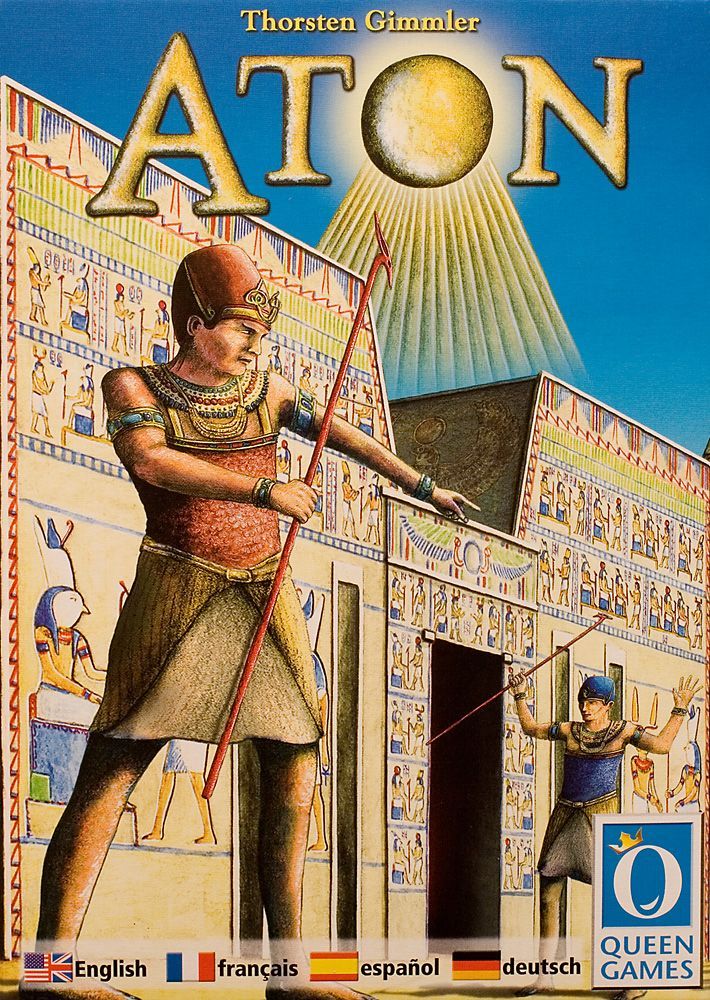
About this board game
Aton is a two-player board game with a playing time of about 30 minutes, in which rival players battle for control of Egypt’s four largest temples.
Egypt is in turmoil after Akhnaton accedes to the throne and seeks to ban the old deity Amon from the temples of the land. In his place, Aton is to be worshiped as the new god, setting the stage for a dramatic struggle between the old order and the new.
The priests of Egypt are not prepared to surrender their temples without resistance. As adversaries, the players fight out this battle of the gods, disputing the four largest temples and seeking to help their chosen god achieve victory.
- Designed specifically for 2 players
- Approximately 30 minutes of play
- A contest centered on Egypt’s four largest temples
- Both players begin from the same starting position
Although each player starts from an equal position, victory depends on who can make better use of their abilities during the conflict. The shared beginning gives the opposing sides the same foundation, while the choices made throughout the game determine who can gain the advantage.
Released in 2005, Aton presents a focused head-to-head contest with a strong historical and mythic setting. Its compact player count and half-hour playing time make the struggle an intimate confrontation, where every advantage may help decide the fate of the temples and the triumph of a god.

Board Game Rules for
Aton
ATON
A game by Thorsten Gimmler for 2 players
The high priests of the two great Egyptian deities Aton and Amon are fighting for supremacy. Both leaders want to place their priests in the crucial positions in the four great temples in Thebes.
Aim of the Game
Each player takes on the role of a high priest striving for power in Thebes of ancient Egypt.
The winner is the player who is the first to:
- gain 40 points, or
- occupy all the squares of a temple, or
- occupy all the yellow squares in the four temples, or
- occupy all the green squares in the four temples.
Playing Equipment
- 72 playing cards with the values 1 to 4 (36 each for blue and red)
- 1 six-part game board
- 58 priests: counters in the colours red and blue
- 2 “exchange” counters (white)
- 2 scoring counters (red and blue)
- 1 set of instructions

Getting Ready to Play
- The game board is fitted together and placed between the two players.
- Each player is given 29 counters in the colour of their choice, the set of cards in the same colour and a white “exchange” counter.
- The players shuffle their cards and place them face down next to the board.
- The scoring counters are placed as score indicators next to square “1” of the scoring strip.

How to Play
- Each player picks up the top 4 cards from their pile, looks at them and then allocates 1 card face down to each of their own cartouches.
- Exchange option: Once during the game each player — by handing in their “exchange” counter — may discard the 4 cards he has picked up and take 4 new cards instead. The “exchange” counter is removed from the game.
- When both players have allocated their cards, these are turned up and evaluated one after the other. [See: 1st cartouche to 4th cartouche]
- When all 8 cards have been evaluated, the upturned cards are discarded and each player takes 4 new cards. Another round follows.
- When a pile of face-down cards has been used up, the discarded cards are shuffled and laid ready as a new face-down pile.

The Cartouches
- Cartouches 2 – 4 determine the order of play and show how many counters are to be removed or brought into play in which temples.
- The player whose turn it is assesses cartouches 2 to 4 one after the other, then the other player follows.
1st Cartouche – Points
The value of both players’ cards is compared. The player with the higher card value receives double the difference in points. If the cards are of equal value, no one receives points.

For example: Peter plays a “1” here, Elke a “4”, the difference is 3. Elke gets double the value, i.e. 6 points.
Note: Points are recorded on the scoring strip. The counter is moved forward the same number of squares as the number of points received.
2nd Cartouche – Order of Play / Removal of Counters
The cards laid here determine two things:
a) The order of play of both players for the rest of the round.

The player with the lower card value begins. If the values are the same, the player who played the smaller value with “cartouche 1” begins. If those values were also equal, both players take cards from their pile until one of them has picked up a lower card than the other. This player then begins. (The cards which have been picked up are returned to the bottom of the pile.)
b) Removing counters (not in the 1st round).
The player whose turn it is now removes counters from the temples. The number of counters is determined by the value of the cards laid minus 2:
- If the result is positive, the corresponding number of any opposing counters are removed.
- If the result is -1, the player must remove any 1 of his own counters.
If there are not enough counters available in the temples, just those available are removed.

Example: If a player has laid a 4 card next to this cartouche, he may remove 4 – 2 = 2 opposing counters from the board. With a 2 card, no counters are removed.
Note: The card next to cartouche 3 shows which temples the counters can be removed from. Removed counters are placed in the Kingdom of the Dead.
3rd Cartouche – Determining the Temple
The card laid here shows the temples from which the player may remove counters or into which counters may be placed. All temples which have a number smaller than or the same as the card may be used.

Example: With a card value of 2, counters may be removed from or placed in temples “1” and “2”.
Note: The card next to cartouche 3 shows which temple the counters may be placed in.
4th Cartouche – Positioning Counters
The card which has been played here states the number of the player’s own counters which can be taken from his own stock in this round and distributed in the temples. 1 counter is always placed on 1 unoccupied square in a temple. If a player has no more counters in his stock, he cannot position any counters.
Each counter which cannot be positioned is put on an empty square in the Kingdom of the Dead.

Example: here, red has a choice of four squares on to which he may place his counter.
Counters in the Kingdom of the Dead
Counters are placed in the Kingdom of the Dead if:
- they are removed from the temples; or
- they cannot be placed in a temple (no more room).
Counters are placed on an empty square of the Kingdom of the Dead. If the Kingdom of the Dead is completely full, both players complete their go and then scoring takes place.
Example: Peter may place 4 counters in temples 1 and 2. Temple 2 still has 1 empty square, temple 2 still has 2. So there is no space for his fourth counter. The counter is placed in the Kingdom of the Dead.
Note: If a player has to place more counters in the Kingdom of the Dead than there are spaces, the remaining counters are returned to the stock.
Temple Scoring
When scoring, the following points are awarded:
- Temple 1: the player with the most counters in this temple gets the number of points which corresponds to the difference in value between the counters belonging to both players in this temple.
- Temple 2: the player with the most counters in this temple gets 5 points.
- Temple 3: the player with the most counters in this temple gets the number of points corresponding to the number of counters which he has placed here.
- Temple 4: the player with the most counters in this temple gets 3 points for each of the blue squares occupied by him (there is one blue square in each of the four temples).
- Black squares: the player with the most counters on these squares gets 8 points.
- Bonus squares: each player whose counter occupies a bonus square receives the value stated there (+1 or +2) as points.

Scoring Example (from illustration):
- Temple 1: Red receives 3 points (P) [6 red counters minus 3 blue counters = 3 P]
- Temple 2: Blue receives 5 P [Majority always receives 5 P]
- Temple 3: Red receives 4 P [Majority consists of 4 counters = 4 P]
- Temple 4: Blue receives 9 P [Majority receives 3 P for each occupied blue square = 9 P]
- Black squares: Red receives 8 P [Majority always receives 8 P]
- Bonus squares: Red receives 4 P, Blue receives 4 P [1 or 2 P as stated on the square]
Note: if there is no majority in a temple, no one receives any points. This also applies to the scoring of black squares.
After the Scoring Round
After the scoring round, both players take turns to remove 4 of their own counters out of the temples, beginning with the leader (If they have equal points, red begins).
- When doing this – if possible – one of the player’s own counters must be removed from each temple.
- If a player has no counters in a temple, then he removes instead one counter from the highest temple in which he has counters.
- The counters in the Kingdom of the Dead and the counters which have just been taken out are put back in the respective stocks of the players.
- If the game is not over, the next round follows.
The End of the Game
- Immediate end: The game ends immediately if, when assessing the 1st or 4th cartouche, one of the four conditions for winning is fulfilled (40 points, all squares of a temple occupied, all yellow or green squares occupied). The player who has fulfilled this condition wins the game.
- End after scoring: Otherwise the game ends after the scoring round in which a player has reached 40 or more points. In this case, the complete scoring is carried out. The winner is the player with the most points (points over 40 also count). If players have equal points, the game is a draw.
Introduction & Objective
ATON
A game by Thorsten Gimmler for 2 players
The high priests of the two great Egyptian deities Aton and Amon are fighting for supremacy. Both leaders want to place their priests in the crucial positions in the four great temples in Thebes.
Aim of the Game
Each player takes on the role of a high priest striving for power in Thebes of ancient Egypt.
The winner is the player who is the first to:
- gain 40 points, or
- occupy all the squares of a temple, or
- occupy all the yellow squares in the four temples, or
- occupy all the green squares in the four temples.
Components & Setup
Playing Equipment
- 72 playing cards with the values 1 to 4 (36 each for blue and red)
- 1 six-part game board
- 58 priests: counters in the colours red and blue
- 2 “exchange” counters (white)
- 2 scoring counters (red and blue)
- 1 set of instructions
Getting Ready to Play
- The game board is fitted together and placed between the two players.
- Each player is given 29 counters in the colour of their choice, the set of cards in the same colour and a white “exchange” counter.
- The players shuffle their cards and place them face down next to the board.
- The scoring counters are placed as score indicators next to square “1” of the scoring strip.
Round Overview & Cartouche Actions
How to Play
- Each player picks up the top 4 cards from their pile, looks at them and then allocates 1 card face down to each of their own cartouches.
- Exchange option: Once during the game each player — by handing in their “exchange” counter — may discard the 4 cards he has picked up and take 4 new cards instead. The “exchange” counter is removed from the game.
- When both players have allocated their cards, these are turned up and evaluated one after the other. [See: 1st cartouche to 4th cartouche]
- When all 8 cards have been evaluated, the upturned cards are discarded and each player takes 4 new cards. Another round follows.
- When a pile of face-down cards has been used up, the discarded cards are shuffled and laid ready as a new face-down pile.
The Cartouches
- Cartouches 2 – 4 determine the order of play and show how many counters are to be removed or brought into play in which temples.
- The player whose turn it is assesses cartouches 2 to 4 one after the other, then the other player follows.
1st Cartouche – Points
The value of both players’ cards is compared. The player with the higher card value receives double the difference in points. If the cards are of equal value, no one receives points.
For example: Peter plays a “1” here, Elke a “4”, the difference is 3. Elke gets double the value, i.e. 6 points.
Note: Points are recorded on the scoring strip. The counter is moved forward the same number of squares as the number of points received.
2nd Cartouche – Order of Play / Removal of Counters
The cards laid here determine two things:
a) The order of play of both players for the rest of the round.
The player with the lower card value begins. If the values are the same, the player who played the smaller value with “cartouche 1” begins. If those values were also equal, both players take cards from their pile until one of them has picked up a lower card than the other. This player then begins. (The cards which have been picked up are returned to the bottom of the pile.)
b) Removing counters (not in the 1st round).
The player whose turn it is now removes counters from the temples. The number of counters is determined by the value of the cards laid minus 2:
- If the result is positive, the corresponding number of any opposing counters are removed.
- If the result is -1, the player must remove any 1 of his own counters.
If there are not enough counters available in the temples, just those available are removed.
Example: If a player has laid a 4 card next to this cartouche, he may remove 4 – 2 = 2 opposing counters from the board. With a 2 card, no counters are removed.
Note: The card next to cartouche 3 shows which temples the counters can be removed from. Removed counters are placed in the Kingdom of the Dead.
3rd Cartouche – Determining the Temple
The card laid here shows the temples from which the player may remove counters or into which counters may be placed. All temples which have a number smaller than or the same as the card may be used.
Example: With a card value of 2, counters may be removed from or placed in temples “1” and “2”.
Note: The card next to cartouche 3 shows which temple the counters may be placed in.
4th Cartouche – Positioning Counters
The card which has been played here states the number of the player’s own counters which can be taken from his own stock in this round and distributed in the temples. 1 counter is always placed on 1 unoccupied square in a temple. If a player has no more counters in his stock, he cannot position any counters.
Each counter which cannot be positioned is put on an empty square in the Kingdom of the Dead.
Example: here, red has a choice of four squares on to which he may place his counter.
The Kingdom of the Dead
Counters in the Kingdom of the Dead
Counters are placed in the Kingdom of the Dead if:
- they are removed from the temples; or
- they cannot be placed in a temple (no more room).
Counters are placed on an empty square of the Kingdom of the Dead. If the Kingdom of the Dead is completely full, both players complete their go and then scoring takes place.
Example: Peter may place 4 counters in temples 1 and 2. Temple 2 still has 1 empty square, temple 2 still has 2. So there is no space for his fourth counter. The counter is placed in the Kingdom of the Dead.
Note: If a player has to place more counters in the Kingdom of the Dead than there are spaces, the remaining counters are returned to the stock.
Scoring
Temple Scoring
When scoring, the following points are awarded:
- Temple 1: the player with the most counters in this temple gets the number of points which corresponds to the difference in value between the counters belonging to both players in this temple.
- Temple 2: the player with the most counters in this temple gets 5 points.
- Temple 3: the player with the most counters in this temple gets the number of points corresponding to the number of counters which he has placed here.
- Temple 4: the player with the most counters in this temple gets 3 points for each of the blue squares occupied by him (there is one blue square in each of the four temples).
- Black squares: the player with the most counters on these squares gets 8 points.
- Bonus squares: each player whose counter occupies a bonus square receives the value stated there (+1 or +2) as points.
Scoring Example (from illustration):
- Temple 1: Red receives 3 points (P) [6 red counters minus 3 blue counters = 3 P]
- Temple 2: Blue receives 5 P [Majority always receives 5 P]
- Temple 3: Red receives 4 P [Majority consists of 4 counters = 4 P]
- Temple 4: Blue receives 9 P [Majority receives 3 P for each occupied blue square = 9 P]
- Black squares: Red receives 8 P [Majority always receives 8 P]
- Bonus squares: Red receives 4 P, Blue receives 4 P [1 or 2 P as stated on the square]
Note: if there is no majority in a temple, no one receives any points. This also applies to the scoring of black squares.
After the Scoring Round
After the scoring round, both players take turns to remove 4 of their own counters out of the temples, beginning with the leader (If they have equal points, red begins).
- When doing this – if possible – one of the player’s own counters must be removed from each temple.
- If a player has no counters in a temple, then he removes instead one counter from the highest temple in which he has counters.
- The counters in the Kingdom of the Dead and the counters which have just been taken out are put back in the respective stocks of the players.
- If the game is not over, the next round follows.
End of the Game
The End of the Game
- Immediate end: The game ends immediately if, when assessing the 1st or 4th cartouche, one of the four conditions for winning is fulfilled (40 points, all squares of a temple occupied, all yellow or green squares occupied). The player who has fulfilled this condition wins the game.
- End after scoring: Otherwise the game ends after the scoring round in which a player has reached 40 or more points. In this case, the complete scoring is carried out. The winner is the player with the most points (points over 40 also count). If players have equal points, the game is a draw.