
Backgammon
-3000
Move, capture, re-enter, and bear off your 15 checkers before your opponent in this ancient two-player strategy classic.
30
minutes
2 - 2
player(s)
8+
Medium Light

About this board game
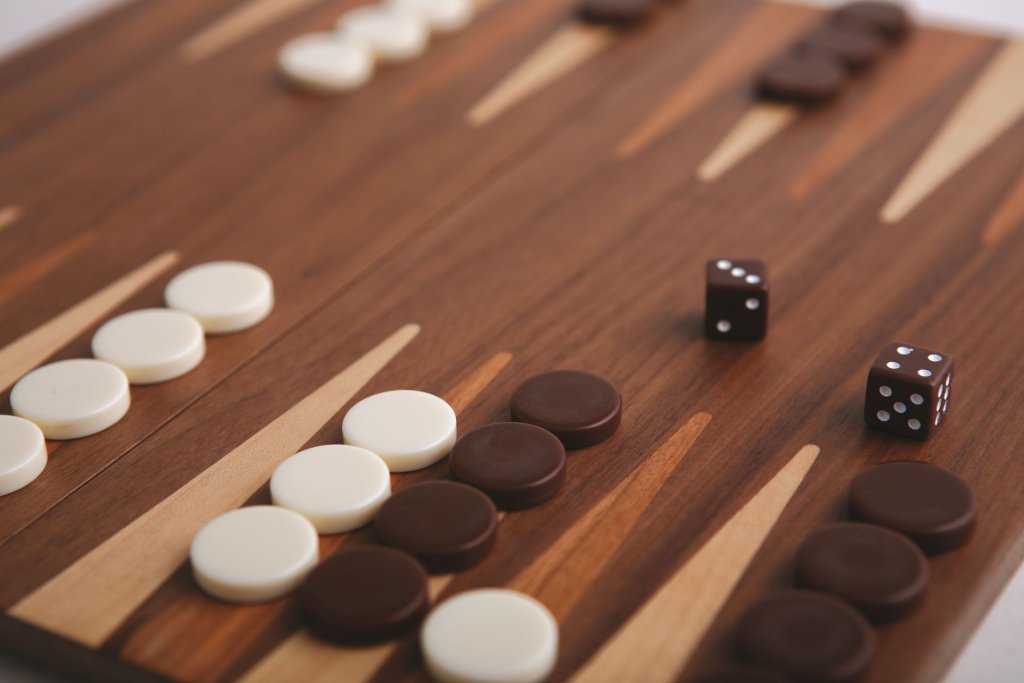
Backgammon is a classic two-player abstract strategy game played in about 30 minutes, combining dice-driven movement with tactical decisions and calculated risk.
Each player controls 15 checkers, moving them from their starting positions around the board and eventually off it. Dice determine the available movement on every turn, but the challenge lies in choosing the most effective way to use each roll while anticipating the possibilities available to the opponent.
- Move 15 checkers around the board and bear them off to win.
- Capture opposing checkers and force them to restart their journey.
- Evaluate risk as you plan around possible future dice rolls.
- Use the optional doubling cube to raise the stakes of the game.
The game’s history reaches back thousands of years. It may be the first game mentioned in written history, with roots traced to the Sumerians of ancient Mesopotamia around 5,000 years ago. Archaeologists have found boards in the ancient town of Ur, as well as boards from ancient Egypt, including examples from Tutankhamun’s tomb.
Across history, the game has been known by many names, including Takhteh Nard in Persia, Tabula and Alea in Rome, and Sugoroko in Japan. Its English name may come from “Bac gamen,” meaning “Back Game,” possibly referring to the re-entry of captured stones.
Often associated with the upper classes and sometimes called “The Aristocratic Game,” Backgammon was standardized in English by Edmond Hoyle in 1743. Those rules remained popular until American innovations in the 1930s.
Thematics
Mechanics
Designer
Illustrators



Board Game Rules for
Backgammon
Components & Setup
Backgammon is a two player game. Both players have an equal opportunity to move first so it makes no difference which side or which color checkers the players use.
Set Includes:
- A. (1) Backgammon Board
- B. (30) Checkers (15 of each color)
- C. (4) Dice
- D. (2) Dice Cups
- E. (1) Doubling Cube. A doubling cube is a 6 sided die with the number 2, 4, 8, 16, 32 and 64 on the 6 faces. A doubling cube is usually oversized.
This die is used to keep track of the number of points or units at stake in the game. The doubling cube is a great source of excitement in backgammon and its use will be explained later in this section.

Setting Up the Board
A backgammon board has 24 triangles in alternating colors called points. The board is divided into 4 quadrants and each quadrant has 6 points. You and your opponent each have a home (inner) board and an outer board which are separated by a raised section called the bar.
The checkers are initially set up with:
- Two checkers on each player’s 24 point
- Five on each player’s 13 point
- Three on each 8 point
- Five on each player’s 6 point
The direction of play is from your opponent’s inner board to their outer board, to your outer board and then to your inner board.
Object of the Game
Each player must move their checkers according to the numbers shown on each throw of their dice. Checkers are moved around the board by the players into their inner boards. Once all of the checkers are in the home board, players can begin to “bear off”. The player who bears off all of their checkers first, wins the game.
Starting the Game
Start the game by having each player throwing a single die. The player with the highest number moves first using the sum from the two dice just thrown. If the same number comes up on both dice, the players re-roll until they are different. After the first move, players alternate turns by rolling their own dice.
Playing the Game
The checkers must always be moved forward around the board according to the numbers shown on the dice.
The numbers on the dice are two separate moves. In other words, one checker can be moved the total amount of the dice or two individual checkers can be moved for the value of one of the dice. For example, a throw that shows 4 and 6 would mean that you can move one checker 10 spaces, or move one checker 4 spaces and another checker 6 spaces. You may move a checker to any point occupied by your own checkers or to a point with 1 or none of your opponent’s checkers. A checker may not be moved to a point with two or more of your opponent’s checkers on it.
If a player rolls doubles, the player may move double the amount shown on the dice. For example, if a double 3 is rolled, the player has several different combinations of moves to make. The player can do any one of the following:
- Move any one checker a total of twelve spaces.
- Move any two checkers a total of twelve spaces with each checker moving six spaces.
- Move any two checkers a total of twelve spaces each with one checker moving nine spaces and the other moving three spaces.
- Move any four checkers three spaces each.
The full roll must be used including doubles. If only one number can be played it must be the higher number of the two, if that is possible.
Points and Blocking
If two or more checkers are on the same point, the opposing player may not land on that point but they may jump over it and move beyond. There is no limit to the number of checkers a player may have on a point. If there are six points made in a row, any checkers behind this row of six points are effectively trapped until the row of six is broken.
Hitting and The Bar
A single checker is susceptible to hits. Since checkers of opposite colors may not occupy the same point, when an opponent lands on a point with a single opponent checker, the checker is removed and replaced with the player’s own. The removed checker is placed on the bar.
The bar is the middle strip that separates the inner and outer boards and once a checker is placed there, it remains out of play until it can be entered into the opponent’s inner board by a throw of the dice. You cannot move your checkers on the board until all of your checkers on the bar have reentered the board.
Entering from the Bar
A checker can be entered from the bar on the player’s next turn and only if one of the numbers on the dice corresponds to a point not occupied by two or more opponent checkers in the opponent’s home board. If you cannot enter because both points indicated by the dice are blocked, then your turn is over.
The Bear Off
The Bear Off is the final stage of the game when you remove your checkers from your home board. You cannot start this process until all fifteen of your checkers are in your home board. You may “bear the checkers off” according to the numbers on the dice you throw.
- For example, if you roll a 4-5 you may take one checker off the 4 point and another off the 5 point.
- If you do not have checkers on one or both of those points, you must move checkers within your board to get closer to the end. If you cannot move any checkers, your turn is over.
- You must use your entire roll. If you roll a six and have no checkers on the 6 point, you must take a checker off of the next highest point with checkers on it.
- If you roll a four and have no checkers on the four point but you do have a checker on the 6 point, you can either move the checker on your 6 point four spaces to the 2 point or move a checker on the 3, 2 or 1 points to bear off.
Your opponent can hit you while you are bearing off if your opponent has a checker on the bar. If your opponent hits you while you are bearing off, you must enter that checker and bring it all the way around back to your home board before you can continue to bear off checkers.
Doubling Cube
Before the game starts, the doubling cube is placed at the side or on the bar with the number 64 on top which indicates that the game is being played for one point or unit. If one player feels they have the advantage during the course of the game, they can double the stakes of the game by turning the cube so that the 2 is facing up. A player may double only before they roll the dice on their turn. The opponent may either decline the double and forfeit the stakes of the game or they may accept the double and play on for double the stakes. The first double may be made by either player but after a double is accepted, the player who accepted it owns the cube and is the only one allowed to re-double the stakes. There is no limit to the number of times the stakes can be redoubled.
The trailing player may not double for one whole game once the leader is one point away from winning the match.
Winning & Scoring
The first player to bear off all 15 checkers wins the game.
Single Game
The player who bears off all fifteen of their checkers first is the winner. If the losing player has borne off at least one checker, the player wins the number on the cube, if the cube was in play, otherwise, the number of losing party’s checkers remaining on the board.
If the losing player has not borne off any of their checkers (called a Gammon), the winning party wins twice the amount indicated by the cube.
If the winning party bears off all of their checkers before the losing party is able to bear off any and the losing party has checkers in the winning party’s home board or on the bar (called a Backgammon), the winning party gets three times the amount of points indicated by the cube.
Overview & Setup
Checkers is a board game for two players. Each player has 12 pieces and attempts to capture the opponent’s pieces. Play is confined to the dark squares only.
The board is positioned so that each player has a row of dark squares at the bottom. Players position pieces on the playing board in the three rows nearest him or her.
Movement
Players take turns moving their pieces. Non-crowned checkers may only be moved forward to one of the dark squares connected to their current position (see illustration).

Capturing
You may capture (by jumping) an opponent’s piece when it is in one of the two dark squares in front of your piece and there is an unoccupied dark tile for you to land on. You may jump multiple pieces in one move, provided all jumps are legal.

Crowning (Kings)
When one of your checkers reaches your opponent’s last row, he or she places one of your captured pieces directly on top of it. This is called crowning. The double piece is called a king. Kings may move only one space forward or backward.
Winning the Game
A game is won when one player has no more checkers or cannot move any of his or her pieces.
Object of the Game
The goal of chess is for a player to checkmate their opponent’s king. The king is not actually captured and removed from the board, but if the king is attacked (“checked”) and threatened with capture, it must get out of check immediately. If there is no way to get out of check, the position is a “checkmate” and the player who is “checkmated” loses the game.
Setup & General Rules
Chess is played by two players on a checkered board divided into 64 squares in two colors. Players sit on opposite sides of each other across the board, so that each player has a dark square in the right hand corner of the board. Each player has 16 pieces – one king, one queen, two bishops, two knights, two rooks and eight pawns.

Dark moves first. Only one piece may be moved at each turn. The knight is the only piece that can jump over other pieces. All others move only along unblocked lines. A piece may not be moved to a square already occupied. An opponent’s piece may be captured from a square where their opponent’s pieces can move. The piece is then removed from the board and replaced by their opponent’s.
Piece Movements
The King
The king is the most important piece. When he is trapped, his whole army loses. The king can move one square in any direction. The king may not move into check (onto a square attacked by an opponent’s piece). (See Diagram “2”.)

The Queen
The queen is the most powerful piece. She can move any number of squares in any direction—vertical, horizontal or diagonal—if her path is not blocked. (See Diagram “3”.)

The Bishop
The bishop can move any number of squares diagonally, if its path is not blocked. At the beginning of the game, each player has one “red-square” bishop and one “black-square” bishop. (See Diagram “4”.)

The Knight
The knight’s move is unique. It moves and captures directly from its old square to its new square. The knight moves in an “L” shape—two squares horizontally or vertically and then makes a right-angle turn for one more square. The knight always lands on a square opposite in color from its old square. (See Diagram “5”.)

The Rook
The rook can move any number of squares vertically or horizontally, if its path is not blocked. (See Diagram “6”.)

The Pawn
The pawn moves straight ahead, but it captures diagonally. On its first move it has the option of moving forward one or two squares, but then it may move only one square at a time. If a pawn moves to the opposite end of the board, it is immediately “promoted,” usually to a queen. It may not remain a pawn or become a king. It is therefore possible to have more than one queen or more than two rooks, bishops or knights on the board. (See Diagram “7”.)

Special Rules & End of Game
Castling
Each player may “castle” only once during a game. Castling is a privilege that lets a player move two pieces at once—one rook and the king. In castling, a player moves their king two squares to its left or right toward a rook. The rook involved goes to the square beside the king and toward the center of the board. Neither the king nor the rook involved may have moved before. The king may not castle out of check, into check or through check. There may not be pieces of either color between the king and the rook. Castling allows a player to place their king in a safe place. Each player has the choice of castling kingside or queenside or not at all.
Check and Checkmate
A player may not move into check. For example, moving into direct line with an opponent’s rook, if there are no other pieces between the rook and the king, is not a legal move. If a player is in check, there are three ways of getting out:
- Capturing the attacking piece
- Placing a piece between the attacker and the king (unless the attacker is a knight)
- Moving the king away from the attack
Winning the Game
If a checked player can do none of the three moves mentioned above, they are “checkmated” and lose the game. If a king is not in check, but the player can make no legal move, the position is called a stalemate and the game is scored as a draw or tie.
Overview & Objective
Chinese checkers is actually a form of Halma, which was created in 1880, and transplanted onto star-shaped board.
The object of the game is to be the first to move all your wooden balls across the board and into the star point directly across from your point.
Moving The Balls
Chinese checkers accommodates two six players. Each player uses a different colored set of 10 wooden balls and places them into a point of the star.
Players move a wooden ball one space in any direction or jump one or multiple balls wherever permissible to go farther. All balls stay on the board. Wooden balls are never removed after a jump has been made. The game can be started by any player and successive turns are taken starting to the left of the starter.
Players can not remain in his or her original starting point in order to prevent an opponent from finishing the game.
Playing with Partners
When playing with partners, in the event that one partner finishes first, he or she is permitted to help the unfinished partner move his or her wooden balls.
Rules of Play
Each domino is divided into two parts of ends, each containing a set of spots. A double domino contains matching ends (6-6, 5-5, etc). All the dominoes are turned face down and shuffled. Each player takes five dominoes (If 4 players, each takes 5. If 2 players, each takes 7) and stands them on edge, facing them so that their opponents cannot see the dots. The remaining dominoes become the draw pile. The player who has chosen the highest double domino places it in the center of the table to begin. If no double was drawn, all the dominoes are returned, re-shuffled and re-drawn.
The next player tries to match one of their dominoes to one end of the double side. For example, if the first domino played is a double four, the player may add any domino with a four on one end. The next player may play to the double four or he may try to match the end of the second domino played. Blanks match other blanks. Only one domino may be played each turn. Dominoes are placed lengthwise end to end, except in the case of a double. If a player cannot match the spots at any open end of a row, they must draw from the pile until able to do so. If they draw the last domino and are still not able to play, they lose their turn. Doubles are always placed crosswise to the end they match, thereby giving two new directions in which to place dominoes.
Play continues until one player has used all their dominoes or until no one can play. The player with no dominoes or with the least number of points (dots) on their remaining dominoes wins the round. The winner subtracts the total remaining points (if any) from the total of their opponent’s points and balance of points.
Winning
The first person to score 100 or more points wins the game.
Object of the Game
To roll the best poker hand.
Game Play
Poker dice are six-sided dice that have images of playing cards on them rather than dots; the sides are ace, king, queen, jack, ten, and nine. It is a game for two or more players. There are many variations, but the basic game is played with five dice; each player has a total of three rolls.
- Roll one die to see who goes first—high roll wins.
- On the first roll, the player rolls all five dice. She may then choose to keep in place any number of dice and roll the remainder, to build the best hand.
- After the second roll, she may keep any dice and roll the remainder. Once dice are set aside to keep, they may not be rolled later.
- A player is not required to roll a second or third time.
- After the three rolls, the best hand wins.
Hand Rankings
The ranks of hands for poker dice are, highest to lowest:
- Five of a kind
- Four of a kind
- Full house (three of a kind plus a pair)
- Straight (five consecutive values—the higher value straight beats the lower ones)
- Three of a kind
- Two pairs
- One pair
Overview
Primarily a gambling game, the two main types of Poker is Draw and Stud. Draw Poker is played with concealed (closed) hands while Stud Poker is played with open hands. Games are usually for five to eight players, using a regular 52 card deck. While some versions of poker use the jokers, the two we will be describing do not.
Chips
Purchased from the banker, the usual values are:
- White: 1 unit
- Red: 5 units
- Blue: 10 points
- Yellow: 25 points
At the end of the game, or when a player leaves, the banker redeems the chips for cash.
The Bet
While up to the individual players, the following are the main approaches:
- Variable Limit: Size of the maximum bet changes at various stages of the game.
- Pot Limit: Bets cannot exceed the value already in the pot.
- Bet by Raise: To raise the bet, the bettor must double the last bet. The number of raises is usually limited to three in any round of betting.
- Table Stakes: A player may bet as much money or chips as he has without going into his wallet or buying more chips.
- Freeze-out: A player must drop out when he loses all his money or chips. Game ends when one player has everybody’s money.
Ranking Poker Hands
- Five of the kind: four card of same denomination (rank) plus a wild card or joker.
- Straight Flush: five cards in sequence of the same suit. A Royal Flush is Ace, King, Queen, Jack, and Ten of the same suit.
- Four of a Kind: Four cards of same rank. If wild cards are used, these may be included.
- Full House: Three cards of one rank plus two of another.
- Flush: Five cards of one suit.
- Straight: Uninterrupted sequence of five cards in more than one suit.
- Three of a Kind: Three cards of same rank.
- Two pairs: Two cards of one rank plus two cards of another rank.
- One pair: Two cards of one rank.
Introduction
Sudoku is an easy to learn yet highly addictive logic puzzle. These popular and fascinating puzzles offer endless fun and intellectual entertainment to puzzle fans of all skills and ages.
The Sudoku puzzles provided in this booklet come in many varieties and range from intermediate to extremely difficult. A puzzle can take from ten minutes to several hours to solve. Each looks different and offers a unique twist to brain challenging logic.
Get stumped? Don’t fret, you can find the solutions to the games provided in the back of this booklet.
Object of the Game
Use 9 x 9 puzzle grid to solve the puzzle. Every row must contain the numbers 1, 2, 3, 4, 5, 6, 7, 8, and 9. There may not be any duplicate numbers in any row and no rows can be identical.
Instructions
Large and small pieces are black on one side and red on the other.
Use the red number for the provided numbers in the game booklet. These are the “givens”. Use the black side to place in the empty squares. Or you can choose the opposite way (black for givens; red for filling the empty squares).
Smaller pieces are the “thinking pieces” (or possible candidates pieces). These are for the spots that are still in progress. You can use black (or red) as special mark for the best candidate of that cell.
Solve the puzzle by only placing a number in a square when you are certain. Using logic, mark where you “think” the number should be placed using the smaller “thinking piece” as a candidates. Whenever the larger number is placed in the square, the thinking piece should be removed. Continue until the entire board is solved.
Backgammon
Components & Setup
Backgammon is a two player game. Both players have an equal opportunity to move first so it makes no difference which side or which color checkers the players use.
Set Includes:
- A. (1) Backgammon Board
- B. (30) Checkers (15 of each color)
- C. (4) Dice
- D. (2) Dice Cups
- E. (1) Doubling Cube. A doubling cube is a 6 sided die with the number 2, 4, 8, 16, 32 and 64 on the 6 faces. A doubling cube is usually oversized.
This die is used to keep track of the number of points or units at stake in the game. The doubling cube is a great source of excitement in backgammon and its use will be explained later in this section.
Setting Up the Board
A backgammon board has 24 triangles in alternating colors called points. The board is divided into 4 quadrants and each quadrant has 6 points. You and your opponent each have a home (inner) board and an outer board which are separated by a raised section called the bar.
The checkers are initially set up with:
- Two checkers on each player’s 24 point
- Five on each player’s 13 point
- Three on each 8 point
- Five on each player’s 6 point
The direction of play is from your opponent’s inner board to their outer board, to your outer board and then to your inner board.
Object of the Game
Each player must move their checkers according to the numbers shown on each throw of their dice. Checkers are moved around the board by the players into their inner boards. Once all of the checkers are in the home board, players can begin to “bear off”. The player who bears off all of their checkers first, wins the game.
Starting the Game
Start the game by having each player throwing a single die. The player with the highest number moves first using the sum from the two dice just thrown. If the same number comes up on both dice, the players re-roll until they are different. After the first move, players alternate turns by rolling their own dice.
Playing the Game
The checkers must always be moved forward around the board according to the numbers shown on the dice.
The numbers on the dice are two separate moves. In other words, one checker can be moved the total amount of the dice or two individual checkers can be moved for the value of one of the dice. For example, a throw that shows 4 and 6 would mean that you can move one checker 10 spaces, or move one checker 4 spaces and another checker 6 spaces. You may move a checker to any point occupied by your own checkers or to a point with 1 or none of your opponent’s checkers. A checker may not be moved to a point with two or more of your opponent’s checkers on it.
If a player rolls doubles, the player may move double the amount shown on the dice. For example, if a double 3 is rolled, the player has several different combinations of moves to make. The player can do any one of the following:
- Move any one checker a total of twelve spaces.
- Move any two checkers a total of twelve spaces with each checker moving six spaces.
- Move any two checkers a total of twelve spaces each with one checker moving nine spaces and the other moving three spaces.
- Move any four checkers three spaces each.
The full roll must be used including doubles. If only one number can be played it must be the higher number of the two, if that is possible.
Points and Blocking
If two or more checkers are on the same point, the opposing player may not land on that point but they may jump over it and move beyond. There is no limit to the number of checkers a player may have on a point. If there are six points made in a row, any checkers behind this row of six points are effectively trapped until the row of six is broken.
Hitting and The Bar
A single checker is susceptible to hits. Since checkers of opposite colors may not occupy the same point, when an opponent lands on a point with a single opponent checker, the checker is removed and replaced with the player’s own. The removed checker is placed on the bar.
The bar is the middle strip that separates the inner and outer boards and once a checker is placed there, it remains out of play until it can be entered into the opponent’s inner board by a throw of the dice. You cannot move your checkers on the board until all of your checkers on the bar have reentered the board.
Entering from the Bar
A checker can be entered from the bar on the player’s next turn and only if one of the numbers on the dice corresponds to a point not occupied by two or more opponent checkers in the opponent’s home board. If you cannot enter because both points indicated by the dice are blocked, then your turn is over.
The Bear Off
The Bear Off is the final stage of the game when you remove your checkers from your home board. You cannot start this process until all fifteen of your checkers are in your home board. You may “bear the checkers off” according to the numbers on the dice you throw.
- For example, if you roll a 4-5 you may take one checker off the 4 point and another off the 5 point.
- If you do not have checkers on one or both of those points, you must move checkers within your board to get closer to the end. If you cannot move any checkers, your turn is over.
- You must use your entire roll. If you roll a six and have no checkers on the 6 point, you must take a checker off of the next highest point with checkers on it.
- If you roll a four and have no checkers on the four point but you do have a checker on the 6 point, you can either move the checker on your 6 point four spaces to the 2 point or move a checker on the 3, 2 or 1 points to bear off.
Your opponent can hit you while you are bearing off if your opponent has a checker on the bar. If your opponent hits you while you are bearing off, you must enter that checker and bring it all the way around back to your home board before you can continue to bear off checkers.
Doubling Cube
Before the game starts, the doubling cube is placed at the side or on the bar with the number 64 on top which indicates that the game is being played for one point or unit. If one player feels they have the advantage during the course of the game, they can double the stakes of the game by turning the cube so that the 2 is facing up. A player may double only before they roll the dice on their turn. The opponent may either decline the double and forfeit the stakes of the game or they may accept the double and play on for double the stakes. The first double may be made by either player but after a double is accepted, the player who accepted it owns the cube and is the only one allowed to re-double the stakes. There is no limit to the number of times the stakes can be redoubled.
The trailing player may not double for one whole game once the leader is one point away from winning the match.
Winning & Scoring
The first player to bear off all 15 checkers wins the game.
Single Game
The player who bears off all fifteen of their checkers first is the winner. If the losing player has borne off at least one checker, the player wins the number on the cube, if the cube was in play, otherwise, the number of losing party’s checkers remaining on the board.
If the losing player has not borne off any of their checkers (called a Gammon), the winning party wins twice the amount indicated by the cube.
If the winning party bears off all of their checkers before the losing party is able to bear off any and the losing party has checkers in the winning party’s home board or on the bar (called a Backgammon), the winning party gets three times the amount of points indicated by the cube.
Checkers
Overview & Setup
Checkers is a board game for two players. Each player has 12 pieces and attempts to capture the opponent’s pieces. Play is confined to the dark squares only.
The board is positioned so that each player has a row of dark squares at the bottom. Players position pieces on the playing board in the three rows nearest him or her.
Movement
Players take turns moving their pieces. Non-crowned checkers may only be moved forward to one of the dark squares connected to their current position (see illustration).
Capturing
You may capture (by jumping) an opponent’s piece when it is in one of the two dark squares in front of your piece and there is an unoccupied dark tile for you to land on. You may jump multiple pieces in one move, provided all jumps are legal.
Crowning (Kings)
When one of your checkers reaches your opponent’s last row, he or she places one of your captured pieces directly on top of it. This is called crowning. The double piece is called a king. Kings may move only one space forward or backward.
Winning the Game
A game is won when one player has no more checkers or cannot move any of his or her pieces.
Chess
Object of the Game
The goal of chess is for a player to checkmate their opponent’s king. The king is not actually captured and removed from the board, but if the king is attacked (“checked”) and threatened with capture, it must get out of check immediately. If there is no way to get out of check, the position is a “checkmate” and the player who is “checkmated” loses the game.
Setup & General Rules
Chess is played by two players on a checkered board divided into 64 squares in two colors. Players sit on opposite sides of each other across the board, so that each player has a dark square in the right hand corner of the board. Each player has 16 pieces – one king, one queen, two bishops, two knights, two rooks and eight pawns.
Dark moves first. Only one piece may be moved at each turn. The knight is the only piece that can jump over other pieces. All others move only along unblocked lines. A piece may not be moved to a square already occupied. An opponent’s piece may be captured from a square where their opponent’s pieces can move. The piece is then removed from the board and replaced by their opponent’s.
Piece Movements
The King
The king is the most important piece. When he is trapped, his whole army loses. The king can move one square in any direction. The king may not move into check (onto a square attacked by an opponent’s piece). (See Diagram “2”.)
The Queen
The queen is the most powerful piece. She can move any number of squares in any direction—vertical, horizontal or diagonal—if her path is not blocked. (See Diagram “3”.)
The Bishop
The bishop can move any number of squares diagonally, if its path is not blocked. At the beginning of the game, each player has one “red-square” bishop and one “black-square” bishop. (See Diagram “4”.)
The Knight
The knight’s move is unique. It moves and captures directly from its old square to its new square. The knight moves in an “L” shape—two squares horizontally or vertically and then makes a right-angle turn for one more square. The knight always lands on a square opposite in color from its old square. (See Diagram “5”.)
The Rook
The rook can move any number of squares vertically or horizontally, if its path is not blocked. (See Diagram “6”.)
The Pawn
The pawn moves straight ahead, but it captures diagonally. On its first move it has the option of moving forward one or two squares, but then it may move only one square at a time. If a pawn moves to the opposite end of the board, it is immediately “promoted,” usually to a queen. It may not remain a pawn or become a king. It is therefore possible to have more than one queen or more than two rooks, bishops or knights on the board. (See Diagram “7”.)
Special Rules & End of Game
Castling
Each player may “castle” only once during a game. Castling is a privilege that lets a player move two pieces at once—one rook and the king. In castling, a player moves their king two squares to its left or right toward a rook. The rook involved goes to the square beside the king and toward the center of the board. Neither the king nor the rook involved may have moved before. The king may not castle out of check, into check or through check. There may not be pieces of either color between the king and the rook. Castling allows a player to place their king in a safe place. Each player has the choice of castling kingside or queenside or not at all.
Check and Checkmate
A player may not move into check. For example, moving into direct line with an opponent’s rook, if there are no other pieces between the rook and the king, is not a legal move. If a player is in check, there are three ways of getting out:
- Capturing the attacking piece
- Placing a piece between the attacker and the king (unless the attacker is a knight)
- Moving the king away from the attack
Winning the Game
If a checked player can do none of the three moves mentioned above, they are “checkmated” and lose the game. If a king is not in check, but the player can make no legal move, the position is called a stalemate and the game is scored as a draw or tie.
Chinese Checkers
Overview & Objective
Chinese checkers is actually a form of Halma, which was created in 1880, and transplanted onto star-shaped board.
The object of the game is to be the first to move all your wooden balls across the board and into the star point directly across from your point.
Moving The Balls
Chinese checkers accommodates two six players. Each player uses a different colored set of 10 wooden balls and places them into a point of the star.
Players move a wooden ball one space in any direction or jump one or multiple balls wherever permissible to go farther. All balls stay on the board. Wooden balls are never removed after a jump has been made. The game can be started by any player and successive turns are taken starting to the left of the starter.
Players can not remain in his or her original starting point in order to prevent an opponent from finishing the game.
Playing with Partners
When playing with partners, in the event that one partner finishes first, he or she is permitted to help the unfinished partner move his or her wooden balls.
Dominoes
Rules of Play
Each domino is divided into two parts of ends, each containing a set of spots. A double domino contains matching ends (6-6, 5-5, etc). All the dominoes are turned face down and shuffled. Each player takes five dominoes (If 4 players, each takes 5. If 2 players, each takes 7) and stands them on edge, facing them so that their opponents cannot see the dots. The remaining dominoes become the draw pile. The player who has chosen the highest double domino places it in the center of the table to begin. If no double was drawn, all the dominoes are returned, re-shuffled and re-drawn.
The next player tries to match one of their dominoes to one end of the double side. For example, if the first domino played is a double four, the player may add any domino with a four on one end. The next player may play to the double four or he may try to match the end of the second domino played. Blanks match other blanks. Only one domino may be played each turn. Dominoes are placed lengthwise end to end, except in the case of a double. If a player cannot match the spots at any open end of a row, they must draw from the pile until able to do so. If they draw the last domino and are still not able to play, they lose their turn. Doubles are always placed crosswise to the end they match, thereby giving two new directions in which to place dominoes.
Play continues until one player has used all their dominoes or until no one can play. The player with no dominoes or with the least number of points (dots) on their remaining dominoes wins the round. The winner subtracts the total remaining points (if any) from the total of their opponent’s points and balance of points.
Winning
The first person to score 100 or more points wins the game.
Poker Dice
Object of the Game
To roll the best poker hand.
Game Play
Poker dice are six-sided dice that have images of playing cards on them rather than dots; the sides are ace, king, queen, jack, ten, and nine. It is a game for two or more players. There are many variations, but the basic game is played with five dice; each player has a total of three rolls.
- Roll one die to see who goes first—high roll wins.
- On the first roll, the player rolls all five dice. She may then choose to keep in place any number of dice and roll the remainder, to build the best hand.
- After the second roll, she may keep any dice and roll the remainder. Once dice are set aside to keep, they may not be rolled later.
- A player is not required to roll a second or third time.
- After the three rolls, the best hand wins.
Hand Rankings
The ranks of hands for poker dice are, highest to lowest:
- Five of a kind
- Four of a kind
- Full house (three of a kind plus a pair)
- Straight (five consecutive values—the higher value straight beats the lower ones)
- Three of a kind
- Two pairs
- One pair
Poker
Overview
Primarily a gambling game, the two main types of Poker is Draw and Stud. Draw Poker is played with concealed (closed) hands while Stud Poker is played with open hands. Games are usually for five to eight players, using a regular 52 card deck. While some versions of poker use the jokers, the two we will be describing do not.
Chips
Purchased from the banker, the usual values are:
- White: 1 unit
- Red: 5 units
- Blue: 10 points
- Yellow: 25 points
At the end of the game, or when a player leaves, the banker redeems the chips for cash.
The Bet
While up to the individual players, the following are the main approaches:
- Variable Limit: Size of the maximum bet changes at various stages of the game.
- Pot Limit: Bets cannot exceed the value already in the pot.
- Bet by Raise: To raise the bet, the bettor must double the last bet. The number of raises is usually limited to three in any round of betting.
- Table Stakes: A player may bet as much money or chips as he has without going into his wallet or buying more chips.
- Freeze-out: A player must drop out when he loses all his money or chips. Game ends when one player has everybody’s money.
Ranking Poker Hands
- Five of the kind: four card of same denomination (rank) plus a wild card or joker.
- Straight Flush: five cards in sequence of the same suit. A Royal Flush is Ace, King, Queen, Jack, and Ten of the same suit.
- Four of a Kind: Four cards of same rank. If wild cards are used, these may be included.
- Full House: Three cards of one rank plus two of another.
- Flush: Five cards of one suit.
- Straight: Uninterrupted sequence of five cards in more than one suit.
- Three of a Kind: Three cards of same rank.
- Two pairs: Two cards of one rank plus two cards of another rank.
- One pair: Two cards of one rank.
Sudoku
Introduction
Sudoku is an easy to learn yet highly addictive logic puzzle. These popular and fascinating puzzles offer endless fun and intellectual entertainment to puzzle fans of all skills and ages.
The Sudoku puzzles provided in this booklet come in many varieties and range from intermediate to extremely difficult. A puzzle can take from ten minutes to several hours to solve. Each looks different and offers a unique twist to brain challenging logic.
Get stumped? Don’t fret, you can find the solutions to the games provided in the back of this booklet.
Object of the Game
Use 9 x 9 puzzle grid to solve the puzzle. Every row must contain the numbers 1, 2, 3, 4, 5, 6, 7, 8, and 9. There may not be any duplicate numbers in any row and no rows can be identical.
Instructions
Large and small pieces are black on one side and red on the other.
Use the red number for the provided numbers in the game booklet. These are the “givens”. Use the black side to place in the empty squares. Or you can choose the opposite way (black for givens; red for filling the empty squares).
Smaller pieces are the “thinking pieces” (or possible candidates pieces). These are for the spots that are still in progress. You can use black (or red) as special mark for the best candidate of that cell.
Solve the puzzle by only placing a number in a square when you are certain. Using logic, mark where you “think” the number should be placed using the smaller “thinking piece” as a candidates. Whenever the larger number is placed in the square, the thinking piece should be removed. Continue until the entire board is solved.
