
Battle Line
2000
Create poker-style formations across nine flags, using tactics and clever card play to claim five flags or three in a row.
30
minutes
2 - 2
player(s)
12+
Medium Light

About this board game
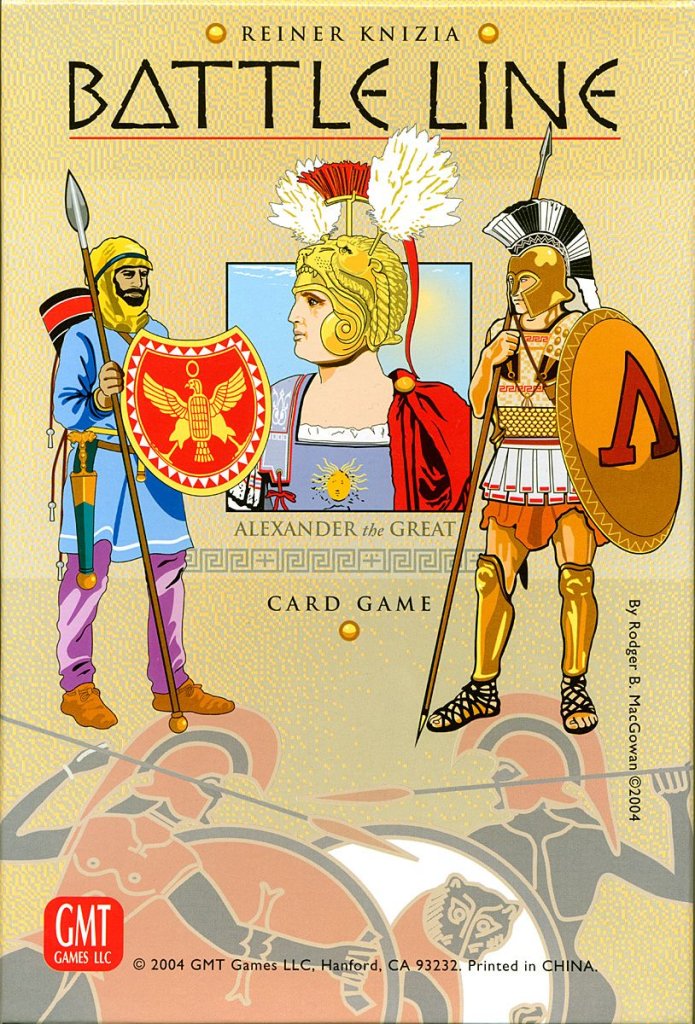
Battle Line is a two-player card game played in about 30 minutes, challenging opponents to win a battle by capturing flags with stronger card formations.
Across the battlefield, nine flags divide the two sides. Players place cards beside each flag, building three-card poker-style hands on their side. Formations include combinations such as a straight flush, three of a kind, a straight, and a flush, with the strongest formation winning the contested flag.
Victory comes through carefully choosing where to commit your cards and when to contest a flag. The first player to take five of the nine flags wins, but there is another route to victory: claiming three adjacent flags.
- Designed for exactly two players
- Approximately 30 minutes of play
- Nine flags create multiple points of conflict
- Three-card formations determine who wins each flag
- Tactics cards add another layer to the battle
Battle Line includes tactics cards, which were introduced with this design and later added to subsequent editions of Schotten Totten. Compared with Schotten Totten, it uses cards numbered from 1 to 10 rather than 1 to 9, gives each player a seven-card hand instead of six, and presents the rule that stones may only be claimed at the start of your turn as an advanced variant.
With its direct two-player confrontation and compact poker-inspired formations, Battle Line turns every card placement into a contest for position. It is a rethemed version of Schotten Totten, featuring different graphics and wooden flag pieces in place of boundary stone cards.

Board Game Rules for
Battle Line
Ancient battles were fought in organized formations. The leaders of both sides directed their forces along the battle line to gain tactical advantages. Overwhelm the opponent in the center, break through one of the flanks, or hold the position until the time has come for a decisive move. How will you muster the battle line?
- Players: Two
- Playing Time: 30 minutes
Components
- This rulebook
- 60 Troop cards, in six colors each with the values 1 to 10:
- 10 = Elephants
- 9 = Chariots
- 8 = Heavy Cavalry
- 7 = Light Cavalry
- 6 = Hypaspists
- 5 = Phalangists
- 4 = Hoplites
- 3 = Javalineers
- 2 = Peltasts
- 1 = Skirmishers
- Ten Tactics cards (white, with different backs)
- Nine Flags (plastic pieces)
Objective
The players aim to create powerful formations on their side of the Flags to beat the formations on the opponent’s side of the respective Flags. The first player to win three adjacent Flags (a Breakthrough) or any five Flags (an Envelopment) achieves victory.
- Layout the nine Flags in a line between the two players.
- Cut the Troop deck until one player has the higher number—that player shuffles and deals seven Troop cards to each player’s hand.
- Place the remaining Troop cards as a facedown deck at one end of the battle line.
- Shuffle the ten Tactics cards and place them as a facedown deck at the other end of the battle line.
The non-dealer plays first; play alternates thereafter.
On his turn, a player selects either one Troop card or one Tactics card from his hand and places it face up on his side of the battle line. At the end of his turn, the player draws one card from either deck to refresh his hand to seven. When both decks run out, no further cards can be drawn, but play continues.
The Flags are won by formations of Troop cards played adjacent to the Flags. The Tactics cards are used to influence the formations.
Playing Troop Cards
A player selects one of his Troop cards and places it face up on his side of the line adjacent to one Flag. There are three imaginary card “slots” on each side of the flag. In the course of the game each player may place a maximum of three Troop cards adjacent to each Flag, in order to create formations. The order in which the cards are played is irrelevant. To save space, later cards are placed partially covering former cards at the same flag.
Passing
When a player is unable to play any Troop card, he may pass or play a Tactics card on his turn, but his opponent still continues to play until the game is decided. Such situations may occur in two ways:
- A player may have filled all his available slots on his side of the battle line.
- A player may have only Tactics cards in his hand.
The different formations from highest to lowest are:
- Wedge: Three cards of the same color with consecutive values. [R4][R5][R3]
- Phalanx: Three cards of the same value. [Y8][R8][G8]
- Battalion Order: Three cards of the same color. [B2][B7][B4]
- Skirmish Line: Three cards with consecutive values. [Y4][R6][G5]
- Host: Any other formation. [Y5][B5][G3]
Comparing Formations
When comparing two formations in the same category, the formation with the higher sum of all three card values is higher than the opposing formation.
Example: This Red Battalion [R4][R6][R3] beats this Blue Battalion [B7][B1][B3].
If the two involved sums are equal, the formations are tied (see the Claiming Flags section below for resolution of ties).
Example: This Host [Y7][B2][G1] is tied with this Host [Y3][B3][G4].
On his turn and before drawing his card from the deck, a player may claim one or more Flags. In order to do so, he must have a completed formation of three cards on his side of the Flag, and he must be able to prove that Troop cards on the opponent’s side of the Flag cannot beat this formation.
- If the opponent’s side also contains three cards, the situation is obvious.
- If the opponent’s side contains less than three cards, the claiming player must prove that the opponent will not be able to create a winning formation, regardless of what Troop cards the opponent might play. For this purpose, the player may use the open information from the layout to show that certain cards are no longer available. The player may not use any information from his own hand. Unplayed Tactics cannot prevent a Flag claim.
Tie Resolution
If the formations on either side of a Flag are tied or at best could be tied, then the player who played (or would play) the last card into the formations loses the Flag. His opponent may claim it on his next turn.
Examples
- This Wedge [R4][R5][R3] beats this Phalanx [Y8][R8][G8] to claim Flag.
- This Phalanx [Y2][R2][G2] beats [R7][G6] to claim Flag.
- This Wedge [R4][R5][R3] beats this [B8] to claim Flag, if the Blue 7 and Blue 10 have been played.
Securing a Flag
When a player successfully claims a Flag, he takes the Flag and moves it to his side, beyond the cards that he played. Then neither player may place further cards adjacent to that Flag, nor may any Tactics card affect those cards.
There are ten Tactics cards. Tactics cards are played instead of Troop cards to influence the formations. A player may hold as many Tactics cards as he wishes within his hand size of seven, but may never play more than one more than his opponent has played. That means, a player can always play a Tactics card unless he has already played more than his opponent. Each Tactics card has a special function and belongs to one of the following three categories.
1. Morale Tactics
These cards are played into the player’s layout in place of, and in a similar way to, Troop cards:
- Leader (Alexander, Darius): The Leaders are wild cards. Play a Leader like any Troop card, but define the color and value when the Flag is resolved. For example, you have a Blue 8 in your layout. If you add a Leader, it gives you the option of adding a Blue 6, 7, 9 or 10 to make a Wedge, or an 8 to form a Phalanx. Each player may only have one Leader on his side of the battle line. If drawn, a second Leader remains unplayable in the player’s hand until the end of the game.
- Companion Cavalry: Play this card like any Troop card of value 8, but define its color when the Flag is resolved.
- Shield Bearers: Play this card like any Troop card, but define its color and its value not larger than 3 when the Flag is resolved.
2. Environment Tactics
These cards are played face up on the player’s near side of an unclaimed Flag, so that there is enough space for the Troop cards to be placed next to the Flag. Once played, the Tactics cards stay in their position until the end of the game.
- Fog: The fog card disables all formations, and the Flag is merely decided on the basis of the total value of cards on each side.
- Mud: The claim for this Flag is now based on four cards on either side, so the formations need to be expanded. This makes it particularly difficult to achieve a Wedge or Phalanx.
3. Guile Tactics
These cards are played face up on the player’s own side next to the Tactics card deck. All cards played there must be clearly visible and remain there until the end of the game.
- Scout: The player draws a total of three cards from one or both decks. Then he chooses any two cards from his hand and places them face down on top of their respective deck or decks.
- Redeploy: The player chooses anyone Troop or Tactics card from his side next to an unclaimed Flag, and places it face up into another of his available slots, or discards it face up on his side next to the Tactics card deck. Do not cover any other discard.
- Deserter: The player may choose any one Troop or Tactics card from the opponent’s side next to an unclaimed Flag, and discards it face up on the opponent’s side next to the Tactics card deck. Do not cover any other discard.
- Traitor: The player may choose anyone Troop card (but not a Tactics card) from the opponent’s side next to an unclaimed Flag, and places it into an empty slot on his own side.
When one player has successfully claimed three adjacent Flags or any five Flags, the game ends immediately with this player winning. Play halts; no other Flags may be claimed after that.
Scoring Across Multiple Games
If several games are played, the winner always scores five points, and the loser scores as many points as Flags he has claimed. The winner then starts the next game.
Advanced Rule
Once you have played the standard game a few times you may wish to try this variant. A player may only claim Flags at the beginning of his turn. This effectively delays claiming a Flag by one turn, enabling the opponent to modify the situation with his Tactics cards.
Game Credits
- Game Designer: Reiner Knizia
- Project Coordinator: Andy Lewis
- Art Director: Rodger B. MacGowan
- Cover and Card Illustrations by: Rodger B. MacGowan ©2000
- Card Design by: Mark Simonitch
- Packaging Design by: Rodger B. MacGowan ©2000
- Rulebook Editing and Layout by: Stuart K. Tucker
- Production Coordinator: Tony Curtis
Many thanks to all playtesters, in particular to David Farquhar for all his contributions to the development of the game.
GMT Games
P.O. Box 1308
Hanford, CA 93232 U.S.A.
www.gmtgames.com
(800) 523-6111
TM and © 2000 GMT Games
Introduction & Components
Ancient battles were fought in organized formations. The leaders of both sides directed their forces along the battle line to gain tactical advantages. Overwhelm the opponent in the center, break through one of the flanks, or hold the position until the time has come for a decisive move. How will you muster the battle line?
- Players: Two
- Playing Time: 30 minutes
Components
- This rulebook
- 60 Troop cards, in six colors each with the values 1 to 10:
- 10 = Elephants
- 9 = Chariots
- 8 = Heavy Cavalry
- 7 = Light Cavalry
- 6 = Hypaspists
- 5 = Phalangists
- 4 = Hoplites
- 3 = Javalineers
- 2 = Peltasts
- 1 = Skirmishers
- Ten Tactics cards (white, with different backs)
- Nine Flags (plastic pieces)
Objective
The players aim to create powerful formations on their side of the Flags to beat the formations on the opponent’s side of the respective Flags. The first player to win three adjacent Flags (a Breakthrough) or any five Flags (an Envelopment) achieves victory.
Setup
- Layout the nine Flags in a line between the two players.
- Cut the Troop deck until one player has the higher number—that player shuffles and deals seven Troop cards to each player’s hand.
- Place the remaining Troop cards as a facedown deck at one end of the battle line.
- Shuffle the ten Tactics cards and place them as a facedown deck at the other end of the battle line.
How to Play
The non-dealer plays first; play alternates thereafter.
On his turn, a player selects either one Troop card or one Tactics card from his hand and places it face up on his side of the battle line. At the end of his turn, the player draws one card from either deck to refresh his hand to seven. When both decks run out, no further cards can be drawn, but play continues.
The Flags are won by formations of Troop cards played adjacent to the Flags. The Tactics cards are used to influence the formations.
Playing Troop Cards
A player selects one of his Troop cards and places it face up on his side of the line adjacent to one Flag. There are three imaginary card “slots” on each side of the flag. In the course of the game each player may place a maximum of three Troop cards adjacent to each Flag, in order to create formations. The order in which the cards are played is irrelevant. To save space, later cards are placed partially covering former cards at the same flag.
Passing
When a player is unable to play any Troop card, he may pass or play a Tactics card on his turn, but his opponent still continues to play until the game is decided. Such situations may occur in two ways:
- A player may have filled all his available slots on his side of the battle line.
- A player may have only Tactics cards in his hand.
Formations
The different formations from highest to lowest are:
- Wedge: Three cards of the same color with consecutive values. [R4][R5][R3]
- Phalanx: Three cards of the same value. [Y8][R8][G8]
- Battalion Order: Three cards of the same color. [B2][B7][B4]
- Skirmish Line: Three cards with consecutive values. [Y4][R6][G5]
- Host: Any other formation. [Y5][B5][G3]
Comparing Formations
When comparing two formations in the same category, the formation with the higher sum of all three card values is higher than the opposing formation.
Example: This Red Battalion [R4][R6][R3] beats this Blue Battalion [B7][B1][B3].
If the two involved sums are equal, the formations are tied (see the Claiming Flags section below for resolution of ties).
Example: This Host [Y7][B2][G1] is tied with this Host [Y3][B3][G4].
Claiming Flags
On his turn and before drawing his card from the deck, a player may claim one or more Flags. In order to do so, he must have a completed formation of three cards on his side of the Flag, and he must be able to prove that Troop cards on the opponent’s side of the Flag cannot beat this formation.
- If the opponent’s side also contains three cards, the situation is obvious.
- If the opponent’s side contains less than three cards, the claiming player must prove that the opponent will not be able to create a winning formation, regardless of what Troop cards the opponent might play. For this purpose, the player may use the open information from the layout to show that certain cards are no longer available. The player may not use any information from his own hand. Unplayed Tactics cannot prevent a Flag claim.
Tie Resolution
If the formations on either side of a Flag are tied or at best could be tied, then the player who played (or would play) the last card into the formations loses the Flag. His opponent may claim it on his next turn.
Examples
- This Wedge [R4][R5][R3] beats this Phalanx [Y8][R8][G8] to claim Flag.
- This Phalanx [Y2][R2][G2] beats [R7][G6] to claim Flag.
- This Wedge [R4][R5][R3] beats this [B8] to claim Flag, if the Blue 7 and Blue 10 have been played.
Securing a Flag
When a player successfully claims a Flag, he takes the Flag and moves it to his side, beyond the cards that he played. Then neither player may place further cards adjacent to that Flag, nor may any Tactics card affect those cards.
Tactics Cards
There are ten Tactics cards. Tactics cards are played instead of Troop cards to influence the formations. A player may hold as many Tactics cards as he wishes within his hand size of seven, but may never play more than one more than his opponent has played. That means, a player can always play a Tactics card unless he has already played more than his opponent. Each Tactics card has a special function and belongs to one of the following three categories.
1. Morale Tactics
These cards are played into the player’s layout in place of, and in a similar way to, Troop cards:
- Leader (Alexander, Darius): The Leaders are wild cards. Play a Leader like any Troop card, but define the color and value when the Flag is resolved. For example, you have a Blue 8 in your layout. If you add a Leader, it gives you the option of adding a Blue 6, 7, 9 or 10 to make a Wedge, or an 8 to form a Phalanx. Each player may only have one Leader on his side of the battle line. If drawn, a second Leader remains unplayable in the player’s hand until the end of the game.
- Companion Cavalry: Play this card like any Troop card of value 8, but define its color when the Flag is resolved.
- Shield Bearers: Play this card like any Troop card, but define its color and its value not larger than 3 when the Flag is resolved.
2. Environment Tactics
These cards are played face up on the player’s near side of an unclaimed Flag, so that there is enough space for the Troop cards to be placed next to the Flag. Once played, the Tactics cards stay in their position until the end of the game.
- Fog: The fog card disables all formations, and the Flag is merely decided on the basis of the total value of cards on each side.
- Mud: The claim for this Flag is now based on four cards on either side, so the formations need to be expanded. This makes it particularly difficult to achieve a Wedge or Phalanx.
3. Guile Tactics
These cards are played face up on the player’s own side next to the Tactics card deck. All cards played there must be clearly visible and remain there until the end of the game.
- Scout: The player draws a total of three cards from one or both decks. Then he chooses any two cards from his hand and places them face down on top of their respective deck or decks.
- Redeploy: The player chooses anyone Troop or Tactics card from his side next to an unclaimed Flag, and places it face up into another of his available slots, or discards it face up on his side next to the Tactics card deck. Do not cover any other discard.
- Deserter: The player may choose any one Troop or Tactics card from the opponent’s side next to an unclaimed Flag, and discards it face up on the opponent’s side next to the Tactics card deck. Do not cover any other discard.
- Traitor: The player may choose anyone Troop card (but not a Tactics card) from the opponent’s side next to an unclaimed Flag, and places it into an empty slot on his own side.
End of Game & Scoring
When one player has successfully claimed three adjacent Flags or any five Flags, the game ends immediately with this player winning. Play halts; no other Flags may be claimed after that.
Scoring Across Multiple Games
If several games are played, the winner always scores five points, and the loser scores as many points as Flags he has claimed. The winner then starts the next game.
Variants
Advanced Rule
Once you have played the standard game a few times you may wish to try this variant. A player may only claim Flags at the beginning of his turn. This effectively delays claiming a Flag by one turn, enabling the opponent to modify the situation with his Tactics cards.
Credits & Publishing Information
Game Credits
- Game Designer: Reiner Knizia
- Project Coordinator: Andy Lewis
- Art Director: Rodger B. MacGowan
- Cover and Card Illustrations by: Rodger B. MacGowan ©2000
- Card Design by: Mark Simonitch
- Packaging Design by: Rodger B. MacGowan ©2000
- Rulebook Editing and Layout by: Stuart K. Tucker
- Production Coordinator: Tony Curtis
Many thanks to all playtesters, in particular to David Farquhar for all his contributions to the development of the game.
GMT Games
P.O. Box 1308
Hanford, CA 93232 U.S.A.
www.gmtgames.com
(800) 523-6111
TM and © 2000 GMT Games
