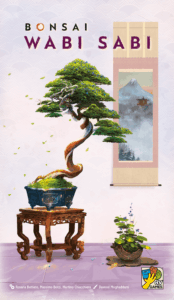
Bonsai
2023
Cultivate a miniature bonsai, claim challenging goals, and grow the best plant in this thoughtful game for 1–4 players.
40
minutes
1 - 4
player(s)
10+
Medium Light


About this board game
Bonsai is a board game for 1–4 players, with sessions lasting around 40 minutes, in which expert bonsai masters grow miniature living works of art.
Each player develops their own bonsai with the aim of growing the best plant and earning the honor of displaying it in the Imperial gardens. The game presents two choices on every turn: meditate or cultivate.
- Meditate: Choose one face-up card on the board and take it, along with any bonsai tiles represented below the card.
- Cultivate: Place tiles from your personal supply into your bonsai, using the symbols on your Seishi tile and any or all of your Growth cards.
- Claim goals: When your bonsai meets or exceeds an available Goal tile’s requirements, immediately decide whether to claim it or renounce it in pursuit of a harder goal.
During cultivation, each symbol allows you to place one tile of the corresponding type. Careful timing matters as you shape your bonsai and pursue the goals still available in the middle of the table.
When the last card from the deck is revealed, the game end is triggered. Every tile in your bonsai is worth a specific number of points, determining how your finished plant compares with the others.
Bonsai also includes a solo game with Additional Scenarios that change the rules and goals. Players can eventually attempt the Emperor Challenge, providing a further test for those seeking to master the art of growing a bonsai.
Mechanics
Illustrator
/pic7182955.jpg)

Board Game Rules for
Bonsai
1-4 players aged 10 and up. 40 minutes.
The Japanese term “bonsai” means “planted in a pot.”
A bonsai is a living work of art, a perfect miniature plant, identical in all respects to its full-size simile, but several times smaller.
A bonsai is a microcosm that contains within itself the mystery of the universe, unchanged in all but dimensions.
Players take on the role of expert bonsai masters intent on growing their own bonsai. Whoever grows the best plant will be appointed to show their bonsai at the Imperial Gardens.
Contents
- 1 Board
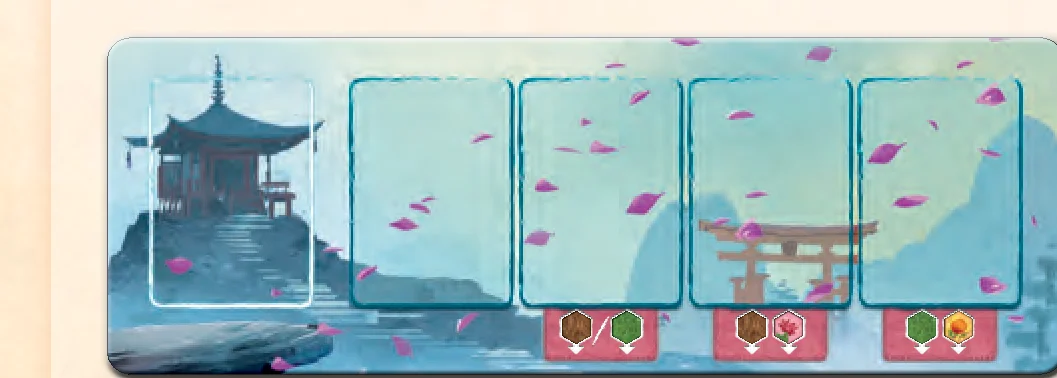
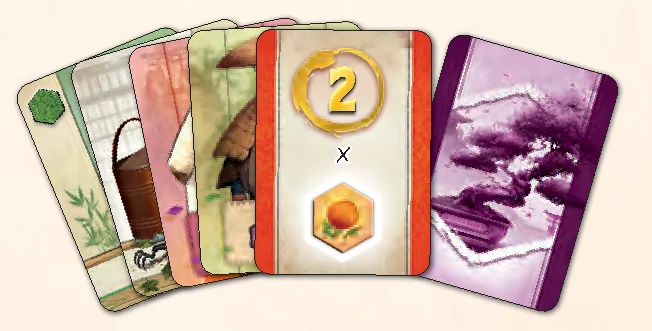
- 47 Zen cards of 5 types: Growth, Tool, Helper, Master, and Parchment
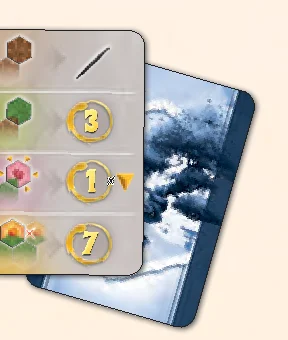
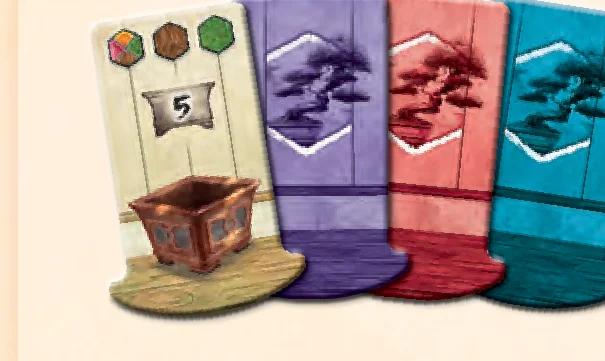
- 4 Summary cards: They show the placement rules and the scoring
- 4 Seishi starting tiles: Seishi is the art of growing and giving bonsai a shape, respecting the plant
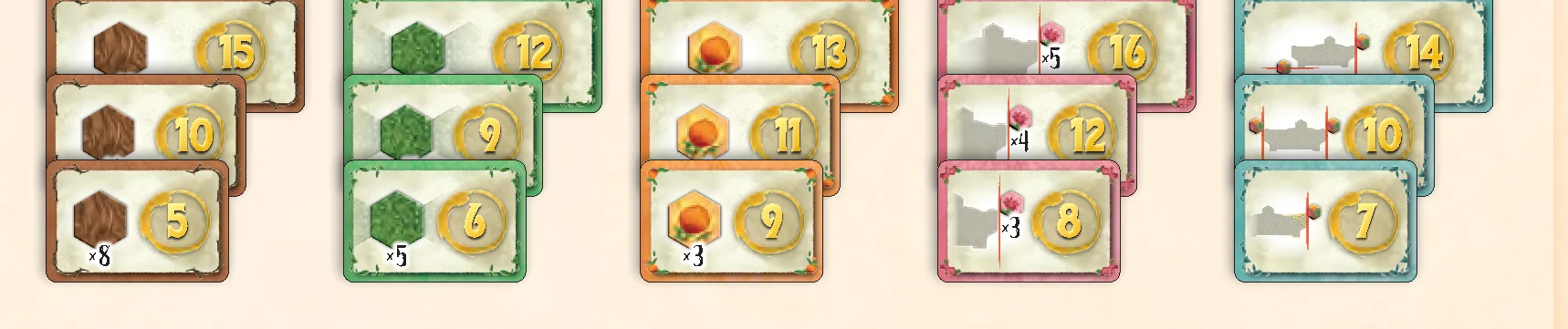
- 15 Goal tiles: For each of the five colors there are 3 Goals divided by difficulty: a low difficulty Goal, scoring the least number of points, an intermediate, and a hard Goal, scoring the greatest number of points
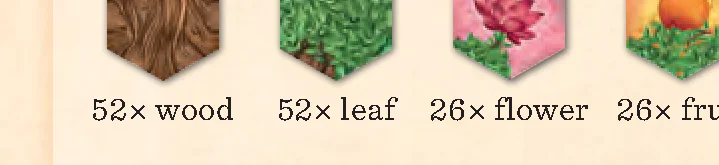
- 156 Bonsai tiles: 52× wood, 52× leaf, 26× flower, 26× fruit
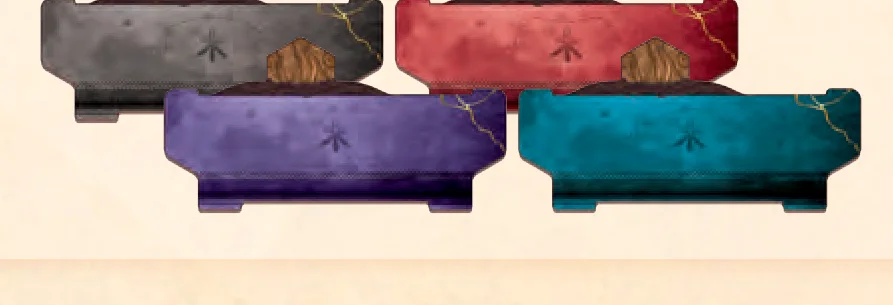
- 4 Pot tiles with starting buds (a wood tile)
- 1 Score pad
- These rules
The rules that follow apply to a game with 2 – 4 players. All modifications for a solo game are shown on page 7.
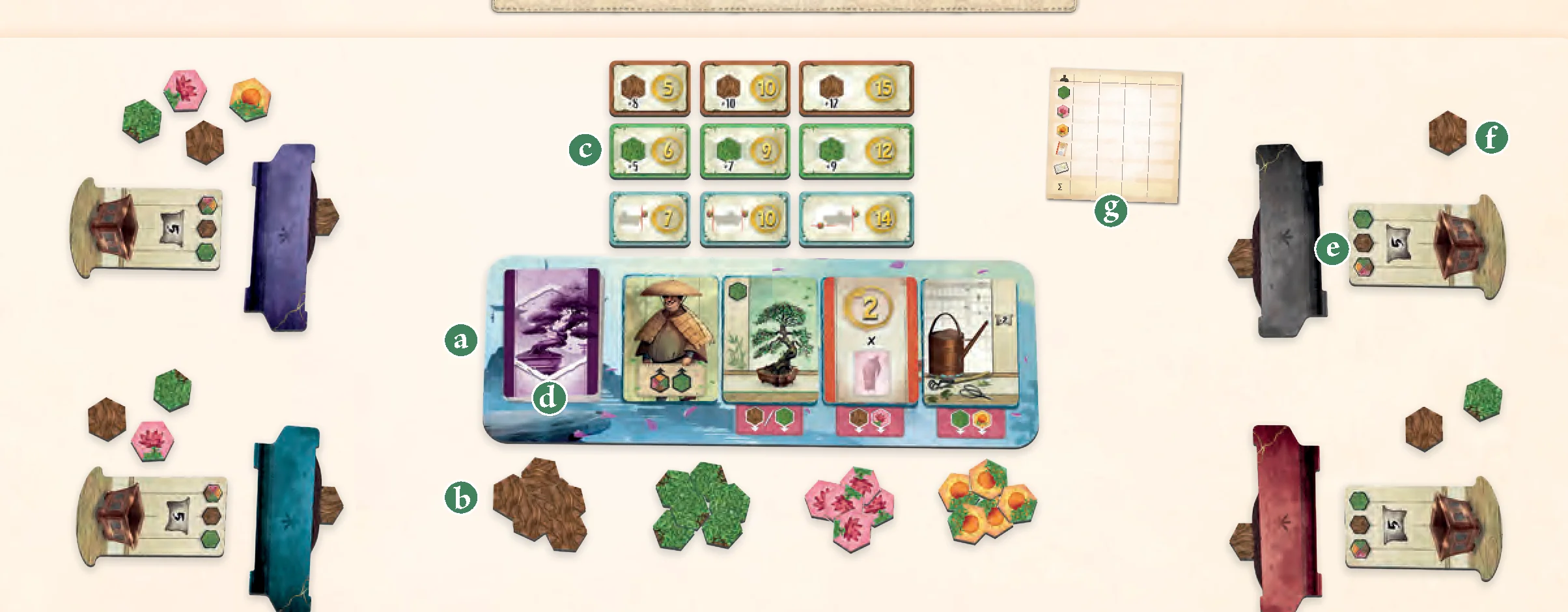
- Place the board in the middle of the table.
- Place all the bonsai tiles in an area which is within reach of all players. This is the common supply.
- Choose three colors at random (among brown, green, pink, orange, and light blue) and place the three Goal tiles of each chosen color beside the board (e.g., 3 brown tiles, 3 green tiles, and 3 light blue tiles, for a total of 9 tiles). Leave the unselected tiles in the box.
With 1 or 2 players, use only 2 tiles per color: discard the intermediate Goals. (If you are playing with inexperienced players, you may decide not to use the Goal tiles at all.) - Prepare the deck of Zen cards:
- 4 players: use all the cards.
- 3 players: remove the 4 cards for 4 players, marked with
 .
. - 2 players: remove the 15 cards for 3 and 4 players, marked with
 / .
/ .
Removed cards are not used in this game. Shuffle the deck and place it face down on the board in the leftmost space, where a temple is depicted. Draw the top 4 cards and place them face up in the spaces of the board.

- Each player receives a Pot tile of their chosen color, a matching Seishi starting tile, and a Summary card (not depicted above), which they place in front of them. Leave unassigned Pot and Seishi tiles as well as unused Summary cards in the box, as they will not be used.
- The first player is the oldest player. Starting with the first player and proceeding clockwise, each player takes from the common supply the bonsai tiles shown in the following table. Keep these tiles in your personal supply:
Player 1st 2nd 3rd 4th Starting tiles 1 wood 1 wood, 1 leaf 1 wood, 1 leaf, 1 flower 1 wood, 1 leaf, 1 flower, 1 fruit - Keep the score pad handy.
The game is played in turns in clockwise order, starting with the first player. On your turn, choose and perform one of these two actions:
- Meditate, or
- Cultivate
Then check if you can claim a Goal tile. After performing the action, and eventually claiming a Goal tile, your turn ends and passes to the next player in clockwise order.
Action 1: Meditate
Take 1 card and up to 2 tiles.
Choose one of the face-up cards on the board and take it, along with any bonsai tiles shown below the card you draw:
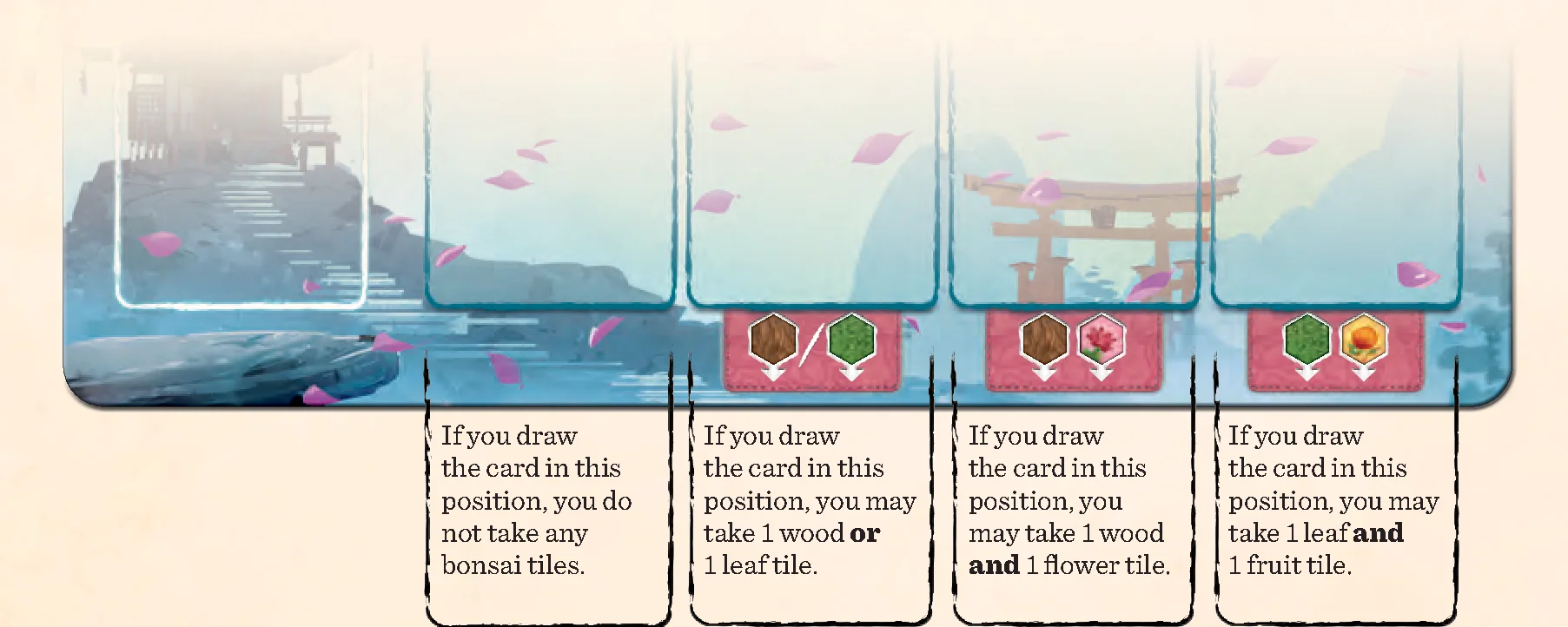
- Position 1 (leftmost): If you draw the card in this position, you do not take any bonsai tiles.
- Position 2: If you draw the card in this position, you may take 1 wood or 1 leaf tile.
- Position 3: If you draw the card in this position, you may take 1 wood and 1 flower tile.
- Position 4 (rightmost): If you draw the card in this position, you may take 1 leaf and 1 fruit tile.
Take the bonsai tiles from the common supply and keep them in your personal supply. (Bonsai tiles are to be considered unlimited. In the improbable case you need extra tiles, use any suitable substitute.)
Finally, slide all face-up cards on the board to the right, so that the just vacated space gets filled, then draw the top card from the deck to refill the empty space to its right.
Place the card you drew as described below:
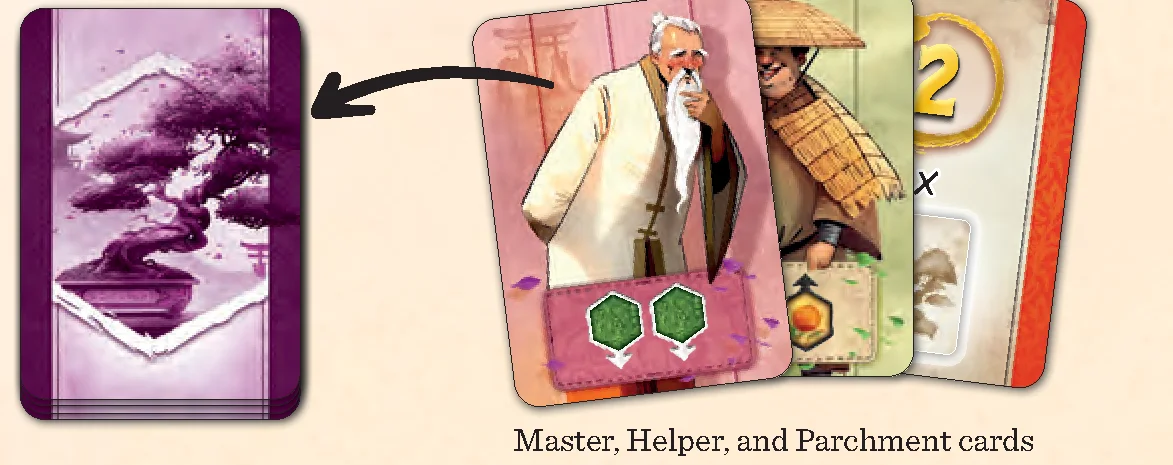
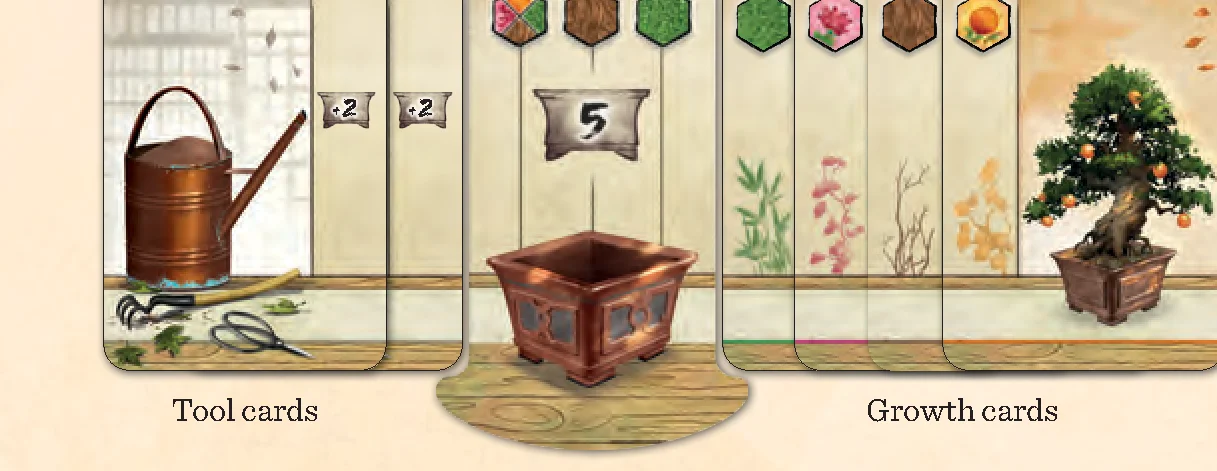
- Growth cards: Arrange your Growth cards to the right of the Seishi tile, fanning them out so that only the sidebar is visible (the bar that shows which tiles you can place with the Cultivate action).
- Tool cards: Arrange your Tool cards in a similar fashion, but to the left of the Seishi tile.
- Helper and Master cards: Keep your Helper and Master cards beside your Seishi tile in a single face-down pile, after performing their effects.
- Parchment cards: Keep your Parchment cards in the same face-down pile: they will be scored at game’s end.
For further information about the cards, see The cards, page 12.
Capacity limit
Your Seishi tile shows that you can only keep a maximum of 5 tiles in your supply. If you have more than 5 tiles at the end of your turn, then you must discard tiles of your choice until you have 5. You can extend this limit by acquiring Tool cards.
Action 2: Cultivate
Place tiles in your bonsai.
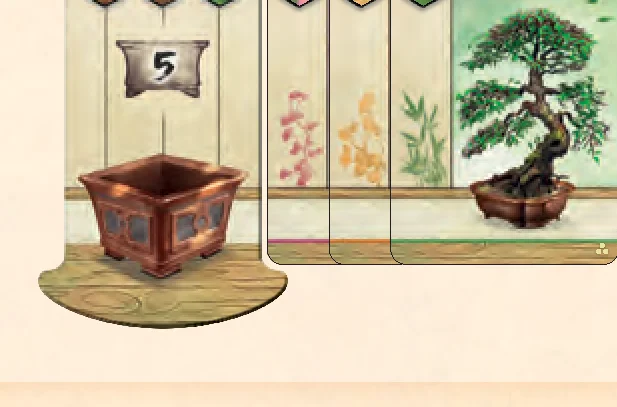
You can place tiles which are in your personal supply in your Bonsai. You can place as many tiles as there are symbols depicted on your Seishi tile and any or all of your Growth cards. Each symbol will let you place one tile of the corresponding type.
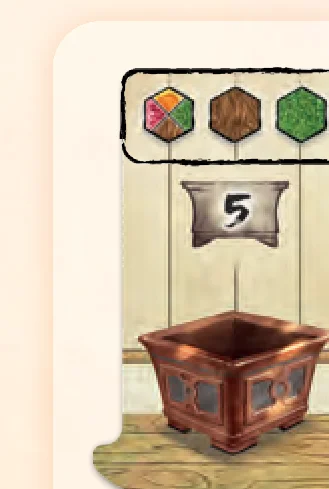
At the start of the game, you only have your Seishi tile to place bonsai tiles. It allows you to place one tile of your choice, and/or one wood tile, and/or one leaf tile during a Cultivate action, in any order. As the game progresses, you can acquire Growth cards that allow you to place more tiles when you choose to Cultivate (see The cards, page 12).
Placing Rules
During a Cultivate action, you must respect the placing rules that follow:
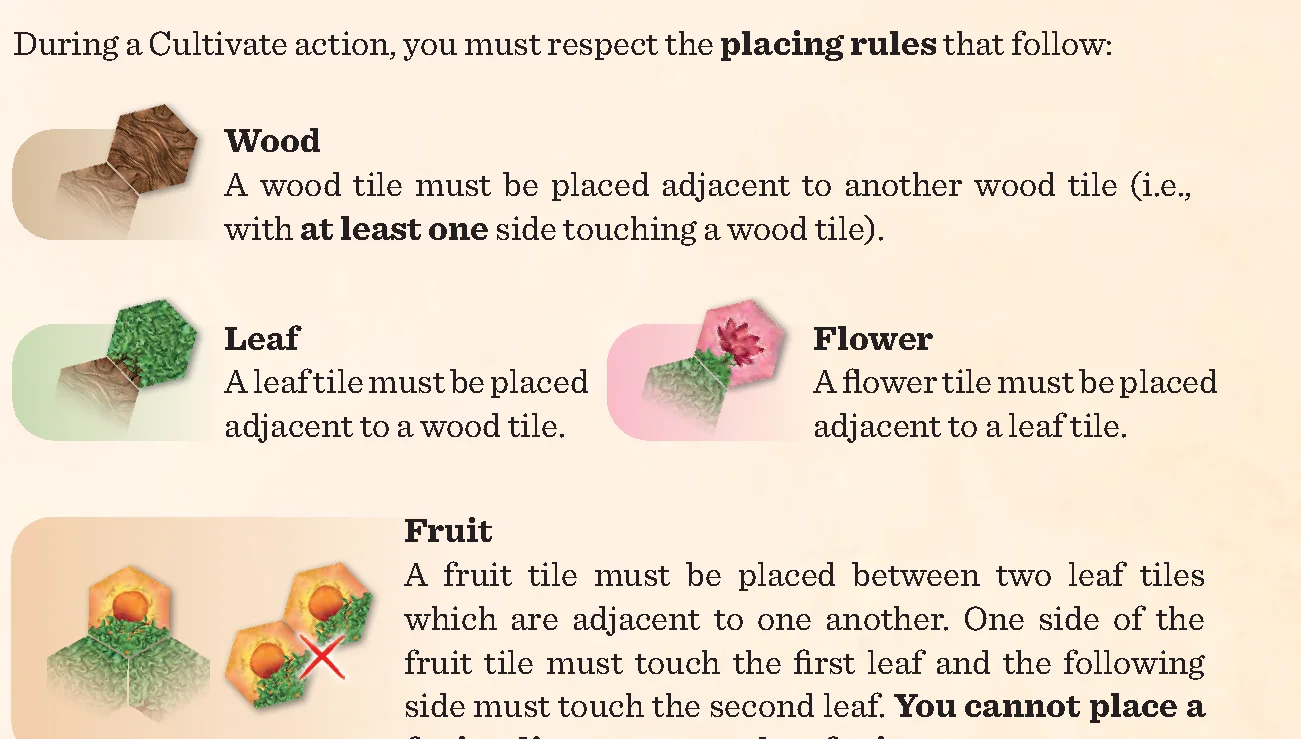
- Wood: A wood tile must be placed adjacent to another wood tile (i.e., with at least one side touching a wood tile).
- Leaf: A leaf tile must be placed adjacent to a wood tile.
- Flower: A flower tile must be placed adjacent to a leaf tile.
- Fruit: A fruit tile must be placed between two leaf tiles which are adjacent to one another. One side of the fruit tile must touch the first leaf and the following side must touch the second leaf. You cannot place a fruit adjacent to another fruit.
Note: In the improbable case that, at the beginning of your turn, it is not possible to add a wood tile to your bonsai, you may remove the least number of tiles from it (put them in the common supply) needed to make it possible again.
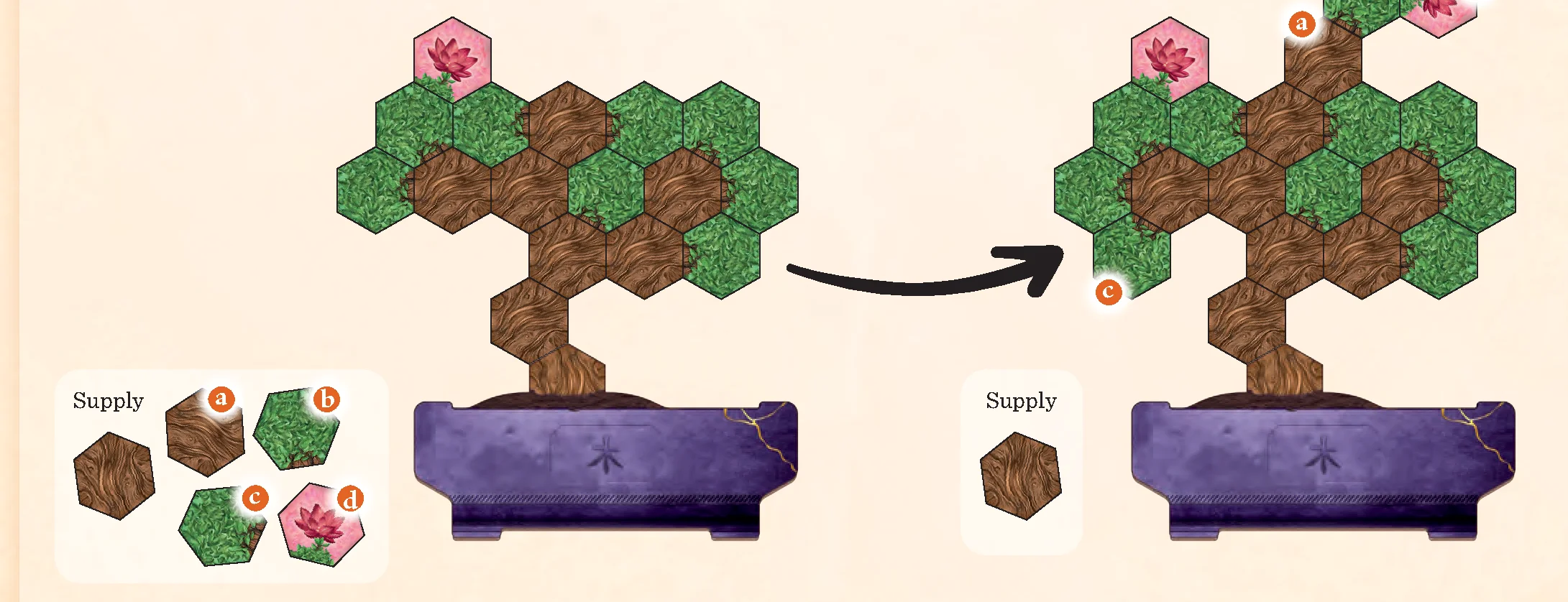
Example: Bryce has a Seishi tile and three Growth cards that allow him to place a total of 1 tile of his choice, 1 wood tile, 2 leaf tiles, 1 flower tile and 1 fruit tile. During his Cultivate action, he decides to place 1 wood (a), 2 leaves (b and c) and 1 flower (d), as he has no fruit in his supply. He chooses not to place a tile of his choice, as he thinks this is not useful at the moment.
Claiming a Goal Tile
During the turn in which your bonsai matches or exceeds the requirements of a Goal tile that is still in the middle of the table (i.e., the Goal tile has not been claimed yet by any player), you must immediately choose whether you want to claim that tile or if you want to renounce it in order to try to achieve a harder Goal tile.
If you complete and claim a Goal tile, take the tile and keep it beside your bonsai. You may only claim one Goal tile per color, however there is no limit to the number of Goal tiles of different colors that you can complete during your turn. If you renounce taking a Goal tile when you complete it, you may still try, in subsequent turns, to complete a harder Goal tile of the same color, but you may no longer claim the one you renounced.

Example: At the start of her turn, Martha has a bonsai with 4 leaves. She adds 2, bringing the total to 6. Now she could claim the Goal tile showing 5 leaves which is worth 6 points, or she can renounce it and try to claim the one showing 9 leaves which is worth 12 points. The intermediate tile, the one showing 7 leaves worth 9 points, was already claimed by Bryce so it cannot be taken anymore.
When the last card from the deck is revealed, the game end is triggered: All players, including the one who triggered the end, get one more turn and then the game ends and points are tallied (use the Score pad).
Each tile in your bonsai is worth a certain number of points, as follows:
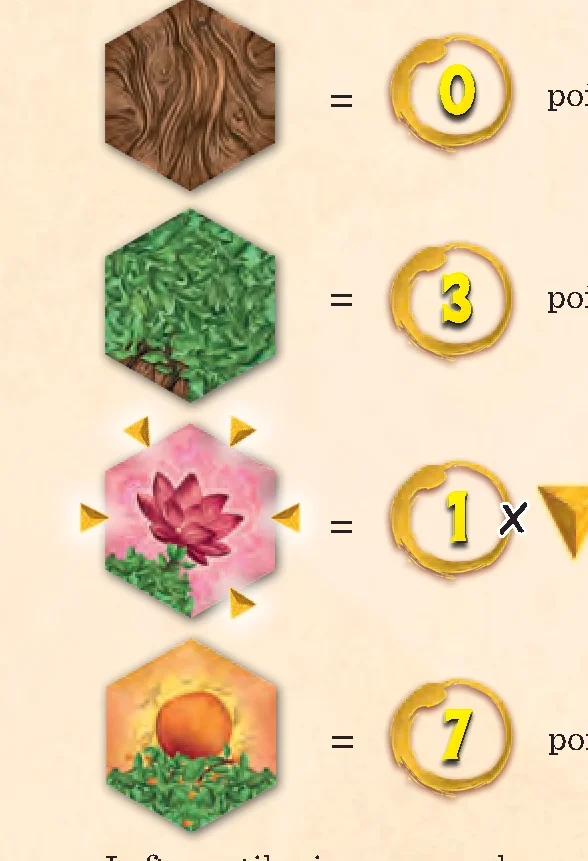
- Wood: 0 points
- Leaf: 3 points
- Flower: 1 point for each side not touching any other Bonsai tile (this tile will be worth from 0 to 5 points).
- Fruit: 7 points
Leftover tiles in your supply are not worth any points.
Reveal the face down cards in your pile. Add to your score any points provided by your Parchment cards and by claimed Goal tiles (see The cards and The Goal tiles, page 12).
The player with the most points is the winner! In case of a tie, the winner among tied players is the one farther away from the starting player, in clockwise order.
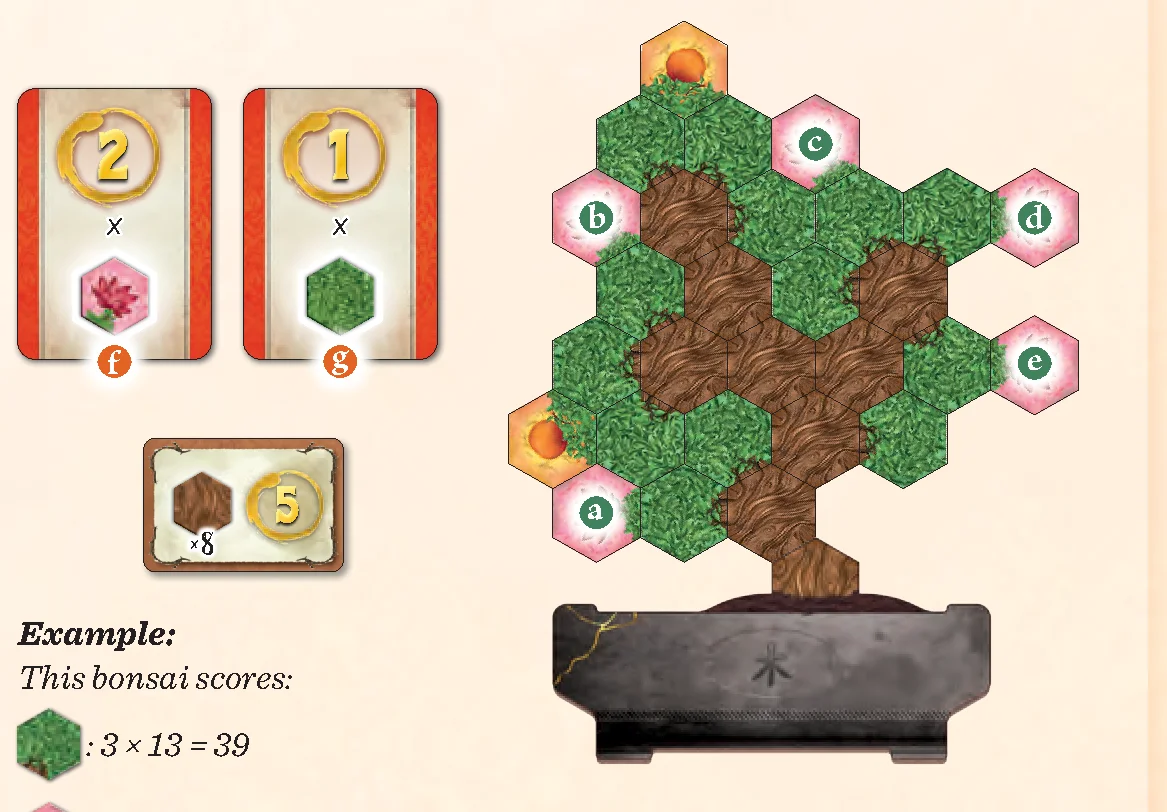
Example: This bonsai scores:
 Leaves: 3 × 13 = 39
 Flowers: 3(a) + 3(b) + 3(c) + 5(d) + 5(e) = 19
 Fruits: 7 × 2 = 14
Total = 72 points
The points obtained from Parchment cards and Goal tiles are added to the bonsai points. In this case, you would add 10 points given by the f Parchment card and 13 points from the g Parchment card, plus 5 points from the brown Goal tile. In total at the end of the game, this player scored 100 points.
Growth cards
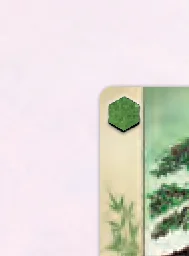
Growth cards stay in front of you for the rest of the game. When you Cultivate, you may place all tiles represented on your Growth cards in addition to the ones you can place thanks to your Seishi tile. If you have multiple copies of the same card, their effects add up. Choose freely the order in which you place the tiles. Each placement is optional.
Tool cards
Tool cards stay in front of you for the rest of the game. For each copy of this card you have, at the end of each turn, you can keep two additional tiles in your personal supply.
Example: If you have two of these cards, you can keep up to 4 more tiles in your personal supply, in addition to the 5 tiles you can keep thanks to your Seishi tile, for a total of 9.

Helper cards
Helper cards are activated once when you take them, then they are kept face down in a pile beside your Seishi tile.
Place in your bonsai one tile of your choice, and/or one tile of the type shown, taken from your personal supply (you may place tiles you just took along with this card).
 = place
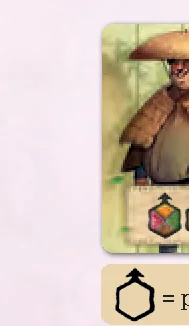
Master cards
Master cards are activated once when you take them, then they are kept face down in a pile beside your Seishi tile.
Take the tiles shown on the card from the common supply. Take these tiles in addition to the tiles you would normally take depending on the position of the card on the board. Remember to respect your capacity limit at the end of your turn.
 = take

Parchment cards
Parchment cards are kept face down in a pile beside your Seishi tile. At the end of the game, each Parchment card awards points depending on the depicted images, as follows:
 1 point for each wood tile in your bonsai (including the starting bud)
 1 point for each leaf tile in your bonsai
 2 points for each flower tile in your bonsai
 2 points for each fruit tile in your bonsai
 2 points for each Growth card you have
 2 points for each Helper card you have
 2 points for each Master card you have
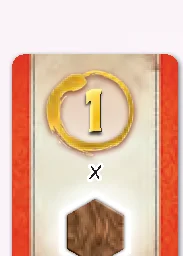
Bujin-ji Style Goal
Your bonsai has 8 / 10 / 12 wood tiles, including the starting bud tile.

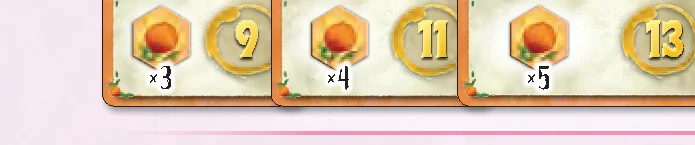
Chokkan Style Goal
Your bonsai has 3 / 4 / 5 fruit tiles.
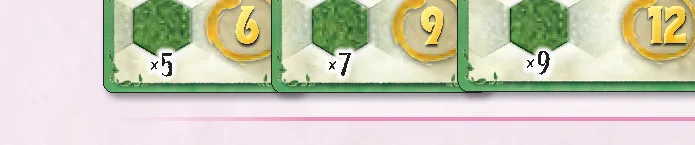
Moyogi Style Goal
Your bonsai has 5 / 7 / 9 leaf tiles, adjacent to one another.
Shakan Style Goal
Your bonsai has 3 / 4 / 5 flower tiles that protrude from the same side of the Pot (it does not matter if it’s the right or the left one).

Kengai Style Goal
- 7 points: Your bonsai has a tile which protrudes out of the farthest side of the pot (on the side showing the gold crack).
- 10 points: Your bonsai has tiles protruding from both sides of the pot.
- 14 points: Your bonsai has a tile protruding out of the pot on one side, and another tile below the pot on the other side (the specific sides do not matter).
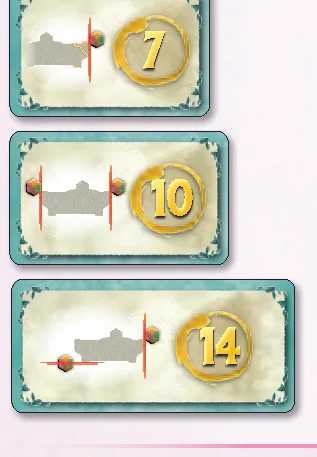
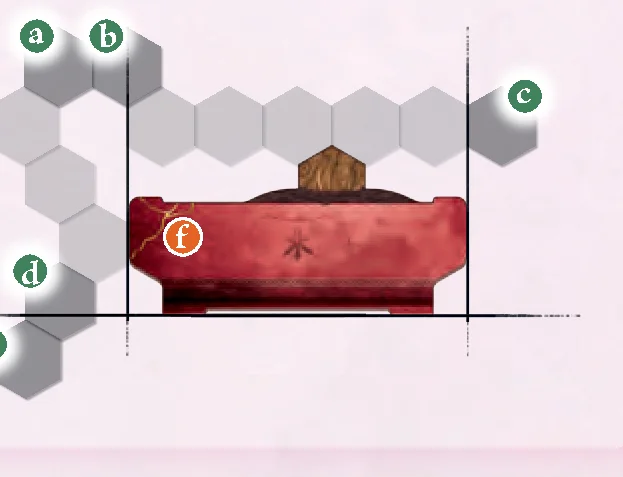
Diagram reference:
- a and b protrude out of one side of the pot;
- c protrudes out of the other side of the pot;
- d and e are below the pot;
- f is the gold crack.
Game variant “Tokonoma”
A tokonoma is a recessed space in a Japanese-style reception room, in which items for artistic appreciation, such as parchments or bonsai, are displayed.
After a few games, you may try this game variant which offers a more controlled experience by putting all Parchment cards in the first half of the deck, encouraging players to concentrate on these cards.
Once you have adjusted the deck depending on the number of players, take out all Parchment cards, shuffle half of the remaining deck and put it on the board. Then take the remaining half of the deck and shuffle it together with the Parchment cards. Finally, put this pile of cards on top of the ones on the board. The game plays as usual.
Solo Game
The rules for a 2-player game apply, with the following changes.
Choose a difficulty level according to the table below:
| Level | Difficulty | Points |
|---|---|---|
| Gakusei | Low | 80 |
| Senmon | Medium | 100 |
| Sensei | High | 120 |
| Yūsha | Extreme | 140 |
Setup: During setup, take 1 wood and 1 leaf tile as starting tiles, and add them to your personal supply.
During the game:
- Each time you take the Meditate action, you must discard in a discard pile the card to the left of the one you take. If you take the card to the right of the deck, reveal and discard the top card from the deck. Slide the other cards to the right to fill the gaps, then reveal new cards from the deck to fill the empty spaces on the board.
- Each time you take the Cultivate action, you must discard the rightmost card on the board, i.e., the one farthest from the deck. Then slide the remaining ones and refill the space as you would do at the end of a Meditate action.
When you reveal and add the last card from the deck to the board, play one last turn, then the game ends. Now check if you won: you must have claimed three Goals (one per color) and scored a point total matching or exceeding your chosen difficulty level.
Solo Scenarios
If you want a more challenging game, use one of the following scenarios, which are designed to explore particular strategies in Bonsai. Choose one of the scenarios (they are ordered from easiest to more difficult), then follow the rules for the solo mode with the changes listed.
1. Slow Fall
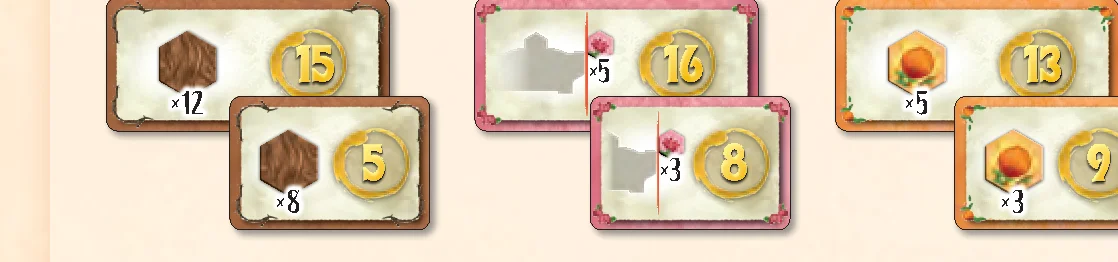
- Setup: Use only the Goal tiles shown above.
- Rules adjustments: None.
- Goal: Score at least 130 points. Claim 2 hard and 1 low difficulty Goal. (Remember that you cannot claim more than 1 Goal for each color.)

2. Long Winter

- Setup: Use only the Goal tiles shown above.
- Rules adjustments: None.
- Goal: Score at least 120 points. Collect at least 4 Parchment cards. Claim all 3 Goals.
Hint: To keep track of how many Parchment cards are left in the deck, you can put them in a face up pile near the board when you discard them. (There are 7 in total.)

3. Flourishing Spring

- Setup: Use only the Goal tiles shown above.
- Rules adjustments: Each time you take a Cultivate action, you must place a flower on your bonsai. You need to have this flower in your supply before taking the action, otherwise you cannot take it. This rule does not apply to the Helper card.
- Goal: Score at least 130 points. Claim all 3 Goals.

4. Scorching Summer

- Setup: Use only the Goal tiles shown above.
- Rules adjustments: At the end of the game, remove all fruit not adjacent to a flower, and all flowers not adjacent to a fruit. In other words, only keep flowers and fruits that are adjacent to each other.
- Goal: Score at least 130 points. Claim all 3 Goals.

5. The Emperor Challenge

- Setup: Use all intermediate Goals. Take a second Pot tile and place it in front of you (leave room between the two Pots for the bonsai). Place a summary card below one of the two Pots: this will be the active bonsai.
- Rules adjustments: When you take a Cultivate action, you may only add tiles to the active bonsai. If you claim Goal tiles, they belong to the active bonsai (place them beside it to remember). At the end of each Cultivate action, move the summary card to the other bonsai, which becomes the new active bonsai. Keep moving the card at the end of each Cultivate turn. If you take a Helper card, add the tiles to the active bonsai, but do not move the summary card.
To claim a Goal, always count only the tiles of the active bonsai.
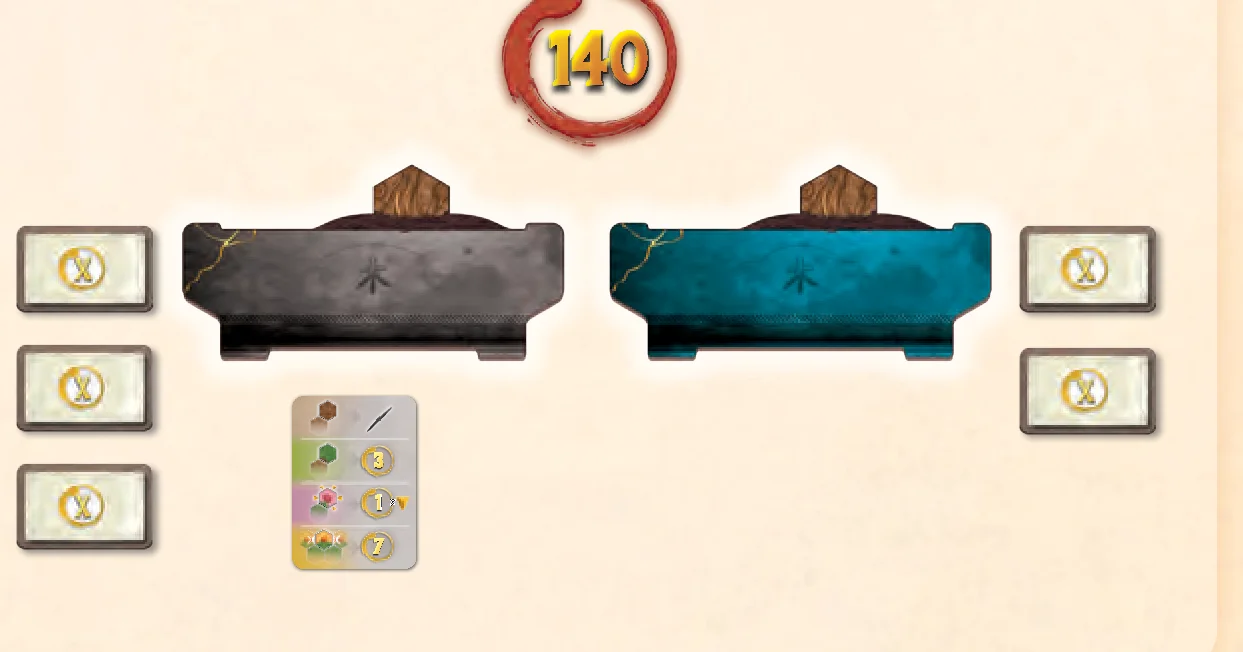
At the end of the game, count the tiles in both bonsai to score points and for Parchment cards. - Goal: Score at least 140 points. Claim all 5 Goals: 3 with one bonsai and 2 with the other bonsai. The order in which you claim the Goals is irrelevant.
Bonsai Origins
“Bonsai” is a term derived from the two kanji symbols 盆 “bon” (= pot) and 栽 “sai” (= to plant). Bonsai are living works of art in constant change, plants that even through their reduced proportions express all the power and balance of a big tree in the wild.
The art of bonsai originated in China over 2000 years ago, beginning in the VI Century, and was adopted and expanded in Japan with the introduction of Zen principles to the cultivation and care process. Approximately in the XVIII Century, the art of bonsai was spread among all social classes of Japan; Today it is an appreciated and practiced form of art all over the world, through globalization and the advent of the internet.
A bonsai is a never-finished masterpiece: the plant keeps growing and changing with the same seasonality that it would have in nature, but with the additional care and attention given by a specialist to guide its natural path. Bonsai are usually passed along from generation to generation and it’s not unusual to see bonsai that are centuries old. A fundamental aspect of bonsai is that they evoke a profound sense of strength, maturity and, most of all, deep peace and serenity to hobbyists, specialists, and newcomers alike.
Bonsai Care
Bonsai are full-fledged trees, and contrary of some folk beliefs, they are not genetically selected and modified to grow smaller, nor do they stay small because they are not watered or fed enough.
Bonsai are followed meticulously for their entire vital cycle, a perfect balance between the apex and the roots is maintained through pruning, fertilization, and other common techniques used for protection and care of plant diseases. Bonsai keep their reduced dimensions, or to be more precise they slow their growth to maintain the right ratio between foliage and roots; This is possible because they are planted in a pot and are not in direct competition with other plants.
Although these practices can appear as invasive to the plant, they are not any more so than pruning an orchard or taking care of a dog: it is the overall state of health of the tree that expresses its well-being. Moreover, techniques such as leaf trimming, root pruning, repotting and wiring are meant to sustain the form of the plant, to increase the exposition of the foliage to the sun, and to rearrange the root system in a better fitting space, thus renovating the terrain nutrients and increasing the long-term health of the tree.
If a bonsai is thoroughly cared for during its growth, its lifespan can be increased up to hundreds of years. The rule-of-thumb for bonsai specialists is “do not do to the plant anything that you need, but only what is best for its health: you are not the owner, but the caretaker”.
Main Bonsai Styles
When working on a bonsai, the specialist must have a general goal to refer to, while following through the formation and education of the plant. This goal is a project that should focus on the representation of nature. The specialist should be careful to respect, for example, trunk orientation, branching direction, shape of the crown, and any other elements that the arboreal species would have in nature. For this reason, the first and foremost source of learning for a specialist is the observation of nature itself. The following is a list of some of the most famous bonsai styles. Although some bonsai may have elements of multiple styles, the best practice is to refer to it by its dominant characteristics.
Chokkan
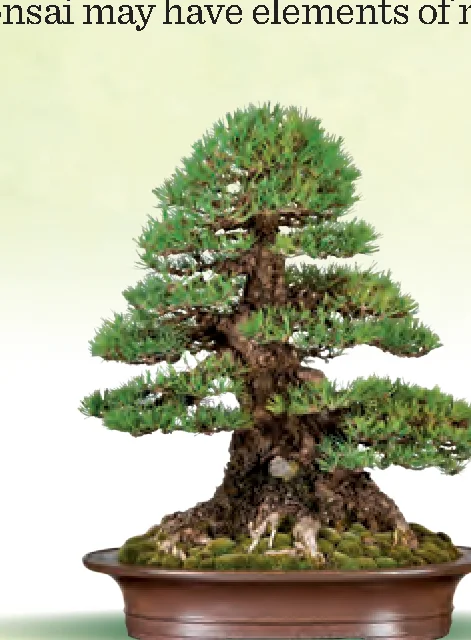
The “Chokkan” or “Formal upright” style is often visible in nature, especially when the tree is exposed to a lot of light and does not suffer competition with neighboring trees. The tapering of the straight trunk should be clearly visible, which means the trunk should be thickest at the bottom, progressing and becoming finer as it reaches the top. The first branching is visible at roughly 1/4 of the total trunk height, while the apex is formed by only one branch.
Moyoji
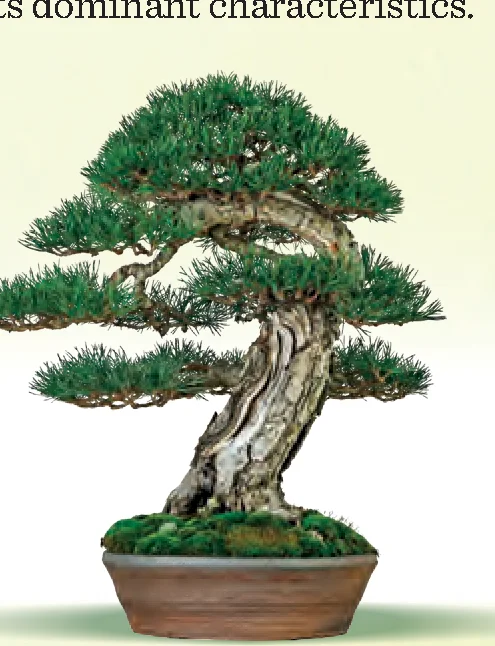
The “Moyoji” or “Informal upright” style is common both in nature and in bonsai art. The trunk grows upwards while slightly curving, and at each turn there is a branching of the trunk. The tapering of the trunk should be clearly visible, which means that the bottom of the trunk should be much larger than the top.
Bujin-ji
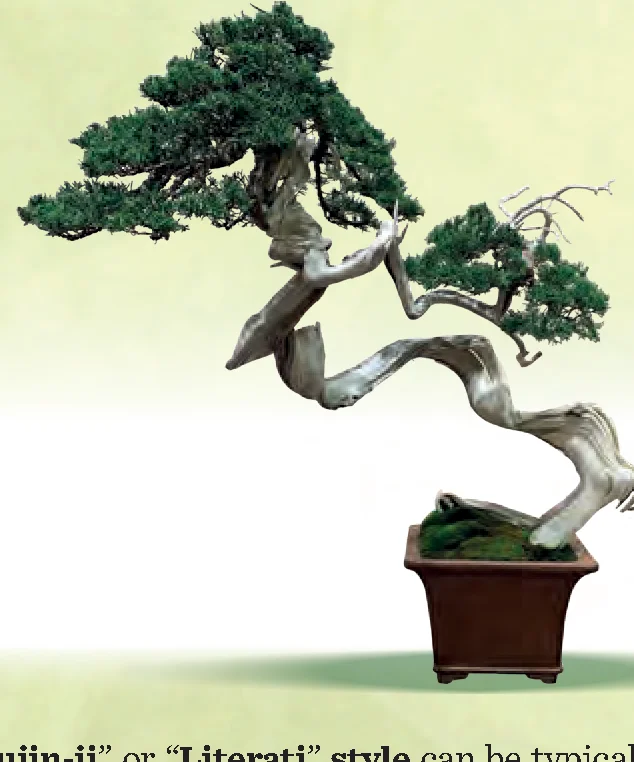
The “Bujin-ji” or “Literati” style can be typically found in nature, and it is one of the hardest styles because it’s hard to replicate it in bonsai art. The trunk is usually contorted and grows upwards, the branches are absent or reduced to a minimum, because the sun exposure is generally only towards the apex. These trees are usually placed in small, rounded pots.
Kengai
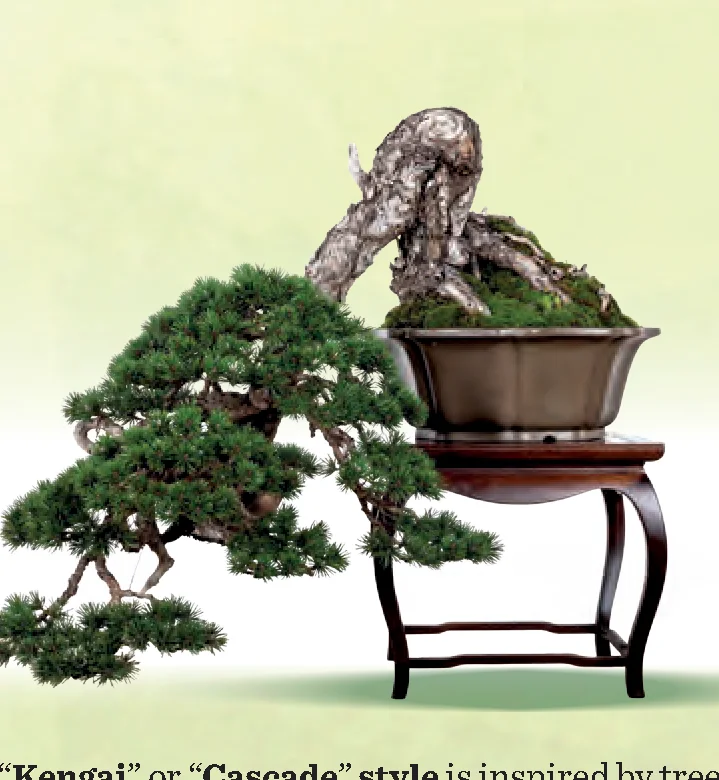
The “Kengai” or “Cascade” style is inspired by trees that grow in the wild on rocky walls and are bent downwards as a consequence of different factors, such as snow falling or rockslides. With bonsai, it can be difficult to maintain the growth downwards as the natural tendency for the trunk would be to go upwards. These bonsai are often planted in high pots with the apex falling below the base. Branches grow in either direction, horizontally, to maintain the balance of the tree.
Han-Kengai
The “Han-Kengai” or “Semi-cascade” style is modeled after trees that grow on cliffs, riverbanks, and lake shores. It differs from the “Kengai” style as the trunk never goes below the pot, the crown is usually above the lip, while the branching spreads below the lip.
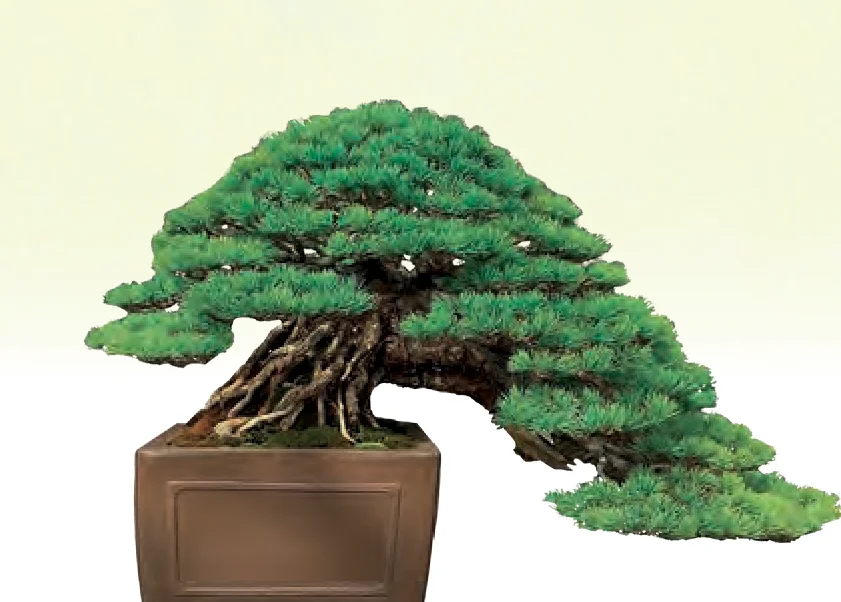
Hokidachi
The “Hokidachi” or “Broom” style is employed for deciduous trees with extended and fine branches. The trunk is straight and does not reach the apex of the tree, instead it branches out in all directions about 1/3 of the entire height of the tree. Branches and leaves form a spheric-like crown, thus guaranteeing a breathtaking view even in winter, when leaves fall.
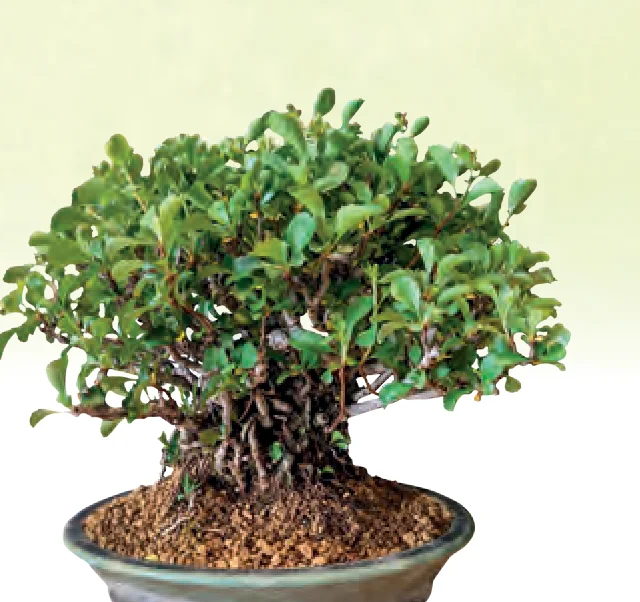
Shakan
The “Shakan” or “Slant” style is similar to the Chokkan style, with the exception that the plant grows out of the soil at an angle. Usually the first branch grows in the opposite direction of the trunk, to balance the tree. This branch can be found at 1/3 of the total height of the plant.
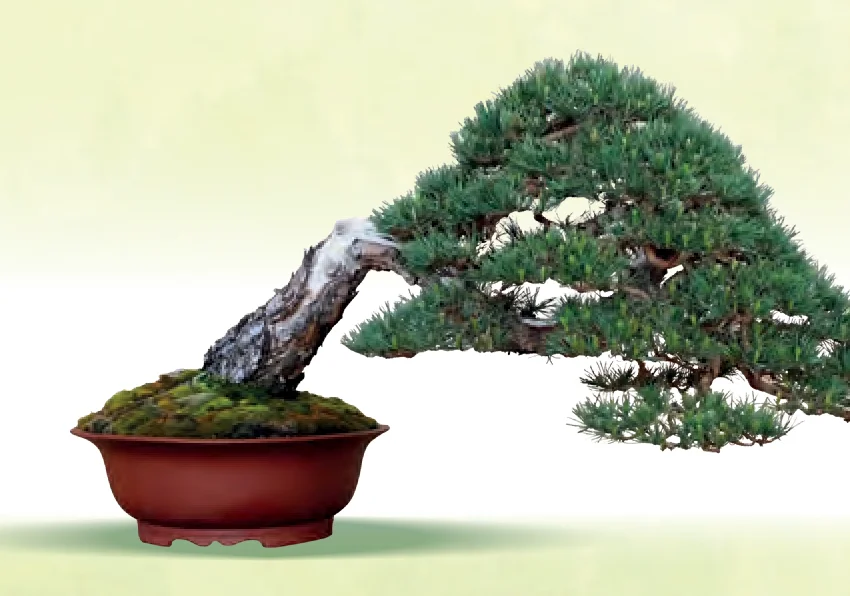
Kabudachi
The “Kabudachi” or “Clump” style is characterized by having many plants of the same species, usually an odd number, in a single bonsai pot. It is common in nature, but not so common in bonsai art. This style tries to recreate a fallen trunk that generates branches that becomes trunks of new plants themselves. For this reason, it’s important that each trunk grows out from the same base. It’s also important to maintain a triangular shape in the whole formation as well as in each individual plant.
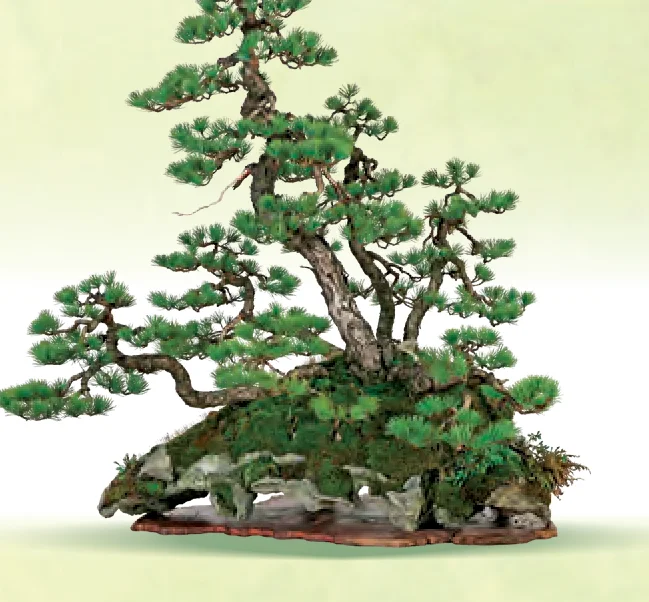
Credits
Game Design: Rosaria Battiato, Massimo Borzì, Martino Chiacchiera
Artworks: Davood Moghaddami
Development: Luca Appolloni, Marta Ciaccasassi
Art Direction: Matteo Brustenghi
Graphic Design: Lisa Bernacchia, Matteo Brustenghi, Daniele Solfrini
English Rules Editing: William Niebling
DV Games would like to thank Matteo Dal Lago and UBI (Bonsai Specialists Italian Union) for their important contribution through review and fact checking of the game so that we manage to deliver an enhanced and complete game experience.
Introduction & Components
1-4 players aged 10 and up. 40 minutes.
The Japanese term “bonsai” means “planted in a pot.”
A bonsai is a living work of art, a perfect miniature plant, identical in all respects to its full-size simile, but several times smaller.
A bonsai is a microcosm that contains within itself the mystery of the universe, unchanged in all but dimensions.
Players take on the role of expert bonsai masters intent on growing their own bonsai. Whoever grows the best plant will be appointed to show their bonsai at the Imperial Gardens.
Contents
- 1 Board
- 47 Zen cards of 5 types: Growth, Tool, Helper, Master, and Parchment
- 4 Summary cards: They show the placement rules and the scoring
- 4 Seishi starting tiles: Seishi is the art of growing and giving bonsai a shape, respecting the plant
- 15 Goal tiles: For each of the five colors there are 3 Goals divided by difficulty: a low difficulty Goal, scoring the least number of points, an intermediate, and a hard Goal, scoring the greatest number of points
- 156 Bonsai tiles: 52× wood, 52× leaf, 26× flower, 26× fruit
- 4 Pot tiles with starting buds (a wood tile)
- 1 Score pad
- These rules
Setup
The rules that follow apply to a game with 2 – 4 players. All modifications for a solo game are shown on page 7.
- Place the board in the middle of the table.
- Place all the bonsai tiles in an area which is within reach of all players. This is the common supply.
- Choose three colors at random (among brown, green, pink, orange, and light blue) and place the three Goal tiles of each chosen color beside the board (e.g., 3 brown tiles, 3 green tiles, and 3 light blue tiles, for a total of 9 tiles). Leave the unselected tiles in the box.
With 1 or 2 players, use only 2 tiles per color: discard the intermediate Goals. (If you are playing with inexperienced players, you may decide not to use the Goal tiles at all.) - Prepare the deck of Zen cards:
- 4 players: use all the cards.
- 3 players: remove the 4 cards for 4 players, marked with .
- 2 players: remove the 15 cards for 3 and 4 players, marked with / .
Removed cards are not used in this game. Shuffle the deck and place it face down on the board in the leftmost space, where a temple is depicted. Draw the top 4 cards and place them face up in the spaces of the board.
- Each player receives a Pot tile of their chosen color, a matching Seishi starting tile, and a Summary card (not depicted above), which they place in front of them. Leave unassigned Pot and Seishi tiles as well as unused Summary cards in the box, as they will not be used.
- The first player is the oldest player. Starting with the first player and proceeding clockwise, each player takes from the common supply the bonsai tiles shown in the following table. Keep these tiles in your personal supply:
Player 1st 2nd 3rd 4th Starting tiles 1 wood 1 wood, 1 leaf 1 wood, 1 leaf, 1 flower 1 wood, 1 leaf, 1 flower, 1 fruit - Keep the score pad handy.
How to Play
The game is played in turns in clockwise order, starting with the first player. On your turn, choose and perform one of these two actions:
- Meditate, or
- Cultivate
Then check if you can claim a Goal tile. After performing the action, and eventually claiming a Goal tile, your turn ends and passes to the next player in clockwise order.
Action 1: Meditate
Take 1 card and up to 2 tiles.
Choose one of the face-up cards on the board and take it, along with any bonsai tiles shown below the card you draw:
- Position 1 (leftmost): If you draw the card in this position, you do not take any bonsai tiles.
- Position 2: If you draw the card in this position, you may take 1 wood or 1 leaf tile.
- Position 3: If you draw the card in this position, you may take 1 wood and 1 flower tile.
- Position 4 (rightmost): If you draw the card in this position, you may take 1 leaf and 1 fruit tile.
Take the bonsai tiles from the common supply and keep them in your personal supply. (Bonsai tiles are to be considered unlimited. In the improbable case you need extra tiles, use any suitable substitute.)
Finally, slide all face-up cards on the board to the right, so that the just vacated space gets filled, then draw the top card from the deck to refill the empty space to its right.
Place the card you drew as described below:
- Growth cards: Arrange your Growth cards to the right of the Seishi tile, fanning them out so that only the sidebar is visible (the bar that shows which tiles you can place with the Cultivate action).
- Tool cards: Arrange your Tool cards in a similar fashion, but to the left of the Seishi tile.
- Helper and Master cards: Keep your Helper and Master cards beside your Seishi tile in a single face-down pile, after performing their effects.
- Parchment cards: Keep your Parchment cards in the same face-down pile: they will be scored at game’s end.
For further information about the cards, see The cards, page 12.
Capacity limit
Your Seishi tile shows that you can only keep a maximum of 5 tiles in your supply. If you have more than 5 tiles at the end of your turn, then you must discard tiles of your choice until you have 5. You can extend this limit by acquiring Tool cards.
Action 2: Cultivate
Place tiles in your bonsai.
You can place tiles which are in your personal supply in your Bonsai. You can place as many tiles as there are symbols depicted on your Seishi tile and any or all of your Growth cards. Each symbol will let you place one tile of the corresponding type.
At the start of the game, you only have your Seishi tile to place bonsai tiles. It allows you to place one tile of your choice, and/or one wood tile, and/or one leaf tile during a Cultivate action, in any order. As the game progresses, you can acquire Growth cards that allow you to place more tiles when you choose to Cultivate (see The cards, page 12).
Placing Rules
During a Cultivate action, you must respect the placing rules that follow:
- Wood: A wood tile must be placed adjacent to another wood tile (i.e., with at least one side touching a wood tile).
- Leaf: A leaf tile must be placed adjacent to a wood tile.
- Flower: A flower tile must be placed adjacent to a leaf tile.
- Fruit: A fruit tile must be placed between two leaf tiles which are adjacent to one another. One side of the fruit tile must touch the first leaf and the following side must touch the second leaf. You cannot place a fruit adjacent to another fruit.
Note: In the improbable case that, at the beginning of your turn, it is not possible to add a wood tile to your bonsai, you may remove the least number of tiles from it (put them in the common supply) needed to make it possible again.
Example: Bryce has a Seishi tile and three Growth cards that allow him to place a total of 1 tile of his choice, 1 wood tile, 2 leaf tiles, 1 flower tile and 1 fruit tile. During his Cultivate action, he decides to place 1 wood (a), 2 leaves (b and c) and 1 flower (d), as he has no fruit in his supply. He chooses not to place a tile of his choice, as he thinks this is not useful at the moment.
Claiming a Goal Tile
During the turn in which your bonsai matches or exceeds the requirements of a Goal tile that is still in the middle of the table (i.e., the Goal tile has not been claimed yet by any player), you must immediately choose whether you want to claim that tile or if you want to renounce it in order to try to achieve a harder Goal tile.
If you complete and claim a Goal tile, take the tile and keep it beside your bonsai. You may only claim one Goal tile per color, however there is no limit to the number of Goal tiles of different colors that you can complete during your turn. If you renounce taking a Goal tile when you complete it, you may still try, in subsequent turns, to complete a harder Goal tile of the same color, but you may no longer claim the one you renounced.
Example: At the start of her turn, Martha has a bonsai with 4 leaves. She adds 2, bringing the total to 6. Now she could claim the Goal tile showing 5 leaves which is worth 6 points, or she can renounce it and try to claim the one showing 9 leaves which is worth 12 points. The intermediate tile, the one showing 7 leaves worth 9 points, was already claimed by Bryce so it cannot be taken anymore.
End of the Game & Scoring
When the last card from the deck is revealed, the game end is triggered: All players, including the one who triggered the end, get one more turn and then the game ends and points are tallied (use the Score pad).
Each tile in your bonsai is worth a certain number of points, as follows:
- Wood: 0 points
- Leaf: 3 points
- Flower: 1 point for each side not touching any other Bonsai tile (this tile will be worth from 0 to 5 points).
- Fruit: 7 points
Leftover tiles in your supply are not worth any points.
Reveal the face down cards in your pile. Add to your score any points provided by your Parchment cards and by claimed Goal tiles (see The cards and The Goal tiles, page 12).
The player with the most points is the winner! In case of a tie, the winner among tied players is the one farther away from the starting player, in clockwise order.
Example: This bonsai scores:
- Leaves: 3 × 13 = 39
- Flowers: 3(a) + 3(b) + 3(c) + 5(d) + 5(e) = 19
- Fruits: 7 × 2 = 14
Total = 72 points
The points obtained from Parchment cards and Goal tiles are added to the bonsai points. In this case, you would add 10 points given by the f Parchment card and 13 points from the g Parchment card, plus 5 points from the brown Goal tile. In total at the end of the game, this player scored 100 points.
Card Reference
Growth cards
Growth cards stay in front of you for the rest of the game. When you Cultivate, you may place all tiles represented on your Growth cards in addition to the ones you can place thanks to your Seishi tile. If you have multiple copies of the same card, their effects add up. Choose freely the order in which you place the tiles. Each placement is optional.
Tool cards
Tool cards stay in front of you for the rest of the game. For each copy of this card you have, at the end of each turn, you can keep two additional tiles in your personal supply.
Example: If you have two of these cards, you can keep up to 4 more tiles in your personal supply, in addition to the 5 tiles you can keep thanks to your Seishi tile, for a total of 9.
Helper cards
Helper cards are activated once when you take them, then they are kept face down in a pile beside your Seishi tile.
Place in your bonsai one tile of your choice, and/or one tile of the type shown, taken from your personal supply (you may place tiles you just took along with this card).
= place
Master cards
Master cards are activated once when you take them, then they are kept face down in a pile beside your Seishi tile.
Take the tiles shown on the card from the common supply. Take these tiles in addition to the tiles you would normally take depending on the position of the card on the board. Remember to respect your capacity limit at the end of your turn.
= take
Parchment cards
Parchment cards are kept face down in a pile beside your Seishi tile. At the end of the game, each Parchment card awards points depending on the depicted images, as follows:
- 1 point for each wood tile in your bonsai (including the starting bud)
- 1 point for each leaf tile in your bonsai
- 2 points for each flower tile in your bonsai
- 2 points for each fruit tile in your bonsai
- 2 points for each Growth card you have
- 2 points for each Helper card you have
- 2 points for each Master card you have
Goal Tiles Reference
Bujin-ji Style Goal
Your bonsai has 8 / 10 / 12 wood tiles, including the starting bud tile.
Chokkan Style Goal
Your bonsai has 3 / 4 / 5 fruit tiles.
Moyogi Style Goal
Your bonsai has 5 / 7 / 9 leaf tiles, adjacent to one another.
Shakan Style Goal
Your bonsai has 3 / 4 / 5 flower tiles that protrude from the same side of the Pot (it does not matter if it’s the right or the left one).
Kengai Style Goal
- 7 points: Your bonsai has a tile which protrudes out of the farthest side of the pot (on the side showing the gold crack).
- 10 points: Your bonsai has tiles protruding from both sides of the pot.
- 14 points: Your bonsai has a tile protruding out of the pot on one side, and another tile below the pot on the other side (the specific sides do not matter).
Diagram reference:
- a and b protrude out of one side of the pot;
- c protrudes out of the other side of the pot;
- d and e are below the pot;
- f is the gold crack.
Variants & Solo Play
Game variant “Tokonoma”
A tokonoma is a recessed space in a Japanese-style reception room, in which items for artistic appreciation, such as parchments or bonsai, are displayed.
After a few games, you may try this game variant which offers a more controlled experience by putting all Parchment cards in the first half of the deck, encouraging players to concentrate on these cards.
Once you have adjusted the deck depending on the number of players, take out all Parchment cards, shuffle half of the remaining deck and put it on the board. Then take the remaining half of the deck and shuffle it together with the Parchment cards. Finally, put this pile of cards on top of the ones on the board. The game plays as usual.
Solo Game
The rules for a 2-player game apply, with the following changes.
Choose a difficulty level according to the table below:
| Level | Difficulty | Points |
|---|---|---|
| Gakusei | Low | 80 |
| Senmon | Medium | 100 |
| Sensei | High | 120 |
| Yūsha | Extreme | 140 |
Setup: During setup, take 1 wood and 1 leaf tile as starting tiles, and add them to your personal supply.
During the game:
- Each time you take the Meditate action, you must discard in a discard pile the card to the left of the one you take. If you take the card to the right of the deck, reveal and discard the top card from the deck. Slide the other cards to the right to fill the gaps, then reveal new cards from the deck to fill the empty spaces on the board.
- Each time you take the Cultivate action, you must discard the rightmost card on the board, i.e., the one farthest from the deck. Then slide the remaining ones and refill the space as you would do at the end of a Meditate action.
When you reveal and add the last card from the deck to the board, play one last turn, then the game ends. Now check if you won: you must have claimed three Goals (one per color) and scored a point total matching or exceeding your chosen difficulty level.
Solo Scenarios
If you want a more challenging game, use one of the following scenarios, which are designed to explore particular strategies in Bonsai. Choose one of the scenarios (they are ordered from easiest to more difficult), then follow the rules for the solo mode with the changes listed.
1. Slow Fall
- Setup: Use only the Goal tiles shown above.
- Rules adjustments: None.
- Goal: Score at least 130 points. Claim 2 hard and 1 low difficulty Goal. (Remember that you cannot claim more than 1 Goal for each color.)
2. Long Winter
- Setup: Use only the Goal tiles shown above.
- Rules adjustments: None.
- Goal: Score at least 120 points. Collect at least 4 Parchment cards. Claim all 3 Goals.
Hint: To keep track of how many Parchment cards are left in the deck, you can put them in a face up pile near the board when you discard them. (There are 7 in total.)
3. Flourishing Spring
- Setup: Use only the Goal tiles shown above.
- Rules adjustments: Each time you take a Cultivate action, you must place a flower on your bonsai. You need to have this flower in your supply before taking the action, otherwise you cannot take it. This rule does not apply to the Helper card.
- Goal: Score at least 130 points. Claim all 3 Goals.
4. Scorching Summer
- Setup: Use only the Goal tiles shown above.
- Rules adjustments: At the end of the game, remove all fruit not adjacent to a flower, and all flowers not adjacent to a fruit. In other words, only keep flowers and fruits that are adjacent to each other.
- Goal: Score at least 130 points. Claim all 3 Goals.
5. The Emperor Challenge
- Setup: Use all intermediate Goals. Take a second Pot tile and place it in front of you (leave room between the two Pots for the bonsai). Place a summary card below one of the two Pots: this will be the active bonsai.
- Rules adjustments: When you take a Cultivate action, you may only add tiles to the active bonsai. If you claim Goal tiles, they belong to the active bonsai (place them beside it to remember). At the end of each Cultivate action, move the summary card to the other bonsai, which becomes the new active bonsai. Keep moving the card at the end of each Cultivate turn. If you take a Helper card, add the tiles to the active bonsai, but do not move the summary card.
To claim a Goal, always count only the tiles of the active bonsai.
At the end of the game, count the tiles in both bonsai to score points and for Parchment cards. - Goal: Score at least 140 points. Claim all 5 Goals: 3 with one bonsai and 2 with the other bonsai. The order in which you claim the Goals is irrelevant.
Bonsai Lore, Styles & Credits
Bonsai Origins
“Bonsai” is a term derived from the two kanji symbols 盆 “bon” (= pot) and 栽 “sai” (= to plant). Bonsai are living works of art in constant change, plants that even through their reduced proportions express all the power and balance of a big tree in the wild.
The art of bonsai originated in China over 2000 years ago, beginning in the VI Century, and was adopted and expanded in Japan with the introduction of Zen principles to the cultivation and care process. Approximately in the XVIII Century, the art of bonsai was spread among all social classes of Japan; Today it is an appreciated and practiced form of art all over the world, through globalization and the advent of the internet.
A bonsai is a never-finished masterpiece: the plant keeps growing and changing with the same seasonality that it would have in nature, but with the additional care and attention given by a specialist to guide its natural path. Bonsai are usually passed along from generation to generation and it’s not unusual to see bonsai that are centuries old. A fundamental aspect of bonsai is that they evoke a profound sense of strength, maturity and, most of all, deep peace and serenity to hobbyists, specialists, and newcomers alike.
Bonsai Care
Bonsai are full-fledged trees, and contrary of some folk beliefs, they are not genetically selected and modified to grow smaller, nor do they stay small because they are not watered or fed enough.
Bonsai are followed meticulously for their entire vital cycle, a perfect balance between the apex and the roots is maintained through pruning, fertilization, and other common techniques used for protection and care of plant diseases. Bonsai keep their reduced dimensions, or to be more precise they slow their growth to maintain the right ratio between foliage and roots; This is possible because they are planted in a pot and are not in direct competition with other plants.
Although these practices can appear as invasive to the plant, they are not any more so than pruning an orchard or taking care of a dog: it is the overall state of health of the tree that expresses its well-being. Moreover, techniques such as leaf trimming, root pruning, repotting and wiring are meant to sustain the form of the plant, to increase the exposition of the foliage to the sun, and to rearrange the root system in a better fitting space, thus renovating the terrain nutrients and increasing the long-term health of the tree.
If a bonsai is thoroughly cared for during its growth, its lifespan can be increased up to hundreds of years. The rule-of-thumb for bonsai specialists is “do not do to the plant anything that you need, but only what is best for its health: you are not the owner, but the caretaker”.
Main Bonsai Styles
When working on a bonsai, the specialist must have a general goal to refer to, while following through the formation and education of the plant. This goal is a project that should focus on the representation of nature. The specialist should be careful to respect, for example, trunk orientation, branching direction, shape of the crown, and any other elements that the arboreal species would have in nature. For this reason, the first and foremost source of learning for a specialist is the observation of nature itself. The following is a list of some of the most famous bonsai styles. Although some bonsai may have elements of multiple styles, the best practice is to refer to it by its dominant characteristics.
Chokkan
The “Chokkan” or “Formal upright” style is often visible in nature, especially when the tree is exposed to a lot of light and does not suffer competition with neighboring trees. The tapering of the straight trunk should be clearly visible, which means the trunk should be thickest at the bottom, progressing and becoming finer as it reaches the top. The first branching is visible at roughly 1/4 of the total trunk height, while the apex is formed by only one branch.
Moyoji
The “Moyoji” or “Informal upright” style is common both in nature and in bonsai art. The trunk grows upwards while slightly curving, and at each turn there is a branching of the trunk. The tapering of the trunk should be clearly visible, which means that the bottom of the trunk should be much larger than the top.
Bujin-ji
The “Bujin-ji” or “Literati” style can be typically found in nature, and it is one of the hardest styles because it’s hard to replicate it in bonsai art. The trunk is usually contorted and grows upwards, the branches are absent or reduced to a minimum, because the sun exposure is generally only towards the apex. These trees are usually placed in small, rounded pots.
Kengai
The “Kengai” or “Cascade” style is inspired by trees that grow in the wild on rocky walls and are bent downwards as a consequence of different factors, such as snow falling or rockslides. With bonsai, it can be difficult to maintain the growth downwards as the natural tendency for the trunk would be to go upwards. These bonsai are often planted in high pots with the apex falling below the base. Branches grow in either direction, horizontally, to maintain the balance of the tree.
Han-Kengai
The “Han-Kengai” or “Semi-cascade” style is modeled after trees that grow on cliffs, riverbanks, and lake shores. It differs from the “Kengai” style as the trunk never goes below the pot, the crown is usually above the lip, while the branching spreads below the lip.
Hokidachi
The “Hokidachi” or “Broom” style is employed for deciduous trees with extended and fine branches. The trunk is straight and does not reach the apex of the tree, instead it branches out in all directions about 1/3 of the entire height of the tree. Branches and leaves form a spheric-like crown, thus guaranteeing a breathtaking view even in winter, when leaves fall.
Shakan
The “Shakan” or “Slant” style is similar to the Chokkan style, with the exception that the plant grows out of the soil at an angle. Usually the first branch grows in the opposite direction of the trunk, to balance the tree. This branch can be found at 1/3 of the total height of the plant.
Kabudachi
The “Kabudachi” or “Clump” style is characterized by having many plants of the same species, usually an odd number, in a single bonsai pot. It is common in nature, but not so common in bonsai art. This style tries to recreate a fallen trunk that generates branches that becomes trunks of new plants themselves. For this reason, it’s important that each trunk grows out from the same base. It’s also important to maintain a triangular shape in the whole formation as well as in each individual plant.
Credits
Game Design: Rosaria Battiato, Massimo Borzì, Martino Chiacchiera
Artworks: Davood Moghaddami
Development: Luca Appolloni, Marta Ciaccasassi
Art Direction: Matteo Brustenghi
Graphic Design: Lisa Bernacchia, Matteo Brustenghi, Daniele Solfrini
English Rules Editing: William Niebling
DV Games would like to thank Matteo Dal Lago and UBI (Bonsai Specialists Italian Union) for their important contribution through review and fact checking of the game so that we manage to deliver an enhanced and complete game experience.