
Castles of Mad King Ludwig
2014
Price and purchase rooms, complete your castle, and earn points by answering King Ludwig’s ever-changing demands.
90
minutes
1 - 4
player(s)
13+
Medium


About this board game
Castles of Mad King Ludwig is a tile-laying game for 1–4 players, with games lasting about 90 minutes. Each player acts as a building contractor, adding rooms one at a time to create an extravagant castle for King Ludwig II of Bavaria.
Every player begins with a simple foyer. In each purchasing round, one player becomes the Master Builder, setting prices for a selection of available rooms. The other players purchase rooms from that selection, while the Master Builder chooses from the rooms left over after the others have paid.
When you add a room to your castle, you gain castle points based on its size and type. The room’s location can provide bonus points as well, making the way you connect and arrange your growing castle an important part of the game. When a room is completed, with all its entranceways leading to other rooms, you receive one of seven special rewards.
- Build a castle room by room with tile-laying gameplay.
- Set prices for rooms as the rotating Master Builder.
- Earn points from room size, room type, placement, and completion rewards.
- Compete for bonus goals, popular rooms, and the King’s changing demands.
After each purchasing round, a new player becomes the Master Builder and prepares another set of rooms. This rotation gives everyone the opportunity to price rooms and select from the available leftovers.
After several rounds, the game ends and additional points are awarded for achieving bonus goals, having the most popular rooms, and responding most effectively to the King’s demands, which change from game to game. In Castles of Mad King Ludwig, the player with the most castle points wins.
Thematics
Mechanics
Designer


Board Game Rules for
Castles of Mad King Ludwig
Castles of Mad King Ludwig is a tile laying game in which each player is trying to build an amazing castle, subject to the whims of the Mad King. Players are contractors, looking for the best deals on rooms while selling their services to other players. As the players add rooms to their castles, they earn points. The player with the most points at the end of the game wins!
Contents

- 1x double-sided Contract board, 2x Room boards, 1x Corridor board, and 1x Scoretower
- 24x King’s Favor tiles
- 1x Master Builder token
- 20x 5000 coins, 76x 1000 coins
- 50x Room cards
- 27x Bonus cards
- 4x Player Reference cards
- 4x Foyer tiles
- 4x Player markers
- Room tiles:
- 6x 500 Room tiles
- 6x 600 Room tiles
- 9x 150 Room tiles
- 9x 300 Room tiles
- 6x 400 Room tiles
- 9x 250 Room tiles
- 6x 350 Room tiles
- 6x 450 Room tiles
- 9x 100 Room tiles
- 9x 200 Room tiles
- 6x Stairs tiles
- 9x double-sided Hallway/Downstairs Hallway tiles

- Contract Board: Place the Contract board in the middle of the table. Use the side with 4 Favor circles for 4 players. Use the other side for 2 or 3 players. Place the other boards around it: On the left, place the 100-300 Room board. On the right, place the 350-600 Room board. At the top, place the Corridor board.
- Room Cards: Shuffle the Room cards, then count out:
- 22 cards for 2 players
- 33 cards for 3 players
- 44 cards for 4 players
Place them face-down here. Put the unused cards back in the box.
- Bonus Cards: Shuffle and place the Bonus card deck face-down.
- Stairs and Hallways: Place the Stairs and Hallways here.
- If playing with 3 players, remove 1 Stairs and 2 Hallways.
- If playing with 2 players, remove 2 Stairs and 4 Hallways.
- Room Tiles: Shuffle and place the stacks of Room tiles face-down around the top edges of the Contract board, one stack per size.
- If playing with 3 players, remove one tile from each of the large stacks (350-600) and two tiles from each of the small stacks (100-300).
- For 2 players, remove two tiles from each of the large stacks and four tiles from each of the small stacks.
Place removed tiles face-down back in the box.
- Money Supply: Place the money supply near the board.
- King’s Favors: Place one face-up Favor tile per player on the designated circles of the Contract board.
- Master Builder: Choose a player and give him the Master Builder token.
- Display Setup: Turn over the top 5 / 6 / 7 (for 2 / 3 / 4 players) Room cards. Place corresponding room tiles face-up in a group below the Contract board. Place the used Room cards in the discard pile.

- Scoretower: Place the Scoretower where everyone can see it.
- Score Markers: Place the Master Builder’s Player token on the 0 space, and place each additional player’s score marker on the next available space (moving clockwise around the table).
- Starting Resources: Give each player a Foyer, 3 Bonus cards, and 15000 Marks (
 ). In player order, starting with the Master Builder, each player returns 1 Bonus card to the bottom of the deck.
The Master Builder draws Room cards equal to the number of empty spaces (if any) on the Contract board, and places a room tile of the sizes drawn below the Contract board at whatever prices he chooses (the 2000 space is not used in a 2-player game). He may move all rooms (not just the new ones) to any price, but there may only be one room per price. Even if no new rooms were added, the Master Builder may move the rooms to any prices (again one room per price) he chooses. If no rooms are available of the size indicated on the Room card, the Master Builder draws another Room card to replace it.
Each player, starting from the player to the left of the Master Builder, chooses one of the priced Room tiles or a Hallway or Stairs and pays the Master Builder (not the bank) the value on the Contract board directly above that room (or 3000 for a Hallway or Stairs) to buy the room. If a player passes, he receives 5000 and the Master Builder receives nothing. When it comes to the Master Builder’s turn, he pays the money supply for the Room tile he chooses or passes and receives 5000 from the money supply. Rooms that were not bought from the Contract board get a 1000 coin from the bank placed on them (in addition to any money that might already be on them). The total amount of coins on a selected tile is kept by the player selecting the tile, and may be used to purchase that tile. Purchased rooms are placed in the buyer’s castle and scored immediately. Then the Master Builder token moves one player to the left.

Rules for Placing Rooms
- At least one entrance from the new room must align with an entrance of a room already in your castle.
- Room tiles may never overlap each other.
- Rooms may be placed in any 90° orientation (round rooms have entrances along 90° edges).
- You may align entrances to walls, as long as rule #1 above has been satisfied.
- Your castle must always have at least one external entrance (not just an entrance that leads to an enclosed area).
- Downstairs rooms and Downstairs Hallway rooms may only connect to upstairs rooms via stairs. Downstairs rooms may be adjacent (walls touching) with upstairs rooms, but entrances from Downstairs and Downstairs Hallway rooms may not connect to entrances of other rooms. See the Downstairs Rooms section on page 4 for more details.
- No rooms may be adjacent to the top (fenced) edge of an Outdoor room. See the Outdoor Rooms section on page 4 for more details.
- If you cannot place a room legally, you may not purchase it.
Icons
In the center of most rooms is a number in a castle shape next to one or more icons representing the different room types. There also may be a wall between the number and the icon:

- Activity rooms have an “adjacency” points penalty if rooms of certain types are adjacent to that Activity room. The red brick wall between the number and icons indicates there is a penalty for adjacency. See the Activity Rooms section on page 4 for more details.
- Many room types provide “connected” points if entrances from the current room are connected to entrances of rooms of specific types.
- Downstairs rooms provide points based on how many rooms of a certain type you have in your castle. See the Downstairs Rooms section on page 4 for more details.
Room Placement Scoring
- Score the number of points in the castle shape in the upper left of the room.
- Add (or subtract) any points based on the icons in the center of the room.
- Check the rooms that are connected to the room you just placed and add any points based on the icons for those rooms, if the new room you placed qualifies.
- Check for any adjacent Activity rooms to the room you just placed and subtract any points based on the icons for those Activity rooms, if the new room you placed qualifies.
- Check for any Downstairs rooms and add points for their “each of your” icon condition if it matches the type of room you just placed.
- If you completed one or more rooms, apply the completion reward for those rooms.
Each room type gives a different reward when it is completed. To complete a room, all of the entrances of that room must connect to entrances in other rooms. If you complete 2 (or more) rooms in a single turn, you may decide the order in which to take completion rewards. If a room entrance butts up against a wall, that room cannot be completed.

 Living Rooms
Living rooms are where the King can relax and enjoy the simple pleasures of royalty, like opulent wall hangings and gold leaf-embossed furniture.
Completion Reward: Re-score points for the room (both the upper left points and points based on the center icons).

 Activity Rooms
The King needs things to do, but the King also loves quiet when he’s not in these rooms, so there are always “Adjacency penalties” for placing an Activity room next to certain room types. Adjacency means that a wall/entrance of another room (even Downstairs rooms) is touching any part of a wall of an Activity room, not just a entrance. If rooms are touching only at their corners, they are not considered Adjacent.
Completion Reward: Receive an additional 5 points instantly.

 Sleeping Rooms
Sleeping rooms are perfect for His Majesty to sleep, nap, relax, and dream what he will build next.
Completion Reward: Look through any stack of Room tiles of one size and place 0, 1, or 2 of those Room tiles face-down on the Room card deck. Shuffle the remaining Room tiles in that stack before returning it face-down to the table. Those selected Room tiles are drawn before Room cards at the beginning of the next round to fill in empty spaces below the Contract board, in order, with the last placed Room tile drawn first.
If a Sleeping room reward is claimed on the last round of a game, when there are no more room cards in the deck, the player claiming the reward places the rooms he chooses on top of the Room card discards; those rooms do not extend the game and will not be put into play, however, they may result in depleting a stack of rooms.

 Outdoor Rooms
The King’s castle isn’t just defined by the rooms in it, but also the grounds surrounding it. The King loves his views, and so all outdoor rooms may not have any rooms directly adjacent to the top edge (which has a wrought iron fence along its edge). No rooms may ever be placed so they are adjacent to this edge, and these rooms may not be placed if the top edge is touching another room.
Completion Reward: Take 10000 from the supply.

 Utility Rooms
His Majesty needs places to tinker, places to clean up, and places to take care of things we’d rather not mention here.
Completion Reward: Take two Bonus cards off the top of the deck, keep one and place the other face down on the bottom of the deck.

 Food Rooms
The King must eat. And eat in luxury, if at all possible.
Completion Reward: Take another turn immediately (either buy and place another room, Hallway, or Stairs, or take 5000). This extra turn happens before the next player in turn order takes their turn.

 Corridor Rooms
Hallways (both regular and Downstairs Hallways), Stairs, your Foyer, and larger halls connect the King’s castle. Halls and Hallways have multiple entrances to allow a great deal of flexibility. Stairs provide a way down to the downstairs rooms. When placing Stairs, place the lighter end against the entrance of the main floor room. You may not place two Stairs so that they connect to each other.
Hallways are double-sided: one side is a regular hallway (for upstairs) and the other is for downstairs hallways. Use the appropriate hallway in all cases. Downstairs and regular Hallways may never have their entrances adjacent to each other, and both are considered Corridor type rooms.
Hallways, Stairs, and Foyers are not counted as “unique sizes” for the Unique Size Bonus card. Nor do they count as small rooms for the Small Rooms Favor.
Completion Reward: Take either a Hallway (regular or Downstairs Hallway) or Stairs and place it immediately, for no cost. This reward may only be taken once per turn. During an extra turn as result of a Food room reward, an additional Corridor room reward may be taken if another Corridor room is completed, even if one was taken during the player’s original turn.

 Downstairs Rooms
These are rooms which he never really “invites” guests to view, but sometimes he might take them there anyway. In order to build a Downstairs room, you must first build Stairs from any existing entrance that go “down” (indicated by the “darker” steps on one end of the Stairs). You may place a Downstairs room or a Downstairs Hallway directly at the “dark” end of the stairs. All rooms placed next to a Downstairs room or Downstairs hallway must also be a Downstairs room or Downstairs hallway (or Stairs going back up). You may place Downstairs rooms (including Downstairs Hallways) adjacent to main floor rooms/hallways, but you may not connect any entrances between them.
All Downstairs rooms have an “Each of your” icon in the center of them. When you place that Downstairs room, take the points for each of the rooms that are of the type indicated on the tile. For Downstairs room type bonuses, include the Downstairs room you just placed. This icon is active when future rooms of that type are placed as well, and the points for new rooms of that type should be scored at that time.
Completion Reward: For every two completed Downstairs rooms, the player gets his choice of any of the other seven rewards. For the Living Room reward (re-score the completed room), the player rescores the downstairs room that was completed (if two or more Downstairs rooms were completed at once, he chooses which of those to take the reward on).
King’s Favors
The King’s Favors are scored at the end of the game as follows:
- 1st Place: 8 points
- 2nd Place: 4 points
- 3rd Place: 2 points
- 4th Place: 1 point
In order to score any points for a favor, you must have at least one of the items on the Favor (for square feet and room Favors, you must have at least one room of that type). If one or more players tie for a Favor, they get the points for that Favor plus the next one(s) divided by the number of tied players (rounded down).
For example, if both the Yellow and Red players tied for the most of a Favor, they would each get 6 points (because 1st place is 8 points, 2nd place is 4 points, and those added together and divided by 2 equals 6), the Green player had the next highest and received 2 points for 3rd place, and the Blue player didn’t have any of that Favor and received 0 points.

- Room Favors: Based on the number of rooms of a specific type you have in your castle.
- The Money Favor: Based on how much cash you have at the end of the game (including money that you use for getting 1 point for every 10000).
- Size Favors: Based on the total square feet of all the rooms of a specific type that you have in your castle. Add up the square feet (in the upper right corner) of each room of that room type.
- The External Entrances Favor: Based on how many external entrances you have in your castle (not including Corridor rooms). An External Entrance is an entrance that leads to the outside edge of your Castle (and not an entrance that leads to enclosed areas).
- The Completed Rooms Favor: Based on how many Completed Rooms you have in your castle. A Completed Room is any room where all the entrances are connected to another room. If this Favor appears on any Favor space to the right of the Incomplete Rooms Favor, remove this Favor and draw another one in its place.
- The Incomplete Rooms Favor: Based on how many Incomplete Rooms you have in your castle. An Incomplete Room is any room where at least one of the entrances is not connected to another room. If this Favor appears on any Favor space to the right of the Completed Rooms Favor, remove this Favor and draw another one in its place.
- The Circular Rooms Favor: Based on how many Circular Rooms you have in your castle. Circular Rooms are the 150 and 500 size rooms.
- The Square Rooms Favor: Based on how many Square Rooms you have in your castle. Square Rooms are the 100 and 400 size rooms.
- The Small Rooms Favor: Based on how many Small Rooms you have in your castle. Small Rooms range from 100 up to 300 size rooms, not including the starting Foyer room.
- The Large Rooms Favor: Based on how many Large Rooms you have in your castle. Large Rooms range from 350 up to 600 size rooms.
Bonus Cards
Whenever a Utility room is completed, the player who completes it takes two Bonus cards, keeps one of them and returns the other face down to the bottom of the deck. Each player’s cards are scored at the end of the game based on the criteria for the card.

- The Unique Size Bonus card: Gives you 8 points if you have at least one of each of the 10 size rooms in your castle. Having more than one of each size does not result in additional points.
- The Unique Types Bonus card: Gives you 7 points if you have all 8 different room types in your castle.
- The Hallways Bonus card: Gives you 1 point for each Hallway or Downstairs Hallway you have in your castle.
- The Stairs Bonus card: Gives you 2 points for each Stairs you have in your castle.
- The External Entrances Bonus card: Gives you 1 point for every 2 External Entrances you have in your castle (not including entrances of Corridor rooms). An External Entrance is an entrance that leads to the outside edge of your castle (and not an entrance that leads to enclosed areas).
- The Completed Room Bonus card: Gives you 1 point for every 2 Completed Rooms you have in your castle. A Completed Room is any room where all the entrances are connected to another room.
- The Square Rooms Bonus card: Gives you 1 point for each of your 100/400 (Square) rooms.
- The Round Rooms Bonus card: Gives you 1 point for each of your 150/500 (Round) rooms.
- The Cash Bonus card: Gives you 1 point for every 5000 you have at the end of the game (this is in addition to the regular 1 point for each 10000 you have at the end of the game).
- Room Bonus cards: Based on the number of rooms you have in your castle of each type at the end of the game.
- Size Bonus cards: Based on the number of rooms you have in your castle that are a specific size at the end of the game.
The game is over immediately after the round in which the deck of Room cards has been depleted. If there are more empty spaces than cards on the last turn, the Master Builder draws the remaining cards, gets the rooms for those cards, then shuffles all the Room cards in that game’s deck (including the ones he just drew) and draws as many as needed for any remaining empty spaces, ensuring that the last round will have a full set of rooms.
After the last round, points for each of the Favor tiles are allocated to the players who qualify (see King’s Favors, below). Each player receives 2 points for each room they have from each depleted stack of rooms, including Hallways and Stairs (even if a room from that stack remains below the Contract board). Then each player, in turn order (from the current holder of the Master Builder clockwise), shows their Bonus cards and receives points per the Bonus card criteria. He also receives 1 point for every 10000 he has. The player with the most points wins! In case of a tie, the player with the largest castle (total square feet, shown in the upper right of each tile) wins!
Set up the game as for 3 players, using the 2-3 player side of the Contract Board, but do not turn over any room cards and don’t use any Favors. Take 2 bonus cards, 15000 Marks, and a Foyer in the color of your choice. Place your score token on the “0” space.
Each turn, flip over 3 Room cards and place the rooms in order (the cards choose the position, not you) on the 2000, 4000, and 6000 spots. These are your room choices for this turn. At the end of the turn, remove the un-purchased Room tiles and place them in the box. If you take 5000 on a turn instead of placing a room, or if you build a hallway or stairs on a turn, you still remove the tiles from below the contract board.
Play the game as normal, with all money that you pay going to the bank.
Scores:
- <50: Court Jester
- 51-70: Servant to his Royal Majesty
- 71-85: The Duke of Castle Building
- 86-100: The Supreme Prince Regent of Palaces
- >101: King of Grand Castle Construction
About “Mad” King Ludwig
King Ludwig II assumed the throne of Bavaria in 1864, which was subjugated by Prussia just two years later. Instead of focusing on matters of state, Ludwig was fascinated with medieval castles, and commissioned the building of three castles, the most famous being Neuschwanstein, a towering, fancy “fairy tale” castle which was the inspiration for the castles at the Disney theme parks around the world.
He spent his entire fortune (more than 30 million marks) on the construction of these castles, and like Ludwig himself, they were both quirky and magnificent. Many of the special rooms that were constructed for his castles are available for building in this game, including the amazing Venus Grotto, an underground cavern filled with water where Ludwig would be able to watch Wagner’s Operas unfold in an amazing environment.
Eventually the Bavarian ministers removed Ludwig from power by having him declared insane, and in 1886, just one day after being deposed of the throne, Ludwig’s body was found floating in a lake. The cause of his death is still disputed to this day, but the castles he built have been the great legacy of his, with tourists flocking to them each year.
About the Developer
Dale Yu has been involved with game development since 2001. Previous projects include Dominion, Suburbia, and Subdivision. He was also involved with refining the solo game for Agricola. He has co-designed a few games (Gib Gas, Start Frei and Flizz&Miez) as well as two expansions for Agricola (The X-Deck and the Legen*Dairy Forest Deck). Since 2010, he has also served as the editor-in-chief for the Opinionated Gamers blog. When he is not working on games, he is a physician in a Midwestern university town. He lives at home with his wife (who never plays games) and his two teenaged boys (who serve as constant playtesters).
About the Designer
Ted Alspach lives in the sprawling Burg von Alspach Castle (located on the Alspach Estates) with his wife, two kids, dog, and two cats somewhere in Northern California. He is the designer of several other games, including Suburbia, Ultimate Werewolf, One Night Ultimate Werewolf, Mutant Meeples, You Suck, Kniffel das Kartenspiel, TieBreaker, and Start Player.
Playtesters
Lots of people built the Castles of their dreams in order to make Castles a reality, and I’m grateful to all of them, especially Nicola Ally, Carol Alspach, Dakota Alspach, Gage Alspach, Toni Alspach, Chris Bender, Isabella Bender, Dave Clunie, Audrey Cueto, Eric Dalehite, Shelley Ganschow, Doug Garrett, Jennifer Geske, Brett Hardin, Lucas Hedgren, Mike Heller, Jeremy Higdon, Shoana Hunt, Dan King, Larry Levy, Dean Lizardo, Jim McQuillan, Karen Miller, Michael Morrison, Nathan Morse, Jesse Mundis, John Palagyi, Aliza Panitz, Steve Samson, Barbara Shepard, Sir Shuffles-a-lot, James Nathan Spencer, Jim Stith, Max Stith, Nick Tannin, Monika von Tagen, Craig Vollmar, Candy Weber, Ray Wisneski, Karen Woodmansee, Christopher Yu, Ryan Yu.
About Bézier Games, Inc.
Bézier Games, Inc is the publisher of great family strategy games, including:
In Suburbia, you’ll plan, build, and develop a small town into a major metropolis. Use hex-shaped building tiles to add residential, commercial, civic, and industrial areas, as well as special points of interest that provide benefits and take advantage of the resources of nearby towns. Your goal is to have your borough thrive and end up with a greater population than any of your opponents.
Suburbia is a tile-laying game in which each player tries to build up an economic engine and infrastructure that will be initially self-sufficient, and eventually become both profitable and encourage population growth. As your town grows, you’ll modify both your income and your reputation. As your income increases, you’ll have more cash on hand to purchase better and more valuable buildings, such as an international airport or a high rise office building. As your reputation increases, you’ll gain more and more population (and the winner at the end of the game is the player with the largest population).
During each game, players compete for several unique goals that offer an additional population boost — and the buildings available in each game vary, so you’ll never play the same game twice!
In Subdivision, develop a master-planned community in a large tract of land that has been annexed off by the local government. Use hex-shaped tiles to convert parcels into residential, luxury, commercial, civic, and industrial zones, and create lakes, parks, roads, sidewalks, and schools to improve your Subdivision.
Subdivision is a simultaneous-play tile-laying game in which each player is building their own community where the the different areas work together harmoniously and efficiently. Through drafting and the roll of the Parcel die, players add Zone tiles to their Subdivision, activating other Zones and generating Improvements. Those Improvements provide money and points, while slowly covering up as many parcels as possible. By the end of the game, each player will have created a unique, custom neighborhood with areas that interact with each other, hoping to out score the competition by having the best “Subdivision”.
You can order these and other great games directly at www.beziergames.com.
Introduction & Components
Castles of Mad King Ludwig is a tile laying game in which each player is trying to build an amazing castle, subject to the whims of the Mad King. Players are contractors, looking for the best deals on rooms while selling their services to other players. As the players add rooms to their castles, they earn points. The player with the most points at the end of the game wins!
Contents
- 1x double-sided Contract board, 2x Room boards, 1x Corridor board, and 1x Scoretower
- 24x King’s Favor tiles
- 1x Master Builder token
- 20x 5000 coins, 76x 1000 coins
- 50x Room cards
- 27x Bonus cards
- 4x Player Reference cards
- 4x Foyer tiles
- 4x Player markers
- Room tiles:
- 6x 500 Room tiles
- 6x 600 Room tiles
- 9x 150 Room tiles
- 9x 300 Room tiles
- 6x 400 Room tiles
- 9x 250 Room tiles
- 6x 350 Room tiles
- 6x 450 Room tiles
- 9x 100 Room tiles
- 9x 200 Room tiles
- 6x Stairs tiles
- 9x double-sided Hallway/Downstairs Hallway tiles
Setup
- Contract Board: Place the Contract board in the middle of the table. Use the side with 4 Favor circles for 4 players. Use the other side for 2 or 3 players. Place the other boards around it: On the left, place the 100-300 Room board. On the right, place the 350-600 Room board. At the top, place the Corridor board.
- Room Cards: Shuffle the Room cards, then count out:
- 22 cards for 2 players
- 33 cards for 3 players
- 44 cards for 4 players
Place them face-down here. Put the unused cards back in the box.
- Bonus Cards: Shuffle and place the Bonus card deck face-down.
- Stairs and Hallways: Place the Stairs and Hallways here.
- If playing with 3 players, remove 1 Stairs and 2 Hallways.
- If playing with 2 players, remove 2 Stairs and 4 Hallways.
- Room Tiles: Shuffle and place the stacks of Room tiles face-down around the top edges of the Contract board, one stack per size.
- If playing with 3 players, remove one tile from each of the large stacks (350-600) and two tiles from each of the small stacks (100-300).
- For 2 players, remove two tiles from each of the large stacks and four tiles from each of the small stacks.
Place removed tiles face-down back in the box.
- Money Supply: Place the money supply near the board.
- King’s Favors: Place one face-up Favor tile per player on the designated circles of the Contract board.
- Master Builder: Choose a player and give him the Master Builder token.
- Display Setup: Turn over the top 5 / 6 / 7 (for 2 / 3 / 4 players) Room cards. Place corresponding room tiles face-up in a group below the Contract board. Place the used Room cards in the discard pile.
- Scoretower: Place the Scoretower where everyone can see it.
- Score Markers: Place the Master Builder’s Player token on the 0 space, and place each additional player’s score marker on the next available space (moving clockwise around the table).
- Starting Resources: Give each player a Foyer, 3 Bonus cards, and 15000 Marks (). In player order, starting with the Master Builder, each player returns 1 Bonus card to the bottom of the deck.
How to Play
The Master Builder draws Room cards equal to the number of empty spaces (if any) on the Contract board, and places a room tile of the sizes drawn below the Contract board at whatever prices he chooses (the 2000 space is not used in a 2-player game). He may move all rooms (not just the new ones) to any price, but there may only be one room per price. Even if no new rooms were added, the Master Builder may move the rooms to any prices (again one room per price) he chooses. If no rooms are available of the size indicated on the Room card, the Master Builder draws another Room card to replace it.
Each player, starting from the player to the left of the Master Builder, chooses one of the priced Room tiles or a Hallway or Stairs and pays the Master Builder (not the bank) the value on the Contract board directly above that room (or 3000 for a Hallway or Stairs) to buy the room. If a player passes, he receives 5000 and the Master Builder receives nothing. When it comes to the Master Builder’s turn, he pays the money supply for the Room tile he chooses or passes and receives 5000 from the money supply. Rooms that were not bought from the Contract board get a 1000 coin from the bank placed on them (in addition to any money that might already be on them). The total amount of coins on a selected tile is kept by the player selecting the tile, and may be used to purchase that tile. Purchased rooms are placed in the buyer’s castle and scored immediately. Then the Master Builder token moves one player to the left.
Placing & Scoring Rooms
Rules for Placing Rooms
- At least one entrance from the new room must align with an entrance of a room already in your castle.
- Room tiles may never overlap each other.
- Rooms may be placed in any 90° orientation (round rooms have entrances along 90° edges).
- You may align entrances to walls, as long as rule #1 above has been satisfied.
- Your castle must always have at least one external entrance (not just an entrance that leads to an enclosed area).
- Downstairs rooms and Downstairs Hallway rooms may only connect to upstairs rooms via stairs. Downstairs rooms may be adjacent (walls touching) with upstairs rooms, but entrances from Downstairs and Downstairs Hallway rooms may not connect to entrances of other rooms. See the Downstairs Rooms section on page 4 for more details.
- No rooms may be adjacent to the top (fenced) edge of an Outdoor room. See the Outdoor Rooms section on page 4 for more details.
- If you cannot place a room legally, you may not purchase it.
Icons
In the center of most rooms is a number in a castle shape next to one or more icons representing the different room types. There also may be a wall between the number and the icon:
- Activity rooms have an “adjacency” points penalty if rooms of certain types are adjacent to that Activity room. The red brick wall between the number and icons indicates there is a penalty for adjacency. See the Activity Rooms section on page 4 for more details.
- Many room types provide “connected” points if entrances from the current room are connected to entrances of rooms of specific types.
- Downstairs rooms provide points based on how many rooms of a certain type you have in your castle. See the Downstairs Rooms section on page 4 for more details.
Room Placement Scoring
- Score the number of points in the castle shape in the upper left of the room.
- Add (or subtract) any points based on the icons in the center of the room.
- Check the rooms that are connected to the room you just placed and add any points based on the icons for those rooms, if the new room you placed qualifies.
- Check for any adjacent Activity rooms to the room you just placed and subtract any points based on the icons for those Activity rooms, if the new room you placed qualifies.
- Check for any Downstairs rooms and add points for their “each of your” icon condition if it matches the type of room you just placed.
- If you completed one or more rooms, apply the completion reward for those rooms.
Room Types & Completion Rewards
Each room type gives a different reward when it is completed. To complete a room, all of the entrances of that room must connect to entrances in other rooms. If you complete 2 (or more) rooms in a single turn, you may decide the order in which to take completion rewards. If a room entrance butts up against a wall, that room cannot be completed.
Living Rooms
Living rooms are where the King can relax and enjoy the simple pleasures of royalty, like opulent wall hangings and gold leaf-embossed furniture.
Completion Reward: Re-score points for the room (both the upper left points and points based on the center icons).
Activity Rooms
The King needs things to do, but the King also loves quiet when he’s not in these rooms, so there are always “Adjacency penalties” for placing an Activity room next to certain room types. Adjacency means that a wall/entrance of another room (even Downstairs rooms) is touching any part of a wall of an Activity room, not just a entrance. If rooms are touching only at their corners, they are not considered Adjacent.
Completion Reward: Receive an additional 5 points instantly.
Sleeping Rooms
Sleeping rooms are perfect for His Majesty to sleep, nap, relax, and dream what he will build next.
Completion Reward: Look through any stack of Room tiles of one size and place 0, 1, or 2 of those Room tiles face-down on the Room card deck. Shuffle the remaining Room tiles in that stack before returning it face-down to the table. Those selected Room tiles are drawn before Room cards at the beginning of the next round to fill in empty spaces below the Contract board, in order, with the last placed Room tile drawn first.
If a Sleeping room reward is claimed on the last round of a game, when there are no more room cards in the deck, the player claiming the reward places the rooms he chooses on top of the Room card discards; those rooms do not extend the game and will not be put into play, however, they may result in depleting a stack of rooms.
Outdoor Rooms
The King’s castle isn’t just defined by the rooms in it, but also the grounds surrounding it. The King loves his views, and so all outdoor rooms may not have any rooms directly adjacent to the top edge (which has a wrought iron fence along its edge). No rooms may ever be placed so they are adjacent to this edge, and these rooms may not be placed if the top edge is touching another room.
Completion Reward: Take 10000 from the supply.
Utility Rooms
His Majesty needs places to tinker, places to clean up, and places to take care of things we’d rather not mention here.
Completion Reward: Take two Bonus cards off the top of the deck, keep one and place the other face down on the bottom of the deck.
Food Rooms
The King must eat. And eat in luxury, if at all possible.
Completion Reward: Take another turn immediately (either buy and place another room, Hallway, or Stairs, or take 5000). This extra turn happens before the next player in turn order takes their turn.
Corridor Rooms
Hallways (both regular and Downstairs Hallways), Stairs, your Foyer, and larger halls connect the King’s castle. Halls and Hallways have multiple entrances to allow a great deal of flexibility. Stairs provide a way down to the downstairs rooms. When placing Stairs, place the lighter end against the entrance of the main floor room. You may not place two Stairs so that they connect to each other.
Hallways are double-sided: one side is a regular hallway (for upstairs) and the other is for downstairs hallways. Use the appropriate hallway in all cases. Downstairs and regular Hallways may never have their entrances adjacent to each other, and both are considered Corridor type rooms.
Hallways, Stairs, and Foyers are not counted as “unique sizes” for the Unique Size Bonus card. Nor do they count as small rooms for the Small Rooms Favor.
Completion Reward: Take either a Hallway (regular or Downstairs Hallway) or Stairs and place it immediately, for no cost. This reward may only be taken once per turn. During an extra turn as result of a Food room reward, an additional Corridor room reward may be taken if another Corridor room is completed, even if one was taken during the player’s original turn.
Downstairs Rooms
These are rooms which he never really “invites” guests to view, but sometimes he might take them there anyway. In order to build a Downstairs room, you must first build Stairs from any existing entrance that go “down” (indicated by the “darker” steps on one end of the Stairs). You may place a Downstairs room or a Downstairs Hallway directly at the “dark” end of the stairs. All rooms placed next to a Downstairs room or Downstairs hallway must also be a Downstairs room or Downstairs hallway (or Stairs going back up). You may place Downstairs rooms (including Downstairs Hallways) adjacent to main floor rooms/hallways, but you may not connect any entrances between them.
All Downstairs rooms have an “Each of your” icon in the center of them. When you place that Downstairs room, take the points for each of the rooms that are of the type indicated on the tile. For Downstairs room type bonuses, include the Downstairs room you just placed. This icon is active when future rooms of that type are placed as well, and the points for new rooms of that type should be scored at that time.
Completion Reward: For every two completed Downstairs rooms, the player gets his choice of any of the other seven rewards. For the Living Room reward (re-score the completed room), the player rescores the downstairs room that was completed (if two or more Downstairs rooms were completed at once, he chooses which of those to take the reward on).
King's Favors & Bonus Cards
King’s Favors
The King’s Favors are scored at the end of the game as follows:
- 1st Place: 8 points
- 2nd Place: 4 points
- 3rd Place: 2 points
- 4th Place: 1 point
In order to score any points for a favor, you must have at least one of the items on the Favor (for square feet and room Favors, you must have at least one room of that type). If one or more players tie for a Favor, they get the points for that Favor plus the next one(s) divided by the number of tied players (rounded down).
For example, if both the Yellow and Red players tied for the most of a Favor, they would each get 6 points (because 1st place is 8 points, 2nd place is 4 points, and those added together and divided by 2 equals 6), the Green player had the next highest and received 2 points for 3rd place, and the Blue player didn’t have any of that Favor and received 0 points.
- Room Favors: Based on the number of rooms of a specific type you have in your castle.
- The Money Favor: Based on how much cash you have at the end of the game (including money that you use for getting 1 point for every 10000).
- Size Favors: Based on the total square feet of all the rooms of a specific type that you have in your castle. Add up the square feet (in the upper right corner) of each room of that room type.
- The External Entrances Favor: Based on how many external entrances you have in your castle (not including Corridor rooms). An External Entrance is an entrance that leads to the outside edge of your Castle (and not an entrance that leads to enclosed areas).
- The Completed Rooms Favor: Based on how many Completed Rooms you have in your castle. A Completed Room is any room where all the entrances are connected to another room. If this Favor appears on any Favor space to the right of the Incomplete Rooms Favor, remove this Favor and draw another one in its place.
- The Incomplete Rooms Favor: Based on how many Incomplete Rooms you have in your castle. An Incomplete Room is any room where at least one of the entrances is not connected to another room. If this Favor appears on any Favor space to the right of the Completed Rooms Favor, remove this Favor and draw another one in its place.
- The Circular Rooms Favor: Based on how many Circular Rooms you have in your castle. Circular Rooms are the 150 and 500 size rooms.
- The Square Rooms Favor: Based on how many Square Rooms you have in your castle. Square Rooms are the 100 and 400 size rooms.
- The Small Rooms Favor: Based on how many Small Rooms you have in your castle. Small Rooms range from 100 up to 300 size rooms, not including the starting Foyer room.
- The Large Rooms Favor: Based on how many Large Rooms you have in your castle. Large Rooms range from 350 up to 600 size rooms.
Bonus Cards
Whenever a Utility room is completed, the player who completes it takes two Bonus cards, keeps one of them and returns the other face down to the bottom of the deck. Each player’s cards are scored at the end of the game based on the criteria for the card.
- The Unique Size Bonus card: Gives you 8 points if you have at least one of each of the 10 size rooms in your castle. Having more than one of each size does not result in additional points.
- The Unique Types Bonus card: Gives you 7 points if you have all 8 different room types in your castle.
- The Hallways Bonus card: Gives you 1 point for each Hallway or Downstairs Hallway you have in your castle.
- The Stairs Bonus card: Gives you 2 points for each Stairs you have in your castle.
- The External Entrances Bonus card: Gives you 1 point for every 2 External Entrances you have in your castle (not including entrances of Corridor rooms). An External Entrance is an entrance that leads to the outside edge of your castle (and not an entrance that leads to enclosed areas).
- The Completed Room Bonus card: Gives you 1 point for every 2 Completed Rooms you have in your castle. A Completed Room is any room where all the entrances are connected to another room.
- The Square Rooms Bonus card: Gives you 1 point for each of your 100/400 (Square) rooms.
- The Round Rooms Bonus card: Gives you 1 point for each of your 150/500 (Round) rooms.
- The Cash Bonus card: Gives you 1 point for every 5000 you have at the end of the game (this is in addition to the regular 1 point for each 10000 you have at the end of the game).
- Room Bonus cards: Based on the number of rooms you have in your castle of each type at the end of the game.
- Size Bonus cards: Based on the number of rooms you have in your castle that are a specific size at the end of the game.
End of Game
The game is over immediately after the round in which the deck of Room cards has been depleted. If there are more empty spaces than cards on the last turn, the Master Builder draws the remaining cards, gets the rooms for those cards, then shuffles all the Room cards in that game’s deck (including the ones he just drew) and draws as many as needed for any remaining empty spaces, ensuring that the last round will have a full set of rooms.
After the last round, points for each of the Favor tiles are allocated to the players who qualify (see King’s Favors, below). Each player receives 2 points for each room they have from each depleted stack of rooms, including Hallways and Stairs (even if a room from that stack remains below the Contract board). Then each player, in turn order (from the current holder of the Master Builder clockwise), shows their Bonus cards and receives points per the Bonus card criteria. He also receives 1 point for every 10000 he has. The player with the most points wins! In case of a tie, the player with the largest castle (total square feet, shown in the upper right of each tile) wins!
Solo Game
Set up the game as for 3 players, using the 2-3 player side of the Contract Board, but do not turn over any room cards and don’t use any Favors. Take 2 bonus cards, 15000 Marks, and a Foyer in the color of your choice. Place your score token on the “0” space.
Each turn, flip over 3 Room cards and place the rooms in order (the cards choose the position, not you) on the 2000, 4000, and 6000 spots. These are your room choices for this turn. At the end of the turn, remove the un-purchased Room tiles and place them in the box. If you take 5000 on a turn instead of placing a room, or if you build a hallway or stairs on a turn, you still remove the tiles from below the contract board.
Play the game as normal, with all money that you pay going to the bank.
Scores:
- <50: Court Jester
- 51-70: Servant to his Royal Majesty
- 71-85: The Duke of Castle Building
- 86-100: The Supreme Prince Regent of Palaces
- >101: King of Grand Castle Construction
Background & Credits
About “Mad” King Ludwig
King Ludwig II assumed the throne of Bavaria in 1864, which was subjugated by Prussia just two years later. Instead of focusing on matters of state, Ludwig was fascinated with medieval castles, and commissioned the building of three castles, the most famous being Neuschwanstein, a towering, fancy “fairy tale” castle which was the inspiration for the castles at the Disney theme parks around the world.
He spent his entire fortune (more than 30 million marks) on the construction of these castles, and like Ludwig himself, they were both quirky and magnificent. Many of the special rooms that were constructed for his castles are available for building in this game, including the amazing Venus Grotto, an underground cavern filled with water where Ludwig would be able to watch Wagner’s Operas unfold in an amazing environment.
Eventually the Bavarian ministers removed Ludwig from power by having him declared insane, and in 1886, just one day after being deposed of the throne, Ludwig’s body was found floating in a lake. The cause of his death is still disputed to this day, but the castles he built have been the great legacy of his, with tourists flocking to them each year.
About the Developer
Dale Yu has been involved with game development since 2001. Previous projects include Dominion, Suburbia, and Subdivision. He was also involved with refining the solo game for Agricola. He has co-designed a few games (Gib Gas, Start Frei and Flizz&Miez) as well as two expansions for Agricola (The X-Deck and the Legen*Dairy Forest Deck). Since 2010, he has also served as the editor-in-chief for the Opinionated Gamers blog. When he is not working on games, he is a physician in a Midwestern university town. He lives at home with his wife (who never plays games) and his two teenaged boys (who serve as constant playtesters).
About the Designer
Ted Alspach lives in the sprawling Burg von Alspach Castle (located on the Alspach Estates) with his wife, two kids, dog, and two cats somewhere in Northern California. He is the designer of several other games, including Suburbia, Ultimate Werewolf, One Night Ultimate Werewolf, Mutant Meeples, You Suck, Kniffel das Kartenspiel, TieBreaker, and Start Player.
Playtesters
Lots of people built the Castles of their dreams in order to make Castles a reality, and I’m grateful to all of them, especially Nicola Ally, Carol Alspach, Dakota Alspach, Gage Alspach, Toni Alspach, Chris Bender, Isabella Bender, Dave Clunie, Audrey Cueto, Eric Dalehite, Shelley Ganschow, Doug Garrett, Jennifer Geske, Brett Hardin, Lucas Hedgren, Mike Heller, Jeremy Higdon, Shoana Hunt, Dan King, Larry Levy, Dean Lizardo, Jim McQuillan, Karen Miller, Michael Morrison, Nathan Morse, Jesse Mundis, John Palagyi, Aliza Panitz, Steve Samson, Barbara Shepard, Sir Shuffles-a-lot, James Nathan Spencer, Jim Stith, Max Stith, Nick Tannin, Monika von Tagen, Craig Vollmar, Candy Weber, Ray Wisneski, Karen Woodmansee, Christopher Yu, Ryan Yu.
About Bézier Games, Inc.
Bézier Games, Inc is the publisher of great family strategy games, including:
In Suburbia, you’ll plan, build, and develop a small town into a major metropolis. Use hex-shaped building tiles to add residential, commercial, civic, and industrial areas, as well as special points of interest that provide benefits and take advantage of the resources of nearby towns. Your goal is to have your borough thrive and end up with a greater population than any of your opponents.
Suburbia is a tile-laying game in which each player tries to build up an economic engine and infrastructure that will be initially self-sufficient, and eventually become both profitable and encourage population growth. As your town grows, you’ll modify both your income and your reputation. As your income increases, you’ll have more cash on hand to purchase better and more valuable buildings, such as an international airport or a high rise office building. As your reputation increases, you’ll gain more and more population (and the winner at the end of the game is the player with the largest population).
During each game, players compete for several unique goals that offer an additional population boost — and the buildings available in each game vary, so you’ll never play the same game twice!
In Subdivision, develop a master-planned community in a large tract of land that has been annexed off by the local government. Use hex-shaped tiles to convert parcels into residential, luxury, commercial, civic, and industrial zones, and create lakes, parks, roads, sidewalks, and schools to improve your Subdivision.
Subdivision is a simultaneous-play tile-laying game in which each player is building their own community where the the different areas work together harmoniously and efficiently. Through drafting and the roll of the Parcel die, players add Zone tiles to their Subdivision, activating other Zones and generating Improvements. Those Improvements provide money and points, while slowly covering up as many parcels as possible. By the end of the game, each player will have created a unique, custom neighborhood with areas that interact with each other, hoping to out score the competition by having the best “Subdivision”.
You can order these and other great games directly at www.beziergames.com.
Expansions for
Castles of Mad King Ludwig
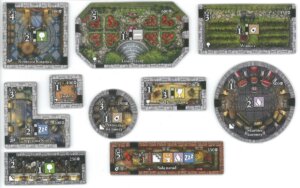
Zamki szalonego króla Ludwika: Polskie zamki
2015
Add ten Polish castle rooms to your Castles of Mad King Ludwig game.
View expansion
Castles of Mad King Ludwig: Expansions
2023
Expand your castle with new rooms, rewards, powers, and goals.
Medium
View expansion
Castles of Mad King Ludwig: Secrets
2015
Discover hidden swans, protective moats, and secret passages.
90
minutes
Medium
View expansion