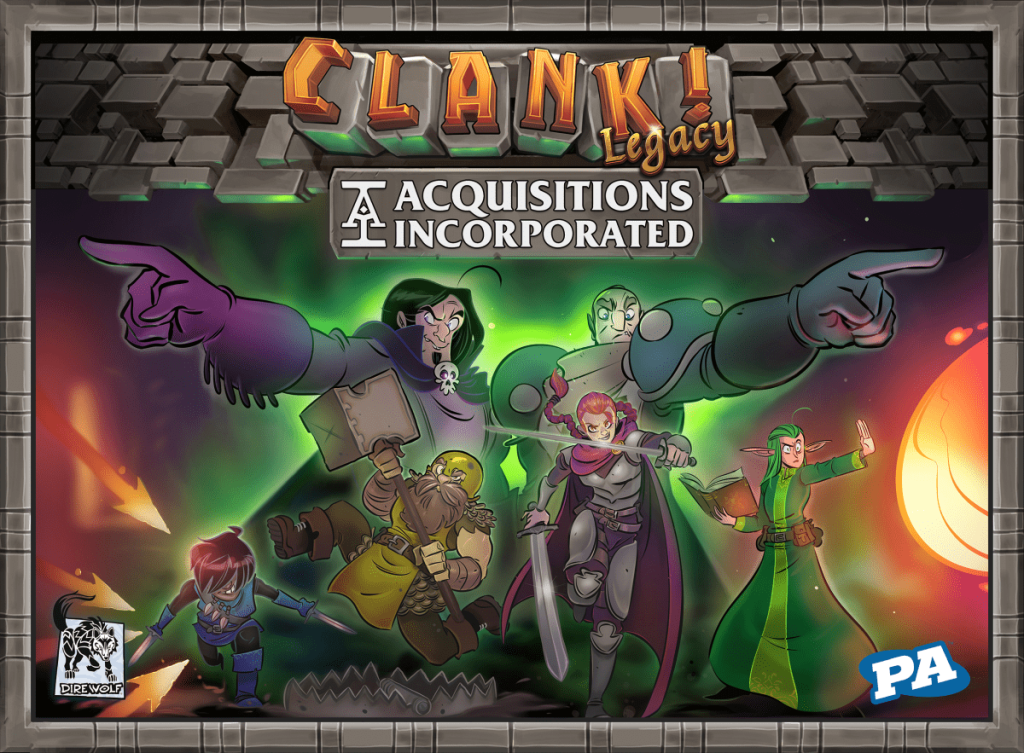
Clank! Legacy: Acquisitions Incorporated
2019
Lead treasure-hunters through a changing legacy campaign as your board, deck, and world evolve toward corporate glory.
120
minutes
2 - 4
player(s)
13+
Medium

About this board game
Clank! Legacy: Acquisitions Incorporated is a legacy-style deck-building game for 2–4 players, with games lasting about 120 minutes.
Found your own franchise of the legendary adventuring company, Acquisitions Incorporated, and guide your fledgling treasure-hunters through a campaign of multiple games. Your goal is nothing less than achieving immortal corporate glory for your new adventuring enterprise.
Clank! Legacy: Acquisitions Incorporated extends the deck-building fun of Clank! with a changing, personalized experience. As you play, the game develops alongside your adventuring party, creating a campaign shaped by the choices and progress of your franchise.
- Legacy-style gameplay: Continue your franchise across multiple games.
- Deck-building: Enjoy the deck-building foundation of Clank!
- A changing game world: Your game board, deck, and world change as you play.
- Personalized campaign: Create a unique experience tailored to your adventuring party.
Every campaign offers an opportunity to shepherd your treasure-hunters from fledgling adventurers toward a place in Acquisitions Incorporated’s corporate legend. The evolving board, deck, and world help make your group’s journey distinct.
Be cunning, be bold, and be ready for the changing challenges of your franchise. Released in 2019, Clank! Legacy: Acquisitions Incorporated combines deck-building fun with a persistent campaign designed to grow into a unique corporate adventure.

Board Game Rules for
Clank! Legacy: Acquisitions Incorporated
Please Read This Page Before Looking at Anything Else in This Box!
CLANK! Legacy: Acquisitions Incorporated is a legacy game. (It’s right there in the name.) Choices you make while playing can affect the next time you play. You will make permanent changes to the components: adding stickers to them, writing on them with a marker (provided by you), or even destroying them (seriously, “destroy” means to permanently remove something from this copy of the board game, never to be used again).
A campaign of at least 10 games tells the continuing story of you and your friends building your own Acquisitions Incorporated franchise. Your decisions will result in a unique copy of this board game—a personal setting for further play.
For the best experience, and to preserve the surprises of the campaign, take special care with the following:
- We strongly suggest that more than one player read this Rulebook, to help ensure all rules are followed correctly.
- You should also check for any rules updates and answers to Frequently Asked Questions in the FAQ document at: clankacqinc.com/faq
- If you have played the original CLANK! A Deck-Building Adventure, look for this symbol on the bottom of some pages. It highlights key rules differences from that game.
Don’t open the following components yet!

The Book of Secrets
The Book of Secrets contains the campaign story. During play, you’ll be asked to read numbered Passages from the book (aloud, to all players). You can designate one reader or take turns, though each Passage (and any decisions it presents) is directed at the player who caused it to be read.
When you read a Passage, read it completely. If you stop in the middle to do something it tells you, make sure you go back and finish.
This Rulebook will tell you when to use the Book of Secrets. Read the Book of Secrets only when directed to. Avoid reading anything but the specified entry.

The Cardporium
The Cardporium contains cards you’ll add during the campaign. Before your first game, open the box, remove the shrink wrap from each group of cards, then put them back without shuffling or looking at them.
Each card has a unique number along the right edge. (They should be in numerical order.) Use the numbers to find specific cards without looking at any others.
Whenever you fetch a new card, read it aloud (or show it to all players) before placing it where the Book of Secrets instructs.

The Sticker Sheets
The Sticker Sheets (hidden inside the Sticker Sheets envelope) are used to modify game components during the campaign.
Some stickers get applied to this Rulebook. Some rules here are contained in boxes you will cover later with revised rules. Other boxes are empty now, to be filled in with brand new rules. Whenever you add a rules sticker, read it aloud to all players.
The Book of Secrets will tell you when to use the Cardporium and Sticker Sheets. Avoid looking at anything but the specific cards and stickers identified by the Book.
Ready to play?
Follow the Setup instructions on the next two pages.
Game Setup
- Read the Game Prologue and Contracts
Identify the current game of your campaign on the Mission Reports document. Read aloud the specified Prologue Passage within the Book of Secrets. Carry out its instructions, which will include telling you which side of the board to use this game. (The Overworld side is shown in the example at the right.)
If you have any Contract cards (either remaining from a previous game, or revealed in the Prologue Passage you just read), place them in a Contracts row above the game board. Read them aloud, and carry out any instructions for the start of this game. [R1]
- Place Your Patron
If the Prologue Passage gave you a Patron card to use this game, read the card aloud and place it in the Reserve next to the board. Note that its instructions may modify these Setup rules. [R2]
- Place Your Franchise Board
Place the Franchise Board below the game board. You will add stickers to it during the campaign, providing permanent abilities that will affect your game (and which may modify these Setup rules).
- Create the Bank
- Create a Bank next to the game board, containing the Gold tokens (valued 1 and 5).
- Shuffle the minor secret tokens face down and add them to the Bank. [R3, R4]
- Prepare the Dragon Bag and Rage Track
- Place all the black cubes in the Dragon Bag, and set the bag next to the game board. (There are 24 black cubes at the start of the campaign.)
- Place the Dragon Marker on the Rage Track:
- In a 4-player game, place it on the first space.
- In a 3-player game, place it on the second space.
- In a 2-player game, place it on the third space.


- Stock the Reserve and Adventure Row
Add the Cultist monster card to the Reserve row next to the board, along with the piles of Mercenary, Explore, and Mysterious Tome cards.
The remaining cards are the Adventure Deck. Shuffle them and deal six cards to form the Adventure Row, face up on the table.
Certain cards cannot be part of the Adventure Row at the start of the game. If you reveal any Event cards or any cards that have the Dragon Attack symbol along the right edge, set them aside and replace them with another card. Once you have six legal cards, shuffle any cards you set aside back into the Adventure Deck.
Leave room next to the Adventure Deck to form an Adventure discard pile during the game.
- Place Remaining Tokens Around the Boards
- Place the Mug tokens near the HQ space, one for each player.
- Shuffle the major secrets face down. Place one at random on each major secret space, then place any extras face down next to the board (in the Bank, separate from the minor secrets).
- Place the mystic fruit on their marked spaces, with the “unexpended” (whole fruit) side face up.
- Place the various Artifacts face up on the spaces marked with their corresponding values. (Not all of them are used in every game. Return artifacts without a space to the box.) [R5, R6, R7]
- Place the market items in the Market Area of the Franchise Board. (The different market items are listed on the back cover of this Rulebook.)

- Take Your Deck Box
Each player takes a deck box. If this is the first game of the campaign, they should write their character’s name on the box. During the campaign, players should use the same box for each game.
From their deck box, each player takes 30 Clank! cubes of their player color, forming a personal supply in front of them. They also take the disc of their color from their deck box, select a player figure, attach the disc to its base, then place the figure on the HQ space along the top edge of the game board. Lastly, they take a 10-card starting deck, shuffle it, and place it face down in front of them.
Each deck contains the following:
- 6 Burgles
- 2 Stumbles
- 1 Sidestep
- 1 Scramble [R8, R9]
- Determine Player Order and Add Starting Clank!
Choose a player at random to take the first turn of the game. Play will proceed clockwise from there. The first player places 3 of their Clank! cubes in the Clank! Area of the Franchise Board (the banner on the right side). The second player places 2 Clank! If there are additional players, the third player places 1 Clank! and the fourth places none.
- ???
This step of the setup will be revealed during the campaign. [R10]
- Draw Opening Hands
Each player draws five cards from their shuffled deck. The starting player begins their first turn.
New components that were not a part of CLANK! A Deck-Building Adventure are used in steps 1, 2, 3, and 7 of Setup. In step 4, minor secrets are placed in the Bank instead of on the board. (Major secrets are placed on the board, though extras are put in the Bank.) Event cards can’t be part of the starting Adventure Row you create in step 6.
The Goal of the Game
Put simply, you have two goals in each game (whether you’re playing the campaign or not):
- Retrieve an Artifact token and escape death (by returning to your franchise headquarters).
- Beat your opponents’ scores to be declared Most Valuable Employee.
But it’s actually not quite as simple as that.
For one thing, CLANK! Legacy: Acquisitions Incorporated is a deck-building game. Each player starts with their own small deck containing the same cards, but they’ll acquire different cards during their turns. Because cards can do many different things, each player’s deck (and strategy) will become more and more different as the game unfolds. Developing your deck (and strategy) is a key to success.
Also, CLANK! Legacy: Acquisitions Incorporated is a legacy game. (Again, it’s right there in the name.) You’ll play several games in an ongoing campaign. During this campaign, you’ll accept a variety of contracts to promote your franchise and the greater reputation of Acquisitions Incorporated. Players can cooperate in this to some extent, making decisions as a group, dividing up exploration, and foregoing actions that might make things harder for each other. Or you can be as cutthroat as you like, looking out for yourself first and foremost. (The health of the franchise will surely follow. It employs someone as wonderful as you, after all.)
Turn Structure
You start each of your turns with five cards in your hand. The one requirement of your turn is that you must play all your cards before ending it, but you may play them in any order you choose. Cards you play go to a “play area” in front of you, where they remain until the end of your turn for easy reference.
Most cards produce the resources you need to take actions. There are a variety of actions you can take during your turn, described in the Actions section on the next page. You may take each action as many times as you like, so long as you have the resources required to do so. You can wait to take actions until after you’ve played all your cards, or take actions between your card plays if you prefer.
Card Resources
Most cards produce one or more of the following resources:
- SKILL, used primarily for the Acquire a Card action.
- SWORDS, used for the Fight a Monster action (and sometimes as part of the Movement action).
- BOOTS, used primarily for the Movement action.
Skill, Swords, and Boots pool as you generate them, so you may play multiple cards to gather the resources for one action. You may also split the resources made by one card to take multiple actions. Any Skill, Swords, or Boots you don’t use during your turn are wasted, so try to make them count!
Other Effects Produced by Cards
- GOLD: Whenever you gain Gold, take it from the Bank and put it in front of you. Each Gold is worth 1 point when the game ends, but you can also use it during the game, such as for the Buy From a Market action.
- CLANK!: Whenever you make Clank! (for example: “+1 Clank!”), add that many cubes from your personal supply to the Clank! Area of the Franchise Board. (If your supply is empty, you skip this.) It’s also possible to remove Clank! For each negative Clank! you get, remove one of your Clank! cubes from the Clank! Area. If you don’t have enough there, you can still remove Clank! later if you add any later on in the turn. Any leftover negative Clank! is lost when your turn ends.
- CARD DRAWS: Whenever you get to draw one or more cards, draw from your own deck, not the Adventure Deck. Whenever you need to draw a card and have none remaining in your deck, shuffle your discard pile (without adding any cards currently in your play area) to form a new deck.
Some cards have effects that depend on things you have, or things you have done during your turn. (Some are detailed later in the Card Effects section.) You get a card’s effects regardless of the order in which you play your cards.
- Freelance Fighter says “If you have another companion in your play area, +[Sword].” You get the Swords whether you play the other companion before or after the Freelance Fighter.
- Herbology says “If you have any mystic fruit, +[Skill].” If you pick up a mystic fruit token after playing Herbology, you still get the extra Skill.
Once you’ve played all of your cards and taken all the actions you wish, declare the end of your turn. (See the Ending Your Turn and Dragon Attacks section for details.)
Available Actions
Acquire a Card
You can use Skill to acquire cards with blue banners from the Adventure Row. The Skill Cost of a card is found in its lower right corner. Once you pay the cost, place the card in your discard pile. It does nothing now, but you’ll have the chance to draw and play it later once you reshuffle your discard pile to form a new deck. Do not immediately replace a card taken from the Adventure Row with a new one from the Adventure Deck.
You may also acquire cards with yellow banners from the Reserve. These cards are the same in every game. The supply is limited, and can be depleted if players acquire enough cards from the Reserve.
Fight a Monster
Monsters are the cards with red banners in the Adventure Row. Instead of acquiring them with Skill, you fight them using Swords. The Swords required to defeat a monster are found in its lower right corner.
When you fight a monster in the Adventure Row, you gain the reward listed in its DEFEAT text. Then the card is placed in the Adventure discard pile (not your own discard pile). Do not immediately replace it with a card from the Adventure Deck.
You may also fight the Cultist in the Reserve. It is not discarded when defeated; each player may fight it multiple times each turn, earning its reward each time.
Movement
Boots are how you traverse the board. Each Boot lets you move along one path to a new space. (Many spaces have special properties, described in the Board Features section.) All paths require at least one Boot. Some paths have additional requirements and rules:
- A path marked with Footprint icons requires two or three Boots total, as shown. Some of these are “mountain paths” (marked in grey stone). Some tokens can interact with this; otherwise, it has no additional effect.
- A path with Monster icons deals one damage to you for each icon when you move through it. (See the Health and Damage section for details.) For each Sword you spend, you prevent damage from one icon. You don’t have to use Swords to move through a Monster icon. [R11]
- You cannot use a path across open water (marked with the Canoe icon) unless you possess a Canoe token (purchased from the Market).
- A one-way path is shaped like an arrow, and can only be used in the direction of that arrow. You can’t move through it in the opposite direction.
- Some paths on the board lead nowhere—there are no spaces on the other side of the path. You can’t move along these paths. During the campaign, you’ll be able to use them once you add destinations to the ends (as directed by the Book of Secrets).
Buy From a Market
If you’re on a Town space, you may buy a token from the Market Area of the Franchise Board. All items are available in each town, each for a cost of 7 Gold. Place each item you buy in front of you, in your play area. You may possess only one item of each type (but as with all actions, you may take the Buy action more than once in a turn, buying different items).
Items available at the Market are described on the back of this Rulebook.
Hire a Coach
If you’re on a Coach space, you may hire a Coach to relocate to any other Coach space on the board. Hiring a Coach always requires one Boot. You may also need to spend Gold: the total amount of Gold shown on both the departure and destination Coach spaces. (For example: if your departure Coach space shows 3 Gold and your destination Coach space shows 5 Gold, you must spend 8 Gold total to make the move.)

Take an Artifact
If you’re on a space with an Artifact token, you may pick it up and place it in your play area. Unlike other tokens described later in the Board Features section, you do not have to pick up an Artifact when you first enter the space.
You can’t take an Artifact token if you already have one. Once you’ve picked one up, you’re stuck with it. Choose carefully! You might want to pass up one Artifact to go after a more valuable one elsewhere.
When you take an Artifact token, move the Dragon Marker up one space along the Rage Track. Once you have an Artifact, you should try to make your way back to the HQ space at the top of the board.

Three Footprint and Canoe icons described under Movement are new, as is the Hire a Coach action. Also note that Taking an Artifact is an action you can take at any point in your turn—you can do it as long as you remain in a space with an artifact, and don’t have to take it when you first enter.
Board Spaces and Elements
Coaches
While you’re on a Coach space, you may take the Hire a Coach action described in the Actions section. [R12]
Forests
When you enter a Forest (or Mushroom Forest) space, you become exhausted. You cannot spend any more Boots on the Movement action for the rest of the turn.
You may still spend Boots for other purposes (for example, to complete a Contract requiring Boots).
You can still move via Teleport (described in the Card Effects section). However, even if you do, you remain exhausted and can’t spend Boots on the Movement action this turn.
HQ
The space you start from each game is your HQ. Returning there with an Artifact is the goal of the game. (See the Game End and Scoring section.) Once you leave HQ, you cannot return empty handed; you must take an Artifact from somewhere on the board before you return.
Magic Circles
A Magic Circle is not a space itself, but a feature marked on the corner of some spaces on the board. Some cards have text allowing you to interact with a Magic Circle; otherwise, they have no effect.
Rewards
Some spaces on the board give you something when you enter them. You don’t have to end your turn there, but you only get these things once each turn; you must re-enter the space on a later turn to receive the thing again. (You may enter more than one space of the same type during a single turn, receiving something from each one.)
The things you can receive from a space include:
- Minor Secret: Take one minor secret at random from the Bank and reveal it. The effects of the minor secrets are described on the back of this Rulebook.
- Major Secret: Take the major secret token from the space and reveal it. If the token from your space was previously taken, you do not get to take one from the Bank. The effects of the major secrets are described on the back of this Rulebook.
- Mystic Fruit: Take one mystic fruit token from the space and put it in front of you with the “unexpended” (whole fruit) side face up.
- Card Draw: Draw one card from your deck.
- Gold: Take the amount shown from the Bank.
- Healing: Heal 1 damage. (See the Health and Damage section for details.) [R13, R14]
Towns
While you’re on a Town space, you may take the Buy From the Market action described in the Actions section. [R15, R16]
Waypoints
A Waypoint is any space on the board marked with a number. The number refers to a Passage in the Book of Secrets. When a player enters such a space, pause their turn and read the corresponding Passage in the Book. (They resume their turn afterward.)
Some secret tokens (major and minor) may present additional Waypoints. These work the same way; pause your turn when you find one, and read the corresponding Passage in the Book of Secrets.

Forests work like Crystal Caves from CLANK! A Deck-Building Adventure. Towns work like Markets. Other Board Features are new, so you should read this section in full.
Keywords and Card Rules
- Acquire: A card’s Acquire text is carried out one time, the moment you acquire it from the Adventure Row (not when you play it later from your hand).
- Arrive: A card’s Arrive text is carried out immediately when the card is revealed in the Adventure Row (before any Dragon Attack that may also have been triggered by refilling the Row). If any cards with Arrive text are in the Adventure Row at the start of a game, carry out that text before the first player takes their turn.
- Danger: For each Danger card in the Adventure Row, you pull an additional cube from the Dragon Bag during each Dragon Attack.
- Discard: Some cards allow you to discard a card. You can only discard cards in your hand that you haven’t played yet. The card does not have its normal effect, which means discarding can be a useful way to get around cards that generate Clank! If you’re asked to discard a card to get something, you must actually discard a card to get it. (Example: Consultant says “You may discard a card to draw two cards.” If you don’t have a card in your hand to discard, you don’t get to draw two cards.)
- Each Player: Most of the time, when “each player” is required to do a thing, the order will not matter. In the rare case that it does (for example: when taking a limited resource), begin with the player taking (or ending) their turn and proceed clockwise. (Ignore players who have escaped or who have been knocked out; see the Game End and Scoring section for more details.) [R17, R18, R19]
- Plus: Some cards have a plus sign attached to the Skill, Swords, or Boots they provide. This is meant to point you to the card’s text, which may provide more of the same resource that the card has already given. (Example: Freelance Cleric always provides you at least 2 Skill. Its text says: “If you have another companion in your play area, +[Skill].” This makes for a total of 4 Skill when you have another companion in your play area.) [R20]
- Teleport: Teleportation is a special form of movement that takes you directly from one space to another. No Boots are required for this move (though you remain exhausted if you entered a Forest space this turn). Often, teleporting takes you to an “adjacent space”: one connected by a path to your current space. You ignore any icons along that path, and can even teleport against the arrow of a one-way path.
- Trash: Some cards and tokens can cause you to trash a card. This removes the chosen card from your deck entirely, which is a great thing to do to the relatively weak cards that make up your starting deck. When you trash a card, place it in the game box. Note that trashing a card is not the same as destroying it! Trashing is not permanent; at the end of the game, return a trashed card to the place it originally came from (a player’s starting deck, the Adventure Deck, etc.), to be used again in your next game.
Take care not to confuse “trash” with “destroy.” Trashing is the same as in CLANK! A Deck-Building Adventure, and is not permanent. In the campaign, you will destroy cards, permanently removing them from your copy of the game.
Ending Your Turn
Once you’ve played all of your cards and taken all the actions you wish for your turn, you simply declare the end of your turn. You then do the following, in order:
- Resolve Contracts
If you’ve fulfilled the conditions of any Contracts that resolve at the end of a turn, do as they say. (Contracts are described in more detail later, in the Contracts section.)
- Clear Your Play Area and Draw a New Hand
Put all of the cards from your play area into your discard pile. Keep this discard pile face up, to easily distinguish it from your deck.
Draw five new cards from your deck in preparation for your next turn. (In the rare case that you already have cards in your hand as a result of resolving a Contract, draw five more cards for your next turn.)
- Refill the Adventure Row
If there are fewer than six cards in the Adventure Row, refill the empty spaces with new cards from the Adventure Deck. (The Adventure Row should have no empty spaces at the start of the next player’s turn.)
- If you reveal an Event card while refilling the Adventure Row, carry out its effects immediately, discard it to the Adventure discard pile, then continue refilling the Adventure Row.
- If there are already more cards than you need in the Adventure Row (due to instructions from a card or the Book of Secrets), leave the Row alone.
- In the rare case that there aren’t enough cards in the Adventure Deck to fill the Row, reshuffle the Adventure discard pile to form a new Adventure Deck.
- Check for a Dragon Attack
If any of the new cards just added to the Adventure Row has a Dragon Attack symbol, the dragon Malathrex attacks! The dragon attacks only once, no matter how many Dragon Attack symbols were revealed. Also note that only new Dragon attack symbols cause an attack. Cards that remain in the Adventure Row for multiple turns do not repeatedly trigger attacks. [R21]
To execute a Dragon Attack, take all of the cubes in the Clank! Area and put them in the Dragon Bag. Shake it up and draw a number of cubes from the bag equal to the number shown in the Dragon Marker’s current space of the Rage Track. Each black cube drawn is set aside, but each colored cube represents damage dealt to that player. (Undrawn cubes remain in the bag—they might still be drawn out later.) The more Clank! you make, the more likely the dragon is to notice and attack you. Managing your noise level is key to survival!
The dragon’s rage level increases throughout the game. Every time an Artifact is picked up, and whenever a Gold Dragon Egg (a type of minor secret) is discovered, advance the Dragon Marker one space along the Rage Track. This may cause more cubes to be drawn in the next attack. The more cubes being drawn, the deadlier the game becomes. Tread carefully!
In the rare case that the Dragon Bag is empty after an attack, the game ends immediately—all remaining players are knocked out.
There is an order to the steps you take when ending your turn. Step 1 (Resolve Contracts) is completely new. Step 3 (Refill the Adventure Row) now includes dealing with Event cards. Also, the game ends immediately if the Dragon Bag is ever empty after an attack.
Health Meter and Damage
Each player’s health is tracked on a Health Meter on the left side of the Franchise Board. When you take damage during the game, place your cubes on the Health Meter of your color, starting on the lowest space.
- If the damage came from a Dragon Attack, use the cubes that were pulled from the Dragon Bag.
- If the damage came by some other means, take the cubes from your personal supply. You can’t voluntarily take damage this way (for example, moving along a Monster path without a Sword) if you have no cubes in your supply, or if doing so would completely fill your Health Meter!
Some effects can heal damage you’ve taken. When you heal, take back a cube of your color from your Health Meter and put it in your personal supply. You can use it again later for more Clank!
If your Health Meter is ever completely filled, you are knocked out. (See the Game End and Scoring section.)
Example Turn
The green player takes her turn by playing the following cards: Stumble, Fancy Disguise, Explore, Burgle, Sidestep.

- She carries out the text on her cards as she plays them, adding 1 Clank! to the Clank! Area for her Stumble, then removing it when she plays Fancy Disguise. (She has another -1 Clank! left over from Fancy Disguise, which she could use later in the turn if she were to make more Clank!)
- She has a total of three Boots. She uses two of them to move along two separate paths, but then enters a Forest space. She can’t spend any more Boots to move this turn, so she ignores her third Boot.
- Because she is now on a Forest space, she can defeat a Dryad in the Adventure Row. She uses her two Swords to do so, gaining 2 Skill (from the Dryad’s DEFEAT text). She then places the monster in the Adventure discard pile.
- She now has a total of 5 skill (3 from the cards she played, and 2 more from the Dryad she defeated). She uses her 5 Skill to acquire a Sales Call from the Adventure Row, placing the card in her own discard pile. (She has just acquired the card; she won’t get gold or Boots from it until she reshuffles her discard pile, draws the card, and plays it.)
- Having played all cards in her hand and used all the resources she can, the green player announces the end of her turn. She has fulfilled no Contracts this turn, so she just puts all the cards she played in her discard pile, then draws five new cards for her next turn.


Next, it’s time to refill the Adventure Row. There are only four cards there after the green player’s turn, so two cards are now revealed from the top of the Adventure Deck to fill the empty spaces. One has a Dragon Attack symbol, triggering an attack this turn.
All the cubes in the Clank! Area are placed in the Dragon Bag. The Dragon Marker is currently on the fifth space of the Rage Track, so four cubes are drawn from the bag. One cube is black; it is set aside, affecting no one. The second is green, so the green player takes 1 damage. The last two cubes are both yellow, so the yellow player takes 2 damage.

Contracts
During the campaign, the Book of Secrets will instruct you to take Contract cards from the Cardporium and place them in a Contracts row (above the Reserve). Contract cards are used during the campaign to represent your work for Acquisitions Incorporated. They are never shuffled into the Adventure Deck or into any player’s deck.
Some Contracts show a number at the top, matching the number of the Waypoint that brought the Contract out of the Cardporium. This serves as a reminder that the story surrounding this Contract is already in progress; you do not repeatedly read the Book of Secrets every time a player enters the space with that number.
To complete a Contract, you are usually required to meet certain conditions and/or pay certain costs described in its text. Any player may do this as specified, often at the end of their turn.
- Completing a Contract usually directs you to read a Passage from the Book of Secrets, and may give you some reward. Remember to always read each Passage completely. If you stop in the middle to do something it tells you, make sure you go back and finish.
- Some Contracts present more than one way to complete them. You must choose just one of the options.
- Some Contracts can be completed only during a game on one particular side of the board: Overworld or Underworld. During setup, you may put aside any Contracts that can’t be completed on the current side of the board, bringing them back in an appropriate future game.
- Some Contracts require you to travel to a particular space on the board. You may use the Waypoint destination tokens to mark these spaces.
When a Contract card is complete, you may destroy it. You will never need it again.
Individual Campaign Progress
On the outside of each player’s deck box are two ways to track individual progress during the campaign: Associate Status and Personal Goals.
- Associate Status is a measure of your standing in Acquisitions Incorporated. It’s a track you fill in by earning Checkmarks of Grudging Approval. Checkmarks can be earned in many ways, including the rewards of a fulfilled Contract, Passages in the Book of Secrets, and employee reviews at the end of a game. Each time you earn a Checkmark, use a marker to check off the next empty space of your Associate Status track. You may notice the track is divided into sections. This is explained later (along with employee reviews) in the End of a Campaign Game section.
- Personal Goals are a list of tasks unique to each player. Whenever you complete one, use a marker to fill in one of its boxes. It is the nature of some Personal Goals that you can complete them more than once per game. (For example: “Take a major secret.”) Whenever you fill in a complete row of Personal Goals, you earn a Checkmark of Grudging Approval (as described above).

This page describes entirely new features of CLANK! Legacy: Acquisitions Incorporated. You should read it in full.
End of the Game
A game ends when all players have gone “off the clock.” There are two ways a player can do this:
- You voluntarily go off the clock when you escape: This happens when you arrive at the HQ space with an artifact. Finish taking the rest of your turn, then before refilling the Adventure Row, remove your figure from the board and all your Clank! cubes from the Clank! Area. Also take one of the Mug tokens near the HQ space; it is worth an additional 20 points!
- You’re involuntarily taken off the clock when you’re knocked out: This happens when your Health Meter is full (as detailed in the Health and Damage section). Lay your figure on its side. If you didn’t pick up an Artifact yet, or if your figure is in the Danger Zone of the board, well… that’s bad for you. Instead of counting your score as described below, you score 0 points. (There are additional effects if you’re playing the campaign; see the End of a Campaign Game section.)

Once a player is off the clock (by either means), they stop taking regular game turns. From then on, they add no more Clank! to the Clank! area. Cards that affect all players don’t affect them. They take no damage from cubes drawn from the Dragon Bag. They neither draw nor play cards, and they take no regular game actions.
Instead, whenever a turn comes for a player who is off the clock, they take all the cubes in the Clank! area and put them in the Dragon Bag. They shake the bag up and, ignoring the Dragon Marker’s current space on the Rage Track and any additional Danger in the Adventure Row, draw exactly four cubes (or, in a 2-player game, six cubes). Damage is taken just like in a Dragon Attack.
Scoring
Once all players have gone off the clock, each player (who wasn’t knocked out in the Danger Zone) counts their score as follows:
- The value of their Artifact. (You can’t score any points without one!) [R22]
- Points from any other tokens they acquired (including, if they reached HQ safely, their Mug token).
- Points equal to the amount of Gold they accumulated.
- Points awarded by cards in their deck, including their hand and discard pile. (The top right corner of each card shows the amount it’s worth.) [R23, R24]
The player with the most points is the winner of this game and is declared your franchise’s Most Valuable Employee! (Until the start of your next game, at least.) In the case of a tie, the tied player with the most valuable Artifact is the winner.
If you’re playing the campaign, continue to the End of a Campaign Game section on the next page.
The Depths of CLANK! A Deck-Building Adventure are now known as the Danger Zone. There is no Countdown Track when a player goes “off the clock” (escapes or is knocked out); read above to see how eliminated players are handled. When a player escapes, they remove all their Clank! from the Clank! area.
Post-Game Campaign Steps
When you finish playing most board games, you simply return all the components to the box and start over again next time you want to play. Because CLANK! Legacy: Acquisitions Incorporated is a legacy game, there’s more to ending the game than just totaling scores and determining the winner.
During the campaign, complete the following steps at the end of each game:
- Fill Out Your Mission Report
Fill in game scores in the appropriate row of your Mission Reports document. (Determine scores as described in the Game End and Scoring section). If you have not already filled in Associate Spotlight information for this game, the Epilogue Passage you read in the next step will explain.
Your Mission Reports (along with your personal Checkmarks of Grudging Approval) will be considered by the Home Office when assessing your performance at the end of your campaign.
- Read Contracts and the Epilogue Passage
Check for any Contracts that have instructions for the end of the game, and do as they say.
Next, read aloud from the Book of Secrets the Epilogue Passage for the game you just completed (as specified on the Mission Reports document). Carry out any instructions the Passage gives you.
- Conduct Employee Reviews
Each player marks the Associate Status track on their own deck box with one Checkmark of Grudging Approval for each of the following conditions they met in the game: [R25]
- Scoring more than 0 points.
- Winning the game.
- Completing a row of Personal Goals on their deck box.
When you check off the first space of a new section of the track, you’ve earned a promotion to a new Associate Status: Copper, Silver, or Gold! Read the entry from the Book of Secrets indicated by the number you checked off.
Note that if your promotion happens during a game, you have to wait for the paperwork to be processed. (You read from the Book of Secrets at the end of the game, during employee reviews.)
- Sort Components
Each player now resets their deck. Any cards they acquired from the Reserve or Adventure Deck during the game are returned to those places. Any cards that were trashed are also returned to where they began. Each player should end up with their original 10-card starting deck. [R26]
Players keep no tokens of any kind from one game to the next. Return any Gold, secrets, and other tokens to the general supply, including any you set aside or put in the box during the game. [R27]
- Check for Player Death
If any player scored 0 points in this game, add an X to the Dran Enterprises Track (on the back cover of this rulebook). Add no more than one X, even if multiple players scored 0 points.
After adding the X, read 167 in the Book of Secrets. [R28]
- Continue?
You may choose to continue directly into the next game of the campaign. If not, each player stores their starting deck in their deck box (along with their Clank! cubes).
Any Contract cards still in the Contracts row are carried over into the next game. You’ll place them on the board during the first step of Setup. (If you’re storing the game for now, keep these Contracts with your Reserve cards; you’ll find them when you’re setting up the game.)
This page details the steps you take at the end of a campaign game. You should read it in full.
Taking Your Franchise on the Road
When Franchises Collide
In the course of the campaign, each copy of CLANK! Legacy: Acquisitions Incorporated becomes as unique as the people playing it. Your choices will result in a different board, a different mix of cards in the adventure deck, and more. You can take your franchise on the road to a different copy of the game, mixing your game board with a different Adventure Deck, your Franchise Board with a different Vault—whatever you can imagine!
Mixing copies of CLANK! Legacy: Acquisitions Incorporated is not recommended until the campaign in both copies of the game is completed, to preserve surprises in the story. But if you simply cannot wait, do not use the Book of Secrets! Ignore Waypoints, Contracts, and any other reference to ongoing story elements. Also, because you’re outside your assigned territory, you do not earn Checkmarks of Grudging Approval. You can resume your campaign progress later, with your copy of the game intact.
A Classic Adventure
Once you have completed the campaign, it is possible to mix parts of CLANK! Legacy: Acquisitions Incorporated with the original CLANK! A Deck-Building Adventure.
- You may use your completed Legacy game board and Franchise Board as an expansion for CLANK! Set up the components normally, but use the original CLANK! Dungeon Deck.
- You may also choose to shuffle cards from the CLANK! Legacy: Acquisitions Incorporated Adventure Deck into the original CLANK! Dungeon Deck. Note that some elements of the Legacy game are not present in the original, such as mystic fruit, wights, and Dran Agents. If you play on an original CLANK! board, you may wish to exclude cards referencing these elements.
Building Character
You can also add to the mix with CLANK! Character Packs: bite-sized expansions that you can play with both CLANK! A Deck-Building Adventure and CLANK! Legacy: Acquisitions Incorporated!
- Upper Management Pack: Break out the big wands! Play as legendary adventurers Omin Dran, Jim Darkmagic, Viari, and Môrgæn — with unique starting character decks and gorgeous collectible miniatures. (Use during the campaign may result in mild narrative inconsistency. Consult your alchemist.)
- The “C” Team Pack: If you’d rather work your way up the corporate ladder, The “C” Team Pack brings Walnut Dankgrass, Rosie Beestinger, K’thriss Drow’b, and Donaar Blit’zen to the table — with more great miniatures and character decks. They may not be Upper Management material, but they’ll totally (probably) survive and, if not… hey, we’re always hiring.

Market Items
- Canoe: You may use paths that cross open water (marked with a dashed blue and white line). (Also worth 5 points at the end of the game.)
- Crown: Worth the number of points shown. (Each player takes the most valuable crown available when they buy one.) [R29, R30, R31]
Major Secrets
- Dark Dragon Egg: Keep this token—it is worth 3 points at the end of the game. All your opponents get +3 Clank!
- Flash of Brilliance: Immediately draw three cards, then return the token to the box.
- Greater Treasure: This token counts as 5 Gold. You may keep it until the end of the game or spend it normally.
- Potion of Greater Healing: Use during your turn to heal 2 damage. (Keep until you use it, then return it to the box.) [R32]
Minor Secrets
- Gold Dragon Egg: Keep this token—it is worth 3 points at the end of the game. Advance the rage level by one.
- Potion of Healing: Use during your turn to heal 1 damage. (Keep until you use it, then return it to the box.)
- Potion of Strength: Use during your turn to gain 2 Swords. (Keep until you use it, then return it to the box.)
- Potion of Swiftness: Use during your turn to gain 1 Boot. (Keep until you use it, then return it to the box.)
- Trash a Card: Trash a card from your discard pile or play area. Return the card and this token to the box.
- Treasure: This token counts as 2 Gold. You may keep it until the end of the game or spend it normally. [R33]
Some market items and secrets differ from CLANK! A Deck-Building Adventure. The Dran Enterprises Track is a new element of the game.
Dran Enterprises Track
Acquisitions Incorporated is the premier adventuring-for-hire organization on this plane and several others. But there are competitors. One you’ll hear about a lot is Dran Enterprises. Whenever the Book of Secrets (or a rule) directs you to add an X to the Dran Enterprises Track, mark off the leftmost empty space below. Whenever your X covers a number, immediately read that entry from the Book of Secrets.
- Track spaces include numbers: 17, 88, 93, 148.
Credits
- Game Design: Andy Clautice
- Design Direction: Paul Dennen
- Executive Producer: Scott Martins
- Art and Graphic Design: Clay Brooks, Anika Burrell, Derek Herring, Raul Ramos, Nate Storm, Alain Viesca
- Card Illustration: Harvey Heinrich, Derek Herring, Kenan Jackson, Eun Kyung, Samson Ledesma, Han Pyo Lee, Paul Medalla, Melvin Quito, Raul Ramos, Hyung Sun, Man Suk, Alben Tan
- Writing: Andy Clautice
- Production: Evan Lorentz, Tim McKnight
- Additional Game Design and Game Development: Paul Dennen, Evan Lorentz, Tim McKnight, Kevin Spak
For Penny Arcade
- Additional Writing: Jerry Holkins
- Cover Art: Mike Krahulik
- Design Direction: Francisco Villaseñor
- Production: Elyssa Grant
Special thanks to: All of the awesome Dire Wolf Digital team members, and their friends and families, who helped to playtest CLANK! Legacy: Acquisitions Incorporated.
Published by: Dire Wolf Digital and Renegade Game Studios.
Acquisitions Incorporated® © 2010 Penny Arcade, Inc., All Rights Reserved.
CLANK! © 2016 Dire Wolf Digital, LLC. All Rights Reserved.
Acquisitions Incorporated and AI logo are registered trademarks of Penny Arcade, Inc.
Jim Darkmagic and Omin Dran characters, © 2010, are properties of Penny Arcade, Inc., All Rights Reserved.
Viari and Môrgæn characters, © 2013, 2014, licensed from Penny Arcade, Inc., All Rights Reserved.
www.penny-arcade.com | www.direwolfdigital.com | www.renegadegames.com
Introduction & Legacy Components
Please Read This Page Before Looking at Anything Else in This Box!
CLANK! Legacy: Acquisitions Incorporated is a legacy game. (It’s right there in the name.) Choices you make while playing can affect the next time you play. You will make permanent changes to the components: adding stickers to them, writing on them with a marker (provided by you), or even destroying them (seriously, “destroy” means to permanently remove something from this copy of the board game, never to be used again).
A campaign of at least 10 games tells the continuing story of you and your friends building your own Acquisitions Incorporated franchise. Your decisions will result in a unique copy of this board game—a personal setting for further play.
For the best experience, and to preserve the surprises of the campaign, take special care with the following:
- We strongly suggest that more than one player read this Rulebook, to help ensure all rules are followed correctly.
- You should also check for any rules updates and answers to Frequently Asked Questions in the FAQ document at: clankacqinc.com/faq
- If you have played the original CLANK! A Deck-Building Adventure, look for this symbol on the bottom of some pages. It highlights key rules differences from that game.
Don’t open the following components yet!
The Book of Secrets
The Book of Secrets contains the campaign story. During play, you’ll be asked to read numbered Passages from the book (aloud, to all players). You can designate one reader or take turns, though each Passage (and any decisions it presents) is directed at the player who caused it to be read.
When you read a Passage, read it completely. If you stop in the middle to do something it tells you, make sure you go back and finish.
This Rulebook will tell you when to use the Book of Secrets. Read the Book of Secrets only when directed to. Avoid reading anything but the specified entry.
The Cardporium
The Cardporium contains cards you’ll add during the campaign. Before your first game, open the box, remove the shrink wrap from each group of cards, then put them back without shuffling or looking at them.
Each card has a unique number along the right edge. (They should be in numerical order.) Use the numbers to find specific cards without looking at any others.
Whenever you fetch a new card, read it aloud (or show it to all players) before placing it where the Book of Secrets instructs.
The Sticker Sheets
The Sticker Sheets (hidden inside the Sticker Sheets envelope) are used to modify game components during the campaign.
Some stickers get applied to this Rulebook. Some rules here are contained in boxes you will cover later with revised rules. Other boxes are empty now, to be filled in with brand new rules. Whenever you add a rules sticker, read it aloud to all players.
The Book of Secrets will tell you when to use the Cardporium and Sticker Sheets. Avoid looking at anything but the specific cards and stickers identified by the Book.
Ready to play?
Follow the Setup instructions on the next two pages.
Setup
Game Setup
- Read the Game Prologue and Contracts
Identify the current game of your campaign on the Mission Reports document. Read aloud the specified Prologue Passage within the Book of Secrets. Carry out its instructions, which will include telling you which side of the board to use this game. (The Overworld side is shown in the example at the right.)
If you have any Contract cards (either remaining from a previous game, or revealed in the Prologue Passage you just read), place them in a Contracts row above the game board. Read them aloud, and carry out any instructions for the start of this game. [R1]
- Place Your Patron
If the Prologue Passage gave you a Patron card to use this game, read the card aloud and place it in the Reserve next to the board. Note that its instructions may modify these Setup rules. [R2]
- Place Your Franchise Board
Place the Franchise Board below the game board. You will add stickers to it during the campaign, providing permanent abilities that will affect your game (and which may modify these Setup rules).
- Create the Bank
- Create a Bank next to the game board, containing the Gold tokens (valued 1 and 5).
- Shuffle the minor secret tokens face down and add them to the Bank. [R3, R4]
- Prepare the Dragon Bag and Rage Track
- Place all the black cubes in the Dragon Bag, and set the bag next to the game board. (There are 24 black cubes at the start of the campaign.)
- Place the Dragon Marker on the Rage Track:
- In a 4-player game, place it on the first space.
- In a 3-player game, place it on the second space.
- In a 2-player game, place it on the third space.
- Stock the Reserve and Adventure Row
Add the Cultist monster card to the Reserve row next to the board, along with the piles of Mercenary, Explore, and Mysterious Tome cards.
The remaining cards are the Adventure Deck. Shuffle them and deal six cards to form the Adventure Row, face up on the table.
Certain cards cannot be part of the Adventure Row at the start of the game. If you reveal any Event cards or any cards that have the Dragon Attack symbol along the right edge, set them aside and replace them with another card. Once you have six legal cards, shuffle any cards you set aside back into the Adventure Deck.
Leave room next to the Adventure Deck to form an Adventure discard pile during the game.
- Place Remaining Tokens Around the Boards
- Place the Mug tokens near the HQ space, one for each player.
- Shuffle the major secrets face down. Place one at random on each major secret space, then place any extras face down next to the board (in the Bank, separate from the minor secrets).
- Place the mystic fruit on their marked spaces, with the “unexpended” (whole fruit) side face up.
- Place the various Artifacts face up on the spaces marked with their corresponding values. (Not all of them are used in every game. Return artifacts without a space to the box.) [R5, R6, R7]
- Place the market items in the Market Area of the Franchise Board. (The different market items are listed on the back cover of this Rulebook.)
- Take Your Deck Box
Each player takes a deck box. If this is the first game of the campaign, they should write their character’s name on the box. During the campaign, players should use the same box for each game.
From their deck box, each player takes 30 Clank! cubes of their player color, forming a personal supply in front of them. They also take the disc of their color from their deck box, select a player figure, attach the disc to its base, then place the figure on the HQ space along the top edge of the game board. Lastly, they take a 10-card starting deck, shuffle it, and place it face down in front of them.
Each deck contains the following:
- 6 Burgles
- 2 Stumbles
- 1 Sidestep
- 1 Scramble [R8, R9]
- Determine Player Order and Add Starting Clank!
Choose a player at random to take the first turn of the game. Play will proceed clockwise from there. The first player places 3 of their Clank! cubes in the Clank! Area of the Franchise Board (the banner on the right side). The second player places 2 Clank! If there are additional players, the third player places 1 Clank! and the fourth places none.
- ???
This step of the setup will be revealed during the campaign. [R10]
- Draw Opening Hands
Each player draws five cards from their shuffled deck. The starting player begins their first turn.
New components that were not a part of CLANK! A Deck-Building Adventure are used in steps 1, 2, 3, and 7 of Setup. In step 4, minor secrets are placed in the Bank instead of on the board. (Major secrets are placed on the board, though extras are put in the Bank.) Event cards can’t be part of the starting Adventure Row you create in step 6.
Game Overview & Goals
The Goal of the Game
Put simply, you have two goals in each game (whether you’re playing the campaign or not):
- Retrieve an Artifact token and escape death (by returning to your franchise headquarters).
- Beat your opponents’ scores to be declared Most Valuable Employee.
But it’s actually not quite as simple as that.
For one thing, CLANK! Legacy: Acquisitions Incorporated is a deck-building game. Each player starts with their own small deck containing the same cards, but they’ll acquire different cards during their turns. Because cards can do many different things, each player’s deck (and strategy) will become more and more different as the game unfolds. Developing your deck (and strategy) is a key to success.
Also, CLANK! Legacy: Acquisitions Incorporated is a legacy game. (Again, it’s right there in the name.) You’ll play several games in an ongoing campaign. During this campaign, you’ll accept a variety of contracts to promote your franchise and the greater reputation of Acquisitions Incorporated. Players can cooperate in this to some extent, making decisions as a group, dividing up exploration, and foregoing actions that might make things harder for each other. Or you can be as cutthroat as you like, looking out for yourself first and foremost. (The health of the franchise will surely follow. It employs someone as wonderful as you, after all.)
How to Play: Taking Your Turn
Turn Structure
You start each of your turns with five cards in your hand. The one requirement of your turn is that you must play all your cards before ending it, but you may play them in any order you choose. Cards you play go to a “play area” in front of you, where they remain until the end of your turn for easy reference.
Most cards produce the resources you need to take actions. There are a variety of actions you can take during your turn, described in the Actions section on the next page. You may take each action as many times as you like, so long as you have the resources required to do so. You can wait to take actions until after you’ve played all your cards, or take actions between your card plays if you prefer.
Card Resources
Most cards produce one or more of the following resources:
- SKILL, used primarily for the Acquire a Card action.
- SWORDS, used for the Fight a Monster action (and sometimes as part of the Movement action).
- BOOTS, used primarily for the Movement action.
Skill, Swords, and Boots pool as you generate them, so you may play multiple cards to gather the resources for one action. You may also split the resources made by one card to take multiple actions. Any Skill, Swords, or Boots you don’t use during your turn are wasted, so try to make them count!
Other Effects Produced by Cards
- GOLD: Whenever you gain Gold, take it from the Bank and put it in front of you. Each Gold is worth 1 point when the game ends, but you can also use it during the game, such as for the Buy From a Market action.
- CLANK!: Whenever you make Clank! (for example: “+1 Clank!”), add that many cubes from your personal supply to the Clank! Area of the Franchise Board. (If your supply is empty, you skip this.) It’s also possible to remove Clank! For each negative Clank! you get, remove one of your Clank! cubes from the Clank! Area. If you don’t have enough there, you can still remove Clank! later if you add any later on in the turn. Any leftover negative Clank! is lost when your turn ends.
- CARD DRAWS: Whenever you get to draw one or more cards, draw from your own deck, not the Adventure Deck. Whenever you need to draw a card and have none remaining in your deck, shuffle your discard pile (without adding any cards currently in your play area) to form a new deck.
Some cards have effects that depend on things you have, or things you have done during your turn. (Some are detailed later in the Card Effects section.) You get a card’s effects regardless of the order in which you play your cards.
- Freelance Fighter says “If you have another companion in your play area, +[Sword].” You get the Swords whether you play the other companion before or after the Freelance Fighter.
- Herbology says “If you have any mystic fruit, +[Skill].” If you pick up a mystic fruit token after playing Herbology, you still get the extra Skill.
Once you’ve played all of your cards and taken all the actions you wish, declare the end of your turn. (See the Ending Your Turn and Dragon Attacks section for details.)
Actions
Available Actions
Acquire a Card
You can use Skill to acquire cards with blue banners from the Adventure Row. The Skill Cost of a card is found in its lower right corner. Once you pay the cost, place the card in your discard pile. It does nothing now, but you’ll have the chance to draw and play it later once you reshuffle your discard pile to form a new deck. Do not immediately replace a card taken from the Adventure Row with a new one from the Adventure Deck.
You may also acquire cards with yellow banners from the Reserve. These cards are the same in every game. The supply is limited, and can be depleted if players acquire enough cards from the Reserve.
Fight a Monster
Monsters are the cards with red banners in the Adventure Row. Instead of acquiring them with Skill, you fight them using Swords. The Swords required to defeat a monster are found in its lower right corner.
When you fight a monster in the Adventure Row, you gain the reward listed in its DEFEAT text. Then the card is placed in the Adventure discard pile (not your own discard pile). Do not immediately replace it with a card from the Adventure Deck.
You may also fight the Cultist in the Reserve. It is not discarded when defeated; each player may fight it multiple times each turn, earning its reward each time.
Movement
Boots are how you traverse the board. Each Boot lets you move along one path to a new space. (Many spaces have special properties, described in the Board Features section.) All paths require at least one Boot. Some paths have additional requirements and rules:
- A path marked with Footprint icons requires two or three Boots total, as shown. Some of these are “mountain paths” (marked in grey stone). Some tokens can interact with this; otherwise, it has no additional effect.
- A path with Monster icons deals one damage to you for each icon when you move through it. (See the Health and Damage section for details.) For each Sword you spend, you prevent damage from one icon. You don’t have to use Swords to move through a Monster icon. [R11]
- You cannot use a path across open water (marked with the Canoe icon) unless you possess a Canoe token (purchased from the Market).
- A one-way path is shaped like an arrow, and can only be used in the direction of that arrow. You can’t move through it in the opposite direction.
- Some paths on the board lead nowhere—there are no spaces on the other side of the path. You can’t move along these paths. During the campaign, you’ll be able to use them once you add destinations to the ends (as directed by the Book of Secrets).
Buy From a Market
If you’re on a Town space, you may buy a token from the Market Area of the Franchise Board. All items are available in each town, each for a cost of 7 Gold. Place each item you buy in front of you, in your play area. You may possess only one item of each type (but as with all actions, you may take the Buy action more than once in a turn, buying different items).
Items available at the Market are described on the back of this Rulebook.
Hire a Coach
If you’re on a Coach space, you may hire a Coach to relocate to any other Coach space on the board. Hiring a Coach always requires one Boot. You may also need to spend Gold: the total amount of Gold shown on both the departure and destination Coach spaces. (For example: if your departure Coach space shows 3 Gold and your destination Coach space shows 5 Gold, you must spend 8 Gold total to make the move.)
Take an Artifact
If you’re on a space with an Artifact token, you may pick it up and place it in your play area. Unlike other tokens described later in the Board Features section, you do not have to pick up an Artifact when you first enter the space.
You can’t take an Artifact token if you already have one. Once you’ve picked one up, you’re stuck with it. Choose carefully! You might want to pass up one Artifact to go after a more valuable one elsewhere.
When you take an Artifact token, move the Dragon Marker up one space along the Rage Track. Once you have an Artifact, you should try to make your way back to the HQ space at the top of the board.
Three Footprint and Canoe icons described under Movement are new, as is the Hire a Coach action. Also note that Taking an Artifact is an action you can take at any point in your turn—you can do it as long as you remain in a space with an artifact, and don’t have to take it when you first enter.
Board Features
Board Spaces and Elements
Coaches
While you’re on a Coach space, you may take the Hire a Coach action described in the Actions section. [R12]
Forests
When you enter a Forest (or Mushroom Forest) space, you become exhausted. You cannot spend any more Boots on the Movement action for the rest of the turn.
You may still spend Boots for other purposes (for example, to complete a Contract requiring Boots).
You can still move via Teleport (described in the Card Effects section). However, even if you do, you remain exhausted and can’t spend Boots on the Movement action this turn.
HQ
The space you start from each game is your HQ. Returning there with an Artifact is the goal of the game. (See the Game End and Scoring section.) Once you leave HQ, you cannot return empty handed; you must take an Artifact from somewhere on the board before you return.
Magic Circles
A Magic Circle is not a space itself, but a feature marked on the corner of some spaces on the board. Some cards have text allowing you to interact with a Magic Circle; otherwise, they have no effect.
Rewards
Some spaces on the board give you something when you enter them. You don’t have to end your turn there, but you only get these things once each turn; you must re-enter the space on a later turn to receive the thing again. (You may enter more than one space of the same type during a single turn, receiving something from each one.)
The things you can receive from a space include:
- Minor Secret: Take one minor secret at random from the Bank and reveal it. The effects of the minor secrets are described on the back of this Rulebook.
- Major Secret: Take the major secret token from the space and reveal it. If the token from your space was previously taken, you do not get to take one from the Bank. The effects of the major secrets are described on the back of this Rulebook.
- Mystic Fruit: Take one mystic fruit token from the space and put it in front of you with the “unexpended” (whole fruit) side face up.
- Card Draw: Draw one card from your deck.
- Gold: Take the amount shown from the Bank.
- Healing: Heal 1 damage. (See the Health and Damage section for details.) [R13, R14]
Towns
While you’re on a Town space, you may take the Buy From the Market action described in the Actions section. [R15, R16]
Waypoints
A Waypoint is any space on the board marked with a number. The number refers to a Passage in the Book of Secrets. When a player enters such a space, pause their turn and read the corresponding Passage in the Book. (They resume their turn afterward.)
Some secret tokens (major and minor) may present additional Waypoints. These work the same way; pause your turn when you find one, and read the corresponding Passage in the Book of Secrets.
Forests work like Crystal Caves from CLANK! A Deck-Building Adventure. Towns work like Markets. Other Board Features are new, so you should read this section in full.
Card Effects & Keywords
Keywords and Card Rules
- Acquire: A card’s Acquire text is carried out one time, the moment you acquire it from the Adventure Row (not when you play it later from your hand).
- Arrive: A card’s Arrive text is carried out immediately when the card is revealed in the Adventure Row (before any Dragon Attack that may also have been triggered by refilling the Row). If any cards with Arrive text are in the Adventure Row at the start of a game, carry out that text before the first player takes their turn.
- Danger: For each Danger card in the Adventure Row, you pull an additional cube from the Dragon Bag during each Dragon Attack.
- Discard: Some cards allow you to discard a card. You can only discard cards in your hand that you haven’t played yet. The card does not have its normal effect, which means discarding can be a useful way to get around cards that generate Clank! If you’re asked to discard a card to get something, you must actually discard a card to get it. (Example: Consultant says “You may discard a card to draw two cards.” If you don’t have a card in your hand to discard, you don’t get to draw two cards.)
- Each Player: Most of the time, when “each player” is required to do a thing, the order will not matter. In the rare case that it does (for example: when taking a limited resource), begin with the player taking (or ending) their turn and proceed clockwise. (Ignore players who have escaped or who have been knocked out; see the Game End and Scoring section for more details.) [R17, R18, R19]
- Plus: Some cards have a plus sign attached to the Skill, Swords, or Boots they provide. This is meant to point you to the card’s text, which may provide more of the same resource that the card has already given. (Example: Freelance Cleric always provides you at least 2 Skill. Its text says: “If you have another companion in your play area, +[Skill].” This makes for a total of 4 Skill when you have another companion in your play area.) [R20]
- Teleport: Teleportation is a special form of movement that takes you directly from one space to another. No Boots are required for this move (though you remain exhausted if you entered a Forest space this turn). Often, teleporting takes you to an “adjacent space”: one connected by a path to your current space. You ignore any icons along that path, and can even teleport against the arrow of a one-way path.
- Trash: Some cards and tokens can cause you to trash a card. This removes the chosen card from your deck entirely, which is a great thing to do to the relatively weak cards that make up your starting deck. When you trash a card, place it in the game box. Note that trashing a card is not the same as destroying it! Trashing is not permanent; at the end of the game, return a trashed card to the place it originally came from (a player’s starting deck, the Adventure Deck, etc.), to be used again in your next game.
Take care not to confuse “trash” with “destroy.” Trashing is the same as in CLANK! A Deck-Building Adventure, and is not permanent. In the campaign, you will destroy cards, permanently removing them from your copy of the game.
Ending Your Turn & Dragon Attacks
Ending Your Turn
Once you’ve played all of your cards and taken all the actions you wish for your turn, you simply declare the end of your turn. You then do the following, in order:
- Resolve Contracts
If you’ve fulfilled the conditions of any Contracts that resolve at the end of a turn, do as they say. (Contracts are described in more detail later, in the Contracts section.)
- Clear Your Play Area and Draw a New Hand
Put all of the cards from your play area into your discard pile. Keep this discard pile face up, to easily distinguish it from your deck.
Draw five new cards from your deck in preparation for your next turn. (In the rare case that you already have cards in your hand as a result of resolving a Contract, draw five more cards for your next turn.)
- Refill the Adventure Row
If there are fewer than six cards in the Adventure Row, refill the empty spaces with new cards from the Adventure Deck. (The Adventure Row should have no empty spaces at the start of the next player’s turn.)
- If you reveal an Event card while refilling the Adventure Row, carry out its effects immediately, discard it to the Adventure discard pile, then continue refilling the Adventure Row.
- If there are already more cards than you need in the Adventure Row (due to instructions from a card or the Book of Secrets), leave the Row alone.
- In the rare case that there aren’t enough cards in the Adventure Deck to fill the Row, reshuffle the Adventure discard pile to form a new Adventure Deck.
- Check for a Dragon Attack
If any of the new cards just added to the Adventure Row has a Dragon Attack symbol, the dragon Malathrex attacks! The dragon attacks only once, no matter how many Dragon Attack symbols were revealed. Also note that only new Dragon attack symbols cause an attack. Cards that remain in the Adventure Row for multiple turns do not repeatedly trigger attacks. [R21]
To execute a Dragon Attack, take all of the cubes in the Clank! Area and put them in the Dragon Bag. Shake it up and draw a number of cubes from the bag equal to the number shown in the Dragon Marker’s current space of the Rage Track. Each black cube drawn is set aside, but each colored cube represents damage dealt to that player. (Undrawn cubes remain in the bag—they might still be drawn out later.) The more Clank! you make, the more likely the dragon is to notice and attack you. Managing your noise level is key to survival!
The dragon’s rage level increases throughout the game. Every time an Artifact is picked up, and whenever a Gold Dragon Egg (a type of minor secret) is discovered, advance the Dragon Marker one space along the Rage Track. This may cause more cubes to be drawn in the next attack. The more cubes being drawn, the deadlier the game becomes. Tread carefully!
In the rare case that the Dragon Bag is empty after an attack, the game ends immediately—all remaining players are knocked out.
There is an order to the steps you take when ending your turn. Step 1 (Resolve Contracts) is completely new. Step 3 (Refill the Adventure Row) now includes dealing with Event cards. Also, the game ends immediately if the Dragon Bag is ever empty after an attack.
Health & Damage
Health Meter and Damage
Each player’s health is tracked on a Health Meter on the left side of the Franchise Board. When you take damage during the game, place your cubes on the Health Meter of your color, starting on the lowest space.
- If the damage came from a Dragon Attack, use the cubes that were pulled from the Dragon Bag.
- If the damage came by some other means, take the cubes from your personal supply. You can’t voluntarily take damage this way (for example, moving along a Monster path without a Sword) if you have no cubes in your supply, or if doing so would completely fill your Health Meter!
Some effects can heal damage you’ve taken. When you heal, take back a cube of your color from your Health Meter and put it in your personal supply. You can use it again later for more Clank!
If your Health Meter is ever completely filled, you are knocked out. (See the Game End and Scoring section.)
Turn Walkthrough & Example
Example Turn
The green player takes her turn by playing the following cards: Stumble, Fancy Disguise, Explore, Burgle, Sidestep.
- She carries out the text on her cards as she plays them, adding 1 Clank! to the Clank! Area for her Stumble, then removing it when she plays Fancy Disguise. (She has another -1 Clank! left over from Fancy Disguise, which she could use later in the turn if she were to make more Clank!)
- She has a total of three Boots. She uses two of them to move along two separate paths, but then enters a Forest space. She can’t spend any more Boots to move this turn, so she ignores her third Boot.
- Because she is now on a Forest space, she can defeat a Dryad in the Adventure Row. She uses her two Swords to do so, gaining 2 Skill (from the Dryad’s DEFEAT text). She then places the monster in the Adventure discard pile.
- She now has a total of 5 skill (3 from the cards she played, and 2 more from the Dryad she defeated). She uses her 5 Skill to acquire a Sales Call from the Adventure Row, placing the card in her own discard pile. (She has just acquired the card; she won’t get gold or Boots from it until she reshuffles her discard pile, draws the card, and plays it.)
- Having played all cards in her hand and used all the resources she can, the green player announces the end of her turn. She has fulfilled no Contracts this turn, so she just puts all the cards she played in her discard pile, then draws five new cards for her next turn.
Next, it’s time to refill the Adventure Row. There are only four cards there after the green player’s turn, so two cards are now revealed from the top of the Adventure Deck to fill the empty spaces. One has a Dragon Attack symbol, triggering an attack this turn.
All the cubes in the Clank! Area are placed in the Dragon Bag. The Dragon Marker is currently on the fifth space of the Rage Track, so four cubes are drawn from the bag. One cube is black; it is set aside, affecting no one. The second is green, so the green player takes 1 damage. The last two cubes are both yellow, so the yellow player takes 2 damage.
Campaign Play: Contracts & Progress
Contracts
During the campaign, the Book of Secrets will instruct you to take Contract cards from the Cardporium and place them in a Contracts row (above the Reserve). Contract cards are used during the campaign to represent your work for Acquisitions Incorporated. They are never shuffled into the Adventure Deck or into any player’s deck.
Some Contracts show a number at the top, matching the number of the Waypoint that brought the Contract out of the Cardporium. This serves as a reminder that the story surrounding this Contract is already in progress; you do not repeatedly read the Book of Secrets every time a player enters the space with that number.
To complete a Contract, you are usually required to meet certain conditions and/or pay certain costs described in its text. Any player may do this as specified, often at the end of their turn.
- Completing a Contract usually directs you to read a Passage from the Book of Secrets, and may give you some reward. Remember to always read each Passage completely. If you stop in the middle to do something it tells you, make sure you go back and finish.
- Some Contracts present more than one way to complete them. You must choose just one of the options.
- Some Contracts can be completed only during a game on one particular side of the board: Overworld or Underworld. During setup, you may put aside any Contracts that can’t be completed on the current side of the board, bringing them back in an appropriate future game.
- Some Contracts require you to travel to a particular space on the board. You may use the Waypoint destination tokens to mark these spaces.
When a Contract card is complete, you may destroy it. You will never need it again.
Individual Campaign Progress
On the outside of each player’s deck box are two ways to track individual progress during the campaign: Associate Status and Personal Goals.
- Associate Status is a measure of your standing in Acquisitions Incorporated. It’s a track you fill in by earning Checkmarks of Grudging Approval. Checkmarks can be earned in many ways, including the rewards of a fulfilled Contract, Passages in the Book of Secrets, and employee reviews at the end of a game. Each time you earn a Checkmark, use a marker to check off the next empty space of your Associate Status track. You may notice the track is divided into sections. This is explained later (along with employee reviews) in the End of a Campaign Game section.
- Personal Goals are a list of tasks unique to each player. Whenever you complete one, use a marker to fill in one of its boxes. It is the nature of some Personal Goals that you can complete them more than once per game. (For example: “Take a major secret.”) Whenever you fill in a complete row of Personal Goals, you earn a Checkmark of Grudging Approval (as described above).
This page describes entirely new features of CLANK! Legacy: Acquisitions Incorporated. You should read it in full.
Game End & Scoring
End of the Game
A game ends when all players have gone “off the clock.” There are two ways a player can do this:
- You voluntarily go off the clock when you escape: This happens when you arrive at the HQ space with an artifact. Finish taking the rest of your turn, then before refilling the Adventure Row, remove your figure from the board and all your Clank! cubes from the Clank! Area. Also take one of the Mug tokens near the HQ space; it is worth an additional 20 points!
- You’re involuntarily taken off the clock when you’re knocked out: This happens when your Health Meter is full (as detailed in the Health and Damage section). Lay your figure on its side. If you didn’t pick up an Artifact yet, or if your figure is in the Danger Zone of the board, well… that’s bad for you. Instead of counting your score as described below, you score 0 points. (There are additional effects if you’re playing the campaign; see the End of a Campaign Game section.)
Once a player is off the clock (by either means), they stop taking regular game turns. From then on, they add no more Clank! to the Clank! area. Cards that affect all players don’t affect them. They take no damage from cubes drawn from the Dragon Bag. They neither draw nor play cards, and they take no regular game actions.
Instead, whenever a turn comes for a player who is off the clock, they take all the cubes in the Clank! area and put them in the Dragon Bag. They shake the bag up and, ignoring the Dragon Marker’s current space on the Rage Track and any additional Danger in the Adventure Row, draw exactly four cubes (or, in a 2-player game, six cubes). Damage is taken just like in a Dragon Attack.
Scoring
Once all players have gone off the clock, each player (who wasn’t knocked out in the Danger Zone) counts their score as follows:
- The value of their Artifact. (You can’t score any points without one!) [R22]
- Points from any other tokens they acquired (including, if they reached HQ safely, their Mug token).
- Points equal to the amount of Gold they accumulated.
- Points awarded by cards in their deck, including their hand and discard pile. (The top right corner of each card shows the amount it’s worth.) [R23, R24]
The player with the most points is the winner of this game and is declared your franchise’s Most Valuable Employee! (Until the start of your next game, at least.) In the case of a tie, the tied player with the most valuable Artifact is the winner.
If you’re playing the campaign, continue to the End of a Campaign Game section on the next page.
The Depths of CLANK! A Deck-Building Adventure are now known as the Danger Zone. There is no Countdown Track when a player goes “off the clock” (escapes or is knocked out); read above to see how eliminated players are handled. When a player escapes, they remove all their Clank! from the Clank! area.
End of a Campaign Game
Post-Game Campaign Steps
When you finish playing most board games, you simply return all the components to the box and start over again next time you want to play. Because CLANK! Legacy: Acquisitions Incorporated is a legacy game, there’s more to ending the game than just totaling scores and determining the winner.
During the campaign, complete the following steps at the end of each game:
- Fill Out Your Mission Report
Fill in game scores in the appropriate row of your Mission Reports document. (Determine scores as described in the Game End and Scoring section). If you have not already filled in Associate Spotlight information for this game, the Epilogue Passage you read in the next step will explain.
Your Mission Reports (along with your personal Checkmarks of Grudging Approval) will be considered by the Home Office when assessing your performance at the end of your campaign.
- Read Contracts and the Epilogue Passage
Check for any Contracts that have instructions for the end of the game, and do as they say.
Next, read aloud from the Book of Secrets the Epilogue Passage for the game you just completed (as specified on the Mission Reports document). Carry out any instructions the Passage gives you.
- Conduct Employee Reviews
Each player marks the Associate Status track on their own deck box with one Checkmark of Grudging Approval for each of the following conditions they met in the game: [R25]
- Scoring more than 0 points.
- Winning the game.
- Completing a row of Personal Goals on their deck box.
When you check off the first space of a new section of the track, you’ve earned a promotion to a new Associate Status: Copper, Silver, or Gold! Read the entry from the Book of Secrets indicated by the number you checked off.
Note that if your promotion happens during a game, you have to wait for the paperwork to be processed. (You read from the Book of Secrets at the end of the game, during employee reviews.)
- Sort Components
Each player now resets their deck. Any cards they acquired from the Reserve or Adventure Deck during the game are returned to those places. Any cards that were trashed are also returned to where they began. Each player should end up with their original 10-card starting deck. [R26]
Players keep no tokens of any kind from one game to the next. Return any Gold, secrets, and other tokens to the general supply, including any you set aside or put in the box during the game. [R27]
- Check for Player Death
If any player scored 0 points in this game, add an X to the Dran Enterprises Track (on the back cover of this rulebook). Add no more than one X, even if multiple players scored 0 points.
After adding the X, read 167 in the Book of Secrets. [R28]
- Continue?
You may choose to continue directly into the next game of the campaign. If not, each player stores their starting deck in their deck box (along with their Clank! cubes).
Any Contract cards still in the Contracts row are carried over into the next game. You’ll place them on the board during the first step of Setup. (If you’re storing the game for now, keep these Contracts with your Reserve cards; you’ll find them when you’re setting up the game.)
This page details the steps you take at the end of a campaign game. You should read it in full.
Variants & Expansions
Taking Your Franchise on the Road
When Franchises Collide
In the course of the campaign, each copy of CLANK! Legacy: Acquisitions Incorporated becomes as unique as the people playing it. Your choices will result in a different board, a different mix of cards in the adventure deck, and more. You can take your franchise on the road to a different copy of the game, mixing your game board with a different Adventure Deck, your Franchise Board with a different Vault—whatever you can imagine!
Mixing copies of CLANK! Legacy: Acquisitions Incorporated is not recommended until the campaign in both copies of the game is completed, to preserve surprises in the story. But if you simply cannot wait, do not use the Book of Secrets! Ignore Waypoints, Contracts, and any other reference to ongoing story elements. Also, because you’re outside your assigned territory, you do not earn Checkmarks of Grudging Approval. You can resume your campaign progress later, with your copy of the game intact.
A Classic Adventure
Once you have completed the campaign, it is possible to mix parts of CLANK! Legacy: Acquisitions Incorporated with the original CLANK! A Deck-Building Adventure.
- You may use your completed Legacy game board and Franchise Board as an expansion for CLANK! Set up the components normally, but use the original CLANK! Dungeon Deck.
- You may also choose to shuffle cards from the CLANK! Legacy: Acquisitions Incorporated Adventure Deck into the original CLANK! Dungeon Deck. Note that some elements of the Legacy game are not present in the original, such as mystic fruit, wights, and Dran Agents. If you play on an original CLANK! board, you may wish to exclude cards referencing these elements.
Building Character
You can also add to the mix with CLANK! Character Packs: bite-sized expansions that you can play with both CLANK! A Deck-Building Adventure and CLANK! Legacy: Acquisitions Incorporated!
- Upper Management Pack: Break out the big wands! Play as legendary adventurers Omin Dran, Jim Darkmagic, Viari, and Môrgæn — with unique starting character decks and gorgeous collectible miniatures. (Use during the campaign may result in mild narrative inconsistency. Consult your alchemist.)
- The “C” Team Pack: If you’d rather work your way up the corporate ladder, The “C” Team Pack brings Walnut Dankgrass, Rosie Beestinger, K’thriss Drow’b, and Donaar Blit’zen to the table — with more great miniatures and character decks. They may not be Upper Management material, but they’ll totally (probably) survive and, if not… hey, we’re always hiring.
Field Reference Guide
Market Items
- Canoe: You may use paths that cross open water (marked with a dashed blue and white line). (Also worth 5 points at the end of the game.)
- Crown: Worth the number of points shown. (Each player takes the most valuable crown available when they buy one.) [R29, R30, R31]
Major Secrets
- Dark Dragon Egg: Keep this token—it is worth 3 points at the end of the game. All your opponents get +3 Clank!
- Flash of Brilliance: Immediately draw three cards, then return the token to the box.
- Greater Treasure: This token counts as 5 Gold. You may keep it until the end of the game or spend it normally.
- Potion of Greater Healing: Use during your turn to heal 2 damage. (Keep until you use it, then return it to the box.) [R32]
Minor Secrets
- Gold Dragon Egg: Keep this token—it is worth 3 points at the end of the game. Advance the rage level by one.
- Potion of Healing: Use during your turn to heal 1 damage. (Keep until you use it, then return it to the box.)
- Potion of Strength: Use during your turn to gain 2 Swords. (Keep until you use it, then return it to the box.)
- Potion of Swiftness: Use during your turn to gain 1 Boot. (Keep until you use it, then return it to the box.)
- Trash a Card: Trash a card from your discard pile or play area. Return the card and this token to the box.
- Treasure: This token counts as 2 Gold. You may keep it until the end of the game or spend it normally. [R33]
Some market items and secrets differ from CLANK! A Deck-Building Adventure. The Dran Enterprises Track is a new element of the game.
Dran Enterprises Track
Acquisitions Incorporated is the premier adventuring-for-hire organization on this plane and several others. But there are competitors. One you’ll hear about a lot is Dran Enterprises. Whenever the Book of Secrets (or a rule) directs you to add an X to the Dran Enterprises Track, mark off the leftmost empty space below. Whenever your X covers a number, immediately read that entry from the Book of Secrets.
- Track spaces include numbers: 17, 88, 93, 148.
Credits
Credits
- Game Design: Andy Clautice
- Design Direction: Paul Dennen
- Executive Producer: Scott Martins
- Art and Graphic Design: Clay Brooks, Anika Burrell, Derek Herring, Raul Ramos, Nate Storm, Alain Viesca
- Card Illustration: Harvey Heinrich, Derek Herring, Kenan Jackson, Eun Kyung, Samson Ledesma, Han Pyo Lee, Paul Medalla, Melvin Quito, Raul Ramos, Hyung Sun, Man Suk, Alben Tan
- Writing: Andy Clautice
- Production: Evan Lorentz, Tim McKnight
- Additional Game Design and Game Development: Paul Dennen, Evan Lorentz, Tim McKnight, Kevin Spak
For Penny Arcade
- Additional Writing: Jerry Holkins
- Cover Art: Mike Krahulik
- Design Direction: Francisco Villaseñor
- Production: Elyssa Grant
Special thanks to: All of the awesome Dire Wolf Digital team members, and their friends and families, who helped to playtest CLANK! Legacy: Acquisitions Incorporated.
Published by: Dire Wolf Digital and Renegade Game Studios.
Acquisitions Incorporated® © 2010 Penny Arcade, Inc., All Rights Reserved.
CLANK! © 2016 Dire Wolf Digital, LLC. All Rights Reserved.
Acquisitions Incorporated and AI logo are registered trademarks of Penny Arcade, Inc.
Jim Darkmagic and Omin Dran characters, © 2010, are properties of Penny Arcade, Inc., All Rights Reserved.
Viari and Môrgæn characters, © 2013, 2014, licensed from Penny Arcade, Inc., All Rights Reserved.
www.penny-arcade.com | www.direwolfdigital.com | www.renegadegames.com