Coup: Rebellion G54
2014
Choose five roles from 25, then bluff and challenge your way to the last remaining influence.
15
minutes
3 - 6
player(s)
14+
Medium Light

About this board game
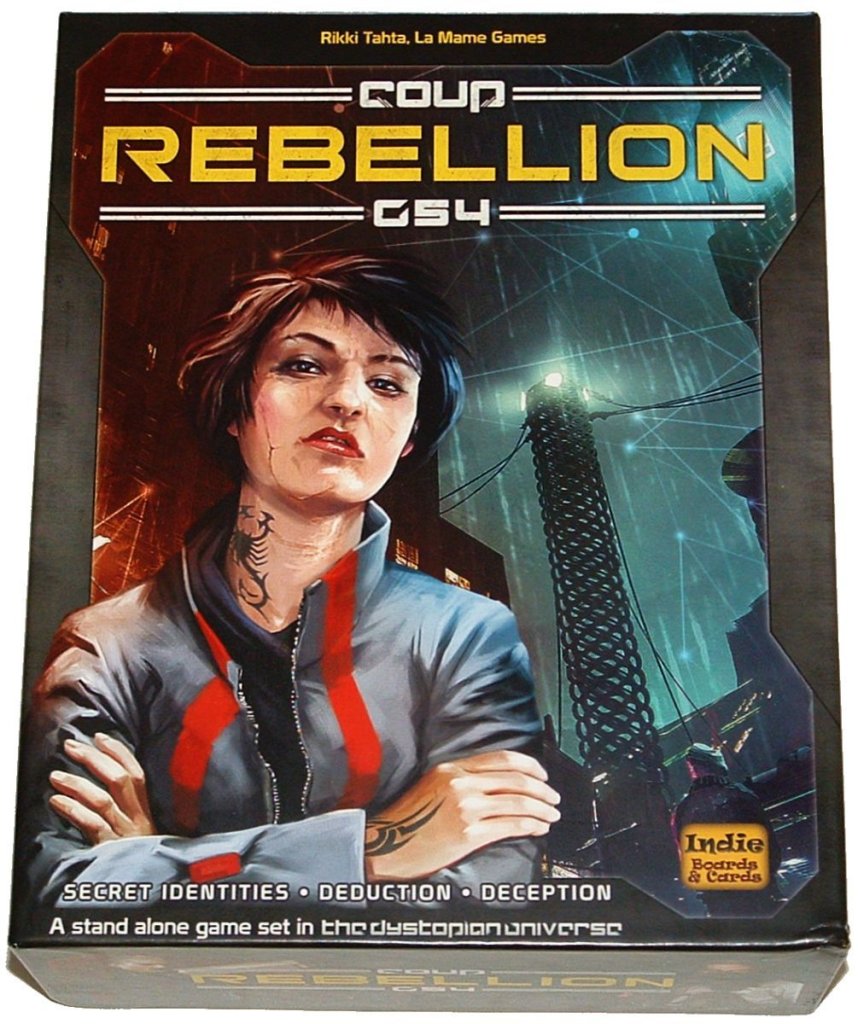
Coup: Rebellion G54 is a bluffing and deduction game for 3–6 players, with games lasting about 15 minutes. Choose five character roles from a variable pool, then compete to be the last player with influence.
Each game begins by selecting five roles from the 25-character deck. The chosen roles form a randomized 15-card deck, with three iterations of each role. Every character has a unique power, so the available actions and the relative advantages of the roles can change from game to game.
Players start with two coins and two face-down influence cards. On your turn, you may take a general action or use any action belonging to one of the five characters in play, whether or not you actually have that character. Take one coin with Income, or pay seven coins to launch a Coup against an opponent and force them to lose influence. If you have ten or more coins, launching a coup is mandatory.
- Challenge character actions: An action succeeds unless an opponent challenges it.
- Risk your influence: If you cannot or do not reveal the claimed character, one of your influence cards becomes face-up.
- Prove your claim: Reveal the character to defeat the challenger, then shuffle it back into the deck and draw a replacement.
Face-up characters cannot be used. When both of your characters are face-up, you are eliminated, while the last player with a face-down character wins.
More variable than the original game, Coup: Rebellion G54 lets each group shape the role mix toward bluffing, deduction, negotiation, or luck.

Board Game Rules for
Coup: Rebellion G54
In the not too distant future, you are a leading person of interest with connections to both the established government and underground rebels. The popular uprising has brought the government to its knees, and the country is in chaos with different factions competing for power in the newly formed democracy. In this environment anyone can become President if they can find the support and eliminate their rivals.
Components
- 75 Influence Cards (3 of each role)
- 2 General Action Cards (Coup and Income)
- 25 Role Action Cards (1 of each role):
- 5 x Finance
- 5 x Communications
- 5 x Force
- 10 x Special Interest
- 8 Role Tokens:
- 2 x Treaty
- 1 x Peacekeeping
- 3 x Disappear
- 2 x Tax
- 50 Coins
- Rules
- 25 Role Dividers (1 of each role used to organize the Influence cards for easy retrieval)
- 2 Dividers (used to organize and store the cards)

- Take the 2 General Action cards and place them in the center of the table.
- Separate Role Action Cards into 4 piles by type. Choose 5 Role Action cards to play with by randomly taking:
- 1 from the Finance pile
- 1 from the Communications pile
- 1 from the Force pile
- 2 from the Special Interests pile
These are the only roles that will be in play for the game. Only include advanced roles if all players are experienced at the game. For your first game we suggest using: Banker, Politician, Guerrilla, Director and Peacekeeper.
- Place the 5 chosen Role Action cards into the center of the table, face up and visible to everyone. Together with the General Actions these define the only actions available this game. Pass around the Role Action cards for each player to see. Players should familiarize themselves with all the roles and their actions before starting the game.
- Place the corresponding Role tokens (if applicable) into the center of the table, face up and visible to everyone. Roles that have tokens are: Mercenary (Disappear), Peacekeeper (Peacekeeping), Foreign Consular (Treaty) and Customs Officer (Tax).
- Take out the 3 copies of each Influence card matching the 5 chosen Role Action cards. These are the only Influence cards used in this game. Shuffle these Influence cards and deal 2 to each player. Players can always look at their cards but must keep them face down in front of them. Place the remaining cards face down in the middle of the play area as the Deck.
- Give each player 2 coins. Each player’s money must be kept visible. Place the remaining coins in the middle of the play area as the Treasury.
- The person who won the last game starts.
Goal
To eliminate all other players and be the last survivor.
Lives and Influence
Face down Influence cards in front of a player represent the players lives and who they influence. The roles printed on their face down cards represents who that player influences and their abilities.
Every time a player loses a life they have to turn over and reveal one of their face down Influence cards. Revealed cards remain face up in front of the player visible to everyone and no longer provide influence for the player. Each player always chooses which of their own cards they wish to reveal when they lose a life.
When a player has lost all their lives they are eliminated.
Total (Lack of) Trust
- Any negotiations are allowed, but none are ever binding.
- Players are not allowed to reveal any of their cards to other players.
- No coins can be given or lent to other players.
- There is no second place.
The game is played in turns in clockwise order.
- Each turn a player chooses one action only. A player may not pass.
- After the action is chosen other players have an opportunity to challenge or counteract that action.
- If an action is not challenged or counteracted, the action automatically succeeds.
- Challenges are resolved first before any action or counteraction is resolved.
- When a player has lost all their lives and have no face down cards in front of them, they are immediately out of the game. They leave their cards face up and return all their coins to the Treasury.
- The game ends when there is only one player left.
Actions
The Role Action cards and the General Action cards define the available actions a player may take in the game.
- A player may choose any action they want and can afford.
- General actions are always available and do not require a specific Influence card.
- To choose a Role Action, a player must claim that the required role is one of their face down Influence cards. They can be telling the truth or bluffing. They do not need to reveal any of their face down cards unless they are challenged. If they are not challenged they automatically succeed.
- If a player starts their turn with 10 (or more) coins they must launch a Coup that turn as their only action.
- If there are not enough coins or cards to fully take an action you may partially take it.
- There is no limit to coins in the Treasury, if none remain use any additional counters.
General Actions
Always available and cannot be challenged or counter-acted.
- Income: Take 1 coin from the Treasury.
- Coup: Pay 7 coins to the Treasury and launch a Coup against another player. That player immediately loses a life. A Coup is always successful. If you start your turn with 10 (or more) coins you are required to launch a Coup.
Role Actions
A player may claim to influence any of the Roles in play and take the Role action as defined on any of the 5 Role Action cards in the game.
If challenged a player must show they have the relevant Influence card for the role they were claiming.
A quick summary of the actions available to each role is on the Influence card. See the relevant Role Action cards for full details.
If multiple role actions are claimed, they are resolved in a clockwise order starting with the active player.
Order of Actions, Challenges & Counteractions
- Claim action and declare any target. (If challenged, resolve now)
- Additional claim(s) of the action. (If challenged, resolve now)
- Counteraction(s) claimed. (If counteractions are challenged, resolve now)
- Counteraction(s) taken.
- Action(s) taken.
Challenges
Any action or counteraction (excluding General Actions) can be challenged. Any other player can issue a challenge to a player regardless of whether they are the involved in the action.
Once an action or counteraction is declared other players must be given an opportunity to challenge. Unless otherwise specified any challenge has to be made before the next claim. Once play continues challenges cannot be retro-actively issued.
If a player is challenged they must prove they had the required influence by showing the relevant role is one of their face down cards. If they can’t, or do not wish to, prove it, they lose the challenge. If they can, the challenger loses.
A challenge is fully resolved before returning to play.
Whoever loses the challenge immediately loses a life.
If a player wins a challenge by showing the relevant character card, they first return that card to the Court deck, re-shuffle the Deck and take a random replacement influence card. (That way they have not lost a life and other players do not know the new influence card they have). Then the action or counteraction is resolved.
If an action is successfully challenged the entire action fails. For instance any coins paid as the cost of the action are returned to the player.
If multiple challenges are issued, they are prioritised by who made the challenge first and if in doubt in clockwise order from the active player.
Counteractions
Counteractions can be taken by other players to intervene or block a player’s action.
- Counteractions operate like role actions. Players may claim to influence any of the roles and use their abilities to counteract another player. They may be telling the truth or bluffing. They do not need to show any cards unless challenged. Counteractions may be challenged, but if not challenged they automatically succeed.
- If an action is successfully counteracted, the effect of the counter-action is applied, but in all other respects the action succeeds. For instance if an action says pay 4 coins to kill another player and that is counteracted by the player to stop the kill, the life is not lost but the 4 coins are still paid.
- Unless otherwise specified, counteractions can only be taken by the target of an action in their own defense.
- Influence cards with the word “Block” usually mean that they counteract the same card and prevent the loss of life or coins that that same card’s action provides. The corresponding Role Action cards specify the Counteraction for that role.
- If multiple counteractions are made, they are taken in clockwise order starting with the active player.
Note: Double Dangers of using Force
It is possible to lose 2 lives in one turn if you unsuccessfully defend against an attack.
For example, if you challenge a Guerrilla used against you and lose the challenge, you will lose 1 life for the lost challenge and then 1 life for the successful Execution by the Guerrilla.
Or if you bluff having a Guerrilla as a counter-action to the Execution attempt and are successfully challenged, you will lose 1 life for the lost challenge and then lose 1 life for the successful Execution.
- Pay: pay a coin to the Treasury.
- Active player: player whose turn it is.
- Target: the player(s) targeted by the action of another player.
 : These icons represent coins with the value indicated.
Credits
Game Design: Rikki Tahta, La Mame Games.
Development & Testing: Haig Tahta, Gabriel Jones, Robin Rightmeyr, Roxana Zegan, Sam Dickinson and everyone at La Mame.
Illustrations & Graphic Design: Jarek Nocon, Luis Francisco, Stephanie Gustafsson.
Similar Games from Indie Boards and Cards
- The Resistance: The ultimate game of hidden identities, deduction and deception for 5 to 10 players. Hidden Agenda and Hostile Intent are two expansions that are already available for The Resistance that add countless hours of deceptive fun.
- Coup: An award winning game of bluff and betting for 2 to 6 players. Reformation is an expansion that brings more roles, more actions and more players to Coup.
- One Night Revolution: The 10 minute game of secret identities, deduction & deception for 3-10 players.
If you liked this game, you can find it and other small publisher games online at WWW.INDIEBOARDSANDCARDS.COM
Introduction & Components
In the not too distant future, you are a leading person of interest with connections to both the established government and underground rebels. The popular uprising has brought the government to its knees, and the country is in chaos with different factions competing for power in the newly formed democracy. In this environment anyone can become President if they can find the support and eliminate their rivals.
Components
- 75 Influence Cards (3 of each role)
- 2 General Action Cards (Coup and Income)
- 25 Role Action Cards (1 of each role):
- 5 x Finance
- 5 x Communications
- 5 x Force
- 10 x Special Interest
- 8 Role Tokens:
- 2 x Treaty
- 1 x Peacekeeping
- 3 x Disappear
- 2 x Tax
- 50 Coins
- Rules
- 25 Role Dividers (1 of each role used to organize the Influence cards for easy retrieval)
- 2 Dividers (used to organize and store the cards)
Setup
- Take the 2 General Action cards and place them in the center of the table.
- Separate Role Action Cards into 4 piles by type. Choose 5 Role Action cards to play with by randomly taking:
- 1 from the Finance pile
- 1 from the Communications pile
- 1 from the Force pile
- 2 from the Special Interests pile
These are the only roles that will be in play for the game. Only include advanced roles if all players are experienced at the game. For your first game we suggest using: Banker, Politician, Guerrilla, Director and Peacekeeper.
- Place the 5 chosen Role Action cards into the center of the table, face up and visible to everyone. Together with the General Actions these define the only actions available this game. Pass around the Role Action cards for each player to see. Players should familiarize themselves with all the roles and their actions before starting the game.
- Place the corresponding Role tokens (if applicable) into the center of the table, face up and visible to everyone. Roles that have tokens are: Mercenary (Disappear), Peacekeeper (Peacekeeping), Foreign Consular (Treaty) and Customs Officer (Tax).
- Take out the 3 copies of each Influence card matching the 5 chosen Role Action cards. These are the only Influence cards used in this game. Shuffle these Influence cards and deal 2 to each player. Players can always look at their cards but must keep them face down in front of them. Place the remaining cards face down in the middle of the play area as the Deck.
- Give each player 2 coins. Each player’s money must be kept visible. Place the remaining coins in the middle of the play area as the Treasury.
- The person who won the last game starts.
Object of the Game & Core Concepts
Goal
To eliminate all other players and be the last survivor.
Lives and Influence
Face down Influence cards in front of a player represent the players lives and who they influence. The roles printed on their face down cards represents who that player influences and their abilities.
Every time a player loses a life they have to turn over and reveal one of their face down Influence cards. Revealed cards remain face up in front of the player visible to everyone and no longer provide influence for the player. Each player always chooses which of their own cards they wish to reveal when they lose a life.
When a player has lost all their lives they are eliminated.
Total (Lack of) Trust
- Any negotiations are allowed, but none are ever binding.
- Players are not allowed to reveal any of their cards to other players.
- No coins can be given or lent to other players.
- There is no second place.
Turn Structure & Actions
The game is played in turns in clockwise order.
- Each turn a player chooses one action only. A player may not pass.
- After the action is chosen other players have an opportunity to challenge or counteract that action.
- If an action is not challenged or counteracted, the action automatically succeeds.
- Challenges are resolved first before any action or counteraction is resolved.
- When a player has lost all their lives and have no face down cards in front of them, they are immediately out of the game. They leave their cards face up and return all their coins to the Treasury.
- The game ends when there is only one player left.
Actions
The Role Action cards and the General Action cards define the available actions a player may take in the game.
- A player may choose any action they want and can afford.
- General actions are always available and do not require a specific Influence card.
- To choose a Role Action, a player must claim that the required role is one of their face down Influence cards. They can be telling the truth or bluffing. They do not need to reveal any of their face down cards unless they are challenged. If they are not challenged they automatically succeed.
- If a player starts their turn with 10 (or more) coins they must launch a Coup that turn as their only action.
- If there are not enough coins or cards to fully take an action you may partially take it.
- There is no limit to coins in the Treasury, if none remain use any additional counters.
General Actions
Always available and cannot be challenged or counter-acted.
- Income: Take 1 coin from the Treasury.
- Coup: Pay 7 coins to the Treasury and launch a Coup against another player. That player immediately loses a life. A Coup is always successful. If you start your turn with 10 (or more) coins you are required to launch a Coup.
Role Actions
A player may claim to influence any of the Roles in play and take the Role action as defined on any of the 5 Role Action cards in the game.
If challenged a player must show they have the relevant Influence card for the role they were claiming.
A quick summary of the actions available to each role is on the Influence card. See the relevant Role Action cards for full details.
If multiple role actions are claimed, they are resolved in a clockwise order starting with the active player.
Order of Actions, Challenges & Counteractions
- Claim action and declare any target. (If challenged, resolve now)
- Additional claim(s) of the action. (If challenged, resolve now)
- Counteraction(s) claimed. (If counteractions are challenged, resolve now)
- Counteraction(s) taken.
- Action(s) taken.
Challenges & Counteractions
Challenges
Any action or counteraction (excluding General Actions) can be challenged. Any other player can issue a challenge to a player regardless of whether they are the involved in the action.
Once an action or counteraction is declared other players must be given an opportunity to challenge. Unless otherwise specified any challenge has to be made before the next claim. Once play continues challenges cannot be retro-actively issued.
If a player is challenged they must prove they had the required influence by showing the relevant role is one of their face down cards. If they can’t, or do not wish to, prove it, they lose the challenge. If they can, the challenger loses.
A challenge is fully resolved before returning to play.
Whoever loses the challenge immediately loses a life.
If a player wins a challenge by showing the relevant character card, they first return that card to the Court deck, re-shuffle the Deck and take a random replacement influence card. (That way they have not lost a life and other players do not know the new influence card they have). Then the action or counteraction is resolved.
If an action is successfully challenged the entire action fails. For instance any coins paid as the cost of the action are returned to the player.
If multiple challenges are issued, they are prioritised by who made the challenge first and if in doubt in clockwise order from the active player.
Counteractions
Counteractions can be taken by other players to intervene or block a player’s action.
- Counteractions operate like role actions. Players may claim to influence any of the roles and use their abilities to counteract another player. They may be telling the truth or bluffing. They do not need to show any cards unless challenged. Counteractions may be challenged, but if not challenged they automatically succeed.
- If an action is successfully counteracted, the effect of the counter-action is applied, but in all other respects the action succeeds. For instance if an action says pay 4 coins to kill another player and that is counteracted by the player to stop the kill, the life is not lost but the 4 coins are still paid.
- Unless otherwise specified, counteractions can only be taken by the target of an action in their own defense.
- Influence cards with the word “Block” usually mean that they counteract the same card and prevent the loss of life or coins that that same card’s action provides. The corresponding Role Action cards specify the Counteraction for that role.
- If multiple counteractions are made, they are taken in clockwise order starting with the active player.
Note: Double Dangers of using Force
It is possible to lose 2 lives in one turn if you unsuccessfully defend against an attack.
For example, if you challenge a Guerrilla used against you and lose the challenge, you will lose 1 life for the lost challenge and then 1 life for the successful Execution by the Guerrilla.
Or if you bluff having a Guerrilla as a counter-action to the Execution attempt and are successfully challenged, you will lose 1 life for the lost challenge and then lose 1 life for the successful Execution.
Glossary of Card Terms
- Pay: pay a coin to the Treasury.
- Active player: player whose turn it is.
- Target: the player(s) targeted by the action of another player.
- : These icons represent coins with the value indicated.
Credits & Similar Games
Credits
Game Design: Rikki Tahta, La Mame Games.
Development & Testing: Haig Tahta, Gabriel Jones, Robin Rightmeyr, Roxana Zegan, Sam Dickinson and everyone at La Mame.
Illustrations & Graphic Design: Jarek Nocon, Luis Francisco, Stephanie Gustafsson.
Similar Games from Indie Boards and Cards
- The Resistance: The ultimate game of hidden identities, deduction and deception for 5 to 10 players. Hidden Agenda and Hostile Intent are two expansions that are already available for The Resistance that add countless hours of deceptive fun.
- Coup: An award winning game of bluff and betting for 2 to 6 players. Reformation is an expansion that brings more roles, more actions and more players to Coup.
- One Night Revolution: The 10 minute game of secret identities, deduction & deception for 3-10 players.
If you liked this game, you can find it and other small publisher games online at WWW.INDIEBOARDSANDCARDS.COM