Dice Forge
2017
Customize dice with removable faces, gather resources, overcome divine ordeals, and pursue victory through clever dice development.
45
minutes
2 - 4
player(s)
10+
Medium Light


About this board game
Dice Forge is a dice development game for 2–4 players, with play lasting about 45 minutes. In this inventive 2017 game, heroes compete for a place in heaven by gathering resources, overcoming ordeals, and outmaneuvering their rivals.
Each player commands divine dice with removable faces. Rather than simply accepting the luck of every roll, you can customize your dice as the game progresses. Sacrifice gold to the gods to obtain enhanced die faces, then upgrade your dice to produce the resources you need.
Dice Forge combines resource management with a distinctive dice-crafting system. Your choices shape how your dice perform, giving you the opportunity to manage luck and take greater control of your destiny. Explore different approaches as you develop your dice and work toward victory.
- Build and customize dice with removable faces.
- Roll your dice to gather valuable resources.
- Spend gold on enhanced die faces.
- Complete divine ordeals for glory and rewards.
- Compete with opponents across multiple winning strategies.
During the game, the gods present ordeals designed to test the heroes. Completing them can help you grow in glory and earn rewards, while careful management of your resources supports further improvements to your dice.
With its blend of dice crafting, development, and tactical resource use, Dice Forge makes every upgrade meaningful. Roll, customize, and refine your divine dice until you are ready to challenge your rivals and prove that you are worthy of ascending to the heavens.
Designer
Illustrator
/pic7182955.jpg)

Board Game Rules for
Dice Forge
Game Overview
Players are heroes competing to gain the most Glory Points  . During the game, players roll their dice to gain Gold
  , Sun Shards
  , and Moon Shards
  , that they can spend to:
- Acquire die faces to modify and upgrade their dice
- Perform powerful heroic feats.
…to collect precious Glory Points.
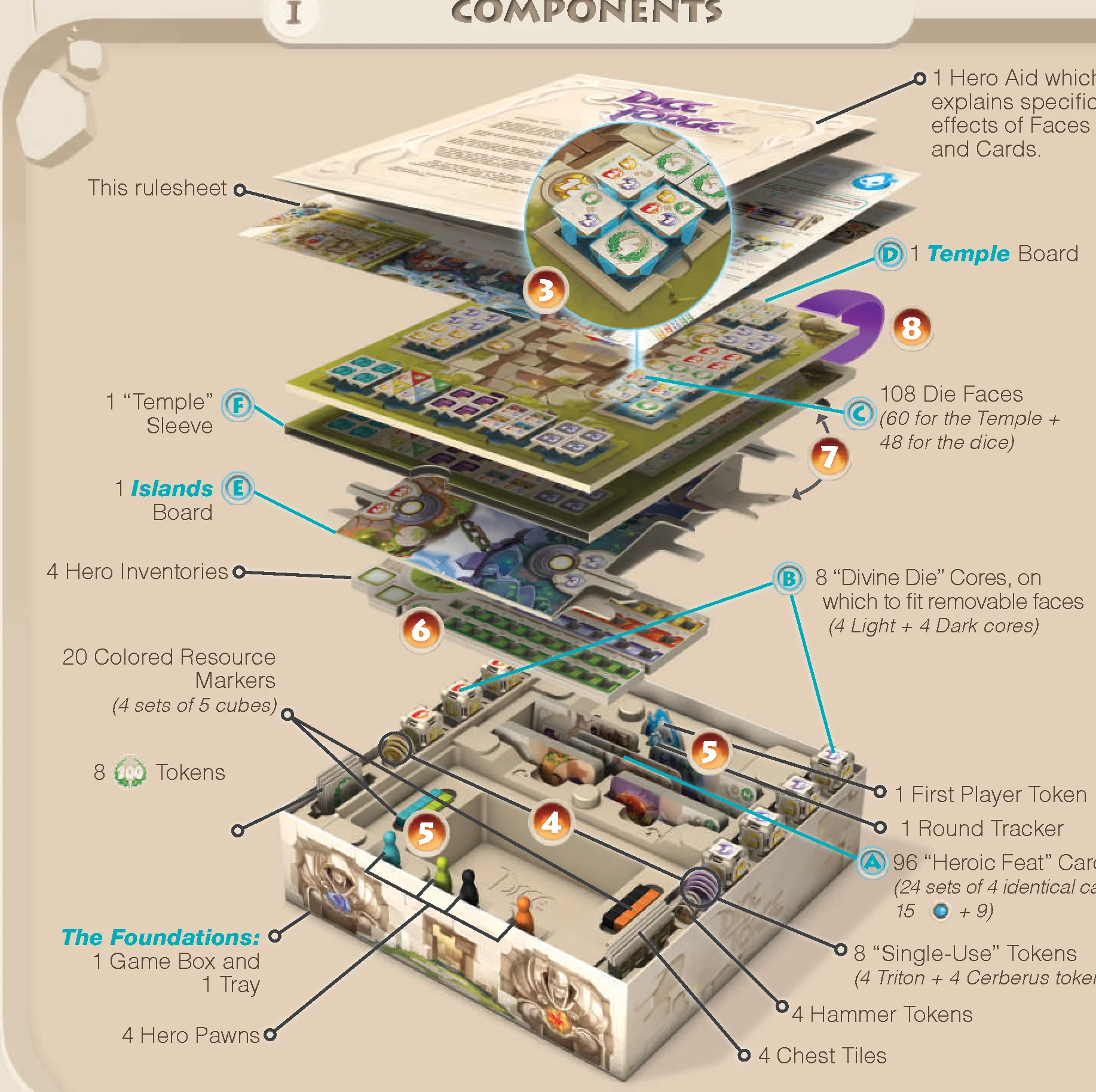
Components
- 1 Temple Sleeve
- 1 Islands Board
- 4 Hero Inventories
- 20 Colored Resource Markers (4 sets of 5 cubes)
- 8 Tokens
- The Foundations: 1 Game Box and 1 Tray
- 4 Hero Pawns
- This rulesheet
- 1 Hero Aid which explains specific effects of Faces and Cards
- 1 Temple Board
- 108 Die Faces (60 for the Temple + 48 for the dice)
- 8 “Divine Die” Cores, on which to fit removable faces (4 Light + 4 Dark cores)
- 1 First Player Token
- 1 Round Tracker
- 96 “Heroic Feat” Cards (24 sets of 4 identical cards: 15
 + 9)
+ 9) - 8 “Single-Use” Tokens (4 Triton + 4 Cerberus tokens)
- 4 Hammer Tokens
- 4 Chest Tiles
Configuration for an Introductory Four-Player Game
For a two-player or three-player game, follow the same setup steps but see “Setup Configurations” for changes.
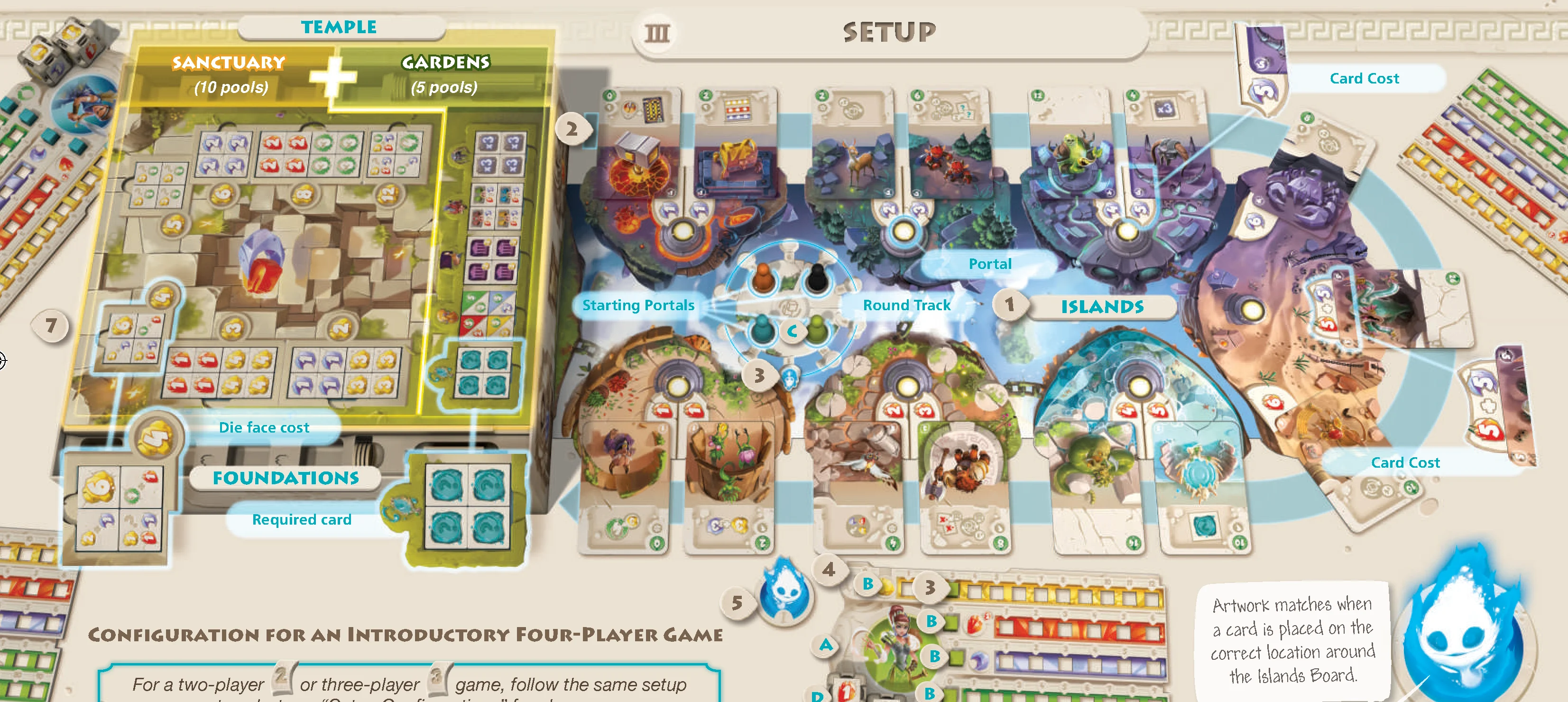
- Ensure the box storage is correct, and remove the sleeved Temple from the Foundations and place it aside for now.
- Place all the cards* in their respective locations around the Islands Board, forming stacks of four identical cards. Match the card cost and the cost indicated on the location.
* cards are recommended for an introductory game. Artwork matches when a card is placed on the correct location around the Islands Board. - Place the Round tracker on space “1” of the round track.
- Then each player must:
- Take a Hero Inventory and place it in front of him.
- Take the five Resource markers of his color and place one on each space “0” of his Hero Inventory.
- Take the Hero pawn of his color and place it on the matching starting portal.
- Take a Light Die and a Dark Die (assembled as shown in “Game Storage”) and place both in their designated spaces on his Hero Inventory.
- The youngest player becomes the first player and takes the First Player token (which he will keep until the end of the game).
- Each player then adjusts his Gold reserve by moving his Resource marker to a new space on his Gold track according to the turn order:
- Player 1 = 3
- Player 2 = 2
- Player 3 = 1
- Player 4 = 0
- Player 1 = 3
- Remove the Temple from its sleeve and place it on top of the Foundations. Place the sleeve aside for the rest of the game.
Hero Inventory Overview
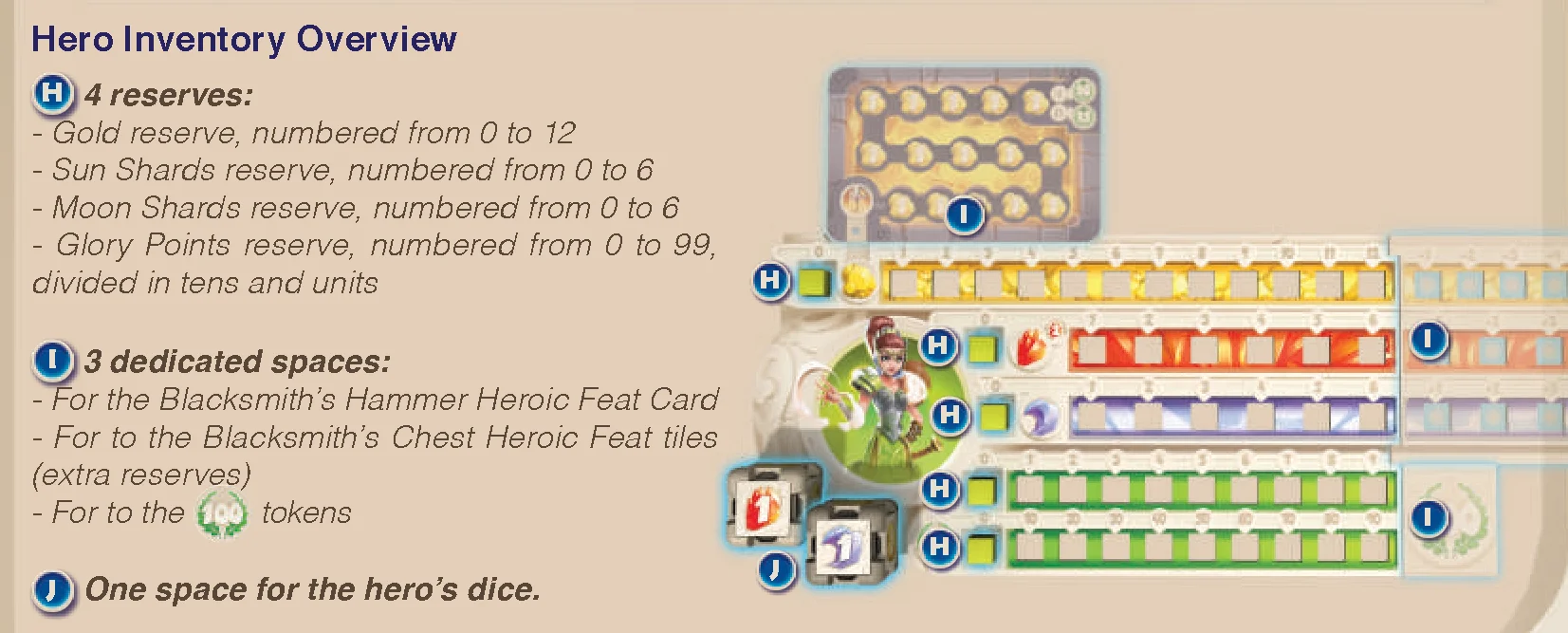
- H – 4 reserves:
- Gold reserve, numbered from 0 to 12
- Sun Shards reserve, numbered from 0 to 6
- Moon Shards reserve, numbered from 0 to 6
- Glory Points reserve, numbered from 0 to 99, divided in tens and units
- I – 3 dedicated spaces:
- For the Blacksmith’s Hammer Heroic Feat Card
- For the Blacksmith’s Chest Heroic Feat tiles (extra reserves)
- For the 100 Glory Point tokens
- J: One space for the hero’s dice.
Heroic Feat Card Overview
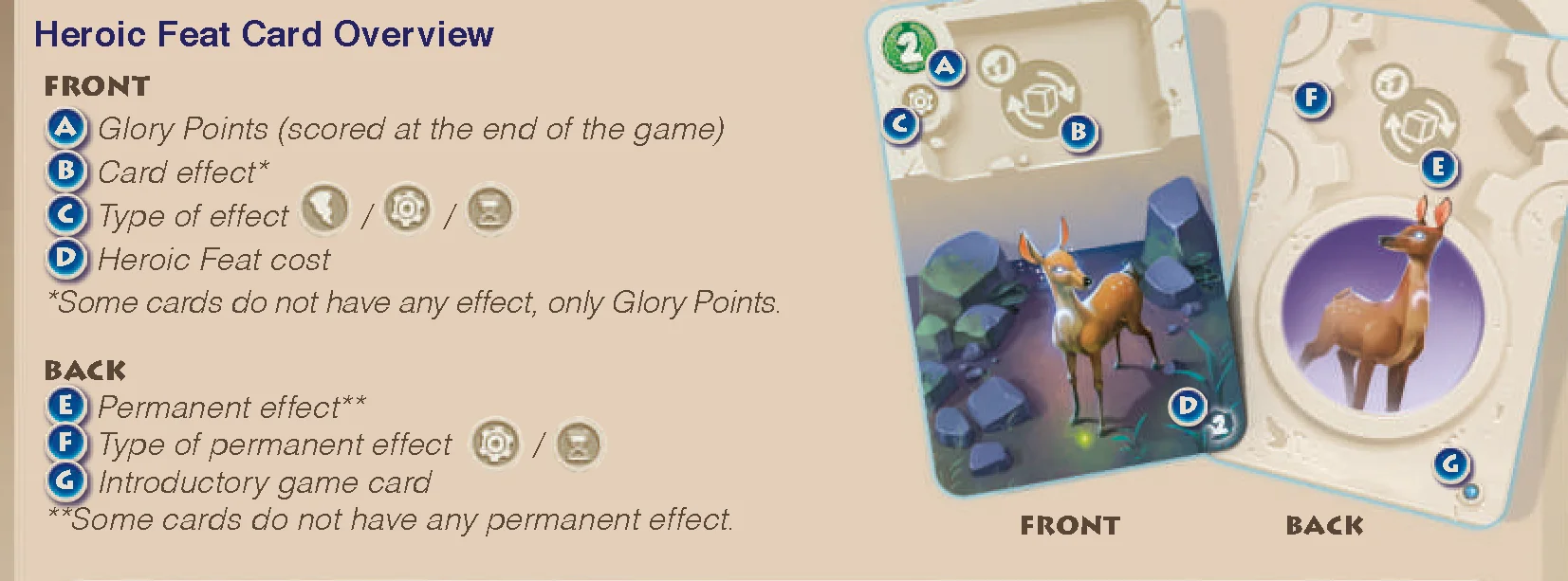
FRONT:
- A: Glory Points (scored at the end of the game)
- B: Card effect*
- C: Type of effect:
 /
/  /
/ 
- D: Heroic Feat cost
*Some cards do not have any effect, only Glory Points.
BACK:
- E: Permanent effect**
- F: Type of permanent effect: /
- G: Introductory game card
**Some cards do not have any permanent effect.
Setup for Different Numbers of Players
| Configuration | 4 Players | 3 Players | 2 Players |
|---|---|---|---|
| Number of cards per stack | 4 | 3 | 2 |
| Number of die faces per pool in the Sanctuary | 4 | 4 | 2* |
| Gold for each player according to turn order | 3 / 2 / 1 / 0 | 3 / 2 / 1 | 3 / 2 |
| Number of rounds | 9 | 10 | 9 |
| Gameplay Changes | — | — | Perform step 1 “All Players Receive Divine Blessings” twice in a row at the start of each round. (See “Playing A Round” on page 2.) |
*Randomly remove 2 die faces per pool.
Game Concepts
- Receiving a Divine Blessing: Roll both your dice and place them back on your Inventory with the rolled faces facing up. Then apply the effects of the two rolled die faces in the order of your choice. (In most cases, this will consist of gaining resources.)
This occurs:- during Step 1,
- via card effects,
- when ousting another Hero.
- Receiving a Minor Blessing: Choose one of your dice and roll it; place the die back on your inventory with the rolled face facing up and apply its effect.
This does not occur during Step 1, only via card effects. - Forging a Die Face: Remove a die face that you want to replace, using the new die face as a lever. Then attach the new face to the empty side of the die and place the removed die face near your Inventory. Finally, place the die back on your Hero Inventory, with the newly-forged die face facing up.
- Ousting Another Hero: If the active player moves his Hero pawn to a portal that is already occupied by another player’s Hero pawn, the other player moves his Hero pawn to his starting portal and immediately receives a divine blessing, as compensation.
Important Details
- During the game, players can handle their dice to look at them as long as they return the dice to their Hero Inventory in their original position.
- Forging a die face is the only way to modify a die. Players cannot rearrange the faces on their dice or put a previously-removed face back on a die.
- A Hero pawn remains in its location until it is either ousted or voluntarily moved to another portal.
- A player can perform any Heroic Feat, including those he already performed (including during the same turn).
- If you have reached the maximum on a particular reserve track (, , or ), any additional resources gained are lost.
- If you reach 100 , take a 100 token, place your marker back on space “0” of the Glory Point track, and start counting from 0 again.
Reminder: Gold | Sun Shards | Moon Shards | Glory Points
Playing a Round
The game is divided into a series of rounds. During each round, each player takes one turn as the active player, starting with the first player.
Active Player Turn
The player whose turn it is to play is known as the “active player.” Each turn consists of four consecutive steps:
- ALL PLAYERS RECEIVE DIVINE BLESSINGS
All players simultaneously* receive divine blessings.
Note: Remember, in a two-player game, perform this step twice.
*In case of a conflict between players when applying the effects of certain special die faces, follow the turn order, starting with the active player. - THE ACTIVE PLAYER MAY CALL FOR REINFORCEMENTS
If he has one or more cards with reinforcement effects, the active player may apply each effect once in the order of his choice. - THE ACTIVE PLAYER MAY PERFORM AN ACTION
The active player may perform either action A or B:- A – MAKE AN OFFERING TO THE GODS: The active player takes one or more strictly different die faces from the Sanctuary, spending the required for each face acquired. The player must then immediately forge these new faces in the order of his choice.
- B – PERFORM A HEROIC FEAT:
- The active player chooses a heroic feat that he wants to perform and spends the resources indicated next to the Heroic Feat card. Then he moves* his pawn to the portal of the island containing the heroic feat. If necessary, he ousts the hero currently occupying the portal.
*If his pawn is already there, he doesn’t need to move it.
Note: A hero cannot perform a heroic feat if the corresponding card pile is empty. - Then the active player takes the top Heroic Feat card from the stack and applies its effect, if any.
- Finally, he places the card facedown near his Hero Inventory in one of three piles, according to its effect type:
- Pile 1: Heroic Feats with no permanent effect.
- Pile 2*: These permanent effects are activated throughout the game, subject to certain conditions. (See Hero Aid.)
Note: This type of effect only appears on cards which are not used in the recommended setup rules for your introductory game (). - Pile 3*: These permanent effects remain active throughout the game, and are activated during step 2 when the owner of the card is the active player. (See Hero Aid.)
*When overlapping cards, ensure that all effects remain visible.
- The active player chooses a heroic feat that he wants to perform and spends the resources indicated next to the Heroic Feat card. Then he moves* his pawn to the portal of the island containing the heroic feat. If necessary, he ousts the hero currently occupying the portal.
- A – MAKE AN OFFERING TO THE GODS: The active player takes one or more strictly different die faces from the Sanctuary, spending the required
- THE ACTIVE PLAYER MAY PERFORM AN EXTRA ACTION
Once per turn, the active player may spend 2 to perform an additional action, either A or B (See step 3 above).
End of the Active Player’s Turn
At the end of step 4, the active player’s turn ends immediately (whether or not he performed an extra action).
A new turn begins. The next player in a clockwise order becomes the new active player.
Example of a Complete Turn by the Active Player
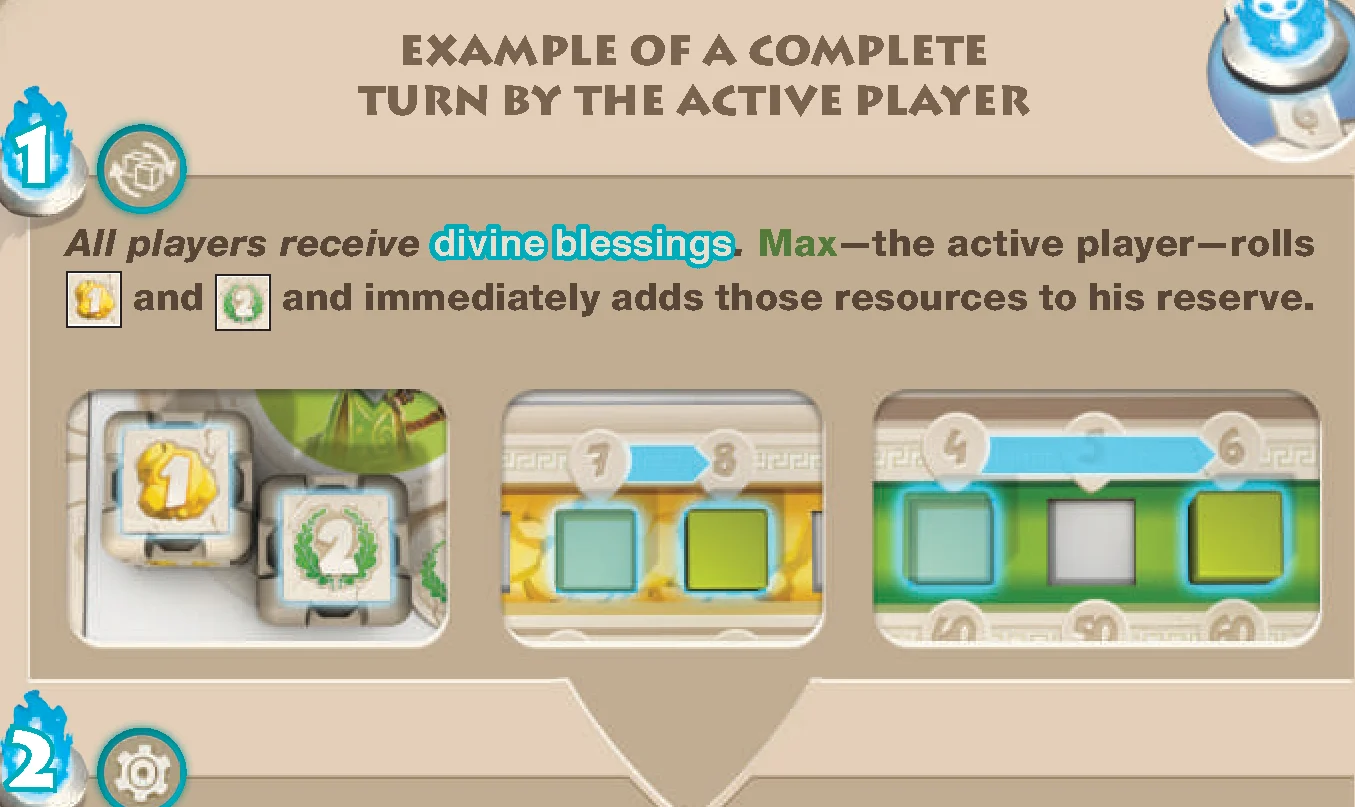
- Step 1: All players receive divine blessings. Max—the active player—rolls 1 and 1 and immediately adds those resources to his reserve.
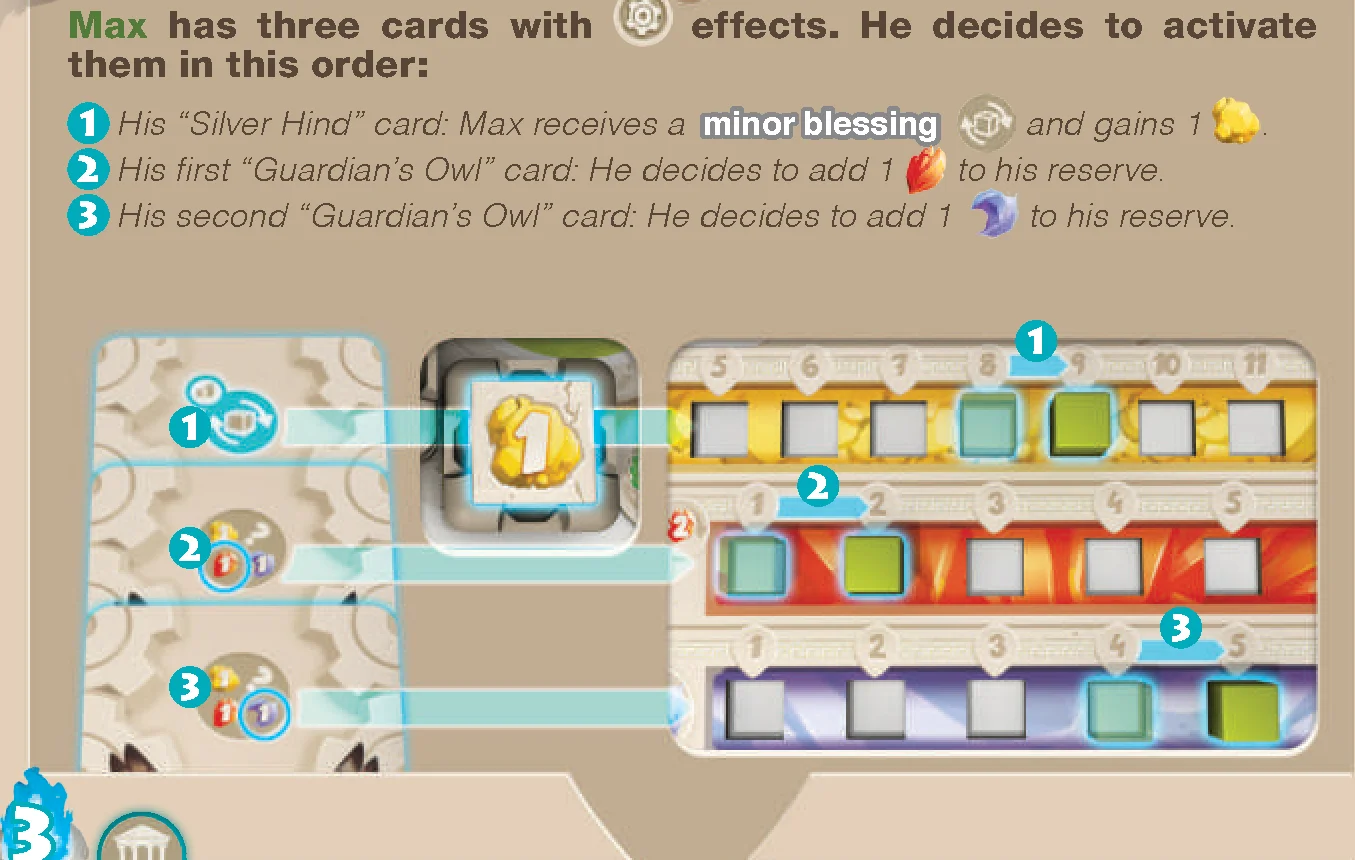
- Step 2: Max has three cards with effects. He decides to activate them in this order:
- His “Silver Hind” card: Max receives a minor blessing and gains 1 .
- His first “Guardian’s Owl” card: He decides to add 1 to his reserve.
- His second “Guardian’s Owl” card: He decides to add 1 to his reserve.
- His “Silver Hind” card: Max receives a minor blessing and gains 1
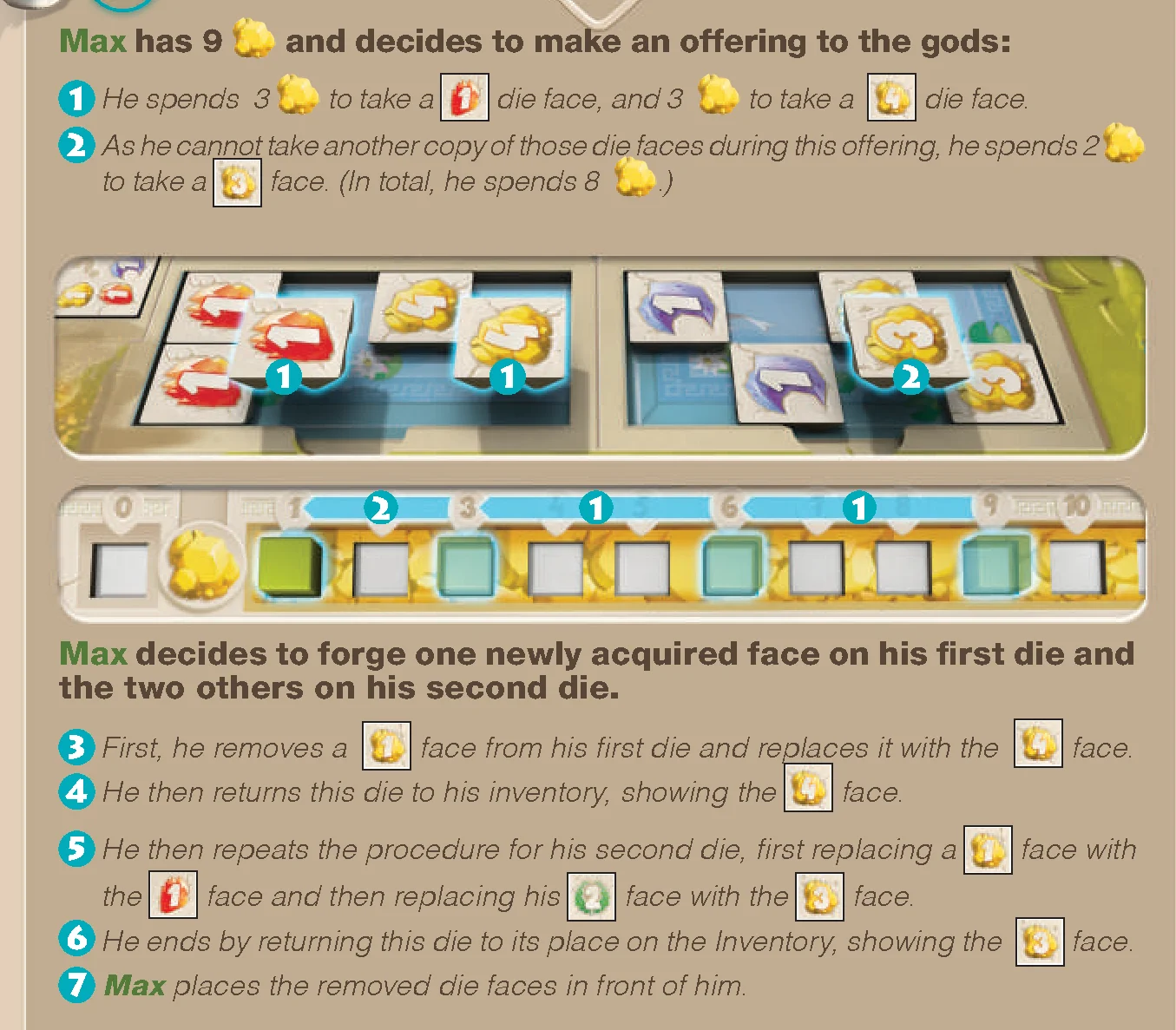
- Step 3: Max has 9 and decides to make an offering to the gods:
- He spends 3 to take a die face, and 3 to take a die face.
- As he cannot take another copy of those die faces during this offering, he spends 2 to take a face. (In total, he spends 8 .)
Max decides to forge one newly acquired face on his first die and the two others on his second die.
- First, he removes a face from his first die and replaces it with the face.
- He then returns this die to his inventory, showing the face.
- He then repeats the procedure for his second die, first replacing a face with the face and then replacing his face with the face.
- He ends by returning this die to its place on the Inventory, showing the face.
- Max places the removed die faces in front of him.
- He spends 3
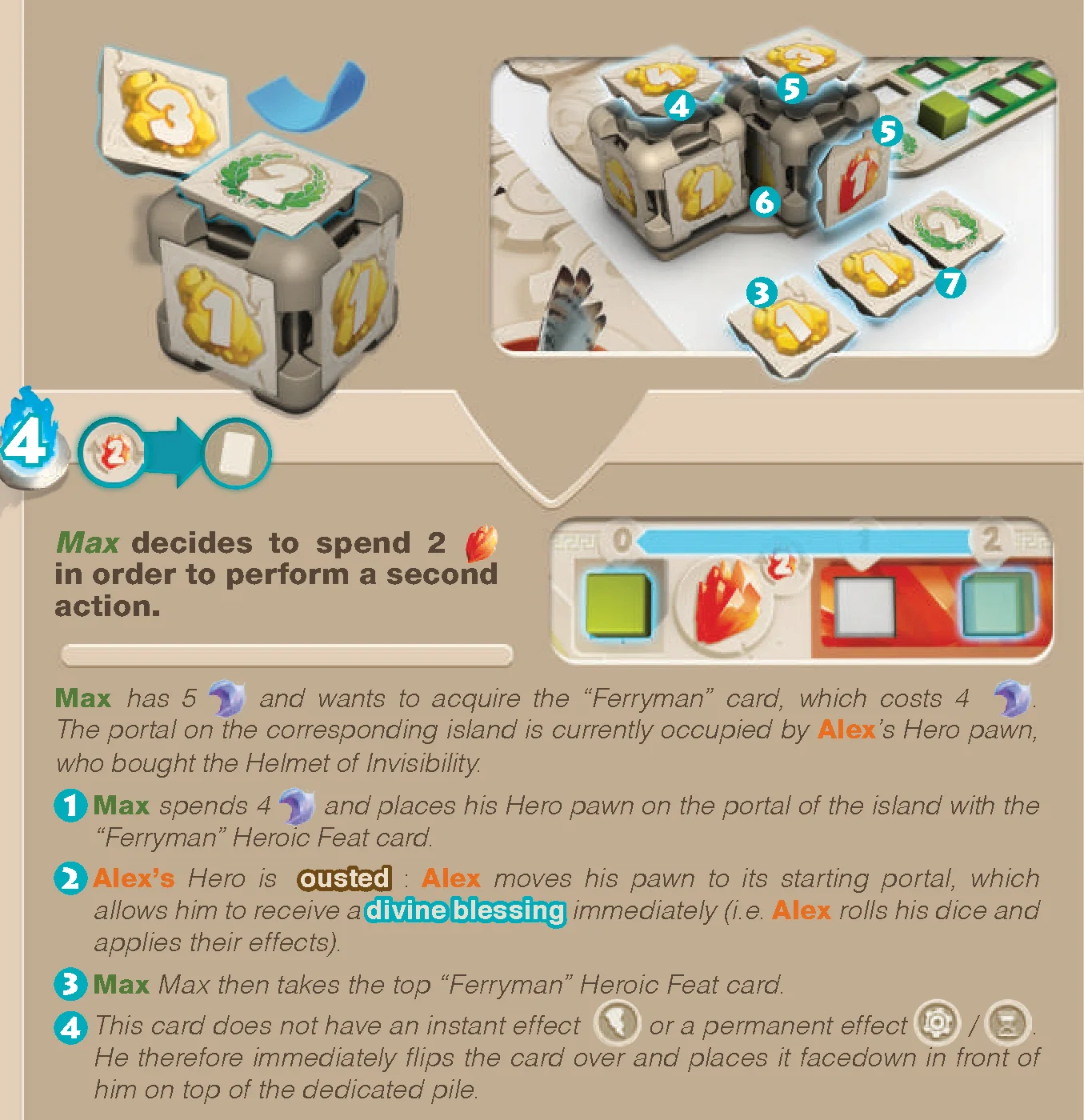
- Step 4: Max decides to spend 2 in order to perform a second action.
Max has 5 and wants to acquire the “Ferryman” card, which costs 4 . The portal on the corresponding island is currently occupied by Alex’s Hero pawn, who bought the Helmet of Invisibility.
- Max spends 4 and places his Hero pawn on the portal of the island with the “Ferryman” Heroic Feat card.
- Alex’s Hero is ousted: Alex moves his pawn to its starting portal, which allows him to receive a divine blessing immediately (i.e. Alex rolls his dice and applies their effects).
- Max then takes the top “Ferryman” Heroic Feat card.
- This card does not have an instant effect or a permanent effect / . He therefore immediately flips the card over and places it facedown in front of him on top of the dedicated pile.
Max then takes the top “Ferryman” Heroic Feat card.
- Max spends 4
End of Round
When all players have taken their turn as the active player, the round ends.
If it is the end of the final round*, the game ends. Otherwise, advance the round tracker one space and begin a new round.
*Nine rounds in a two- or four-player game, and ten rounds in a three-player game.
End of Game and Scoring Phase
At the end of the final round, the game ends immediately and the scoring phase begins.
Each player adds all the from his Heroic Feat cards and his Hero Inventory together, including any tokens. The player with the most is the winner and earns a place among the gods. In case of a tie, all tied players win the game together.
Using Different Heroic Feat Cards
After their first game, players can add variety by changing which Heroic Feat cards appear in the game.
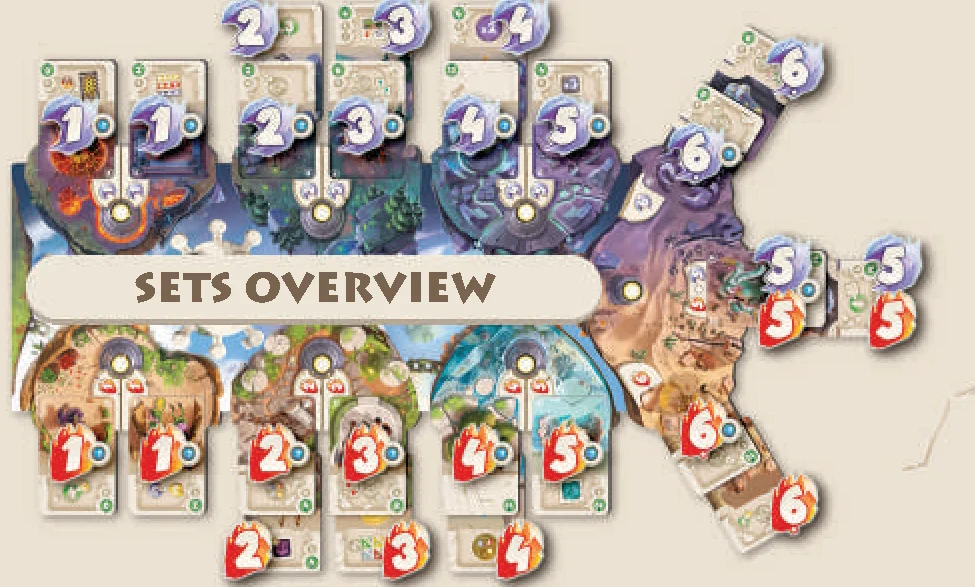
When setting up the game, simply replace* one to nine sets of Heroic Feat card with the corresponding alternate set(s) available, as shown on the right.
Example: You may replace the sets numbered 3, 5, 7, and 8 with the sets numbered 4, 6, 7, and 8 respectively.
*To add more challenge, you may randomly select, for each location, which one of the two sets is used for the game.
Storage Instructions
Save time! In Dice Forge, storing your game properly allows you to set up your next game much faster.
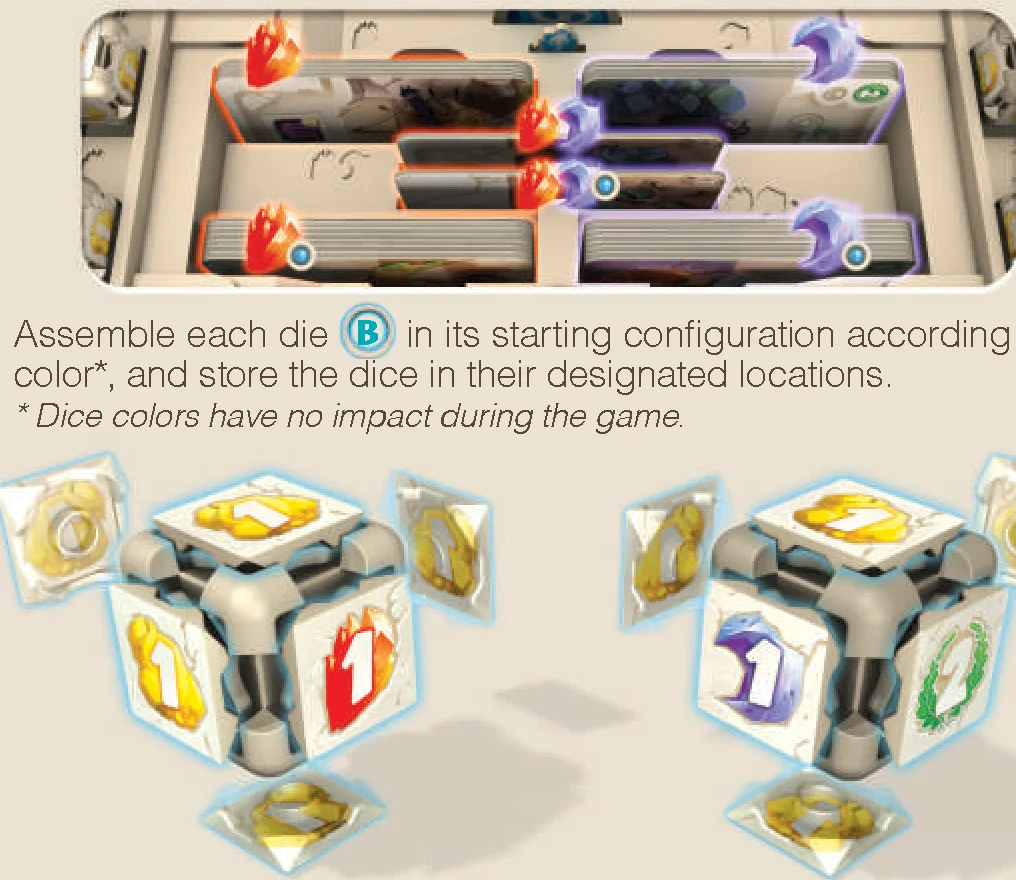
After opening the box for the first time and after each game, follow these steps to store the components in the Foundations:
- By looking at the artwork, sort the Heroic Feat cards in small piles of 4 identical cards. Then store them in their designated locations based on their cost and type (with or without ), as follows.
- Assemble each die in its starting configuration according to its color*, and store the dice in their designated locations.
*Dice colors have no impact during the game. - Store the remaining die faces on the Temple as represented on the Temple sleeve.
- Store the Single-Use tokens, tokens, Hammer tokens, and Chest tiles in their designated locations.
- Store the Hero pawns, Round tracker, First Player token and Resource markers in their designated locations.
- Store the Hero Inventories in their designated location.
- Fold up the Islands board and store it in its designated location.
- Insert the Temple into its sleeve and store it in its designated location.
Credits
Game Design: Régis Bonnessée
Artwork: Biboun
Translation: Andrew Seaward
Editing: Thomas Gallecier
Overview & Components
Game Overview
Players are heroes competing to gain the most Glory Points . During the game, players roll their dice to gain Gold , Sun Shards , and Moon Shards , that they can spend to:
- Acquire die faces to modify and upgrade their dice
- Perform powerful heroic feats.
…to collect precious Glory Points.
Components
- 1 Temple Sleeve
- 1 Islands Board
- 4 Hero Inventories
- 20 Colored Resource Markers (4 sets of 5 cubes)
- 8 Tokens
- The Foundations: 1 Game Box and 1 Tray
- 4 Hero Pawns
- This rulesheet
- 1 Hero Aid which explains specific effects of Faces and Cards
- 1 Temple Board
- 108 Die Faces (60 for the Temple + 48 for the dice)
- 8 “Divine Die” Cores, on which to fit removable faces (4 Light + 4 Dark cores)
- 1 First Player Token
- 1 Round Tracker
- 96 “Heroic Feat” Cards (24 sets of 4 identical cards: 15 + 9)
- 8 “Single-Use” Tokens (4 Triton + 4 Cerberus tokens)
- 4 Hammer Tokens
- 4 Chest Tiles
Setup
Configuration for an Introductory Four-Player Game
For a two-player or three-player game, follow the same setup steps but see “Setup Configurations” for changes.
- Ensure the box storage is correct, and remove the sleeved Temple from the Foundations and place it aside for now.
- Place all the cards* in their respective locations around the Islands Board, forming stacks of four identical cards. Match the card cost and the cost indicated on the location.
* cards are recommended for an introductory game. Artwork matches when a card is placed on the correct location around the Islands Board. - Place the Round tracker on space “1” of the round track.
- Then each player must:
- Take a Hero Inventory and place it in front of him.
- Take the five Resource markers of his color and place one on each space “0” of his Hero Inventory.
- Take the Hero pawn of his color and place it on the matching starting portal.
- Take a Light Die and a Dark Die (assembled as shown in “Game Storage”) and place both in their designated spaces on his Hero Inventory.
- The youngest player becomes the first player and takes the First Player token (which he will keep until the end of the game).
- Each player then adjusts his Gold reserve by moving his Resource marker to a new space on his Gold track according to the turn order:
- Player 1 = 3
- Player 2 = 2
- Player 3 = 1
- Player 4 = 0
- Player 1 = 3
- Remove the Temple from its sleeve and place it on top of the Foundations. Place the sleeve aside for the rest of the game.
Hero Inventory Overview
- H – 4 reserves:
- Gold reserve, numbered from 0 to 12
- Sun Shards reserve, numbered from 0 to 6
- Moon Shards reserve, numbered from 0 to 6
- Glory Points reserve, numbered from 0 to 99, divided in tens and units
- I – 3 dedicated spaces:
- For the Blacksmith’s Hammer Heroic Feat Card
- For the Blacksmith’s Chest Heroic Feat tiles (extra reserves)
- For the 100 Glory Point tokens
- J: One space for the hero’s dice.
Heroic Feat Card Overview
FRONT:
- A: Glory Points (scored at the end of the game)
- B: Card effect*
- C: Type of effect: / /
- D: Heroic Feat cost
*Some cards do not have any effect, only Glory Points.
BACK:
- E: Permanent effect**
- F: Type of permanent effect: /
- G: Introductory game card
**Some cards do not have any permanent effect.
Setup for Different Numbers of Players
| Configuration | 4 Players | 3 Players | 2 Players |
|---|---|---|---|
| Number of cards per stack | 4 | 3 | 2 |
| Number of die faces per pool in the Sanctuary | 4 | 4 | 2* |
| Gold for each player according to turn order | 3 / 2 / 1 / 0 | 3 / 2 / 1 | 3 / 2 |
| Number of rounds | 9 | 10 | 9 |
| Gameplay Changes | — | — | Perform step 1 “All Players Receive Divine Blessings” twice in a row at the start of each round. (See “Playing A Round” on page 2.) |
*Randomly remove 2 die faces per pool.
Core Concepts & Rules
Game Concepts
- Receiving a Divine Blessing: Roll both your dice and place them back on your Inventory with the rolled faces facing up. Then apply the effects of the two rolled die faces in the order of your choice. (In most cases, this will consist of gaining resources.)
This occurs:- during Step 1,
- via card effects,
- when ousting another Hero.
- Receiving a Minor Blessing: Choose one of your dice and roll it; place the die back on your inventory with the rolled face facing up and apply its effect.
This does not occur during Step 1, only via card effects. - Forging a Die Face: Remove a die face that you want to replace, using the new die face as a lever. Then attach the new face to the empty side of the die and place the removed die face near your Inventory. Finally, place the die back on your Hero Inventory, with the newly-forged die face facing up.
- Ousting Another Hero: If the active player moves his Hero pawn to a portal that is already occupied by another player’s Hero pawn, the other player moves his Hero pawn to his starting portal and immediately receives a divine blessing, as compensation.
Important Details
- During the game, players can handle their dice to look at them as long as they return the dice to their Hero Inventory in their original position.
- Forging a die face is the only way to modify a die. Players cannot rearrange the faces on their dice or put a previously-removed face back on a die.
- A Hero pawn remains in its location until it is either ousted or voluntarily moved to another portal.
- A player can perform any Heroic Feat, including those he already performed (including during the same turn).
- If you have reached the maximum on a particular reserve track (, , or ), any additional resources gained are lost.
- If you reach 100 , take a 100 token, place your marker back on space “0” of the Glory Point track, and start counting from 0 again.
How to Play
Reminder: Gold | Sun Shards | Moon Shards | Glory Points
Playing a Round
The game is divided into a series of rounds. During each round, each player takes one turn as the active player, starting with the first player.
Active Player Turn
The player whose turn it is to play is known as the “active player.” Each turn consists of four consecutive steps:
- ALL PLAYERS RECEIVE DIVINE BLESSINGS
All players simultaneously* receive divine blessings.
Note: Remember, in a two-player game, perform this step twice.
*In case of a conflict between players when applying the effects of certain special die faces, follow the turn order, starting with the active player. - THE ACTIVE PLAYER MAY CALL FOR REINFORCEMENTS
If he has one or more cards with reinforcement effects, the active player may apply each effect once in the order of his choice. - THE ACTIVE PLAYER MAY PERFORM AN ACTION
The active player may perform either action A or B:- A – MAKE AN OFFERING TO THE GODS: The active player takes one or more strictly different die faces from the Sanctuary, spending the required for each face acquired. The player must then immediately forge these new faces in the order of his choice.
- B – PERFORM A HEROIC FEAT:
- The active player chooses a heroic feat that he wants to perform and spends the resources indicated next to the Heroic Feat card. Then he moves* his pawn to the portal of the island containing the heroic feat. If necessary, he ousts the hero currently occupying the portal.
*If his pawn is already there, he doesn’t need to move it.
Note: A hero cannot perform a heroic feat if the corresponding card pile is empty. - Then the active player takes the top Heroic Feat card from the stack and applies its effect, if any.
- Finally, he places the card facedown near his Hero Inventory in one of three piles, according to its effect type:
- Pile 1: Heroic Feats with no permanent effect.
- Pile 2*: These permanent effects are activated throughout the game, subject to certain conditions. (See Hero Aid.)
Note: This type of effect only appears on cards which are not used in the recommended setup rules for your introductory game (). - Pile 3*: These permanent effects remain active throughout the game, and are activated during step 2 when the owner of the card is the active player. (See Hero Aid.)
*When overlapping cards, ensure that all effects remain visible.
- The active player chooses a heroic feat that he wants to perform and spends the resources indicated next to the Heroic Feat card. Then he moves* his pawn to the portal of the island containing the heroic feat. If necessary, he ousts the hero currently occupying the portal.
- A – MAKE AN OFFERING TO THE GODS: The active player takes one or more strictly different die faces from the Sanctuary, spending the required
- THE ACTIVE PLAYER MAY PERFORM AN EXTRA ACTION
Once per turn, the active player may spend 2 to perform an additional action, either A or B (See step 3 above).
End of the Active Player’s Turn
At the end of step 4, the active player’s turn ends immediately (whether or not he performed an extra action).
A new turn begins. The next player in a clockwise order becomes the new active player.
Example of a Complete Turn by the Active Player
- Step 1: All players receive divine blessings. Max—the active player—rolls 1 and 1 and immediately adds those resources to his reserve.
- Step 2: Max has three cards with effects. He decides to activate them in this order:
- His “Silver Hind” card: Max receives a minor blessing and gains 1 .
- His first “Guardian’s Owl” card: He decides to add 1 to his reserve.
- His second “Guardian’s Owl” card: He decides to add 1 to his reserve.
- His “Silver Hind” card: Max receives a minor blessing and gains 1
- Step 3: Max has 9 and decides to make an offering to the gods:
- He spends 3 to take a die face, and 3 to take a die face.
- As he cannot take another copy of those die faces during this offering, he spends 2 to take a face. (In total, he spends 8 .)
Max decides to forge one newly acquired face on his first die and the two others on his second die.
- First, he removes a face from his first die and replaces it with the face.
- He then returns this die to his inventory, showing the face.
- He then repeats the procedure for his second die, first replacing a face with the face and then replacing his face with the face.
- He ends by returning this die to its place on the Inventory, showing the face.
- Max places the removed die faces in front of him.
- He spends 3
- Step 4: Max decides to spend 2 in order to perform a second action.
Max has 5 and wants to acquire the “Ferryman” card, which costs 4 . The portal on the corresponding island is currently occupied by Alex’s Hero pawn, who bought the Helmet of Invisibility.
- Max spends 4 and places his Hero pawn on the portal of the island with the “Ferryman” Heroic Feat card.
- Alex’s Hero is ousted: Alex moves his pawn to its starting portal, which allows him to receive a divine blessing immediately (i.e. Alex rolls his dice and applies their effects).
- Max then takes the top “Ferryman” Heroic Feat card.
- This card does not have an instant effect or a permanent effect / . He therefore immediately flips the card over and places it facedown in front of him on top of the dedicated pile.
Max then takes the top “Ferryman” Heroic Feat card.
- Max spends 4
End of Round
When all players have taken their turn as the active player, the round ends.
If it is the end of the final round*, the game ends. Otherwise, advance the round tracker one space and begin a new round.
*Nine rounds in a two- or four-player game, and ten rounds in a three-player game.
End of Game & Scoring
End of Game and Scoring Phase
At the end of the final round, the game ends immediately and the scoring phase begins.
Each player adds all the from his Heroic Feat cards and his Hero Inventory together, including any tokens. The player with the most is the winner and earns a place among the gods. In case of a tie, all tied players win the game together.
Variants & Customization
Using Different Heroic Feat Cards
After their first game, players can add variety by changing which Heroic Feat cards appear in the game.
When setting up the game, simply replace* one to nine sets of Heroic Feat card with the corresponding alternate set(s) available, as shown on the right.
Example: You may replace the sets numbered 3, 5, 7, and 8 with the sets numbered 4, 6, 7, and 8 respectively.
*To add more challenge, you may randomly select, for each location, which one of the two sets is used for the game.
Game Storage
Storage Instructions
Save time! In Dice Forge, storing your game properly allows you to set up your next game much faster.
After opening the box for the first time and after each game, follow these steps to store the components in the Foundations:
- By looking at the artwork, sort the Heroic Feat cards in small piles of 4 identical cards. Then store them in their designated locations based on their cost and type (with or without ), as follows.
- Assemble each die in its starting configuration according to its color*, and store the dice in their designated locations.
*Dice colors have no impact during the game. - Store the remaining die faces on the Temple as represented on the Temple sleeve.
- Store the Single-Use tokens, tokens, Hammer tokens, and Chest tiles in their designated locations.
- Store the Hero pawns, Round tracker, First Player token and Resource markers in their designated locations.
- Store the Hero Inventories in their designated location.
- Fold up the Islands board and store it in its designated location.
- Insert the Temple into its sleeve and store it in its designated location.
Credits
Credits
Game Design: Régis Bonnessée
Artwork: Biboun
Translation: Andrew Seaward
Editing: Thomas Gallecier