Encore!
2016
Use color-and-number dice to fill connected spaces, claim column bonuses, and complete two colors before anyone else.
20
minutes
1 - 6
player(s)
8+
Light

About this board game
Encore! is a 2016 roll-and-write game for 1–6 players that takes about 20 minutes. Each turn, the dice determine which color and how many spaces players can mark on their sheets.
Players choose a combination of one Color die and one Number die, then check the matching number of spaces in that color. Marked spaces must be connected to other boxes, making each choice part of an ongoing attempt to build across the sheet.
The starting player has an important decision before everyone selects their dice. After considering what the other players are doing, the starting player removes two dice, leaving the remaining options for everyone else. This shared selection creates opportunities to pursue your own plans while limiting the combinations available to your opponents.
Completing columns is a central way to score. The first player to check off every box in a column earns more points than players who complete that column later. Players can also receive a bonus for checking off all the boxes of the same color.
- Choose a color-and-number combination from the available dice.
- Mark only connected boxes on your playing sheet.
- Race to complete columns before other players do.
- Earn bonuses by completing every box of a color.
The game ends when a player has checked off all the boxes of two colors. If the group wants another contest, Encore! offers the simple possibility of playing once more—an encore after the first game.
With its compact play time and simultaneous opportunities to make meaningful choices, Encore! turns dice results into a race for space, timing, and points.
/pic7182955.jpg)
Board Game Rules for
Encore!
ENCORE!
The ingenious dice game by Inka & Markus Brand for 1–6 players, ages 8+.
- Age: 8+
- Players: 1–6
- Time: 20 min
CONTENTS
- 3 Color dice
- 3 Number dice
- 1 Scoring Pad
- 6 Pens
GAME OVERVIEW
Players earn points by being the first to check off all boxes in a column, and all boxes of the same color. Players pick a combination of a Color die and a Number die, and check the respective boxes. Only boxes connected to other boxes can be checked.
Make sure to complete columns before other players do! The first to complete a column earns more points than those who complete them later. In addition to points for completed columns, a player can receive a bonus if they checked all the boxes of the same color. The game is over when one player has checked off all boxes of two colors, but you could have an Encore! by playing once more!
PREPARATION
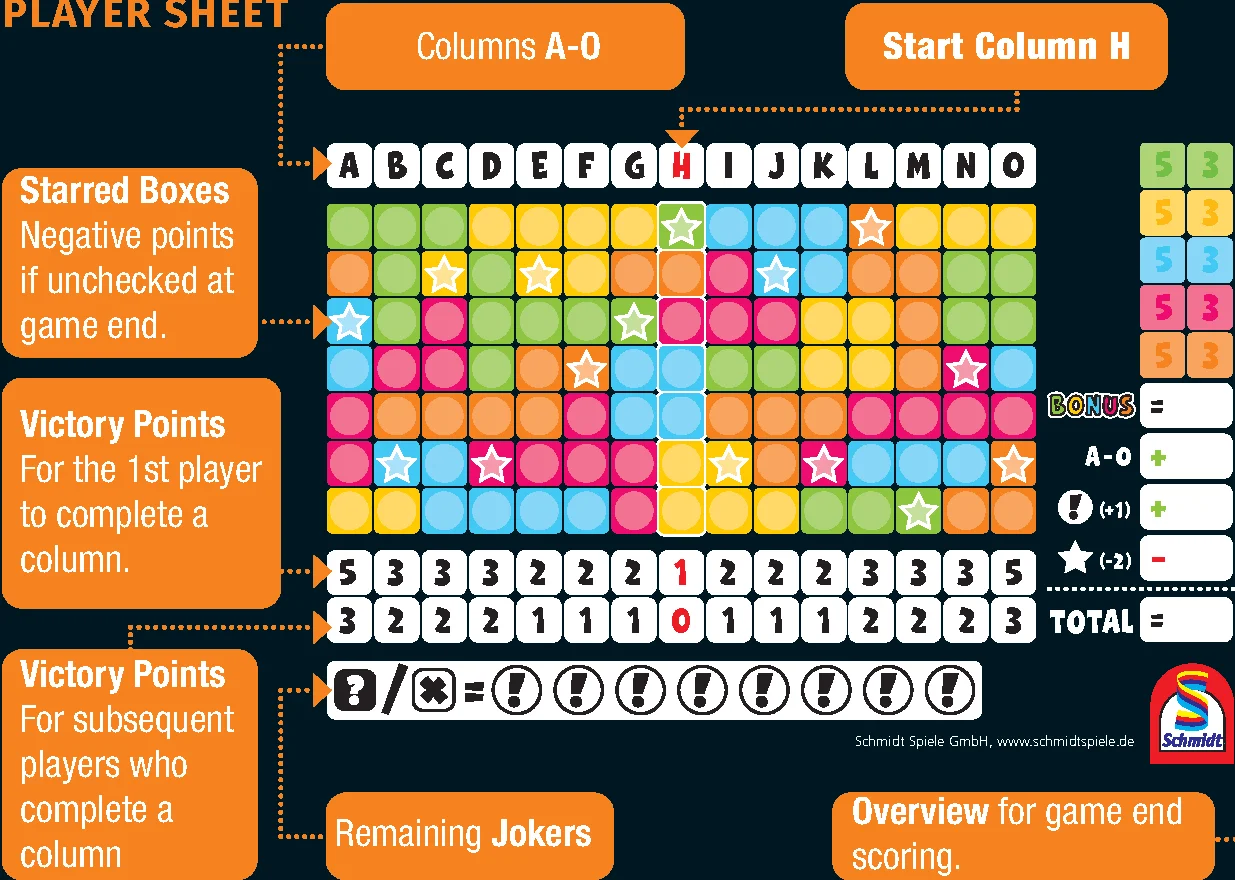
Give each player one Player Sheet from the Scoring Pad and Pen.
PLAYER SHEET
TURN SEQUENCE
Determine a starting player. This is the first active player, who will throw all six dice once.
The active player then chooses one Color die and one Number die, which they place in front of them. They check off the relevant boxes on their Player Sheet (see below). All other players may now choose any combination (one Color die and one Number die) from the remaining four dice and check off the appropriate boxes on their Player Sheet. The only dice “removed” are those selected by the active player.
After all players have had an opportunity to choose a pair of dice, and check off the respective boxes, the dice are passed to the next player clockwise, and play progresses.
EXCEPTIONS & SPECIAL RULES
EXCEPTION: For the first three turns (the first three active players), all players may choose a combination of one Number die and one Color die from all six of the thrown dice. The active player does NOT remove any dice to be placed in front of them. Players may choose the same combinations.
PASSING: A player may always choose not to use any combination, and therefore check off nothing. This also applies to the active player. If the active player chooses to take no dice, the other players may choose a combination from all of the six dice.
SELECT A COMBINATION AND CHECK A BOX
To check off boxes, a player must select a combination of dice, one Number die and one Color die, then check off the appropriate number of adjacent colored boxes. For instance, if a player selected a Number die with a four, and a yellow Color die, they must check off four adjacent yellow boxes.
THE FOLLOWING RULES APPLY:
- At the beginning of the game, the first checked box must be in Column H. However, checks made during that turn can spread into other columns.
- All checked boxes must connect, and all must be of the same chosen color.
- Checks must be horizontally or vertically adjacent to at least one already checked box, or start in the Column H. Boxes that touch only diagonally do not count as adjacent.
- You must check the exact number of boxes indicated by the die.
- All checks made in a turn must connect to each other, in one “clump”.
- A color block of several boxes need not be filled completely in a turn.
- You can never check more than five boxes in one turn. A Joker cannot be a “6”.
- On a turn, the value of a die may not be split up in order to tick boxes in two separate color blocks of the same color.
- The number
 on the Number dice and the black
  on the Color dice are Jokers (see JOKER).
JOKER
The Number and the Color dice are Jokers.
- If a player chooses the symbol, they can choose any color.
- If they choose the symbol, they can specify a number between one and five.
ATTENTION: You may not choose six even if you wish to fill in a block of 6 boxes as five is the maximum Number die. 6 block boxes always require two turns at least.
IMPORTANT: For each Joker which a player uses, they must check off an exclamation mark on their Player Sheet. If they no longer have any exclamation points, they can no longer use Jokers. A player can use two Joker dice if they wish. If they do, however, they must check off two exclamation points. Note that leftover  at the end of the game are worth points!
EXAMPLE: FIRST TURN OPTIONS
For the first turn of the game, David rolls .
- One choice (A) is to choose
 and check off five yellow boxes, which he can do because at least one of the checked boxes is in Column H. He could have also chosen
  , but that would be an odd choice.
 - Another choice (B) could have been
 . He would have checked off the entire 2-orange color block, which he can do because it is at least partially in Column H.
  could not be chosen, for there is no space along Column H to check off 5 orange boxes.
 - Yet another option (C) would be to choose
 and check off two of the blue boxes in the 4-blue color block. He can do this because one of the boxes was in Column H, and both checks made were connected. Checking off all 4 blue boxes would not have been possible if the
  was chosen, because the entire value must be used.
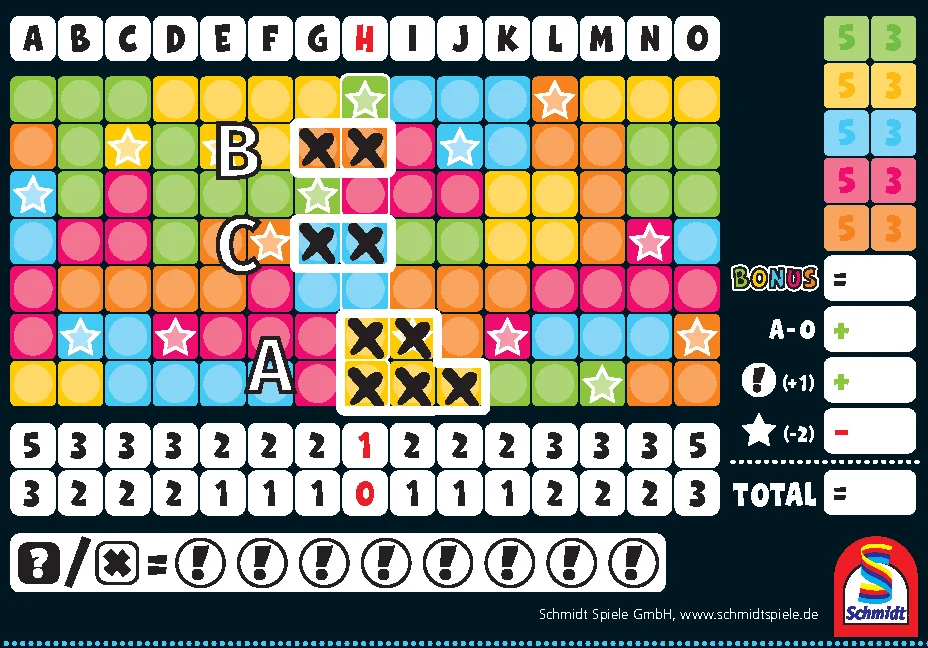
NOTE: If David chose Option C, in order to complete the 4-blue color block, he would later need to choose again, or  in two separate turns.
EXAMPLES OF CORRECT AND INCORRECT MOVES
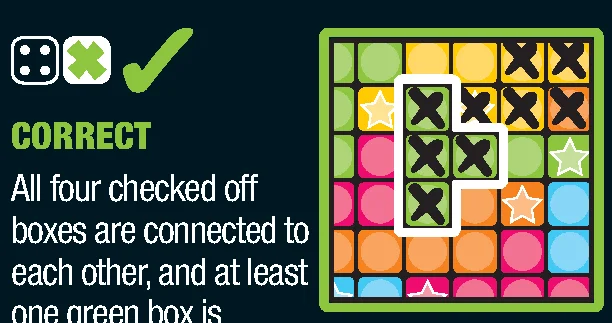
CORRECT: All four checked off boxes are connected to each other, and at least one green box is adjacent to the already checked yellow box.
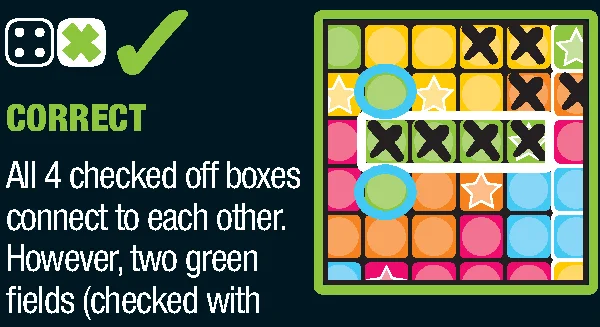
CORRECT: All 4 checked off boxes connect to each other. However, two green fields (checked with blue) have now emerged, each of which can only be ticked with a “1”. A green “2” cannot be used for this.
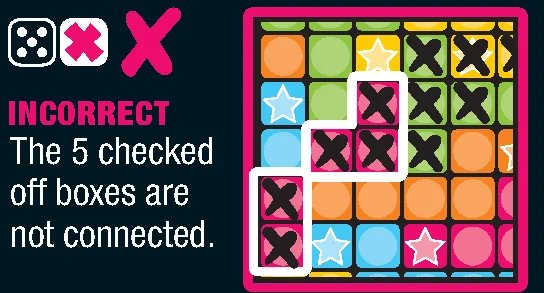
INCORRECT: The 5 checked off boxes are not connected.
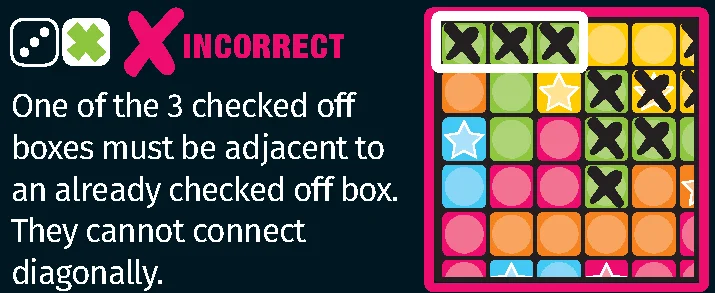
INCORRECT: One of the 3 checked off boxes must be adjacent to an already checked off box. They cannot connect diagonally.
CLAIMING COLUMNS
Whenever a player succeeds in filling a column with checks, they earn the specified points below that column.
- If they are the first to do so, they circle the top (higher value) number beneath that column. That player lets the rest of the players know they should cross out that value.
- Other players may still earn points for filling that column, but they will circle the bottom (lower value) number. The bottom (lower value) number is available to all subsequent players; it is never “claimed” as the first player to complete that column did the higher value.
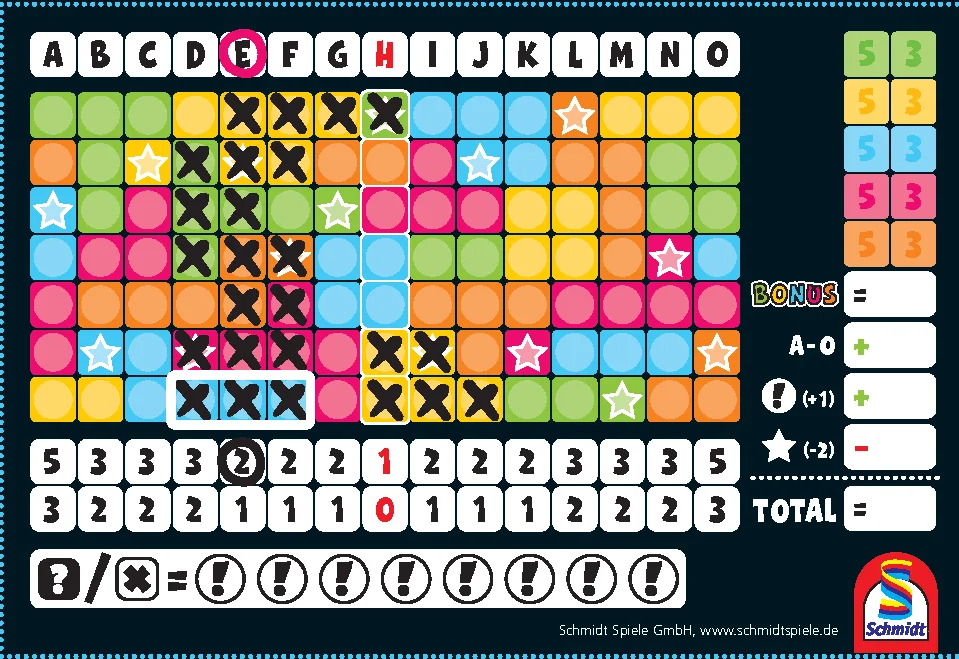
EXAMPLE: After a few throws Inka has just the 3 blue boxes and fills a column. She says aloud to her teammates: “Column E is full.” And circles the 2 points. The other players cross out the 2, they can in Column E only earn 1 point.
IMPORTANT:
- Only the upper value of a column is crossed out. All other players still have the possibility to earn the lower value.
- In one turn, a player may complete multiple columns, and claim multiple points.
- If multiple players complete a column on the same turn, all receive the higher points.
COLOR BONUS POINTS
Whenever a player succeeds in checking off all of the areas for one color, they earn the specified points for that color.
- If they are the first to do so, they circle the left (higher value) number for that color. That player lets the rest of the players know they should cross out that value.
- Other players may still earn points for checking off all of the areas for that color, but they will circle the right (lower value) number. The right (lower value) number is available to all subsequent players; it is never “claimed” as the first player to complete that color.
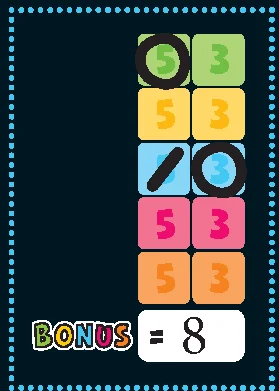
STARS
Each star on a player’s sheet which has not been checked off by the end of the game is negative 2 points each, for a maximum of 30 points lost.
GAME END
The game ends immediately after the turn in which (at least) one player succeeds in circling their second Color Bonus (the value does not matter, either high or low). If the active player is the one to end the game, all other players still get to end their turn with the remaining four dice, as usual. Then the points of the individual players are determined. (A player could never have more than 2 Color Bonuses, but, of course, they may not have any.)
SCORING
- BONUS = : Enter the bonus points of the color fields here.
- A-O + : Enter the bonus points below the columns here.
- ! (+1) + : Each remaining exclamation mark on the Player Sheet earns the player 1 point each.
- ★ (-2) – : Each star not checked off on a Player Sheet results in -2 points!
- TOTAL = : Sum of all points.
Whoever has the most points wins! In a tie, the player who has more exclamation points remaining is the winner. Otherwise, if there are several winners, you can break the tie by playing another game of Encore!
SOLO RULES
If there are no players at hand, you can play ENCORE! on your own. The solo game is about collecting as many points as possible. The rules of the game remain largely unchanged. However, the player may play only with 2 Color and 2 Number dice.
After every roll, they have to make a slash in one of the upper letter boxes. In each of these letter fields will be a total of 2 slashes made: one diagonally to the right and one diagonally to the left.

Letter fields after 11 turns.
After 30 turns, the solo game ends. Add together your points and check the table below to see how well you did!
SOLO RATING TABLE
- > 40 Points: ★★★★ So there are super heroes!
- 37–40 Points: ★★★★ Do your friends call you The Brain?
- 33–36 Points: ★★★★ You could be a professional ENCORE! player!
- 29–32 Points: ★★★☆ Excellent! A great result!
- 25–28 Points: ★★★☆ Hopefully done without cheating.
- 21–24 Points: ★★☆☆ That went well.
- 17–20 Points: ★★☆☆ That was probably not your first time.
- 13–16 Points: ★☆☆☆ Ok, but I bet you do better on your next try.
- 9–12 Points: ★☆☆☆ Was that your first try?
- 5–8 Points: ★☆☆☆ Not very good at all.
- 1–4 Points: ☆☆☆☆ Maybe there’s something else you could practice?
- 0 Points: ☆☆☆☆ Checkers. Do you like checkers?
- < 0 Points: You should be shamed. We will be alerting your friends.
Schmidt Spiele GmbH
Lahnstraße 21, 12055 Berlin
www.schmidtspiele.de
www.schmidtspiele-shop.de
Stronghold Games
7964 Emerald Winds Circle, Boynton Beach, FL 33473 USA
Email: [email protected]
Visit our website at: StrongholdGames.com
© 2019 Stronghold Games All Rights Reserved. Under license from Schmidt Spiele GmbH.
Author: Inka & Markus Brand
Layout: Leon Schiffer
Editor: Thorsten Gimmler
Localization: T.R. Knight
Overview & Setup
ENCORE!
The ingenious dice game by Inka & Markus Brand for 1–6 players, ages 8+.
- Age: 8+
- Players: 1–6
- Time: 20 min
CONTENTS
- 3 Color dice
- 3 Number dice
- 1 Scoring Pad
- 6 Pens
GAME OVERVIEW
Players earn points by being the first to check off all boxes in a column, and all boxes of the same color. Players pick a combination of a Color die and a Number die, and check the respective boxes. Only boxes connected to other boxes can be checked.
Make sure to complete columns before other players do! The first to complete a column earns more points than those who complete them later. In addition to points for completed columns, a player can receive a bonus if they checked all the boxes of the same color. The game is over when one player has checked off all boxes of two colors, but you could have an Encore! by playing once more!
PREPARATION
Give each player one Player Sheet from the Scoring Pad and Pen.
PLAYER SHEET
How to Play
TURN SEQUENCE
Determine a starting player. This is the first active player, who will throw all six dice once.
The active player then chooses one Color die and one Number die, which they place in front of them. They check off the relevant boxes on their Player Sheet (see below). All other players may now choose any combination (one Color die and one Number die) from the remaining four dice and check off the appropriate boxes on their Player Sheet. The only dice “removed” are those selected by the active player.
After all players have had an opportunity to choose a pair of dice, and check off the respective boxes, the dice are passed to the next player clockwise, and play progresses.
EXCEPTIONS & SPECIAL RULES
EXCEPTION: For the first three turns (the first three active players), all players may choose a combination of one Number die and one Color die from all six of the thrown dice. The active player does NOT remove any dice to be placed in front of them. Players may choose the same combinations.
PASSING: A player may always choose not to use any combination, and therefore check off nothing. This also applies to the active player. If the active player chooses to take no dice, the other players may choose a combination from all of the six dice.
Checking Boxes & Jokers
SELECT A COMBINATION AND CHECK A BOX
To check off boxes, a player must select a combination of dice, one Number die and one Color die, then check off the appropriate number of adjacent colored boxes. For instance, if a player selected a Number die with a four, and a yellow Color die, they must check off four adjacent yellow boxes.
THE FOLLOWING RULES APPLY:
- At the beginning of the game, the first checked box must be in Column H. However, checks made during that turn can spread into other columns.
- All checked boxes must connect, and all must be of the same chosen color.
- Checks must be horizontally or vertically adjacent to at least one already checked box, or start in the Column H. Boxes that touch only diagonally do not count as adjacent.
- You must check the exact number of boxes indicated by the die.
- All checks made in a turn must connect to each other, in one “clump”.
- A color block of several boxes need not be filled completely in a turn.
- You can never check more than five boxes in one turn. A Joker cannot be a “6”.
- On a turn, the value of a die may not be split up in order to tick boxes in two separate color blocks of the same color.
- The number on the Number dice and the black on the Color dice are Jokers (see JOKER).
JOKER
The Number and the Color dice are Jokers.
- If a player chooses the symbol, they can choose any color.
- If they choose the symbol, they can specify a number between one and five.
ATTENTION: You may not choose six even if you wish to fill in a block of 6 boxes as five is the maximum Number die. 6 block boxes always require two turns at least.
IMPORTANT: For each Joker which a player uses, they must check off an exclamation mark on their Player Sheet. If they no longer have any exclamation points, they can no longer use Jokers. A player can use two Joker dice if they wish. If they do, however, they must check off two exclamation points. Note that leftover at the end of the game are worth points!
EXAMPLE: FIRST TURN OPTIONS
For the first turn of the game, David rolls .
- One choice (A) is to choose and check off five yellow boxes, which he can do because at least one of the checked boxes is in Column H. He could have also chosen , but that would be an odd choice.
- Another choice (B) could have been . He would have checked off the entire 2-orange color block, which he can do because it is at least partially in Column H. could not be chosen, for there is no space along Column H to check off 5 orange boxes.
- Yet another option (C) would be to choose and check off two of the blue boxes in the 4-blue color block. He can do this because one of the boxes was in Column H, and both checks made were connected. Checking off all 4 blue boxes would not have been possible if the was chosen, because the entire value must be used.
NOTE: If David chose Option C, in order to complete the 4-blue color block, he would later need to choose again, or in two separate turns.
EXAMPLES OF CORRECT AND INCORRECT MOVES
CORRECT: All four checked off boxes are connected to each other, and at least one green box is adjacent to the already checked yellow box.
CORRECT: All 4 checked off boxes connect to each other. However, two green fields (checked with blue) have now emerged, each of which can only be ticked with a “1”. A green “2” cannot be used for this.
INCORRECT: The 5 checked off boxes are not connected.
INCORRECT: One of the 3 checked off boxes must be adjacent to an already checked off box. They cannot connect diagonally.
Bonuses & Negative Points
CLAIMING COLUMNS
Whenever a player succeeds in filling a column with checks, they earn the specified points below that column.
- If they are the first to do so, they circle the top (higher value) number beneath that column. That player lets the rest of the players know they should cross out that value.
- Other players may still earn points for filling that column, but they will circle the bottom (lower value) number. The bottom (lower value) number is available to all subsequent players; it is never “claimed” as the first player to complete that column did the higher value.
EXAMPLE: After a few throws Inka has just the 3 blue boxes and fills a column. She says aloud to her teammates: “Column E is full.” And circles the 2 points. The other players cross out the 2, they can in Column E only earn 1 point.
IMPORTANT:
- Only the upper value of a column is crossed out. All other players still have the possibility to earn the lower value.
- In one turn, a player may complete multiple columns, and claim multiple points.
- If multiple players complete a column on the same turn, all receive the higher points.
COLOR BONUS POINTS
Whenever a player succeeds in checking off all of the areas for one color, they earn the specified points for that color.
- If they are the first to do so, they circle the left (higher value) number for that color. That player lets the rest of the players know they should cross out that value.
- Other players may still earn points for checking off all of the areas for that color, but they will circle the right (lower value) number. The right (lower value) number is available to all subsequent players; it is never “claimed” as the first player to complete that color.
STARS
Each star on a player’s sheet which has not been checked off by the end of the game is negative 2 points each, for a maximum of 30 points lost.
Game End & Final Scoring
GAME END
The game ends immediately after the turn in which (at least) one player succeeds in circling their second Color Bonus (the value does not matter, either high or low). If the active player is the one to end the game, all other players still get to end their turn with the remaining four dice, as usual. Then the points of the individual players are determined. (A player could never have more than 2 Color Bonuses, but, of course, they may not have any.)
SCORING
- BONUS = : Enter the bonus points of the color fields here.
- A-O + : Enter the bonus points below the columns here.
- ! (+1) + : Each remaining exclamation mark on the Player Sheet earns the player 1 point each.
- ★ (-2) – : Each star not checked off on a Player Sheet results in -2 points!
- TOTAL = : Sum of all points.
Whoever has the most points wins! In a tie, the player who has more exclamation points remaining is the winner. Otherwise, if there are several winners, you can break the tie by playing another game of Encore!
Solo Game
SOLO RULES
If there are no players at hand, you can play ENCORE! on your own. The solo game is about collecting as many points as possible. The rules of the game remain largely unchanged. However, the player may play only with 2 Color and 2 Number dice.
After every roll, they have to make a slash in one of the upper letter boxes. In each of these letter fields will be a total of 2 slashes made: one diagonally to the right and one diagonally to the left.
Letter fields after 11 turns.
After 30 turns, the solo game ends. Add together your points and check the table below to see how well you did!
SOLO RATING TABLE
- > 40 Points: ★★★★ So there are super heroes!
- 37–40 Points: ★★★★ Do your friends call you The Brain?
- 33–36 Points: ★★★★ You could be a professional ENCORE! player!
- 29–32 Points: ★★★☆ Excellent! A great result!
- 25–28 Points: ★★★☆ Hopefully done without cheating.
- 21–24 Points: ★★☆☆ That went well.
- 17–20 Points: ★★☆☆ That was probably not your first time.
- 13–16 Points: ★☆☆☆ Ok, but I bet you do better on your next try.
- 9–12 Points: ★☆☆☆ Was that your first try?
- 5–8 Points: ★☆☆☆ Not very good at all.
- 1–4 Points: ☆☆☆☆ Maybe there’s something else you could practice?
- 0 Points: ☆☆☆☆ Checkers. Do you like checkers?
- < 0 Points: You should be shamed. We will be alerting your friends.
Credits
Schmidt Spiele GmbH
Lahnstraße 21, 12055 Berlin
www.schmidtspiele.de
www.schmidtspiele-shop.de
Stronghold Games
7964 Emerald Winds Circle, Boynton Beach, FL 33473 USA
Email: [email protected]
Visit our website at: StrongholdGames.com
© 2019 Stronghold Games All Rights Reserved. Under license from Schmidt Spiele GmbH.
Author: Inka & Markus Brand
Layout: Leon Schiffer
Editor: Thorsten Gimmler
Localization: T.R. Knight
Expansions for
Encore!
Noch mal!: Zusatzblockset
2017
Three new sheet booklets bring fresh color arrangements to the dice game.
20
minutes
View expansion
Noch mal!: Zusatzblock II
2017
Fresh color arrangements for a new Noch mal! dice game experience
20
minutes
Light
View expansion
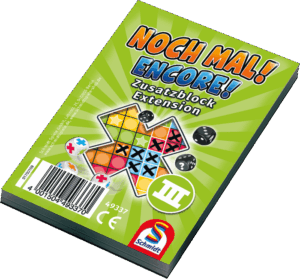
Noch mal!: Zusatzblock III
2017
Fresh sheets bring a new color arrangement to the dice game.
20
minutes
Light
View expansion
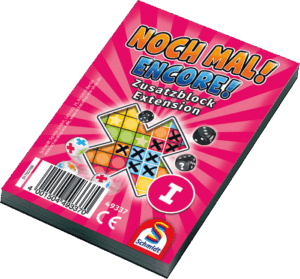
Noch mal!: Zusatzblock I
2017
Fresh color arrangements for a new Noch mal! dice game experience
20
minutes
Light
View expansion
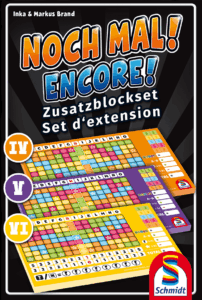
Noch mal!: Zusatzblockset
2018
Three new sheets bring fresh color arrangements to the dice game.
20
minutes
Light
View expansion