
Fugitive
2017
Race from town to a goal while an unstoppable agent works to uncover every face-down card.
20
minutes
2 - 2
player(s)
10+
Medium Light


About this board game
Fugitive is a two-player card game that takes about 20 minutes to play, set in the world of Burgle Bros.
One player takes the role of the fugitive, trying to make it out of town. The other plays an unstoppable agent in pursuit, creating a focused contest between hidden movement and deduction.
The fugitive plays cards face down to the table while working their way toward a goal. Because the cards remain hidden, the agent must use guesses to uncover them and narrow the fugitive’s path.
- Players: 2
- Play time: approximately 20 minutes
- Core tension: hidden cards versus the agent’s guesses
- Setting: the world of Burgle Bros.
Every face-down card represents another step in the fugitive’s attempt to reach safety, while every successful guess brings the agent closer to the truth. The game keeps both roles centered on the same question: can the fugitive reach the goal before the hidden route is fully revealed?
If all the cards are turned face up, the fugitive is caught. That simple outcome gives Fugitive a clear objective and a sharp finish, with one player trying to remain hidden and the other trying to expose the entire escape.
Released in 2017, Fugitive offers a compact two-player experience built around a direct pursuit, face-down card play, and deduction. Its short playing time makes the escalating chase easy to bring to the table when you want a concentrated card-game contest.
Mechanics
Designer
Illustrator
/pic7182955.jpg)

Board Game Rules for
Fugitive
Fugitive is a quick 2-player game where one player is the Fugitive moving from hideout to hideout on his escape route, and the other player is the Marshal trying to catch him before he escapes.
The main deck is composed of 43 Hideout cards, which represent places the Fugitive can hide. Optionally, you can add Event cards to introduce more uncertainty to the Fugitive and Marshal’s standoff.
Object of the Game
- The Fugitive wins by playing cards until he can eventually play the #42 Hideout card to escape the Marshal.
- The Marshal wins by identifying all the Fugitive’s hideouts to find and arrest the Fugitive.
Card Types
Hideout cards
Each card has 2 values: a Hideout number (#0–#42) and a Sprint number indicated by footprints (+1 or +2).
The Fugitive uses cards by placing them as Hideouts and by sacrificing them to Sprint. The Marshal uses cards to deduce where the Fugitive is hiding and, by holding them, to decrease the number of options available to the Fugitive.
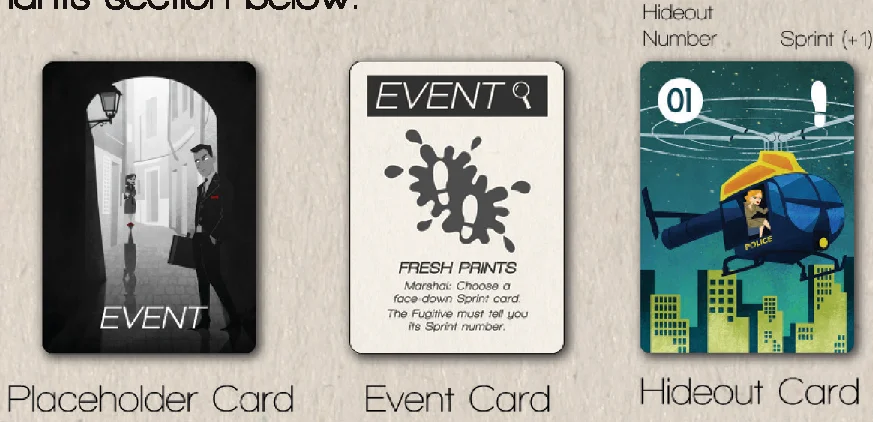
Event and Placeholder cards
Event cards and Placeholder cards are an optional variant. Each Event either helps the Fugitive, helps the Marshal, or helps whomever draws it. Placeholder cards are used in place of events for certain variants.
For your first game, set the Event cards aside. For information on playing with events, read the Game play variants section below.
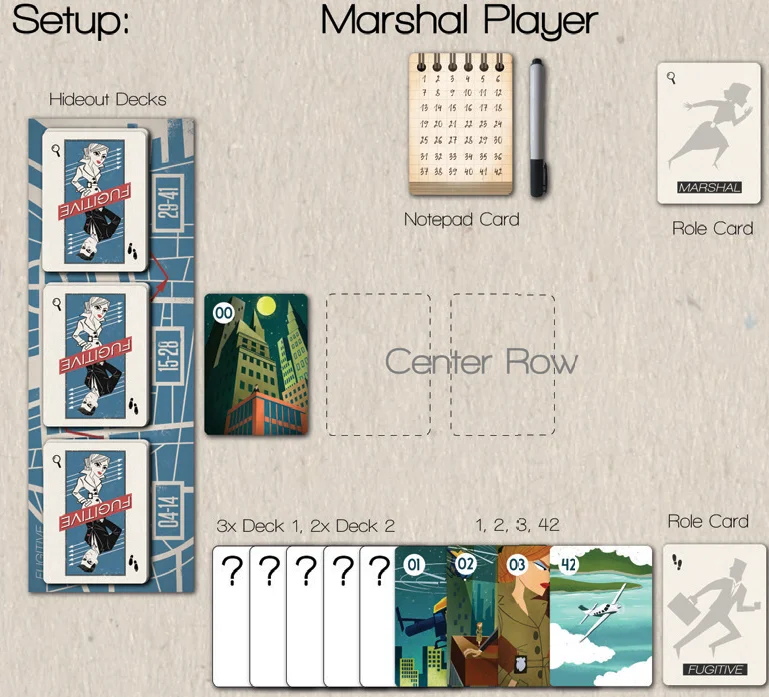
- Place the 0 card, the Fugitive’s first Hideout, in the center of the play area. This is the first card of the center row.
- Sort the Hideout cards into three decks: 4–14, 15–28, and 29–41. Shuffle each deck separately and place each deck face down near the center row.
- Give the Fugitive his starting hand. (The Marshal has no starting hand.) The Fugitive starts with the Hideout cards numbered 1, 2, 3, and 42.
- The Fugitive draws additional cards from the three sorted Hideout decks:
- Deck 1 (4–14): Draw 3 cards.
- Deck 2 (15–28): Draw 2 cards.
- Deck 3 (29–41): Draw 0 cards.
The Fugitive and Marshal alternate turns throughout the game. On the Fugitive’s turn, he may move to a new Hideout as part of his path to escape. On the Marshal’s turn, she attempts to catch the Fugitive by uncovering the Fugitive’s Hideouts.
The Fugitive always takes the first turn.
Turn Structure Overview
Fugitive’s first turn:
- The Fugitive places 1 or 2 new Hideouts.
Marshal’s first turn:
- The Marshal draws 2 cards total, either from the same deck or from different decks.
- The Marshal makes a guess to find one or more Hideouts.
Fugitive’s subsequent turns:
- The Fugitive draws 1 card from any deck.
- The Fugitive may place 1 new Hideout (or pass).
Marshal’s normal turn:
- The Marshal draws 1 card from any deck.
- The Marshal makes a guess to find one or more Hideouts.
The Fugitive’s Options
Place a new Hideout
The Fugitive places a card face-down to the right of the previous Hideout, establishing a new Hideout. Hideouts are any face-down or face-up cards in the center row. The Fugitive can look at any face-down cards at any time to help him remember what’s been played.
Placing a Hideout normally
Normally, the Fugitive can place a Hideout card if its Hideout number is up to 3 higher than the previous Hideout. The Fugitive cannot place a new Hideout with a lower number than his previous Hideout.
For example, if the previous Hideout was card 4, the Fugitive could choose to play a card with the Hideout numbers 5, 6, or 7 card, but not a card with the Hideout numbers 3 (because that’s lower than the previous Hideout number) or 15 (because that’s more than 3 higher than the previous Hideout number).
Using cards to Sprint
The Fugitive may extend the normal range of 3 by placing the new Hideout with one or more extra cards underneath it, face-down. These extra cards are used as Sprint cards, and they extend the Fugitive’s range by the sum of their Sprint numbers.
When using cards as Sprint cards, the Fugitive must place them so that the Marshal can see how many Sprint cards have been played (but not their Sprint numbers). The Fugitive may always choose to place more Sprint cards than necessary, even if no sprinting is required.
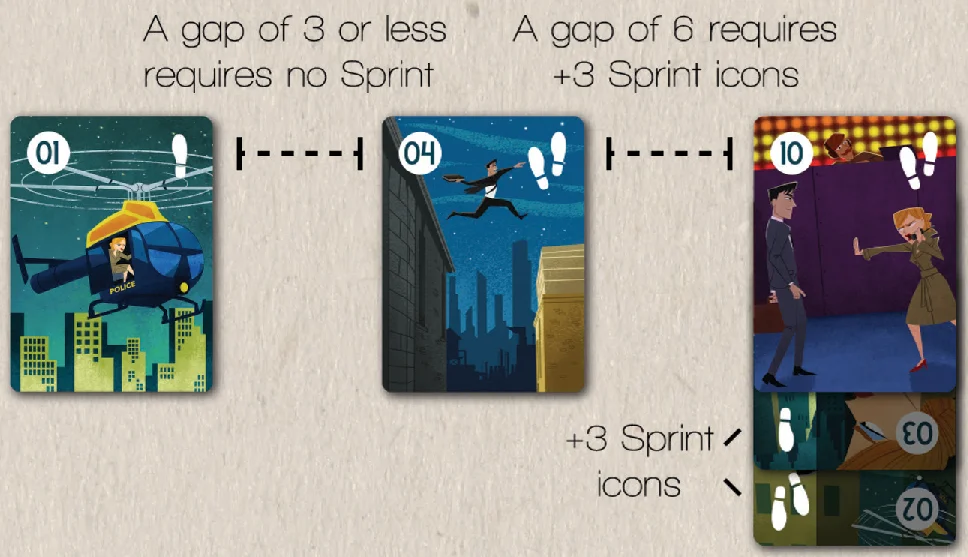
For example, if the previous Hideout had the Hideout number 4, the Fugitive could normally play only the 5, 6, or 7. If the Fugitive wants to play the 10 as the next Hideout, he must add cards with a total Sprint value of at least +3 (because 10 is 3 higher than the Fugitive’s normal range).
Pass
The Fugitive can choose to pass his turn and play no cards. This lets him build up cards in his hand for later turns, but it gives the Marshal a chance to catch up.
The Marshal’s Options
Guess a single Hideout
The Marshal guesses a number between 1 and 41. If that number matches any of the face-down Hideouts in the center row, the Fugitive reveals the Hideout card and any Sprint cards under it.
The Marshal doesn’t need to select a specific face-down card when guessing, and the Marshal never needs to guess Sprint cards.
Guess a series of Hideouts
The Marshal guesses multiple numbers.
- If all of her guessed numbers match face-down Hideouts in the center row, the Fugitive reveals all the guessed Hideout cards and any Sprint cards under them.
- If any of her guessed numbers are wrong, the Fugitive does not reveal any cards—even if one or more guessed numbers are correct.
The Marshal doesn’t have to select specific face-down cards when guessing, and she never has to guess Sprint cards.
Continue taking turns until one player wins:
- The Fugitive wins by playing card #42 (and escaping the manhunt, if necessary!).
- The Marshal wins by guessing all the Fugitive’s Hideouts, either during her normal turn or by starting a manhunt.
Start a manhunt
As a last effort to catch the Fugitive, the Marshal can start a manhunt, which happens separately from the normal sequence of turns. The Marshal can start a manhunt only when the Fugitive plays the Hideout card numbered #42 while the highest revealed Hideout number is #29 or lower.
In a manhunt, the Marshal guesses a single Hideout (as above):
- If she guesses correctly, she continues to guess another single Hideout. If the Marshal guesses all Hideouts, the manhunt was successful. She catches the Fugitive at the last second, and the Marshal wins!
- If she guesses incorrectly at any point, the manhunt failed. The Fugitive escapes, and the Marshal loses!
Random events
This variant adds more randomness and uncertainty to the game.
After setup:
- Shuffle all the Event cards (not the Placeholder cards) together.
- Shuffle 2 random Event cards into each of the three draw piles.
- Set aside the other Event cards and the Placeholder cards; they are not used.
During play: when either player draws an Event, resolve it immediately. Then they draw another card.
Discovery events
This variant introduces a twist to the game whenever the Marshal discovers a Hideout.
- During setup: shuffle all the Event cards together and place them near the play area. Set aside the Placeholder cards; they are not used.
- During play: when the Marshal successfully guesses one or more Hideouts, the Fugitive immediately draws and resolves an event from the Event pile.
Helpful events
This variant gives some help to one of the players.
During setup:
- Sort out all the Events that have the icon for the player who receives help from the Events (Fugitive or Marshal).
- Shuffle those Events evenly into each of the three draw piles.
- Set aside the other Event cards and the Placeholder cards; they are not used.
During play: when either player draws an Event, resolve it immediately. Then draw another card.
Catchup events
This variant helps the player who’s currently behind.
During setup:
- Sort the Event cards into 3 Event piles based on their icons (Fugitive, Marshal, or no icon).
- Shuffle each Event pile.
- Place the Event piles near the play area, keeping track of each Event pile.
- Shuffle 2 Placeholder cards into each of the 3 draw piles of Hideout cards.
During play:
When either player draws a Placeholder card, draw and resolve an Event card from one of the Event piles, depending on how many Hideouts are currently face-down in the center row:
- 1 Hideout is face-down: draw and resolve an Event from the Fugitive’s Event pile.
- 2 Hideouts are face-down: draw and resolve an Event from the neutral Event pile.
- 3 Hideouts or more are face-down: draw and resolve an Event from the Marshal’s Event pile.
After each event, that player draws another card.
Being a good Fugitive requires taking risks. The Marshal must methodically search and deduce where the Fugitive might be. Here are a few strategies and tips for each side.
Fugitive strategies
- You don’t always have to play a Hideout. Sometimes it’s best to wait for better cards.
- You may sprint to your first hideouts.
- Sprinting too often as the Fugitive can use up too many cards, often making you wait for a good draw.
- You can bluff by playing unnecessary Sprint cards, but don’t bluff too often. It may keep the Marshal guessing, but it can also make you run out of cards quickly.
- Drawing from a higher pile than you need can throw off the Marshal and help you later in the game.
- Playing a Hideout number that the Marshal just guessed can be smart: she’s unlikely to guess it again.
Marshal strategies
- Take notes with the marker on the notepad to remember what you’ve guessed.
- When guessing a hideout with two Sprint cards, there is a 50% chance the total Sprint value is +3.
- Don’t guess more than one Hideout very often. It can leave you further behind instead of catching up. However, if you are certain about one Hideout, it can be useful to guess it along with another number.
- Sometimes drawing exclusively from a higher pile can create a “roadblock” that is harder for the Fugitive to get around.
- Jumping ahead and guessing a higher Hideout can reveal Sprint cards that help guess the hideouts before it. Sometimes you can “count” backwards with the revealed Sprint cards to determine the Hideout immediately before it.
- Pay attention to the cards the Fugitive looks at when checking a guess. Watch which pile he draws from. Information is everywhere.
- Design: Tim Fowers
- Art: Ryan Goldsberry
- Rules: Scott Post
- Layout: Charles Polenzani
Special Thanks
- All the Kickstarter Backers
- Sam Aho for being unbeatable
- Utah State University Dept of Theatre Arts
- My wife Nikki
Overview & Components
Fugitive is a quick 2-player game where one player is the Fugitive moving from hideout to hideout on his escape route, and the other player is the Marshal trying to catch him before he escapes.
The main deck is composed of 43 Hideout cards, which represent places the Fugitive can hide. Optionally, you can add Event cards to introduce more uncertainty to the Fugitive and Marshal’s standoff.
Object of the Game
- The Fugitive wins by playing cards until he can eventually play the #42 Hideout card to escape the Marshal.
- The Marshal wins by identifying all the Fugitive’s hideouts to find and arrest the Fugitive.
Card Types
Hideout cards
Each card has 2 values: a Hideout number (#0–#42) and a Sprint number indicated by footprints (+1 or +2).
The Fugitive uses cards by placing them as Hideouts and by sacrificing them to Sprint. The Marshal uses cards to deduce where the Fugitive is hiding and, by holding them, to decrease the number of options available to the Fugitive.
Event and Placeholder cards
Event cards and Placeholder cards are an optional variant. Each Event either helps the Fugitive, helps the Marshal, or helps whomever draws it. Placeholder cards are used in place of events for certain variants.
For your first game, set the Event cards aside. For information on playing with events, read the Game play variants section below.
Setup
- Place the 0 card, the Fugitive’s first Hideout, in the center of the play area. This is the first card of the center row.
- Sort the Hideout cards into three decks: 4–14, 15–28, and 29–41. Shuffle each deck separately and place each deck face down near the center row.
- Give the Fugitive his starting hand. (The Marshal has no starting hand.) The Fugitive starts with the Hideout cards numbered 1, 2, 3, and 42.
- The Fugitive draws additional cards from the three sorted Hideout decks:
- Deck 1 (4–14): Draw 3 cards.
- Deck 2 (15–28): Draw 2 cards.
- Deck 3 (29–41): Draw 0 cards.
How to Play
The Fugitive and Marshal alternate turns throughout the game. On the Fugitive’s turn, he may move to a new Hideout as part of his path to escape. On the Marshal’s turn, she attempts to catch the Fugitive by uncovering the Fugitive’s Hideouts.
The Fugitive always takes the first turn.
Turn Structure Overview
Fugitive’s first turn:
- The Fugitive places 1 or 2 new Hideouts.
Marshal’s first turn:
- The Marshal draws 2 cards total, either from the same deck or from different decks.
- The Marshal makes a guess to find one or more Hideouts.
Fugitive’s subsequent turns:
- The Fugitive draws 1 card from any deck.
- The Fugitive may place 1 new Hideout (or pass).
Marshal’s normal turn:
- The Marshal draws 1 card from any deck.
- The Marshal makes a guess to find one or more Hideouts.
The Fugitive’s Options
Place a new Hideout
The Fugitive places a card face-down to the right of the previous Hideout, establishing a new Hideout. Hideouts are any face-down or face-up cards in the center row. The Fugitive can look at any face-down cards at any time to help him remember what’s been played.
Placing a Hideout normally
Normally, the Fugitive can place a Hideout card if its Hideout number is up to 3 higher than the previous Hideout. The Fugitive cannot place a new Hideout with a lower number than his previous Hideout.
For example, if the previous Hideout was card 4, the Fugitive could choose to play a card with the Hideout numbers 5, 6, or 7 card, but not a card with the Hideout numbers 3 (because that’s lower than the previous Hideout number) or 15 (because that’s more than 3 higher than the previous Hideout number).
Using cards to Sprint
The Fugitive may extend the normal range of 3 by placing the new Hideout with one or more extra cards underneath it, face-down. These extra cards are used as Sprint cards, and they extend the Fugitive’s range by the sum of their Sprint numbers.
When using cards as Sprint cards, the Fugitive must place them so that the Marshal can see how many Sprint cards have been played (but not their Sprint numbers). The Fugitive may always choose to place more Sprint cards than necessary, even if no sprinting is required.
For example, if the previous Hideout had the Hideout number 4, the Fugitive could normally play only the 5, 6, or 7. If the Fugitive wants to play the 10 as the next Hideout, he must add cards with a total Sprint value of at least +3 (because 10 is 3 higher than the Fugitive’s normal range).
Pass
The Fugitive can choose to pass his turn and play no cards. This lets him build up cards in his hand for later turns, but it gives the Marshal a chance to catch up.
The Marshal’s Options
Guess a single Hideout
The Marshal guesses a number between 1 and 41. If that number matches any of the face-down Hideouts in the center row, the Fugitive reveals the Hideout card and any Sprint cards under it.
The Marshal doesn’t need to select a specific face-down card when guessing, and the Marshal never needs to guess Sprint cards.
Guess a series of Hideouts
The Marshal guesses multiple numbers.
- If all of her guessed numbers match face-down Hideouts in the center row, the Fugitive reveals all the guessed Hideout cards and any Sprint cards under them.
- If any of her guessed numbers are wrong, the Fugitive does not reveal any cards—even if one or more guessed numbers are correct.
The Marshal doesn’t have to select specific face-down cards when guessing, and she never has to guess Sprint cards.
Game End & Manhunt
Continue taking turns until one player wins:
- The Fugitive wins by playing card #42 (and escaping the manhunt, if necessary!).
- The Marshal wins by guessing all the Fugitive’s Hideouts, either during her normal turn or by starting a manhunt.
Start a manhunt
As a last effort to catch the Fugitive, the Marshal can start a manhunt, which happens separately from the normal sequence of turns. The Marshal can start a manhunt only when the Fugitive plays the Hideout card numbered #42 while the highest revealed Hideout number is #29 or lower.
In a manhunt, the Marshal guesses a single Hideout (as above):
- If she guesses correctly, she continues to guess another single Hideout. If the Marshal guesses all Hideouts, the manhunt was successful. She catches the Fugitive at the last second, and the Marshal wins!
- If she guesses incorrectly at any point, the manhunt failed. The Fugitive escapes, and the Marshal loses!
Variants
Random events
This variant adds more randomness and uncertainty to the game.
After setup:
- Shuffle all the Event cards (not the Placeholder cards) together.
- Shuffle 2 random Event cards into each of the three draw piles.
- Set aside the other Event cards and the Placeholder cards; they are not used.
During play: when either player draws an Event, resolve it immediately. Then they draw another card.
Discovery events
This variant introduces a twist to the game whenever the Marshal discovers a Hideout.
- During setup: shuffle all the Event cards together and place them near the play area. Set aside the Placeholder cards; they are not used.
- During play: when the Marshal successfully guesses one or more Hideouts, the Fugitive immediately draws and resolves an event from the Event pile.
Helpful events
This variant gives some help to one of the players.
During setup:
- Sort out all the Events that have the icon for the player who receives help from the Events (Fugitive or Marshal).
- Shuffle those Events evenly into each of the three draw piles.
- Set aside the other Event cards and the Placeholder cards; they are not used.
During play: when either player draws an Event, resolve it immediately. Then draw another card.
Catchup events
This variant helps the player who’s currently behind.
During setup:
- Sort the Event cards into 3 Event piles based on their icons (Fugitive, Marshal, or no icon).
- Shuffle each Event pile.
- Place the Event piles near the play area, keeping track of each Event pile.
- Shuffle 2 Placeholder cards into each of the 3 draw piles of Hideout cards.
During play:
When either player draws a Placeholder card, draw and resolve an Event card from one of the Event piles, depending on how many Hideouts are currently face-down in the center row:
- 1 Hideout is face-down: draw and resolve an Event from the Fugitive’s Event pile.
- 2 Hideouts are face-down: draw and resolve an Event from the neutral Event pile.
- 3 Hideouts or more are face-down: draw and resolve an Event from the Marshal’s Event pile.
After each event, that player draws another card.
Strategy & Tips
Being a good Fugitive requires taking risks. The Marshal must methodically search and deduce where the Fugitive might be. Here are a few strategies and tips for each side.
Fugitive strategies
- You don’t always have to play a Hideout. Sometimes it’s best to wait for better cards.
- You may sprint to your first hideouts.
- Sprinting too often as the Fugitive can use up too many cards, often making you wait for a good draw.
- You can bluff by playing unnecessary Sprint cards, but don’t bluff too often. It may keep the Marshal guessing, but it can also make you run out of cards quickly.
- Drawing from a higher pile than you need can throw off the Marshal and help you later in the game.
- Playing a Hideout number that the Marshal just guessed can be smart: she’s unlikely to guess it again.
Marshal strategies
- Take notes with the marker on the notepad to remember what you’ve guessed.
- When guessing a hideout with two Sprint cards, there is a 50% chance the total Sprint value is +3.
- Don’t guess more than one Hideout very often. It can leave you further behind instead of catching up. However, if you are certain about one Hideout, it can be useful to guess it along with another number.
- Sometimes drawing exclusively from a higher pile can create a “roadblock” that is harder for the Fugitive to get around.
- Jumping ahead and guessing a higher Hideout can reveal Sprint cards that help guess the hideouts before it. Sometimes you can “count” backwards with the revealed Sprint cards to determine the Hideout immediately before it.
- Pay attention to the cards the Fugitive looks at when checking a guess. Watch which pile he draws from. Information is everywhere.
Credits
- Design: Tim Fowers
- Art: Ryan Goldsberry
- Rules: Scott Post
- Layout: Charles Polenzani
Special Thanks
- All the Kickstarter Backers
- Sam Aho for being unbeatable
- Utah State University Dept of Theatre Arts
- My wife Nikki