Gutenberg
2021
Lead a 15th-century printing workshop, fulfill orders, bid for actions, and combine rotating-gear bonuses across six rounds.
120
minutes
1 - 4
player(s)
10+
Medium

About this board game
Gutenberg is a board game for 1–4 players, with an approximately 120-minute play time, in which you become a pioneer of printing in the 15th century.
Across six rounds, players carry out orders to build their wealth and fame. By improving their printing workshops and gaining the support of patrons, they develop their production capacity and work toward becoming the most recognized and prosperous printer.
Players begin shaping their progress by bidding for specific actions. These actions let them develop their workshops and acquire the tools and materials needed for their printing efforts, including new fonts, inks, and decorations.
- Fulfill orders to increase wealth and fame.
- Bid for actions that advance your printing workshop.
- Acquire fonts, inks, and decorations.
- Combine bonuses with the unique rotating-gear system.
The rotating gears are a distinctive feature of Gutenberg. By combining their bonuses, players can create powerful interactions and earn a large number of points as their workshops develop.
Every decision contributes to the final contest for recognition and wealth. The game ends after six rounds, and the winner is the printer with the most points.
With its focus on bidding, workshop development, order fulfillment, and bonus combinations, Gutenberg presents the rise of printing as a structured competition among ambitious 15th-century printers. It supports 1–4 players and offers a substantial tabletop experience built around planning and progression.
/pic7182955.jpg)
Board Game Rules for
Gutenberg
About the Game
Printing technology enabled the spread of knowledge, thoughts, and ideas. For this reason, the invention of printing is considered one of the pivotal global events ending the Middle Ages. At the local level, talented craftsmen and efficient entrepreneurs have a great opportunity to develop a profitable business. The demand for books is growing, the competition is still small, and the potential for development is unlimited…
Gutenberg is a board game for 1-4 players who take on the role of printing pioneers. During the game, they will acquire and fulfill orders for valuable volumes, develop their specialties, improve their printing houses, and obtain the support of a powerful patron. Through these actions, players will earn fame points, which will determine the winner.
Rulebook Conventions
Manicule
In medieval manuscripts, manicules (lat. manicula – “little hand”) were frequent. They found their way from manuscripts to the first printed texts. They indicate important places in a text. In this manual, manicule is used to indicate particularly important rules.
Advice from the Master
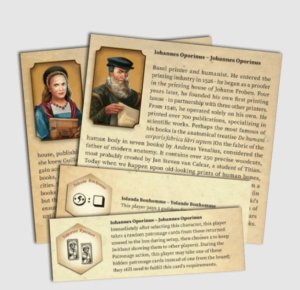
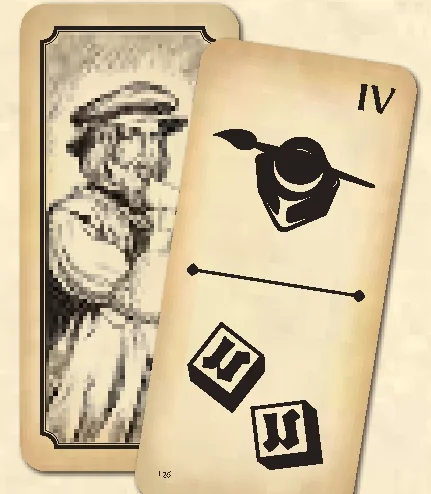
Johannes Gutenberg, as an inventor and pioneer of printing, was very knowledgeable. Practical tips for players appear in boxes marked with his image.
Component List
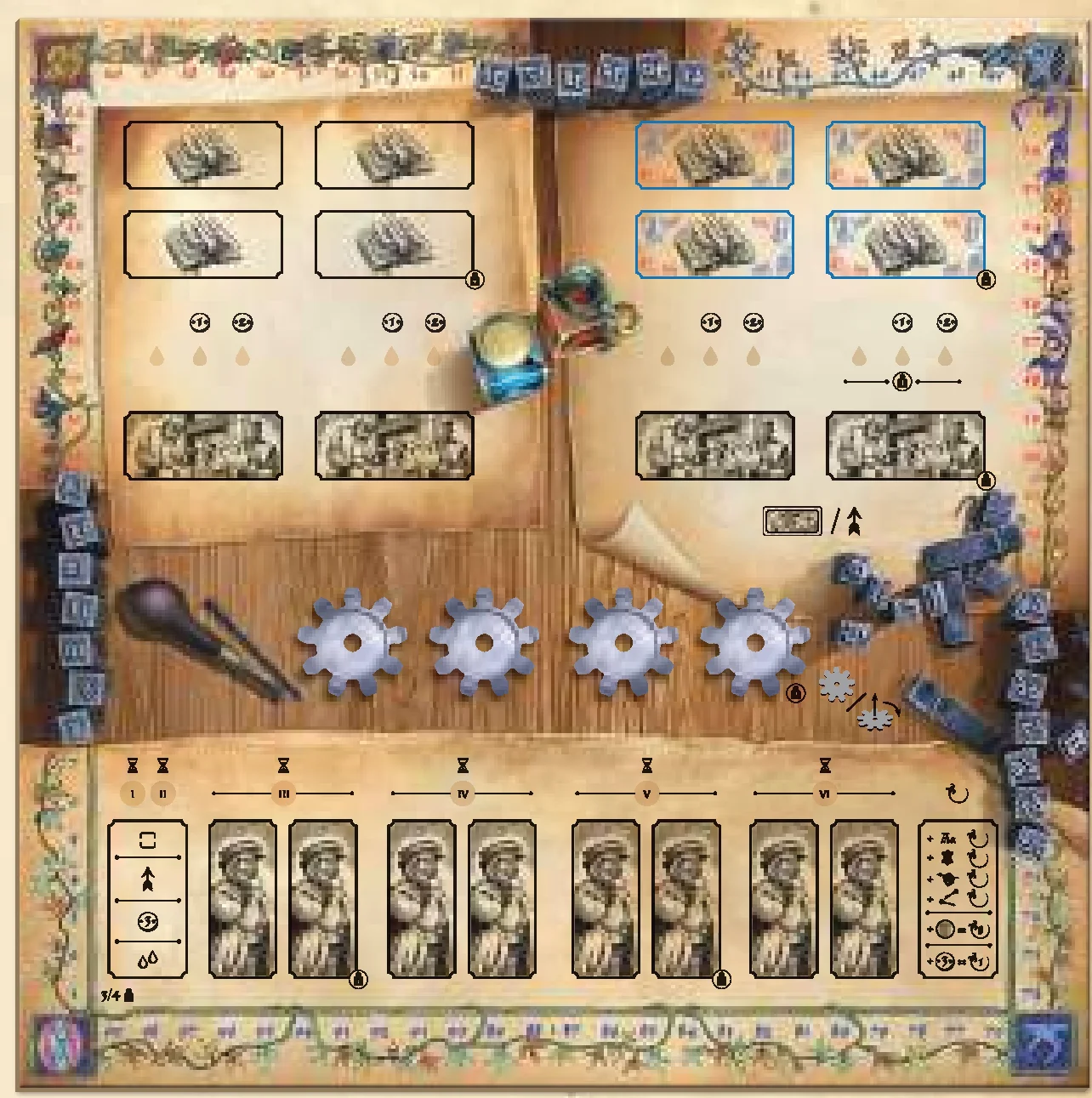
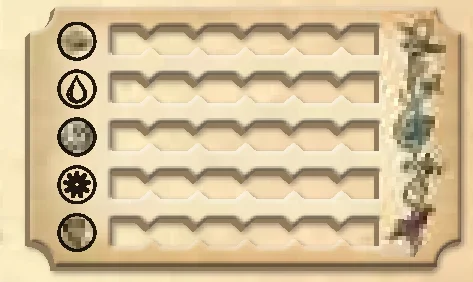
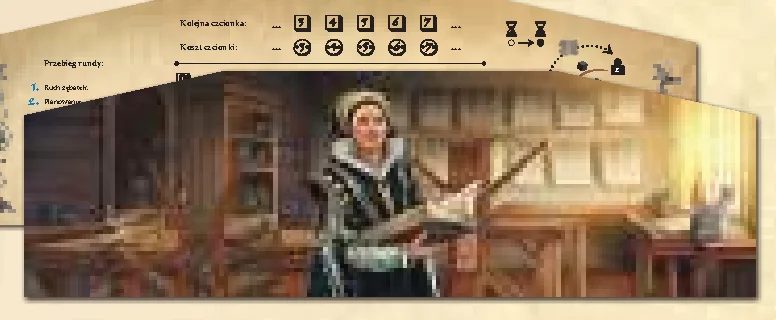
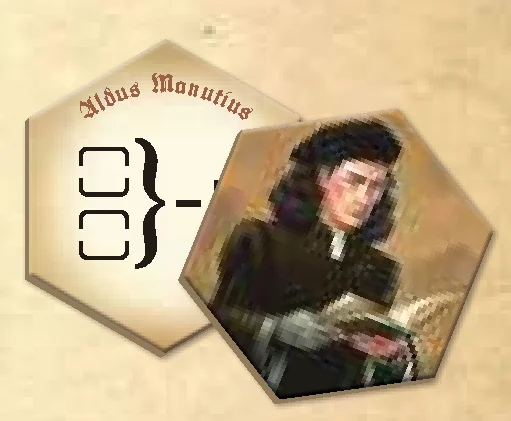
- Double-sided main board
- 4 printing house boards
- 4 initiative boards
- 4 screens
- 10 character tiles
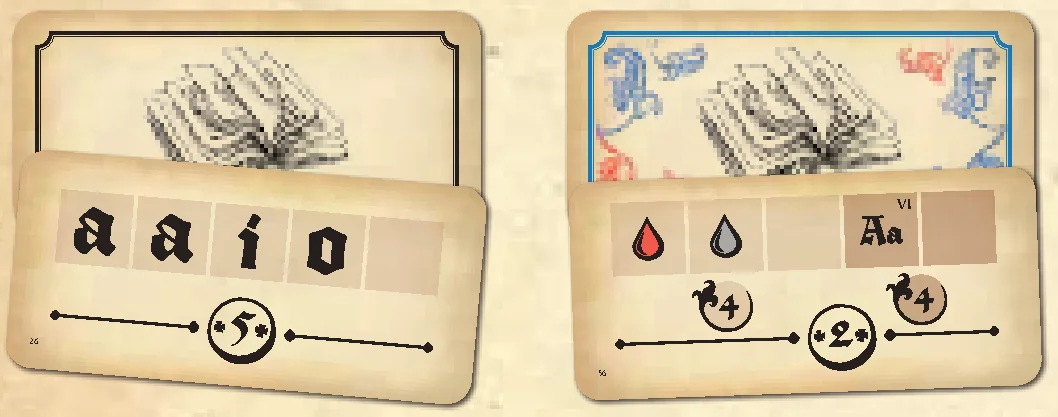




- 100 order cards:
- 50 printing cards (black and white backs)
- 50 refinement cards (colored backs)
- 10 specialty cards
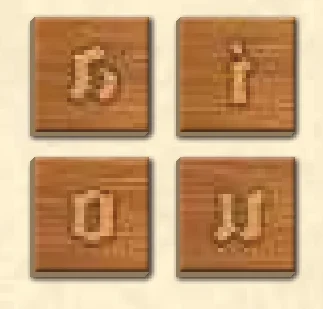
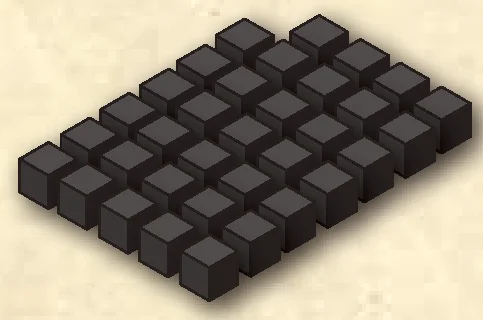
- 40 3D wooden letter block types
- first player token
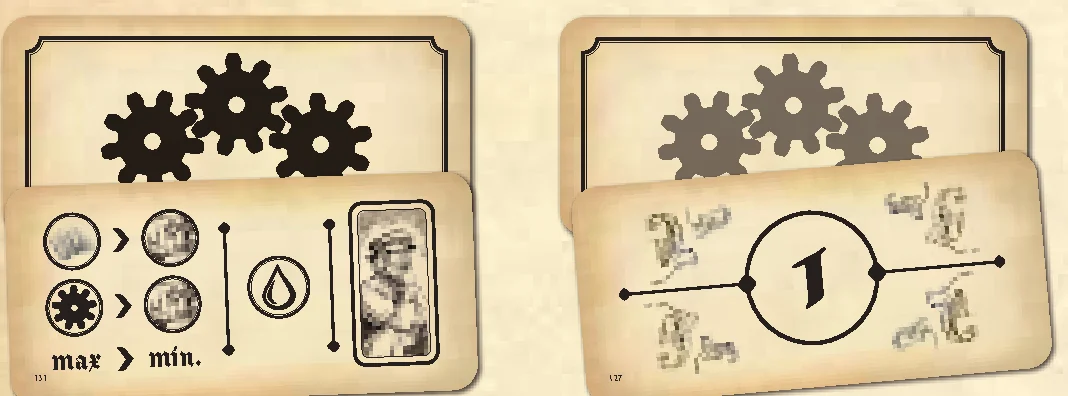
- 14 automa cards:
- 10 planning cards
- 4 execution cards
- 16 patronage cards
- 8 spare type tokens (2 of each type)
- 2 William Caxton’s tokens
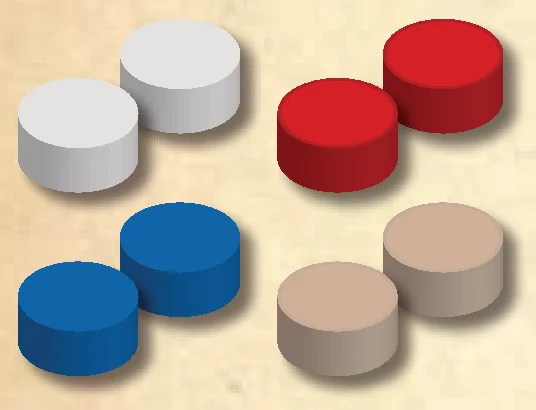
- 8 player disks (2 in each of 4 player colors)
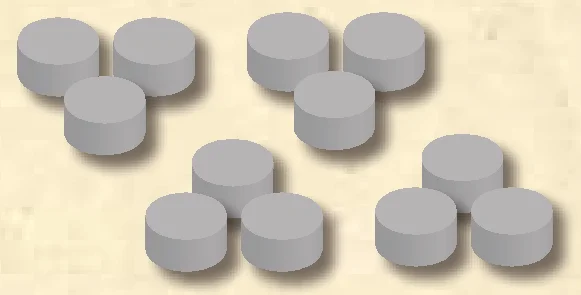
- 12 gray cylinders (used as gear axles)
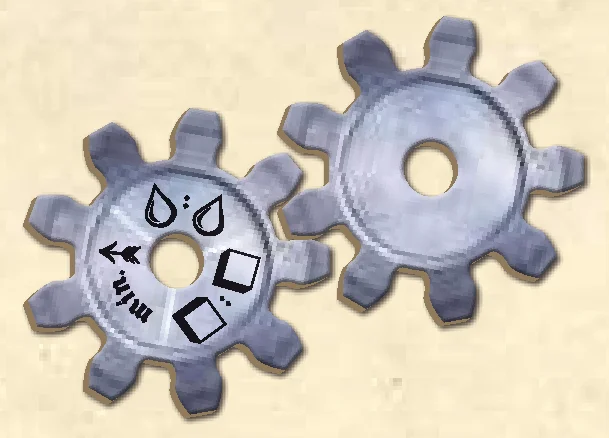
- 32 gears
- 12 used gear markers
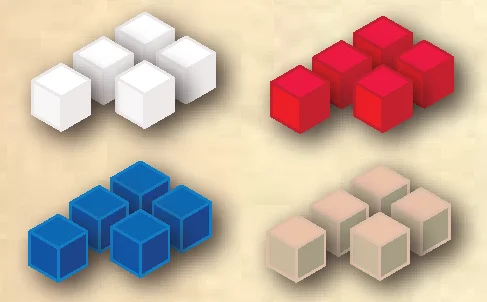
- 48 ink tokens:
- 12 blue
- 12 silver
- 12 gold
- 12 red
- 20 player markers (5 in each of 4 player colors)
- 34 initiative markers
- current round marker
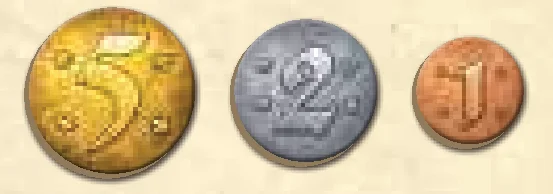
- 57 guilders:
- 15 worth 5
- 12 worth 2
- 30 worth 1
- bag
Items may differ from those shown.
Game Preparation
- Place the main board in the center of the table, with the correct side up for the number of players.
- Use the spaces with the symbol
 only when playing with 4 players.
 - When playing with 2 players, use the board side marked: 2
- Use the spaces with the symbol
- Shuffle both decks of order cards (printing cards and refinement cards) separately, then place each deck face down next to the board. Leave space by each deck for its own discard pile.
- With 2/3/4 players, draw 6/8/10 printing cards and 6/8/10 refinement cards and place them face up next to the main board. Players will select several from them later during setup (in step 16), so this table space will only be temporarily occupied during setup.
- For each printing and refinement space on the main board, draw and place a random card of that type face up on the space.
- Put all ink tokens into the bag. Going from left to right, place a randomly drawn ink token onto each ink space on the main board. Place the bag with remaining ink tokens next to the board.
- Ink tokens are limited; there are 12 of each color. A player cannot take a color from the bag if the bag has none of that color. Players can check the contents of the bag at any time.
- Shuffle the specialty cards, then place them face down in a deck next to the game board. Leave space by the deck for its discard pile.
- For each specialty space on the main board, draw and place a specialty card face up on the space.
- Shuffle and place the gears face down in a deck next to the main board.
- In a 2-player game, return the gears with white lines between sectors to the box (they will not be used); use only the gears with gray lines.
- For each gear space on the main board, draw and place a gear face up on the space.
- Shuffle the patronage cards and place one face up on each patronage space on the main board. Return the remaining patronage cards to the box.
- Place the round marker on the first space of the round track.
- Place the guilders and types where all players can reach them.
- Guilders and types are unlimited. In case they run out, players may improvise as needed, e.g. using spare type tokens included in the game as substitutes.
- Each player says which book they most recently read; whoever’s book is the thickest will be the first player and receives the first player token. Players will then take turns in clockwise order.
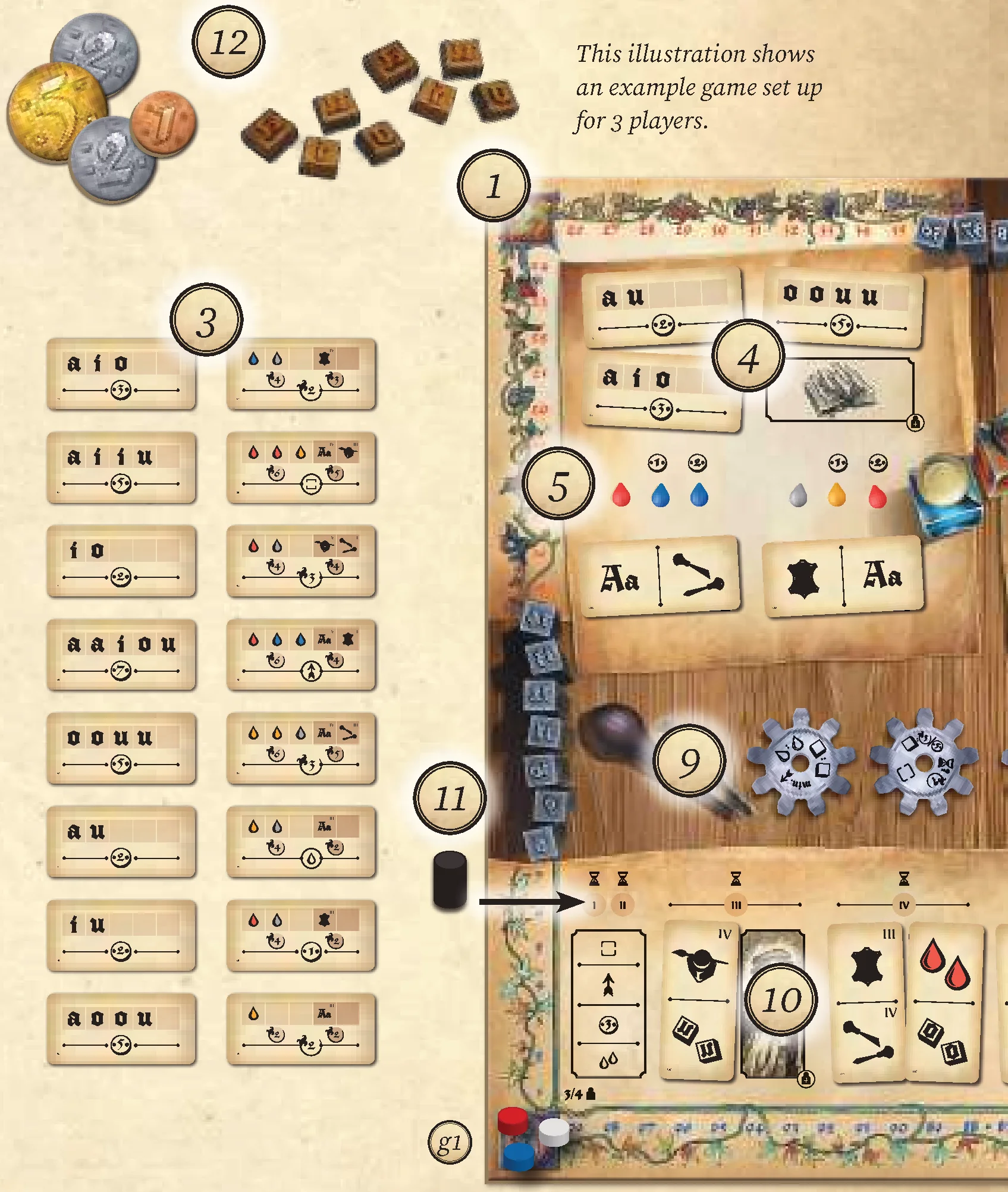
Player Setup
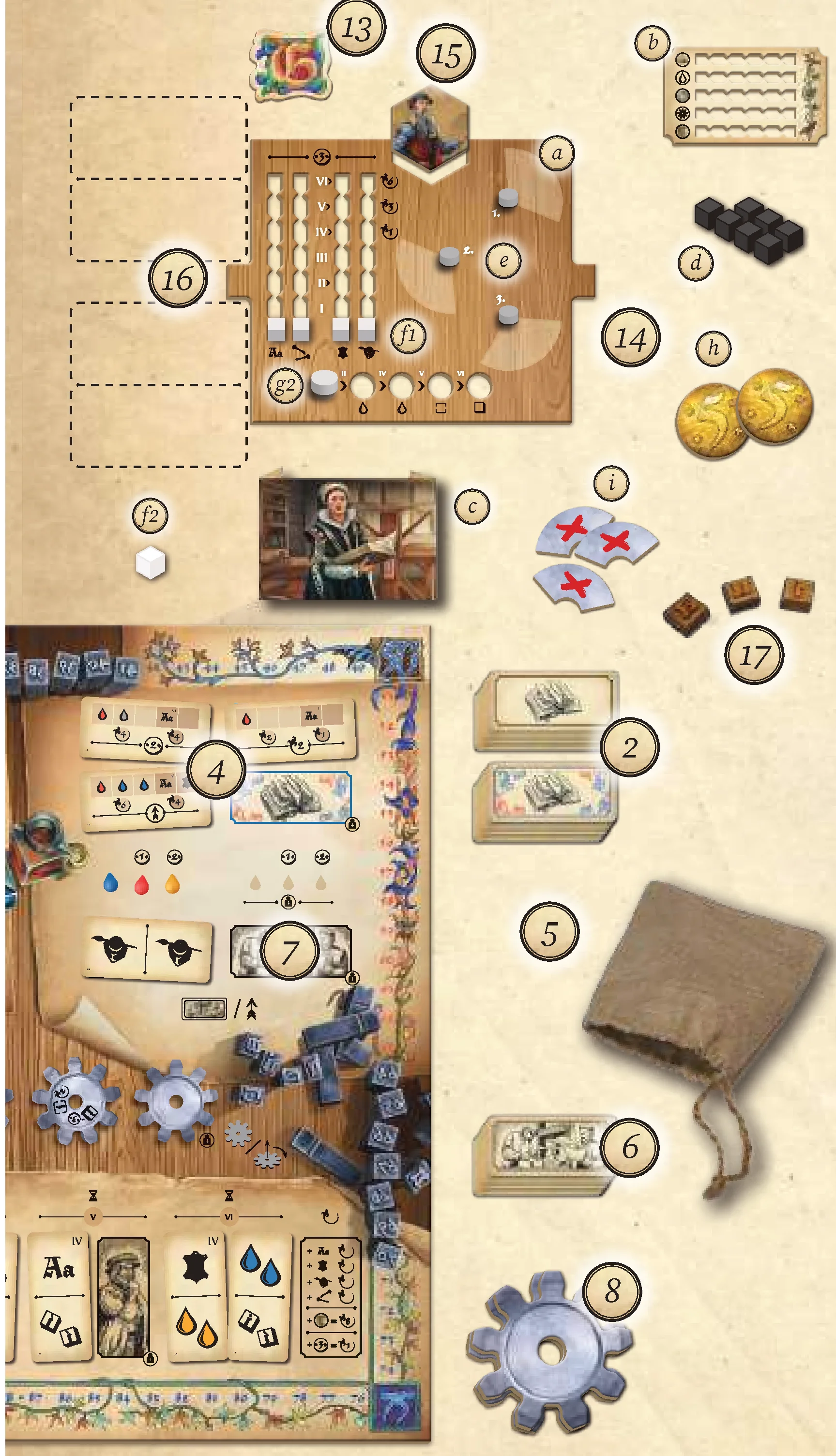
- Each player chooses their player color and takes:
- a printing house board;
- an initiative board;
- a screen;
- a set of initiative markers according to this table:
- first player: 7
- second player: 8
- third player: 9
- fourth player: 10
- 3 gray cylinders, which should be pushed into the 3 gear axle holes on the printing house board (this may require force);
- 5 player markers in their chosen color. 1 player marker goes on the lowest space of each of the 4 specialty tracks on the printing house (f1). The remaining marker goes beside their printing house (f2);
- 2 player disks in their chosen color. One goes on “0” on the fame track on the main board (g1), and one goes on the leftmost space of the reward track (g2) on their printing house board;
- 10 guilders from the bank;
- 3 used gear markers go beside their printing house.
- Each player draws 2 random character tiles, then chooses one to keep and returns the other to the box.
- Players should read aloud each chosen character’s special rules. During your first games, we suggest playing a simpler version of the game without characters, skipping this character selection step.
- Starting with the first player and continuing clockwise, each player selects one order from the face up cards prepared in step 3, i.e. one printing card and one refinement card from the table; a player can freely combine any printing card with any refinement card to make an order. Then in reverse order, starting with the last player (to the right of the first player) and continuing counter-clockwise, each player selects a second order (printing + refinement). Return the 4 unselected cards to their discard piles.
- An order is always a pair of cards: one printing + one refinement. A selected order goes into a free slot beside the player’s printing house. Each order pair is permanently linked: players may never swap individual cards between orders.
- Each player chooses 3 types from the type pool and places them in their resources.
- Advice from the Master: It is best to first choose types that help fulfill these first orders.
Round Overview
The game lasts 6 rounds. Each round has the following steps in order:
- Turn Gears
- Plan
- Execute Plans:
- take orders;
- take inks;
- develop specialties;
- improve printing houses;
- patronage.
- Fulfill Orders
- Prepare the Next Round
1. Turn Gears
Each player must turn the top gear on their printing house board clockwise one sector. The other connected gears will also turn. In the first round, skip this step.
Advice from the Master: Gears taken during the Improve Printing Houses action are an important strategic element. It is worth planning gear placement with future game rounds in mind.
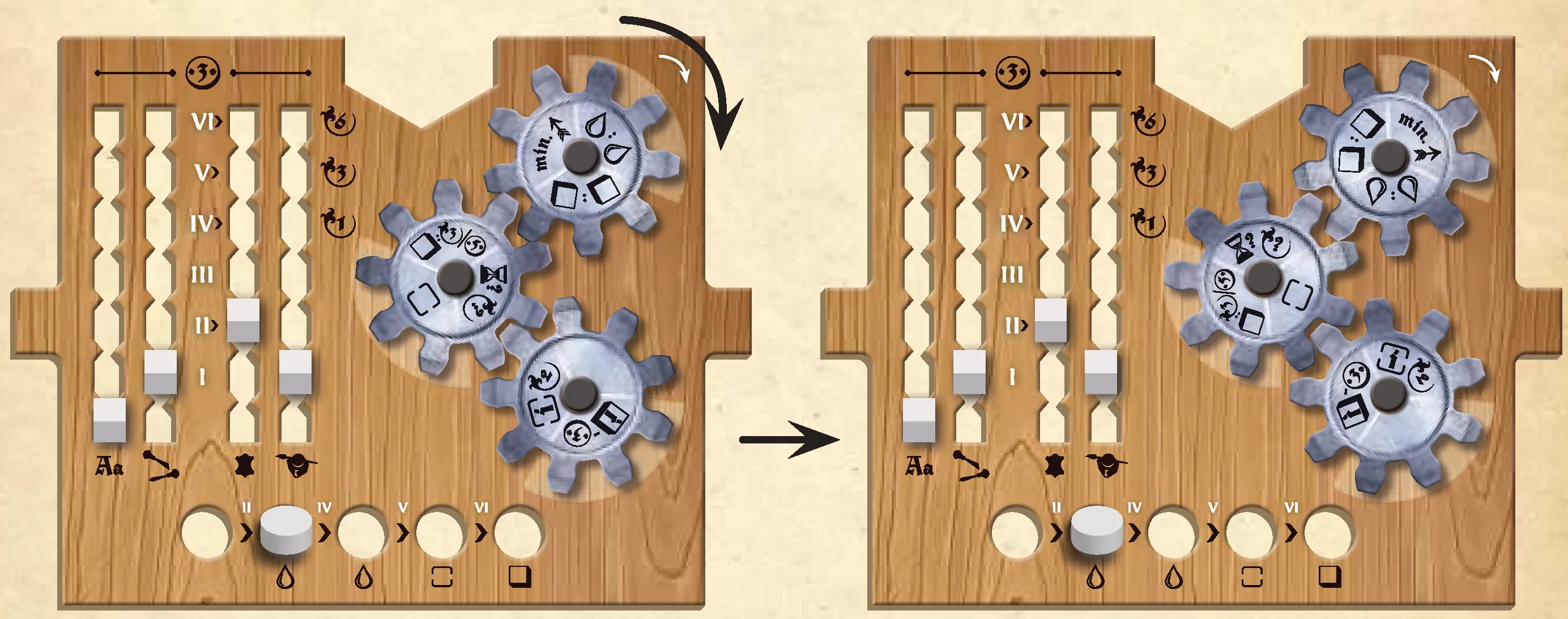
2. Plan
Players plan actions for the current round. Each player hides their initiative board and initiative markers behind their screen. They simultaneously allocate their markers among the 5 actions. Markers go on empty slots (from left to right) on a desired action’s row. A row can have at most 6 markers.
When all players are ready, they all remove their screens to reveal their plans.
Actions are resolved in sequence, from top to bottom. The sequence on the initiative boards matches the sequence on the main board.
For each action, each player’s number of markers determines the player order for that action: players do a given action in order from the player with the most markers on that action to the player with the fewest markers. Ties in markers are broken by player order.
For each action, it is advantageous to play earlier, since more options are available earlier. A player must have at least one marker on a given action to do that action. Doing an action is optional, regardless how many markers a player placed on that action.
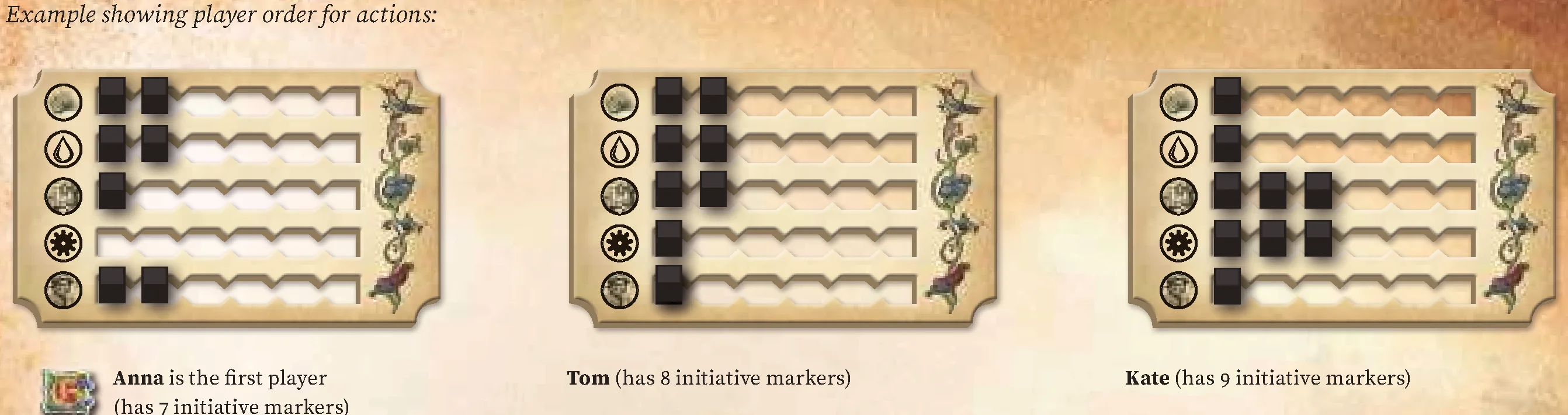
Example showing player order for actions:
- Anna is the first player (has 7 initiative markers)
- Tom (has 8 initiative markers)
- Kate (has 9 initiative markers)
| Action | First | Second | Third |
|---|---|---|---|
| Take Orders | Anna | Tom | Kate |
| Take Inks | Anna | Tom | Kate |
| Develop Specialties | Kate | Tom | Anna |
| Improve Printing Houses | Kate | Tom | — |
| Patronage | Anna | Tom | Kate |
- Take Orders: Anna and Tom both have 2 markers on the first action, while Kate has only 1. So Kate is third. Since Anna and Tom are tied in markers, Anna goes first, because player order in the round breaks ties in markers. Likewise for the second action (Take Inks).
- Develop Specialties: Kate has the most markers (3), so she goes first on this action. Tom is second with 2 markers, and Anna is third with only 1 marker.
- Improve Printing Houses: Kate again has the most markers, so she goes first, and Tom is second. Anna put no markers on this action, so she cannot do this action.
- Patronage: The Patronage action will be performed by Anna first. Next will be Tom, because he is the next player clockwise.
3. Execute Plans
For each action, players do that action in the order determined by how they planned on their initiative boards.
a. Take Orders
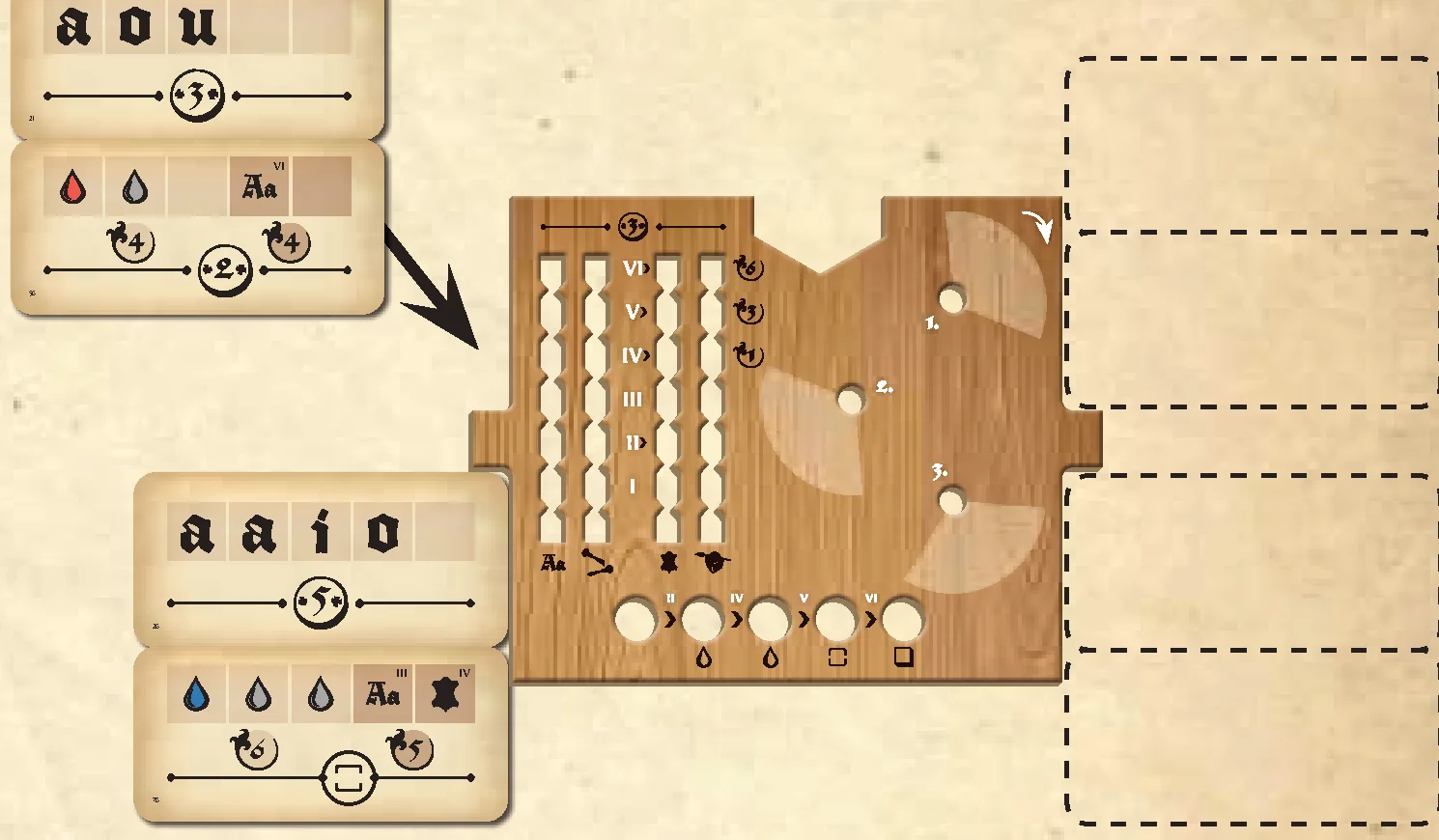
Each acting player may choose one printing card and one refinement card from the main board, creating an order, then places this order in a free slot beside their printing house. The 2 cards of an order cannot be separated later. A player can store at most 4 orders at a time. A player with 4 orders may take another order, but they must first discard one of the 4 they have to create a free slot.
After players are done with this action, discard any remaining printing and refinement cards from the main board to their discard piles.
Order as a Reward
It is also possible to gain an order as an (optional) reward, e.g. for fulfilling an order, from an active gear space, for developing a specialty, or from a Patronage action. The symbol  indicates such a reward. In this case, the player draws 2 printing cards and 2 refinement cards from their decks, then chooses one of each type to create an order, then places it in an empty slot beside their printing house. The unchosen cards are discarded. A player who is not satisfied with the 4 drawn cards may pay 2 guilders to draw 2 additional cards, which can be 2 printing cards, or 2 refinement cards, or one of each type. A player may repeatedly do this as long as they can afford to.
b. Take Inks
Each acting player may select one set of 3 inks from the main board and take 1, 2, or all 3 inks from that set. The first (leftmost) ink in a set is free; the second (center) costs 1 guilder; the third (rightmost) costs 2 guilders. The inks in the selected set must be taken from left to right, e.g. a player may not take the third ink while leaving the first (which is free) or the second (which costs 1 guilder). A player may choose a set that was partially taken by a previous player, but the costs remain the same (1 or 2 guilders for the second or third ink). A player puts their inks beside their printing house board.
After players are done with this action, put any inks remaining on the board back into the bag.

Example: John is the last player to take inks. There are 3 remaining sets of inks. John chooses the rightmost set, from which a previous player already took the first ink for free. John takes the blue and gold inks, paying 1+2=3 guilders. John wants these colors to fulfill an order.
c. Develop Specialties
Players doing this action may choose one specialty card from the main board. A card can be used in one of two ways:
- A: move the indicated specialty marker(s) up (one level for each of a specialty’s symbols on the card)
or - B: move any other specialty marker 1 level up.
Players move their markers on specialty tracks C on their printing house boards. The first time a player reaches a level marked by  (i.e. II, IV, V, VI) on any of their specialty tracks, the player advances their disk on the reward track reward marker D accordingly to the next space and takes the indicated reward.
- Reaching the same reward level in another specialty does not give the player any additional reward.
- Level VI is the maximum for each specialty. If a player develops a specialty that is already at level VI, the player does not move the marker further, but gains 3 guilders.
- After players are done with this action, discard all specialty cards remaining on the board.
Specialties:
 Typesetting
 Woodcutting
 Binding
 Illuminating
Rewards for reaching specialty levels:
| Icon | Reward |
|---|---|
 |
The player takes 1 ink of their choice from the bag. |
|
The player takes 1 new order (see Order as a Reward, p. 8). |
 |
The player takes 1 type of their choice for free. |
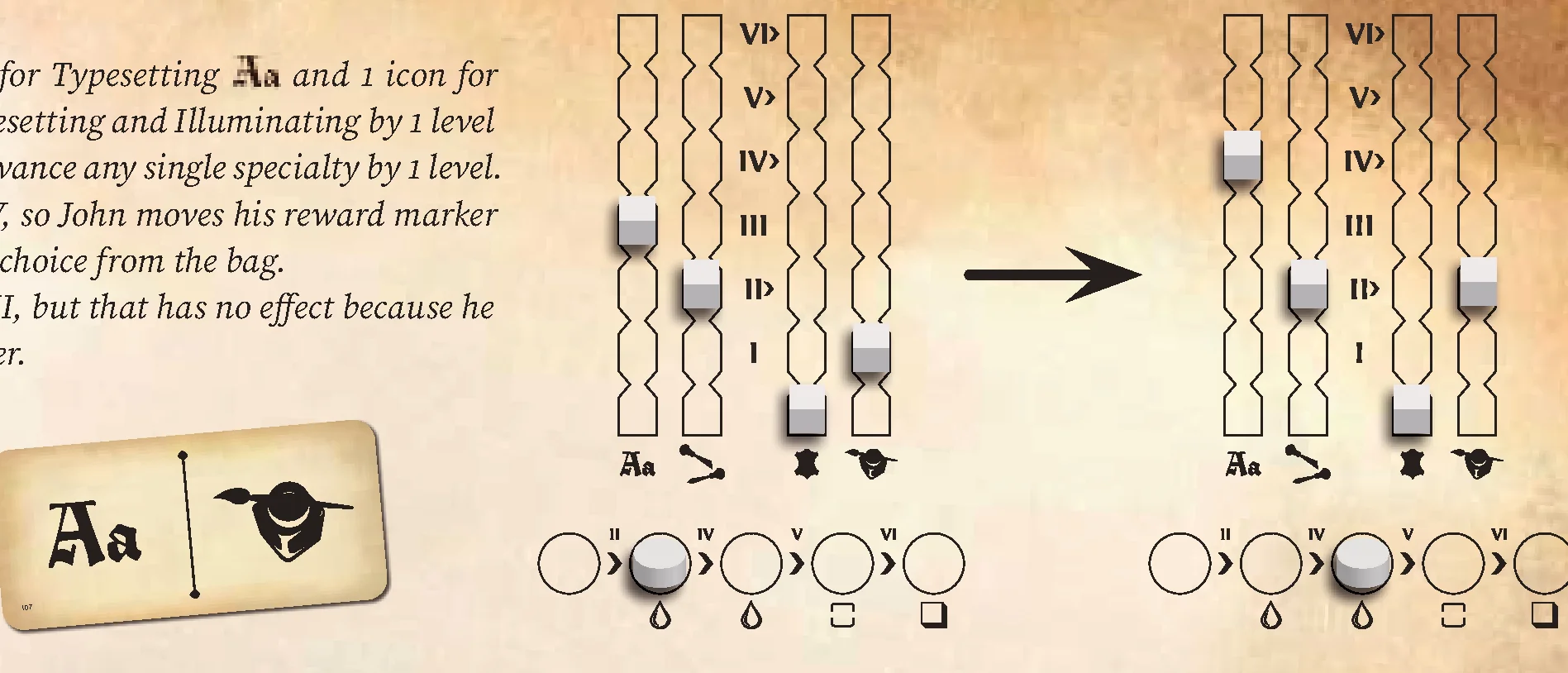
Example: John takes a specialty card with 1 icon for Typesetting and 1 icon for Illuminating. He increases his Typesetting and Illuminating by 1 level each. He could instead have chosen to advance any single specialty by 1 level. His Typesetting now reached level IV, so John moves his reward marker to the next space and takes an ink of his choice from the bag. His Illuminating now reached level II, but that has no effect because he already received his level II reward earlier.
d. Improve Printing Houses
The gears in printing house mechanisms allow players to receive additional rewards or improve a current action.
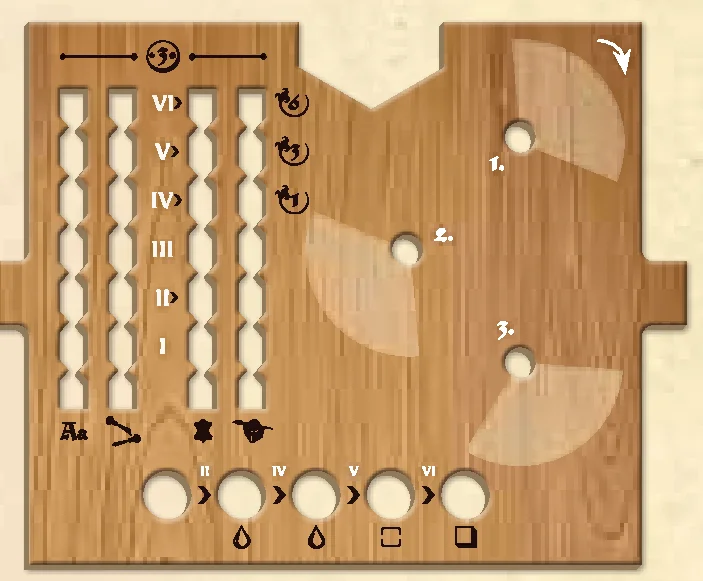
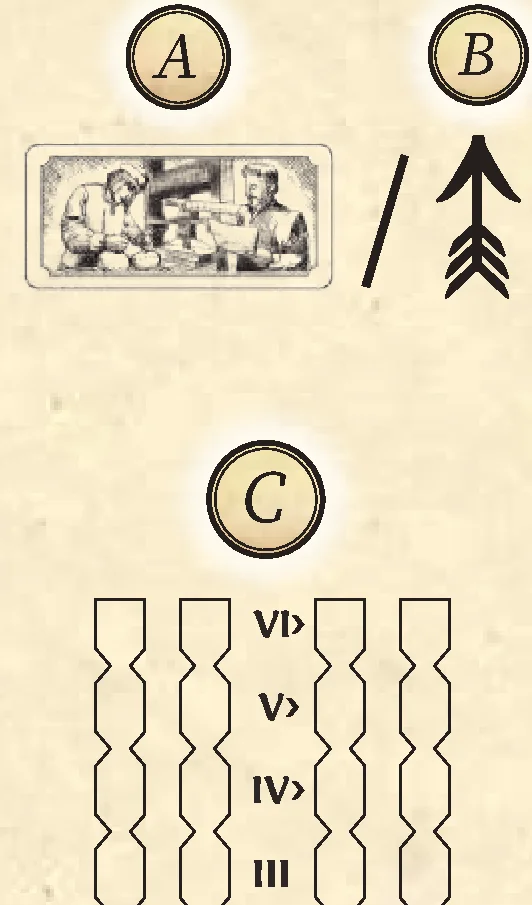
Players doing this action may take one gear from the main board and install it in their printing house A. Gears are installed on the gray cylinders on printing house boards, starting at the topmost gear space (number 1). Each successive gear must touch the previously installed gear, and they should be correctly meshed. When adding a new gear, be sure that exactly one of its 3 sectors is aligned with that gear’s active sector mark on the board C.
Instead of taking a gear from the main board, a player can uninstall one gear from their mechanism, rotate it as they like, and reinstall it back B.
A printing house can have at most 3 gears. A player with 3 gears can take another, but must discard one of their installed gears to make space for the new gear.
Each gear has 3 sectors with rewards. Only the gear sectors next to the shaded crescents on the printing house board C are active. A gear’s active sector has a reward that a player can gain at any time. To gain a gear’s reward, the player takes a used gear marker from their stock and puts it onto the activated gear sector. A gear can only give its reward once per round. A player may place up to 3 markers (1 on each of 3 gears) per round. A detailed description of the reward symbols on the gears is on page 22. The player does not have to collect rewards from their gears if for some reason they do not wish to do so.
- If a player has used a gear this round, that gear cannot be repositioned or discarded this round.
- After players are done with this action, discard all gears remaining on the board.
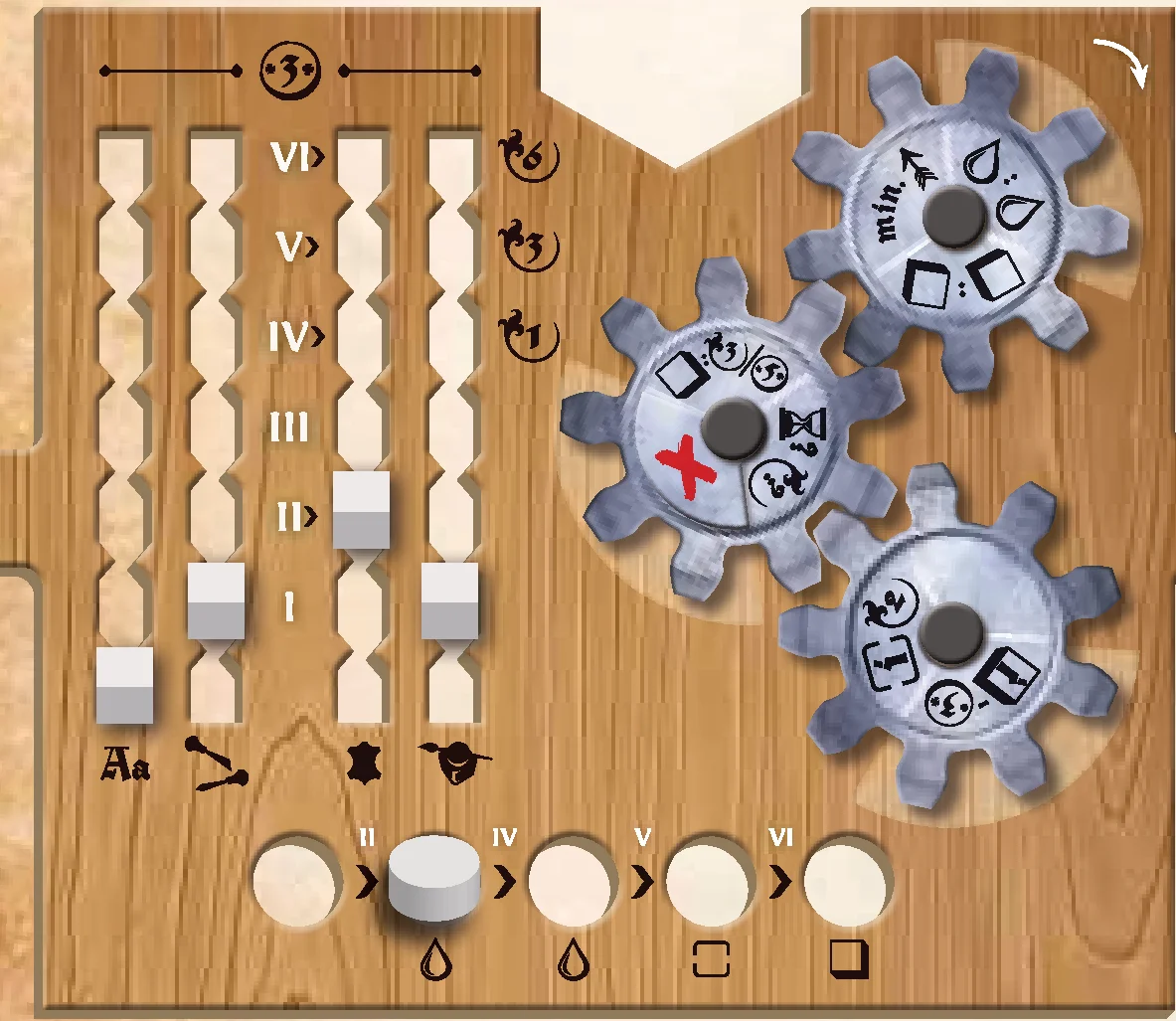
Example: Anna wants to use her gears. At this moment, she can use one gear’s reward to exchange one ink for another and another gear’s reward to buy one I type for 3 guilders cheaper. She cannot gain her third gear’s reward (to take an order) because she already did that earlier this round.
e. Patronage
Players doing the Patronage action may do one of the following actions:
- Choose one available reward: The player puts their marker on it, making this reward unavailable to other players until the end of the round:
- Take 1 order, or
- Advance one specialty by one level, or
- Take 3 guilders, or
- Take any 2 inks from the bag
- or Take 1 patronage card (if the player meets the patronage card’s conditions).
A patronage card may only be taken if it is on a space below or to the left of the round marker. If a player uses ink to take a patronage card, the player must put the indicated ink back into the bag (similar to fulfilling an order). Types and specialties are not spent; they remain permanently with a player.
In the first two rounds, the round marker has not yet reached any patronage cards, so players cannot take a patronage card; they can only take one of the rewards.
Patronage card requirements:
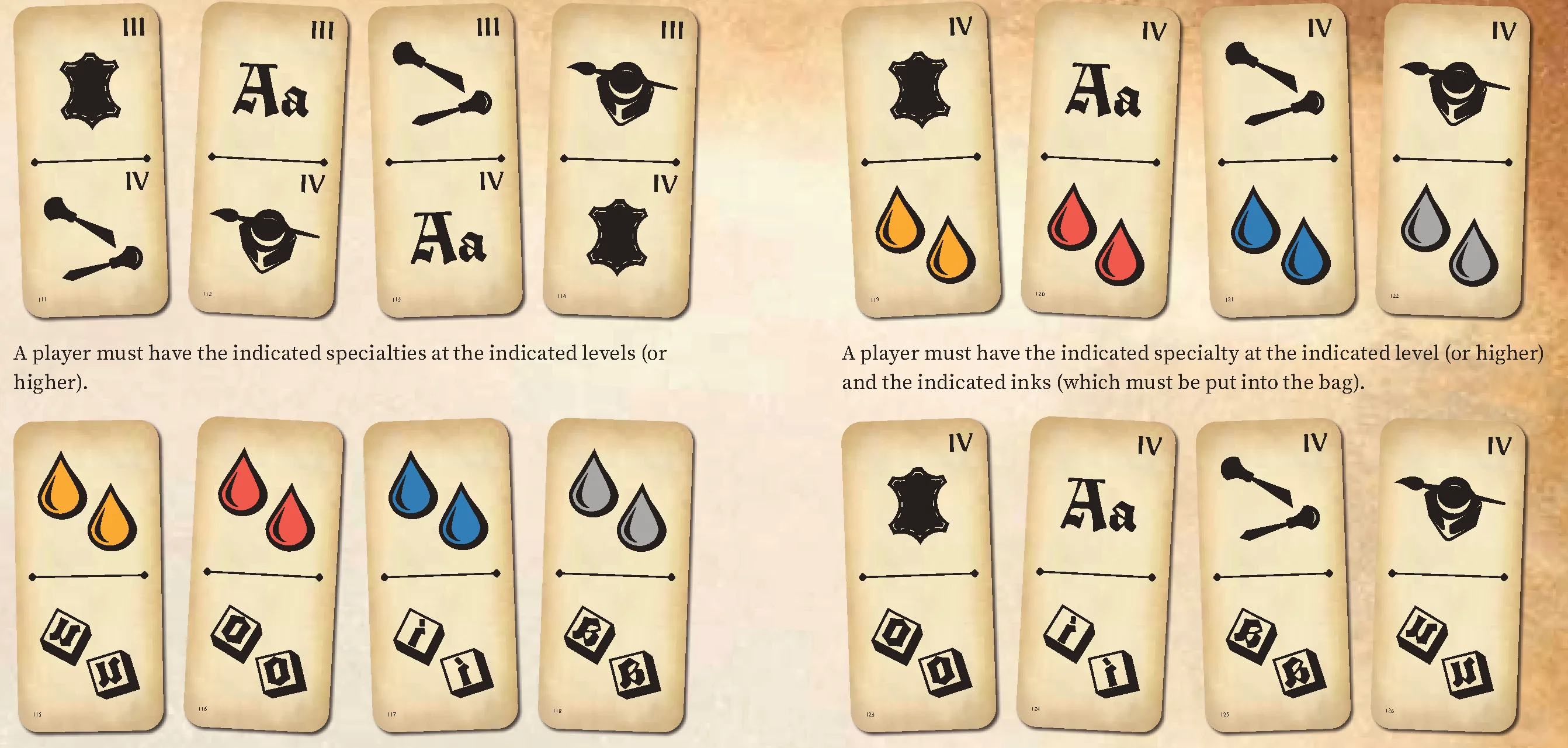
- A player must have the indicated specialties at the indicated levels (or higher).
- A player must have the indicated specialty at the indicated level (or higher) and the indicated inks (which must be put into the bag).
- A player must have the indicated inks (which must be put into the bag) and the indicated types.
- A player must have the indicated specialty at the indicated level (or higher) and the indicated types.
4. Fulfill Orders
After players are done with actions, they fulfill orders. This is done in clockwise order, starting with the first player.
Orders Structure
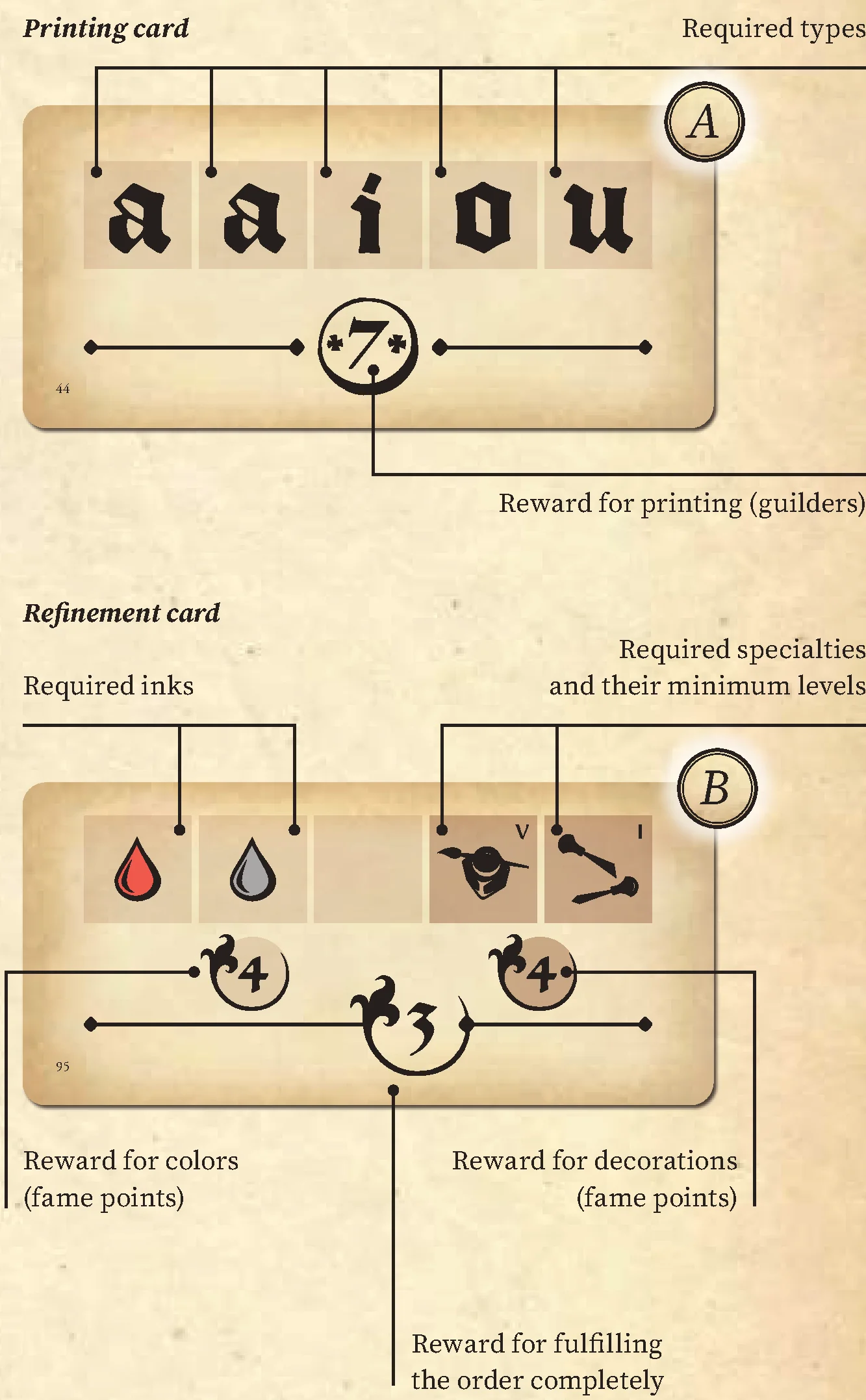
Each order has two cards: a printing card (A) and a refinement card (B). Fulfilling orders is the main way players earn points. To fulfill an order, a player needs the resources indicated on its cards.
Types and specialties are permanent (not discarded after fulfilling an order), but inks are used up (discarded into the bag after fulfilling an order).
For fulfilling the printing card, a player earns guilders; for additionally fulfilling refinements, a player earns fame points. If the order is completely fulfilled, a player gains an additional reward.
- A player must fulfill the printing card’s requirements.
- The refinements are optional: a player may fulfill both, one, or none of the refinement card’s requirements.
- The order’s two cards are permanently linked from the moment a player places them in a free slot of their printing house. After fulfilling an order, both cards are discarded, even if the refinement requirements were not fulfilled. During this step, a player may fulfill all, some, or none of their orders. Unfulfilled orders simply remain in their slot.
- All orders are fulfilled simultaneously. This means that types used to fulfill one order or rewards from fulfilling an order cannot be used to fulfill another order in the same round.
Printing
To fulfill a printing card, a player must assign the required types to the printing card. The player receives the card’s indicated number of guilders as a reward.
- Using types to fulfill an order does not use them up. After fulfilling the order, the types used for it return to the player’s resources.
During game preparation, each player chooses 3 types. Players can buy additional types. The cost to buy another type depends on how many types you have (see table below). Buying your 4th type costs 4 guilders, your 5th type costs 5 guilders, and so on.
| Buying your n-th type | 3 | 4 | 5 | 6 | 7 | 8 | 9 | 10 | 11 | … |
|---|---|---|---|---|---|---|---|---|---|---|
| Costs n guilders | 3 | 4 | 5 | 6 | 7 | 8 | 9 | 10 | 11 | … |
Example: Anna has 3 types: A, I, O. She wants to buy 2 more: one U and another A. So she spends 4 + 5 = 9 guilders.
Players can buy types at any time during a round – it is not an action. A player can buy and own as many types as they want (and can afford). A given type can be assigned to only one order in a round in the Fulfill Orders step. Players should place their types on their order cards to clearly indicate which order each type is assigned to. Types are unlimited – in the rare event that a given type runs out, players may use spare type tokens or improvise other substitutes.
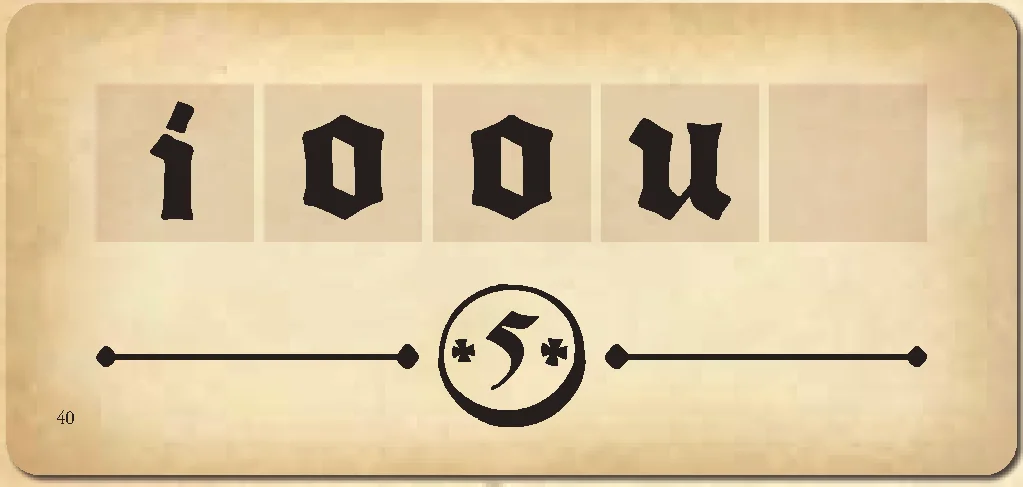
Example: This printing card requires the player to use types I, O, O, and U. Fulfilling an order with this printing card gives a player 5 guilders.
Refinements
Refinements include colors and decorations. Both parts are optional. Each part gives fame points independently if fulfilled. Whenever a player gains fame points, they advance their disk on the fame track accordingly. Fulfilling both refinements gives an additional reward, depending on the card.
- Colors (A) require assigning the indicated inks to the refinement card. This uses up the ink! After fulfilling a color requirement, the used inks go back into the bag. Inks are limited by the contents of the bag: a given color cannot be taken from the bag if the bag has none of that color.
- Decorations (B) require that the player have all the indicated specialties, and each must be at the same level (or higher) as indicated on the card, otherwise the decoration cannot be fulfilled. Specialties are not used up and do not decrease in value during the game.
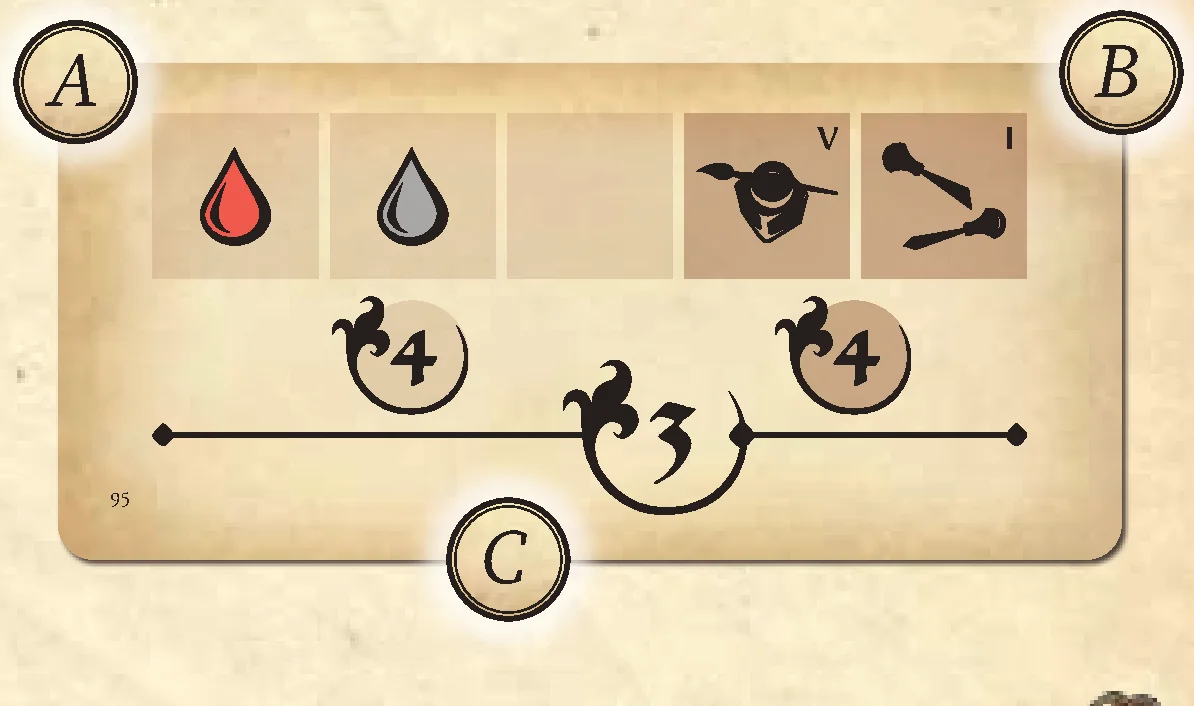
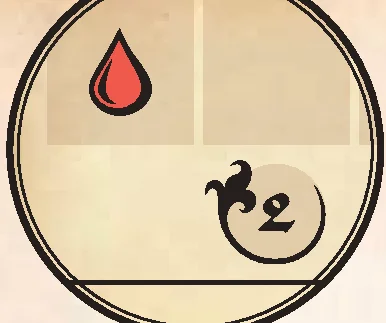
Example: a player can spend 1 red ink to gain 2 fame points.
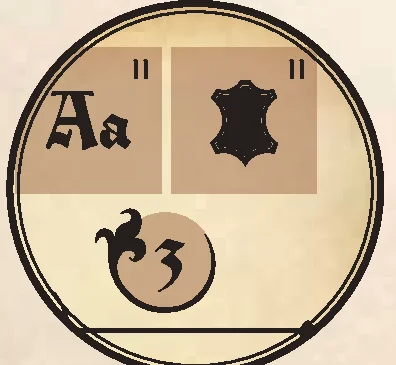
Example: if a player has typesetting and binding, each at level II or higher, the player gains 3 fame points.
Reward for completely fulfilling an order
If a player completely fulfills an order (the printing card and both parts of the refinement card), they may take the additional reward C shown at the bottom of the refinement card. Taking a reward is optional.
Table of possible rewards for completely fulfilling an order:
| Reward | Description |
|---|---|
 |
The player takes 1 / 2 selected inks from the bag. |
 |
The player takes 1 / 2 guilders from the bank. |
 |
The player gains 2 / 3 fame points. |
 |
The player selects one specialty and advances it 1 level higher. |
 |
The player takes a new order (see: Order as a Reward p. 8). |
5. Prepare the Next Round
At the end of each round (except the last round), do these steps:
- Refill the main board as during the setup to add:
- order cards: one face-up printing card on each printing space, and one face-up refinement card on each refinement space,
- inks: one ink (drawn from the bag) on each ink space,
- specialty cards: one face-up specialty card on each specialty space,
- gears: one gear on each gear space.
If any deck runs out, shuffle its discard pile to form a new deck.
- Move the round marker to the next space.
- All player markers on patronage spaces return to their owners.
- Remove used gear markers from gears.
- Remove initiative markers from initiative boards.
- Pass the first player token to the next player (clockwise).
- Each player gives one initiative marker to the player who just passed the first player token.
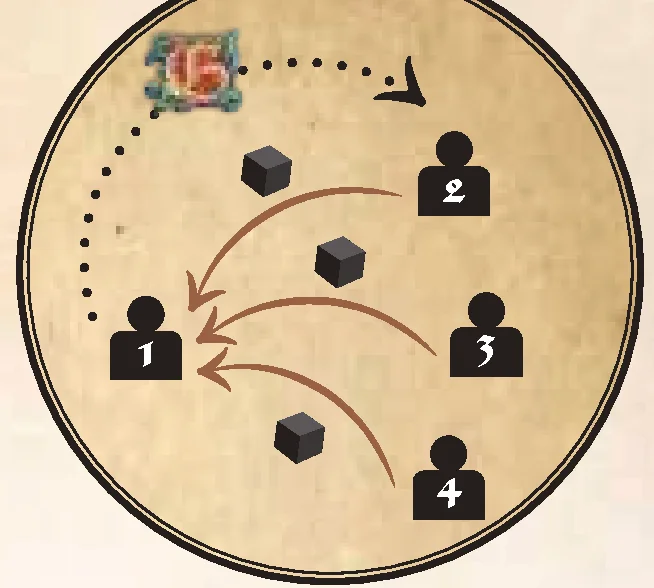
Example of passing the first player token: The first player, i.e. the player with the first player token, always has 7 initiative cubes, the second player has 8, the third player has 9, and the fourth player has 10. When the first player gives the first player token to the next player (clockwise), the other players each give one initiative cube to the player who gave the token. Thus in the new round, the first player has 7 initiative markers, the second player has 8, the third player has 9, and the fourth player has 10.
6. End of the Game
After 6 rounds, the game is over, and there is final scoring of fame points. In addition to points earned during the game and already marked on the fame track, players receive additional points as follows:
- specialties:
- 6 points for each specialty at level VI;
- 3 points for each specialty at level V;
- 1 point for each specialty at level IV;
- patronage cards: 8 points for each acquired patronage card;
- guilders: 1 point for every 3 guilders.
The player with the most fame points is the winner. Ties are broken in favor of players with fewer types. Remaining ties are broken in favor of players with fewer inks. Remaining ties remain unbroken ties.
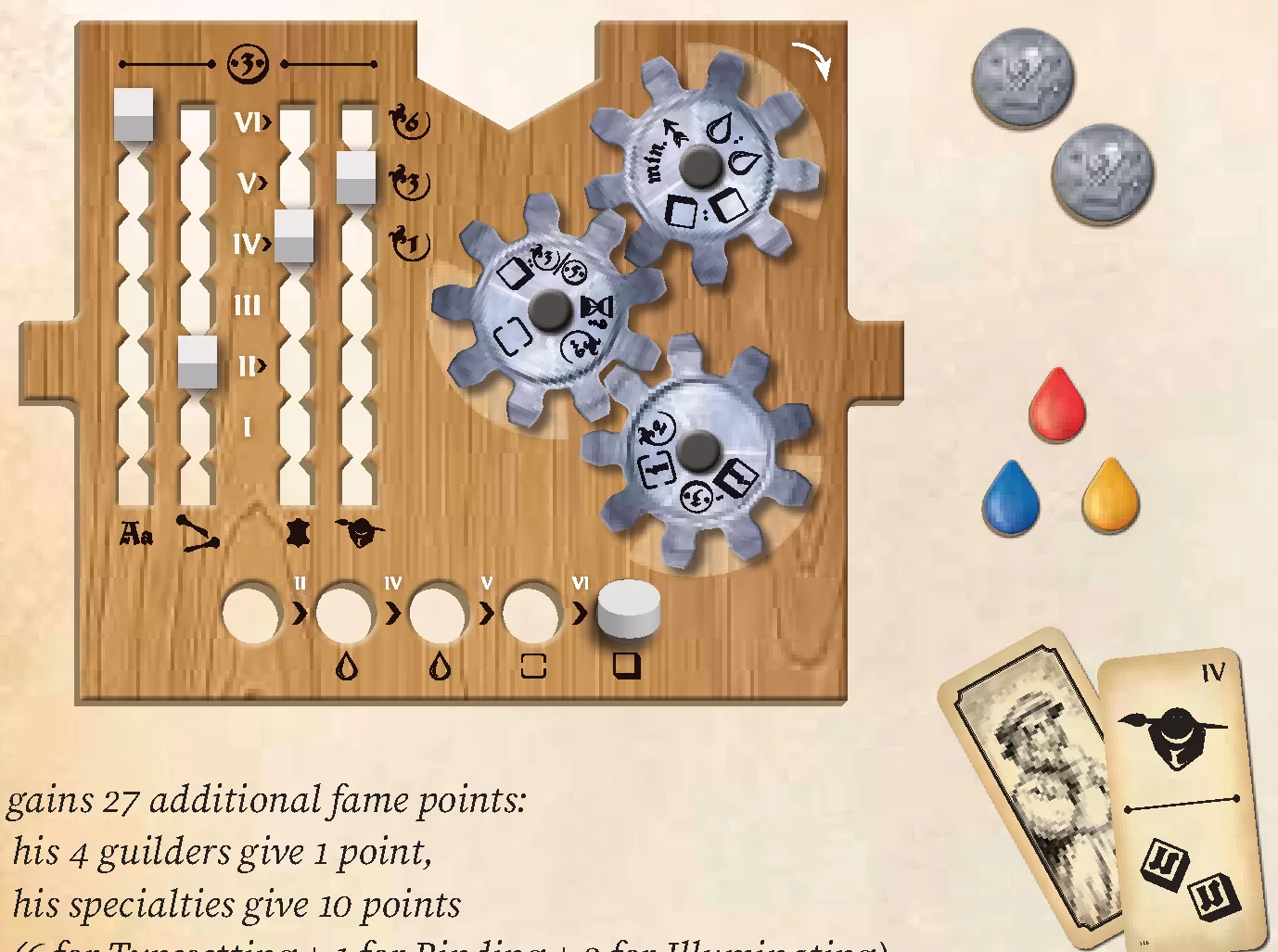
Example: After 6 rounds, the game ends. John has 84 fame points, and his printing house looks like this:
He gains 27 additional fame points:
- his 4 guilders give 1 point,
- his specialties give 10 points (6 for Typesetting + 1 for Binding + 3 for Illuminating),
- his 2 patronage cards give 16 points.
In total John accumulated 111 fame points.
Overview
The automa simulates an abstracted additional player in the Plan and Execute Plans steps. When the automa acts, it will randomly discard resources from the main board. The automa enables solitaire play. It can also be added to a game with 2 or 3 players.
Components for the Automa
- Initiative board (one of the unused boards),
- 7 initiative markers (the same number as for the first player),
- One player marker of an unused color (to mark a patronage reward),
- Automa cards (10 planning cards and 4 execution cards).
Automa Setup
When setting up the game, count the automa as an additional player and set up the game according to the usual rules:
- Prepare an unused initiative board for the automa.
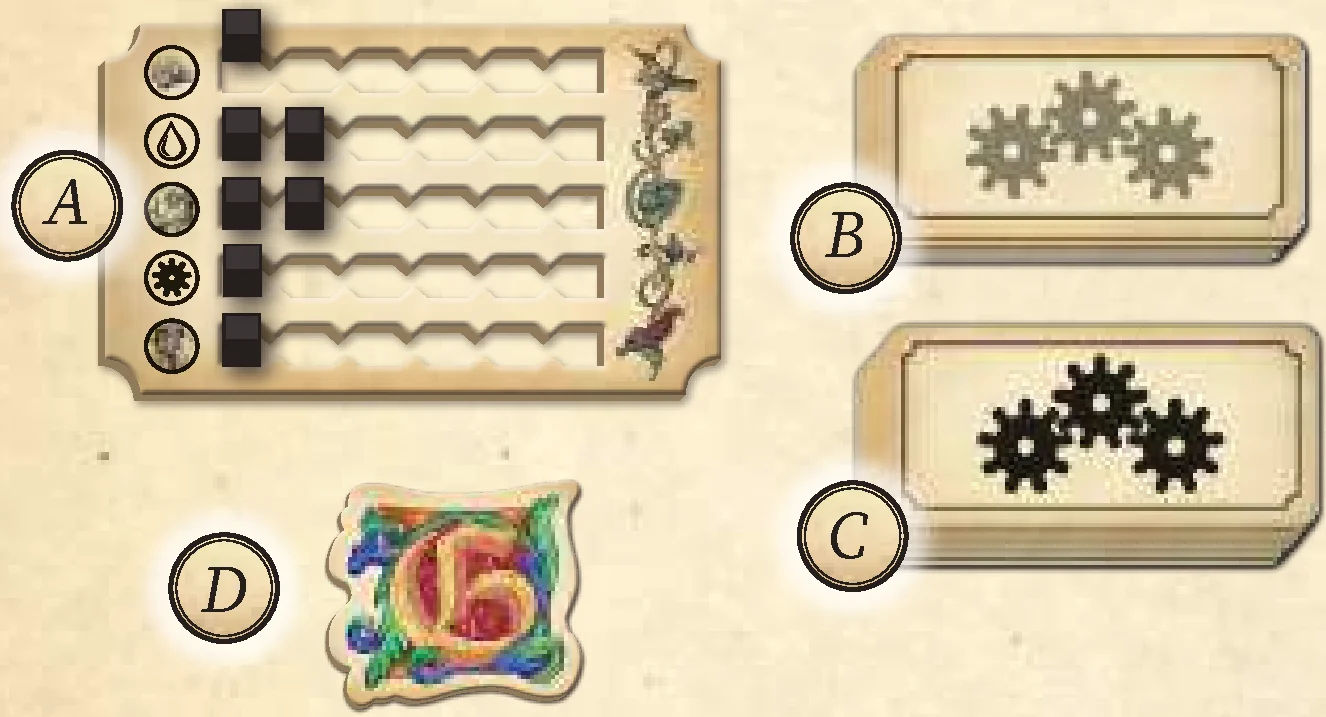
- The automa takes the first player token (D).
- Place its initiative markers on its initiative board as shown (A).
- Shuffle the 4 automa execution cards (B) and place them face down near the automa’s initiative board.
- Shuffle the 10 automa planning cards (C) and deal 6 face down into a deck near the automa’s initiative board. Return the 4 remaining planning cards without looking at them to the box; they will not be used.
- During step 3 of Game Preparation (page 4) put one order less than indicated. The automa does not take order cards.
Automa Rules
Each round, after all players complete the Plan step, reveal the top automa planning card (C), and rearrange the automa’s initiative markers on its initiative board as directed by its planning card. Then Execute Plans as usual, resolving player order for each action according to each player’s assigned initiative markers (including the automa’s markers) by the usual rules of the game (see p. 7).
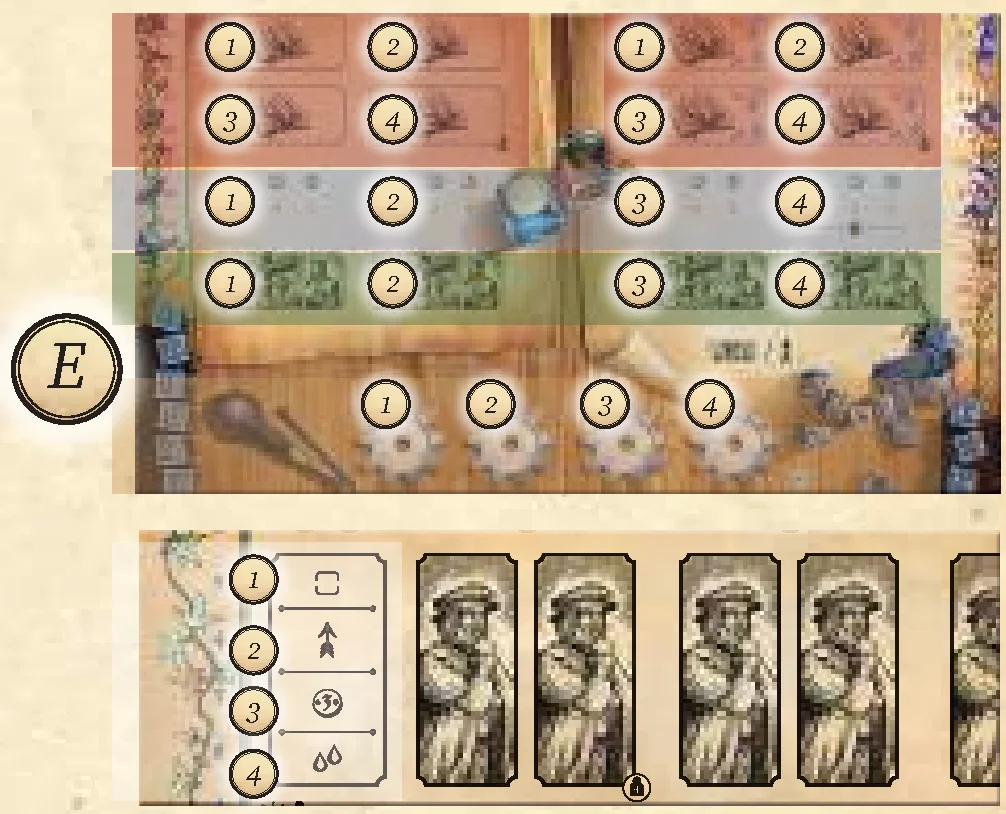
When the automa does an action, draw a random automa execution card to see from which space the automa takes a resource. The card’s number indicates the resource space (see E). If there is no resource in that space on the board (i.e. that number is empty because fewer players are playing, or because another player already took from that space this round), then draw the next execution card. After the automa does its action, reshuffle the entire automa execution deck: for each action, the automa starts drawing from its full deck of 4 execution cards.
Actions
- During the Take Orders action: the automa randomly removes a printing card and a refinement card. Draw an execution card for each of the 2 cards.
- During the Take Inks action: the automa removes all inks from a random ink space.
- During the Develop Specialties action: the automa removes a random specialty card.
- During the Improve Printing Houses action: the automa removes a random gear.
- During the Patronage action: the automa will take a patronage card or one of the rewards. If this round’s planning card shows a patronage card (G), the automa takes the leftmost card (exception: in the first and second rounds, the automa must take a reward: see Patronage, page 11.) Otherwise, the automa takes one of the rewards (chosen randomly by an execution card).
The automa does not accumulate resources. Put any ink it takes back into the bag, and put other resources it takes onto their discard piles.
End of Round
At the end of a round, the automa passes or receives initiative markers as usual, like other players, when the first player token is passed:
- If the automa passes a marker, it takes it from its action that has the most markers.
- If the automa receives markers, put them one after another onto whichever action has the fewest markers at the moment a marker is placed.
If there is a tie among its actions for the fewest or the most markers, use this round’s planning card center icon to break the tie; see detailed rules below. Unlike human players, the automa then leaves its markers on its initiative board, and will simply shift a few markers during the next Plan step.
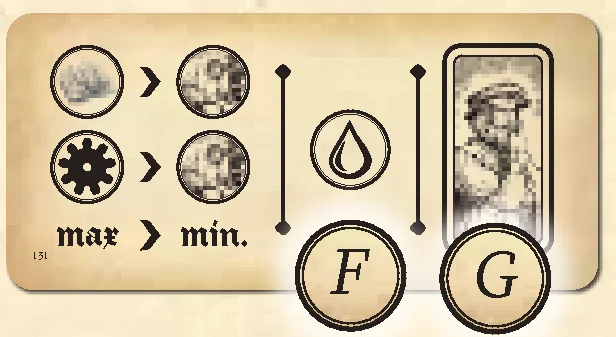
Detailed rules of the iconography of automa cards and automa initiative markers
 : means to move an initiative marker from the first action to the second action.
- If the first action has no marker, then instead move a marker from the second action to the first. If neither has any markers, then do nothing.
- Some cards also have min. and max.:
- min. – the action with the fewest initiative markers,
- max. – the action with the most initiative markers.
- If there is a tie for minimum or for maximum, then scan the actions, starting at the action printed in the middle of the planning card (F), then scanning downward, possibly wrapping around to the top action and continuing, until you reach one of the tied actions: this is the action that wins the tie.
- If an action already has 6 initiative markers, do not move another marker to it.
Solitaire Scoring Titles
Solitaire players may earn professional titles from the printing guild based on their scores, as shown in this table:
| Score | Level |
|---|---|
| < 100 | Student |
| 101–110 | Senior Student |
| 111–120 | Apprentice |
| 121–130 | Senior Apprentice |
| 131–140 | Junior Master |
| 141–150 | Master of Printing |
| > 150 | Guildmaster |
Gear Rewards
| Symbol | Reward Description |
|---|---|
 |
The player exchanges one of their inks for another ink available in the bag. |
 |
The player exchanges one of their types for another from the pool. |
 |
The player increases their lowest specialty by 1 level. In case of a tie for their lowest specialty level, the player chooses one of their lowest specialties. |
 |
The player gains as many fame points as the current round number (1-6). |
|
The player takes an order (see Order as a Reward, p. 8). |
 |
The player discards one type, then gains either 3 fame points or 5 guilders. |
 |
The player gains 2 fame points for each of the orders they are currently fulfilling for which the player is using one or more of the indicated inks to fulfill the Color refinement. If an order requires more than one indicated ink, the order still gives 2 points; there is no additional benefit. |
 |
The player gains the indicated color of ink from the bag. |
 |
The player puts 1 ink of the indicated color into the bag, then takes any 2 inks available in the bag. The player can re-take the color they put in. |
 |
The player gains 2 fame points for each of the orders they are currently fulfilling that has the indicated type. If an order has more than one indicated type, the order gives 2 points; there is no additional benefit. |
 |
The player can buy one of the indicated type for 3 guilders less. |
 |
The player gains 2 fame points for each of the orders they are currently fulfilling for which they fulfill the Decoration refinement with the indicated specialty. |
 |
The player advances their indicated specialty by 1 level. |
Characters – Special Rules
Iohannes Gutenberg – Johannes Gutenberg
After all players reveal their initiative boards with planned actions – but before players execute actions – this player may shift 1 initiative marker on his board to a different action.
Carola Guillard – Charlotte Guillard
Immediately after selecting this character, this player draws 4 random gears, selects 2, and installs them in their printing house.
Aldus Manutius – Aldo Manuzio
If this player fulfills 2 or more orders at the same time, they may ignore one of the required types on one order.
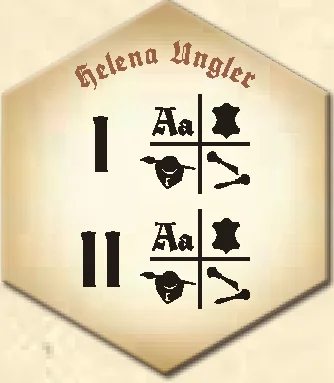
Helena Ungler – Helena Ungler
Immediately after selecting this character, this player advances one specialty to level I and another to level II, then advances their reward marker on the reward track to level II and receives that reward (ink).
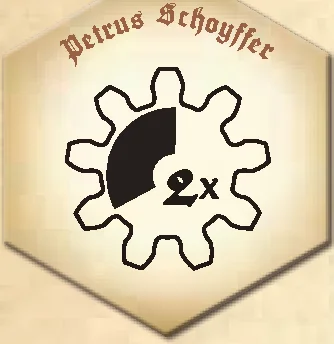
Petrus Schoyffer – Peter Schöffer
This player may use the active sector of one gear 2 times in a round. They still may do only 3 gear actions total per round.
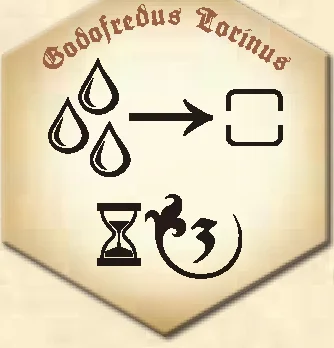
Godofredus Torinus – Geoffroy Tory
At the end of each round, if this player can assign all of their inks to their current orders, they gain 3 fame points.
The inks are not permanently assigned to these orders; in future rounds, they may be assigned to other orders.
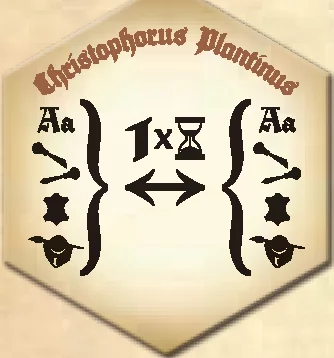
Christophorus Plantinus – Christophe Plantin
Once per round, this player can swap the levels of 2 of their specialties, adjusting the markers on both tracks. (I.e., this is not a temporary effect.)
Gulielmus Caxton – William Caxton
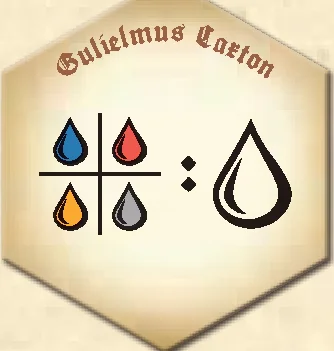
Immediately after selecting this character, this player takes the two large William Caxton tokens. At the start of each round, this player must select one ink color which will be wild (i.e. usable as any colors) for this player (only) during this round. Put the corresponding Caxton token with that selected color face up beside the Caxton character tile as a reminder.
Sveboldus Fiol – Schweipolt Fiol
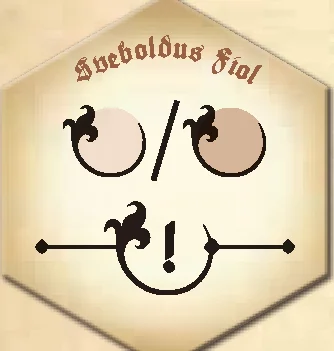
If this player fulfills only one refinement requirement of an order (color or decoration), then they nonetheless gain the reward for completely fulfilling the order.
Hieronymus Vietor – Hieronymus Vietor
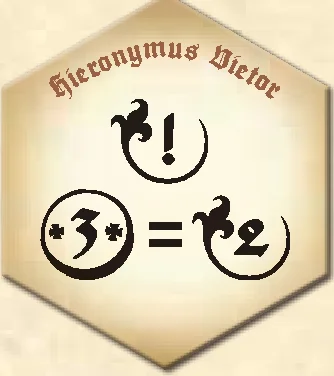
At the end of the game, this player doubles their fame points gained from guilders.
E.g. 5 guilders normally give 1 fame point, but this player would earn 2 fame points from 5 guilders.
The Origin of Printing
Western Europe, the mid-15th century. Mainz was a typical city of its time. There were no signs that a great technological revolution would take place there, which from today’s perspective can be compared to the development of the Internet at the end of the 20th century. The book had already evolved into the form of a codex, i.e. folded sheets of paper joined in a block and bound. It functions in this form to this day. However, all books from medieval Europe were written by hand. If you wanted a copy of any of them, you had to rewrite it. Copying texts was done by scriptoria – church and secular – in which scribes filled parchment or paper pages with text, writing with sharpened quills and ink. It was very difficult and painstaking work – a lot of time was needed to write one codex while maintaining the highest quality. Therefore, books were exclusive products that only the wealthiest could afford. Information circulated mainly by word of mouth. There was no effective way to share knowledge quickly and universally, and the skills of reading and writing were rare.
At this time, Johannes Gutenberg, a goldsmith and gem cutter, entered the historical scene. This craftsman had an idea for a technological innovation that could make him a fortune. Gutenberg had noticed that the demand for books was much greater than their supply, and their prices were soaring, due to the time-consuming copying by hand. If he could devise a way to copy codices quickly and efficiently, then selling them would bring him a huge profit. As a result, he created a new technology that would soon change the world.
His invention consisted of several elements. The first was an apparatus to cast movable type. Movable type consists of small metal blocks called “sorts”, each with a raised mirrored form of a letter or other sign. The casting apparatus allowed Gutenberg to create consistent typefaces, making it possible to print many identical letters on one page. The Mainz printer’s second innovation was composing the individual sorts into a page image, held tightly together in a single block, which was then inked to leave an impression on parchment or paper. The third element of the invention was the use of a press to make the prints. He also used oil-based ink for printing books.
Interestingly, Gutenberg didn’t invent types. Already in ancient Mesopotamia, stone seals were used to mark earthenware objects. He was also not the first to use movable type for typesetting – in the 11th century, a certain Bi Sheng already did it in China. The craftsman from Mainz did not invent the press either – he used machinery that already existed. His genius was to combine all these elements, thus producing an extremely efficient method of duplicating texts.
Character Biographies
Iohannes Gutenberg – Johannes Gutenberg
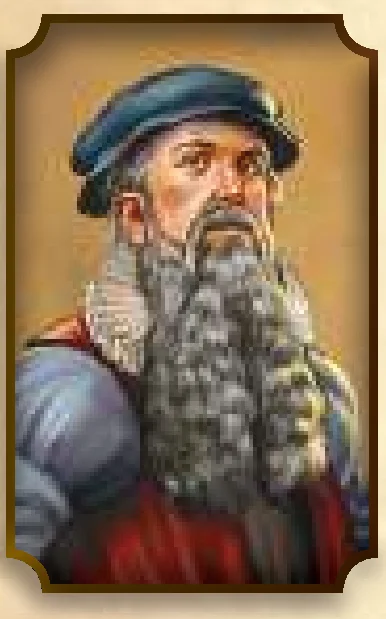
Certainly the most famous printer in history. Interestingly, his invention brought him fame and… bankruptcy. Having an idea how to speed up the book-making process, all he needed was funding to start his workshop. For this purpose, in 1450 he borrowed from Johann Fust, another goldsmith in Mainz, the huge sum of 800 guilders. (At that time, the annual earnings of a skilled craftsman were about 300 guilders.) Fust himself also borrowed to finance Gutenberg’s endeavor, which shows how tempting the new technology was. Gutenberg managed to publish his life’s work – what we know today as the 42-line Gutenberg Bible – but failed to pay his debts (in 1452, he took another loan, again for 800 guilders), and so Fust took possession of his printing house. Gutenberg did not benefit financially from his invention, but he started a new industry that allowed others to expand their business.
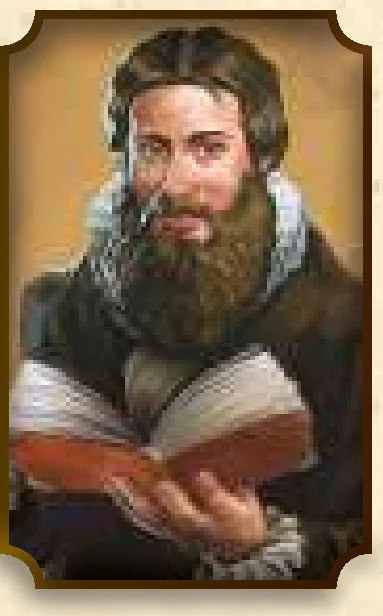
Petrus Schoyffer – Peter Schöffer
The adopted son-in-law of Johann Fust – the goldsmith to whom Johannes Gutenberg owed the astronomical sum of 1600 guilders (in two loans of 800 guilders each) to finance his printing project. Fust told Gutenberg that he must either take Peter into his workshop as an apprentice, or he would not receive the second loan. Gutenberg agreed, so Schöffer ended up in his printing house and learned the trade. When Gutenberg was unable to pay off his debt, the creditor took possession of Gutenberg’s workshop and entered into a partnership with Schöffer. Fust now owned the machines, and Schöffer knew how to operate them. An impressive result of their work was the Mainz Psalter of 1457 and 1459. This beautiful book, printed in three colors, was proof that Schöffer had mastered the art of printing.
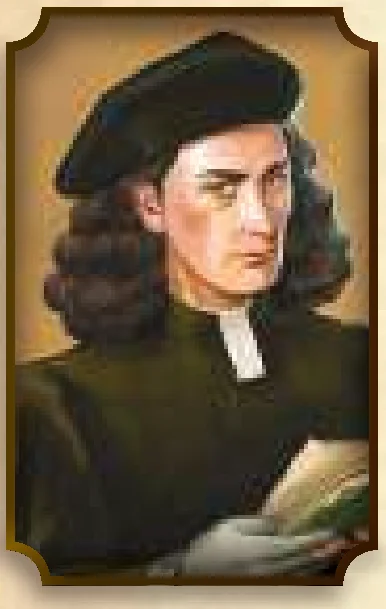
Aldus Manutius – Aldo Manuzio
Aldo Manuzio was the Steve Jobs of the beginning of printing. He started in Venice in the 1490s and introduced some innovations to which modern publishing owes a debt. First of all, he changed the size of books. Before Manuzio, books were big and bulky. Aldo decided to publish books in smaller (for those times) formats. One of his most famous works – Hypnerotomachia Poliphili by Francesco Colonna – had dimensions similar to today’s A4 size. Small-format printing made it possible for Renaissance humanists to take their book collections while traveling. Aldo’s second innovation concerned lettering. The first books were printed in Gothic script (difficult for us to read today), which was intended to imitate scribes’ handwriting. Aldo published texts in italics and antiquas – typefaces like those we use today. Manuzio greatly influenced the development of humanism – he was the first printer to undertake a large-scale publication of classical Greek texts, and he introduced ancient works to Renaissance humanists. These Aldine editions are still named today after him and his press.
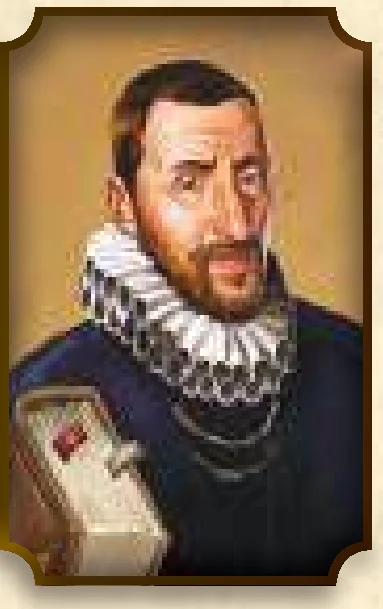
Christophorus Plantinus – Christophe Plantin
He was born in France, studied in Paris, and after a short craftsman apprenticeship, moved to Antwerp, where in 1549 he founded a bookbindery and bookshop. Thanks to him, Antwerp became – after Paris and Venice – one of the three most important printing centers in Europe. Plantin is considered the most outstanding printer of the second half of the 16th century, and his company gained international fame. In 1575, he employed almost 150 people and ran 16 presses in his printing house. In 1583, war and Antwerp’s occupation by Spaniards forced him to move to Leiden, where he founded another printing house. The work of his life is the Plantin Polyglot Bible – an edition of the Holy Scriptures published in Hebrew, Latin, Greek, Aramaic, and Syriac. Over 40 people worked on it for 5 years (1569–1573). Plantin adopted a printer’s mark depicting a hand with a compass and the Latin motto Labore et constantia (By work and constancy).
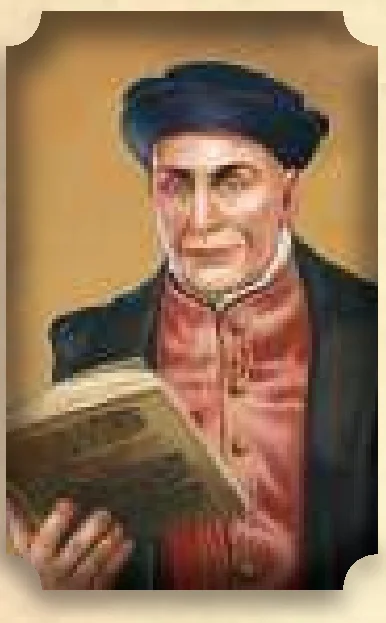
Sveboldus Fiol – Schweipolt Fiol
Fiol was Frankish by birth, Cracovian by choice. A Renaissance man with many occupations, he not only embroidered liturgical vestments with golden threads, but was also interested in mining – he invented a machine to drain mines. Later, he entered the printing business, expecting it to be more profitable than embroidery. Eastern Europe owes much to him in the printing field. Polish printers at that time did not cast their own types, but imported them from Western Europe. Only four decades after Gutenberg’s invention, Fiol decided to start printing with an alphabet that had never appeared in print before. To this end, he hired Rudolf Borsdorf, an engraver and type caster from Braunschweig, commissioned him to make the world’s first Cyrillic typeface, which was also the first original typeface created in Poland. Their contract granted Fiol exclusive rights to Borsdorf’s work. Like Gutenberg, Fiol did not profit from his innovation. The Inquisition confiscated the books he had printed. Fiol was eventually acquitted, but he never returned to printing.
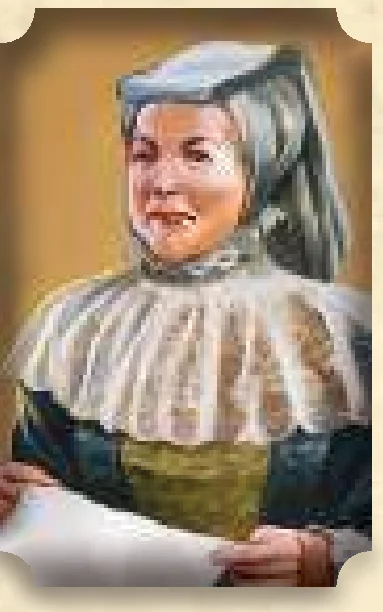
Carola Guillard – Charlotte Guillard
She worked at the Soleil d’Or printing house in Paris from 1502 to 1557. She was one of the few women who worked in the printing industry under her own name in the 16th century. In those days, for a woman to run a printing house, she had to… become a widow. The guild system did not permit women to run their own business. An exception was when a printer died – then his wife received permission to continue his work. So Charlotte ran a printing house from 1519 to 1520, after the death of her husband, Berthold Rembolt. After her two years of widowhood, she remarried, to Claude Chevallon, a bookseller and printer. Then in 1537, she again became a widow. Once again she became the head of the company, this time as Madame Chevallon. And it was quite a company – it had 4 or 5 presses and had from 12 to 25 employees. Charlotte’s books were considered beautiful, with great attention to detail.
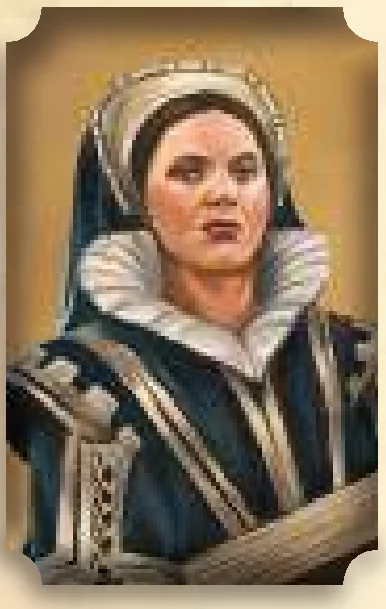
Helena Ungler – Helena Ungler
She was a woman, and she was a printer, so she was also… a widow. She married Florian Ungler, a Kraków printer. After his death in 1536, she continued his printing house. In practice, the work was supervised by professionals – qualified printing apprentices. For the first five years after Florian’s death, Ungler’s prints were marked with his name, for commercial reasons. In 1541, Helena began to sign books as the Widow of Ungler. She printed a total of 129 titles, more than half of which were theological works. Her last publication was Marcin Bielski’s Chronicle of the Whole World – an ambitious book about the entire history of mankind, from the creation of the world to the author’s time. Not surprisingly, this work was very different from today’s history books – it combined stories from the Old and New Testaments, historical facts, apocrypha, fairy tales, legends, and more.
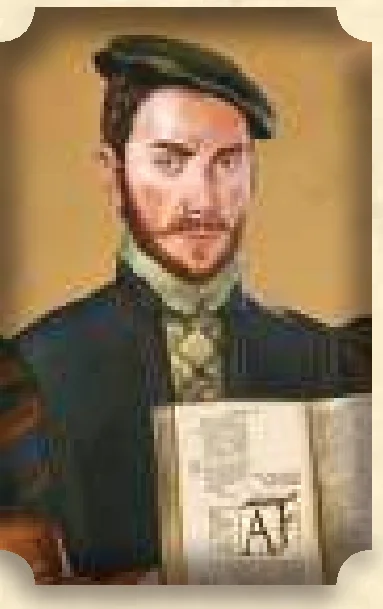
Godofredus Torinus – Geoffroy Tory
His Parisian printing house stood out from the crowd. Among other things, he published a decorative Book of Hours, a popular prayer book. His prints were richly illustrated and decorated with woodcuts. Tory was also active in typography, to which he devoted much attention. In 1529, he published his work Champ Fleury (full title: Champ Fleury, Au quel est contenu L’art & Science de la deue & vraye Proportion des Lettres Attiques, quo dit autrement Lettres Antiques, & vulgairement Lettres Romaines, proportionnees selon le Corps et Visage humain.), in which he analyzed the structure of the Roman alphabet by comparing the proportions of letters to those of the human body. The illustrations in Champ Fleury were distinctive: capital antiqua letters are superimposed on squares and circles, often with other geometrical shapes in the background. Tory moved away from typefaces that imitate handwriting: he pushed typography away from calligraphic styles toward more designed styles.
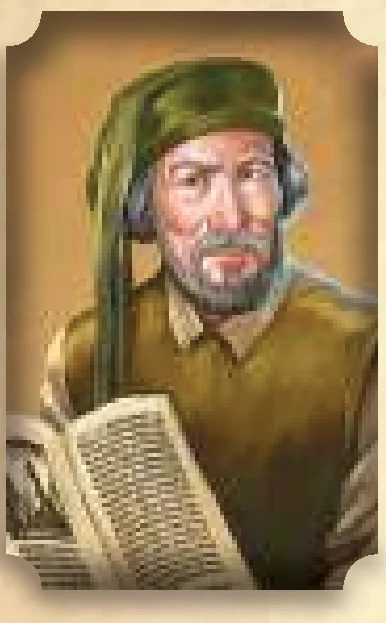
Gulielmus Caxton – William Caxton
Writer, merchant and diplomat. The first English printer, he learned the printing craft during his stay in Cologne (1470–1472). Two years later, he set up a workshop in Bruges, where he translated and printed Recuyell of the Historyes of Troye. He published one or two more books there, then he returned to England, where in 1476 he established the first printing house in the British Isles in Westminster, near London. He published mainly in his national language, which was a very unusual printing practice at the time. But Caxton had very practical reasons for this. Publishing in Latin meant competing with the major printers in continental Europe. By publishing in English, he satisfied a niche market. The first book he published was an edition of Chaucer’s The Canterbury Tales. He also published the first English translation of Ovid’s Metamorphoses. Caxton had a huge influence on English literature.
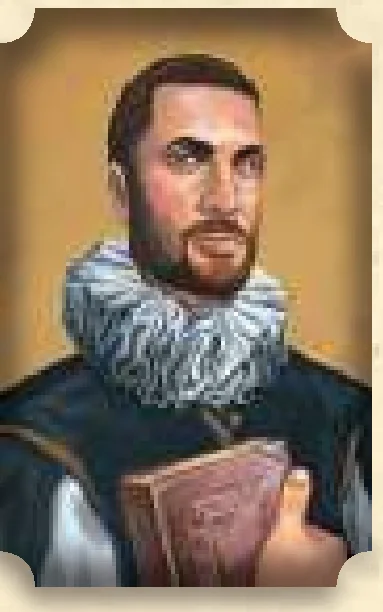
Hieronymus Vietor – Hieronymus Vietor
An educated humanist and graduate of the Kraków Academy, he opened his first printing house in Vienna in 1510. Seven years later, he returned to Kraków, where he ran his printing house from 1518 to 1546. The Vienna branch was then run by his brother, Benedykt, and later by his son, Florian. He carefully kept high typographic standards in the books he published. Polish culture owes much to Vietor. In the early days of printing, books were published mainly in Latin, which served as an international language. Vietor’s printing activities in Polish contributed to the development of Polish literature. Besides Latin and Polish, he also published in German, Greek (the first in Poland) and Hungarian (the first in the world). One of the books he published was The Life of the Lord Jesus Christ by Baltazar Opec from 1522 – an apocryphal story about the life of Jesus Christ. It is a special publication – it is the oldest fully-preserved Polish-language book. (Paradise of the Soul by Biernat of Lublin is older, but it has survived only in fragments.)
Credits
- Game designers: Katarzyna Cioch, Wojciech Wiśniewski
- Illustrator: Rafał Szłapa
- Graphic design: Małgorzata Parczewska
- Graphic assistance: Michał Moskalewicz
- Production assistance: Bartłomiej Napieraj
- Historical research and rulebook layout: Mateusz Czekała
- Editing: Krzysztof Jurzysta, Aleksander Redwan, Joanna Wójtowicz
- English translation: Russ Williams
From the authors
The authors would especially like to thank Johannes Gutenberg for his inspiration; Mateusz Czekała for his committed support and fact-checking; Mikołaj Cioch and Tomasz Cioch for their constant support; the test groups PortoTypy, Pamper, Tabletop Simulator test group, and all the testers for their time and valuable professional comments.
Introduction & Components
About the Game
Printing technology enabled the spread of knowledge, thoughts, and ideas. For this reason, the invention of printing is considered one of the pivotal global events ending the Middle Ages. At the local level, talented craftsmen and efficient entrepreneurs have a great opportunity to develop a profitable business. The demand for books is growing, the competition is still small, and the potential for development is unlimited…
Gutenberg is a board game for 1-4 players who take on the role of printing pioneers. During the game, they will acquire and fulfill orders for valuable volumes, develop their specialties, improve their printing houses, and obtain the support of a powerful patron. Through these actions, players will earn fame points, which will determine the winner.
Rulebook Conventions
Manicule
In medieval manuscripts, manicules (lat. manicula – “little hand”) were frequent. They found their way from manuscripts to the first printed texts. They indicate important places in a text. In this manual, manicule is used to indicate particularly important rules.
Advice from the Master
Johannes Gutenberg, as an inventor and pioneer of printing, was very knowledgeable. Practical tips for players appear in boxes marked with his image.
Component List
- Double-sided main board
- 4 printing house boards
- 4 initiative boards
- 4 screens
- 10 character tiles
- 100 order cards:
- 50 printing cards (black and white backs)
- 50 refinement cards (colored backs)
- 10 specialty cards
- 40 3D wooden letter block types
- first player token
- 14 automa cards:
- 10 planning cards
- 4 execution cards
- 16 patronage cards
- 8 spare type tokens (2 of each type)
- 2 William Caxton’s tokens
- 8 player disks (2 in each of 4 player colors)
- 12 gray cylinders (used as gear axles)
- 32 gears
- 12 used gear markers
- 48 ink tokens:
- 12 blue
- 12 silver
- 12 gold
- 12 red
- 20 player markers (5 in each of 4 player colors)
- 34 initiative markers
- current round marker
- 57 guilders:
- 15 worth 5
- 12 worth 2
- 30 worth 1
- bag
Items may differ from those shown.
Setup
Game Preparation
- Place the main board in the center of the table, with the correct side up for the number of players.
- Use the spaces with the symbol only when playing with 4 players.
- When playing with 2 players, use the board side marked: 2
- Use the spaces with the symbol
- Shuffle both decks of order cards (printing cards and refinement cards) separately, then place each deck face down next to the board. Leave space by each deck for its own discard pile.
- With 2/3/4 players, draw 6/8/10 printing cards and 6/8/10 refinement cards and place them face up next to the main board. Players will select several from them later during setup (in step 16), so this table space will only be temporarily occupied during setup.
- For each printing and refinement space on the main board, draw and place a random card of that type face up on the space.
- Put all ink tokens into the bag. Going from left to right, place a randomly drawn ink token onto each ink space on the main board. Place the bag with remaining ink tokens next to the board.
- Ink tokens are limited; there are 12 of each color. A player cannot take a color from the bag if the bag has none of that color. Players can check the contents of the bag at any time.
- Shuffle the specialty cards, then place them face down in a deck next to the game board. Leave space by the deck for its discard pile.
- For each specialty space on the main board, draw and place a specialty card face up on the space.
- Shuffle and place the gears face down in a deck next to the main board.
- In a 2-player game, return the gears with white lines between sectors to the box (they will not be used); use only the gears with gray lines.
- For each gear space on the main board, draw and place a gear face up on the space.
- Shuffle the patronage cards and place one face up on each patronage space on the main board. Return the remaining patronage cards to the box.
- Place the round marker on the first space of the round track.
- Place the guilders and types where all players can reach them.
- Guilders and types are unlimited. In case they run out, players may improvise as needed, e.g. using spare type tokens included in the game as substitutes.
- Each player says which book they most recently read; whoever’s book is the thickest will be the first player and receives the first player token. Players will then take turns in clockwise order.
Player Setup
- Each player chooses their player color and takes:
- a printing house board;
- an initiative board;
- a screen;
- a set of initiative markers according to this table:
- first player: 7
- second player: 8
- third player: 9
- fourth player: 10
- 3 gray cylinders, which should be pushed into the 3 gear axle holes on the printing house board (this may require force);
- 5 player markers in their chosen color. 1 player marker goes on the lowest space of each of the 4 specialty tracks on the printing house (f1). The remaining marker goes beside their printing house (f2);
- 2 player disks in their chosen color. One goes on “0” on the fame track on the main board (g1), and one goes on the leftmost space of the reward track (g2) on their printing house board;
- 10 guilders from the bank;
- 3 used gear markers go beside their printing house.
- Each player draws 2 random character tiles, then chooses one to keep and returns the other to the box.
- Players should read aloud each chosen character’s special rules. During your first games, we suggest playing a simpler version of the game without characters, skipping this character selection step.
- Starting with the first player and continuing clockwise, each player selects one order from the face up cards prepared in step 3, i.e. one printing card and one refinement card from the table; a player can freely combine any printing card with any refinement card to make an order. Then in reverse order, starting with the last player (to the right of the first player) and continuing counter-clockwise, each player selects a second order (printing + refinement). Return the 4 unselected cards to their discard piles.
- An order is always a pair of cards: one printing + one refinement. A selected order goes into a free slot beside the player’s printing house. Each order pair is permanently linked: players may never swap individual cards between orders.
- Each player chooses 3 types from the type pool and places them in their resources.
- Advice from the Master: It is best to first choose types that help fulfill these first orders.
Round Structure & Actions
Round Overview
The game lasts 6 rounds. Each round has the following steps in order:
- Turn Gears
- Plan
- Execute Plans:
- take orders;
- take inks;
- develop specialties;
- improve printing houses;
- patronage.
- Fulfill Orders
- Prepare the Next Round
1. Turn Gears
Each player must turn the top gear on their printing house board clockwise one sector. The other connected gears will also turn. In the first round, skip this step.
Advice from the Master: Gears taken during the Improve Printing Houses action are an important strategic element. It is worth planning gear placement with future game rounds in mind.
2. Plan
Players plan actions for the current round. Each player hides their initiative board and initiative markers behind their screen. They simultaneously allocate their markers among the 5 actions. Markers go on empty slots (from left to right) on a desired action’s row. A row can have at most 6 markers.
When all players are ready, they all remove their screens to reveal their plans.
Actions are resolved in sequence, from top to bottom. The sequence on the initiative boards matches the sequence on the main board.
For each action, each player’s number of markers determines the player order for that action: players do a given action in order from the player with the most markers on that action to the player with the fewest markers. Ties in markers are broken by player order.
For each action, it is advantageous to play earlier, since more options are available earlier. A player must have at least one marker on a given action to do that action. Doing an action is optional, regardless how many markers a player placed on that action.
Example showing player order for actions:
- Anna is the first player (has 7 initiative markers)
- Tom (has 8 initiative markers)
- Kate (has 9 initiative markers)
| Action | First | Second | Third |
|---|---|---|---|
| Take Orders | Anna | Tom | Kate |
| Take Inks | Anna | Tom | Kate |
| Develop Specialties | Kate | Tom | Anna |
| Improve Printing Houses | Kate | Tom | — |
| Patronage | Anna | Tom | Kate |
- Take Orders: Anna and Tom both have 2 markers on the first action, while Kate has only 1. So Kate is third. Since Anna and Tom are tied in markers, Anna goes first, because player order in the round breaks ties in markers. Likewise for the second action (Take Inks).
- Develop Specialties: Kate has the most markers (3), so she goes first on this action. Tom is second with 2 markers, and Anna is third with only 1 marker.
- Improve Printing Houses: Kate again has the most markers, so she goes first, and Tom is second. Anna put no markers on this action, so she cannot do this action.
- Patronage: The Patronage action will be performed by Anna first. Next will be Tom, because he is the next player clockwise.
3. Execute Plans
For each action, players do that action in the order determined by how they planned on their initiative boards.
a. Take Orders
Each acting player may choose one printing card and one refinement card from the main board, creating an order, then places this order in a free slot beside their printing house. The 2 cards of an order cannot be separated later. A player can store at most 4 orders at a time. A player with 4 orders may take another order, but they must first discard one of the 4 they have to create a free slot.
After players are done with this action, discard any remaining printing and refinement cards from the main board to their discard piles.
Order as a Reward
It is also possible to gain an order as an (optional) reward, e.g. for fulfilling an order, from an active gear space, for developing a specialty, or from a Patronage action. The symbol indicates such a reward. In this case, the player draws 2 printing cards and 2 refinement cards from their decks, then chooses one of each type to create an order, then places it in an empty slot beside their printing house. The unchosen cards are discarded. A player who is not satisfied with the 4 drawn cards may pay 2 guilders to draw 2 additional cards, which can be 2 printing cards, or 2 refinement cards, or one of each type. A player may repeatedly do this as long as they can afford to.
b. Take Inks
Each acting player may select one set of 3 inks from the main board and take 1, 2, or all 3 inks from that set. The first (leftmost) ink in a set is free; the second (center) costs 1 guilder; the third (rightmost) costs 2 guilders. The inks in the selected set must be taken from left to right, e.g. a player may not take the third ink while leaving the first (which is free) or the second (which costs 1 guilder). A player may choose a set that was partially taken by a previous player, but the costs remain the same (1 or 2 guilders for the second or third ink). A player puts their inks beside their printing house board.
After players are done with this action, put any inks remaining on the board back into the bag.
Example: John is the last player to take inks. There are 3 remaining sets of inks. John chooses the rightmost set, from which a previous player already took the first ink for free. John takes the blue and gold inks, paying 1+2=3 guilders. John wants these colors to fulfill an order.
c. Develop Specialties
Players doing this action may choose one specialty card from the main board. A card can be used in one of two ways:
- A: move the indicated specialty marker(s) up (one level for each of a specialty’s symbols on the card)
or - B: move any other specialty marker 1 level up.
Players move their markers on specialty tracks C on their printing house boards. The first time a player reaches a level marked by (i.e. II, IV, V, VI) on any of their specialty tracks, the player advances their disk on the reward track reward marker D accordingly to the next space and takes the indicated reward.
- Reaching the same reward level in another specialty does not give the player any additional reward.
- Level VI is the maximum for each specialty. If a player develops a specialty that is already at level VI, the player does not move the marker further, but gains 3 guilders.
- After players are done with this action, discard all specialty cards remaining on the board.
Specialties:
- Typesetting
- Woodcutting
- Binding
- Illuminating
Rewards for reaching specialty levels:
| Icon | Reward |
|---|---|
|
The player takes 1 ink of their choice from the bag. |
|
The player takes 1 new order (see Order as a Reward, p. 8). |
|
The player takes 1 type of their choice for free. |
Example: John takes a specialty card with 1 icon for Typesetting and 1 icon for Illuminating. He increases his Typesetting and Illuminating by 1 level each. He could instead have chosen to advance any single specialty by 1 level. His Typesetting now reached level IV, so John moves his reward marker to the next space and takes an ink of his choice from the bag. His Illuminating now reached level II, but that has no effect because he already received his level II reward earlier.
d. Improve Printing Houses
The gears in printing house mechanisms allow players to receive additional rewards or improve a current action.
Players doing this action may take one gear from the main board and install it in their printing house A. Gears are installed on the gray cylinders on printing house boards, starting at the topmost gear space (number 1). Each successive gear must touch the previously installed gear, and they should be correctly meshed. When adding a new gear, be sure that exactly one of its 3 sectors is aligned with that gear’s active sector mark on the board C.
Instead of taking a gear from the main board, a player can uninstall one gear from their mechanism, rotate it as they like, and reinstall it back B.
A printing house can have at most 3 gears. A player with 3 gears can take another, but must discard one of their installed gears to make space for the new gear.
Each gear has 3 sectors with rewards. Only the gear sectors next to the shaded crescents on the printing house board C are active. A gear’s active sector has a reward that a player can gain at any time. To gain a gear’s reward, the player takes a used gear marker from their stock and puts it onto the activated gear sector. A gear can only give its reward once per round. A player may place up to 3 markers (1 on each of 3 gears) per round. A detailed description of the reward symbols on the gears is on page 22. The player does not have to collect rewards from their gears if for some reason they do not wish to do so.
- If a player has used a gear this round, that gear cannot be repositioned or discarded this round.
- After players are done with this action, discard all gears remaining on the board.
Example: Anna wants to use her gears. At this moment, she can use one gear’s reward to exchange one ink for another and another gear’s reward to buy one I type for 3 guilders cheaper. She cannot gain her third gear’s reward (to take an order) because she already did that earlier this round.
e. Patronage
Players doing the Patronage action may do one of the following actions:
- Choose one available reward: The player puts their marker on it, making this reward unavailable to other players until the end of the round:
- Take 1 order, or
- Advance one specialty by one level, or
- Take 3 guilders, or
- Take any 2 inks from the bag
- or Take 1 patronage card (if the player meets the patronage card’s conditions).
A patronage card may only be taken if it is on a space below or to the left of the round marker. If a player uses ink to take a patronage card, the player must put the indicated ink back into the bag (similar to fulfilling an order). Types and specialties are not spent; they remain permanently with a player.
In the first two rounds, the round marker has not yet reached any patronage cards, so players cannot take a patronage card; they can only take one of the rewards.
Patronage card requirements:
- A player must have the indicated specialties at the indicated levels (or higher).
- A player must have the indicated specialty at the indicated level (or higher) and the indicated inks (which must be put into the bag).
- A player must have the indicated inks (which must be put into the bag) and the indicated types.
- A player must have the indicated specialty at the indicated level (or higher) and the indicated types.
Fulfilling Orders
4. Fulfill Orders
After players are done with actions, they fulfill orders. This is done in clockwise order, starting with the first player.
Orders Structure
Each order has two cards: a printing card (A) and a refinement card (B). Fulfilling orders is the main way players earn points. To fulfill an order, a player needs the resources indicated on its cards.
Types and specialties are permanent (not discarded after fulfilling an order), but inks are used up (discarded into the bag after fulfilling an order).
For fulfilling the printing card, a player earns guilders; for additionally fulfilling refinements, a player earns fame points. If the order is completely fulfilled, a player gains an additional reward.
- A player must fulfill the printing card’s requirements.
- The refinements are optional: a player may fulfill both, one, or none of the refinement card’s requirements.
- The order’s two cards are permanently linked from the moment a player places them in a free slot of their printing house. After fulfilling an order, both cards are discarded, even if the refinement requirements were not fulfilled. During this step, a player may fulfill all, some, or none of their orders. Unfulfilled orders simply remain in their slot.
- All orders are fulfilled simultaneously. This means that types used to fulfill one order or rewards from fulfilling an order cannot be used to fulfill another order in the same round.
Printing
To fulfill a printing card, a player must assign the required types to the printing card. The player receives the card’s indicated number of guilders as a reward.
- Using types to fulfill an order does not use them up. After fulfilling the order, the types used for it return to the player’s resources.
During game preparation, each player chooses 3 types. Players can buy additional types. The cost to buy another type depends on how many types you have (see table below). Buying your 4th type costs 4 guilders, your 5th type costs 5 guilders, and so on.
| Buying your n-th type | 3 | 4 | 5 | 6 | 7 | 8 | 9 | 10 | 11 | … |
|---|---|---|---|---|---|---|---|---|---|---|
| Costs n guilders | 3 | 4 | 5 | 6 | 7 | 8 | 9 | 10 | 11 | … |
Example: Anna has 3 types: A, I, O. She wants to buy 2 more: one U and another A. So she spends 4 + 5 = 9 guilders.
Players can buy types at any time during a round – it is not an action. A player can buy and own as many types as they want (and can afford). A given type can be assigned to only one order in a round in the Fulfill Orders step. Players should place their types on their order cards to clearly indicate which order each type is assigned to. Types are unlimited – in the rare event that a given type runs out, players may use spare type tokens or improvise other substitutes.
Example: This printing card requires the player to use types I, O, O, and U. Fulfilling an order with this printing card gives a player 5 guilders.
Refinements
Refinements include colors and decorations. Both parts are optional. Each part gives fame points independently if fulfilled. Whenever a player gains fame points, they advance their disk on the fame track accordingly. Fulfilling both refinements gives an additional reward, depending on the card.
- Colors (A) require assigning the indicated inks to the refinement card. This uses up the ink! After fulfilling a color requirement, the used inks go back into the bag. Inks are limited by the contents of the bag: a given color cannot be taken from the bag if the bag has none of that color.
- Decorations (B) require that the player have all the indicated specialties, and each must be at the same level (or higher) as indicated on the card, otherwise the decoration cannot be fulfilled. Specialties are not used up and do not decrease in value during the game.
Example: a player can spend 1 red ink to gain 2 fame points.
Example: if a player has typesetting and binding, each at level II or higher, the player gains 3 fame points.
Reward for completely fulfilling an order
If a player completely fulfills an order (the printing card and both parts of the refinement card), they may take the additional reward C shown at the bottom of the refinement card. Taking a reward is optional.
Table of possible rewards for completely fulfilling an order:
| Reward | Description |
|---|---|
|
The player takes 1 / 2 selected inks from the bag. |
|
The player takes 1 / 2 guilders from the bank. |
|
The player gains 2 / 3 fame points. |
|
The player selects one specialty and advances it 1 level higher. |
|
The player takes a new order (see: Order as a Reward p. 8). |
Round End & End of Game
5. Prepare the Next Round
At the end of each round (except the last round), do these steps:
- Refill the main board as during the setup to add:
- order cards: one face-up printing card on each printing space, and one face-up refinement card on each refinement space,
- inks: one ink (drawn from the bag) on each ink space,
- specialty cards: one face-up specialty card on each specialty space,
- gears: one gear on each gear space.
If any deck runs out, shuffle its discard pile to form a new deck.
- Move the round marker to the next space.
- All player markers on patronage spaces return to their owners.
- Remove used gear markers from gears.
- Remove initiative markers from initiative boards.
- Pass the first player token to the next player (clockwise).
- Each player gives one initiative marker to the player who just passed the first player token.
Example of passing the first player token: The first player, i.e. the player with the first player token, always has 7 initiative cubes, the second player has 8, the third player has 9, and the fourth player has 10. When the first player gives the first player token to the next player (clockwise), the other players each give one initiative cube to the player who gave the token. Thus in the new round, the first player has 7 initiative markers, the second player has 8, the third player has 9, and the fourth player has 10.
6. End of the Game
After 6 rounds, the game is over, and there is final scoring of fame points. In addition to points earned during the game and already marked on the fame track, players receive additional points as follows:
- specialties:
- 6 points for each specialty at level VI;
- 3 points for each specialty at level V;
- 1 point for each specialty at level IV;
- patronage cards: 8 points for each acquired patronage card;
- guilders: 1 point for every 3 guilders.
The player with the most fame points is the winner. Ties are broken in favor of players with fewer types. Remaining ties are broken in favor of players with fewer inks. Remaining ties remain unbroken ties.
Example: After 6 rounds, the game ends. John has 84 fame points, and his printing house looks like this:
He gains 27 additional fame points:
- his 4 guilders give 1 point,
- his specialties give 10 points (6 for Typesetting + 1 for Binding + 3 for Illuminating),
- his 2 patronage cards give 16 points.
In total John accumulated 111 fame points.
Solo Mode (Automa)
Overview
The automa simulates an abstracted additional player in the Plan and Execute Plans steps. When the automa acts, it will randomly discard resources from the main board. The automa enables solitaire play. It can also be added to a game with 2 or 3 players.
Components for the Automa
- Initiative board (one of the unused boards),
- 7 initiative markers (the same number as for the first player),
- One player marker of an unused color (to mark a patronage reward),
- Automa cards (10 planning cards and 4 execution cards).
Automa Setup
When setting up the game, count the automa as an additional player and set up the game according to the usual rules:
- Prepare an unused initiative board for the automa.
- The automa takes the first player token (D).
- Place its initiative markers on its initiative board as shown (A).
- Shuffle the 4 automa execution cards (B) and place them face down near the automa’s initiative board.
- Shuffle the 10 automa planning cards (C) and deal 6 face down into a deck near the automa’s initiative board. Return the 4 remaining planning cards without looking at them to the box; they will not be used.
- During step 3 of Game Preparation (page 4) put one order less than indicated. The automa does not take order cards.
Automa Rules
Each round, after all players complete the Plan step, reveal the top automa planning card (C), and rearrange the automa’s initiative markers on its initiative board as directed by its planning card. Then Execute Plans as usual, resolving player order for each action according to each player’s assigned initiative markers (including the automa’s markers) by the usual rules of the game (see p. 7).
When the automa does an action, draw a random automa execution card to see from which space the automa takes a resource. The card’s number indicates the resource space (see E). If there is no resource in that space on the board (i.e. that number is empty because fewer players are playing, or because another player already took from that space this round), then draw the next execution card. After the automa does its action, reshuffle the entire automa execution deck: for each action, the automa starts drawing from its full deck of 4 execution cards.
Actions
- During the Take Orders action: the automa randomly removes a printing card and a refinement card. Draw an execution card for each of the 2 cards.
- During the Take Inks action: the automa removes all inks from a random ink space.
- During the Develop Specialties action: the automa removes a random specialty card.
- During the Improve Printing Houses action: the automa removes a random gear.
- During the Patronage action: the automa will take a patronage card or one of the rewards. If this round’s planning card shows a patronage card (G), the automa takes the leftmost card (exception: in the first and second rounds, the automa must take a reward: see Patronage, page 11.) Otherwise, the automa takes one of the rewards (chosen randomly by an execution card).
The automa does not accumulate resources. Put any ink it takes back into the bag, and put other resources it takes onto their discard piles.
End of Round
At the end of a round, the automa passes or receives initiative markers as usual, like other players, when the first player token is passed:
- If the automa passes a marker, it takes it from its action that has the most markers.
- If the automa receives markers, put them one after another onto whichever action has the fewest markers at the moment a marker is placed.
If there is a tie among its actions for the fewest or the most markers, use this round’s planning card center icon to break the tie; see detailed rules below. Unlike human players, the automa then leaves its markers on its initiative board, and will simply shift a few markers during the next Plan step.
Detailed rules of the iconography of automa cards and automa initiative markers
- : means to move an initiative marker from the first action to the second action.
- If the first action has no marker, then instead move a marker from the second action to the first. If neither has any markers, then do nothing.
- Some cards also have min. and max.:
- min. – the action with the fewest initiative markers,
- max. – the action with the most initiative markers.
- If there is a tie for minimum or for maximum, then scan the actions, starting at the action printed in the middle of the planning card (F), then scanning downward, possibly wrapping around to the top action and continuing, until you reach one of the tied actions: this is the action that wins the tie.
- If an action already has 6 initiative markers, do not move another marker to it.
Solitaire Scoring Titles
Solitaire players may earn professional titles from the printing guild based on their scores, as shown in this table:
| Score | Level |
|---|---|
| < 100 | Student |
| 101–110 | Senior Student |
| 111–120 | Apprentice |
| 121–130 | Senior Apprentice |
| 131–140 | Junior Master |
| 141–150 | Master of Printing |
| > 150 | Guildmaster |
Reference: Gear Rewards & Characters
Gear Rewards
| Symbol | Reward Description |
|---|---|
|
The player exchanges one of their inks for another ink available in the bag. |
|
The player exchanges one of their types for another from the pool. |
|
The player increases their lowest specialty by 1 level. In case of a tie for their lowest specialty level, the player chooses one of their lowest specialties. |
|
The player gains as many fame points as the current round number (1-6). |
|
The player takes an order (see Order as a Reward, p. 8). |
|
The player discards one type, then gains either 3 fame points or 5 guilders. |
|
The player gains 2 fame points for each of the orders they are currently fulfilling for which the player is using one or more of the indicated inks to fulfill the Color refinement. If an order requires more than one indicated ink, the order still gives 2 points; there is no additional benefit. |
|
The player gains the indicated color of ink from the bag. |
|
The player puts 1 ink of the indicated color into the bag, then takes any 2 inks available in the bag. The player can re-take the color they put in. |
|
The player gains 2 fame points for each of the orders they are currently fulfilling that has the indicated type. If an order has more than one indicated type, the order gives 2 points; there is no additional benefit. |
|
The player can buy one of the indicated type for 3 guilders less. |
|
The player gains 2 fame points for each of the orders they are currently fulfilling for which they fulfill the Decoration refinement with the indicated specialty. |
|
The player advances their indicated specialty by 1 level. |
Characters – Special Rules
Iohannes Gutenberg – Johannes Gutenberg
After all players reveal their initiative boards with planned actions – but before players execute actions – this player may shift 1 initiative marker on his board to a different action.
Carola Guillard – Charlotte Guillard
Immediately after selecting this character, this player draws 4 random gears, selects 2, and installs them in their printing house.
Aldus Manutius – Aldo Manuzio
If this player fulfills 2 or more orders at the same time, they may ignore one of the required types on one order.
Helena Ungler – Helena Ungler
Immediately after selecting this character, this player advances one specialty to level I and another to level II, then advances their reward marker on the reward track to level II and receives that reward (ink).
Petrus Schoyffer – Peter Schöffer
This player may use the active sector of one gear 2 times in a round. They still may do only 3 gear actions total per round.
Godofredus Torinus – Geoffroy Tory
At the end of each round, if this player can assign all of their inks to their current orders, they gain 3 fame points.
The inks are not permanently assigned to these orders; in future rounds, they may be assigned to other orders.
Christophorus Plantinus – Christophe Plantin
Once per round, this player can swap the levels of 2 of their specialties, adjusting the markers on both tracks. (I.e., this is not a temporary effect.)
Gulielmus Caxton – William Caxton
Immediately after selecting this character, this player takes the two large William Caxton tokens. At the start of each round, this player must select one ink color which will be wild (i.e. usable as any colors) for this player (only) during this round. Put the corresponding Caxton token with that selected color face up beside the Caxton character tile as a reminder.
Sveboldus Fiol – Schweipolt Fiol
If this player fulfills only one refinement requirement of an order (color or decoration), then they nonetheless gain the reward for completely fulfilling the order.
Hieronymus Vietor – Hieronymus Vietor
At the end of the game, this player doubles their fame points gained from guilders.
E.g. 5 guilders normally give 1 fame point, but this player would earn 2 fame points from 5 guilders.
Historical Context & Credits
The Origin of Printing
Western Europe, the mid-15th century. Mainz was a typical city of its time. There were no signs that a great technological revolution would take place there, which from today’s perspective can be compared to the development of the Internet at the end of the 20th century. The book had already evolved into the form of a codex, i.e. folded sheets of paper joined in a block and bound. It functions in this form to this day. However, all books from medieval Europe were written by hand. If you wanted a copy of any of them, you had to rewrite it. Copying texts was done by scriptoria – church and secular – in which scribes filled parchment or paper pages with text, writing with sharpened quills and ink. It was very difficult and painstaking work – a lot of time was needed to write one codex while maintaining the highest quality. Therefore, books were exclusive products that only the wealthiest could afford. Information circulated mainly by word of mouth. There was no effective way to share knowledge quickly and universally, and the skills of reading and writing were rare.
At this time, Johannes Gutenberg, a goldsmith and gem cutter, entered the historical scene. This craftsman had an idea for a technological innovation that could make him a fortune. Gutenberg had noticed that the demand for books was much greater than their supply, and their prices were soaring, due to the time-consuming copying by hand. If he could devise a way to copy codices quickly and efficiently, then selling them would bring him a huge profit. As a result, he created a new technology that would soon change the world.
His invention consisted of several elements. The first was an apparatus to cast movable type. Movable type consists of small metal blocks called “sorts”, each with a raised mirrored form of a letter or other sign. The casting apparatus allowed Gutenberg to create consistent typefaces, making it possible to print many identical letters on one page. The Mainz printer’s second innovation was composing the individual sorts into a page image, held tightly together in a single block, which was then inked to leave an impression on parchment or paper. The third element of the invention was the use of a press to make the prints. He also used oil-based ink for printing books.
Interestingly, Gutenberg didn’t invent types. Already in ancient Mesopotamia, stone seals were used to mark earthenware objects. He was also not the first to use movable type for typesetting – in the 11th century, a certain Bi Sheng already did it in China. The craftsman from Mainz did not invent the press either – he used machinery that already existed. His genius was to combine all these elements, thus producing an extremely efficient method of duplicating texts.
Character Biographies
Iohannes Gutenberg – Johannes Gutenberg
Certainly the most famous printer in history. Interestingly, his invention brought him fame and… bankruptcy. Having an idea how to speed up the book-making process, all he needed was funding to start his workshop. For this purpose, in 1450 he borrowed from Johann Fust, another goldsmith in Mainz, the huge sum of 800 guilders. (At that time, the annual earnings of a skilled craftsman were about 300 guilders.) Fust himself also borrowed to finance Gutenberg’s endeavor, which shows how tempting the new technology was. Gutenberg managed to publish his life’s work – what we know today as the 42-line Gutenberg Bible – but failed to pay his debts (in 1452, he took another loan, again for 800 guilders), and so Fust took possession of his printing house. Gutenberg did not benefit financially from his invention, but he started a new industry that allowed others to expand their business.
Petrus Schoyffer – Peter Schöffer
The adopted son-in-law of Johann Fust – the goldsmith to whom Johannes Gutenberg owed the astronomical sum of 1600 guilders (in two loans of 800 guilders each) to finance his printing project. Fust told Gutenberg that he must either take Peter into his workshop as an apprentice, or he would not receive the second loan. Gutenberg agreed, so Schöffer ended up in his printing house and learned the trade. When Gutenberg was unable to pay off his debt, the creditor took possession of Gutenberg’s workshop and entered into a partnership with Schöffer. Fust now owned the machines, and Schöffer knew how to operate them. An impressive result of their work was the Mainz Psalter of 1457 and 1459. This beautiful book, printed in three colors, was proof that Schöffer had mastered the art of printing.
Aldus Manutius – Aldo Manuzio
Aldo Manuzio was the Steve Jobs of the beginning of printing. He started in Venice in the 1490s and introduced some innovations to which modern publishing owes a debt. First of all, he changed the size of books. Before Manuzio, books were big and bulky. Aldo decided to publish books in smaller (for those times) formats. One of his most famous works – Hypnerotomachia Poliphili by Francesco Colonna – had dimensions similar to today’s A4 size. Small-format printing made it possible for Renaissance humanists to take their book collections while traveling. Aldo’s second innovation concerned lettering. The first books were printed in Gothic script (difficult for us to read today), which was intended to imitate scribes’ handwriting. Aldo published texts in italics and antiquas – typefaces like those we use today. Manuzio greatly influenced the development of humanism – he was the first printer to undertake a large-scale publication of classical Greek texts, and he introduced ancient works to Renaissance humanists. These Aldine editions are still named today after him and his press.
Christophorus Plantinus – Christophe Plantin
He was born in France, studied in Paris, and after a short craftsman apprenticeship, moved to Antwerp, where in 1549 he founded a bookbindery and bookshop. Thanks to him, Antwerp became – after Paris and Venice – one of the three most important printing centers in Europe. Plantin is considered the most outstanding printer of the second half of the 16th century, and his company gained international fame. In 1575, he employed almost 150 people and ran 16 presses in his printing house. In 1583, war and Antwerp’s occupation by Spaniards forced him to move to Leiden, where he founded another printing house. The work of his life is the Plantin Polyglot Bible – an edition of the Holy Scriptures published in Hebrew, Latin, Greek, Aramaic, and Syriac. Over 40 people worked on it for 5 years (1569–1573). Plantin adopted a printer’s mark depicting a hand with a compass and the Latin motto Labore et constantia (By work and constancy).
Sveboldus Fiol – Schweipolt Fiol
Fiol was Frankish by birth, Cracovian by choice. A Renaissance man with many occupations, he not only embroidered liturgical vestments with golden threads, but was also interested in mining – he invented a machine to drain mines. Later, he entered the printing business, expecting it to be more profitable than embroidery. Eastern Europe owes much to him in the printing field. Polish printers at that time did not cast their own types, but imported them from Western Europe. Only four decades after Gutenberg’s invention, Fiol decided to start printing with an alphabet that had never appeared in print before. To this end, he hired Rudolf Borsdorf, an engraver and type caster from Braunschweig, commissioned him to make the world’s first Cyrillic typeface, which was also the first original typeface created in Poland. Their contract granted Fiol exclusive rights to Borsdorf’s work. Like Gutenberg, Fiol did not profit from his innovation. The Inquisition confiscated the books he had printed. Fiol was eventually acquitted, but he never returned to printing.
Carola Guillard – Charlotte Guillard
She worked at the Soleil d’Or printing house in Paris from 1502 to 1557. She was one of the few women who worked in the printing industry under her own name in the 16th century. In those days, for a woman to run a printing house, she had to… become a widow. The guild system did not permit women to run their own business. An exception was when a printer died – then his wife received permission to continue his work. So Charlotte ran a printing house from 1519 to 1520, after the death of her husband, Berthold Rembolt. After her two years of widowhood, she remarried, to Claude Chevallon, a bookseller and printer. Then in 1537, she again became a widow. Once again she became the head of the company, this time as Madame Chevallon. And it was quite a company – it had 4 or 5 presses and had from 12 to 25 employees. Charlotte’s books were considered beautiful, with great attention to detail.
Helena Ungler – Helena Ungler
She was a woman, and she was a printer, so she was also… a widow. She married Florian Ungler, a Kraków printer. After his death in 1536, she continued his printing house. In practice, the work was supervised by professionals – qualified printing apprentices. For the first five years after Florian’s death, Ungler’s prints were marked with his name, for commercial reasons. In 1541, Helena began to sign books as the Widow of Ungler. She printed a total of 129 titles, more than half of which were theological works. Her last publication was Marcin Bielski’s Chronicle of the Whole World – an ambitious book about the entire history of mankind, from the creation of the world to the author’s time. Not surprisingly, this work was very different from today’s history books – it combined stories from the Old and New Testaments, historical facts, apocrypha, fairy tales, legends, and more.
Godofredus Torinus – Geoffroy Tory
His Parisian printing house stood out from the crowd. Among other things, he published a decorative Book of Hours, a popular prayer book. His prints were richly illustrated and decorated with woodcuts. Tory was also active in typography, to which he devoted much attention. In 1529, he published his work Champ Fleury (full title: Champ Fleury, Au quel est contenu L’art & Science de la deue & vraye Proportion des Lettres Attiques, quo dit autrement Lettres Antiques, & vulgairement Lettres Romaines, proportionnees selon le Corps et Visage humain.), in which he analyzed the structure of the Roman alphabet by comparing the proportions of letters to those of the human body. The illustrations in Champ Fleury were distinctive: capital antiqua letters are superimposed on squares and circles, often with other geometrical shapes in the background. Tory moved away from typefaces that imitate handwriting: he pushed typography away from calligraphic styles toward more designed styles.
Gulielmus Caxton – William Caxton
Writer, merchant and diplomat. The first English printer, he learned the printing craft during his stay in Cologne (1470–1472). Two years later, he set up a workshop in Bruges, where he translated and printed Recuyell of the Historyes of Troye. He published one or two more books there, then he returned to England, where in 1476 he established the first printing house in the British Isles in Westminster, near London. He published mainly in his national language, which was a very unusual printing practice at the time. But Caxton had very practical reasons for this. Publishing in Latin meant competing with the major printers in continental Europe. By publishing in English, he satisfied a niche market. The first book he published was an edition of Chaucer’s The Canterbury Tales. He also published the first English translation of Ovid’s Metamorphoses. Caxton had a huge influence on English literature.
Hieronymus Vietor – Hieronymus Vietor
An educated humanist and graduate of the Kraków Academy, he opened his first printing house in Vienna in 1510. Seven years later, he returned to Kraków, where he ran his printing house from 1518 to 1546. The Vienna branch was then run by his brother, Benedykt, and later by his son, Florian. He carefully kept high typographic standards in the books he published. Polish culture owes much to Vietor. In the early days of printing, books were published mainly in Latin, which served as an international language. Vietor’s printing activities in Polish contributed to the development of Polish literature. Besides Latin and Polish, he also published in German, Greek (the first in Poland) and Hungarian (the first in the world). One of the books he published was The Life of the Lord Jesus Christ by Baltazar Opec from 1522 – an apocryphal story about the life of Jesus Christ. It is a special publication – it is the oldest fully-preserved Polish-language book. (Paradise of the Soul by Biernat of Lublin is older, but it has survived only in fragments.)
Credits
- Game designers: Katarzyna Cioch, Wojciech Wiśniewski
- Illustrator: Rafał Szłapa
- Graphic design: Małgorzata Parczewska
- Graphic assistance: Michał Moskalewicz
- Production assistance: Bartłomiej Napieraj
- Historical research and rulebook layout: Mateusz Czekała
- Editing: Krzysztof Jurzysta, Aleksander Redwan, Joanna Wójtowicz
- English translation: Russ Williams
From the authors
The authors would especially like to thank Johannes Gutenberg for his inspiration; Mateusz Czekała for his committed support and fact-checking; Mikołaj Cioch and Tomasz Cioch for their constant support; the test groups PortoTypy, Pamper, Tabletop Simulator test group, and all the testers for their time and valuable professional comments.