
Invasion: America – Death Throes of the Superpower
1976
A corps-level mini-monster wargame of invasion, hidden unit strengths, terrain-driven combat, and campaigns lasting up to 60 turns.
240
minutes
2 - 5
player(s)
12+
Medium Heavy

About this board game
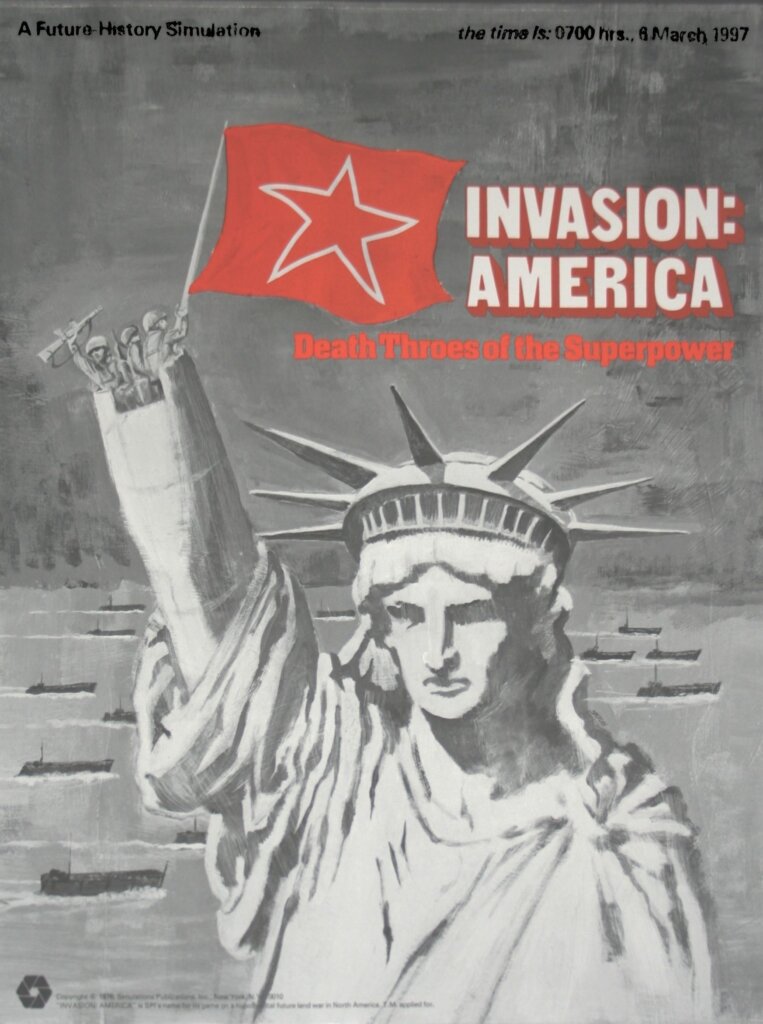
Invasion: America – Death Throes of the Superpower is a corps-level mini-monster wargame for 2–5 players, with games lasting about 240 minutes. Designed by Jim Dunnigan and published by SPI in 1976, it portrays a hypothetical invasion of North America by three competing forces.
The European Socialist Coalition launches from Cuba, the South American Union invades from Colombia, and the Pan Asiatic League advances along the Pacific coast. The United States and Canada form the defending coalition, while Central America and Mexico have already been annexed in this alternate-history setting.
Players maneuver land, air, naval, and logistics units across a 35-by-42-inch map. Each hex represents approximately 130 kilometers, with terrain, rivers, borders, ports, supply sources, resource centers, and amphibious landing zones shaping movement and combat.
- Hidden strength: Land and air units begin untried, displaying question marks until combat reveals their actual values.
- Hex-based operations: Units may move up to their movement ratings, after which adjacent opposing forces can engage.
- Odds-based battles: Combat strengths are converted into simplified odds, followed by a six-sided die roll that can cause retreats and losses.
- Multiple scenarios: Six eight-turn scenarios accompany a 60-turn campaign game.
Each turn represents one month. Scenario rules establish deployments, orders of battle, replacement rates, and victory conditions, while control of urban, supply, and resource hexes provides victory points.
With 400 half-inch counters, distinctive map symbology, and a campaign framework built around a continent-spanning conflict, Invasion: America offers a compact but substantial examination of invasion and defense. Its untried-unit feature was notably introduced here, and the popular game later led to the larger 1978 sequel Objective Moscow.
/pic7182955.jpg)
