Little Town
2017
Lead architects in a four-round contest to place workers, gather resources, construct buildings, and earn the most victory points.
60
minutes
2 - 4
player(s)
10+
Medium Light


About this board game
Little Town is a strategy board game for 2–4 players, played over four rounds in about 60 minutes. Lead a team of architects as you place workers, gather resources, construct buildings, and develop a growing town.
Each round, you place three workers on the board. Workers collect resources from the surrounding squares, including wood, stones, fish, and wheat. When a worker is placed, you acquire the resources available in all eight spaces around it, making positioning an important part of your plans.
Use your collected resources to build buildings. Buildings can provide useful effects whenever you or another player places a worker next to them. If the building belongs to another player, you must pay that player a coin before collecting the building’s resources or effect.
- Place workers to collect resources from surrounding squares.
- Build structures using wood, stones, fish, wheat, and other available resources.
- Use building powers and manage payments when working near opponents’ buildings.
- Earn victory points from buildings, their powers, and personal goals.
Players receive goals at the beginning of the game, creating another way to pursue victory points alongside construction and building powers. After the fourth round, everyone adds their victory points, and the player with the highest total wins.
With direct competition over worker placement, resources, and building benefits, Little Town offers a focused town-development challenge in a compact four-round format. Plan where to send your workers, decide which buildings to construct, and make the most of the opportunities your developing town provides.
/pic7182955.jpg)
Board Game Rules for
Little Town
Far, far away beyond the farthest mountains, there exists a rich and bountiful land yet to be explored. This region overflowing with riches is the ideal place to begin building a beautiful city. To do so, you will need to gather resources to begin your first building, then add another, and another, until a magnificent city is brought forth! Do you have what it takes to be an ambitious and talented architect?
Overview and Object of the Game
During each turn, place a worker onto the board. Gather the nearby resources and activate the neighboring buildings, or build new buildings. Position yourself with care, build in the best places, and anticipate your opponents’ choices to benefit from all possible situations and emerge victorious!
Build the town according to your ideas and prove that you are the greatest architect.
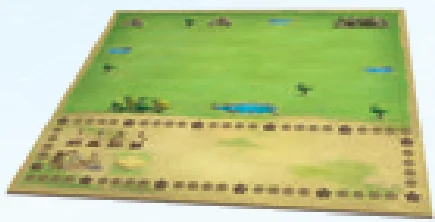
- 1 game board
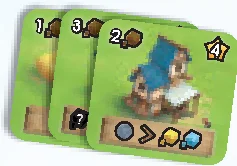
- 29 Building tiles
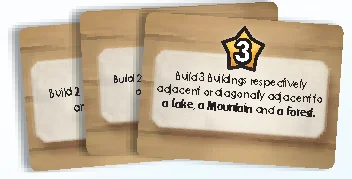
- 15 Objective cards

- 20 Worker tokens (5 white, 5 orange, 5 red and 5 purple)

- 60 Resource cubes (15 Wood, 15 Stone, 15 Fish and 15 Wheat)

- 1 First Player token

- 28 House tokens (7 purple, 7 red, 7 orange and 7 white)

- 1 Round token

- 4 Victory Point pawns
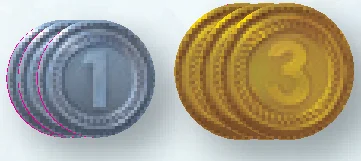
- 24 Coin tokens (16 “1” Coin tokens and 8 “3” Coins tokens)
- 4 “60” tokens
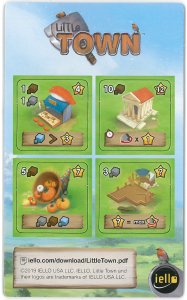
- 1 Gameplay aid
Building tiles
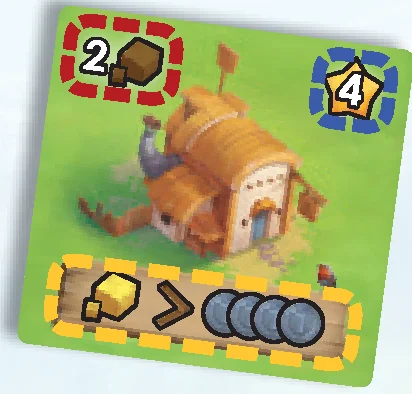
These tiles represent the different buildings that you can build. Each tile has its own Resource cost, number of Victory Points, and its Effect when placed.
Objective cards
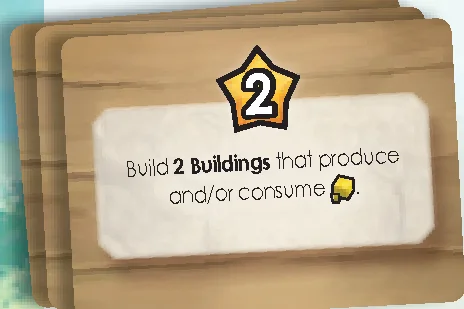
Each player receives objective cards at the beginning (the number dealt varies based on the number of players). Objective cards give different ways to gain Victory Points.
Game board
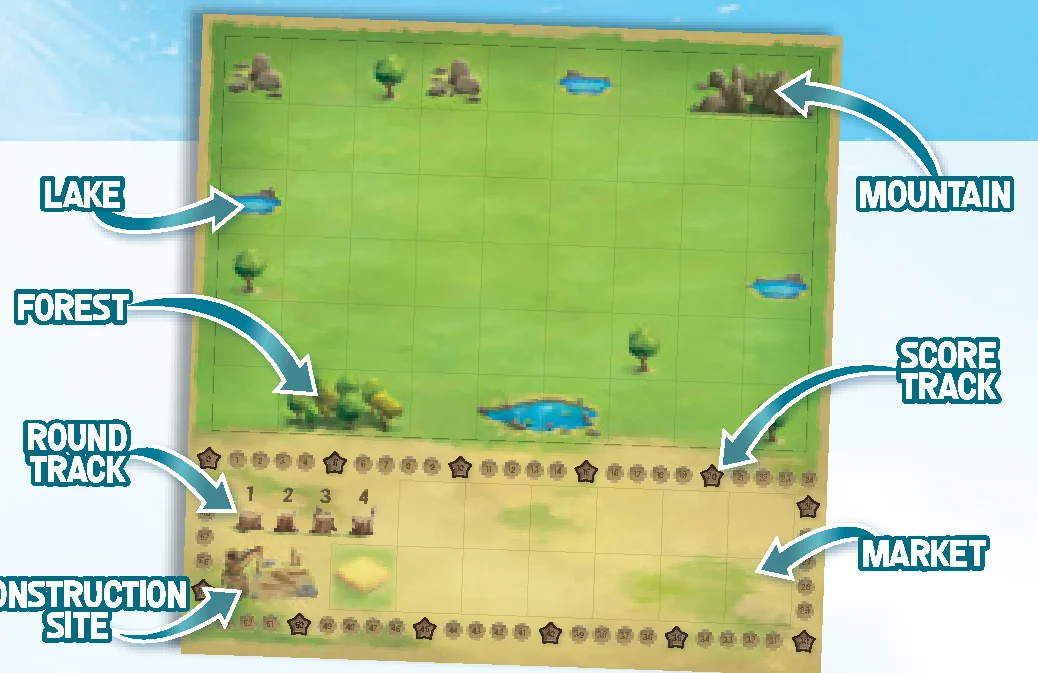
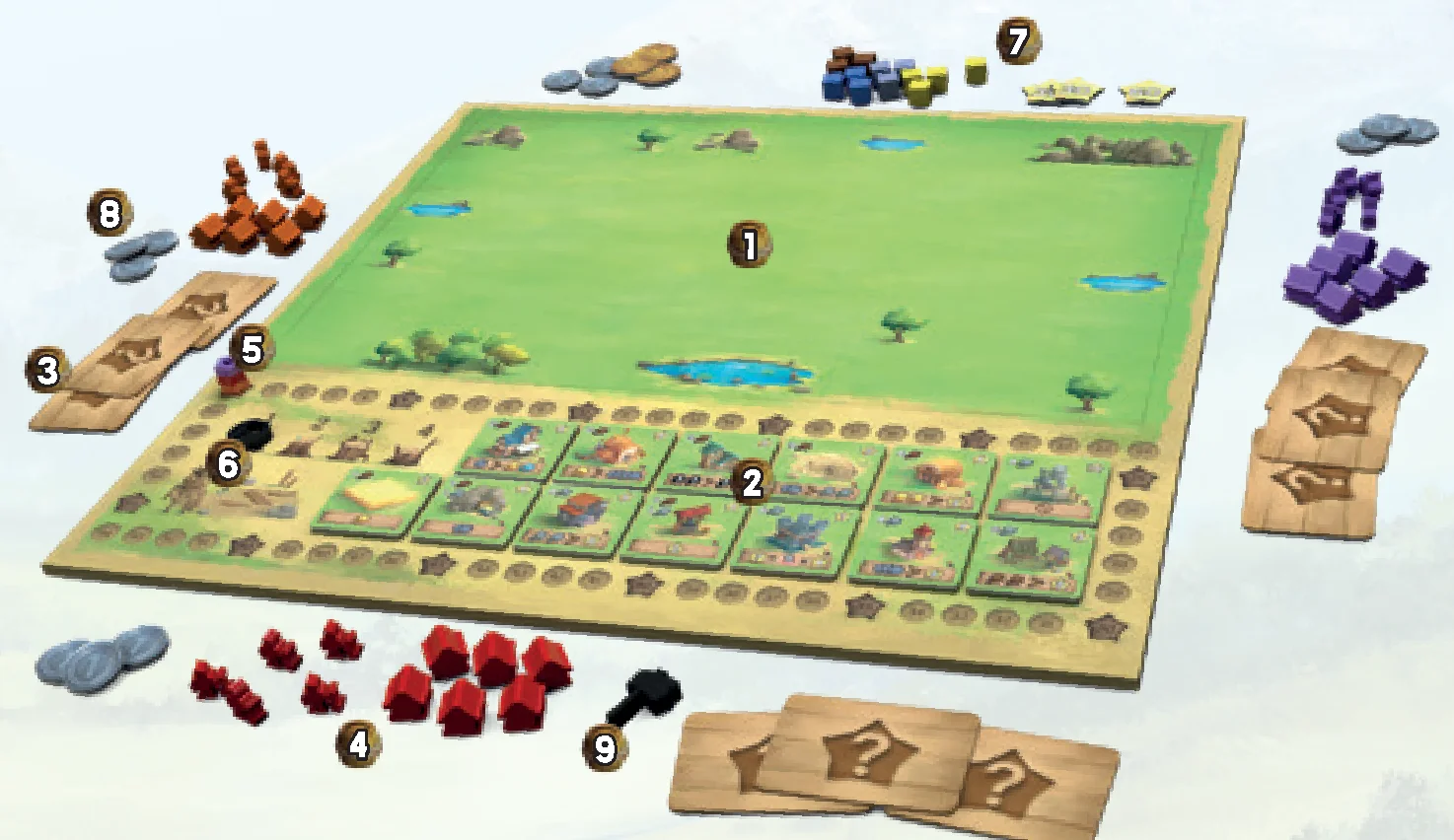
The upper part of the board represents the area where you will build your town with lakes, forests, mountains, and grass. To add variation to the game, each side of the board is slightly different. In the lower part, you’ll find the Construction Site, the Market, the Score track, and the Round track.
Worker tokens
These tokens allow you to gather Resources, build and activate buildings. The number of tokens in play depends on the number of players.
House tokens
These tokens are placed on Building tiles. They indicate who owns them. The number of these tokens in play depends on the number of players.
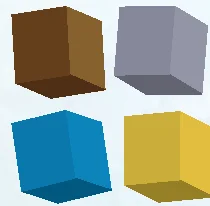
Resource cubes
- The brown cubes represent Wood
 .
. - The grey cubes represent Stone
 .
. - The blue cubes represent Fish
 .
. - The yellow cubes represent Wheat
 .
.
They allow you to buy Building tiles or to feed your workers.
Coin tokens
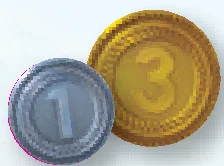
These coins ( ) allow you to activate opponents’ buildings or can be substituted for Resources. You can always make change.
First Player token
This token helps indicate which player begins the next Round.

Victory Point pawns
These pawns help track your Victory Points ( ).
).

Round token
This token moves along the Round track to indicate the current round being played.

60 tokens
These tokens help track whether a player has exceeded 60 .

- Place the game board in the center of the table facing up. Pick a side of the game board you wish to play.
- Place the 5 Wheat Field building tiles in a stack in the Market. Shuffle the other Building tiles, take 12 of them randomly, and place these on each open spot in the Market.
For your first game, we recommend using the Building tiles with the bird. - Shuffle and distribute the Objective cards face down to each player:
- 2 players: 4 cards each
- 3 players: 3 cards each
- 4 players: 2 cards each
- Each player chooses one color and places all Worker and House of that color as well as the Victory Point pawn in front of them:
- 2 players: 5 Workers, 7 Houses
- 3 players: 4 Workers, 6 Houses
- 4 players: 3 Workers, 6 Houses
- Place your Victory Point pawn on the 0 space on the Score track.
- Place the Round token on the 1 space on the Round track.
- Place the Resource cubes, the Coin tokens, and the 60 tokens near the board to make up the reserve.
- Each player takes 3 Coins and places them in front of themselves in full view.
- The First player is chosen randomly. Once the first player has been determined, place the First Player token in front of them.
Note: Certain Objective cards include the  symbol, which means that they can only be accomplished if certain Building tiles are available in the market. If an Objective card with this symbol would be impossible to accomplish, discard it and draw another one.
The game is played in 4 Rounds.
Structure of a Round
Each player in turn, clockwise, starting with the first player, performs one of the following actions:
- Gather and Activate
- Build a Building
Each of these actions requires a Worker. A Round is over once all players have placed all of their workers.
1. Gather and Activate
On your turn, you may choose to place an unused Worker on the game board. It can only be placed on an empty grass space.
Any spaces already containing a Worker token or a Building tile are not considered to be empty as well as the forest, mountain, and lake spaces.
A worker gathers Resources and can activate Buildings in the 8 adjacent spaces (including diagonals).
Gather Resources
The forest, mountain, and lake spaces allow you to gather Wood , Stone and Fish respectively.
You may gather Resources in any order you choose.
Take resources from the reserve and place them in front of you. When there are no more Resources (or ), you cannot gather more.
When a type of terrain extends over more than one space, consider each space separately for determining the number of Resources you gather.
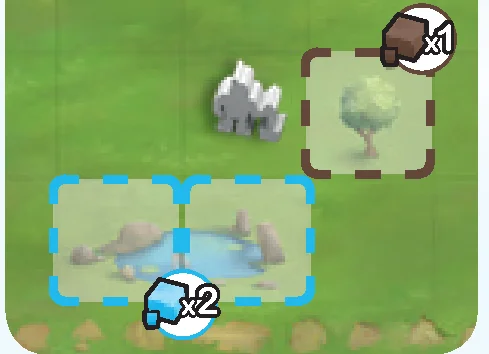
Here, your Worker token gathers 2 Fish and 1 Wood .
Activate a Building
If you place a Worker adjacent to one or more Buildings tiles (including diagonally), you may activate them and benefit from their Effects.
If the Building that you want to activate belongs to another player, you must first pay them 1 before applying its Effect. You are never forced to activate a Building tile.
A Building tile may only be activated once per Worker, meaning that you can only benefit from its effect once per activation.
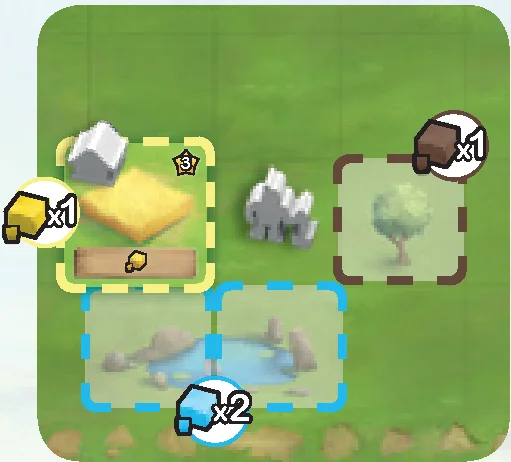
This Worker can activate the Wheat Field tile to gain 1 Wheat . He also gathers 2 Fish and 1 Wood .
Buildings have two types of Effects that can be activated:
- Gain a Resource
 , or .
 - Exchange resources or for resources, , or .
You can activate the Effects of different Buildings in whatever order you choose.
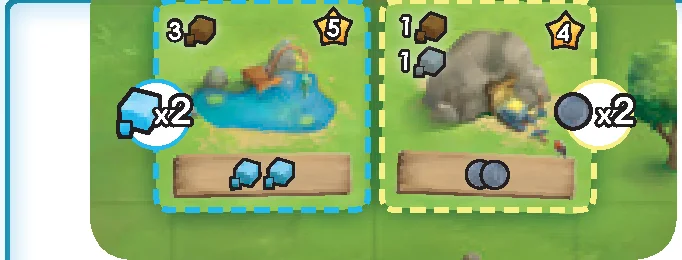
On the left, the Pier allows you to gain 2 Fish . On the right, the Gold Mine allows you to gain 2 .
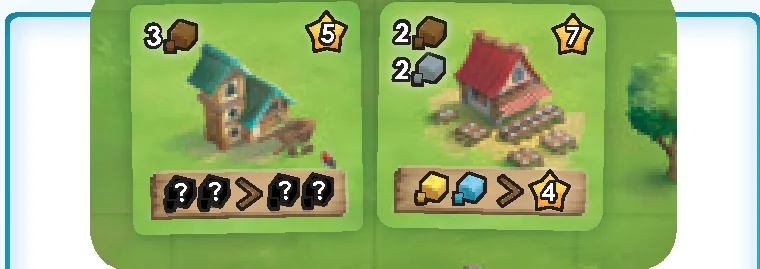
Building tile on the left contains a Shop which lets you switch 2 Resource cubes for 2 different Resource cubes of your choice. On the right, the Restaurant lets you exchange 1 Fish and 1 Wheat for 4 .
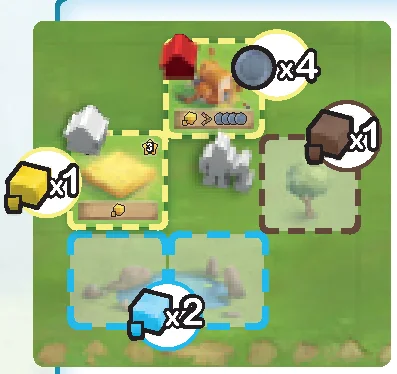
The Worker can first harvest his Wheat field to gain a Wheat , then pay 1 to the red player to transform this Wheat into 4 thanks to the Bakery. He also gathers 2 Fish and 1 Wood .
The Effects of the Residence and the Cathedral are not activated until the end of the round (see gameplay aid).
2. Build a Building
To build a Building, follow these steps in order:
- Place one of your unused Workers onto the Construction Site area (the construction area may hold any number of Workers).
- Choose a Building tile from those available in the Market.
- To pay for the construction of a building use as many Resource cubes and/or Coins as needed. Place your payment in the reserve.
- Place the Building tile on an empty grass space on the game board.
- Once the tile has been placed, place one of your House tokens onto the tile to show your ownership.
- Move your Victory Point pawn on the Score track up as many spaces as the number of shown on the Building tile.
If you don’t have enough Resources, Coins or House tokens you cannot build a building.
The from the Castle and the Watchtower aren’t counted until the end of the game (see gameplay aid).
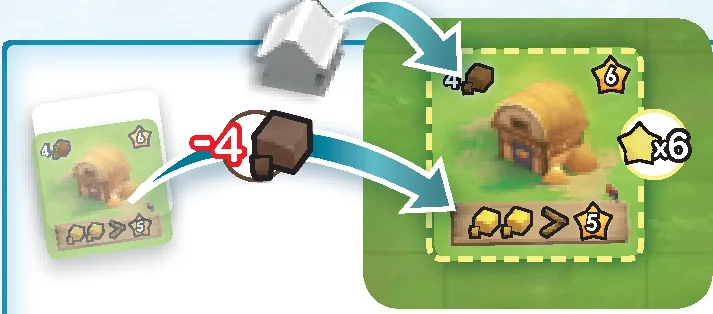
In order to build the Barn you must spend 4 Wood . After placing it onto the game board, place one of your Houses onto the upper left portion of the tile. Now move your Victory Point pawn up 6 spaces on the Score track.
In addition to placing a Worker during your turn, you may also at any time complete an Objective card or exchange Coins for Resource cubes.
Complete an Objective card
At the beginning of the game, you receive a certain number of Objective cards that can direct your strategy.
At any time you can complete one of these Objective cards if you fulfill the conditions indicated on it. Announce this completion and reveal the Objective card.
Gain the corresponding immediately.
There is no penalty if an Objective card is not completed by the end of the game.
Substituting Coins for Resources
At any time during the game, you may exchange 3 for any Resource cube in the reserve.
You may take this action as many times as needed, but only if you immediately spend all of the substituted Resources.

Once all of the players have used all of their Workers, the Round is over. Follow these steps in order:
1. Activate the Effects of Special Buildings
The Effects of certain Buildings, (for instance the Residence and the Cathedral), only activate at the end of each Round. Their owners may now activate them for free and benefit from their Effects. The  symbol is to remind you of this type of Effect.
2. Feed the Workers
At the end of each Round, all the players must feed their Workers. Starting with the first player, everyone discards the same amount of food Resource (Fish and/or Wheat ) as Worker.
For each Worker that you cannot feed, lose 3 . Move your Victory Point pawn back 3 spaces on the Score track for each unfed Worker. It is possible to have negative Victory Points if you descend below the 0 space.
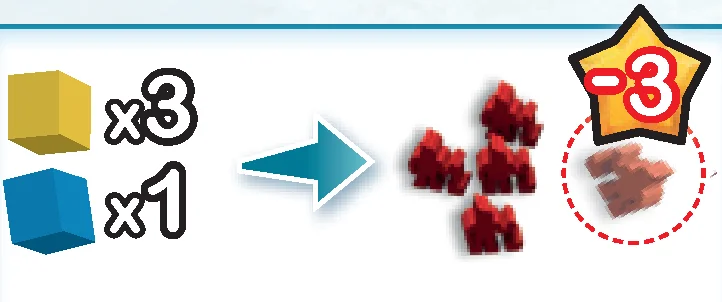
You have 5 Workers, 1 Fish and 3 Wheat . Since you only have 4 total food Resources and 5 Worker, you lose 3 for the 1 remaining unfed Worker.
3. Prepare for the Next Round
- Each player picks up their Workers (the House tokens and the Building tiles stay in place).
- Move the Round token up one space.
- Pass the First Player token to the next player clockwise.
The player with the First Player token begins the new Round.
The 4th Round is the last Round. Once this Round is completed proceed to the End of the Game section.
Note: In a 3-player game, and only for the 4th Round, pass the First Player token to the player with the fewest . If there is a tie, pass it to the 1st of the tied players going clockwise from the last player to have the token. If all 3 players are tied, pass the token as normal.
Clarifications on the Score Track
If you reach or exceed 60 , take a 60 token and place it in front of you. You can continue to advance on the Score track.

Final Scoring
Each player adds the following to the already gained over the course of the game:
- The from the Castle and the Watchtower, as appropriate;
- 1 for each set of 3 in your possession.
Add these to your total on the Score track.
The player with the most is declared victorious. If there is a tie, the tied players share the victory.
- Designers: Shun et Aya Taguchi
- Illustrator: Sabrina Miramon
- Project Manager: Ludovic Papaïs
- Editor: Delphine Brennan
- Reviewer: Xavier Taverne and Alain Wernert
- Graphic Designer: Mélanie Walryck
- Translator: Timothy Marcroft
Introduction & Overview
Far, far away beyond the farthest mountains, there exists a rich and bountiful land yet to be explored. This region overflowing with riches is the ideal place to begin building a beautiful city. To do so, you will need to gather resources to begin your first building, then add another, and another, until a magnificent city is brought forth! Do you have what it takes to be an ambitious and talented architect?
Overview and Object of the Game
During each turn, place a worker onto the board. Gather the nearby resources and activate the neighboring buildings, or build new buildings. Position yourself with care, build in the best places, and anticipate your opponents’ choices to benefit from all possible situations and emerge victorious!
Build the town according to your ideas and prove that you are the greatest architect.
Components
- 1 game board
- 29 Building tiles
- 15 Objective cards
- 20 Worker tokens (5 white, 5 orange, 5 red and 5 purple)
- 60 Resource cubes (15 Wood, 15 Stone, 15 Fish and 15 Wheat)
- 1 First Player token
- 28 House tokens (7 purple, 7 red, 7 orange and 7 white)
- 1 Round token
- 4 Victory Point pawns
- 24 Coin tokens (16 “1” Coin tokens and 8 “3” Coins tokens)
- 4 “60” tokens
- 1 Gameplay aid
Game Elements
Building tiles
These tiles represent the different buildings that you can build. Each tile has its own Resource cost, number of Victory Points, and its Effect when placed.
Objective cards
Each player receives objective cards at the beginning (the number dealt varies based on the number of players). Objective cards give different ways to gain Victory Points.
Game board
The upper part of the board represents the area where you will build your town with lakes, forests, mountains, and grass. To add variation to the game, each side of the board is slightly different. In the lower part, you’ll find the Construction Site, the Market, the Score track, and the Round track.
Worker tokens
These tokens allow you to gather Resources, build and activate buildings. The number of tokens in play depends on the number of players.
House tokens
These tokens are placed on Building tiles. They indicate who owns them. The number of these tokens in play depends on the number of players.
Resource cubes
- The brown cubes represent Wood .
- The grey cubes represent Stone .
- The blue cubes represent Fish .
- The yellow cubes represent Wheat .
They allow you to buy Building tiles or to feed your workers.
Coin tokens
These coins () allow you to activate opponents’ buildings or can be substituted for Resources. You can always make change.
First Player token
This token helps indicate which player begins the next Round.
Victory Point pawns
These pawns help track your Victory Points ().
Round token
This token moves along the Round track to indicate the current round being played.
60 tokens
These tokens help track whether a player has exceeded 60 .
Game Setup
- Place the game board in the center of the table facing up. Pick a side of the game board you wish to play.
- Place the 5 Wheat Field building tiles in a stack in the Market. Shuffle the other Building tiles, take 12 of them randomly, and place these on each open spot in the Market.
For your first game, we recommend using the Building tiles with the bird. - Shuffle and distribute the Objective cards face down to each player:
- 2 players: 4 cards each
- 3 players: 3 cards each
- 4 players: 2 cards each
- Each player chooses one color and places all Worker and House of that color as well as the Victory Point pawn in front of them:
- 2 players: 5 Workers, 7 Houses
- 3 players: 4 Workers, 6 Houses
- 4 players: 3 Workers, 6 Houses
- Place your Victory Point pawn on the 0 space on the Score track.
- Place the Round token on the 1 space on the Round track.
- Place the Resource cubes, the Coin tokens, and the 60 tokens near the board to make up the reserve.
- Each player takes 3 Coins and places them in front of themselves in full view.
- The First player is chosen randomly. Once the first player has been determined, place the First Player token in front of them.
Note: Certain Objective cards include the symbol, which means that they can only be accomplished if certain Building tiles are available in the market. If an Objective card with this symbol would be impossible to accomplish, discard it and draw another one.
Gameplay
The game is played in 4 Rounds.
Structure of a Round
Each player in turn, clockwise, starting with the first player, performs one of the following actions:
- Gather and Activate
- Build a Building
Each of these actions requires a Worker. A Round is over once all players have placed all of their workers.
1. Gather and Activate
On your turn, you may choose to place an unused Worker on the game board. It can only be placed on an empty grass space.
Any spaces already containing a Worker token or a Building tile are not considered to be empty as well as the forest, mountain, and lake spaces.
A worker gathers Resources and can activate Buildings in the 8 adjacent spaces (including diagonals).
Gather Resources
The forest, mountain, and lake spaces allow you to gather Wood , Stone and Fish respectively.
You may gather Resources in any order you choose.
Take resources from the reserve and place them in front of you. When there are no more Resources (or ), you cannot gather more.
When a type of terrain extends over more than one space, consider each space separately for determining the number of Resources you gather.
Here, your Worker token gathers 2 Fish and 1 Wood .
Activate a Building
If you place a Worker adjacent to one or more Buildings tiles (including diagonally), you may activate them and benefit from their Effects.
If the Building that you want to activate belongs to another player, you must first pay them 1 before applying its Effect. You are never forced to activate a Building tile.
A Building tile may only be activated once per Worker, meaning that you can only benefit from its effect once per activation.
This Worker can activate the Wheat Field tile to gain 1 Wheat . He also gathers 2 Fish and 1 Wood .
Buildings have two types of Effects that can be activated:
- Gain a Resource , or .
- Exchange resources or for resources, , or .
You can activate the Effects of different Buildings in whatever order you choose.
On the left, the Pier allows you to gain 2 Fish . On the right, the Gold Mine allows you to gain 2 .
Building tile on the left contains a Shop which lets you switch 2 Resource cubes for 2 different Resource cubes of your choice. On the right, the Restaurant lets you exchange 1 Fish and 1 Wheat for 4 .
The Worker can first harvest his Wheat field to gain a Wheat , then pay 1 to the red player to transform this Wheat into 4 thanks to the Bakery. He also gathers 2 Fish and 1 Wood .
The Effects of the Residence and the Cathedral are not activated until the end of the round (see gameplay aid).
2. Build a Building
To build a Building, follow these steps in order:
- Place one of your unused Workers onto the Construction Site area (the construction area may hold any number of Workers).
- Choose a Building tile from those available in the Market.
- To pay for the construction of a building use as many Resource cubes and/or Coins as needed. Place your payment in the reserve.
- Place the Building tile on an empty grass space on the game board.
- Once the tile has been placed, place one of your House tokens onto the tile to show your ownership.
- Move your Victory Point pawn on the Score track up as many spaces as the number of shown on the Building tile.
If you don’t have enough Resources, Coins or House tokens you cannot build a building.
The from the Castle and the Watchtower aren’t counted until the end of the game (see gameplay aid).
In order to build the Barn you must spend 4 Wood . After placing it onto the game board, place one of your Houses onto the upper left portion of the tile. Now move your Victory Point pawn up 6 spaces on the Score track.
Additional Actions
In addition to placing a Worker during your turn, you may also at any time complete an Objective card or exchange Coins for Resource cubes.
Complete an Objective card
At the beginning of the game, you receive a certain number of Objective cards that can direct your strategy.
At any time you can complete one of these Objective cards if you fulfill the conditions indicated on it. Announce this completion and reveal the Objective card.
Gain the corresponding immediately.
There is no penalty if an Objective card is not completed by the end of the game.
Substituting Coins for Resources
At any time during the game, you may exchange 3 for any Resource cube in the reserve.
You may take this action as many times as needed, but only if you immediately spend all of the substituted Resources.
End of the Round
Once all of the players have used all of their Workers, the Round is over. Follow these steps in order:
1. Activate the Effects of Special Buildings
The Effects of certain Buildings, (for instance the Residence and the Cathedral), only activate at the end of each Round. Their owners may now activate them for free and benefit from their Effects. The symbol is to remind you of this type of Effect.
2. Feed the Workers
At the end of each Round, all the players must feed their Workers. Starting with the first player, everyone discards the same amount of food Resource (Fish and/or Wheat ) as Worker.
For each Worker that you cannot feed, lose 3 . Move your Victory Point pawn back 3 spaces on the Score track for each unfed Worker. It is possible to have negative Victory Points if you descend below the 0 space.
You have 5 Workers, 1 Fish and 3 Wheat . Since you only have 4 total food Resources and 5 Worker, you lose 3 for the 1 remaining unfed Worker.
3. Prepare for the Next Round
- Each player picks up their Workers (the House tokens and the Building tiles stay in place).
- Move the Round token up one space.
- Pass the First Player token to the next player clockwise.
The player with the First Player token begins the new Round.
The 4th Round is the last Round. Once this Round is completed proceed to the End of the Game section.
Note: In a 3-player game, and only for the 4th Round, pass the First Player token to the player with the fewest . If there is a tie, pass it to the 1st of the tied players going clockwise from the last player to have the token. If all 3 players are tied, pass the token as normal.
End of the Game & Scoring
Clarifications on the Score Track
If you reach or exceed 60 , take a 60 token and place it in front of you. You can continue to advance on the Score track.
Final Scoring
Each player adds the following to the already gained over the course of the game:
- The from the Castle and the Watchtower, as appropriate;
- 1 for each set of 3 in your possession.
Add these to your total on the Score track.
The player with the most is declared victorious. If there is a tie, the tied players share the victory.
Credits
- Designers: Shun et Aya Taguchi
- Illustrator: Sabrina Miramon
- Project Manager: Ludovic Papaïs
- Editor: Delphine Brennan
- Reviewer: Xavier Taverne and Alain Wernert
- Graphic Designer: Mélanie Walryck
- Translator: Timothy Marcroft