
Pandemic Legacy: Season 0
2020
Investigate Project MEDUSA across twelve tense months while managing enemy agents, covert operations, and the consequences of every mission.
60
minutes
2 - 4
player(s)
14+
Medium Heavy


About this board game
Pandemic Legacy: Season 0 is a cooperative Cold War spy thriller for 2–4 players, with games lasting about 60 minutes. Set in 1962, it casts you and your fellow medical graduates as CIA recruits investigating a deadly Soviet bioweapon known as Project MEDUSA.
Travel between Allied, Neutral, and Soviet cities using carefully constructed aliases. Your missions may require you to neutralize enemy agents, acquire specific targets, or place other CIA agents at key locations so your operations can proceed successfully.
The campaign unfolds across twelve months, with every success or failure bringing you closer to the truth. Enemy agents can take root around the world, so containing them is essential before international tensions escalate. Coordinate with other covert operatives and use their teams strategically to clear the board while keeping your main objectives in focus.
- Create aliases that gain contacts and other assets over time.
- Manage new cards, rules, and conditions that affect future games.
- Respond to the CIA’s evaluation of your performance in the field.
- Balance the threat of the bioweapon with the growing presence of enemy agents.
As a prequel, Pandemic Legacy: Season 0 does not require prior experience with Season 1 or Season 2. Each game can change what comes next, making your decisions matter throughout this Cold War mission.
Released in 2020, Pandemic Legacy: Season 0 combines global movement, covert operations, evolving conditions, and a shared struggle to prevent a new bio-threat. Work together to uncover the truth and determine whether humanity can be saved once again.
Mechanics
Designers
/pic7182955.jpg)

Board Game Rules for
Pandemic Legacy: Season 0
N4245.3 DEPARTMENT OF SABOTAGE FIELD MANUAL
RULEBOOK
PREPARED UNDER DIRECTION OF THE DIRECTOR OF STRATEGIC SERVICES
DECLASSIFIED
MATT LEACOCK AND ROB DAVIAU — PANDEMIC LEGACY: SEASON 0
YOU WERE CHOSEN TO SERVE. YOU WERE WILLING TO LEAD.
DECEMBER, 1961
An unremarkable job description: “Graduating medical students needed for government program.” You quickly discovered that “government program” meant the CIA. They believed it easier to teach a doctor how to be a spy than the other way around, and you were quickly swept into months of training at “Camp Swampy.”
Meanwhile, a fanatical research group within the Soviet Union has been developing bioweapons in a bid to end the Cold War and destroy the West. Having failed to weaponize their C0dA virus project, they recently made a breakthrough with a different pathogen they call MEDUSA.
Your training has ended, and it is time to take the field.
LISTEN TO THE BRIEFING READ ALOUD ON THE Z-MAN GAMES WEBSITE:
WWW.ZMANGAMES.COM/LEGACY-SEASON-0

MISSION BRIEFING

Welcome agents, glad to see you made it through Swampy. I’m your Collection Management Officer: your handler, basically. John Cooper’s the name, but you can call me ‘Coop.’ There’s a lot to talk about, so I’m gonna dive right in.
Analytics are telling us that the Reds are cookin’ up something big: a top-secret plague they call ‘Project MEDUSA.’ Now their research ain’t complete yet, but if they manage to weaponize and deploy it, I’m told the death toll could be in the tens of millions.
I get it; we’re droppin’ you in the deep end, but your medical training gives you the edge here, and this is what we call a time of great need. Gather intel on the MEDUSA plague: samples, research notes, whatever you can find. We gotta know what it does, where they’re makin’ it, and how they plan to spread it.

Got a related job as well: locate Agent Charles Sabik, one of our best. The Reds caught him in Siberia last year, and sadly we could not extract him. Good news is he managed to get loose, but he hasn’t made contact yet. We gotta find out: did he escape, or did they let him go? Is he workin’ for the Reds now? Did he learn anything about MEDUSA while he was inside? Find him, talk to him, and bring him home if you can. Just be careful; he’s ruthless, smart as hell, and twice as dangerous.
Last thing I have is a bit of fair warning. The CIA is a peerless organization dedicated to the defense of this country, but a well-oiled machine it is not. There’s procedures, committees, meetings, approvals, and a helluva lot of paperwork, especially for junior agents like yourselves.
All that said, don’t worry too much about the red tape; your buddy Coop will keep the worst of it off your back. You focus on MEDUSA and Sabik. No problem for Swampy’s top of ’61, am I right?
This is a work of fiction set in a historical period. Names, characters, businesses, places, events, locales, and incidents are either the products of the designers’ imagination or used in a fictitious manner. Any resemblance to actual persons, living or dead, or actual events is purely coincidental. The game board is an abstract representation of the world circa 1962. First and foremost, this is a game, and some concessions were made to provide the best possible gameplay experience.
CREDITS
Game Design: Matt Leacock and Rob Daviau
Story Writers: Rob Daviau and Justin Kemppainen
Producer: Michael Sanfilippo
Managing Game Designer: Justin Kemppainen
Editing: Alexandar Ortloff
Proofreading: Christopher Meyer
Graphic Design: Monica Helland
Illustration: Atha Kanaani and Monica Helland with Samuel R. Shimota and Dan Gerlach
Plastic Sculpting: Monica Helland and Samuel R. Shimota
Art Direction: Bree Lindsoe and Samuel R. Shimota
Managing Art Director: Samuel R. Shimota
Voice of John Cooper: Clint McElroy
Publisher: Steven Kimball
STARTING COMPONENTS
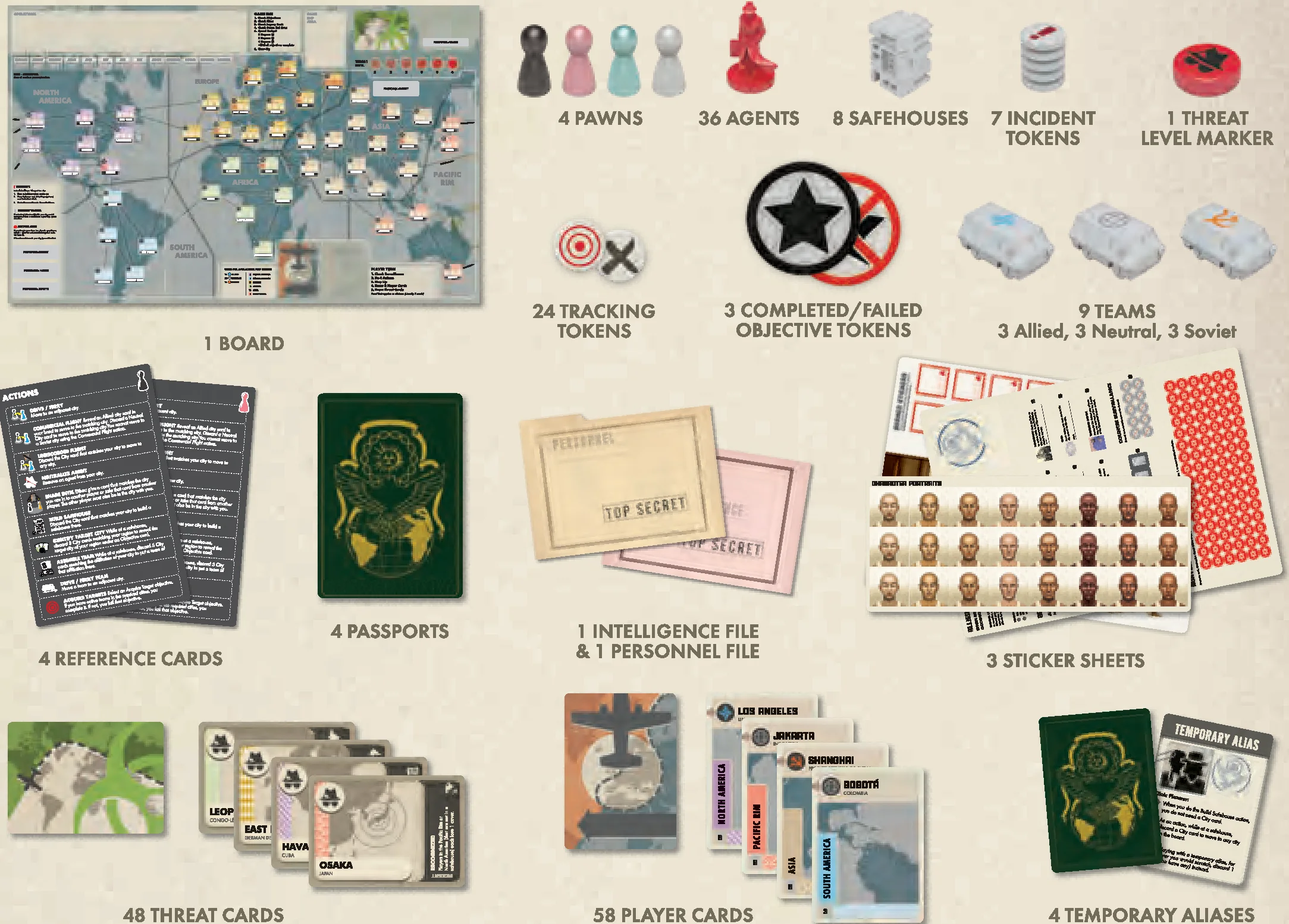
- 1 Board
- 4 Pawns
- 36 Agents
- 8 Safehouses
- 7 Incident Tokens
- 1 Threat Level Marker
- 24 Tracking Tokens
- 3 Completed/Failed Objective Tokens
- 9 Teams (3 Allied, 3 Neutral, 3 Soviet)
- 4 Reference Cards
- 4 Passports
- 1 Intelligence File & 1 Personnel File
- 3 Sticker Sheets
- 48 Threat Cards
- 58 Player Cards
- 4 Temporary Aliases
CAMPAIGN MATERIALS – DO NOT OPEN OR EXAMINE UNTIL INSTRUCTED!
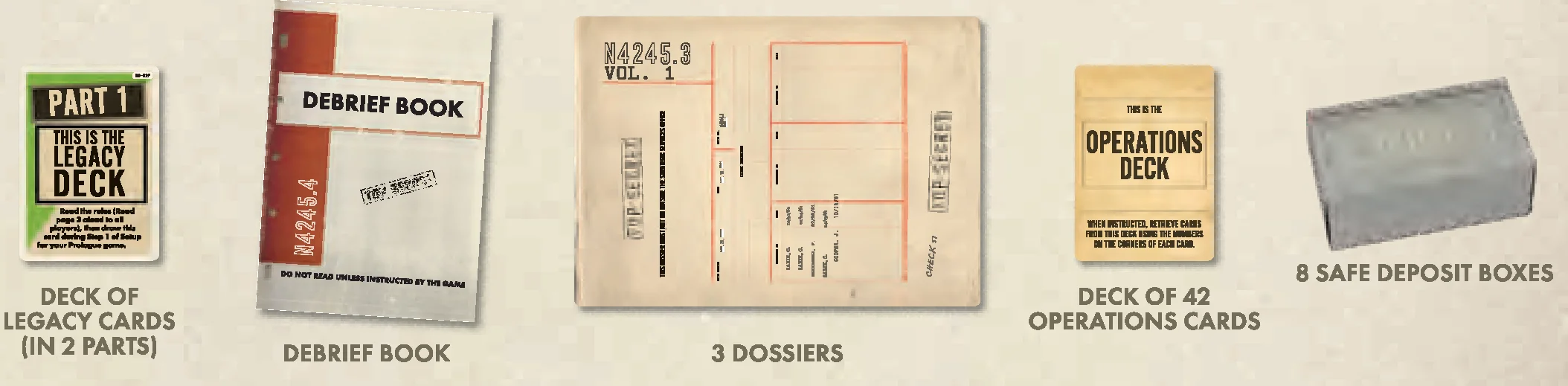
- Deck of Legacy Cards (in 2 parts)
- Debrief Book
- 3 Dossiers
- Deck of 42 Operations Cards
- 8 Safe Deposit Boxes
PLAYING A LEGACY GAME
Unlike most games, which fully reset every time you play, Pandemic Legacy carries some elements forward from one session to the next. Decisions you make in your first game will be in effect every time you play your copy of the game. Different groups will make different decisions and will have a different experience. What results is a game unique to the group that plays it.
You will write on parts of the game. You will place stickers on cards, the characters, or the board. Sometimes you will even destroy (tear up) a card. These changes are permanent. Also, at the end of each game, your group will make permanent improvements to prepare for future games. As you play, the game will change in other ways. Some elements of play are hidden and sealed off until later, when you are instructed to reveal them.
DO NOT OPEN OR READ ANY OF THE FOLLOWING UNTIL INSTRUCTED:
- Any cards in the Legacy or Operations decks
- Entries in the Debrief Book
- Any Dossier doors
- Any of the Safe Deposit Boxes
Some rules are deliberately omitted from this rulebook (shown by boxes containing redactions). As you play, you will gain rules and sticker them into the rulebook.
THE PROLOGUE
To help introduce you to the new gameplay, there is a prologue game. This prologue game has no lasting effects: no permanent changes.
You should play the prologue at least once and as many times as you wish until you feel comfortable with the new gameplay. After that, you should start the legacy campaign.
IF YOU’VE PLAYED SEASONS 1 OR 2…
You will be familiar with many elements in this game, such as the legacy deck, funding levels, game end upgrades, dossiers, and sealed boxes.
Playing either previous season is not necessary to play this game; they are independent games enriched by a connected narrative.
NEW AND MODIFIED RULES
There are many new rules or rules that are slightly different from Pandemic or previous Pandemic Legacy games; you should pay particular attention to the following:
- Operations Cards and the Debrief Book (pg. 5)
- Agents and Threat cards (pg. 6 and 13)
- Teams (pg. 6 and 11)
- Surveillance (pg. 7)
- The “Commercial Flight” action (pg. 10)
- The “Acquire Targets” action (pg. 11)
- Incidents (pg. 14)
- When to proceed to the next month of the campaign and funding level adjustments (“Check Objectives” on pg. 16)
LEGACY DECK
The Legacy deck is wrapped in two separate parts and contains cards that will describe what happens over the course of the game’s prologue and the next 12 months. It is arranged in a specific order; do not look through or shuffle these cards.
When you play the prologue for the first time, make sure to unwrap and use Part 1; return Part 2 to the box until you have gone through all of Part 1.
The first step of setting up the game, including the prologue, is to draw cards from this deck one at a time, resolving both sides of each card until you get to a card that says “PAUSE” or “STOP.” This card will tell you when to continue drawing from the deck, which might be at the end of a game, or at the start of the next month.
The Legacy deck is a one-way trip. Even if you repeat a month, do not put Legacy cards back.
DECKS OUT OF ORDER?
If the Legacy decks get out of order, have someone who is not playing the game put the cards back in order using the numbers in the top-right corner of each card.
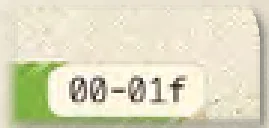
The first set of digits indicate the in-game month (“00” for the prologue). The second set of digits indicate the order of cards for that month (“f” for the front of the card and “b” for the back).
OTHER LEGACY COMPONENTS
Throughout the campaign, there are many other components that tell the story or modify the rules. For all of these components, remember that you will be told when to open or interact with them!
SAFE DEPOSIT BOXES (NUMBERED 0001–0008)
These boxes contain new components and substantial rules changes.
DOSSIERS (NUMBERED 11–46 & VARIOUS LETTERS)
As you play, certain cards and components will instruct you to open dossier doors of specific numbers and letters. Carefully open and tear off the matching door.
Many of the dossiers feature stickers to be placed on reference cards, the game board, or the rulebook.
Dossier doors marked with letters are new rules: add these to their matching section in the rulebook, but keep in mind:
- Stickers AA and BB are distinct from stickers A and B.
- Not all of the rulebook stickers come from the dossiers. Some of them come from the safe deposit boxes.
- Some numbers in the dossiers are skipped.
OPERATIONS CARDS (NUMBERED 50–89)
During the game, when you are told to take a specific numbered card from the Operations deck, find the card with the matching number on its back, draw it, and flip it over. You will not see all the Operations cards during the campaign.
DEBRIEF BOOK (NUMBERED 100–252)
This book tells the story and gives instructions for how to resolve complete and failed objectives:
- Do not read the entries in this book until instructed.
- You may re-read any previously read entries at any time. Consider marking those you have read so that you can return to them.
PROTOCOL WORDS ON THE GAME BOARD
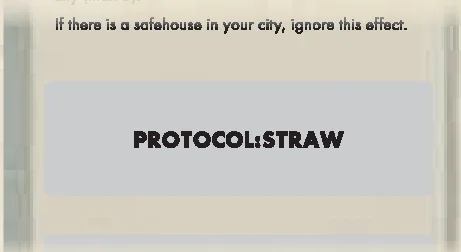
There are five protocol words on the game board (CRANE, HADES, RABBIT, STRAW, and ZEPHYR). These are protocol terms that may be activated during the year, which will add new rules and reminders to the game board. If activated, place a protocol sticker on them.
PERSONNEL & INTELLIGENCE FILES
The Personnel File contains information related to your conduct and performance within the CIA. The Intelligence File contains leads and information about your work against the Soviets and MEDUSA.
Both files start the campaign empty, and during the campaign, you can examine their contents at any time.
GAME CALENDAR AND FUNDING
Use the game calendar (located on the back of the Debrief Book) to record your progress, your group’s evaluation, players involved, and your current funding level (how many Event cards you include in your Player deck).
Your funding level is “5” at the start of January, but it goes up and down from game to game. The minimum funding level is “1” and the maximum is “10.” At the end of a game, if your funding would go above “10” for the first time, open Door 14.
WHAT STAYS AND WHAT RESETS?
Writing on or placing stickers on components, opening new materials, adding rules, and destroying components are permanent changes. When the game tells you to destroy a component, it will not be used in that game or any future games. Tear it up (or do what you like with it).
In all other ways, reset the game at the start of each new month. The pieces on the board, cards in hand, other tokens on the board, and so on, all start fresh. Whenever an effect refers to a “game”, it refers to a single playthrough of a month, from setup through game end, not all 12 months as a whole.
THE RESERVE
The reserve is where you store cards, stickers, and tokens that are not currently in play, but might be needed during or after a game.
It is not in any specific location; your group determines where to store reserve components, and any player can examine the reserve’s contents at any time.
GAME MONTHS
Pandemic: Legacy Season 0 is broken into 12 months, starting in January of 1962. In each month, you are assigned unique objectives and tasked with completing all of them.
At the end of each game, you are given an evaluation (SUCCEEDING, ADEQUATE, FAILING) based on how many objectives you completed. Your evaluation determines what your funding is for the next game as well as whether or not you move on to the next month of the campaign (see “Check Objectives” on pg. 16).
END OF THE CAMPAIGN AND SCORING
The campaign ends after you finish December. At that point, you are scored on your final results. Your score will largely be based on your evaluations each month as well as the final state of the world.
WORLD SETTING & KEY CONCEPTS
It is 1962, the height of the Cold War. Fanatical elements of the Soviet Union seek to create a bioweapon to destroy the West. You are trained in both medicine and field operations, so you must travel across the world, neutralizing Soviet agents and achieving specific objectives while setting up teams of CIA operatives to assist with both.
AFFILIATION
The divided ideology in the world is represented by the affiliation of each city on the board: Allied (including US, NATO, and others), Neutral, and Soviet.

In general, affiliations modify or add requirements to various actions and effects.
AGENTS
Each city on the board has a matching Threat card, and when that card is drawn, you place a Soviet agent in that city. Left unchecked, these agents will cause severe negative effects and might cause you to lose the game!
OBJECTIVES
Your primary goal in each game is to complete a unique set of objectives given to you at the start of each month (as well as the prologue).
Objectives must be completed in specific cities on the board. To complete most objectives, you must create a team matching that city’s affiliation (see “Teams” below), position the team in that city, and then resolve an action (see “Acquire Targets” on page 11).
Sometimes, you have an unknown target city for your objective and must deduce its location during the game (or use certain actions, see “Identify Target City” on page 11).
Note: Objectives are different in every month, so feel free to destroy any old objectives from previous months.
TEAMS
During the game, you collect and discard sets of City cards with matching affiliations to create teams. Teams are groups of covert CIA operatives working under your direction, represented by undercover vans.
There are three different types of teams: Allied, Neutral, and Soviet. (They all work for the CIA, but have passports and aliases that allow them to operate only in cities matching their affiliation.)
After a team has been created, any player can use it. Teams are required to complete most objectives, and they are very effective at removing Soviet agents from the board, but to do either, a team must be active.
ACTIVE TEAMS
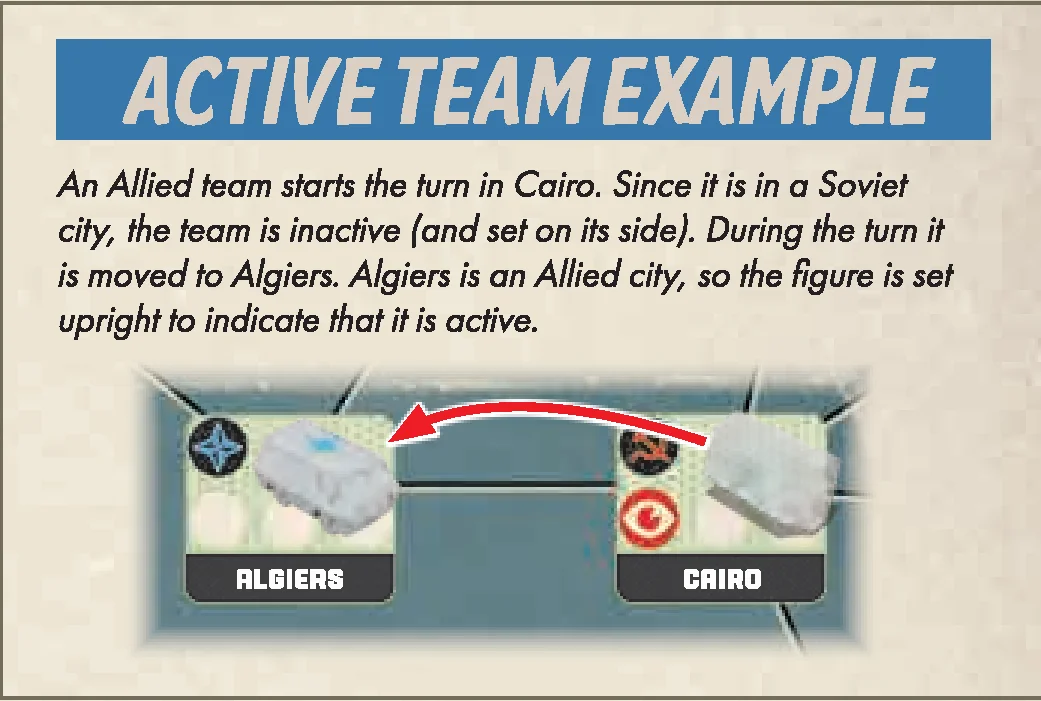
A team is active only while in a city matching its affiliation. (i.e., Allied teams are active only in Allied cities.) A team in a city not matching its affiliation is inactive. When a team is inactive, set the figure on its side as a reminder.
ACTIVE TEAM EXAMPLE
An Allied team starts the turn in Cairo. Since it is in a Soviet city, the team is inactive (and set on its side). During the turn it is moved to Algiers. Algiers is an Allied city, so the figure is set upright to indicate that it is active.
CHARACTERS & ALIASES
To accomplish your goals, you must travel the world using passports with different aliases. Eventually, each character will have three aliases (Allied, Neutral, and Soviet) but can use only one at a time.
You do not need to play the same character each game.
TEMPORARY ALIASES
During the prologue, you have a temporary alias. This alias has all you need to learn how to play the prologue.
This alias has no cover; when you would lose cover, discard a Player card instead.
CREATING ALIASES
You create Allied aliases in January of the campaign for all four of the passports. You will be instructed how to create an alias by cards in the legacy deck (also below for reference).
ALIAS DETAILS
When you create your alias, give them a name and choose a cover occupation. This occupation gives you plausible reason to travel around the globe and a special ability while using that alias. (The cover occupations of your Allied alias are the same as the cover occupations for the temporary aliases in the prologue.)
There is also a space for a specialization; leave it empty until instructed otherwise.
MODIFYING APPEARANCE
When creating an alias, use the disguise stickers to alter the appearance on the passport. This has no game effect, so have some fun with it!
GAINING ASSETS
At the end of each game, you can purchase assets for aliases. Assets include gadgets, contacts, and visas. You can purchase assets for any aliases, but you can use assets only on your current alias.
Note: Contacts are people that know you by one of your aliases and will do favors for you. You can use a contact while you are in any city on the board (unless otherwise specified).
LOSING COVER
An alias is a precious thing. As you go about the world, your cover could get blown. Each time you lose cover, scratch off the leftmost space on the cover track of your current alias.
Though many game effects can cause you to lose cover, you most often lose cover due to surveillance.
SURVEILLANCE
Surveillance represents how closely the Soviets are monitoring a city and is represented by the  icons on the board. Some cities start the campaign under surveillance, and more might be added at the end of each game (up to a maximum of 3 per city).
At the start of your turn, you lose one cover for each surveillance icon in your city unless there is a safehouse in your city.
LIABILITIES AND GETTING BURNED
Each time you lose cover, if there is an icon under the scratched-off space, resolve the corresponding effect:
 You discard a Player card (if you have any).
 Your alias gains a liability. Choose a liability sticker and place it on that alias. Other aliases are not affected by that liability.
 Your alias has been fully burned and cannot be used in any game for the rest of the campaign. Place a BURNED sticker over the name and photo of the alias. Discard all the cards you have, lose any actions you have remaining, then move your pawn to Washington. Return your passport to the reserve.
When you start your next turn, choose a temporary alias. Use that temporary alias for the rest of that game.
When choosing characters at the start of a game, if all the active aliases of a character are burned, you must use either a different character or a temporary alias instead.
SURVEILLANCE EXAMPLE
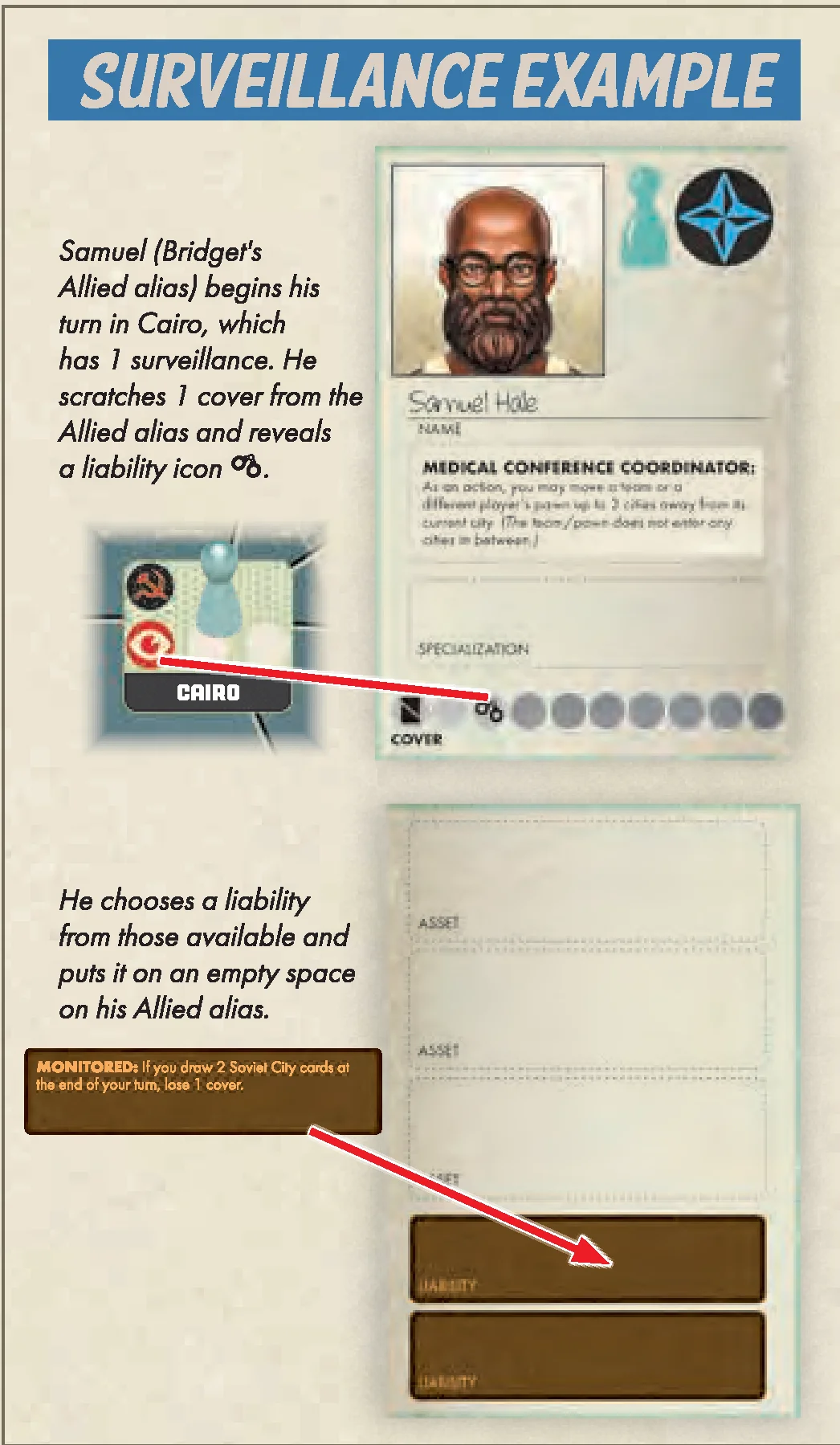
Samuel (Bridget’s Allied alias) begins his turn in Cairo, which has 1 surveillance. He scratches 1 cover from the Allied alias and reveals a liability icon .
He chooses a liability from those available and puts it on an empty space on his Allied alias.
GAME SETUP
-
CHECK THE LEGACY DECK AND PREPARE OBJECTIVES
Before you set up the game (and inevitably realize that you forgot to deal Player cards before shuffling in the Escalation cards), draw cards from the Legacy deck. Draw them one at a time and read them out loud. Follow the instructions on both sides of each card and continue drawing until you get to a card that says “PAUSE” or “STOP.”
The Legacy deck will tell you how to prepare your objectives for that month.
Then collect any cards in the reserve that are needed for that month.
-
PREPARE BOARD AND PIECES
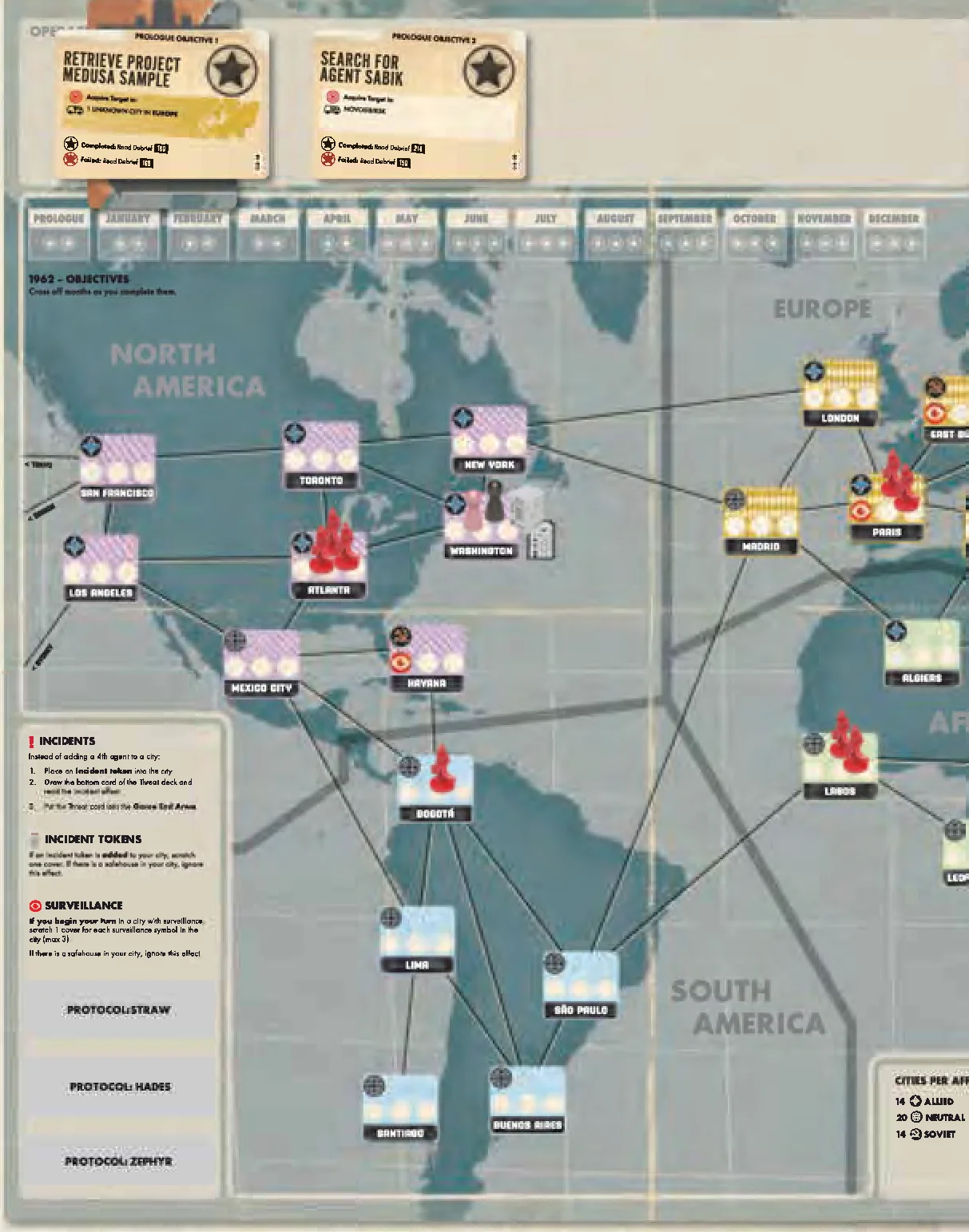
Place the board in the center of the table. Place 1 safehouse in each city marked with a permanent safehouse. For the prologue and January, this will be Washington only.
Place the Threat Level marker on the leftmost space of the Threat Level track.
Place the agents, Incident tokens, objective tokens, tracking tokens, teams, and remaining safehouses in separate supplies near the board.
board setup illustration step 2 and 4 -
[Box 3: Redacted – PLACE RULE STICKER A HERE WHEN INSTRUCTED]
-
ADD AGENTS TO THE BOARD
Shuffle the Threat cards and flip over 3 of them. Place 3 agents into each city shown. Then flip 3 more cards and place 2 agents into each city shown. Finally, flip 3 more cards and place 1 agent into each city shown. Place the flipped cards faceup into the Threat discard pile.
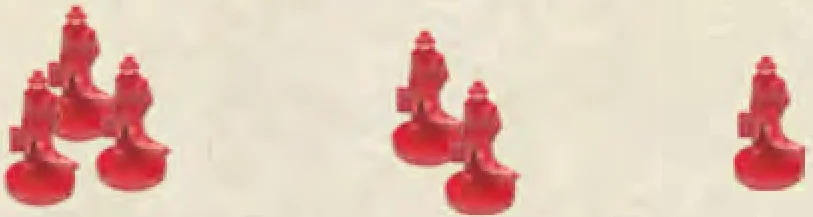
agent placement icons -
[Box 5: Redacted – PLACE RULE STICKER B HERE WHEN INSTRUCTED]
-
[Box 6: Redacted – PLACE RULE STICKER C HERE WHEN INSTRUCTED]
-
PREPARE THE PLAYER DECK AND DEAL CARDS
As a group, choose and add Event cards equal to your current funding level to the Player deck. For both the prologue and the start of January, your funding level is 5, so simply include all five initial Event cards.
Shuffle these Event cards and the City cards together, then deal cards to each player based on the player count:
- 2 Players: 4 Cards
- 3 Players: 3 Cards
- 4 Players: 2 Cards
Players keep their hands faceup at all times.
-
ADD ESCALATION CARDS TO THE PLAYER DECK
Divide the remaining Player cards into 5 facedown piles, as equal in size as possible. Place smaller piles toward the right side of the row. Shuffle 1 Escalation card facedown into each pile.
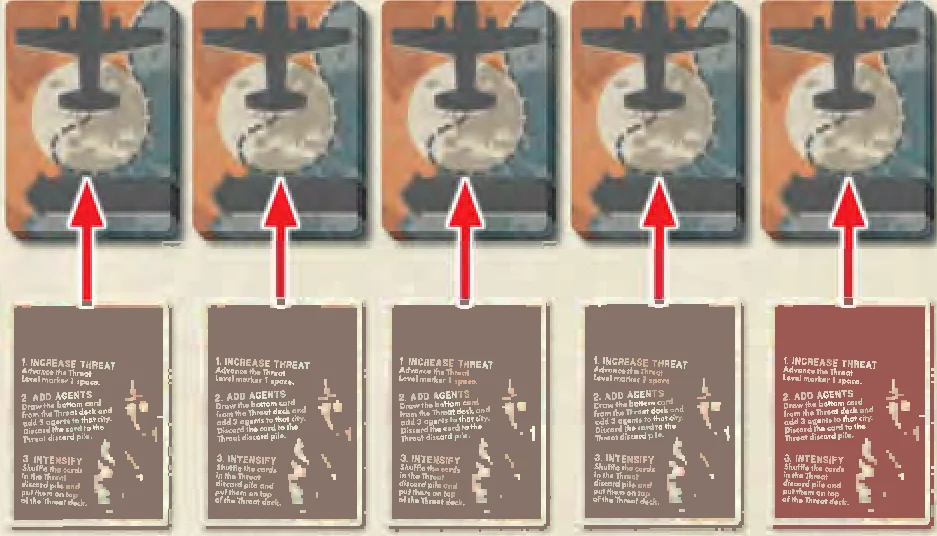
escalation cards pile distribution diagram [Box: Redacted – PLACE RULE STICKER D HERE WHEN INSTRUCTED]
-
REASSEMBLE THE PLAYER DECK
Stack the Player card piles from left to right (so that the leftmost pile is on top) to form the Player deck. Place the Player deck on the board.
-
CHOOSE CHARACTERS AND ALIASES
Each player chooses a character. Give them the matching pawn, Reference card, and passport (in the prologue, take a temporary alias instead of a passport). Return any unused pawns, Reference cards, and passports to the box.
Then, if characters have more than one alias, each player chooses which alias to start with.
If all of a character’s aliases have been burned, that player must either use a different character or a temporary alias instead.
-
BEGIN PLAY
Gather all of the pawns and randomly select one. That player takes the first turn. Place all pawns in Washington.
TURN OVERVIEW
During your turn, follow these 5 steps in order:
- Check Surveillance
- Do Actions
- Mop Up
- Draw 2 Player Cards
- Draw Threat Cards
After you have done all of these steps, the next player in clockwise order takes their turn.
Players should freely give each other advice. Let everyone offer opinions and ideas. However, the player whose turn it is decides what to do.
Your hand can have City and Event cards in it. City cards are used in some actions and Event cards can be played without using an action and even on other players’ turns.
[Redacted Rule Sticker Slots: E, F, G, H, J]
STEP 1: CHECK SURVEILLANCE
The Soviets are watching every minute of every day.
If you start your turn in a city with surveillance, lose 1 cover for each surveillance symbol () in that city (max 3).
Ignore this if there is a safehouse in your city.
STEP 2: DO ACTIONS
Time is limited. You can’t do everything you want.
You can do up to 4 actions each turn.
Select any combination of the following actions. You can do the same action several times, each time counting as 1 action. Your character’s special abilities may change how an action is done. Some actions involve discarding a card from your hand; these discards go to the Player discard pile.
MOVEMENT ACTIONS
DRIVE / FERRY
Move to an adjacent city (connected by a line).
COMMERCIAL FLIGHT
This action varies as follows:
 Reveal an Allied City card in your hand to move to the matching city (revealed cards are not discarded).
 Discard a Neutral City card to move to the matching city.
 You cannot move to a Soviet city using the Commercial Flight action.
UNRECORDED FLIGHT
Discard the City card matching your city to move to any city on the board (including a Soviet city).
OPERATIONAL ACTIONS
NEUTRALIZE AGENT
Remove an agent from your city and return it to the supply.
SHARE INTEL
If there is another player in your city and you both agree to it, you can do one of the following:
- Give the City card that matches your city to that player.
- Take the City card that matches your city from that player.
If the player who gets the card now has more than their hand limit (usually 7 cards), that player must immediately discard a card or play an Event card.
BUILD SAFEHOUSE
Discard a card matching your city to place a safehouse in your city. It will last for the rest of the game. If all safehouse pieces are in use, you can relocate a safehouse from another city on the board to your city. Each city can have only one safehouse.
Note: Unlike Pandemic, there is no “Shuttle Flight” action (you cannot move directly from one safehouse to another).
ASSEMBLE TEAM
While at a safehouse, discard 5 City cards matching the affiliation of your city to place a team of that affiliation there.
If all of the teams of that affiliation are already on the board, you may relocate a team of that affiliation from a different city to your city.
DRIVE / FERRY TEAM
Move a team to an adjacent city. You do not have to be in the city of the team you are moving. Multiple teams can be in the same city. Teams are not affected by surveillance (except through certain Incident effects).
[Box: Redacted – PLACE RULE STICKER K HERE WHEN INSTRUCTED]
OBJECTIVE ACTIONS
IDENTIFY TARGET CITY
While at a safehouse, discard 3 City cards matching your region to reveal an unknown target city of that region under an Objective card (see “Unknown Target Cities” below).
For example, while in a safehouse in Africa, you may discard 3 Africa City cards to identify an unknown target city in Africa. This objective now has a known city. You must still complete the objective using the “Acquire Targets” action.
ACQUIRE TARGETS
Complete an objective with a known or unknown target city. Remember to read the matching debrief entry.
KNOWN TARGET CITIES
To acquire targets in a known city, you must position an active team in the city shown on the card. Do the Acquire Targets action, mark the objective with a “Complete” token, and read its debrief entry.
Note that some objectives may require multiple active teams in a single city or one active team each in multiple cities.
Prologue Example: To complete the “Search For Agent Sabik” objective, players must do the Acquire Targets action while one active (Soviet) team is in Novosibirsk, after which they mark the objective complete and read debrief entry 214.
UNKNOWN TARGET CITIES
Certain objectives have an unknown target city. You must still position an active team in a specific city, but you do not know which.
During the game, you can discover the target city through process of elimination or by using the Identify Target City action.
Setting Up an Unknown Target City: You find and set up objective cards with unknown target cities as you draw and resolve cards from the Legacy deck. To set up an unknown target city:
- Remove all City cards listed on the objective from the Player deck. Prologue Example: For the “Retrieve Project MEDUSA Sample” objective, remove all the Europe City cards.
- Randomly place one of those cards facedown under the Objective card without looking at it. This card is the target city.
- Shuffle the remaining City cards back into the Player deck.
Eliminating Possible Target Cities: When you draw a card from the Player deck that matches the region of an unknown target city, you eliminate that city as a possible target (it cannot be the City card under the objective). Use the tracking tokens to mark which cities have been eliminated.
Acquiring Targets in an Unknown City: To acquire targets in an unknown city, you must position active teams in the city (or cities) you think might be the correct city. Then, do the Acquire Targets action and reveal the City card under the objective.
If you have an active team positioned in that city, mark the objective with a “Complete” token. Otherwise, mark it with a “Failed” token. In either case, immediately read the appropriate debrief entry.
Important! You can place teams in multiple possible cities to increase your odds. As long as there is an active team in the correct city, the objective is complete.

UNKNOWN TARGET CITY EXAMPLE
Players have narrowed down the possible target cities in Europe to Paris, Rome, and Prague: two Allied cities and one Soviet.
They position their Soviet team in Prague. They can position their Allied team in Paris or Rome. On a gamble, they place their Allied team in Rome and then do the Acquire Targets action. If the target city is either Prague or Rome, they’ll successfully complete the objective. If it is Paris, they will fail.
Given how the game was going, they didn’t believe they would be able to assemble and position another Allied team in Paris to guarantee success. Ultimately, they decided it was worth the risk!
[Redacted Rule Sticker Slots: L, M, N, O, P, Q, R, S, T, U]
STEP 3: MOP UP
Your teams do what they were sent to do.
Remove all agents in each city with an active team.
[Box: Redacted – PLACE RULE STICKER V HERE WHEN INSTRUCTED]
STEP 4: DRAW 2 PLAYER CARDS
We will try to help you. Sometimes the Soviets disrupt our plans.
Draw the top 2 cards together from the Player deck.
When you are about to draw, if there are fewer than 2 cards left in the Player deck, the game ends! Do not reshuffle the discard pile to form a new deck. See “Game End” on page 14.
Hand Limit: If you are over your hand limit (usually 7 cards), immediately discard cards or play Event cards until you are at your limit.
[Box: Redacted – PLACE RULE STICKER W HERE WHEN INSTRUCTED]
ESCALATION CARDS
If your draw includes any Escalation cards, do not add them to your hand (and do not draw replacement cards for them). Instead, immediately do the following:
- Increase Threat: Move the Threat Level marker 1 space to the right on the Threat Level track.
- Add Agents: Draw the bottom card from the Threat deck. Place three agents in that city. Discard the drawn card to the Threat discard pile.
- Intensify: Shuffle all cards in the Threat discard pile (including the one just drawn) and place them facedown on top of the Threat deck.
[Box: Redacted – PLACE RULE STICKER X HERE WHEN INSTRUCTED]
Remember: When resolving an Escalation card, draw from the bottom of the Threat deck and shuffle only the cards in the Threat discard pile, placing them on top of the existing Threat deck.
It is rare but possible to draw 2 Escalation cards at once. In this case, do all the steps above once and then again.
After resolving any Escalation cards, discard them.
STEP 5: DRAW THREAT CARDS
The Soviets dispatch agents to infiltrate cities and cause incidents.
One at a time, flip over as many Threat cards from the top of the Threat deck as the current Threat level (indicated by the Threat Level track on the board). For each card flipped over, place 1 agent on the matching city and discard the card to the Threat discard pile.
If you would place a fourth agent on a city, an incident occurs instead. (Agents do not spread like disease outbreaks in other Pandemic games.)
TURN END
After drawing and resolving Threat cards, your turn is over. The next player in clockwise order takes their turn.
RESOLVING INCIDENTS
When an incident occurs in a city, place one Incident token in that city. Any players in that city lose 1 cover from their current alias unless there is a safehouse in that city. A city can contain any number of Incident tokens.
Then, immediately draw the bottom card from the Threat deck and apply the incident effect on the card (do not place an agent). Place this card in the Game End area (not the discard pile).
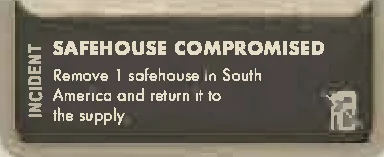
INCIDENT EXAMPLE #1
There is an incident in Paris. The players place an Incident token in Paris and then draw the bottom card from the Threat deck. The incident effect instructs them to remove a safehouse in South America. The players don’t have a safehouse in that region, so the card has no effect.
CHAIN INCIDENTS
Some incident effects require you to place agents. If you would place a fourth agent in one or more cities, another incident occurs.
Place an Incident token into each of the affected cities (players in those cities lose cover as normal). Draw another Threat card from the bottom of the Threat deck and apply its incident effect. Note that you draw only one Threat card, even if the previous incident effect placed multiple Incident tokens.
If you must place an Incident token and there are none left in the supply, the game immediately ends! See “Game End” to the right.
INCIDENT EXAMPLE #2
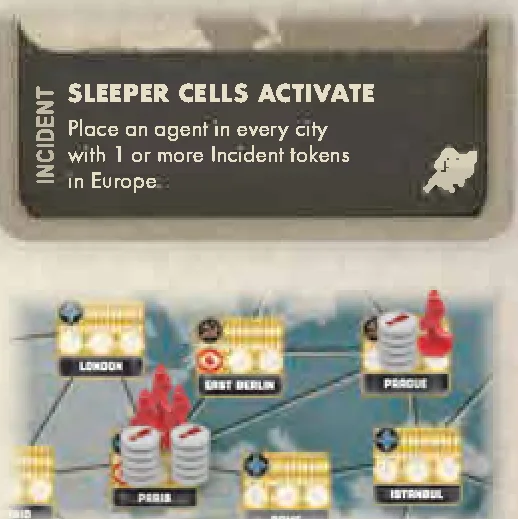
Later in the game, there’s another incident in Paris. A second Incident token is placed, and a card is drawn from the bottom of the Threat deck. It instructs the players to place an agent in every city with one or more Incident tokens in Europe.
One agent is placed in Prague. Another would be placed in Paris, but there are already three agents there, so a third Incident token is placed, and another Threat card is drawn and another incident effect is applied.
GENERAL RULES
HAND LIMIT
If you ever have more than your hand limit (after first resolving any Escalation cards you may have drawn), discard cards or play Event cards until you are at your hand limit. Normally, the hand limit is 7 cards. Your hand limit applies at all times.
EVENT CARDS
During any turn, any player can play an Event card. Playing an Event card is not an action, and the player who plays it decides how it is used. Event cards can be played at any time, except in between drawing and resolving a card. For example, you cannot draw a Threat card, see that you do not like it, and then choose to play an Event card to prevent its effect. After playing an Event card, discard it to the Player discard pile.
USING EFFECTS
You must be able to resolve all of an effect or card in order to use it, whether it is a character or card effect. For example, if you had a card that let you move a team on the board, and there were no teams on the board, you could not play that card just to be able to discard it.
TAKING NOTES AND LOOKING AT CARDS
We encourage you to take notes as you go. For example, you can mark the debrief entries you’ve read so you can return to them.
Also, you can look at any cards in the reserve, the Personnel and Intelligence files, the Threat discard pile, and the Player discard pile at any time. Cards in the Player deck and Threat deck cannot be looked at unless an effect allows it.
OVERLOOKED RULES
- Teams are active only while in a city of their affiliation.
- You always draw exactly 2 cards from the Player deck at the end of your turn. Do not draw replacement cards for cards you do not keep, such as Escalation cards.
- For objectives with unknown target cities, you can increase your odds of finding the correct city by positioning active teams in multiple cities. As long as the correct city has an active team, you complete the objective.
- During your turn, the Share Intel action allows you to take a card from another player if you are both in the matching city.
- Your hand limit applies at all times.
- If you repeat a month, any objective you completed in your first try starts COMPLETED for your second try (May onward).
WHAT HAPPENS IF WE MESS UP A RULE SINCE WE CAN’T GO BACK?
In most cases, it won’t matter. A little rule confusion here or there, a card left out of a deck, or something forgotten will not greatly affect your game. Just acknowledge it and move on.
In some cases, a missed or confused rule will result in a whole game being too easy or too hard. In this case, the group should decide whether to increase their funding for next game (if you accidentally made a game too hard) or reduce their funding for the next game (if you made a game too easy).
GAME END TRIGGERS
The game ends when any of the following occurs:
- All objectives have a Completed or Failed token.
- You cannot draw 2 Player cards because there are not enough cards left in the Player deck.
- You need to place an agent, but the supply is empty.
- You need to place an Incident token, but the supply is empty.
[Box: Redacted – PLACE RULE STICKER AA HERE WHEN INSTRUCTED]
The game ends immediately, even if it is the middle of a player’s turn. You cannot finish your turn, even if you would like to.
After the game ends, proceed to “After the Game” on page 16.
[Redacted Rule Sticker Slots: Y, Z]
AFTER THE GAME
When playing the prologue, do only Steps 1, 4 and 6 (but read the other steps so you understand how they will work during the campaign).
1. CHECK OBJECTIVES
Mark any incomplete objectives with a “Failed” token, read the appropriate debrief entry, follow any instructions in the debrief, and evaluate your team’s status.
ALL OBJECTIVES COMPLETE
Your group is evaluated as SUCCEEDING.
Proceed to the next month. Decrease your funding level by 1 (because you clearly don’t need the help). Destroy the objectives for the month you finished. Record your evaluation and new funding level on the calendar on the back of the Debrief Book.
1 OBJECTIVE FAILED
Your group is evaluated as ADEQUATE.
It’ll have to be good enough: time is ticking. Proceed to the next month. Increase your funding level by 1. Destroy the objectives for the month you finished (including the one you failed). Record your evaluation and new funding level on the calendar on the back of the Debrief Book.
2+ OBJECTIVES FAILED
Your group is evaluated as FAILING.
Increase your funding level by 2; we need to get back on track. Record your evaluation and new funding level on the calendar on the back of the Debrief Book.
If this was your first attempt at the month, you must repeat the month. When you start the next game, mark any objectives that you completed in the first half of the month as COMPLETE (only possible once you have 3 objectives, starting in May).
If this was your second attempt at the month, proceed to the next month. Destroy the objectives for the month you finished (including any you failed).
2. CHECK CITIES
Add a Surveillance sticker to cities that contain one or more Incident tokens. Add only one sticker regardless of how many Incident tokens are in the city. Do not skip this step, even if you plan to spend budgetary units on counter surveillance to offset the new surveillance stickers.
Each city can have up to 3 surveillance. If a city already has 3, do not add any more, even if there are Incident tokens in that city at game end.
[Box: Redacted – PLACE RULE STICKER BB HERE WHEN INSTRUCTED]
3. CHECK LEGACY DECK
If there is a PAUSE card at the top of the deck, you may be instructed to draw more cards.
4. CHECK GAME END AREA
If there are any Threat cards in this area, place them into the Threat discard pile.
5. SPEND BUDGET
Regardless of your group’s evaluation, you choose upgrades at the end of each game. You receive budgetary units equal to the number of players who just played that game plus an additional +1 unit if you completed every objective.
Costs are shown next to each upgrade, and unused units are lost and do not roll over from game to game.
ASSETS
Add an Asset to any empty Asset slot on a created alias (even for a character you did not use in that game). You cannot place assets on aliases that have not been created yet, and you cannot place an asset over a liability or another asset. Each asset is usable only by the alias that has it.
PERMANENT SAFEHUSES
Choose a city with a safehouse and place a permanent safehouse sticker near that city. At the start of each game, place a safehouse on each city with a permanent safehouse sticker.
COUNTER SURVEILLANCE
Place a counter surveillance sticker over a surveillance symbol on a city (either a sticker or starting surveillance). That city’s surveillance is reduced by 1.
6. CLEAN UP
Discard all Player cards and clear the board of all game pieces (but not stickers—those are permanent). These all reset for the start of the next game.
Introduction & Overview
N4245.3 DEPARTMENT OF SABOTAGE FIELD MANUAL
RULEBOOK
PREPARED UNDER DIRECTION OF THE DIRECTOR OF STRATEGIC SERVICES
DECLASSIFIED
MATT LEACOCK AND ROB DAVIAU — PANDEMIC LEGACY: SEASON 0
YOU WERE CHOSEN TO SERVE. YOU WERE WILLING TO LEAD.
DECEMBER, 1961
An unremarkable job description: “Graduating medical students needed for government program.” You quickly discovered that “government program” meant the CIA. They believed it easier to teach a doctor how to be a spy than the other way around, and you were quickly swept into months of training at “Camp Swampy.”
Meanwhile, a fanatical research group within the Soviet Union has been developing bioweapons in a bid to end the Cold War and destroy the West. Having failed to weaponize their C0dA virus project, they recently made a breakthrough with a different pathogen they call MEDUSA.
Your training has ended, and it is time to take the field.
LISTEN TO THE BRIEFING READ ALOUD ON THE Z-MAN GAMES WEBSITE:
WWW.ZMANGAMES.COM/LEGACY-SEASON-0
MISSION BRIEFING
Welcome agents, glad to see you made it through Swampy. I’m your Collection Management Officer: your handler, basically. John Cooper’s the name, but you can call me ‘Coop.’ There’s a lot to talk about, so I’m gonna dive right in.
Analytics are telling us that the Reds are cookin’ up something big: a top-secret plague they call ‘Project MEDUSA.’ Now their research ain’t complete yet, but if they manage to weaponize and deploy it, I’m told the death toll could be in the tens of millions.
I get it; we’re droppin’ you in the deep end, but your medical training gives you the edge here, and this is what we call a time of great need. Gather intel on the MEDUSA plague: samples, research notes, whatever you can find. We gotta know what it does, where they’re makin’ it, and how they plan to spread it.
Got a related job as well: locate Agent Charles Sabik, one of our best. The Reds caught him in Siberia last year, and sadly we could not extract him. Good news is he managed to get loose, but he hasn’t made contact yet. We gotta find out: did he escape, or did they let him go? Is he workin’ for the Reds now? Did he learn anything about MEDUSA while he was inside? Find him, talk to him, and bring him home if you can. Just be careful; he’s ruthless, smart as hell, and twice as dangerous.
Last thing I have is a bit of fair warning. The CIA is a peerless organization dedicated to the defense of this country, but a well-oiled machine it is not. There’s procedures, committees, meetings, approvals, and a helluva lot of paperwork, especially for junior agents like yourselves.
All that said, don’t worry too much about the red tape; your buddy Coop will keep the worst of it off your back. You focus on MEDUSA and Sabik. No problem for Swampy’s top of ’61, am I right?
This is a work of fiction set in a historical period. Names, characters, businesses, places, events, locales, and incidents are either the products of the designers’ imagination or used in a fictitious manner. Any resemblance to actual persons, living or dead, or actual events is purely coincidental. The game board is an abstract representation of the world circa 1962. First and foremost, this is a game, and some concessions were made to provide the best possible gameplay experience.
CREDITS
Game Design: Matt Leacock and Rob Daviau
Story Writers: Rob Daviau and Justin Kemppainen
Producer: Michael Sanfilippo
Managing Game Designer: Justin Kemppainen
Editing: Alexandar Ortloff
Proofreading: Christopher Meyer
Graphic Design: Monica Helland
Illustration: Atha Kanaani and Monica Helland with Samuel R. Shimota and Dan Gerlach
Plastic Sculpting: Monica Helland and Samuel R. Shimota
Art Direction: Bree Lindsoe and Samuel R. Shimota
Managing Art Director: Samuel R. Shimota
Voice of John Cooper: Clint McElroy
Publisher: Steven Kimball
Components
STARTING COMPONENTS
- 1 Board
- 4 Pawns
- 36 Agents
- 8 Safehouses
- 7 Incident Tokens
- 1 Threat Level Marker
- 24 Tracking Tokens
- 3 Completed/Failed Objective Tokens
- 9 Teams (3 Allied, 3 Neutral, 3 Soviet)
- 4 Reference Cards
- 4 Passports
- 1 Intelligence File & 1 Personnel File
- 3 Sticker Sheets
- 48 Threat Cards
- 58 Player Cards
- 4 Temporary Aliases
CAMPAIGN MATERIALS – DO NOT OPEN OR EXAMINE UNTIL INSTRUCTED!
- Deck of Legacy Cards (in 2 parts)
- Debrief Book
- 3 Dossiers
- Deck of 42 Operations Cards
- 8 Safe Deposit Boxes
Legacy & Campaign Rules
PLAYING A LEGACY GAME
Unlike most games, which fully reset every time you play, Pandemic Legacy carries some elements forward from one session to the next. Decisions you make in your first game will be in effect every time you play your copy of the game. Different groups will make different decisions and will have a different experience. What results is a game unique to the group that plays it.
You will write on parts of the game. You will place stickers on cards, the characters, or the board. Sometimes you will even destroy (tear up) a card. These changes are permanent. Also, at the end of each game, your group will make permanent improvements to prepare for future games. As you play, the game will change in other ways. Some elements of play are hidden and sealed off until later, when you are instructed to reveal them.
DO NOT OPEN OR READ ANY OF THE FOLLOWING UNTIL INSTRUCTED:
- Any cards in the Legacy or Operations decks
- Entries in the Debrief Book
- Any Dossier doors
- Any of the Safe Deposit Boxes
Some rules are deliberately omitted from this rulebook (shown by boxes containing redactions). As you play, you will gain rules and sticker them into the rulebook.
THE PROLOGUE
To help introduce you to the new gameplay, there is a prologue game. This prologue game has no lasting effects: no permanent changes.
You should play the prologue at least once and as many times as you wish until you feel comfortable with the new gameplay. After that, you should start the legacy campaign.
IF YOU’VE PLAYED SEASONS 1 OR 2…
You will be familiar with many elements in this game, such as the legacy deck, funding levels, game end upgrades, dossiers, and sealed boxes.
Playing either previous season is not necessary to play this game; they are independent games enriched by a connected narrative.
NEW AND MODIFIED RULES
There are many new rules or rules that are slightly different from Pandemic or previous Pandemic Legacy games; you should pay particular attention to the following:
- Operations Cards and the Debrief Book (pg. 5)
- Agents and Threat cards (pg. 6 and 13)
- Teams (pg. 6 and 11)
- Surveillance (pg. 7)
- The “Commercial Flight” action (pg. 10)
- The “Acquire Targets” action (pg. 11)
- Incidents (pg. 14)
- When to proceed to the next month of the campaign and funding level adjustments (“Check Objectives” on pg. 16)
LEGACY DECK
The Legacy deck is wrapped in two separate parts and contains cards that will describe what happens over the course of the game’s prologue and the next 12 months. It is arranged in a specific order; do not look through or shuffle these cards.
When you play the prologue for the first time, make sure to unwrap and use Part 1; return Part 2 to the box until you have gone through all of Part 1.
The first step of setting up the game, including the prologue, is to draw cards from this deck one at a time, resolving both sides of each card until you get to a card that says “PAUSE” or “STOP.” This card will tell you when to continue drawing from the deck, which might be at the end of a game, or at the start of the next month.
The Legacy deck is a one-way trip. Even if you repeat a month, do not put Legacy cards back.
DECKS OUT OF ORDER?
If the Legacy decks get out of order, have someone who is not playing the game put the cards back in order using the numbers in the top-right corner of each card.
The first set of digits indicate the in-game month (“00” for the prologue). The second set of digits indicate the order of cards for that month (“f” for the front of the card and “b” for the back).
OTHER LEGACY COMPONENTS
Throughout the campaign, there are many other components that tell the story or modify the rules. For all of these components, remember that you will be told when to open or interact with them!
SAFE DEPOSIT BOXES (NUMBERED 0001–0008)
These boxes contain new components and substantial rules changes.
DOSSIERS (NUMBERED 11–46 & VARIOUS LETTERS)
As you play, certain cards and components will instruct you to open dossier doors of specific numbers and letters. Carefully open and tear off the matching door.
Many of the dossiers feature stickers to be placed on reference cards, the game board, or the rulebook.
Dossier doors marked with letters are new rules: add these to their matching section in the rulebook, but keep in mind:
- Stickers AA and BB are distinct from stickers A and B.
- Not all of the rulebook stickers come from the dossiers. Some of them come from the safe deposit boxes.
- Some numbers in the dossiers are skipped.
OPERATIONS CARDS (NUMBERED 50–89)
During the game, when you are told to take a specific numbered card from the Operations deck, find the card with the matching number on its back, draw it, and flip it over. You will not see all the Operations cards during the campaign.
DEBRIEF BOOK (NUMBERED 100–252)
This book tells the story and gives instructions for how to resolve complete and failed objectives:
- Do not read the entries in this book until instructed.
- You may re-read any previously read entries at any time. Consider marking those you have read so that you can return to them.
PROTOCOL WORDS ON THE GAME BOARD
There are five protocol words on the game board (CRANE, HADES, RABBIT, STRAW, and ZEPHYR). These are protocol terms that may be activated during the year, which will add new rules and reminders to the game board. If activated, place a protocol sticker on them.
PERSONNEL & INTELLIGENCE FILES
The Personnel File contains information related to your conduct and performance within the CIA. The Intelligence File contains leads and information about your work against the Soviets and MEDUSA.
Both files start the campaign empty, and during the campaign, you can examine their contents at any time.
GAME CALENDAR AND FUNDING
Use the game calendar (located on the back of the Debrief Book) to record your progress, your group’s evaluation, players involved, and your current funding level (how many Event cards you include in your Player deck).
Your funding level is “5” at the start of January, but it goes up and down from game to game. The minimum funding level is “1” and the maximum is “10.” At the end of a game, if your funding would go above “10” for the first time, open Door 14.
WHAT STAYS AND WHAT RESETS?
Writing on or placing stickers on components, opening new materials, adding rules, and destroying components are permanent changes. When the game tells you to destroy a component, it will not be used in that game or any future games. Tear it up (or do what you like with it).
In all other ways, reset the game at the start of each new month. The pieces on the board, cards in hand, other tokens on the board, and so on, all start fresh. Whenever an effect refers to a “game”, it refers to a single playthrough of a month, from setup through game end, not all 12 months as a whole.
THE RESERVE
The reserve is where you store cards, stickers, and tokens that are not currently in play, but might be needed during or after a game.
It is not in any specific location; your group determines where to store reserve components, and any player can examine the reserve’s contents at any time.
GAME MONTHS
Pandemic: Legacy Season 0 is broken into 12 months, starting in January of 1962. In each month, you are assigned unique objectives and tasked with completing all of them.
At the end of each game, you are given an evaluation (SUCCEEDING, ADEQUATE, FAILING) based on how many objectives you completed. Your evaluation determines what your funding is for the next game as well as whether or not you move on to the next month of the campaign (see “Check Objectives” on pg. 16).
END OF THE CAMPAIGN AND SCORING
The campaign ends after you finish December. At that point, you are scored on your final results. Your score will largely be based on your evaluations each month as well as the final state of the world.
Key Concepts
WORLD SETTING & KEY CONCEPTS
It is 1962, the height of the Cold War. Fanatical elements of the Soviet Union seek to create a bioweapon to destroy the West. You are trained in both medicine and field operations, so you must travel across the world, neutralizing Soviet agents and achieving specific objectives while setting up teams of CIA operatives to assist with both.
AFFILIATION
The divided ideology in the world is represented by the affiliation of each city on the board: Allied (including US, NATO, and others), Neutral, and Soviet.
In general, affiliations modify or add requirements to various actions and effects.
AGENTS
Each city on the board has a matching Threat card, and when that card is drawn, you place a Soviet agent in that city. Left unchecked, these agents will cause severe negative effects and might cause you to lose the game!
OBJECTIVES
Your primary goal in each game is to complete a unique set of objectives given to you at the start of each month (as well as the prologue).
Objectives must be completed in specific cities on the board. To complete most objectives, you must create a team matching that city’s affiliation (see “Teams” below), position the team in that city, and then resolve an action (see “Acquire Targets” on page 11).
Sometimes, you have an unknown target city for your objective and must deduce its location during the game (or use certain actions, see “Identify Target City” on page 11).
Note: Objectives are different in every month, so feel free to destroy any old objectives from previous months.
TEAMS
During the game, you collect and discard sets of City cards with matching affiliations to create teams. Teams are groups of covert CIA operatives working under your direction, represented by undercover vans.
There are three different types of teams: Allied, Neutral, and Soviet. (They all work for the CIA, but have passports and aliases that allow them to operate only in cities matching their affiliation.)
After a team has been created, any player can use it. Teams are required to complete most objectives, and they are very effective at removing Soviet agents from the board, but to do either, a team must be active.
ACTIVE TEAMS
A team is active only while in a city matching its affiliation. (i.e., Allied teams are active only in Allied cities.) A team in a city not matching its affiliation is inactive. When a team is inactive, set the figure on its side as a reminder.
ACTIVE TEAM EXAMPLE
An Allied team starts the turn in Cairo. Since it is in a Soviet city, the team is inactive (and set on its side). During the turn it is moved to Algiers. Algiers is an Allied city, so the figure is set upright to indicate that it is active.
Characters, Aliases & Cover
CHARACTERS & ALIASES
To accomplish your goals, you must travel the world using passports with different aliases. Eventually, each character will have three aliases (Allied, Neutral, and Soviet) but can use only one at a time.
You do not need to play the same character each game.
TEMPORARY ALIASES
During the prologue, you have a temporary alias. This alias has all you need to learn how to play the prologue.
This alias has no cover; when you would lose cover, discard a Player card instead.
CREATING ALIASES
You create Allied aliases in January of the campaign for all four of the passports. You will be instructed how to create an alias by cards in the legacy deck (also below for reference).
ALIAS DETAILS
When you create your alias, give them a name and choose a cover occupation. This occupation gives you plausible reason to travel around the globe and a special ability while using that alias. (The cover occupations of your Allied alias are the same as the cover occupations for the temporary aliases in the prologue.)
There is also a space for a specialization; leave it empty until instructed otherwise.
MODIFYING APPEARANCE
When creating an alias, use the disguise stickers to alter the appearance on the passport. This has no game effect, so have some fun with it!
GAINING ASSETS
At the end of each game, you can purchase assets for aliases. Assets include gadgets, contacts, and visas. You can purchase assets for any aliases, but you can use assets only on your current alias.
Note: Contacts are people that know you by one of your aliases and will do favors for you. You can use a contact while you are in any city on the board (unless otherwise specified).
LOSING COVER
An alias is a precious thing. As you go about the world, your cover could get blown. Each time you lose cover, scratch off the leftmost space on the cover track of your current alias.
Though many game effects can cause you to lose cover, you most often lose cover due to surveillance.
SURVEILLANCE
Surveillance represents how closely the Soviets are monitoring a city and is represented by the icons on the board. Some cities start the campaign under surveillance, and more might be added at the end of each game (up to a maximum of 3 per city).
At the start of your turn, you lose one cover for each surveillance icon in your city unless there is a safehouse in your city.
LIABILITIES AND GETTING BURNED
Each time you lose cover, if there is an icon under the scratched-off space, resolve the corresponding effect:
- You discard a Player card (if you have any).
- Your alias gains a liability. Choose a liability sticker and place it on that alias. Other aliases are not affected by that liability.
- Your alias has been fully burned and cannot be used in any game for the rest of the campaign. Place a BURNED sticker over the name and photo of the alias. Discard all the cards you have, lose any actions you have remaining, then move your pawn to Washington. Return your passport to the reserve.
When you start your next turn, choose a temporary alias. Use that temporary alias for the rest of that game.
When choosing characters at the start of a game, if all the active aliases of a character are burned, you must use either a different character or a temporary alias instead.
SURVEILLANCE EXAMPLE
Samuel (Bridget’s Allied alias) begins his turn in Cairo, which has 1 surveillance. He scratches 1 cover from the Allied alias and reveals a liability icon .
He chooses a liability from those available and puts it on an empty space on his Allied alias.
Setup
GAME SETUP
-
CHECK THE LEGACY DECK AND PREPARE OBJECTIVES
Before you set up the game (and inevitably realize that you forgot to deal Player cards before shuffling in the Escalation cards), draw cards from the Legacy deck. Draw them one at a time and read them out loud. Follow the instructions on both sides of each card and continue drawing until you get to a card that says “PAUSE” or “STOP.”
The Legacy deck will tell you how to prepare your objectives for that month.
Then collect any cards in the reserve that are needed for that month.
-
PREPARE BOARD AND PIECES
Place the board in the center of the table. Place 1 safehouse in each city marked with a permanent safehouse. For the prologue and January, this will be Washington only.
Place the Threat Level marker on the leftmost space of the Threat Level track.
Place the agents, Incident tokens, objective tokens, tracking tokens, teams, and remaining safehouses in separate supplies near the board.
board setup illustration step 2 and 4 -
[Box 3: Redacted – PLACE RULE STICKER A HERE WHEN INSTRUCTED]
-
ADD AGENTS TO THE BOARD
Shuffle the Threat cards and flip over 3 of them. Place 3 agents into each city shown. Then flip 3 more cards and place 2 agents into each city shown. Finally, flip 3 more cards and place 1 agent into each city shown. Place the flipped cards faceup into the Threat discard pile.
agent placement icons -
[Box 5: Redacted – PLACE RULE STICKER B HERE WHEN INSTRUCTED]
-
[Box 6: Redacted – PLACE RULE STICKER C HERE WHEN INSTRUCTED]
-
PREPARE THE PLAYER DECK AND DEAL CARDS
As a group, choose and add Event cards equal to your current funding level to the Player deck. For both the prologue and the start of January, your funding level is 5, so simply include all five initial Event cards.
Shuffle these Event cards and the City cards together, then deal cards to each player based on the player count:
- 2 Players: 4 Cards
- 3 Players: 3 Cards
- 4 Players: 2 Cards
Players keep their hands faceup at all times.
-
ADD ESCALATION CARDS TO THE PLAYER DECK
Divide the remaining Player cards into 5 facedown piles, as equal in size as possible. Place smaller piles toward the right side of the row. Shuffle 1 Escalation card facedown into each pile.
escalation cards pile distribution diagram [Box: Redacted – PLACE RULE STICKER D HERE WHEN INSTRUCTED]
-
REASSEMBLE THE PLAYER DECK
Stack the Player card piles from left to right (so that the leftmost pile is on top) to form the Player deck. Place the Player deck on the board.
-
CHOOSE CHARACTERS AND ALIASES
Each player chooses a character. Give them the matching pawn, Reference card, and passport (in the prologue, take a temporary alias instead of a passport). Return any unused pawns, Reference cards, and passports to the box.
Then, if characters have more than one alias, each player chooses which alias to start with.
If all of a character’s aliases have been burned, that player must either use a different character or a temporary alias instead.
-
BEGIN PLAY
Gather all of the pawns and randomly select one. That player takes the first turn. Place all pawns in Washington.
Player Turns & Actions
TURN OVERVIEW
During your turn, follow these 5 steps in order:
- Check Surveillance
- Do Actions
- Mop Up
- Draw 2 Player Cards
- Draw Threat Cards
After you have done all of these steps, the next player in clockwise order takes their turn.
Players should freely give each other advice. Let everyone offer opinions and ideas. However, the player whose turn it is decides what to do.
Your hand can have City and Event cards in it. City cards are used in some actions and Event cards can be played without using an action and even on other players’ turns.
[Redacted Rule Sticker Slots: E, F, G, H, J]
STEP 1: CHECK SURVEILLANCE
The Soviets are watching every minute of every day.
If you start your turn in a city with surveillance, lose 1 cover for each surveillance symbol () in that city (max 3).
Ignore this if there is a safehouse in your city.
STEP 2: DO ACTIONS
Time is limited. You can’t do everything you want.
You can do up to 4 actions each turn.
Select any combination of the following actions. You can do the same action several times, each time counting as 1 action. Your character’s special abilities may change how an action is done. Some actions involve discarding a card from your hand; these discards go to the Player discard pile.
MOVEMENT ACTIONS
DRIVE / FERRY
Move to an adjacent city (connected by a line).
COMMERCIAL FLIGHT
This action varies as follows:
- Reveal an Allied City card in your hand to move to the matching city (revealed cards are not discarded).
- Discard a Neutral City card to move to the matching city.
- You cannot move to a Soviet city using the Commercial Flight action.
UNRECORDED FLIGHT
Discard the City card matching your city to move to any city on the board (including a Soviet city).
OPERATIONAL ACTIONS
NEUTRALIZE AGENT
Remove an agent from your city and return it to the supply.
SHARE INTEL
If there is another player in your city and you both agree to it, you can do one of the following:
- Give the City card that matches your city to that player.
- Take the City card that matches your city from that player.
If the player who gets the card now has more than their hand limit (usually 7 cards), that player must immediately discard a card or play an Event card.
BUILD SAFEHOUSE
Discard a card matching your city to place a safehouse in your city. It will last for the rest of the game. If all safehouse pieces are in use, you can relocate a safehouse from another city on the board to your city. Each city can have only one safehouse.
Note: Unlike Pandemic, there is no “Shuttle Flight” action (you cannot move directly from one safehouse to another).
ASSEMBLE TEAM
While at a safehouse, discard 5 City cards matching the affiliation of your city to place a team of that affiliation there.
If all of the teams of that affiliation are already on the board, you may relocate a team of that affiliation from a different city to your city.
DRIVE / FERRY TEAM
Move a team to an adjacent city. You do not have to be in the city of the team you are moving. Multiple teams can be in the same city. Teams are not affected by surveillance (except through certain Incident effects).
[Box: Redacted – PLACE RULE STICKER K HERE WHEN INSTRUCTED]
OBJECTIVE ACTIONS
IDENTIFY TARGET CITY
While at a safehouse, discard 3 City cards matching your region to reveal an unknown target city of that region under an Objective card (see “Unknown Target Cities” below).
For example, while in a safehouse in Africa, you may discard 3 Africa City cards to identify an unknown target city in Africa. This objective now has a known city. You must still complete the objective using the “Acquire Targets” action.
ACQUIRE TARGETS
Complete an objective with a known or unknown target city. Remember to read the matching debrief entry.
KNOWN TARGET CITIES
To acquire targets in a known city, you must position an active team in the city shown on the card. Do the Acquire Targets action, mark the objective with a “Complete” token, and read its debrief entry.
Note that some objectives may require multiple active teams in a single city or one active team each in multiple cities.
Prologue Example: To complete the “Search For Agent Sabik” objective, players must do the Acquire Targets action while one active (Soviet) team is in Novosibirsk, after which they mark the objective complete and read debrief entry 214.
UNKNOWN TARGET CITIES
Certain objectives have an unknown target city. You must still position an active team in a specific city, but you do not know which.
During the game, you can discover the target city through process of elimination or by using the Identify Target City action.
Setting Up an Unknown Target City: You find and set up objective cards with unknown target cities as you draw and resolve cards from the Legacy deck. To set up an unknown target city:
- Remove all City cards listed on the objective from the Player deck. Prologue Example: For the “Retrieve Project MEDUSA Sample” objective, remove all the Europe City cards.
- Randomly place one of those cards facedown under the Objective card without looking at it. This card is the target city.
- Shuffle the remaining City cards back into the Player deck.
Eliminating Possible Target Cities: When you draw a card from the Player deck that matches the region of an unknown target city, you eliminate that city as a possible target (it cannot be the City card under the objective). Use the tracking tokens to mark which cities have been eliminated.
Acquiring Targets in an Unknown City: To acquire targets in an unknown city, you must position active teams in the city (or cities) you think might be the correct city. Then, do the Acquire Targets action and reveal the City card under the objective.
If you have an active team positioned in that city, mark the objective with a “Complete” token. Otherwise, mark it with a “Failed” token. In either case, immediately read the appropriate debrief entry.
Important! You can place teams in multiple possible cities to increase your odds. As long as there is an active team in the correct city, the objective is complete.
UNKNOWN TARGET CITY EXAMPLE
Players have narrowed down the possible target cities in Europe to Paris, Rome, and Prague: two Allied cities and one Soviet.
They position their Soviet team in Prague. They can position their Allied team in Paris or Rome. On a gamble, they place their Allied team in Rome and then do the Acquire Targets action. If the target city is either Prague or Rome, they’ll successfully complete the objective. If it is Paris, they will fail.
Given how the game was going, they didn’t believe they would be able to assemble and position another Allied team in Paris to guarantee success. Ultimately, they decided it was worth the risk!
[Redacted Rule Sticker Slots: L, M, N, O, P, Q, R, S, T, U]
STEP 3: MOP UP
Your teams do what they were sent to do.
Remove all agents in each city with an active team.
[Box: Redacted – PLACE RULE STICKER V HERE WHEN INSTRUCTED]
STEP 4: DRAW 2 PLAYER CARDS
We will try to help you. Sometimes the Soviets disrupt our plans.
Draw the top 2 cards together from the Player deck.
When you are about to draw, if there are fewer than 2 cards left in the Player deck, the game ends! Do not reshuffle the discard pile to form a new deck. See “Game End” on page 14.
Hand Limit: If you are over your hand limit (usually 7 cards), immediately discard cards or play Event cards until you are at your limit.
[Box: Redacted – PLACE RULE STICKER W HERE WHEN INSTRUCTED]
ESCALATION CARDS
If your draw includes any Escalation cards, do not add them to your hand (and do not draw replacement cards for them). Instead, immediately do the following:
- Increase Threat: Move the Threat Level marker 1 space to the right on the Threat Level track.
- Add Agents: Draw the bottom card from the Threat deck. Place three agents in that city. Discard the drawn card to the Threat discard pile.
- Intensify: Shuffle all cards in the Threat discard pile (including the one just drawn) and place them facedown on top of the Threat deck.
[Box: Redacted – PLACE RULE STICKER X HERE WHEN INSTRUCTED]
Remember: When resolving an Escalation card, draw from the bottom of the Threat deck and shuffle only the cards in the Threat discard pile, placing them on top of the existing Threat deck.
It is rare but possible to draw 2 Escalation cards at once. In this case, do all the steps above once and then again.
After resolving any Escalation cards, discard them.
STEP 5: DRAW THREAT CARDS
The Soviets dispatch agents to infiltrate cities and cause incidents.
One at a time, flip over as many Threat cards from the top of the Threat deck as the current Threat level (indicated by the Threat Level track on the board). For each card flipped over, place 1 agent on the matching city and discard the card to the Threat discard pile.
If you would place a fourth agent on a city, an incident occurs instead. (Agents do not spread like disease outbreaks in other Pandemic games.)
TURN END
After drawing and resolving Threat cards, your turn is over. The next player in clockwise order takes their turn.
Incidents
RESOLVING INCIDENTS
When an incident occurs in a city, place one Incident token in that city. Any players in that city lose 1 cover from their current alias unless there is a safehouse in that city. A city can contain any number of Incident tokens.
Then, immediately draw the bottom card from the Threat deck and apply the incident effect on the card (do not place an agent). Place this card in the Game End area (not the discard pile).
INCIDENT EXAMPLE #1
There is an incident in Paris. The players place an Incident token in Paris and then draw the bottom card from the Threat deck. The incident effect instructs them to remove a safehouse in South America. The players don’t have a safehouse in that region, so the card has no effect.
CHAIN INCIDENTS
Some incident effects require you to place agents. If you would place a fourth agent in one or more cities, another incident occurs.
Place an Incident token into each of the affected cities (players in those cities lose cover as normal). Draw another Threat card from the bottom of the Threat deck and apply its incident effect. Note that you draw only one Threat card, even if the previous incident effect placed multiple Incident tokens.
If you must place an Incident token and there are none left in the supply, the game immediately ends! See “Game End” to the right.
INCIDENT EXAMPLE #2
Later in the game, there’s another incident in Paris. A second Incident token is placed, and a card is drawn from the bottom of the Threat deck. It instructs the players to place an agent in every city with one or more Incident tokens in Europe.
One agent is placed in Prague. Another would be placed in Paris, but there are already three agents there, so a third Incident token is placed, and another Threat card is drawn and another incident effect is applied.
General Rules & Game End Triggers
GENERAL RULES
HAND LIMIT
If you ever have more than your hand limit (after first resolving any Escalation cards you may have drawn), discard cards or play Event cards until you are at your hand limit. Normally, the hand limit is 7 cards. Your hand limit applies at all times.
EVENT CARDS
During any turn, any player can play an Event card. Playing an Event card is not an action, and the player who plays it decides how it is used. Event cards can be played at any time, except in between drawing and resolving a card. For example, you cannot draw a Threat card, see that you do not like it, and then choose to play an Event card to prevent its effect. After playing an Event card, discard it to the Player discard pile.
USING EFFECTS
You must be able to resolve all of an effect or card in order to use it, whether it is a character or card effect. For example, if you had a card that let you move a team on the board, and there were no teams on the board, you could not play that card just to be able to discard it.
TAKING NOTES AND LOOKING AT CARDS
We encourage you to take notes as you go. For example, you can mark the debrief entries you’ve read so you can return to them.
Also, you can look at any cards in the reserve, the Personnel and Intelligence files, the Threat discard pile, and the Player discard pile at any time. Cards in the Player deck and Threat deck cannot be looked at unless an effect allows it.
OVERLOOKED RULES
- Teams are active only while in a city of their affiliation.
- You always draw exactly 2 cards from the Player deck at the end of your turn. Do not draw replacement cards for cards you do not keep, such as Escalation cards.
- For objectives with unknown target cities, you can increase your odds of finding the correct city by positioning active teams in multiple cities. As long as the correct city has an active team, you complete the objective.
- During your turn, the Share Intel action allows you to take a card from another player if you are both in the matching city.
- Your hand limit applies at all times.
- If you repeat a month, any objective you completed in your first try starts COMPLETED for your second try (May onward).
WHAT HAPPENS IF WE MESS UP A RULE SINCE WE CAN’T GO BACK?
In most cases, it won’t matter. A little rule confusion here or there, a card left out of a deck, or something forgotten will not greatly affect your game. Just acknowledge it and move on.
In some cases, a missed or confused rule will result in a whole game being too easy or too hard. In this case, the group should decide whether to increase their funding for next game (if you accidentally made a game too hard) or reduce their funding for the next game (if you made a game too easy).
GAME END TRIGGERS
The game ends when any of the following occurs:
- All objectives have a Completed or Failed token.
- You cannot draw 2 Player cards because there are not enough cards left in the Player deck.
- You need to place an agent, but the supply is empty.
- You need to place an Incident token, but the supply is empty.
[Box: Redacted – PLACE RULE STICKER AA HERE WHEN INSTRUCTED]
The game ends immediately, even if it is the middle of a player’s turn. You cannot finish your turn, even if you would like to.
After the game ends, proceed to “After the Game” on page 16.
[Redacted Rule Sticker Slots: Y, Z]
After the Game (End of Month)
AFTER THE GAME
When playing the prologue, do only Steps 1, 4 and 6 (but read the other steps so you understand how they will work during the campaign).
1. CHECK OBJECTIVES
Mark any incomplete objectives with a “Failed” token, read the appropriate debrief entry, follow any instructions in the debrief, and evaluate your team’s status.
ALL OBJECTIVES COMPLETE
Your group is evaluated as SUCCEEDING.
Proceed to the next month. Decrease your funding level by 1 (because you clearly don’t need the help). Destroy the objectives for the month you finished. Record your evaluation and new funding level on the calendar on the back of the Debrief Book.
1 OBJECTIVE FAILED
Your group is evaluated as ADEQUATE.
It’ll have to be good enough: time is ticking. Proceed to the next month. Increase your funding level by 1. Destroy the objectives for the month you finished (including the one you failed). Record your evaluation and new funding level on the calendar on the back of the Debrief Book.
2+ OBJECTIVES FAILED
Your group is evaluated as FAILING.
Increase your funding level by 2; we need to get back on track. Record your evaluation and new funding level on the calendar on the back of the Debrief Book.
If this was your first attempt at the month, you must repeat the month. When you start the next game, mark any objectives that you completed in the first half of the month as COMPLETE (only possible once you have 3 objectives, starting in May).
If this was your second attempt at the month, proceed to the next month. Destroy the objectives for the month you finished (including any you failed).
2. CHECK CITIES
Add a Surveillance sticker to cities that contain one or more Incident tokens. Add only one sticker regardless of how many Incident tokens are in the city. Do not skip this step, even if you plan to spend budgetary units on counter surveillance to offset the new surveillance stickers.
Each city can have up to 3 surveillance. If a city already has 3, do not add any more, even if there are Incident tokens in that city at game end.
[Box: Redacted – PLACE RULE STICKER BB HERE WHEN INSTRUCTED]
3. CHECK LEGACY DECK
If there is a PAUSE card at the top of the deck, you may be instructed to draw more cards.
4. CHECK GAME END AREA
If there are any Threat cards in this area, place them into the Threat discard pile.
5. SPEND BUDGET
Regardless of your group’s evaluation, you choose upgrades at the end of each game. You receive budgetary units equal to the number of players who just played that game plus an additional +1 unit if you completed every objective.
Costs are shown next to each upgrade, and unused units are lost and do not roll over from game to game.
ASSETS
Add an Asset to any empty Asset slot on a created alias (even for a character you did not use in that game). You cannot place assets on aliases that have not been created yet, and you cannot place an asset over a liability or another asset. Each asset is usable only by the alias that has it.
PERMANENT SAFEHUSES
Choose a city with a safehouse and place a permanent safehouse sticker near that city. At the start of each game, place a safehouse on each city with a permanent safehouse sticker.
COUNTER SURVEILLANCE
Place a counter surveillance sticker over a surveillance symbol on a city (either a sticker or starting surveillance). That city’s surveillance is reduced by 1.
6. CLEAN UP
Discard all Player cards and clear the board of all game pieces (but not stickers—those are permanent). These all reset for the start of the next game.
