Pandemic Legacy: Season 1
2015
A cooperative 12–24-session campaign where specialists fight four plagues, meet monthly objectives, and permanently shape the evolving story.
60
minutes
2 - 4
player(s)
13+
Medium


About this board game
Pandemic Legacy: Season 1 is a cooperative campaign board game for 2–4 players, with sessions lasting about 60 minutes. Across 12–24 sessions, your team of disease-fighting specialists races around the world to contain outbreaks, discover cures, and complete monthly objectives.
The game begins much like basic Pandemic. Each player has four actions per turn, which can be used to travel, build research stations, treat disease, trade cards, or find a cure. Curing a disease requires discarding five cards of the same color while at a research station, while removing every cube of a color eradicates that disease.
After taking actions, a player draws two cards. Epidemics can add disease cubes and trigger outbreaks, spreading infection to nearby cities. Outbreaks also raise a city’s panic level, making it more expensive to travel there. Unique player roles provide special abilities to support the team’s efforts.
- Cooperative strategy: Work together to manage travel, cards, disease cubes, research stations, and cures.
- Monthly objectives: Each month offers two chances to succeed; a failed first attempt provides a second chance with more funding for beneficial event cards.
- Campaign consequences: New rules and components appear during the campaign, while characters can gain skills, suffer detrimental effects, or be lost permanently.
Progress in Pandemic Legacy: Season 1 changes the game itself. The campaign may require permanently altering components by writing on cards, ripping up cards, and placing stickers on components, making each group’s unfolding experience part of its continuing story.
/pic7182955.jpg)
Board Game Rules for
Pandemic Legacy: Season 1
Pandemic Legacy – Season 1
by Matt Leacock and Rob Daviau
The world is falling apart. Four diseases are sweeping the planet and your team is on the front lines. Worse yet, one disease has shown signs that it may become resistant to any treatment.
Pandemic Legacy is a cooperative game where all players must work together to develop cures and prevent disease outbreaks, before 4 diseases contaminate humanity. You will all win or lose together.
Can you survive the year and save humanity?
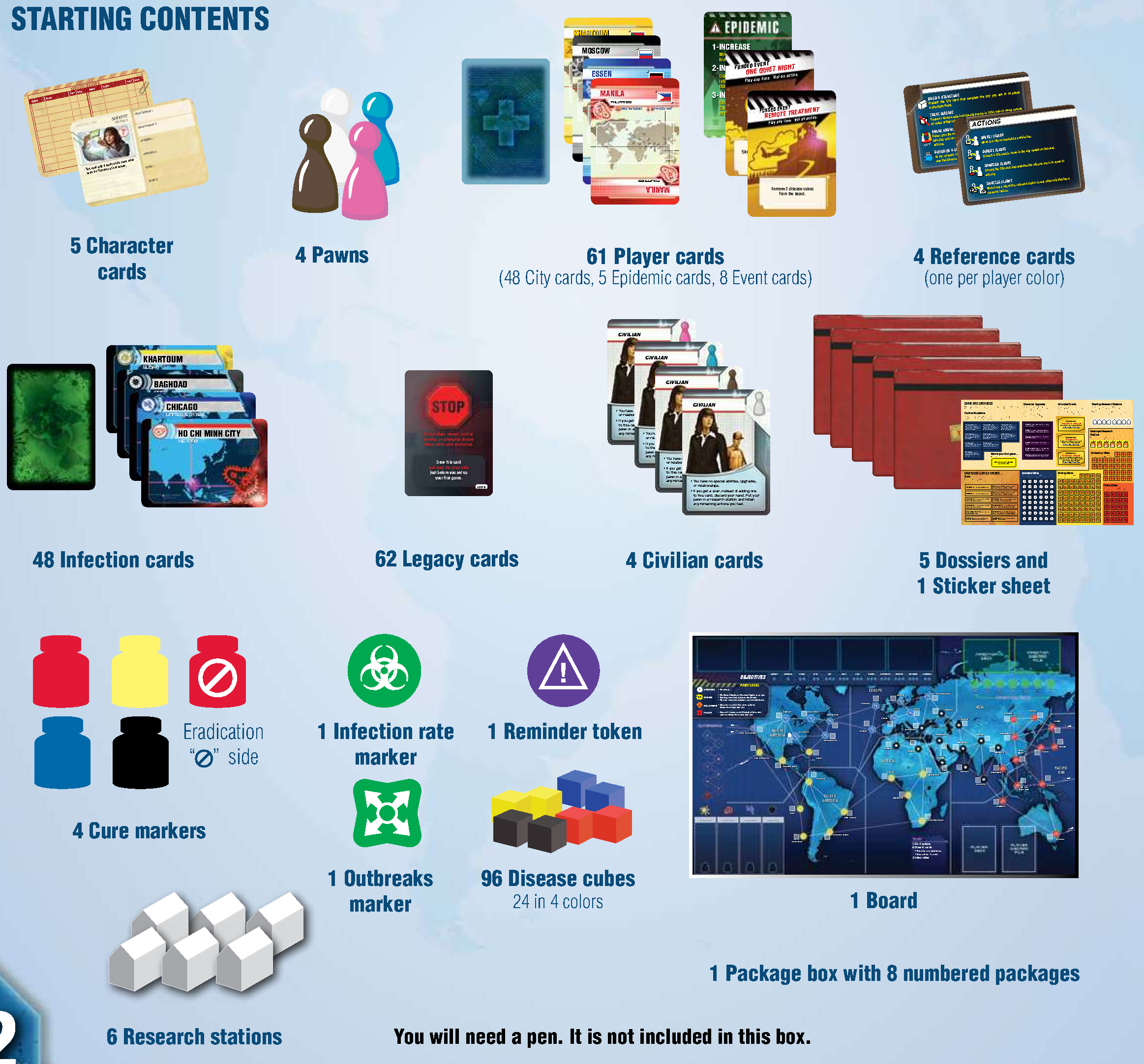
Starting Contents
- 5 Character cards
- 4 Pawns
- 61 Player cards (48 City cards, 5 Epidemic cards, 8 Event cards)
- 4 Reference cards (one per player color)
- 48 Infection cards
- 62 Legacy cards
- 4 Civilian cards
- 5 Dossiers and 1 Sticker sheet
- 1 Board
- 1 Package box with 8 numbered packages
- 96 Disease cubes (24 in 4 colors)
- 4 Cure markers
- 1 Infection rate marker
- 1 Outbreaks marker
- 1 Reminder token
- 6 Research stations
You will need a pen. It is not included in this box.
If You’ve Never Played Pandemic…
We recommend that you play a few games without any of the special “Legacy” rules to get a feel for the decisions you will have to make. Read this rulebook then play without using the following rules:
- Game Months, Legacy Deck, Dossiers
- Objectives, Funding, Game Calendar, Panic Level
- Scars and Lost Characters
- Game End Upgrades
The object of these warm-up games is to cure four diseases before any of the game-losing conditions are triggered (noted on page 14 of these rules). You should play at least two games this way to get a feel for the game before adding the additional rules.
If You Have Played Pandemic…
You will see that game 1 of Pandemic Legacy plays like Pandemic with a few changes, explained in the next few pages.
Pandemic Legacy – Season 1
Cooperative campaign game: work together to treat diseases, find cures, and prevent outbreaks across a 12-month calendar.
Starting Contents
- Cards: 5 Character, 4 Civilian, 4 Reference, 61 Player (48 City, 5 Epidemic, 8 Event), 48 Infection, 62 Legacy
- Tokens & Markers: 4 Pawns, 96 Disease cubes (24 in 4 colors), 4 Cure markers, 1 Infection rate marker, 1 Outbreaks marker, 1 Reminder token, 6 Research stations
- Campaign Components: 1 Board, 5 Dossiers, 1 Sticker sheet, 1 Box with 8 numbered packages
- Other: Pen required (not included)
Optional Warm-Up Games
To practice without Legacy elements, win by curing all 4 diseases while ignoring:
- Legacy Deck, Game Months, and Dossiers
- Objectives, Funding, Game Calendar, and Panic Levels
- Scars, Lost Characters, and End-of-Game Upgrades
How Do You Play a Legacy Game?
Unlike most games, which fully reset every time you play, Pandemic Legacy carries some elements forward from one game to the next. Decisions you make in game 1 will be there in game 2, 3, and every game played with your copy of the game. Different groups will make different decisions and will have a different experience. What results is a game unique to the group that plays it.
Sometimes you will write on parts of the game. Sometimes you will put stickers on cards or the board. Sometimes you will even destroy (tear up) a card. These changes are permanent.
Also, at the end of each game, the group will make two Game End Upgrades to prepare for future games. You will put stickers on the board, cards, and character.
As you play, you will learn about other ways the game will change.
Also, some elements of play are hidden and sealed off before your very first game. As you play, you will find instructions that tell you when to open these packages. Do not open the packages in the box until you receive instructions to do so. The dossiers also contain hidden information that will be revealed as you play.
Some rules, labeled A through Y, are missing throughout this rulebook. As you play, you will gain these missing rules and stick them into the rulebook. From that point on, the rules will be permanently changed.
What Stays and What Gets Reset?
Writing on the board, putting stickers on the board or on cards, and possibly tearing up or destroying components are permanent changes. In all other ways, the game resets for the start of each game. The pieces on the board, cards in hand, outbreaks, etc. all start fresh.
Game Months
Pandemic Legacy is broken into 12 months, starting with January. If your group succeeds in a month, you move on to play the next month. If you fail, you get one more chance to succeed in the current month. Start a new game with the current set of rules and objectives for the month you just lost. If you lose again, you must move on to the next month for your next game.
The Legacy Deck
The Legacy Deck contains cards that will describe what happens over the course of the game’s 12 months. It is arranged in a specific order — do not look through or shuffle these cards.
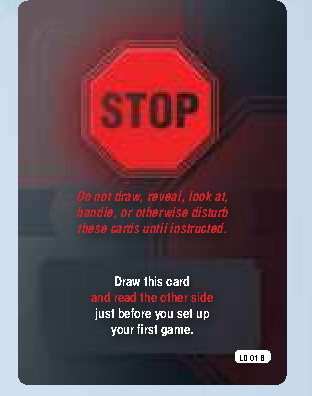
At the start of a game, draw the cards and read them one at a time, until you get to a card that says STOP on the back. This card will tell you when to continue drawing from the deck, which might be mid-game, at the end of a game, or at the start of the next month. The Legacy Deck is a one-way trip. Even if you repeat a month, do not put Legacy cards back. The tray was designed with two spaces for used Legacy cards: one for the used cards, the other for cards that will be used in future games.
If the Legacy Deck becomes scattered, have someone who is not playing the game put the cards back in order using the numbers in the corner of each card. Shown to the right is the first Legacy Deck card (LD 01 B). To ensure this does not happen, once you’ve removed it from its packaging, leave the Legacy Deck in the storing tray.
The Dossiers
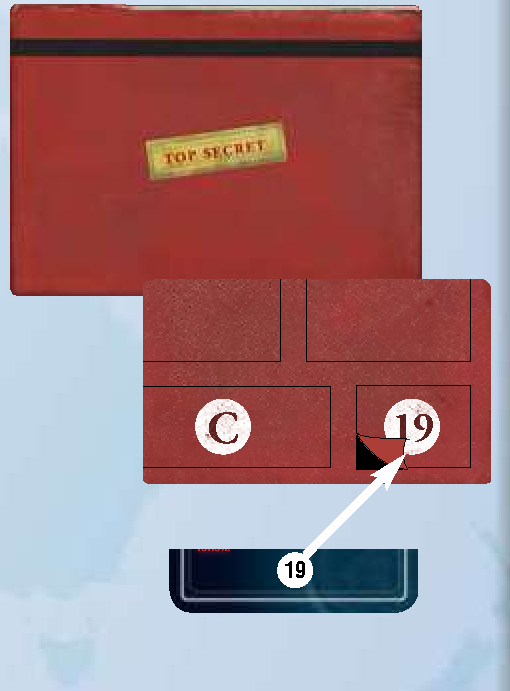
The five dossiers contain the stickers that will go onto the game. As you go through the Legacy Deck, you will come across cards that have dossier numbers or letters on them. When you do, open up – and tear off using the precut corner – the dossier doors matching the numbers (or letters) on the card, one at a time, resolving each one before opening the next. Some of these dossier doors will contain one-time stickers. Others will create a card that will be used from time to time in future games.
The Packages
There are eight packages in the game. As you play through the game, yellow boxes will instruct you to open specific packages.
Important: Before your very first game, place the Open Package 8 sticker on door 8 of the package box, in the frame designed for it.
Objectives
At the beginning of each game, you will have an objective (or objectives) you need to complete in order to win. The number of objectives needed to win in a month is shown on the board for that month.
If an objective is marked as mandatory, it must be completed in order to win. You do not need to decide which other objectives you are trying to accomplish at the beginning of any game; you may wait to see how the game unfolds.
Some objectives will remain in play until the group completes them; others will expire at the end of a particular month. As the year unfolds, new objectives will be introduced.
Funding
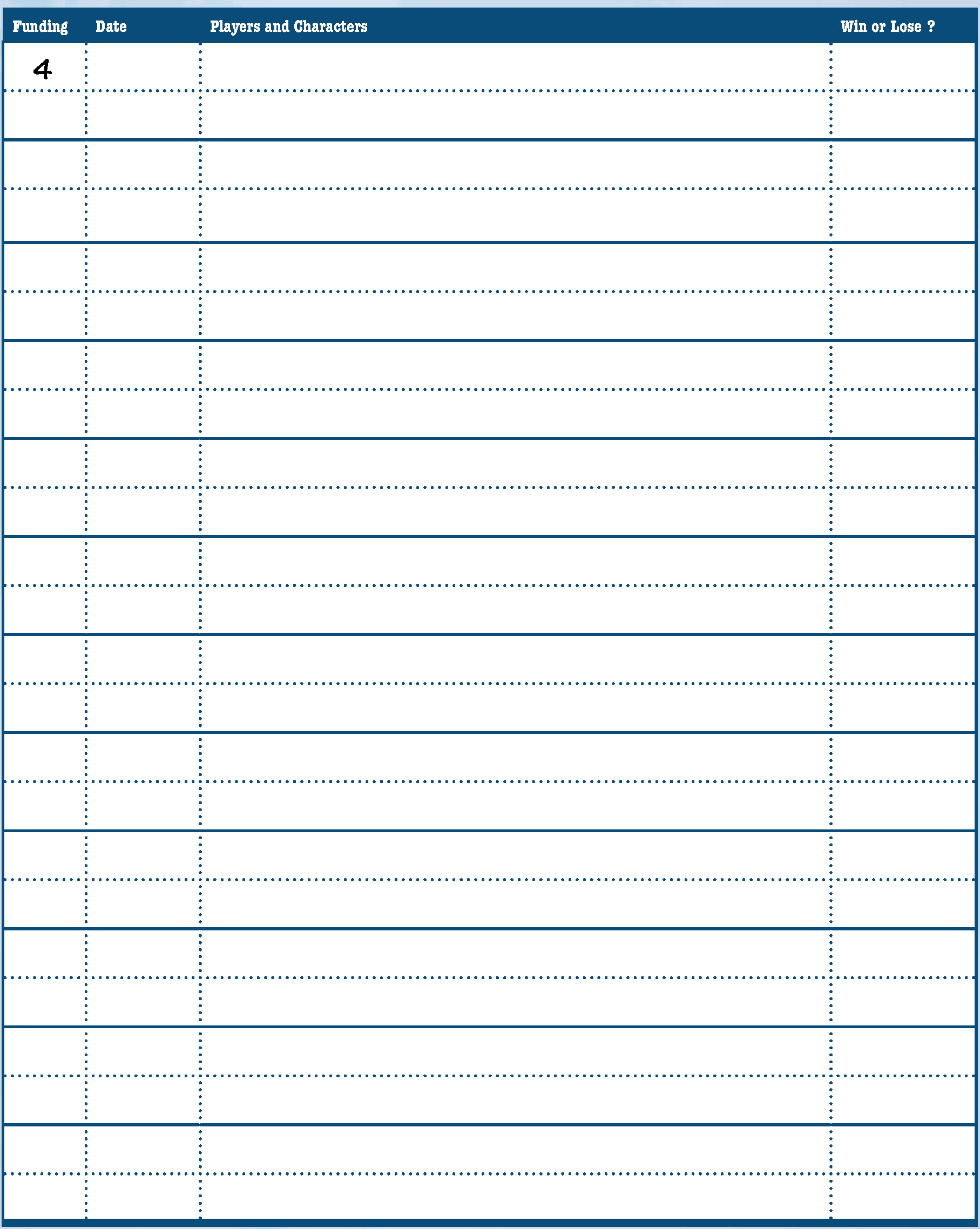
At the beginning of each game, you will add Funded Event cards (of the group’s choice) to the Player Deck equal to your Funding Level. Your Funding Level is 4 at the beginning of the first game in January but will go up and down from game to game. The minimum funding is 0 and the maximum is 10.
Game Calendar
Use the game calendar to record your progress, wins and losses, players involved, and your current Funding Level. The game calendar can be found on the back cover of this rulebook.
Reminder Token
This token is used occasionally during games to remind players to remember something.
The Game Board
Regions
The board is broken up into six regions, each roughly equivalent to a continent. These will come into play later.
Objectives Section
In one corner of the board is a section where objectives are placed. January will start with one objective. Other objectives will be added and removed in future months.
Disease Tracking Area
Use this area of the board to apply changes to any of the four diseases.
Panic Level
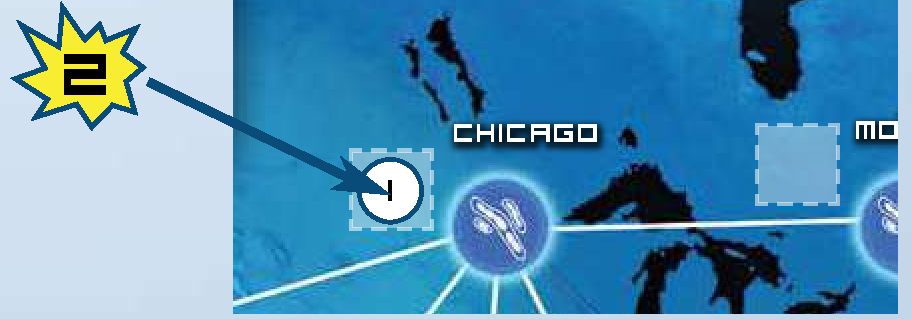
Cities are panicking as these diseases take hold. Whenever an outbreak occurs in a city, its panic level will go up by one. The first time a city panics, place the level 1 sticker (unstable) in the panic level sticker box near the city. After that, place the next numbered sticker over the previous one (level 2, then level 3, etc.). The effects of panic levels are shown below. These effects are cumulative.
| Level | State | Effect |
|---|---|---|
| 1 | Unstable | No effect. |
| 2–3 | Rioting | Players cannot take Direct Flights or Charter Flights in or out. Research stations are destroyed and cannot be rebuilt. |
| 4 | Collapsing | Discard 1 card of the city’s color to enter this city with the Drive/Ferry action. |
| 5 | Fallen | Discard an additional card of the city’s color to enter this city with the Drive/Ferry action (for a total of 2 cards). If your character is in a city when it falls, it is lost. See Lost Characters on page 5. |
How Do You Play a Legacy Game?
- Permanent changes: Stickers (board, cards, characters, rulebook slots A–Y), writing, and destroyed (torn) components.
- End of Game: Choose 2 Game End Upgrades to apply permanently.
- Sealed materials: Do not open packages, dossiers, or examine the Legacy Deck until explicitly instructed.
What Stays and What Gets Reset?
- Resets every game: Board pieces, player cards/hands, outbreak track, disease cubes, and decks.
- Carries over: All stickers, writing, destroyed cards, and upgrades.
Game Months
- 12 calendar months (January–December).
- Win: Advance to the next month.
- Loss: Replay the month once. If you lose the second attempt, advance to the next month anyway (maximum 2 games per month).
- Track results, players, and funding on the rulebook’s Game Calendar.
Legacy Deck, Dossiers & Packages
- Legacy Deck: Do not shuffle or browse. Draw cards one by one from the top until reaching a card marked STOP. Never return drawn cards to the deck.
- Dossiers: Open numbered/lettered doors only when directed; resolve each fully before opening the next.
- Packages: Open only when prompted by a yellow box. Before Game 1: Place the “Open Package 8” sticker on door 8.
Objectives & Funding
- Objectives: The board indicates how many are required to win. Mandatory objectives must be completed; others are completed as opportunities arise.
- Funding: At setup, add Funded Event cards to the Player Deck equal to the current Funding Level (Game 1 starts at 4; range: 0–10).
Panic Levels
Each outbreak increases the city’s panic level by 1 (place the next sticker over the previous). Effects are cumulative:
- Level 1 (Unstable): No effect.
- Levels 2–3 (Rioting): No Direct or Charter Flights in or out. Research stations are permanently destroyed.
- Level 4 (Collapsing): Discard 1 card of the city’s color to enter via Drive/Ferry.
- Level 5 (Fallen): Discard 2 cards of the city’s color to enter via Drive/Ferry. Characters inside when the city falls are lost.
Characters
Each player has a specific character with special abilities to improve the team’s chances. Each player begins game 1 by creating a character.
To create a character: Select a Character card (each one has different special abilities) and give your character a name.
These characters will carry through from game to game and they may become lost (see below). You do not have to play the same character in every game.
Scars
Characters can be mentally or physically damaged over the course of play. When this happens, choose an available scar and add it to your character’s card. Characters are scarred when they are in a city that outbreaks and may be scarred in other ways that will be noted in future rules.
Whenever you must place a scar on a character that has no room for it, that character becomes lost.
Lost Characters
If you have to put a scar on your character and it has no more scar slots, or if your character is in a city when it falls, your character is lost.
When your character is lost:
- Destroy (rip up) your Character card. It cannot be played in this or in future games.
- Discard all cards you have.
- Take the Civilian card matching your pawn.
- Place your pawn in a city with a research station (this may be your current city). If there are no research stations in play, place your pawn in Atlanta.
If your character was lost during your turn, continue with your turn, keeping any remaining actions you have.
Character Reference
Refer to this section after you’ve learned how to play the game for fine points regarding each of the characters.
Dispatcher
The Dispatcher may, as an action, either:
- move any pawn, if its owner agrees, to any city containing another pawn, or
- move another player’s pawn, if its owner agrees, as if it were his own.
The Dispatcher can only move other players’ pawns; he may not direct them to do other actions, such as Treat Disease.
When the Dispatcher moves a player’s pawn as if it were his own:
- use the Dispatcher’s scars and upgrades, not those belonging to the character he is moving,
- cards that need to be played or discarded (for Direct and Charter Flights or to enter a collapsing or fallen city) come from the Dispatcher’s hand. A card discarded for a Charter Flight must match the city the pawn is moving from.
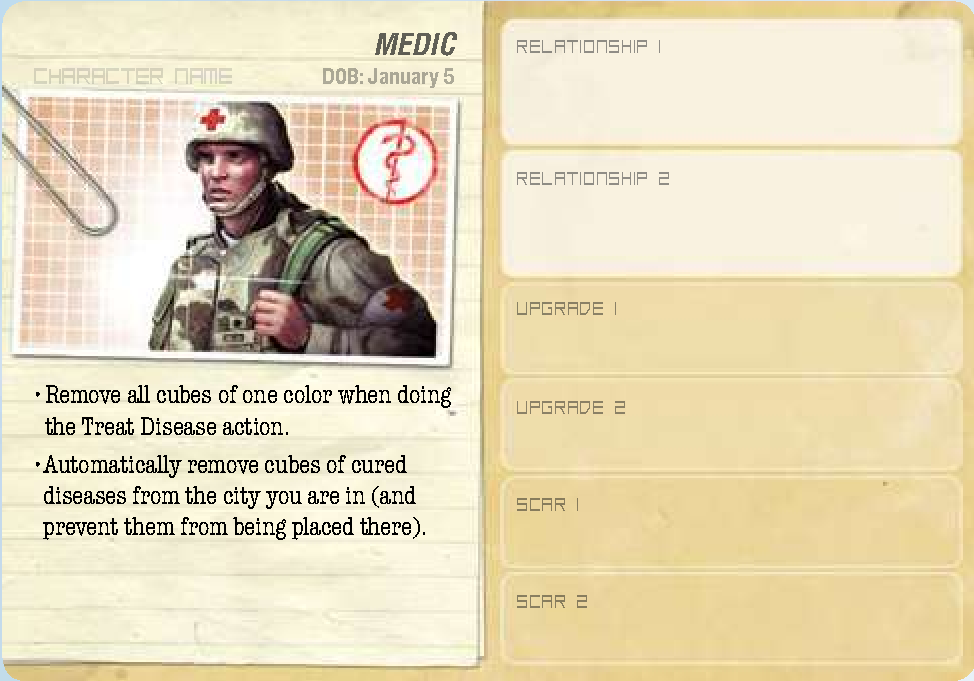
Medic
- The Medic removes all cubes, not 1, of the same color when doing the Treat Disease action.
- If a disease has been cured, he automatically removes all cubes of that color from a city, simply by entering it or being there. This does not take an action.
- The Medic also prevents placing disease cubes (and outbreaks) of cured diseases in his location. The Medic’s automatic removal of cubes also happens during other players’ turns.
Scientist
The Scientist needs only 4 (not 5) City cards of the same disease color to Discover a Cure.
Researcher
When doing the Share Knowledge action, the Researcher may give any City card from her hand to another player in the same city as her, without this card having to match her city. The transfer must be from her hand to the other player’s hand, but it can occur on either player’s turn.
Generalist
The Generalist has slots for 4 different character upgrades and gets 5 actions per turn.
Characters
Choose and name a Character card. Characters persist across games.
Scars
- Gained when present in an outbreaking city.
- Taking a scar with no available slots makes the character lost.
Lost Characters
Triggered when a character must take a scar with no open slots, or is in a city when it falls.
- Destroy (rip up) the Character card permanently.
- Discard all cards in hand.
- Take the matching Civilian card.
- Place pawn at any research station (or Atlanta if none exist).
- If lost on your turn, continue using remaining actions.
Character Reference
- Dispatcher: As an action (with owner’s permission), move any pawn to a city with another pawn, or move another pawn as your own. Uses Dispatcher’s cards, scars, and upgrades. Cannot perform non-movement actions for others.
- Medic: Treat Disease removes all cubes of that color. Automatically clears cured disease cubes upon entering/occupying a city for 0 actions (active on all players’ turns). Blocks cube placement and outbreaks of cured diseases in current city.
- Scientist: Needs only 4 matching City cards to Discover a Cure.
- Researcher: When sharing knowledge, may give any City card from hand to a player in the same city (usable on either player’s turn).
- Generalist: Has 5 actions per turn and 4 upgrade slots.
Game Setup
You may notice that some steps are missing. They will be added later.
- Read the Mission Briefing: When playing a month for the first time, draw cards off the top of the Legacy Deck until you reach one that says STOP. Read the mission briefing and integrate new cards (if any) to the game.
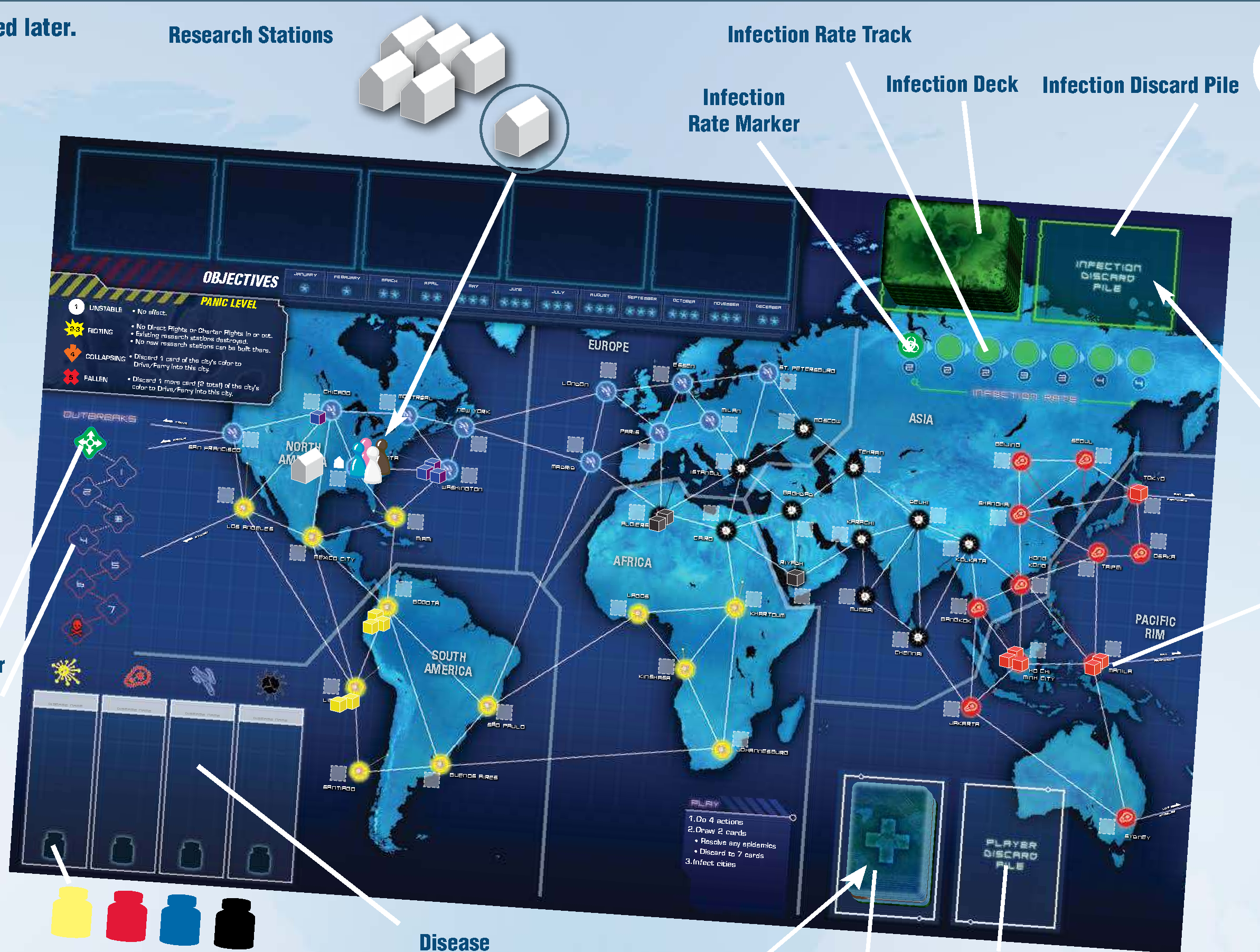
- Set out the board and pieces: Put all structures (initially you’ll only have research stations) nearby. Separate the cubes by color into 4 supply piles. Place a research station in each city with a starting research station sticker. (You begin the game with one in Atlanta.) In future games there may be other pieces you place.
- Place outbreaks, cure markers, and objectives: Place the outbreaks marker on the “0” space of the Outbreaks Track. Place the 4 cure markers, “vial” side up, at the bottom of the disease tracking area. Place all current objectives in the objectives area.
- Place infection rate marker and infect 9 cities: Place the infection rate marker on the left-most “2” space of the Infection Rate Track. Shuffle the Infection cards and flip over 3 of them. Put 3 disease cubes of the matching color on each of these cities. Flip over 3 more cards: put 2 disease cubes on each of these cities. Flip over 3 more cards: put 1 disease cube on each of these cities. (You will place a total of 18 disease cubes, each matching the color of the city.) Place these 9 cards faceup on the Infection Discard Pile. The other Infection cards form the Infection Deck.
- Select Funded Events, add them to the deck, and deal out Player cards: As a group, decide which Funded Event cards are going into the Player Deck. The Player Deck can have as many Funded Event cards as your current funding level. (Your funding level is 4 for your first game.) Shuffle these Event cards and City cards together and deal cards to the players to form their initial hands. Give cards according to the number of players:
- 2-player game: 4 cards
- 3-player game: 3 cards
- 4-player game: 2 cards
In Pandemic Legacy, players keep their hands faceup at all times.
- Prepare the Player Deck: Divide the remaining player cards into 5 facedown piles, as equal in size as you can. Shuffle 1 Epidemic card into each pile, facedown. Stack these piles to form the Player Deck, placing smaller piles at the bottom.
- Select Characters and Starting Location: Have each player select a character and player color. Give them the corresponding Reference card and pawn. Place their pawns at any one research station. (Players will start their first game in Atlanta.) All the characters must start together. Place any remaining character cards and pawns back in the box. If there are no research stations, players start in the ruins of Atlanta.
- [RULE STICKER D will go here]
- Use game winning bonus: Winning a month will result in getting a bonus for the next month played. The group should use that bonus now. (You won’t have a bonus for your first game.)
- Begin play: Take all the pawns and blindly select one. That player goes first and play proceeds clockwise.
Game Setup
1. Briefing & Board Setup
- Legacy Deck: Draw cards until “STOP”; read briefing and integrate new cards.
- Structures & Markers: Place research stations on marked cities (Atlanta initially). Set Outbreaks marker to 0 and 4 cure markers vial-side up. Set active objectives.
- Bonus: Apply game-winning bonus from the previous month (if applicable).
2. Infection
- Set Infection Rate marker on the leftmost 2 space.
- Draw Infection cards and place matching cubes (9 cards total, 18 cubes):
- 3 cards: 3 cubes each.
- 3 cards: 2 cubes each.
- 3 cards: 1 cube each.
- Discard the 9 drawn cards faceup to start the Infection Discard Pile. Remaining cards form the Infection Deck.
3. Player Deck & Hands
- Add Funded Event cards equal to the current funding level (4 in first game) to City cards and shuffle.
- Deal starting hands faceup:
- 2 players: 4 cards each
- 3 players: 3 cards each
- 4 players: 2 cards each
- Divide remaining player cards into 5 equal piles. Shuffle 1 Epidemic card into each pile, then stack them (smaller piles on bottom) to form the Player Deck.
4. Characters & Turn Order
- Select characters. Place all pawns together at any one research station (Atlanta initially).
- Randomly draw a pawn to determine the starting player. Play proceeds clockwise.
Turn Overview
Each player turn is divided into 3 steps:
- Do 4 actions.
- Draw 2 Player cards.
- Infect cities.
After a player is done infecting cities, the player on their left goes next.
Players should freely give each other advice. Let everyone offer opinions and ideas. However, the player whose turn it is decides what to do.
Your hand can have City and Event cards in it. City cards are used in some actions and Event cards can be played at any time.
Actions (Step 1)
You may do up to 4 actions each turn. Select any combination of the actions listed below. You may do the same action several times, each time counting as 1 action. Your character’s special abilities may change how an action is done. Some actions involve discarding a card from your hand; all these discards go to the Player Discard Pile.
Movement Actions
- Drive / Ferry: Move to a city connected by a white line to the one you are in. (A white line that goes off the board “wraps around” to the other edge and connects to a city. Example: Sydney and Los Angeles are connected.)
- Direct Flight: Discard a City card to move to the city named on the card. You cannot use Direct Flight in or out of a city that is rioting, collapsing, or fallen.
- Charter Flight: Discard the City card that matches the city you are in to move to any city. You cannot use Charter Flight into or out of a city that is rioting, collapsing, or fallen.
- Shuttle Flight: Move from a city with a research station to any other city that has a research station.
Other Actions
Build a Structure
Discard the City card that matches the city you are in to place a structure there. In January, the only structures you have available are research stations; more will come later. Take the structure from the pile next to the board. If all structures of a type have been built, you may take one from anywhere on the board and move it to your current city. Each city may contain one of each type of structure.
Treat Disease
Remove 1 disease cube from the city you are in, placing it in the cube supply next to the board. If this disease color has been cured (see Discover a Cure below), remove all cubes of that color from the city you are in.
If there are cubes from several cured diseases in a city, you must still Treat Disease once for each cured color to remove these cubes.
If the last cube of a cured disease is removed from the board, this disease is eradicated. Flip its cure marker from its vial side to its eradicated side.
The first time you eradicate a disease, invent a name for it, then write its new name on the board in the disease tracking area. Eradicating a disease also gives you the option to give it a positive mutation at the end of the game as one of your bonuses. Positive mutations may only be applied to diseases that were eradicated in the just-played game.
Eradicating a disease is not needed to win. However, when cities of an eradicated disease are infected, no new disease cubes are placed there (see Epidemics and Infections on pages 11-12). Removing the last cube of a disease that is not cured has no effect.
Share Knowledge
You can do this action in two ways:
- give the City card that matches the city you are in to another player, or
- take the City card that matches the city you are in from another player.
The other player must also be in the city with you. Both of you need to agree to do this.
If the player who gets the card now has more than 7 cards, that player must immediately discard a card or play an Event card.
Discover a Cure
At any research station, discard 5 City cards of the same color from your hand to cure the disease of that color. Cover the disease icon (shown at the top of the disease tracking area) with the matching cure marker. If no cubes of this color are on the board, this disease is eradicated. Flip its cure marker to its eradicated side.
If no action is required to Discover a Cure (due to positive mutations) then a player may discard the needed cards from their hand immediately, even if it isn’t their turn.
When a disease is cured, its cubes remain on the board and new cubes can still be placed during epidemics or infections (see Epidemics and Infections on pages 11-12). However, treating this disease is now easier.
Cards & Structures Rules
Player Cards
As you play, you will have the option to place stickers on City cards. Each City card can have one sticker. When you play a City card with a sticker, you choose whether it is being played as a City card or using the effect of the sticker, never both.
Players may always examine discard piles.
Hand Limit
If you ever have more than 7 cards in hand (after first resolving any Epidemic cards you may have drawn), discard cards or play Event cards until you have 7 cards in hand (see Event Cards).
Only Player cards count towards your hand limit.
Event Cards
Playing an Event card is not an action. The player who plays an Event card decides how it is used. Event cards can be played at any time, except in between drawing and resolving a card.
Example: During infections, the first Infection card drawn causes an outbreak. You may not play the Remote Treatment to prevent this. After this outbreak happens however, you may use Remote Treatment before flipping over the next Infection card.
After playing an Event card, discard it to the Player Discard Pile.
Structures
Each city may contain one of each type of structure.
Research Stations
You need to be at a research station to use the Discover a Cure action. You can also use the Shuttle Flight action to travel between two research stations. Destroy a research station in a city if it is rioting. If it was a starting research station, replace the starting research station sticker with a destroyed research station sticker. You cannot build a research station in a city that is rioting, collapsing, or fallen.
Turn Overview
- Do 4 actions.
- Draw 2 Player cards.
- Infect cities.
Play passes clockwise. Any player may give advice, but active player decides.
Actions
Take up to 4 actions (any combination, may repeat):
Movement Actions
- Drive / Ferry: Move to a connected adjacent city.
- Direct Flight: Discard a City card to move to that city. Cannot enter or leave rioting, collapsing, or fallen cities.
- Charter Flight: Discard your current city’s card to move anywhere. Cannot enter or leave rioting, collapsing, or fallen cities.
- Shuttle Flight: Move between any two research stations.
Other Actions
- Build a Structure: Discard your current city’s card to build a structure there (limit 1 of each type per city). If supply is empty, move one from anywhere on the board.
- Treat Disease: Remove 1 disease cube from your current city. If that disease is cured, remove all cubes of that color instead. Removing the last cube of a cured disease eradicates it.
- Share Knowledge: Give or take the City card matching your current city to/from another player in the same city (both must agree).
- Discover a Cure: At a research station, discard 5 City cards of the same color to cure that disease.
Cards & Structures Rules
Player Cards
- Card Stickers: Choose to use the card as a City card or use the sticker effect; never both.
- Discard Piles: May be examined at any time.
- Hand Limit: Maximum 7 Player cards. Discard or play Events immediately if exceeded (resolved after Epidemics).
- Event Cards: Free action; play at any time except between drawing and resolving a card.
Structures
- Limit 1 of each structure type per city.
- Research Stations: Required for Discover a Cure and Shuttle Flight. Destroyed if city enters rioting state. Cannot build in rioting, collapsing, or fallen cities.
Draw Cards (Step 2)
After doing 4 actions, draw the top 2 cards together from the Player Deck.
Warning: If, as you are about to draw, there are fewer than 2 cards left in the Player Deck, the game ends and your team has lost! (Do not reshuffle the discard to form a new deck.)
Epidemic Cards
If your draws include any Epidemic cards, do not add them to your hand (and do not draw replacement cards for them). Instead, immediately do the following steps in order:
- Increase: Move the infection rate marker forward 1 space on the Infection Rate Track.
- Infect: Draw the bottom card from the Infection Deck. Unless its disease color has been eradicated, put 3 disease cubes of that color on the named city. If the city already has cubes of this color, do not add 3 cubes to it. Instead, add just enough cubes so that it has 3 cubes of this color and then an outbreak of this disease occurs in the city (see Outbreaks on page 13). Discard this card to the Infection Discard Pile.
Warning: If you cannot place the number of cubes actually needed on the board, because there are not enough cubes of the needed color left in the supply, the game ends and your team has lost! This can occur during an epidemic, an outbreak, or infections.
- Intensify: Reshuffle just the cards in the Infection Discard Pile and place them on top of the Infection Deck.
When doing these steps, remember to draw from the bottom of the Infection Deck and to then reshuffle only the Infection Discard Pile, placing it on top of the existing Infection Deck.
It is rare but possible to draw 2 Epidemic cards at once. In this case, do all three steps above once and then again.
In this case, the second epidemic’s Infection card will be the only card to “reshuffle”, ending on top of the Infection Deck. An outbreak will then occur in this city during Infections (see Infections on page 12), unless an Event card is played to prevent this (see Event Cards on page 15).
After resolving any Epidemic cards, discard them.
Infections (Step 3)
Flip over as many Infection cards from the top of the Infection Deck as the current infection rate. This number is below the space of the Infection Rate Track that has the infection rate marker. Flip these cards over one at a time, infecting the city named on each card.
To infect a city, place 1 disease cube matching its color onto the city, unless this disease has been eradicated. If the city already has 3 cubes of this color, do not place a 4th cube. Instead, an outbreak of this disease occurs in the city (see Outbreaks on page 13). Discard this card to the Infection Discard Pile.
Outbreaks
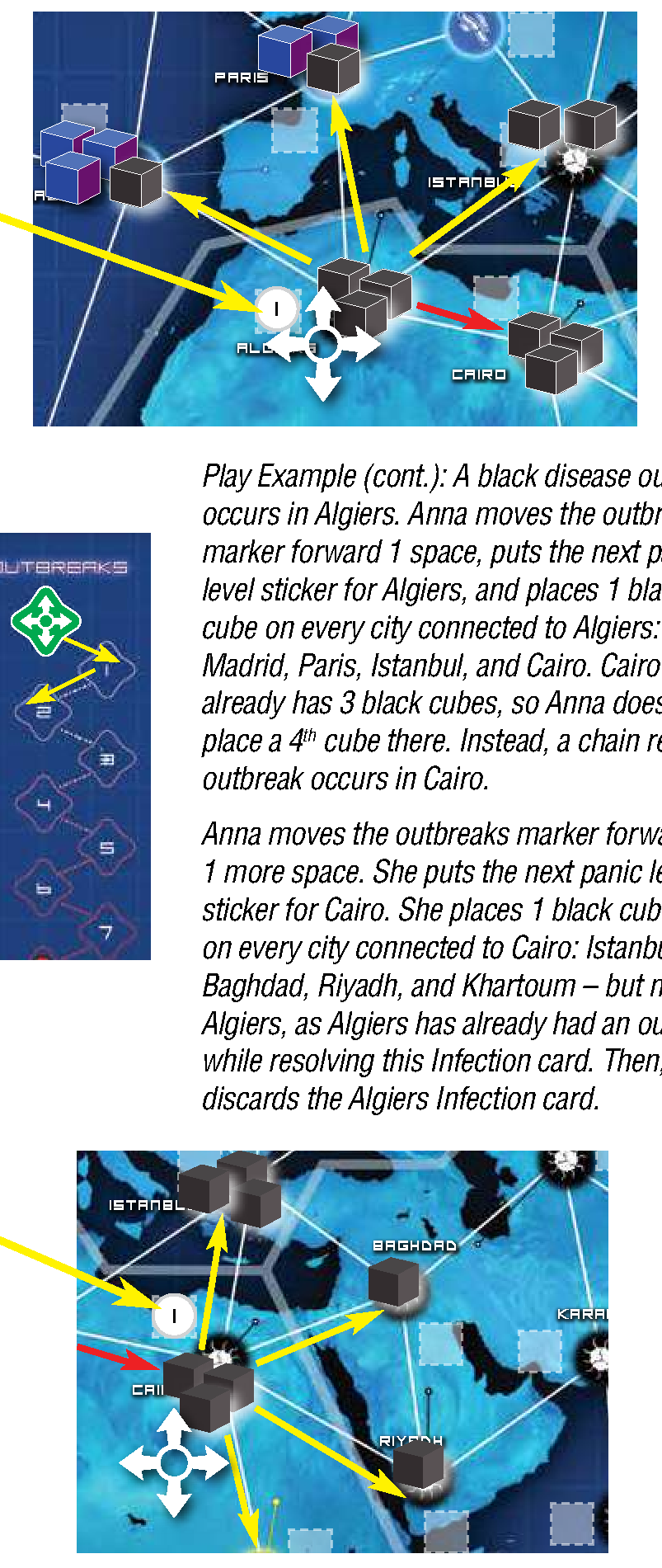
When a disease outbreak occurs:
- Move the outbreaks marker forward 1 space on the Outbreaks Track.
- Place 1 cube of the disease color on every city connected to the city.
- If any of them already has 3 cubes of the disease color, do not place a 4th cube in those cities. Instead, in each of them, a chain reaction outbreak occurs after the current outbreak is done.
When a chain reaction outbreak occurs, first move the outbreaks marker forward 1 space. Then, place cubes as above, except do not add a cube to cities that have already had an outbreak (or a chain reaction outbreak) as part of resolving the current Infection card.
As a result of outbreaks, a city may have disease cubes of multiple colors on it; up to 3 cubes of each color.
Warning: If the outbreaks marker reaches the last space of the Outbreaks Track, the game ends and your team has lost!
Increase Panic Level
Increase the panic level of all cities that have an outbreak. If the game would end due to outbreaks, only increase the panic level for the first 8 outbreaks. If more than 8 cities would outbreak (due to chain reactions) players may choose which cities outbreak and increase their panic level, stopping when you get to the 8th outbreak.
If a city’s panic level reaches level 2, remove any research station present in that city. If there is a starting research station sticker in that city (explained on page 14), cover that sticker with a destroyed research station sticker.
When an outbreak occurs in a city at panic level 5, do not place a sticker, but resolve the outbreak as usual.
In later games, it is possible for cities to become isolated so that outbreaks in it do not affect any adjacent cities. In this case, increase the panic level of the outbreaking city but do not raise the Outbreaks Track marker.
Check for Scars
Characters standing in an outbreaking city receive a scar.
Turn End
After infecting cities and discarding Infection cards, your turn is over. The player on your left begins their turn.
Draw Cards (Step 2)
Draw 2 cards from the Player Deck.
- Defeat: If fewer than 2 cards remain in the deck when drawing, the game is lost.
Epidemic Cards
Do not add to hand. Resolve immediately in order (resolve one at a time if 2 drawn):
- Increase: Advance the Infection Rate marker 1 space.
- Infect: Draw the bottom card of the Infection Deck. Place 3 cubes on that city (or bring it to 3 cubes and trigger an outbreak) unless eradicated. Discard to Infection Discard Pile.
- Intensify: Reshuffle the Infection Discard Pile and place it on top of the Infection Deck.
- Defeat: If you cannot place required cubes due to an empty supply, the game is lost.
Infections (Step 3)
Flip cards from top of Infection Deck equal to the current Infection Rate, one by one:
- Place 1 matching cube on the named city unless eradicated.
- If the city already has 3 cubes of that color, trigger an outbreak instead.
- Discard cards to Infection Discard Pile.
Outbreaks
- Advance Outbreaks marker 1 space.
- Place 1 matching cube on each connected city.
- Chain Reactions: If a connected city already has 3 cubes of that color, it outbreaks next. A city can only outbreak once per Infection card.
- Max 3 cubes per color per city.
- Defeat: If the Outbreaks marker reaches the final space, the game is lost.
Increase Panic Level
- Increase panic level by 1 in each outbreaking city (cap at 8 outbreaks if game ends).
- Panic Level 2: Destroy any research station in that city.
- Isolated cities: Increase panic level, but do not advance the Outbreaks marker.
Check for Scars
Characters present in an outbreaking city receive a scar.
Turn End
Play passes to the player on the left.
Game End
You win as soon as you meet the necessary number of objectives. The game ends immediately, even if it is the middle of a player’s turn or a series of outbreaks.
There are many ways for the game to end and the players to lose:
- Immediately when the outbreaks marker reaches the last space of the Outbreaks Track.
- Immediately if you are unable to place the number of disease cubes actually needed on the board. Any future cubes and/or outbreaks don’t happen.
- If a player cannot draw 2 Player cards after doing their actions.
WIN OR LOSE, THE GROUP CHOOSES TWO GAME END UPGRADES AT THE END OF THE GAME.
If You Win the Game
- You get the Win Bonus for the next month. This is described on cards in the Legacy deck.
- You start your next game at the beginning of the next month.
- Your Funding Level is cut by 2 (minimum of 0) as you clearly have the situation in hand.
- Record your new funding level.
If You Lose the Game
- If this is the first time the month has been played, you must try the month again. If not, move on to the next month for your next game.
- Your Funding Level is increased by 2 (maximum of 10) as this mess needs to be fixed ASAP.
- Record your new funding level.
In Either Case (Win or Lose)
- Choose two upgrades (see next section).
- Clear the board of all game pieces.
- Discard all City cards. These all reset for the start of the next game. Do not put any Legacy cards back in the Legacy deck, even if playing the same month. Just continue where you left off in the Legacy deck.
- If playing the same month again, your mission briefing and objectives are the same.
Set up future games as described in Setup on pages 6-7.
Game End Upgrades
Win or lose, you choose two upgrades at the end of each game. You may choose the same upgrade twice.
Unfunded Events
Select an event sticker to add to any City card in the Player Deck. This card is now both a City card and an Event card and can be used either way, but not both. These City/Event cards are available every game (they’re unaffected by the funding level). Each City card can only have one sticker.
Starting Research Stations
Select a city currently containing a research station and add a starting research station sticker. Add a research station to every city with one of these stickers during the setup of all future games. When placing a starting research station sticker, place it close to the city (similar to the one printed on the board for Atlanta). Do not place it in a panic level sticker box.
Character Upgrades
Add an upgrade to a character. Each character has room for 2 upgrades (except the Generalist, who has 4). Players may stick an upgrade over an existing upgrade. Upgrades can only be applied to characters that were in the just-played game.
Positive Mutations
If you’ve eradicated a disease during this game, you may give that disease a positive mutation to make it easier to find a cure in future games. Put the positive mutation sticker on the disease tracking area of the board.
Diseases that gain the Efficient to Sequence mutation are cured as soon as one player discards the necessary number of cards. This does not require an action and can happen on another player’s turn.
Game Calendar
Notes on using the Game Calendar:
- If you win, advance to the next month and decrease your funding by 2.
- If you lose the first half of the month, play the second half of the month and increase your funding by 2.
- If you lose in the second half of the month, increase your funding by 2, then proceed to the next month.
- Funding cannot go under 0 or over 10.
Game End
Win: Immediately when required objectives are met.
Lose (Immediately):
- Outbreaks marker reaches final space.
- Cannot place required disease cubes.
- Player cannot draw 2 Player cards.
If You Win
- Gain next month’s Win Bonus.
- Advance to next month.
- Funding level decreases by 2 (minimum 0).
If You Lose
- First loss in month: Replay the month.
- Second loss in month: Advance to next month.
- Funding level increases by 2 (maximum 10).
Cleanup (Win or Lose)
- Select 2 upgrades.
- Clear the board and reset City cards.
- Never return cards to the Legacy deck; continue where you left off.
Game End Upgrades
Choose 2 total per game (can choose the same upgrade twice):
Unfunded Events
Place an event sticker on any City card (limit 1 per card). Usable as either City or Event card in all future games.
Starting Research Stations
Place sticker near a city with a current research station (not in panic box). Station is placed there during all future setups.
Character Upgrades
Add to a character used in the current game (limit 2 per character, Generalist 4; can overwrite existing upgrades).
Positive Mutations
Add to the disease tracking area of a disease eradicated during this game. Efficient to Sequence: cures immediately when cards are discarded (no action required; can occur on any player’s turn).
Game Calendar
- Win: Advance to next month; funding -2.
- Lose (Game 1): Play second half of month; funding +2.
- Lose (Game 2): Advance to next month; funding +2.
- Funding range: 0 to 10.
Overlooked Rules
- You do not draw a replacement card after drawing an Epidemic card.
- You may Discover a Cure at any Research Station – the color of its city does not need to match the disease you are curing.
- On your turn, you may take a card from another player, if you are both in the city that matches the card you are taking.
- On your turn, you may take any City card from the Researcher (only), if you are both in the same city.
- Your hand limit applies immediately after getting a card from another player.
- Characters gain a scar from standing in a city that outbreaks.
What Happens If We Mess Up a Rule Since We Can’t Go Back?
In most cases, it won’t matter. A little rule confusion here or there or a card left out of a deck or something forgotten will not greatly affect your game. Just note it and move on.
In some cases a missing or confused rule will have resulted in a whole game being too easy or too hard. In this case, the group should decide whether to increase their funding for next game (if you accidentally made a game too hard) or reduce funding for the next game (if you made a game too easy).
Credits
- Game design: Matt Leacock and Rob Daviau
- Artwork: Chris Quilliams
- Graphic design: Philippe Guérin
- Rules Layout: Marie-Eve Joly
- Editing: Jean-François Gagné
- Playtesters: Sherrie Alder, Robby Anderson, Chris Aylott, Margaret and Richard Bliss, Michael Bretzlaff, Brett Burgess, Danny Calderon, Chris and Kim Farrell, Nathan Fluegel, Rich Fulcher, Mark Goetz, Jason Grantz, Mickie Grantz, Chris Grim, Philip Gross, Shelby Hemker, David Heron, Carissa Josephic, Jesse Josephic, Tim Keating, David Kloba, Shawn Murphy, Colleen, Donna, Ruth and Tim Leacock, Patrick Neary, Steve Nix, Dave Nolin, Jonathan Owens, Bryan Reed, Jason Schklar, Jenn Skahen, Ken Tidwell, Stephen Waldron, Kit Yona, and Ian Zang.
- Gen Con Playtesters: Ryan Corder, Martin Lieser, Paul Madden, and Nicholas Kent.
- Special Thanks: Tom Lehmann, Beth Heile, and John Knoerzer.
Overlooked Rules
- Epidemics: Do not draw a replacement card.
- Cures: Can be discovered at any Research Station (city color does not need to match).
- Share Knowledge: Both players must be in the matching city to take that card on your turn.
- Researcher: Can give any City card to a player in the same city.
- Hand Limit: Applies immediately after receiving a card.
- Scars: Any character in a city during an outbreak gains a scar.
Rule Mistakes
- Minor errors: Note it and continue playing.
- Balance affected: Adjust next game’s funding (increase funding if made too hard, decrease if made too easy).
Introduction & Components
Pandemic Legacy – Season 1
by Matt Leacock and Rob Daviau
The world is falling apart. Four diseases are sweeping the planet and your team is on the front lines. Worse yet, one disease has shown signs that it may become resistant to any treatment.
Pandemic Legacy is a cooperative game where all players must work together to develop cures and prevent disease outbreaks, before 4 diseases contaminate humanity. You will all win or lose together.
Can you survive the year and save humanity?
Starting Contents
- 5 Character cards
- 4 Pawns
- 61 Player cards (48 City cards, 5 Epidemic cards, 8 Event cards)
- 4 Reference cards (one per player color)
- 48 Infection cards
- 62 Legacy cards
- 4 Civilian cards
- 5 Dossiers and 1 Sticker sheet
- 1 Board
- 1 Package box with 8 numbered packages
- 96 Disease cubes (24 in 4 colors)
- 4 Cure markers
- 1 Infection rate marker
- 1 Outbreaks marker
- 1 Reminder token
- 6 Research stations
You will need a pen. It is not included in this box.
If You’ve Never Played Pandemic…
We recommend that you play a few games without any of the special “Legacy” rules to get a feel for the decisions you will have to make. Read this rulebook then play without using the following rules:
- Game Months, Legacy Deck, Dossiers
- Objectives, Funding, Game Calendar, Panic Level
- Scars and Lost Characters
- Game End Upgrades
The object of these warm-up games is to cure four diseases before any of the game-losing conditions are triggered (noted on page 14 of these rules). You should play at least two games this way to get a feel for the game before adding the additional rules.
If You Have Played Pandemic…
You will see that game 1 of Pandemic Legacy plays like Pandemic with a few changes, explained in the next few pages.
Pandemic Legacy – Season 1
Cooperative campaign game: work together to treat diseases, find cures, and prevent outbreaks across a 12-month calendar.
Starting Contents
- Cards: 5 Character, 4 Civilian, 4 Reference, 61 Player (48 City, 5 Epidemic, 8 Event), 48 Infection, 62 Legacy
- Tokens & Markers: 4 Pawns, 96 Disease cubes (24 in 4 colors), 4 Cure markers, 1 Infection rate marker, 1 Outbreaks marker, 1 Reminder token, 6 Research stations
- Campaign Components: 1 Board, 5 Dossiers, 1 Sticker sheet, 1 Box with 8 numbered packages
- Other: Pen required (not included)
Optional Warm-Up Games
To practice without Legacy elements, win by curing all 4 diseases while ignoring:
- Legacy Deck, Game Months, and Dossiers
- Objectives, Funding, Game Calendar, and Panic Levels
- Scars, Lost Characters, and End-of-Game Upgrades
Legacy Concepts & The World
How Do You Play a Legacy Game?
Unlike most games, which fully reset every time you play, Pandemic Legacy carries some elements forward from one game to the next. Decisions you make in game 1 will be there in game 2, 3, and every game played with your copy of the game. Different groups will make different decisions and will have a different experience. What results is a game unique to the group that plays it.
Sometimes you will write on parts of the game. Sometimes you will put stickers on cards or the board. Sometimes you will even destroy (tear up) a card. These changes are permanent.
Also, at the end of each game, the group will make two Game End Upgrades to prepare for future games. You will put stickers on the board, cards, and character.
As you play, you will learn about other ways the game will change.
Also, some elements of play are hidden and sealed off before your very first game. As you play, you will find instructions that tell you when to open these packages. Do not open the packages in the box until you receive instructions to do so. The dossiers also contain hidden information that will be revealed as you play.
Some rules, labeled A through Y, are missing throughout this rulebook. As you play, you will gain these missing rules and stick them into the rulebook. From that point on, the rules will be permanently changed.
What Stays and What Gets Reset?
Writing on the board, putting stickers on the board or on cards, and possibly tearing up or destroying components are permanent changes. In all other ways, the game resets for the start of each game. The pieces on the board, cards in hand, outbreaks, etc. all start fresh.
Game Months
Pandemic Legacy is broken into 12 months, starting with January. If your group succeeds in a month, you move on to play the next month. If you fail, you get one more chance to succeed in the current month. Start a new game with the current set of rules and objectives for the month you just lost. If you lose again, you must move on to the next month for your next game.
The Legacy Deck
The Legacy Deck contains cards that will describe what happens over the course of the game’s 12 months. It is arranged in a specific order — do not look through or shuffle these cards.
At the start of a game, draw the cards and read them one at a time, until you get to a card that says STOP on the back. This card will tell you when to continue drawing from the deck, which might be mid-game, at the end of a game, or at the start of the next month. The Legacy Deck is a one-way trip. Even if you repeat a month, do not put Legacy cards back. The tray was designed with two spaces for used Legacy cards: one for the used cards, the other for cards that will be used in future games.
If the Legacy Deck becomes scattered, have someone who is not playing the game put the cards back in order using the numbers in the corner of each card. Shown to the right is the first Legacy Deck card (LD 01 B). To ensure this does not happen, once you’ve removed it from its packaging, leave the Legacy Deck in the storing tray.
The Dossiers
The five dossiers contain the stickers that will go onto the game. As you go through the Legacy Deck, you will come across cards that have dossier numbers or letters on them. When you do, open up – and tear off using the precut corner – the dossier doors matching the numbers (or letters) on the card, one at a time, resolving each one before opening the next. Some of these dossier doors will contain one-time stickers. Others will create a card that will be used from time to time in future games.
The Packages
There are eight packages in the game. As you play through the game, yellow boxes will instruct you to open specific packages.
Important: Before your very first game, place the Open Package 8 sticker on door 8 of the package box, in the frame designed for it.
Objectives
At the beginning of each game, you will have an objective (or objectives) you need to complete in order to win. The number of objectives needed to win in a month is shown on the board for that month.
If an objective is marked as mandatory, it must be completed in order to win. You do not need to decide which other objectives you are trying to accomplish at the beginning of any game; you may wait to see how the game unfolds.
Some objectives will remain in play until the group completes them; others will expire at the end of a particular month. As the year unfolds, new objectives will be introduced.
Funding
At the beginning of each game, you will add Funded Event cards (of the group’s choice) to the Player Deck equal to your Funding Level. Your Funding Level is 4 at the beginning of the first game in January but will go up and down from game to game. The minimum funding is 0 and the maximum is 10.
Game Calendar
Use the game calendar to record your progress, wins and losses, players involved, and your current Funding Level. The game calendar can be found on the back cover of this rulebook.
Reminder Token
This token is used occasionally during games to remind players to remember something.
The Game Board
Regions
The board is broken up into six regions, each roughly equivalent to a continent. These will come into play later.
Objectives Section
In one corner of the board is a section where objectives are placed. January will start with one objective. Other objectives will be added and removed in future months.
Disease Tracking Area
Use this area of the board to apply changes to any of the four diseases.
Panic Level
Cities are panicking as these diseases take hold. Whenever an outbreak occurs in a city, its panic level will go up by one. The first time a city panics, place the level 1 sticker (unstable) in the panic level sticker box near the city. After that, place the next numbered sticker over the previous one (level 2, then level 3, etc.). The effects of panic levels are shown below. These effects are cumulative.
| Level | State | Effect |
|---|---|---|
| 1 | Unstable | No effect. |
| 2–3 | Rioting | Players cannot take Direct Flights or Charter Flights in or out. Research stations are destroyed and cannot be rebuilt. |
| 4 | Collapsing | Discard 1 card of the city’s color to enter this city with the Drive/Ferry action. |
| 5 | Fallen | Discard an additional card of the city’s color to enter this city with the Drive/Ferry action (for a total of 2 cards). If your character is in a city when it falls, it is lost. See Lost Characters on page 5. |
How Do You Play a Legacy Game?
- Permanent changes: Stickers (board, cards, characters, rulebook slots A–Y), writing, and destroyed (torn) components.
- End of Game: Choose 2 Game End Upgrades to apply permanently.
- Sealed materials: Do not open packages, dossiers, or examine the Legacy Deck until explicitly instructed.
What Stays and What Gets Reset?
- Resets every game: Board pieces, player cards/hands, outbreak track, disease cubes, and decks.
- Carries over: All stickers, writing, destroyed cards, and upgrades.
Game Months
- 12 calendar months (January–December).
- Win: Advance to the next month.
- Loss: Replay the month once. If you lose the second attempt, advance to the next month anyway (maximum 2 games per month).
- Track results, players, and funding on the rulebook’s Game Calendar.
Legacy Deck, Dossiers & Packages
- Legacy Deck: Do not shuffle or browse. Draw cards one by one from the top until reaching a card marked STOP. Never return drawn cards to the deck.
- Dossiers: Open numbered/lettered doors only when directed; resolve each fully before opening the next.
- Packages: Open only when prompted by a yellow box. Before Game 1: Place the “Open Package 8” sticker on door 8.
Objectives & Funding
- Objectives: The board indicates how many are required to win. Mandatory objectives must be completed; others are completed as opportunities arise.
- Funding: At setup, add Funded Event cards to the Player Deck equal to the current Funding Level (Game 1 starts at 4; range: 0–10).
Panic Levels
Each outbreak increases the city’s panic level by 1 (place the next sticker over the previous). Effects are cumulative:
- Level 1 (Unstable): No effect.
- Levels 2–3 (Rioting): No Direct or Charter Flights in or out. Research stations are permanently destroyed.
- Level 4 (Collapsing): Discard 1 card of the city’s color to enter via Drive/Ferry.
- Level 5 (Fallen): Discard 2 cards of the city’s color to enter via Drive/Ferry. Characters inside when the city falls are lost.
Characters
Characters
Each player has a specific character with special abilities to improve the team’s chances. Each player begins game 1 by creating a character.
To create a character: Select a Character card (each one has different special abilities) and give your character a name.
These characters will carry through from game to game and they may become lost (see below). You do not have to play the same character in every game.
Scars
Characters can be mentally or physically damaged over the course of play. When this happens, choose an available scar and add it to your character’s card. Characters are scarred when they are in a city that outbreaks and may be scarred in other ways that will be noted in future rules.
Whenever you must place a scar on a character that has no room for it, that character becomes lost.
Lost Characters
If you have to put a scar on your character and it has no more scar slots, or if your character is in a city when it falls, your character is lost.
When your character is lost:
- Destroy (rip up) your Character card. It cannot be played in this or in future games.
- Discard all cards you have.
- Take the Civilian card matching your pawn.
- Place your pawn in a city with a research station (this may be your current city). If there are no research stations in play, place your pawn in Atlanta.
If your character was lost during your turn, continue with your turn, keeping any remaining actions you have.
Character Reference
Refer to this section after you’ve learned how to play the game for fine points regarding each of the characters.
Dispatcher
The Dispatcher may, as an action, either:
- move any pawn, if its owner agrees, to any city containing another pawn, or
- move another player’s pawn, if its owner agrees, as if it were his own.
The Dispatcher can only move other players’ pawns; he may not direct them to do other actions, such as Treat Disease.
When the Dispatcher moves a player’s pawn as if it were his own:
- use the Dispatcher’s scars and upgrades, not those belonging to the character he is moving,
- cards that need to be played or discarded (for Direct and Charter Flights or to enter a collapsing or fallen city) come from the Dispatcher’s hand. A card discarded for a Charter Flight must match the city the pawn is moving from.
Medic
- The Medic removes all cubes, not 1, of the same color when doing the Treat Disease action.
- If a disease has been cured, he automatically removes all cubes of that color from a city, simply by entering it or being there. This does not take an action.
- The Medic also prevents placing disease cubes (and outbreaks) of cured diseases in his location. The Medic’s automatic removal of cubes also happens during other players’ turns.
Scientist
The Scientist needs only 4 (not 5) City cards of the same disease color to Discover a Cure.
Researcher
When doing the Share Knowledge action, the Researcher may give any City card from her hand to another player in the same city as her, without this card having to match her city. The transfer must be from her hand to the other player’s hand, but it can occur on either player’s turn.
Generalist
The Generalist has slots for 4 different character upgrades and gets 5 actions per turn.
Characters
Choose and name a Character card. Characters persist across games.
Scars
- Gained when present in an outbreaking city.
- Taking a scar with no available slots makes the character lost.
Lost Characters
Triggered when a character must take a scar with no open slots, or is in a city when it falls.
- Destroy (rip up) the Character card permanently.
- Discard all cards in hand.
- Take the matching Civilian card.
- Place pawn at any research station (or Atlanta if none exist).
- If lost on your turn, continue using remaining actions.
Character Reference
- Dispatcher: As an action (with owner’s permission), move any pawn to a city with another pawn, or move another pawn as your own. Uses Dispatcher’s cards, scars, and upgrades. Cannot perform non-movement actions for others.
- Medic: Treat Disease removes all cubes of that color. Automatically clears cured disease cubes upon entering/occupying a city for 0 actions (active on all players’ turns). Blocks cube placement and outbreaks of cured diseases in current city.
- Scientist: Needs only 4 matching City cards to Discover a Cure.
- Researcher: When sharing knowledge, may give any City card from hand to a player in the same city (usable on either player’s turn).
- Generalist: Has 5 actions per turn and 4 upgrade slots.
Setup
Game Setup
You may notice that some steps are missing. They will be added later.
- Read the Mission Briefing: When playing a month for the first time, draw cards off the top of the Legacy Deck until you reach one that says STOP. Read the mission briefing and integrate new cards (if any) to the game.
- Set out the board and pieces: Put all structures (initially you’ll only have research stations) nearby. Separate the cubes by color into 4 supply piles. Place a research station in each city with a starting research station sticker. (You begin the game with one in Atlanta.) In future games there may be other pieces you place.
- Place outbreaks, cure markers, and objectives: Place the outbreaks marker on the “0” space of the Outbreaks Track. Place the 4 cure markers, “vial” side up, at the bottom of the disease tracking area. Place all current objectives in the objectives area.
- Place infection rate marker and infect 9 cities: Place the infection rate marker on the left-most “2” space of the Infection Rate Track. Shuffle the Infection cards and flip over 3 of them. Put 3 disease cubes of the matching color on each of these cities. Flip over 3 more cards: put 2 disease cubes on each of these cities. Flip over 3 more cards: put 1 disease cube on each of these cities. (You will place a total of 18 disease cubes, each matching the color of the city.) Place these 9 cards faceup on the Infection Discard Pile. The other Infection cards form the Infection Deck.
- Select Funded Events, add them to the deck, and deal out Player cards: As a group, decide which Funded Event cards are going into the Player Deck. The Player Deck can have as many Funded Event cards as your current funding level. (Your funding level is 4 for your first game.) Shuffle these Event cards and City cards together and deal cards to the players to form their initial hands. Give cards according to the number of players:
- 2-player game: 4 cards
- 3-player game: 3 cards
- 4-player game: 2 cards
In Pandemic Legacy, players keep their hands faceup at all times.
- Prepare the Player Deck: Divide the remaining player cards into 5 facedown piles, as equal in size as you can. Shuffle 1 Epidemic card into each pile, facedown. Stack these piles to form the Player Deck, placing smaller piles at the bottom.
- Select Characters and Starting Location: Have each player select a character and player color. Give them the corresponding Reference card and pawn. Place their pawns at any one research station. (Players will start their first game in Atlanta.) All the characters must start together. Place any remaining character cards and pawns back in the box. If there are no research stations, players start in the ruins of Atlanta.
- [RULE STICKER D will go here]
- Use game winning bonus: Winning a month will result in getting a bonus for the next month played. The group should use that bonus now. (You won’t have a bonus for your first game.)
- Begin play: Take all the pawns and blindly select one. That player goes first and play proceeds clockwise.
Game Setup
1. Briefing & Board Setup
- Legacy Deck: Draw cards until “STOP”; read briefing and integrate new cards.
- Structures & Markers: Place research stations on marked cities (Atlanta initially). Set Outbreaks marker to 0 and 4 cure markers vial-side up. Set active objectives.
- Bonus: Apply game-winning bonus from the previous month (if applicable).
2. Infection
- Set Infection Rate marker on the leftmost 2 space.
- Draw Infection cards and place matching cubes (9 cards total, 18 cubes):
- 3 cards: 3 cubes each.
- 3 cards: 2 cubes each.
- 3 cards: 1 cube each.
- Discard the 9 drawn cards faceup to start the Infection Discard Pile. Remaining cards form the Infection Deck.
3. Player Deck & Hands
- Add Funded Event cards equal to the current funding level (4 in first game) to City cards and shuffle.
- Deal starting hands faceup:
- 2 players: 4 cards each
- 3 players: 3 cards each
- 4 players: 2 cards each
- Divide remaining player cards into 5 equal piles. Shuffle 1 Epidemic card into each pile, then stack them (smaller piles on bottom) to form the Player Deck.
4. Characters & Turn Order
- Select characters. Place all pawns together at any one research station (Atlanta initially).
- Randomly draw a pawn to determine the starting player. Play proceeds clockwise.
Turn Overview & Actions
Turn Overview
Each player turn is divided into 3 steps:
- Do 4 actions.
- Draw 2 Player cards.
- Infect cities.
After a player is done infecting cities, the player on their left goes next.
Players should freely give each other advice. Let everyone offer opinions and ideas. However, the player whose turn it is decides what to do.
Your hand can have City and Event cards in it. City cards are used in some actions and Event cards can be played at any time.
Actions (Step 1)
You may do up to 4 actions each turn. Select any combination of the actions listed below. You may do the same action several times, each time counting as 1 action. Your character’s special abilities may change how an action is done. Some actions involve discarding a card from your hand; all these discards go to the Player Discard Pile.
Movement Actions
- Drive / Ferry: Move to a city connected by a white line to the one you are in. (A white line that goes off the board “wraps around” to the other edge and connects to a city. Example: Sydney and Los Angeles are connected.)
- Direct Flight: Discard a City card to move to the city named on the card. You cannot use Direct Flight in or out of a city that is rioting, collapsing, or fallen.
- Charter Flight: Discard the City card that matches the city you are in to move to any city. You cannot use Charter Flight into or out of a city that is rioting, collapsing, or fallen.
- Shuttle Flight: Move from a city with a research station to any other city that has a research station.
Other Actions
Build a Structure
Discard the City card that matches the city you are in to place a structure there. In January, the only structures you have available are research stations; more will come later. Take the structure from the pile next to the board. If all structures of a type have been built, you may take one from anywhere on the board and move it to your current city. Each city may contain one of each type of structure.
Treat Disease
Remove 1 disease cube from the city you are in, placing it in the cube supply next to the board. If this disease color has been cured (see Discover a Cure below), remove all cubes of that color from the city you are in.
If there are cubes from several cured diseases in a city, you must still Treat Disease once for each cured color to remove these cubes.
If the last cube of a cured disease is removed from the board, this disease is eradicated. Flip its cure marker from its vial side to its eradicated side.
The first time you eradicate a disease, invent a name for it, then write its new name on the board in the disease tracking area. Eradicating a disease also gives you the option to give it a positive mutation at the end of the game as one of your bonuses. Positive mutations may only be applied to diseases that were eradicated in the just-played game.
Eradicating a disease is not needed to win. However, when cities of an eradicated disease are infected, no new disease cubes are placed there (see Epidemics and Infections on pages 11-12). Removing the last cube of a disease that is not cured has no effect.
Share Knowledge
You can do this action in two ways:
- give the City card that matches the city you are in to another player, or
- take the City card that matches the city you are in from another player.
The other player must also be in the city with you. Both of you need to agree to do this.
If the player who gets the card now has more than 7 cards, that player must immediately discard a card or play an Event card.
Discover a Cure
At any research station, discard 5 City cards of the same color from your hand to cure the disease of that color. Cover the disease icon (shown at the top of the disease tracking area) with the matching cure marker. If no cubes of this color are on the board, this disease is eradicated. Flip its cure marker to its eradicated side.
If no action is required to Discover a Cure (due to positive mutations) then a player may discard the needed cards from their hand immediately, even if it isn’t their turn.
When a disease is cured, its cubes remain on the board and new cubes can still be placed during epidemics or infections (see Epidemics and Infections on pages 11-12). However, treating this disease is now easier.
Cards & Structures Rules
Player Cards
As you play, you will have the option to place stickers on City cards. Each City card can have one sticker. When you play a City card with a sticker, you choose whether it is being played as a City card or using the effect of the sticker, never both.
Players may always examine discard piles.
Hand Limit
If you ever have more than 7 cards in hand (after first resolving any Epidemic cards you may have drawn), discard cards or play Event cards until you have 7 cards in hand (see Event Cards).
Only Player cards count towards your hand limit.
Event Cards
Playing an Event card is not an action. The player who plays an Event card decides how it is used. Event cards can be played at any time, except in between drawing and resolving a card.
Example: During infections, the first Infection card drawn causes an outbreak. You may not play the Remote Treatment to prevent this. After this outbreak happens however, you may use Remote Treatment before flipping over the next Infection card.
After playing an Event card, discard it to the Player Discard Pile.
Structures
Each city may contain one of each type of structure.
Research Stations
You need to be at a research station to use the Discover a Cure action. You can also use the Shuttle Flight action to travel between two research stations. Destroy a research station in a city if it is rioting. If it was a starting research station, replace the starting research station sticker with a destroyed research station sticker. You cannot build a research station in a city that is rioting, collapsing, or fallen.
Turn Overview
- Do 4 actions.
- Draw 2 Player cards.
- Infect cities.
Play passes clockwise. Any player may give advice, but active player decides.
Actions
Take up to 4 actions (any combination, may repeat):
Movement Actions
- Drive / Ferry: Move to a connected adjacent city.
- Direct Flight: Discard a City card to move to that city. Cannot enter or leave rioting, collapsing, or fallen cities.
- Charter Flight: Discard your current city’s card to move anywhere. Cannot enter or leave rioting, collapsing, or fallen cities.
- Shuttle Flight: Move between any two research stations.
Other Actions
- Build a Structure: Discard your current city’s card to build a structure there (limit 1 of each type per city). If supply is empty, move one from anywhere on the board.
- Treat Disease: Remove 1 disease cube from your current city. If that disease is cured, remove all cubes of that color instead. Removing the last cube of a cured disease eradicates it.
- Share Knowledge: Give or take the City card matching your current city to/from another player in the same city (both must agree).
- Discover a Cure: At a research station, discard 5 City cards of the same color to cure that disease.
Cards & Structures Rules
Player Cards
- Card Stickers: Choose to use the card as a City card or use the sticker effect; never both.
- Discard Piles: May be examined at any time.
- Hand Limit: Maximum 7 Player cards. Discard or play Events immediately if exceeded (resolved after Epidemics).
- Event Cards: Free action; play at any time except between drawing and resolving a card.
Structures
- Limit 1 of each structure type per city.
- Research Stations: Required for Discover a Cure and Shuttle Flight. Destroyed if city enters rioting state. Cannot build in rioting, collapsing, or fallen cities.
Draw Cards, Epidemics & Infections
Draw Cards (Step 2)
After doing 4 actions, draw the top 2 cards together from the Player Deck.
Warning: If, as you are about to draw, there are fewer than 2 cards left in the Player Deck, the game ends and your team has lost! (Do not reshuffle the discard to form a new deck.)
Epidemic Cards
If your draws include any Epidemic cards, do not add them to your hand (and do not draw replacement cards for them). Instead, immediately do the following steps in order:
- Increase: Move the infection rate marker forward 1 space on the Infection Rate Track.
- Infect: Draw the bottom card from the Infection Deck. Unless its disease color has been eradicated, put 3 disease cubes of that color on the named city. If the city already has cubes of this color, do not add 3 cubes to it. Instead, add just enough cubes so that it has 3 cubes of this color and then an outbreak of this disease occurs in the city (see Outbreaks on page 13). Discard this card to the Infection Discard Pile.
Warning: If you cannot place the number of cubes actually needed on the board, because there are not enough cubes of the needed color left in the supply, the game ends and your team has lost! This can occur during an epidemic, an outbreak, or infections.
- Intensify: Reshuffle just the cards in the Infection Discard Pile and place them on top of the Infection Deck.
When doing these steps, remember to draw from the bottom of the Infection Deck and to then reshuffle only the Infection Discard Pile, placing it on top of the existing Infection Deck.
It is rare but possible to draw 2 Epidemic cards at once. In this case, do all three steps above once and then again.
In this case, the second epidemic’s Infection card will be the only card to “reshuffle”, ending on top of the Infection Deck. An outbreak will then occur in this city during Infections (see Infections on page 12), unless an Event card is played to prevent this (see Event Cards on page 15).
After resolving any Epidemic cards, discard them.
Infections (Step 3)
Flip over as many Infection cards from the top of the Infection Deck as the current infection rate. This number is below the space of the Infection Rate Track that has the infection rate marker. Flip these cards over one at a time, infecting the city named on each card.
To infect a city, place 1 disease cube matching its color onto the city, unless this disease has been eradicated. If the city already has 3 cubes of this color, do not place a 4th cube. Instead, an outbreak of this disease occurs in the city (see Outbreaks on page 13). Discard this card to the Infection Discard Pile.
Outbreaks
When a disease outbreak occurs:
- Move the outbreaks marker forward 1 space on the Outbreaks Track.
- Place 1 cube of the disease color on every city connected to the city.
- If any of them already has 3 cubes of the disease color, do not place a 4th cube in those cities. Instead, in each of them, a chain reaction outbreak occurs after the current outbreak is done.
When a chain reaction outbreak occurs, first move the outbreaks marker forward 1 space. Then, place cubes as above, except do not add a cube to cities that have already had an outbreak (or a chain reaction outbreak) as part of resolving the current Infection card.
As a result of outbreaks, a city may have disease cubes of multiple colors on it; up to 3 cubes of each color.
Warning: If the outbreaks marker reaches the last space of the Outbreaks Track, the game ends and your team has lost!
Increase Panic Level
Increase the panic level of all cities that have an outbreak. If the game would end due to outbreaks, only increase the panic level for the first 8 outbreaks. If more than 8 cities would outbreak (due to chain reactions) players may choose which cities outbreak and increase their panic level, stopping when you get to the 8th outbreak.
If a city’s panic level reaches level 2, remove any research station present in that city. If there is a starting research station sticker in that city (explained on page 14), cover that sticker with a destroyed research station sticker.
When an outbreak occurs in a city at panic level 5, do not place a sticker, but resolve the outbreak as usual.
In later games, it is possible for cities to become isolated so that outbreaks in it do not affect any adjacent cities. In this case, increase the panic level of the outbreaking city but do not raise the Outbreaks Track marker.
Check for Scars
Characters standing in an outbreaking city receive a scar.
Turn End
After infecting cities and discarding Infection cards, your turn is over. The player on your left begins their turn.
Draw Cards (Step 2)
Draw 2 cards from the Player Deck.
- Defeat: If fewer than 2 cards remain in the deck when drawing, the game is lost.
Epidemic Cards
Do not add to hand. Resolve immediately in order (resolve one at a time if 2 drawn):
- Increase: Advance the Infection Rate marker 1 space.
- Infect: Draw the bottom card of the Infection Deck. Place 3 cubes on that city (or bring it to 3 cubes and trigger an outbreak) unless eradicated. Discard to Infection Discard Pile.
- Intensify: Reshuffle the Infection Discard Pile and place it on top of the Infection Deck.
- Defeat: If you cannot place required cubes due to an empty supply, the game is lost.
Infections (Step 3)
Flip cards from top of Infection Deck equal to the current Infection Rate, one by one:
- Place 1 matching cube on the named city unless eradicated.
- If the city already has 3 cubes of that color, trigger an outbreak instead.
- Discard cards to Infection Discard Pile.
Outbreaks
- Advance Outbreaks marker 1 space.
- Place 1 matching cube on each connected city.
- Chain Reactions: If a connected city already has 3 cubes of that color, it outbreaks next. A city can only outbreak once per Infection card.
- Max 3 cubes per color per city.
- Defeat: If the Outbreaks marker reaches the final space, the game is lost.
Increase Panic Level
- Increase panic level by 1 in each outbreaking city (cap at 8 outbreaks if game ends).
- Panic Level 2: Destroy any research station in that city.
- Isolated cities: Increase panic level, but do not advance the Outbreaks marker.
Check for Scars
Characters present in an outbreaking city receive a scar.
Turn End
Play passes to the player on the left.
Game End & Campaign Progression
Game End
You win as soon as you meet the necessary number of objectives. The game ends immediately, even if it is the middle of a player’s turn or a series of outbreaks.
There are many ways for the game to end and the players to lose:
- Immediately when the outbreaks marker reaches the last space of the Outbreaks Track.
- Immediately if you are unable to place the number of disease cubes actually needed on the board. Any future cubes and/or outbreaks don’t happen.
- If a player cannot draw 2 Player cards after doing their actions.
WIN OR LOSE, THE GROUP CHOOSES TWO GAME END UPGRADES AT THE END OF THE GAME.
If You Win the Game
- You get the Win Bonus for the next month. This is described on cards in the Legacy deck.
- You start your next game at the beginning of the next month.
- Your Funding Level is cut by 2 (minimum of 0) as you clearly have the situation in hand.
- Record your new funding level.
If You Lose the Game
- If this is the first time the month has been played, you must try the month again. If not, move on to the next month for your next game.
- Your Funding Level is increased by 2 (maximum of 10) as this mess needs to be fixed ASAP.
- Record your new funding level.
In Either Case (Win or Lose)
- Choose two upgrades (see next section).
- Clear the board of all game pieces.
- Discard all City cards. These all reset for the start of the next game. Do not put any Legacy cards back in the Legacy deck, even if playing the same month. Just continue where you left off in the Legacy deck.
- If playing the same month again, your mission briefing and objectives are the same.
Set up future games as described in Setup on pages 6-7.
Game End Upgrades
Win or lose, you choose two upgrades at the end of each game. You may choose the same upgrade twice.
Unfunded Events
Select an event sticker to add to any City card in the Player Deck. This card is now both a City card and an Event card and can be used either way, but not both. These City/Event cards are available every game (they’re unaffected by the funding level). Each City card can only have one sticker.
Starting Research Stations
Select a city currently containing a research station and add a starting research station sticker. Add a research station to every city with one of these stickers during the setup of all future games. When placing a starting research station sticker, place it close to the city (similar to the one printed on the board for Atlanta). Do not place it in a panic level sticker box.
Character Upgrades
Add an upgrade to a character. Each character has room for 2 upgrades (except the Generalist, who has 4). Players may stick an upgrade over an existing upgrade. Upgrades can only be applied to characters that were in the just-played game.
Positive Mutations
If you’ve eradicated a disease during this game, you may give that disease a positive mutation to make it easier to find a cure in future games. Put the positive mutation sticker on the disease tracking area of the board.
Diseases that gain the Efficient to Sequence mutation are cured as soon as one player discards the necessary number of cards. This does not require an action and can happen on another player’s turn.
Game Calendar
Notes on using the Game Calendar:
- If you win, advance to the next month and decrease your funding by 2.
- If you lose the first half of the month, play the second half of the month and increase your funding by 2.
- If you lose in the second half of the month, increase your funding by 2, then proceed to the next month.
- Funding cannot go under 0 or over 10.
Game End
Win: Immediately when required objectives are met.
Lose (Immediately):
- Outbreaks marker reaches final space.
- Cannot place required disease cubes.
- Player cannot draw 2 Player cards.
If You Win
- Gain next month’s Win Bonus.
- Advance to next month.
- Funding level decreases by 2 (minimum 0).
If You Lose
- First loss in month: Replay the month.
- Second loss in month: Advance to next month.
- Funding level increases by 2 (maximum 10).
Cleanup (Win or Lose)
- Select 2 upgrades.
- Clear the board and reset City cards.
- Never return cards to the Legacy deck; continue where you left off.
Game End Upgrades
Choose 2 total per game (can choose the same upgrade twice):
Unfunded Events
Place an event sticker on any City card (limit 1 per card). Usable as either City or Event card in all future games.
Starting Research Stations
Place sticker near a city with a current research station (not in panic box). Station is placed there during all future setups.
Character Upgrades
Add to a character used in the current game (limit 2 per character, Generalist 4; can overwrite existing upgrades).
Positive Mutations
Add to the disease tracking area of a disease eradicated during this game. Efficient to Sequence: cures immediately when cards are discarded (no action required; can occur on any player’s turn).
Game Calendar
- Win: Advance to next month; funding -2.
- Lose (Game 1): Play second half of month; funding +2.
- Lose (Game 2): Advance to next month; funding +2.
- Funding range: 0 to 10.
Additional Rules & Credits
Overlooked Rules
- You do not draw a replacement card after drawing an Epidemic card.
- You may Discover a Cure at any Research Station – the color of its city does not need to match the disease you are curing.
- On your turn, you may take a card from another player, if you are both in the city that matches the card you are taking.
- On your turn, you may take any City card from the Researcher (only), if you are both in the same city.
- Your hand limit applies immediately after getting a card from another player.
- Characters gain a scar from standing in a city that outbreaks.
What Happens If We Mess Up a Rule Since We Can’t Go Back?
In most cases, it won’t matter. A little rule confusion here or there or a card left out of a deck or something forgotten will not greatly affect your game. Just note it and move on.
In some cases a missing or confused rule will have resulted in a whole game being too easy or too hard. In this case, the group should decide whether to increase their funding for next game (if you accidentally made a game too hard) or reduce funding for the next game (if you made a game too easy).
Credits
- Game design: Matt Leacock and Rob Daviau
- Artwork: Chris Quilliams
- Graphic design: Philippe Guérin
- Rules Layout: Marie-Eve Joly
- Editing: Jean-François Gagné
- Playtesters: Sherrie Alder, Robby Anderson, Chris Aylott, Margaret and Richard Bliss, Michael Bretzlaff, Brett Burgess, Danny Calderon, Chris and Kim Farrell, Nathan Fluegel, Rich Fulcher, Mark Goetz, Jason Grantz, Mickie Grantz, Chris Grim, Philip Gross, Shelby Hemker, David Heron, Carissa Josephic, Jesse Josephic, Tim Keating, David Kloba, Shawn Murphy, Colleen, Donna, Ruth and Tim Leacock, Patrick Neary, Steve Nix, Dave Nolin, Jonathan Owens, Bryan Reed, Jason Schklar, Jenn Skahen, Ken Tidwell, Stephen Waldron, Kit Yona, and Ian Zang.
- Gen Con Playtesters: Ryan Corder, Martin Lieser, Paul Madden, and Nicholas Kent.
- Special Thanks: Tom Lehmann, Beth Heile, and John Knoerzer.
Overlooked Rules
- Epidemics: Do not draw a replacement card.
- Cures: Can be discovered at any Research Station (city color does not need to match).
- Share Knowledge: Both players must be in the matching city to take that card on your turn.
- Researcher: Can give any City card to a player in the same city.
- Hand Limit: Applies immediately after receiving a card.
- Scars: Any character in a city during an outbreak gains a scar.
Rule Mistakes
- Minor errors: Note it and continue playing.
- Balance affected: Adjust next game’s funding (increase funding if made too hard, decrease if made too easy).

Game Setup
- Infection Rate at leftmost 2; infect 3/2/1 cubes (3 cards each).

- Starting Hands Deal faceup: 2 players: 4, 3: 3, 4: 2 cards.

- Player Deck Shuffle 1 Epidemic into 5 equal piles; stack.

- Pawns & Start Place at research station; randomly draw starting player pawn.

Role Capabilities
- Dispatcher Move pawns to other pawns, or move others.
- Medic Treat clears all; clears and blocks cured cubes.

- Scientist Needs only 4 matching City cards to cure.

- Researcher May give any City card to same-city player.

- Generalist Has 5 actions per turn, 4 upgrade slots.

Scars & Elimination
- Scars Gained in outbreaking city; lost if slots full.

- Lost Character When city falls: destroy card, discard hand, become Civilian.

Turn Overview
- Actions Do 4 actions.
- Draw Cards Draw 2 Player cards.
- Infect Infect cities.
Movement Actions
- Drive / Ferry Move to connected adjacent city.
- Direct Flight Discard destination City card to move there.
- Charter Flight Discard current City card to move anywhere.
- Shuttle Flight Move between any two research stations.
Other Actions
- Treat Disease Remove 1 cube; all if cured.
- Discover Cure Discard 5 matching City cards at research station.
- Share Knowledge Give or take current City card together.
- Build Structure Discard current City card to build there.

Important Rules
- Hand Limit Maximum 7 Player cards; discard immediately.

- Event Cards Play anytime except between draw and resolve.

- Outbreak Scars Any character in outbreak city gains scar.
Step 2: Draw Cards
- Draw 2 Cards From Player Deck. Defeat if under 2 remain.
- Epidemic Drawn Resolve immediately in order, one at a time.
Epidemic Procedure
- Increase Advance Infection Rate marker 1 space.
- Infect Draw bottom Infection card; place 3 cubes.
- Intensify Reshuffle Infection Discard Pile onto Infection Deck.
Step 3: Infections
- Flip Cards Draw cards equal to current Infection Rate.
- Infect City Place 1 matching cube unless eradicated.
- Outbreak Triggers if city already has 3 cubes.
Outbreaks & Aftermath
- Outbreak Steps Advance marker 1; place 1 cube on connected.
- Chain Outbreaks Cities at 3 cubes outbreak next; max 1.
- Panic Level Increase by 1. Level 2 destroys station.
- Scars Present characters in outbreaking city gain scar.
Month & Funding Resolution
- Win: Gain Win Bonus, advance month, funding -2 (minimum 0).

- First Loss: Replay month, funding +2 (maximum 10).
- Second Loss: Advance to next month, funding +2 (maximum 10).
City Panic Levels
- Level 1: Unstable. No effect.
- Levels 2–3: Rioting. No flights. Research stations permanently destroyed.
- Level 4: Collapsing. Discard 1 matching color card to Drive/Ferry.
- Level 5: Fallen. Discard 2 matching cards; characters inside lost.
Game End Upgrades
- Upgrade Limit: Choose 2 total; may pick same upgrade twice.
- Unfunded Events: Sticker 1 City card; usable as City or Event.
- Starting Station: Sticker existing station; placed during all future setups.
- Character Upgrade: Apply to played character (limit 2, Generalist 4).
- Positive Mutation: Eradicated disease; cures immediately when cards discarded.
Setup & Characters
Game Setup
- Infection Rate at leftmost 2; infect 3/2/1 cubes (3 cards each).
- Starting Hands Deal faceup: 2 players: 4, 3: 3, 4: 2 cards.
- Player Deck Shuffle 1 Epidemic into 5 equal piles; stack.
- Pawns & Start Place at research station; randomly draw starting player pawn.
Role Capabilities
- Dispatcher Move pawns to other pawns, or move others.
- Medic Treat clears all; clears and blocks cured cubes.
- Scientist Needs only 4 matching City cards to cure.
- Researcher May give any City card to same-city player.
- Generalist Has 5 actions per turn, 4 upgrade slots.
Scars & Elimination
- Scars Gained in outbreaking city; lost if slots full.
- Lost Character When city falls: destroy card, discard hand, become Civilian.
Turn & Actions
Turn Overview
- Actions Do 4 actions.
- Draw Cards Draw 2 Player cards.
- Infect Infect cities.
Movement Actions
- Drive / Ferry Move to connected adjacent city.
- Direct Flight Discard destination City card to move there.
- Charter Flight Discard current City card to move anywhere.
- Shuttle Flight Move between any two research stations.
Other Actions
- Treat Disease Remove 1 cube; all if cured.
- Discover Cure Discard 5 matching City cards at research station.
- Share Knowledge Give or take current City card together.
- Build Structure Discard current City card to build there.
Important Rules
- Hand Limit Maximum 7 Player cards; discard immediately.
- Event Cards Play anytime except between draw and resolve.
- Outbreak Scars Any character in outbreak city gains scar.
Infection & Outbreaks
Step 2: Draw Cards
- Draw 2 Cards From Player Deck. Defeat if under 2 remain.
- Epidemic Drawn Resolve immediately in order, one at a time.
Epidemic Procedure
- Increase Advance Infection Rate marker 1 space.
- Infect Draw bottom Infection card; place 3 cubes.
- Intensify Reshuffle Infection Discard Pile onto Infection Deck.
Step 3: Infections
- Flip Cards Draw cards equal to current Infection Rate.
- Infect City Place 1 matching cube unless eradicated.
- Outbreak Triggers if city already has 3 cubes.
Outbreaks & Aftermath
- Outbreak Steps Advance marker 1; place 1 cube on connected.
- Chain Outbreaks Cities at 3 cubes outbreak next; max 1.
- Panic Level Increase by 1. Level 2 destroys station.
- Scars Present characters in outbreaking city gain scar.
Campaign Progression
Month & Funding Resolution
- Win: Gain Win Bonus, advance month, funding -2 (minimum 0).
- First Loss: Replay month, funding +2 (maximum 10).
- Second Loss: Advance to next month, funding +2 (maximum 10).
City Panic Levels
- Level 1: Unstable. No effect.
- Levels 2–3: Rioting. No flights. Research stations permanently destroyed.
- Level 4: Collapsing. Discard 1 matching color card to Drive/Ferry.
- Level 5: Fallen. Discard 2 matching cards; characters inside lost.
Game End Upgrades
- Upgrade Limit: Choose 2 total; may pick same upgrade twice.
- Unfunded Events: Sticker 1 City card; usable as City or Event.
- Starting Station: Sticker existing station; placed during all future setups.
- Character Upgrade: Apply to played character (limit 2, Generalist 4).
- Positive Mutation: Eradicated disease; cures immediately when cards discarded.
