Patchwork
2014
Build a 9×9 quilt from colorful patches, balance button costs and time, and finish with the highest score.
30
minutes
2 - 2
player(s)
8+
Medium Light

About this board game
Patchwork is a two-player quilt-building game that takes about 30 minutes to play. Players compete to create the most aesthetic and highest-scoring design on a personal 9×9 game board.
At the start of the game, patches are arranged in a circle around a spool. On your turn, choose one of the three patches clockwise from the spool and pay its button cost, or pass. Purchased patches advance your time token along the time track by their listed time cost, then you place them anywhere on your board without overlapping existing pieces.
Time determines whose turn it is: the player whose token is behind or on top of the other token takes the next turn. Passing moves your token just in front of your opponent’s and earns one button for every space moved. Buttons serve as both currency during the game and points at the end, while patches with button symbols increase your future button income whenever you pass income spaces on the time track.
- Fit irregular patches together on a personal 9×9 board.
- Balance button costs, time costs, and future button income.
- Claim five available 1×1 patches as they appear on the time track.
- Compete for a bonus tile worth 7 points by completing a 7×7 square first.
When both players reach the center of the time track, scoring begins. Each player scores one point per button, then loses two points for every empty square on their board; scores can be negative. The player with the highest total wins, making every placement and purchase in Patchwork matter.
Mechanics
Designer
/pic7182955.jpg)

Board Game Rules for
Patchwork
Patchwork is a form of needlework that involves sewing together pieces of fabric into a larger design. In the past, it was a way to make use of leftover pieces of cloth to create clothing and quilts. Today, patchwork is a form of art, in which the designers use precious fabrics to create beautiful textiles. The use of uneven pieces of fabric in particular can result in real masterpieces and is therefore being practiced by a large number of textile artists.
To create a beautiful quilt, however, requires effort and time, but the available patches just do not want to fit together. So choose your patches carefully and keep a healthy supply of buttons to not only finish your quilt, but to make it better and more beautiful than your opponent’s.
Components
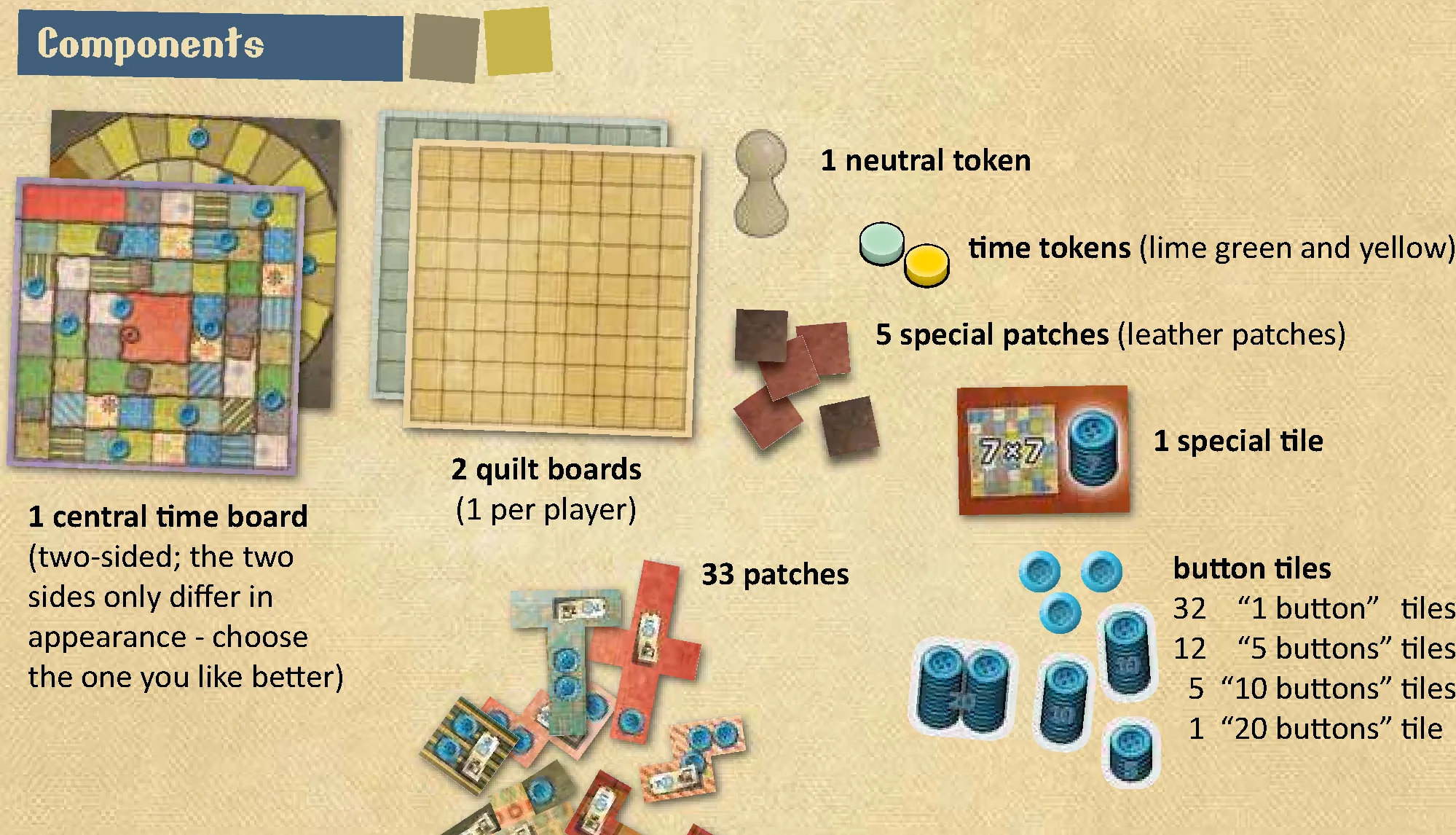
- 1 central time board (two-sided; the two sides only differ in appearance – choose the one you like better)
- 2 quilt boards (1 per player)
- 1 neutral token
- 2 time tokens (lime green and yellow)
- 5 special patches (leather patches)
- 1 special tile
- Button tiles:
- 32 “1 button” tiles
- 12 “5 buttons” tiles
- 5 “10 buttons” tiles
- 1 “20 buttons” tile
- 33 patches
- Each player takes a quilt board, a time token and 5 buttons (as currency). Keep the remaining buttons on the table close at hand.
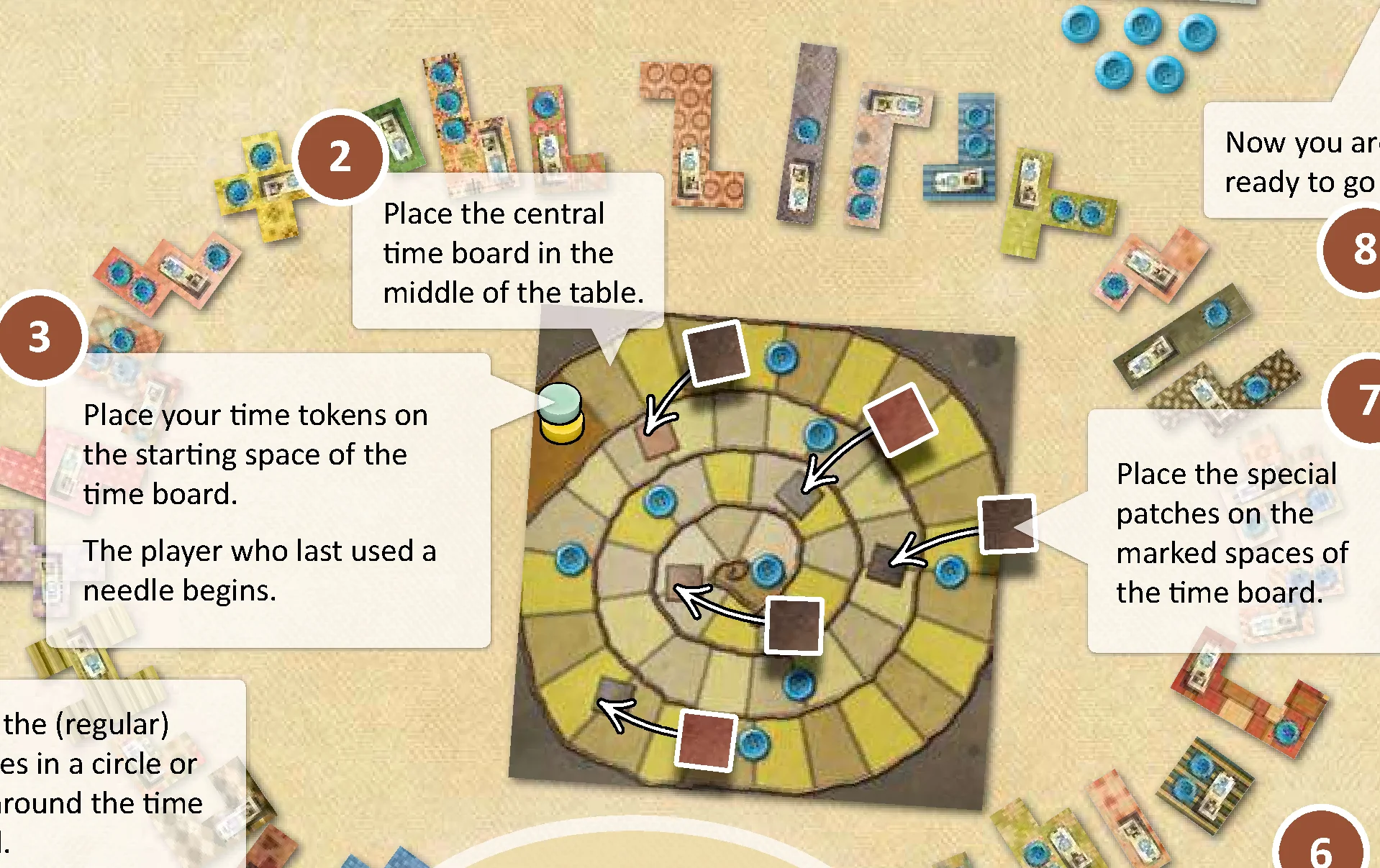
- Place the central time board in the middle of the table.
- Place your time tokens on the starting space of the time board. The player who last used a needle begins.
- Place the (regular) patches in a circle or oval around the time board.
- Locate the smallest patch, i.e. the patch of size 1×2, and place the neutral token between this patch and the next patch in clockwise order.
- Lay out the special tile.
- Place the special patches on the marked spaces of the time board.
- Now you are ready to go!
Turn Order
In this game, you do not necessarily alternate between turns. The player whose time token is the furthest behind on the time board takes his turn. This may result in a player taking multiple turns in a row before his opponent can take one.
If both time tokens are on the same space, the player whose token is on top goes first.
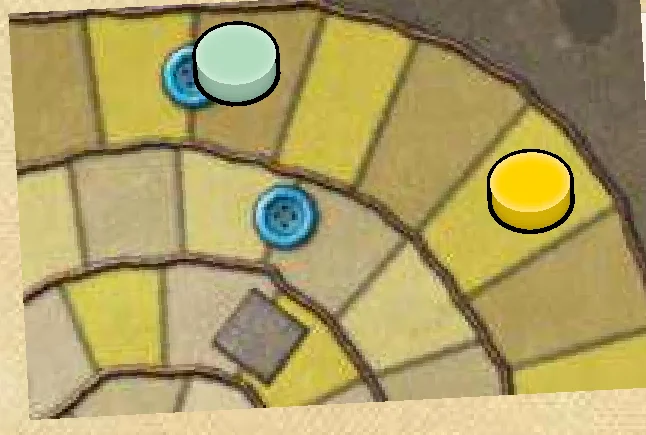
It is the lime green player’s turn. Unless her time token moves more than 3 spaces forward, she may immediately take another turn.
Actions
On your turn, you carry out one of the following actions:
- Action A: Advance and Receive Buttons
- or
- Action B: Take and Place a Patch
Action A: Advance and Receive Buttons
Move your time token on the time board so that it occupies the space directly in front of your opponent’s time token. You receive 1 button (i.e. a button tile of value 1) per space you moved your time token.
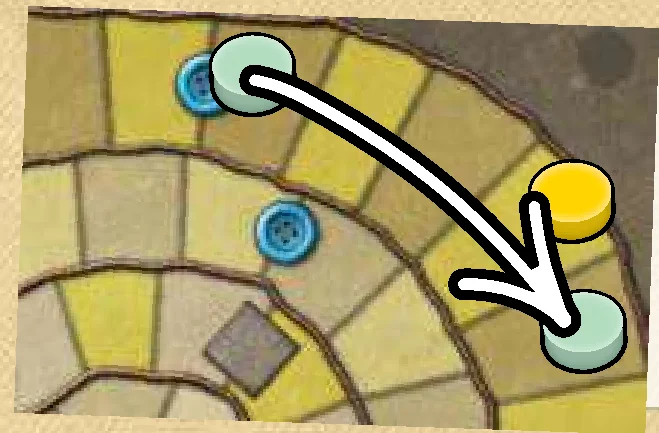
The lime green player moves her time token 4 spaces forward so that it is now in front of the yellow time token. She receives 4 buttons for that.
Action B: Take and Place a Patch
This action consists of 5 steps that must be carried out in the given order:
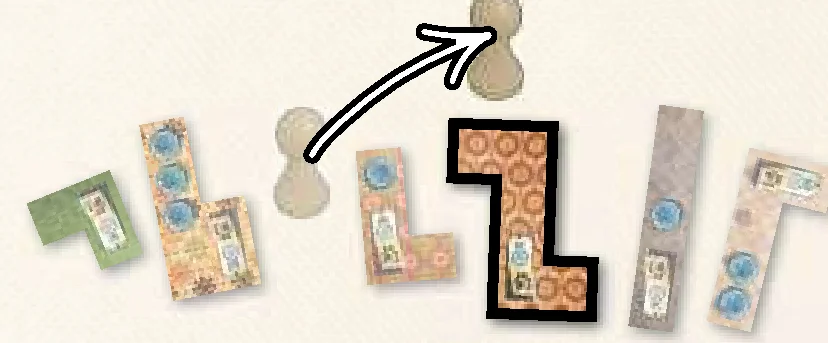
1. Choose a Patch
You can choose from the three patches in front of the neutral token (in clockwise order).
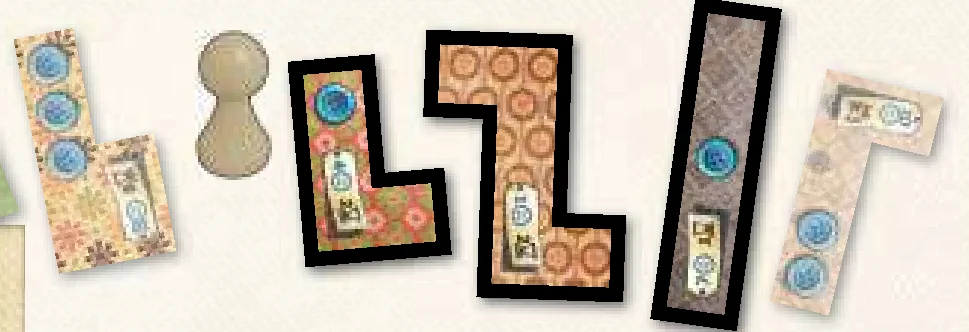
In this example, you can choose from the 3 marked patches. You cannot choose any other patch at the moment.
2. Move the Neutral Token
Place the neutral token next to the chosen patch.
3. Pay for the Patch
Pay the depicted number of buttons to the supply.
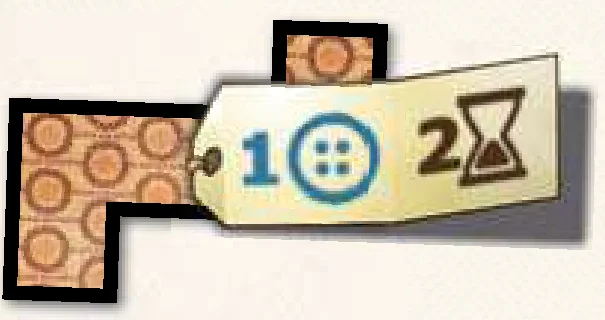
The label indicates the number of buttons to pay for the patch.
4. Place the Patch on Your Quilt Board
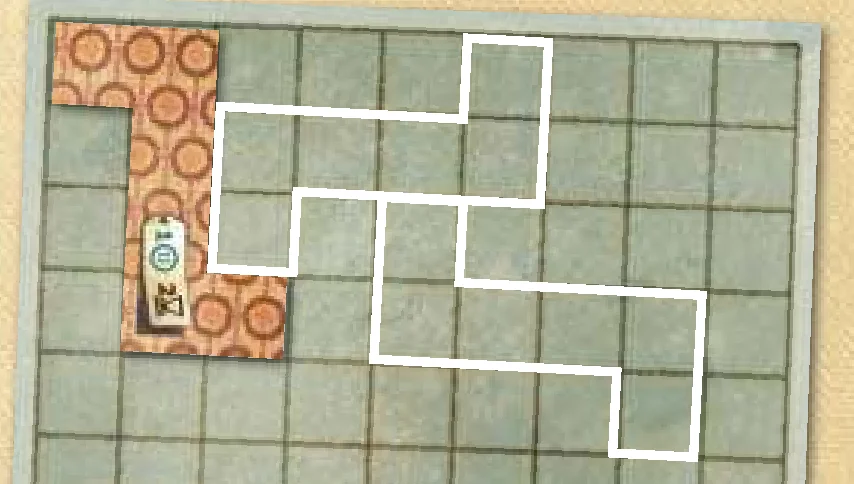
The patches on your quilt board may not overlap. You may turn the patch any way you like before placing it on your quilt board.
5. Move Your Time Token
Move your time token on the time board by a number of spaces as depicted on the label.
If your time token ends up on the same space as your opponent’s time token, place your token on top of it.
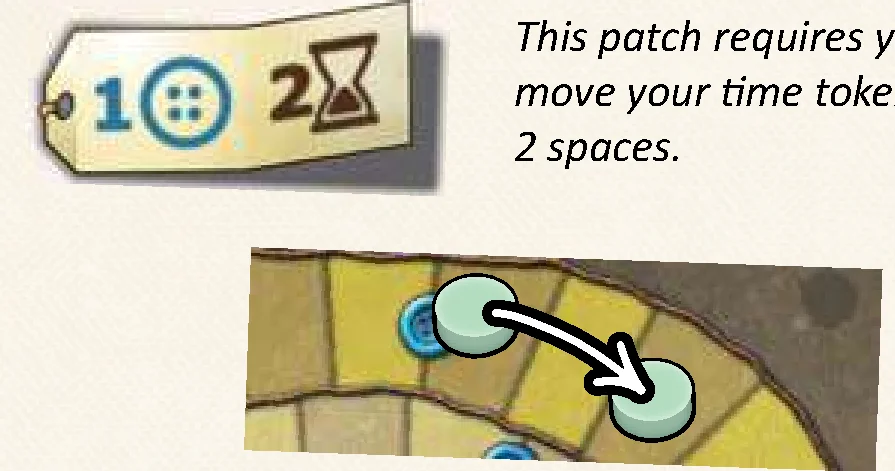
This patch requires you move your time token by 2 spaces.
Regardless of the action you take, you always move your time token on the time board. Some spaces of the time board are marked. Whenever you move onto or past one of those spaces, resolve the corresponding event:
Special Patch
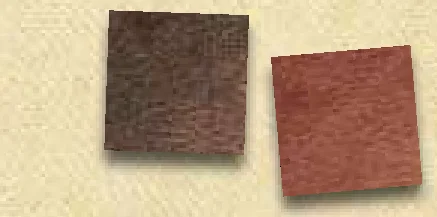
Take the special patch and place it on your quilt board immediately. The special patches are the only way to “patch” single spaces of your quilt board.
Button Income
You receive a number of buttons according to the patches on your quilt board.
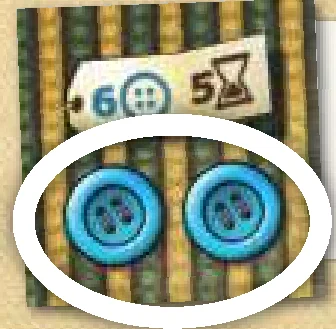
You will receive 2 buttons for this patch every time you receive button income.
The Special Tile
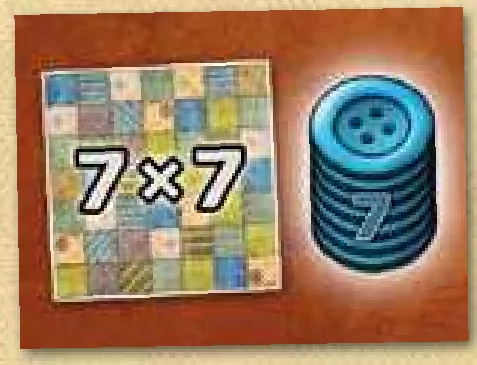
The first player to completely fill a 7×7 square of spaces on his quilt board receives the special tile, which is worth 7 points.
End of the Game
The game ends after both time tokens reach the last space of the time board. If a time token were to move past the last space, it simply stops on the last space. In case of action A, you only receive buttons for the actual number of spaces moved.
Scoring
Determine the number of buttons you have left, adding the value of the special tile if available. From this score, subtract 2 points for each empty space of your quilt board.
The player with the highest score wins. In case of a tie, the player who got to the final space of the time board first wins.
Example:
Doris and Andrea are playing. At the end of the game, Doris has 14 buttons left and she got the special tile. There are 5 empty spaces left on her quilt board. Her final score is 11 points.
(14 + 7 – 10 (5×2) = 11)
Andrea has 18 buttons left and only 2 empty spaces on her quilt board. She wins with 14 points.
Designer: Uwe Rosenberg
Editors: Stefan Stadler & Rolf Raupach
Graphic Design: Klemens Franz | atelier198
Translation: Grzegorz Kobiela
© 2014 Lookout GmbH
Hiddigwarder Straße 37, D-27804 Berne, Germany.
Mayfair Games, Inc. 8060 St. Louis Ave. Skokie, IL 60076
www.mayfairgames.com
Introduction & Components
Patchwork is a form of needlework that involves sewing together pieces of fabric into a larger design. In the past, it was a way to make use of leftover pieces of cloth to create clothing and quilts. Today, patchwork is a form of art, in which the designers use precious fabrics to create beautiful textiles. The use of uneven pieces of fabric in particular can result in real masterpieces and is therefore being practiced by a large number of textile artists.
To create a beautiful quilt, however, requires effort and time, but the available patches just do not want to fit together. So choose your patches carefully and keep a healthy supply of buttons to not only finish your quilt, but to make it better and more beautiful than your opponent’s.
Components
- 1 central time board (two-sided; the two sides only differ in appearance – choose the one you like better)
- 2 quilt boards (1 per player)
- 1 neutral token
- 2 time tokens (lime green and yellow)
- 5 special patches (leather patches)
- 1 special tile
- Button tiles:
- 32 “1 button” tiles
- 12 “5 buttons” tiles
- 5 “10 buttons” tiles
- 1 “20 buttons” tile
- 33 patches
Setup
- Each player takes a quilt board, a time token and 5 buttons (as currency). Keep the remaining buttons on the table close at hand.
- Place the central time board in the middle of the table.
- Place your time tokens on the starting space of the time board. The player who last used a needle begins.
- Place the (regular) patches in a circle or oval around the time board.
- Locate the smallest patch, i.e. the patch of size 1×2, and place the neutral token between this patch and the next patch in clockwise order.
- Lay out the special tile.
- Place the special patches on the marked spaces of the time board.
- Now you are ready to go!
Course of Play
Turn Order
In this game, you do not necessarily alternate between turns. The player whose time token is the furthest behind on the time board takes his turn. This may result in a player taking multiple turns in a row before his opponent can take one.
If both time tokens are on the same space, the player whose token is on top goes first.
It is the lime green player’s turn. Unless her time token moves more than 3 spaces forward, she may immediately take another turn.
Actions
On your turn, you carry out one of the following actions:
- Action A: Advance and Receive Buttons
- or
- Action B: Take and Place a Patch
Action A: Advance and Receive Buttons
Move your time token on the time board so that it occupies the space directly in front of your opponent’s time token. You receive 1 button (i.e. a button tile of value 1) per space you moved your time token.
The lime green player moves her time token 4 spaces forward so that it is now in front of the yellow time token. She receives 4 buttons for that.
Action B: Take and Place a Patch
This action consists of 5 steps that must be carried out in the given order:
1. Choose a Patch
You can choose from the three patches in front of the neutral token (in clockwise order).
In this example, you can choose from the 3 marked patches. You cannot choose any other patch at the moment.
2. Move the Neutral Token
Place the neutral token next to the chosen patch.
3. Pay for the Patch
Pay the depicted number of buttons to the supply.
The label indicates the number of buttons to pay for the patch.
4. Place the Patch on Your Quilt Board
The patches on your quilt board may not overlap. You may turn the patch any way you like before placing it on your quilt board.
5. Move Your Time Token
Move your time token on the time board by a number of spaces as depicted on the label.
If your time token ends up on the same space as your opponent’s time token, place your token on top of it.
This patch requires you move your time token by 2 spaces.
The Time Board & Special Elements
Regardless of the action you take, you always move your time token on the time board. Some spaces of the time board are marked. Whenever you move onto or past one of those spaces, resolve the corresponding event:
Special Patch
Take the special patch and place it on your quilt board immediately. The special patches are the only way to “patch” single spaces of your quilt board.
Button Income
You receive a number of buttons according to the patches on your quilt board.
You will receive 2 buttons for this patch every time you receive button income.
The Special Tile
The first player to completely fill a 7×7 square of spaces on his quilt board receives the special tile, which is worth 7 points.
End of the Game & Scoring
End of the Game
The game ends after both time tokens reach the last space of the time board. If a time token were to move past the last space, it simply stops on the last space. In case of action A, you only receive buttons for the actual number of spaces moved.
Scoring
Determine the number of buttons you have left, adding the value of the special tile if available. From this score, subtract 2 points for each empty space of your quilt board.
The player with the highest score wins. In case of a tie, the player who got to the final space of the time board first wins.
Example:
Doris and Andrea are playing. At the end of the game, Doris has 14 buttons left and she got the special tile. There are 5 empty spaces left on her quilt board. Her final score is 11 points.
(14 + 7 – 10 (5×2) = 11)
Andrea has 18 buttons left and only 2 empty spaces on her quilt board. She wins with 14 points.
Credits
Designer: Uwe Rosenberg
Editors: Stefan Stadler & Rolf Raupach
Graphic Design: Klemens Franz | atelier198
Translation: Grzegorz Kobiela
© 2014 Lookout GmbH
Hiddigwarder Straße 37, D-27804 Berne, Germany.
Mayfair Games, Inc. 8060 St. Louis Ave. Skokie, IL 60076
www.mayfairgames.com