
Pax Pamir: Second Edition
2019
Build a court, manipulate rival coalitions, and pursue victory amid Afghanistan’s struggle for a new state.
120
minutes
1 - 5
player(s)
13+
Medium Heavy


About this board game
Pax Pamir: Second Edition is a tableau-building game for 1–5 players, set in nineteenth-century Afghanistan and lasting about 120 minutes. Players take the roles of Afghan leaders seeking to forge a new state after the collapse of the Durrani Empire.
Western histories often call this period “The Great Game,” but Pax Pamir presents the rival European empires from the perspective of the Afghans who attempted to manipulate these foreign interlopers, or ferengi, for their own purposes.
On most turns, players purchase cards from a central market and play them into a single row called a court. These cards add units to the game’s map and provide access to additional actions, creating opportunities to disrupt opponents and influence the changing political landscape.
- Build a personal court from cards acquired in the central market.
- Add units to the map and unlock actions that affect other players.
- Organize around coalitions as their dominance shifts throughout the game.
- Earn points through coalition influence or an individual power base.
Players must decide when to support a coalition and when to pursue their own position. During a Dominance Check, the current balance of power is evaluated. If one coalition has a commanding lead, its loyal players score based on their influence within it; if Afghanistan remains fragmented, players instead score according to their personal power base.
After each Dominance Check, victory is assessed and the game is partially reset, giving everyone a renewed opportunity to pursue their ambitions. Pax Pamir: Second Edition ends when a player achieves a lead of four or more victory points, or after the fourth and final Dominance Check.
Thematics
Mechanics
Designer
Illustrator
/pic7182955.jpg)

Board Game Rules for
Pax Pamir: Second Edition
Rules of Play
In Pax Pamir, each player assumes the role of a nineteenth-century Afghan leader attempting to forge a new state after the collapse of the Durrani Empire. Western histories often call this period “The Great Game” because of the role played by the Europeans who attempted to use Central Asia as a theater for their own rivalries. In this game, those empires are viewed strictly from the perspective of the Afghans who sought to manipulate the interloping ferengi (foreigners) for their own purposes.
In terms of gameplay, Pax Pamir is a pretty straightforward tableau builder. Players will spend most of their turns purchasing cards from a central market and then playing those cards in front of them in a single row called a court. Playing cards adds units to the game’s map and grants access to additional actions that can be taken to disrupt other players and influence the course of the game. That last point is worth emphasizing. Though everyone is building their own row of cards, the game offers many ways for players to interfere with each other, both directly and indirectly.
To survive, players will organize into coalitions. In the game, these coalitions are identified chiefly by their sponsors. Two of the coalitions (British and Russian) are supported by European powers. The third coalition (Afghan) is backed by nativist elements who want to end European involvement in the region.
Throughout the game, the different coalitions will be evaluated when a special event card, called a Dominance Check, is resolved. If a single coalition has a commanding lead during one of these checks, players loyal to that coalition will receive victory points based on their influence in that coalition. However, if Afghanistan remains fragmented during one of these checks, players instead will receive victory points based on their personal power base.
The Map
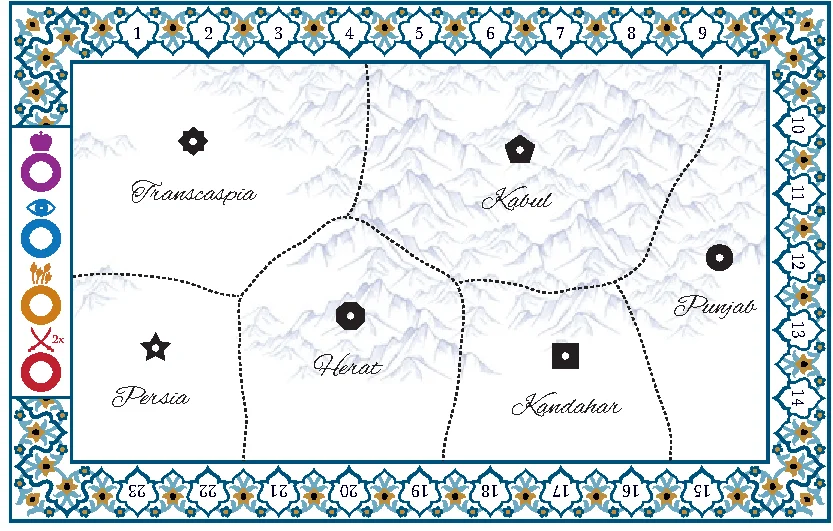
The map consists of six regions. There is no limit to the number of pieces that can be placed on a specific region or border, and pieces belonging to different players and coalitions can occupy the same region or border. The map is bordered by a victory point track and spaces to mark the favored suit.
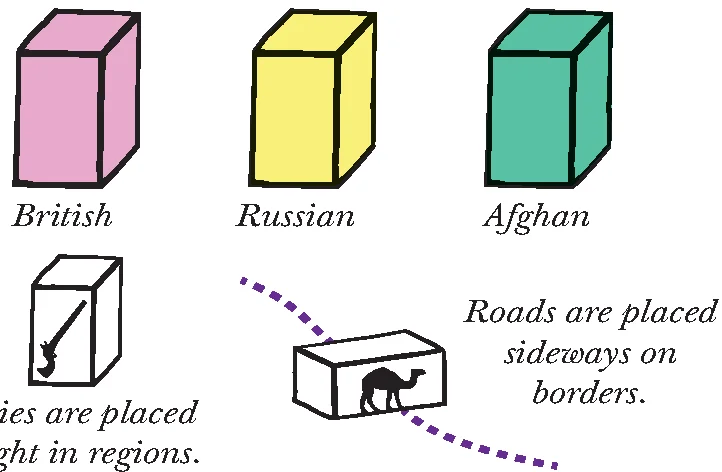
Coalition Blocks (36)
Each coalition has twelve blocks in its color. What a block represents depends on where it is placed:
- A block placed in a region is called an army (armies are placed upright in regions).
- If placed on a border, the block is called a road (it helps to set roads on their side to make them stand out at a glance).
In general, coalition blocks only help players who are currently loyal to that coalition. So, even if you helped raise the army, your soldiers will not follow you if you change your loyalty.
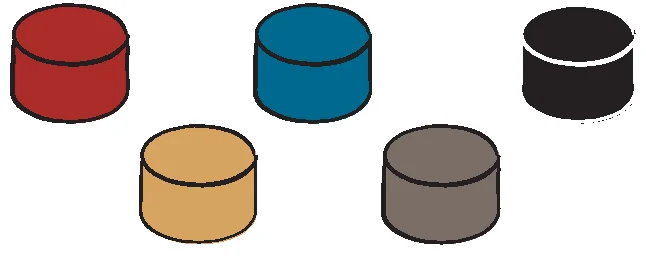
Cylinders (55)
Each player has eleven cylinders in their color:
- The cylinder with the gold design is used to track victory points.
- The remaining cylinders represent different things based on where they are placed:
- A cylinder placed in a region is called a tribe.
- If placed on a card in a player’s court, the cylinder is called a spy.
Unlike coalition pieces, cylinders will always be on your side, even if you change loyalty.
Money Supply (36)
There are 36 coins in the game. Each is worth a single rupee. Unlike other components in the game, there is no hard limit to the number of coins, but it is very rare to need additional coins. In Pax Pamir, rupees represent political capital. During this time, political capital was largely a zero sum game, and that is true as well in Pax Pamir.
Other Pieces
A variety of other playing pieces perform various functions throughout the game, including ruler tokens, player boards, loyalty dials, and the favored suit marker.

Cards (142)
There are three types of cards in Pax Pamir: event cards (16), court cards (100), and Wakhan cards (24 AI and 2 aid).
Event Cards
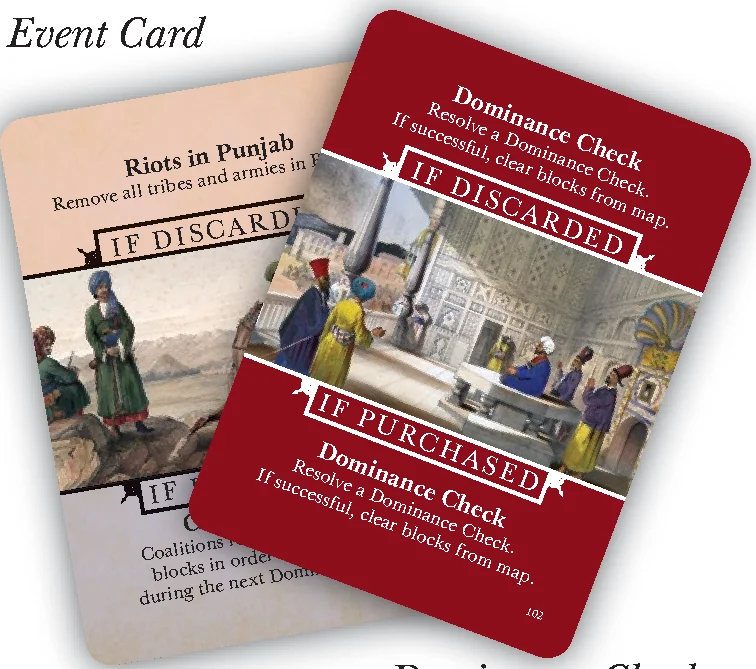
Event cards are fairly straightforward. Each has two effects:
- The bottom effect is triggered if it is purchased by a player.
- The top effect is triggered if the card is automatically discarded during the cleanup phase at the end of a player’s turn.
Players should note that four of these event cards feature the same picture of the throne room of the Bala Hissar; these are special event cards called Dominance Checks that determine when and how victory points are awarded.
Court Cards
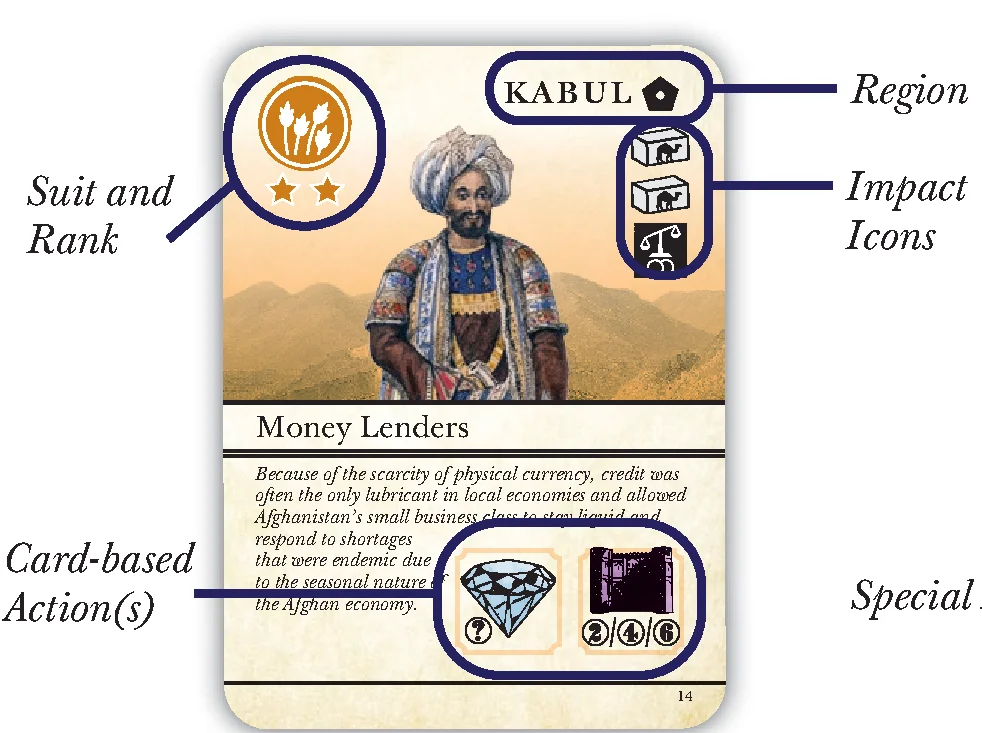
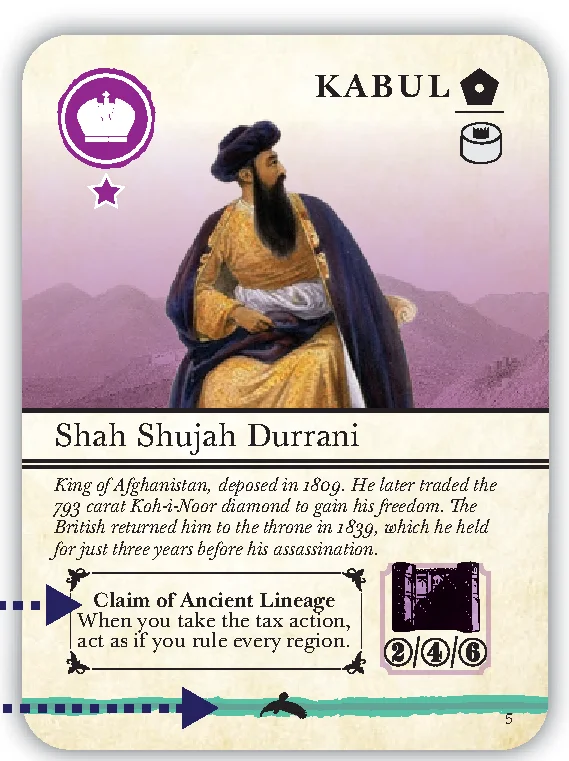
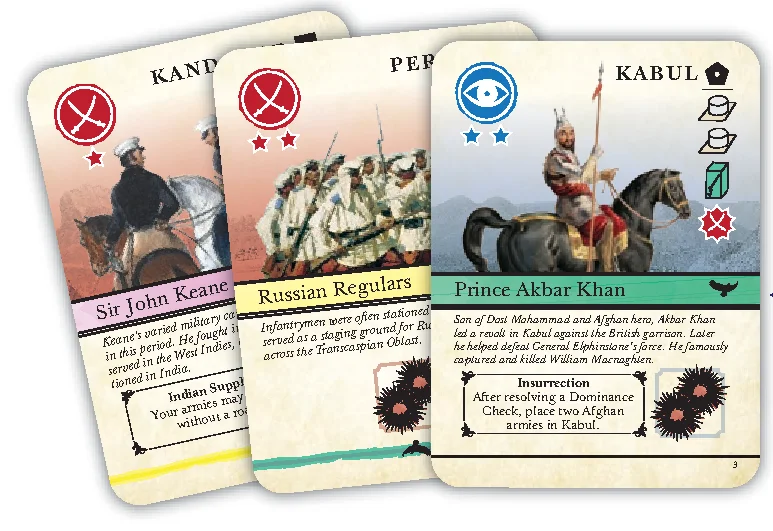
The vast majority of the cards in the game are called court cards. Court cards hold a lot of information and understanding them is critical to playing Pax Pamir. Their anatomy is described below.
Wakhan Cards
Wakhan AI cards are used only when playing with Wakhan (page 16). Wakhan aid cards are used to store his gifts and provide reminders about important rules.
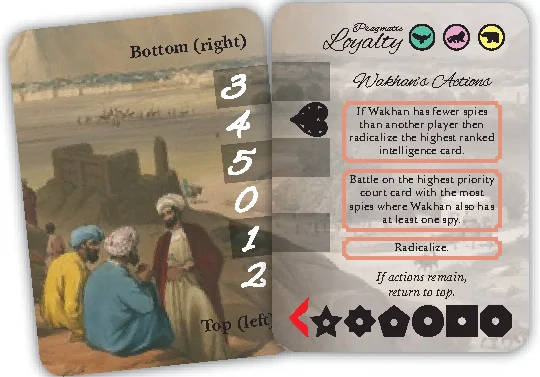
To use Wakhan, the automated opponent, with either one or two human players, consult the rules on page 16.
Starting Favored Suit
Pax Pamir begins in a period of great political upheaval. Ayub Shah, the last of the Durrani emperors, has just been deposed. A region once unified is now on the verge of total collapse, and local authorities are taking the initiative.
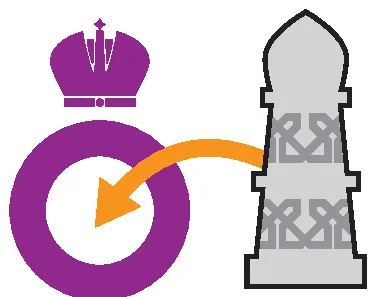
To represent this political climate, place the favored suit marker on the space next to the political suit.
Build the Draw Deck
Build the draw deck using the following steps:
- Separate the court cards and the event cards.
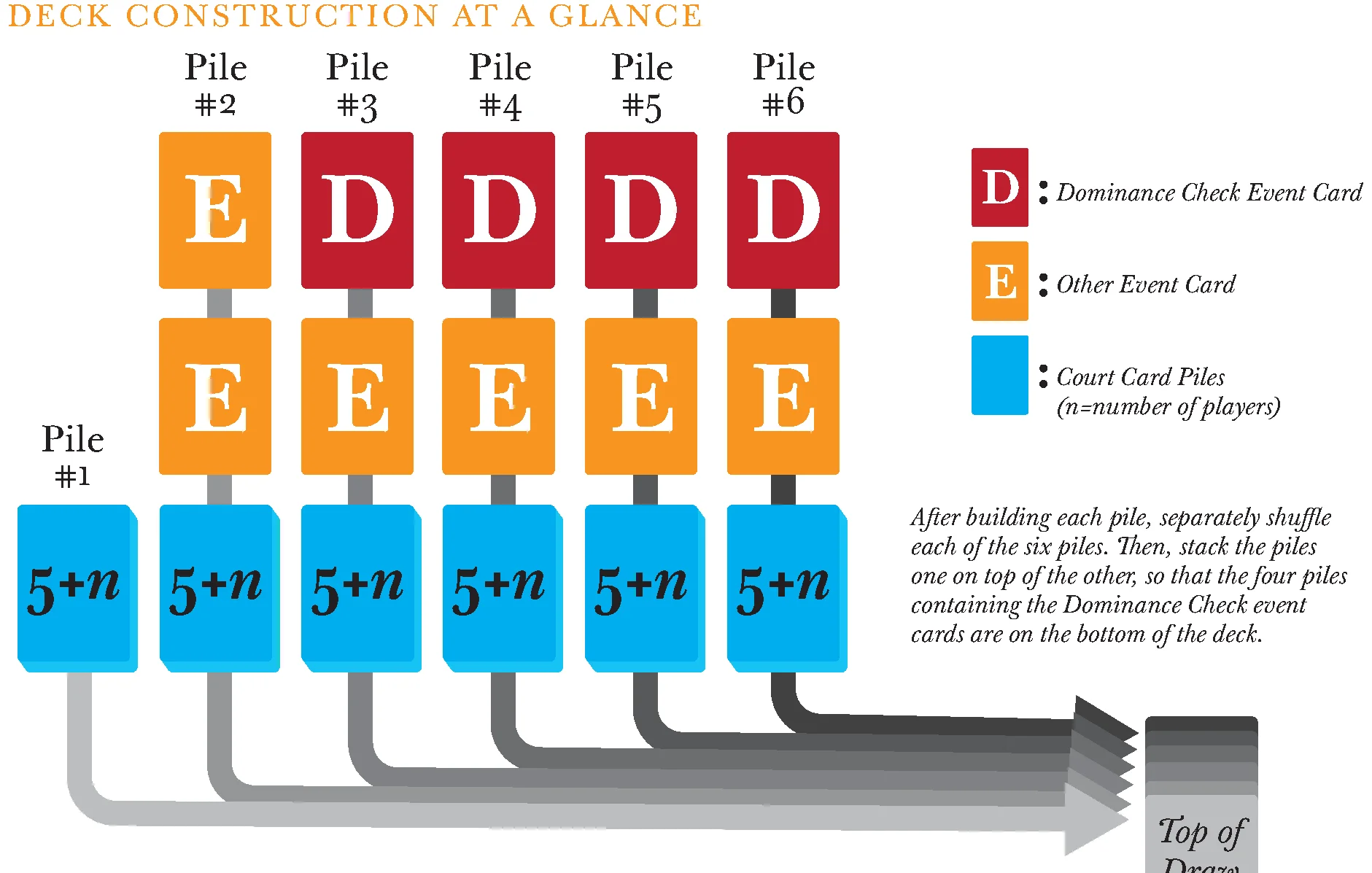
- Shuffle the court cards. Create six face-down piles of court cards, each consisting of five cards, plus one card per player. The remaining court cards will not be used this game.
- Remove the four Dominance Check event cards from the other event cards. Place one in each of the four rightmost piles.
- Shuffle the remaining event cards. Place two in the second pile from the left and one in each of the remaining four piles to its right. The six remaining event cards will not be used this game.
- Finally, separately shuffle each of the six piles. Then, stack the piles one on top of the other, so that the four piles containing the Dominance Check event cards are on the bottom of the deck. Do not shuffle this combined deck.
Create the Market
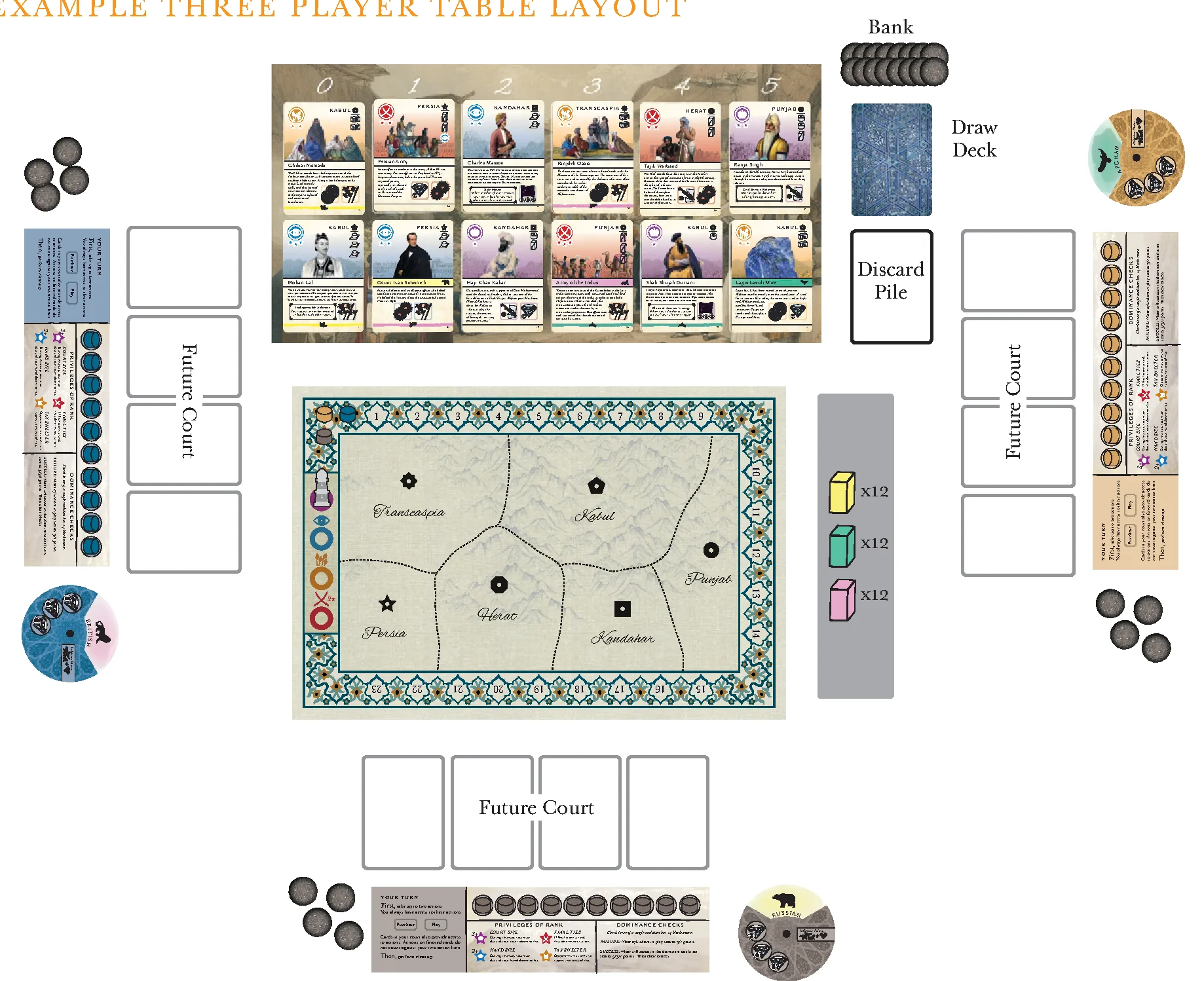
In Pax Pamir, cards enter play through a market. The market is an array of 12 face-up cards, arranged in a grid of two rows and six columns. During setup, create this market by drawing cards from the draw deck and filling each market column (top row first), starting with the leftmost column. Then place the draw deck to the right of the market.
Take Player Pieces
Give each player a set of eleven cylinders, one loyalty dial, a player board, and four rupees. Place one cylinder from each player on the zero space of the victory point track and the rest on each player’s player board.
Bank and Coalition Blocks
Place the remaining coins and the tray of coalition blocks near the area of play.
Starting Loyalty
Starting with a random player and proceeding clockwise, each player adjusts their loyalty dial to indicate the loyalty they have chosen. After the last player has chosen their starting loyalty, that player will take the first turn. The game is now ready to play.
The Four Suits
The vast majority of the cards in Pax Pamir are divided into four suits that each correspond to a different mode of power: economic, military, political, and intelligence. Each suit has its own advantages. Generally speaking…
 The economic suit controls the flow of rupees and the movement of pieces. It also protects wealth from taxation in the game.
 The military suit commands armies and helps secure a coalition’s dominance.
 The political suit consolidates power and controls which cards are able to be played.
 The intelligence suit grants diplomatic flexibility and the ability to compromise enemies.
The Favored Suit
One suit is always considered favored. This suit determines which cards take bonus actions (page 12) and may make cards more expensive (page 10). The favored suit changes when certain cards are played (page 11).
Your Court
Each player is associated with a single row of cards called a court. Players begin the game without any cards in their court, but will gradually add cards to and remove cards from their court over the course of the game. Cards in a court cannot be freely rearranged. While your court can grow to any size during your turn, during cleanup you must discard cards from your court so that you do not have more court cards than three plus the sum of purple stars on cards in your court.
Your Hand
Each player is associated with a hand of cards. While your hand can grow to any size during your turn, during cleanup you must discard cards from your hand so that you do not have more hand cards than two plus the sum of blue stars on cards in your court.
Rank and Privilege
Each court card has a rank from one to three stars. Rank has two important consequences:
- A card’s rank determines the strength of some of its actions. These actions feature additional symbols to help players remember which actions depend on rank.
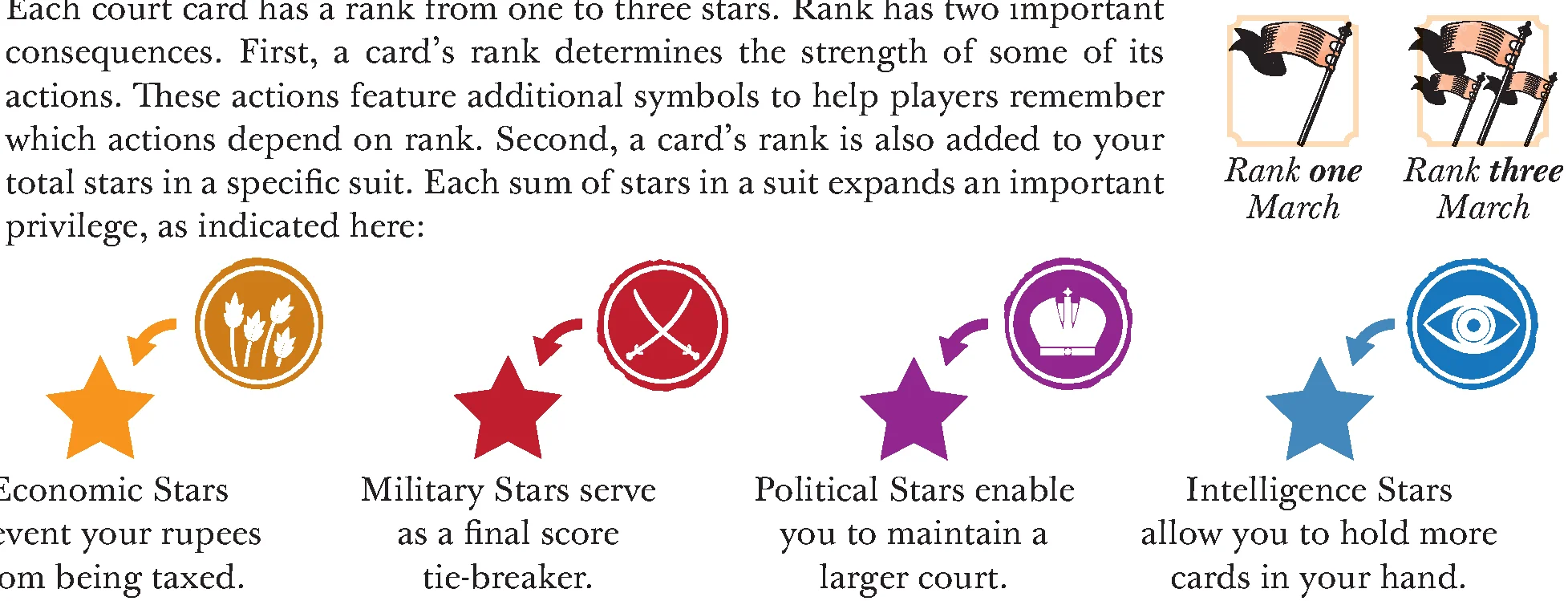
- A card’s rank is also added to your total stars in a specific suit. Each sum of stars in a suit expands an important privilege, as indicated here:
- Economic Stars: prevent your rupees from being taxed.
- Military Stars: serve as a final score tie-breaker.
- Political Stars: enable you to maintain a larger court.
- Intelligence Stars: allow you to hold more cards in your hand.
Loyalty and Influence
Players in Pax Pamir are always loyal to one of three coalitions: British (pink), Russian (yellow), or Afghan (green). Your loyalty determines the color of coalition blocks which you will place when playing cards e.g. players loyal to the Russian coalition place blocks that are yellow.
The extent of your loyalty to a coalition is measured in influence points. We’ll get to the various ways you’ll acquire these things later, but, for now, know that your total influence is the sum of one plus the number of patriots in your court, the number of your prizes, and the number of your gifts.
To change your loyalty, you must gain an influence point associated with a different coalition than your own (either by playing patriots or by betraying cards with prizes). Whenever you change loyalty, first return your gifts to your supply and discard any prizes and patriots you had previously accumulated. Finally, adjust your loyalty dial to indicate your new loyalty.
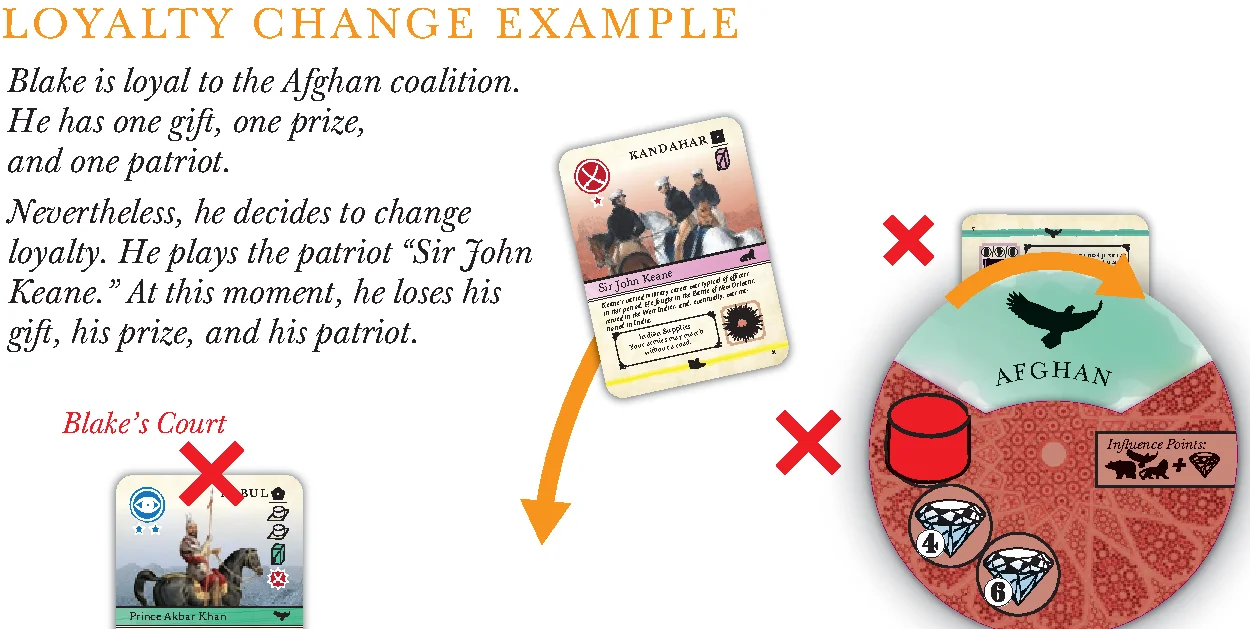
Ruling a Region
Each of the six regions in the game is associated with a ruler token. Ruler tokens remain on the board if no player currently rules the region. If a player does rule a region, they should immediately take the associated ruler token and place it in their play area. Likewise, if a player ceases ruling a region, the associated ruler token should be immediately returned to the board.
In order to take a ruler token, you must have at least one tribe and a plurality of ruling pieces (more than all others individually). Tribes and loyal armies are considered ruling pieces. If there is a tie, no player rules the region. Armies belonging to enemy coalitions can prevent you from taking a ruler token, even if there are no enemy tribes.
Ruling a region grants players access to:
- the build action (page 13),
- special taxing privileges (page 13), and
- the ability to extract bribes from other players who want to play cards associated with that region (page 11).
It’s good to be king.
Example: You have three ruling pieces in Kandahar (one tribe and two Afghan armies loyal to you). There are also four additional armies not loyal to you (two British, two Russian). Because you have at least one tribe in the region and the most ruling pieces, you take the ruler token.
General Rules
Negotiation
Players are free to discuss the game during play and explicitly coordinate their actions. However, any agreed-upon deal should be considered non-binding. Cards may never be transferred between players. Money can only be transferred from one player to another if explicitly sanctioned by the rules e.g. taxation of subjects, bribes for taking hostage actions, playing cards.
Component Limits
If asked to place a unit and none remain in the supply, you must take a piece of the required shape/color from anywhere in play, excluding any pieces placed this turn. In taking and placing a piece this way, you may convert one type of unit to another.
Example: You must place a spy, but you have no cylinders remaining in your stock, so you take one of your tribes in play and place it as a spy as instructed.
Card Precedence and Special Abilities
Some event cards and court cards with special abilities will modify the rules of the game. These cards always take precedence over the rules. If a court card has a special ability, it is active as long as the card remains in your court.
Discarding a Card in Your Court
Whenever a card in your court is discarded, the following rules always take effect:
- Any spies on the card are lost and returned to their owner’s supply.
- If the card had the leveraged icon
 , you must return two rupees to the supply. For each rupee you cannot return, you must discard one card from your hand or court (not including this card, of course). If you have no cards left, no further payment is required.
The Overthrow Rule
In general, there is no persistent link between the cards in your court and the pieces on the map. However:
- if you lose your last tribe in a region, you must immediately discard all political cards associated with that region from your court.
- Likewise, if you lose the last political card in your court associated with a region, you must immediately remove all of your tribes in that region.
Many games will be won and lost because of this rule, so you may want to read it again just to make sure you’ve got it!
Sequence of Play
Pax Pamir occurs over a series of turns. Each turn, the active player performs up to two actions which are described in the following two sections of this rulebook. Bonus actions (page 12) do not count against this limit. You may opt to take only a single action or no action at all. After you have completed your turn, perform cleanup. Then play continues clockwise to the next player until the game is over.
Access to Actions
You always have access to the following core actions: purchase and play. In addition, the cards in your court provide you access to the actions listed on that card. Each card in your court can only be used for one action per turn. That is, even if a card has three actions on it, only one of those actions can be used each turn.
Core Actions
The two core actions of Pax Pamir are described in this section. While not difficult, the purchase and play actions are, by far, the most complicated actions of the game. When teaching the game, some groups may prefer to learn just these two actions and then introduce the other actions gradually over the first few rounds of play.
Purchase
Purchase a card from the market and add it to your hand. If you purchase a card that has rupees on it, you receive them along with the card.
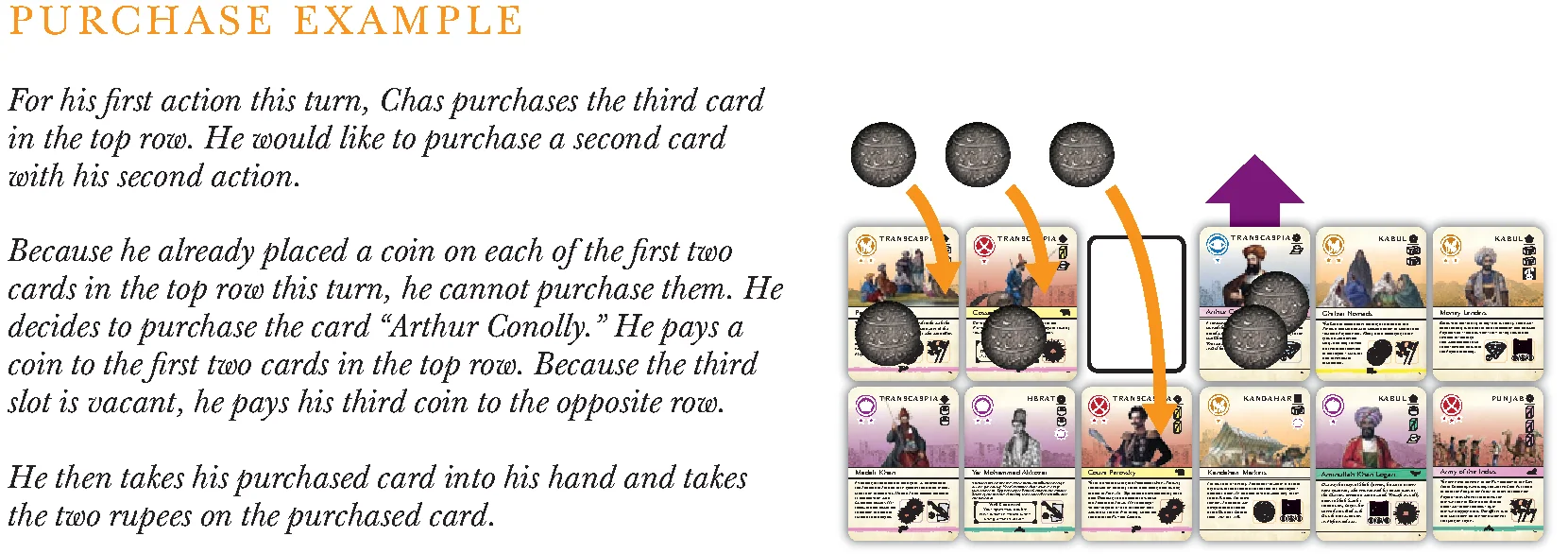
In order to purchase a card, you must be able to pay the card’s cost to the market. The cost of the card depends on its current column in the market:
- The leftmost column is free, the next column costs one rupee, then two, etc.
- Pay this cost by placing one rupee on each card in the same row to the left of the card you are purchasing.
- If you are ever required to place a rupee on a vacant market spot, pay the cost to the card in the same column in the other market row.
- If you place a rupee on a market card for any reason, you may not purchase that card this turn.
Event Cards: Event cards (including Dominance Checks) never enter a player’s hand and are resolved the moment they are bought from the market. Many event cards have a persistent effect that lasts until the next Dominance Check is resolved. Players who take these event cards should place them below their court. Event cards that alter the general game should be placed near the map in easy view of all players.
Purchasing Cards when Military Cards are Favored: If military cards are favored  , the cost to purchase a card is doubled. When purchasing cards from the market, place two rupees on each card to the left of the purchased card instead of one.
Play
Play any card from your hand to your court.
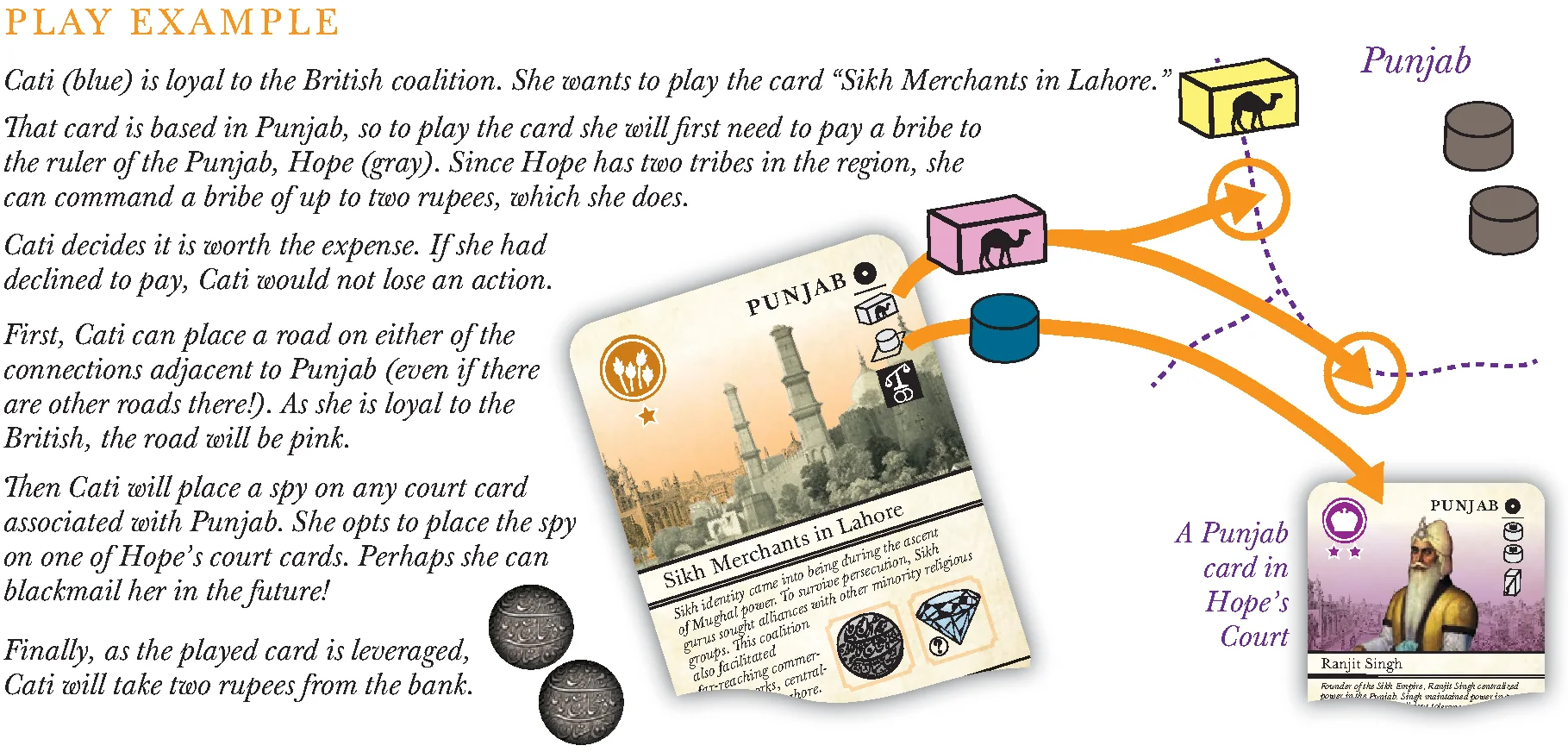
In order to play a card, first reveal that card to everyone and announce its name and region.
- If you are the ruler of that card’s region or if no one rules the region, you can freely play the card.
- If someone else is that region’s ruler, you must pay a bribe of rupees to them that is equal to the number of the ruler’s tribes in that region. Any portion of this cost can be waived with the permission of the ruler. If the bribe is not paid (or waived), play continues as if the action had never been taken.
The played card may be added to either the left or right end of your court.
If the card is a patriot that does not match your loyalty, discard all of your patriots and prizes, and remove any gifts. Then adjust your loyalty dial to match that of the patriot.
After a card is played, resolve each impact icon on the right side of the card from top to bottom:
 Road: Place one coalition block of your loyalty on any border of this region. This piece is now a road.
 Army: Place one coalition block of your loyalty in this region. This piece is now an army.
- Leveraged: Take two rupees from the bank. This card is leveraged. Reminder: If you ever discard this card, you must pay back the rupees (page 8).
 Spy: Place one of your cylinders on a card in any player’s court that matches the played card’s region. This piece is now a spy.
 Tribe: Place one of your cylinders in this region. This piece is now a tribe.
 Favored Suit Change: Move the favored suit marker to the suit indicated. Reminder: If the favored suit is military, the cost to take the purchase action is doubled.
No Stacking Limit: In general, there is no limit to the number of pieces that can exist in any particular region, border, or court card. Pieces may also coexist with those belonging to different players and coalitions.
Card-Based Actions
The rest of the actions in Pax Pamir are associated with court cards and can only be taken if you have a card in your court which displays that action. Each card can only be used for one action once per turn, regardless of the number of actions icons on that card.
Some card-based actions are modified by the rank of a card. The higher the rank, the more effective the action is. To help you remember this, action icons modified by rank feature additional symbols.
Bonus Actions: Actions on cards matching the favored suit do not count against your turn’s two-action limit. Remember: each of these cards can still only be used for a single action per turn.
Action Costs: Some card-based actions require the acting player to pay an amount of rupees to cards in the market. These rupees are always paid in a similar fashion: rupees equal to the cost should be placed on the rightmost market cards of both rows, with a single rupee being paid to each card. If a market slot is vacant, skip that vacancy and pay the next market card(s) in the row. Reminder: if you place a rupee on a market card for any reason, you may not purchase that card this turn. For an example of paying action costs, see the example of the Build Action on the next page.
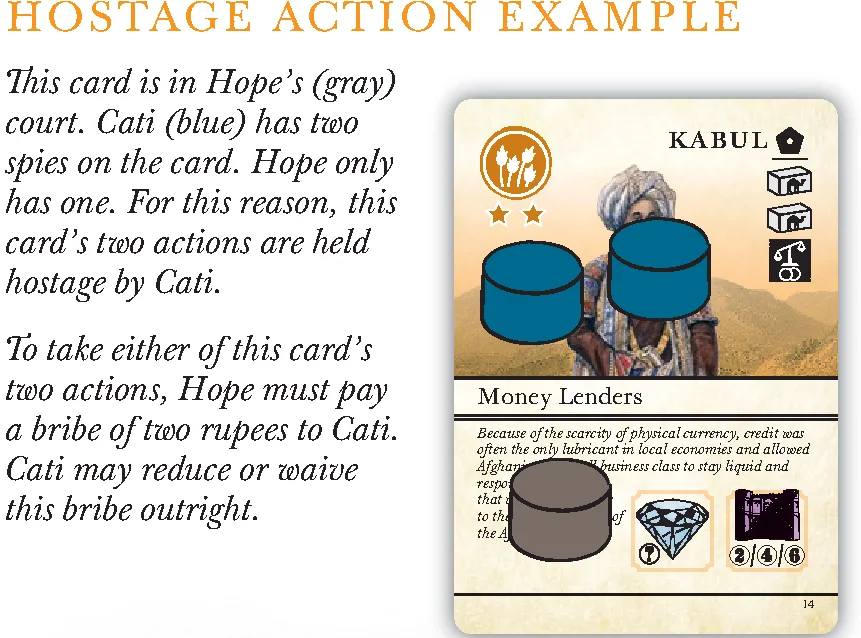
Hostage Actions: Court cards can be held hostage much in the same way that a player can rule a region. To hold a card hostage, a single enemy player must have more spies on the card than each other player. When a card in a player’s court is held hostage, that player can only use the card’s actions if the player holding it hostage is paid a bribe equal to the number of hostage-holding spies on the card. Any portion of this payment can be waived with the permission of the player holding the actions hostage. Special abilities (those described in a small text box) are never held hostage.
Tax
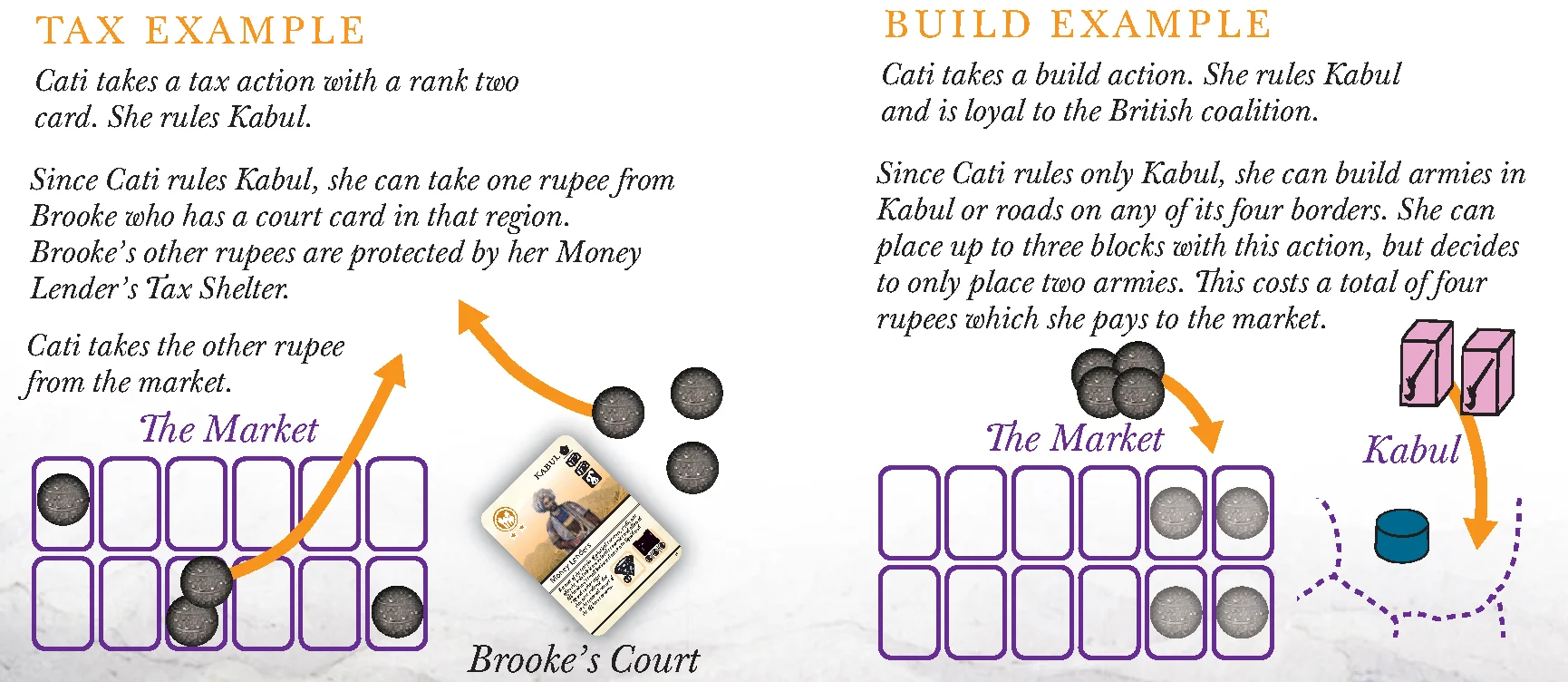
Take rupees up to the acting card’s rank from players with at least one court card associated with a region you rule or any card(s) in the market (regardless of their region). You may take rupees from several sources so long as the total taken does not exceed the rank of the acting card.
Tax Shelter: The total number of gold stars in your court indicates the amount of rupees you can shelter from the Tax Action. Only rupees you hold in excess of your Tax Shelter are vulnerable to the Tax Action.
Gift
Place one of your cylinders on one of your empty gift spaces on your loyalty dial. Each gift will count as one influence point in your current coalition. The cost of this action is equal to the marked price of the gift placed (2, 4, or 6).
Reminder: Gifts are lost whenever you change loyalty!
Build
Place up to three armies and/or roads among any regions that you rule. Roads may be placed on any adjacent borders. Any combination of different units may be purchased. The cost of this action is equal to two rupees per unit placed.
Move
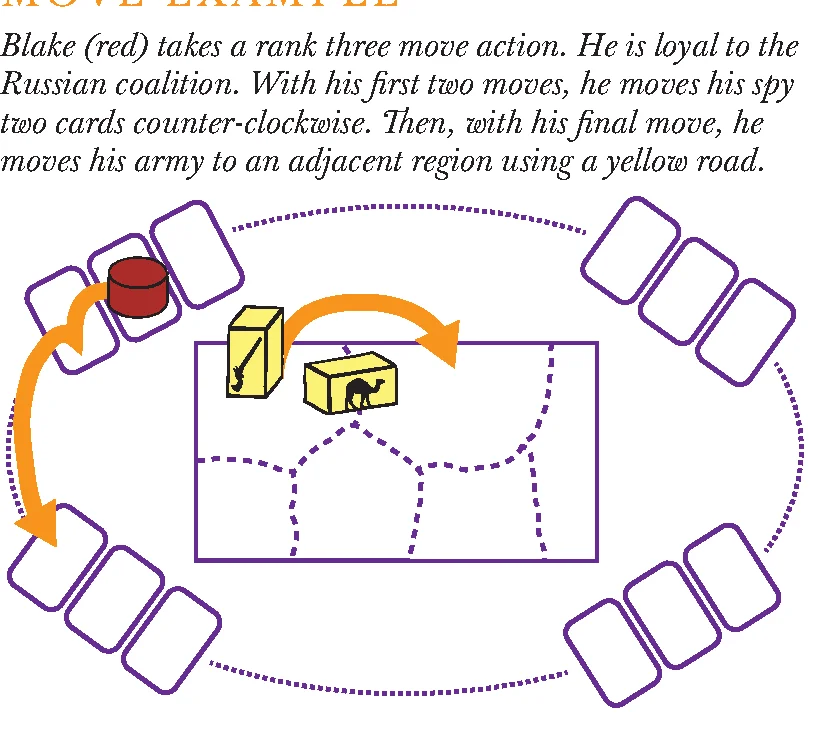
For each rank of the acting card you may move one loyal army or spy. The same unit can be moved multiple times on a single turn. Likewise, multiple moves may be split across several of your spies and loyal armies.
- To move an army from one region to an adjacent region there must be a road matching the loyalty of the moving army on the border being crossed.
- Spies move along cards in the players’ courts (clockwise or counter-clockwise), as if they formed a single continuous track around the area of play.
Betray
Discard one card where you have a Spy (including cards in your own court). Any spies on the betrayed card are lost and returned to their owner’s supply. This action always costs two.
After the betrayed card is discarded, you may accept it as a prize, tucking it partially behind your loyalty dial. If this prize is different from your current loyalty, first remove all gifts, prizes, and patriots in your court matching your previous loyalty.
Reminder: Betrayals may trigger leveraged icons and The Overthrow Rule (page 8).
Battle
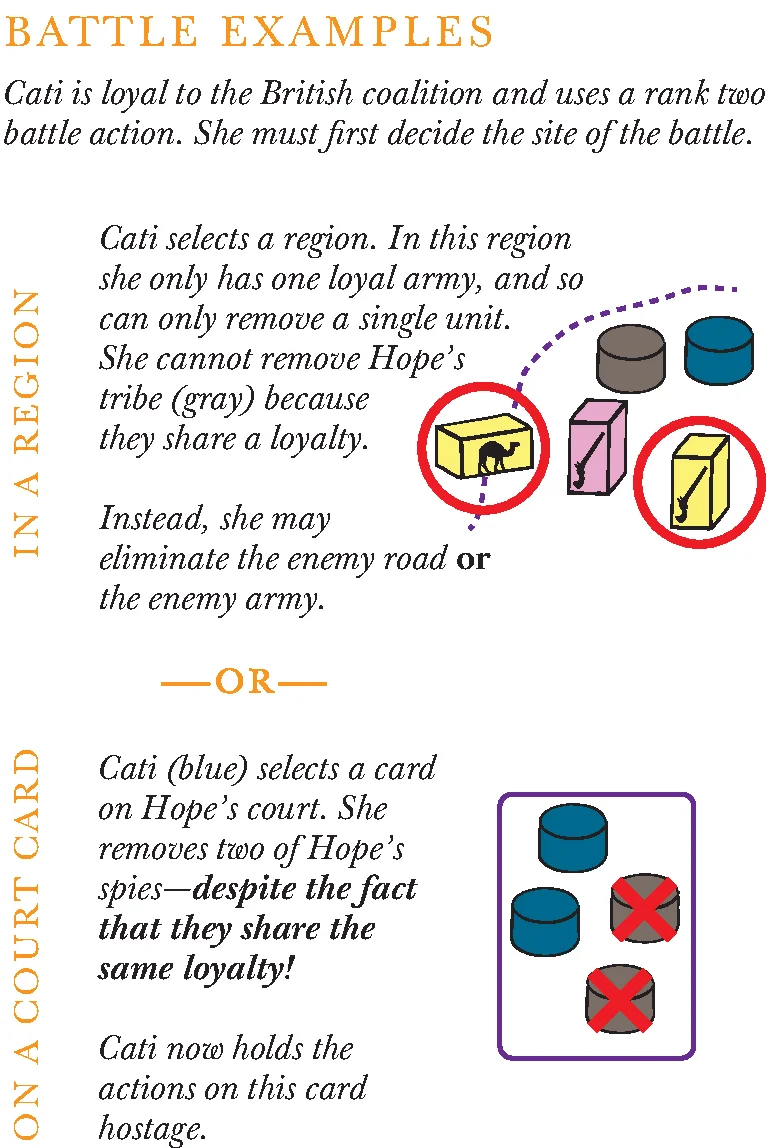
Start a battle in a single region or on a court card. At the site of the battle, remove any combination of tribes, spies, roads, or armies equal to the acting card’s rank. There are three restrictions to this rule:
- You cannot remove more units than you yourself have armies or spies in that battle.
- You cannot remove armies or roads that are of your loyalty.
- You cannot remove tribes belonging to players that share your loyalty. However, their spies may be removed!
Cleanup
Cleanup has four steps:
- First, if you have more cards than three plus the sum of the purple stars on cards in your court, discard cards in your court until you are within your limit.
- Second, if you have more cards than two plus the sum of the blue stars on cards in your court, discard cards in your hand until you are within your limit.
- Third, discard any event cards that are in the leftmost column of the market. Any rupees on the discarded event will remain in their position. The top row is always discarded first, followed by the bottom row. When an event card is discarded, all players are affected by the text or impact icon at the top of the card.
- Fourth, fill any empty spaces in the market by moving all cards in that market row (along with their rupees) to their leftmost position and then draw new cards to fill in any rightmost empty spaces, returning the market to its normal size, if possible. If a card moves into a space with rupees from a previously-discarded event card, those rupees are placed on the new card taking that position.
Instability: If a Dominance Check card is revealed and there is already a Dominance Check card in the market, immediately perform a Dominance Check and then discard both Dominance Check cards and fill the empty spaces in the market as described above. If the final Dominance Check card was discarded in this way, the Dominance Check will count as the final check.
Dominance Checks
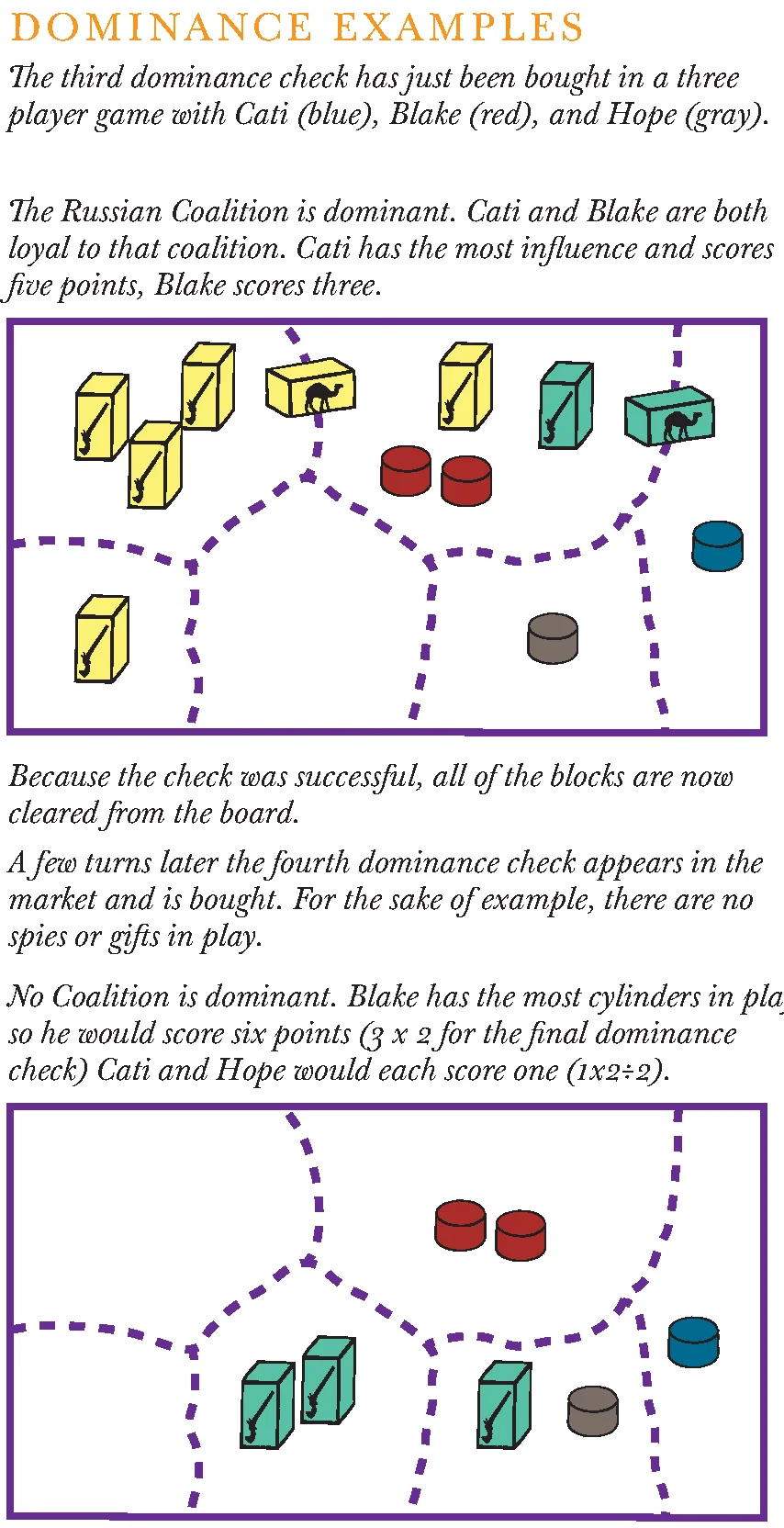
Dominance Check event cards are resolved when purchased by a player or when triggered during cleanup. When resolved, take account of the game-state. If a single coalition has the most blocks in play and at least four more than all other coalitions (uncombined), the Dominance Check is successful. Otherwise the check is unsuccessful.
Example: If the British coalition has eight blocks and the other two coalitions both have four blocks, the British Coalition would be dominant.
The result of this check determines what happens next.
Early End: If, after scoring a Dominance Check, the leading player has at least four more victory points than the next highest scoring player, the game is over and that player wins!
Unsuccessful Check
Players will score points based on the number of cylinders they have in play. A cylinder is considered to be in play if it is not on a player board.
- The player with the most cylinders in play scores three victory points.
- The player with the second most cylinders in play scores one victory point.
If there is a tie, add up the victory points for the tied places and then divide that number by the number of tied players (rounding down) e.g. two players tied for first place will both score two points ((3+1)÷2).
Successful Check
Players loyal to the Dominant Coalition score victory points based on their influence points (page 6). Each loyal player has one influence point plus the sum of their gifts, prizes, and the number of patriots in their court.
- The player with the most influence scores five victory points.
- The player with the second most scores three victory points.
- The player with the third most scores one victory point.
If there is a tie, add up the victory points for the tied places and then divide that number by the number of tied players (rounding down).
After awarding points for the successful check, the region settles into an uneasy peace. Remove all coalition blocks from the board.
Final Dominance Check
Any points earned during the final Dominance Check are doubled. This doubling occurs before any victory points are split in the case of ties for influence or cylinders.
Game End and Victory
A game of Pax Pamir can end two ways:
- If, after any Dominance Check, a single player leads all other players by at least four victory points, the game is over and that player wins.
- Barring that, after the deck’s final Dominance Check is resolved, the game will always end, and the player with the most victory points wins.
Tie-breakers:
- If one or more players have the same number of victory points when the game ends, the player with the most red stars in their court among the tied players wins.
- If there is still a tie, the player with the most rupees among the tied players wins.
- If there is still a tie, whoever can cook the best chopan kebab wins.
The scoring of Dominance Checks is described on page 15.
This section introduces an automated opponent called Wakhan. Thematically, this opponent represents some radical ideology (theological or philosophical) that has taken hold across the region and that transcends traditional loyalties.
Wakhan can be faced by one or two human players. However, this is not a cooperative variant and only one player (or Wakhan) can win the game.
Setting Up
When setting up a game with Wakhan, make the following adjustments:
- Include Wakhan as a player when determining the size of the deck.
- Shuffle the deck of 24 AI cards and place them in a stack face down.
- Wakhan will use a spare set of player cylinders. Wakhan does not take a loyalty dial and will instead place her gifts on her aid card. Place Wakhan’s pieces to the right of the player who choses their loyalty last. Wakhan will take the first turn of the game.
General Rules
Wakhan must pay all costs, including bribes, just like a regular player.
If Wakhan’s court cards have a Special Ability that says she “may” do something, Wakhan always will.
Wakhan is not loyal to a coalition; rather, Wakhan is effectively loyal to all coalitions. Wakhan can hold loyalty prizes and patriots belonging to different coalitions. Nevertheless, she will always assume a single pragmatic loyalty.
Wakhan’s Pragmatic Loyalty is always the leftmost loyalty on the AI card that is not shared by any other player. This loyalty is used to determine the regions in which she rules (and who can attack her tribes), as well as the blocks she places, moves, and battles.
Frequently, Wakhan will have to chose a specific court card. To decide which card to chose, Wakhan will always pick the card with the highest card priority.
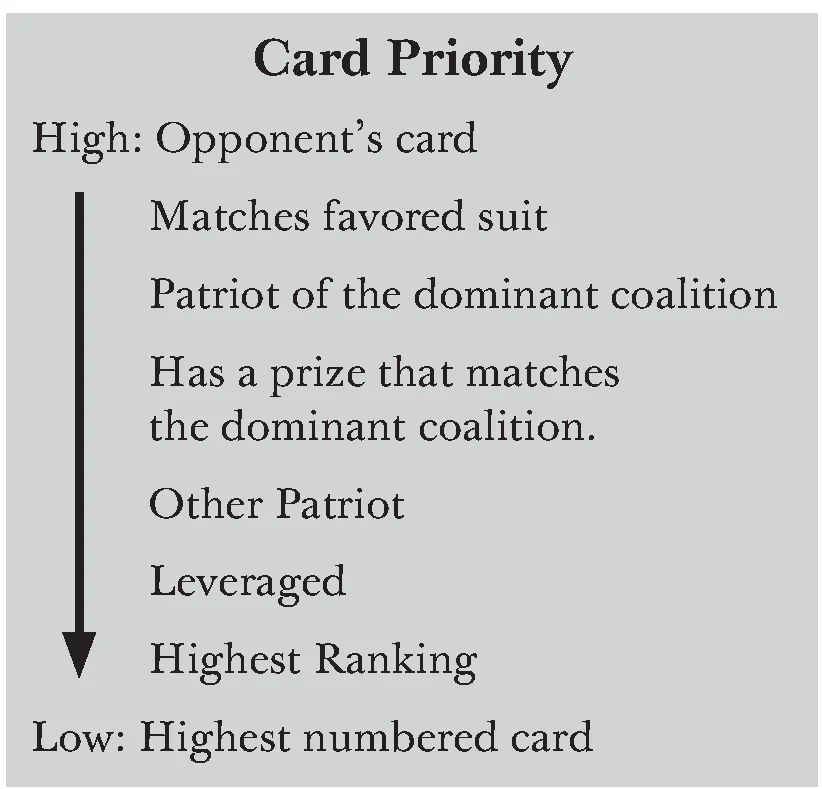
Example: Wakhan must betray a card. First, following the standard rules, it needs to be a card where she has at least one spy. Wakhan will first look for cards with her spies on her opponent’s courts. If there is more than one option, she will prioritize those that match the favored suit. If there is still more than one option, she will look for patriots of the dominant coalition etc.
Wakhan’s Turn
On Wakhan’s turn, draw an AI card and place it face up to the immediate right of the AI card draw deck in a discard pile. You will use this face-up card and the back of the card now on top of the draw deck to make decisions for Wakhan. If the draw deck is empty, reshuffle the entire discard pile (including the card just drawn) to create a new draw deck and draw again.
Wakhan then performs two actions. To determine which actions Wakhan takes, look at the central Actions section of the drawn AI card; start at top action and work down, performing each valid action in turn until Wakhan has performed the allotted two-action limit. If Wakhan still has an action left after performing the bottom action, start again at the top and work your way down again until two (non-bonus) actions have been taken.
Remember: as per the regular rules, actions taken with cards in the favored suit are bonus actions and do not count against her two-action limit. Remember too that each of these cards can still only be used for a single action per turn.
Wakhan’s Ambition: If Wakhan is able to purchase the Dominance Check and score the most victory points, she will use her action to do that, regardless of the actions listed on her AI card.
Once both actions are used, or if there are no valid choices available, Wakhan will take any available free actions from the court cards in her tableau that have not yet been used for actions. When taking bonus actions, Wakhan will always start with the leftmost, unused card on her court and take the leftmost action on the card, skipping any actions that cannot be taken. Remember too that each of Wakhan’s court cards can still only be used for a single action per turn.
Wakhan’s Core Action
Wakhan does not use the two core actions like a human players. Instead, she has one core action:
Radicalize: When Wakhan takes the radicalize action, she will purchase one card from the market and then attempt to play it immediately. This counts as a single action.
When radicalizing cards, Wakhan will consider:
- If there is a Dominance Check in the Market: Wakhan only purchases a Dominance Check event card if she will score the most points from the check. However, when a Dominance Check is in the market, Wakhan will choose the cheapest Patriot loyal to the dominant coalition, or, if no coalition is dominant, she will chose the cheapest card with the most spy and/or tribe impact icons. If there is a tie, use the highest card number.
- If there are specific instructions: Follow them. Ties are decided by the cheapest card in the market with the highest card number breaking any further ties.
- Otherwise: Use the red and black arrows. The red arrow will point to either “Top” or “Bottom” on the back of the top card of the draw deck and determines which market row to purchase from. The black arrow will point to a number between 0 and 5 on the back of the top card of the draw deck. This tells you which column to purchase from. If that card is not a valid choice, pick the next valid card to its left; if Wakhan exhausts that row then switch to the original position in the other market row. Remember, like a human player, Wakhan cannot purchase a card she has paid a rupee to this turn!
After purchasing a card from the market, Wakhan will play the card if she can afford to bribe the player ruling the region associated with that card. If she cannot pay the bribe, she will discard the card.
Wakhan should play the card to the left side of her court if the red arrow is pointing to top or the right side of her court if the red arrow is pointing to bottom.
When playing a card, Wakhan will resolve the impact icons as normal with two modifications:
- Wakhan’s Spies: Place spies on the highest priority cards associated with the played card’s region where Wakhan does not have the most spies.
- Wakhan’s Roads: Place roads on consecutive borders following the region priority on the AI card. If roads remain to be placed after going through these regions, resolve the priority a second time.
Wakhan’s Card-Based Actions
Most of the actions on Wakhan’s AI card are card-based actions. Unless otherwise noted, these actions will always follow the same restrictions as those taken by players e.g. Wakhan cannot tax a player unless she rules a territory where that player has a court card and that player has some rupees outside of their tax shelter.
When selecting which card on her court will be used to take the listed action, Wakhan will always used the highest priority card among those that could legally take the action.
Many actions on the AI card will list a set of instructions and conditions which must be true in order for the action to be taken. If these conditions cannot be met, the action is skipped. If no conditions are stated, Wakhan will use the following default behavior when resolving the action:
- Gift: Wakhan will buy the cheapest gift she can afford to buy, placing it on her aid card. Remember: this Gift will count as influence in all three coalitions.
- Build: Wakhan will build armies in the leftmost region as listed on the AI card that she rules. She will spend as much of her money as possible.
- Betray: Wakhan will betray the highest priority card with a loyalty prize where she also has a spy. She will always take the loyalty prize.
- Battle: Wakhan will battle in the region where another player has pieces (tribes and loyal roads/armies) and she has at least one army. If multiple regions fulfill this condition, use the leftmost region as listed on the AI card. Once the region is chosen she will try to destroy tribes, armies, and roads in that order. If no region is chosen, she will battle on the highest priority court card where she and another player have spies. If multiple players can be targeted in a battle action, use the red arrow to determine which player is targeted.
- Tax: Wakhan will always tax players instead of market cards if able. She will always tax from players with the most rupees first. If both players are tied, use the red arrow to determine which player is targeted. If no players can be taxed, she will tax from the market, taking rupees from the leftmost market cards and using the red arrow to determine ties.
- Move: Wakhan only moves armies and does not require any roads to facilitate movement. When moving, Wakhan will try to move her armies to adjacent regions where other players have tribes, using the region priority on the AI card to determine the choice between equally viable origins and destinations. She will seek to have only as many armies as there are tribes in that region. Wakhan will not move Armies if doing so would cause her to lose a ruler token.
Cleanup
When discarding cards from Wakhan’s court during cleanup, discard non-political cards first, then non-patriots, then non-leveraged cards, then cards with the most player spies more than Wakhan spies, fewest spies, lowest rank, not matching the favored climate, and then lowest card number.
Dominance Checks and Victory
Wakhan will claim VPs and victory just like a regular player. Remember that Wakhan is loyal to all coalitions so will be in the running no matter which coalition is dominant.
Credits
- Game Design, Graphic Design, and Research: Cole Wehrle
- Development: Drew Wehrle (Second Edition), Phil Eklund (First Edition)
- Design of Wakhan: Richard Wilkins
- Editor: Travis D. Hill
- Calligraphy for Cover: Josh Berer
- Icon Illustrations: Abol Bahadori
- Tabletop Simulator Module: Josh (AgentElrond)
- Primary Playtesters: Blake Wehrle, Cati Wehrle, Chas Threlkeld, Graham MacDonald, Corey Porter, Grayson Page and his group (Martin Weeks, Tony Au, and Jared Arkin), and the many excellent players of the First Minnesota.
- Special Thanks: Dan Thurot, Alex Singh, Joe Wiggins and the team at Panda.
- Mentors: Samuel Baker, Phil Eklund, and Patrick Leder.
Design History and Dedication
The design of Pax Pamir began shortly after the release of Phil Eklund’s Pax Porfiriana in 2012. At the back of the rulebook, Phil included a small note, urging anyone with an interesting setting in mind to submit a design to Sierra Madre Games. Spurred by this request, I began working on several games, including an adaption of Lords of the Renaissance and a game on Russian expansion in the Caucuses. Both of those designs failed to mature, but the work put me in direct contact with Phil and got me thinking seriously about game design. In late 2013, as I helped Phil playtest Greenland, he encouraged me to try my hand at a Pax design on The Great Game. The design for the first edition was submitted to Sierra Madre Games in the fall of 2014 and was published the following year after receiving additional development from Phil and Matt Eklund.
Though Pax Pamir was well-received, my own feelings on the first production were mixed. Simply put, I felt like I had strayed from some of my original hopes for an accessible Pax design that was both more strategic and more dependent on emergent partnerships than Pax Porfiriana. These feelings led to the creation of Pamir’s expansion, Khyber Knives. By the end of its development, I had answered some of my initial misgivings, but I still felt that the game deserved a full overhaul. Expansions are fundamentally additive, and some problems can only be addressed by altering the foundations. So, after submitting the files to the factory, I wrote myself a long memo on the design of Pax Pamir and tucked it away on the off-chance that I would have an opportunity to revisit the project someday.
Khyber Knives sold as well as its predecessor, and the game continued to get good reviews. Pretty soon it was out-of-print. As requests came in from other publishers for the license to Pax Pamir in 2016 and 2017, the possibility of a freshly-developed second edition became more likely. Without knowing exactly what I was going to do with the final product, my brother Drew and I began working on a new edition of Pax Pamir in December of 2017. As we worked on the design, we found ourselves increasingly interested in the game’s overall product design, inspired by the dramatic productions of games like Ortus Regni, Sol: Last Days of a Star, and the work of Jordan Draper and Nate Hayden. Once we had a clear vision for the new edition, we brought the game to Kickstarter in the fall of 2018. The game was successfully funded in September of 2018, raising nearly a quarter-of-a-million dollars. The design was finalized in December of that year.
This project would not have been possible without the support of our friends, family, and the many fans of the game who encouraged us to take on this project and who helped raise the funds required to print this edition. We happily dedicate the work of the past year to you all.
Reading the Great Game
Most of the stories about the Great Game reveal far more about the Western imagination than they do about central Asia in the nineteenth century. Partly this is a consequence of recent history. Many stories about this period were produced during the Cold War and staked their relevance on the parallels they drew between the nineteenth and twentieth centuries. John Huston’s rollicking adventure film The Man Who Would Be King (itself an adaption of a earlier Kipling story) speaks as much to anxieties over the Vietnam War as to the hubris of the British Empire. Even Peter Hopkirk’s The Great Game (1992), an otherwise excellent and well-written history, cannot quite escape the shadow of a half century of spy thrillers, nor should we expect it to.
Every creation reflects the values of its author and the world of its creation. We may have escaped the shadow of the Cold War, but our own period is no less vexed. Our histories brim with anxieties about representation, ideology, and the limits of understanding. Thankfully, these concerns are well-suited to any study of the Great Game.
For those looking to learn more about the period, begin with William Dalrymple’s Return of a King (2012). Dalrymple’s book is particularly notable both for its gripping narrative style and its incredible archival range that draws from a vast trove of poetry, history, and first-hand accounts. Many of these sources were previously unpublished in English.
For those looking to go deeper, there are many excellent sources for further reading. Be warned, the following books are quite expensive, so a library card is recommended. The single most important source for the biographies in the game and the game’s general narrative sense can be found in Fayż Muhammad Kātib Hazārah’s Sirāj al-tawārīkh as translated by R.D. McChesney (2012). For a more measured and scholarly view on the dynamics of Afghan politics in this period, see Christine Noelle’s State and Tribe in Nineteenth Century Afghanistan (1997). I drew from this book extensively during the early stages of the design, and it informed the game’s attempt to capture what political will meant in the context of Afghanistan at this time with a largely zero-sum economic system.
For those looking for a exhaustive treatment of European (especially British) foreign policy in the region during this period, look to the work of M. E. Yapp, especially Strategies of British India, Britain, Iran and Afghanistan (1980). The game’s emphasis on intelligence resources comes largely from C.A. Bayly’s magisterial Empire and Information (2000). Bayly argues that a large portion of the British success in India was tied to their ability to control information and participate in an economy of intelligence with the other centers of political power. The general theories of empire and dominance come from Jane Burbank and Frederick Cooper’s Empires in World History: Power and the Politics of Difference (2011). Burbank and Cooper suggest that empire is not hegemonic in practice, and that an effective imperial operation requires a robust infrastructure that is sensitive to traditional centers of power. This book also greatly informed the foundational political theories in my design for Root (2018).
Pax Pamir: Second Edition — First Printing, 2019 — Game Published by Wehrlegig Games LLC
Introduction
Rules of Play
In Pax Pamir, each player assumes the role of a nineteenth-century Afghan leader attempting to forge a new state after the collapse of the Durrani Empire. Western histories often call this period “The Great Game” because of the role played by the Europeans who attempted to use Central Asia as a theater for their own rivalries. In this game, those empires are viewed strictly from the perspective of the Afghans who sought to manipulate the interloping ferengi (foreigners) for their own purposes.
In terms of gameplay, Pax Pamir is a pretty straightforward tableau builder. Players will spend most of their turns purchasing cards from a central market and then playing those cards in front of them in a single row called a court. Playing cards adds units to the game’s map and grants access to additional actions that can be taken to disrupt other players and influence the course of the game. That last point is worth emphasizing. Though everyone is building their own row of cards, the game offers many ways for players to interfere with each other, both directly and indirectly.
To survive, players will organize into coalitions. In the game, these coalitions are identified chiefly by their sponsors. Two of the coalitions (British and Russian) are supported by European powers. The third coalition (Afghan) is backed by nativist elements who want to end European involvement in the region.
Throughout the game, the different coalitions will be evaluated when a special event card, called a Dominance Check, is resolved. If a single coalition has a commanding lead during one of these checks, players loyal to that coalition will receive victory points based on their influence in that coalition. However, if Afghanistan remains fragmented during one of these checks, players instead will receive victory points based on their personal power base.
Components
The Map
The map consists of six regions. There is no limit to the number of pieces that can be placed on a specific region or border, and pieces belonging to different players and coalitions can occupy the same region or border. The map is bordered by a victory point track and spaces to mark the favored suit.
Coalition Blocks (36)
Each coalition has twelve blocks in its color. What a block represents depends on where it is placed:
- A block placed in a region is called an army (armies are placed upright in regions).
- If placed on a border, the block is called a road (it helps to set roads on their side to make them stand out at a glance).
In general, coalition blocks only help players who are currently loyal to that coalition. So, even if you helped raise the army, your soldiers will not follow you if you change your loyalty.
Cylinders (55)
Each player has eleven cylinders in their color:
- The cylinder with the gold design is used to track victory points.
- The remaining cylinders represent different things based on where they are placed:
- A cylinder placed in a region is called a tribe.
- If placed on a card in a player’s court, the cylinder is called a spy.
Unlike coalition pieces, cylinders will always be on your side, even if you change loyalty.
Money Supply (36)
There are 36 coins in the game. Each is worth a single rupee. Unlike other components in the game, there is no hard limit to the number of coins, but it is very rare to need additional coins. In Pax Pamir, rupees represent political capital. During this time, political capital was largely a zero sum game, and that is true as well in Pax Pamir.
Other Pieces
A variety of other playing pieces perform various functions throughout the game, including ruler tokens, player boards, loyalty dials, and the favored suit marker.
Cards (142)
There are three types of cards in Pax Pamir: event cards (16), court cards (100), and Wakhan cards (24 AI and 2 aid).
Event Cards
Event cards are fairly straightforward. Each has two effects:
- The bottom effect is triggered if it is purchased by a player.
- The top effect is triggered if the card is automatically discarded during the cleanup phase at the end of a player’s turn.
Players should note that four of these event cards feature the same picture of the throne room of the Bala Hissar; these are special event cards called Dominance Checks that determine when and how victory points are awarded.
Court Cards
The vast majority of the cards in the game are called court cards. Court cards hold a lot of information and understanding them is critical to playing Pax Pamir. Their anatomy is described below.
Wakhan Cards
Wakhan AI cards are used only when playing with Wakhan (page 16). Wakhan aid cards are used to store his gifts and provide reminders about important rules.
Setup
To use Wakhan, the automated opponent, with either one or two human players, consult the rules on page 16.
Starting Favored Suit
Pax Pamir begins in a period of great political upheaval. Ayub Shah, the last of the Durrani emperors, has just been deposed. A region once unified is now on the verge of total collapse, and local authorities are taking the initiative.
To represent this political climate, place the favored suit marker on the space next to the political suit.
Build the Draw Deck
Build the draw deck using the following steps:
- Separate the court cards and the event cards.
- Shuffle the court cards. Create six face-down piles of court cards, each consisting of five cards, plus one card per player. The remaining court cards will not be used this game.
- Remove the four Dominance Check event cards from the other event cards. Place one in each of the four rightmost piles.
- Shuffle the remaining event cards. Place two in the second pile from the left and one in each of the remaining four piles to its right. The six remaining event cards will not be used this game.
- Finally, separately shuffle each of the six piles. Then, stack the piles one on top of the other, so that the four piles containing the Dominance Check event cards are on the bottom of the deck. Do not shuffle this combined deck.
Create the Market
In Pax Pamir, cards enter play through a market. The market is an array of 12 face-up cards, arranged in a grid of two rows and six columns. During setup, create this market by drawing cards from the draw deck and filling each market column (top row first), starting with the leftmost column. Then place the draw deck to the right of the market.
Take Player Pieces
Give each player a set of eleven cylinders, one loyalty dial, a player board, and four rupees. Place one cylinder from each player on the zero space of the victory point track and the rest on each player’s player board.
Bank and Coalition Blocks
Place the remaining coins and the tray of coalition blocks near the area of play.
Starting Loyalty
Starting with a random player and proceeding clockwise, each player adjusts their loyalty dial to indicate the loyalty they have chosen. After the last player has chosen their starting loyalty, that player will take the first turn. The game is now ready to play.
Key Concepts & General Rules
The Four Suits
The vast majority of the cards in Pax Pamir are divided into four suits that each correspond to a different mode of power: economic, military, political, and intelligence. Each suit has its own advantages. Generally speaking…
- The economic suit controls the flow of rupees and the movement of pieces. It also protects wealth from taxation in the game.
- The military suit commands armies and helps secure a coalition’s dominance.
- The political suit consolidates power and controls which cards are able to be played.
- The intelligence suit grants diplomatic flexibility and the ability to compromise enemies.
The Favored Suit
One suit is always considered favored. This suit determines which cards take bonus actions (page 12) and may make cards more expensive (page 10). The favored suit changes when certain cards are played (page 11).
Your Court
Each player is associated with a single row of cards called a court. Players begin the game without any cards in their court, but will gradually add cards to and remove cards from their court over the course of the game. Cards in a court cannot be freely rearranged. While your court can grow to any size during your turn, during cleanup you must discard cards from your court so that you do not have more court cards than three plus the sum of purple stars on cards in your court.
Your Hand
Each player is associated with a hand of cards. While your hand can grow to any size during your turn, during cleanup you must discard cards from your hand so that you do not have more hand cards than two plus the sum of blue stars on cards in your court.
Rank and Privilege
Each court card has a rank from one to three stars. Rank has two important consequences:
- A card’s rank determines the strength of some of its actions. These actions feature additional symbols to help players remember which actions depend on rank.
- A card’s rank is also added to your total stars in a specific suit. Each sum of stars in a suit expands an important privilege, as indicated here:
- Economic Stars: prevent your rupees from being taxed.
- Military Stars: serve as a final score tie-breaker.
- Political Stars: enable you to maintain a larger court.
- Intelligence Stars: allow you to hold more cards in your hand.
Loyalty and Influence
Players in Pax Pamir are always loyal to one of three coalitions: British (pink), Russian (yellow), or Afghan (green). Your loyalty determines the color of coalition blocks which you will place when playing cards e.g. players loyal to the Russian coalition place blocks that are yellow.
The extent of your loyalty to a coalition is measured in influence points. We’ll get to the various ways you’ll acquire these things later, but, for now, know that your total influence is the sum of one plus the number of patriots in your court, the number of your prizes, and the number of your gifts.
To change your loyalty, you must gain an influence point associated with a different coalition than your own (either by playing patriots or by betraying cards with prizes). Whenever you change loyalty, first return your gifts to your supply and discard any prizes and patriots you had previously accumulated. Finally, adjust your loyalty dial to indicate your new loyalty.
Ruling a Region
Each of the six regions in the game is associated with a ruler token. Ruler tokens remain on the board if no player currently rules the region. If a player does rule a region, they should immediately take the associated ruler token and place it in their play area. Likewise, if a player ceases ruling a region, the associated ruler token should be immediately returned to the board.
In order to take a ruler token, you must have at least one tribe and a plurality of ruling pieces (more than all others individually). Tribes and loyal armies are considered ruling pieces. If there is a tie, no player rules the region. Armies belonging to enemy coalitions can prevent you from taking a ruler token, even if there are no enemy tribes.
Ruling a region grants players access to:
- the build action (page 13),
- special taxing privileges (page 13), and
- the ability to extract bribes from other players who want to play cards associated with that region (page 11).
It’s good to be king.
Example: You have three ruling pieces in Kandahar (one tribe and two Afghan armies loyal to you). There are also four additional armies not loyal to you (two British, two Russian). Because you have at least one tribe in the region and the most ruling pieces, you take the ruler token.
General Rules
Negotiation
Players are free to discuss the game during play and explicitly coordinate their actions. However, any agreed-upon deal should be considered non-binding. Cards may never be transferred between players. Money can only be transferred from one player to another if explicitly sanctioned by the rules e.g. taxation of subjects, bribes for taking hostage actions, playing cards.
Component Limits
If asked to place a unit and none remain in the supply, you must take a piece of the required shape/color from anywhere in play, excluding any pieces placed this turn. In taking and placing a piece this way, you may convert one type of unit to another.
Example: You must place a spy, but you have no cylinders remaining in your stock, so you take one of your tribes in play and place it as a spy as instructed.
Card Precedence and Special Abilities
Some event cards and court cards with special abilities will modify the rules of the game. These cards always take precedence over the rules. If a court card has a special ability, it is active as long as the card remains in your court.
Discarding a Card in Your Court
Whenever a card in your court is discarded, the following rules always take effect:
- Any spies on the card are lost and returned to their owner’s supply.
- If the card had the leveraged icon , you must return two rupees to the supply. For each rupee you cannot return, you must discard one card from your hand or court (not including this card, of course). If you have no cards left, no further payment is required.
The Overthrow Rule
In general, there is no persistent link between the cards in your court and the pieces on the map. However:
- if you lose your last tribe in a region, you must immediately discard all political cards associated with that region from your court.
- Likewise, if you lose the last political card in your court associated with a region, you must immediately remove all of your tribes in that region.
Many games will be won and lost because of this rule, so you may want to read it again just to make sure you’ve got it!
Sequence of Play & Actions
Sequence of Play
Pax Pamir occurs over a series of turns. Each turn, the active player performs up to two actions which are described in the following two sections of this rulebook. Bonus actions (page 12) do not count against this limit. You may opt to take only a single action or no action at all. After you have completed your turn, perform cleanup. Then play continues clockwise to the next player until the game is over.
Access to Actions
You always have access to the following core actions: purchase and play. In addition, the cards in your court provide you access to the actions listed on that card. Each card in your court can only be used for one action per turn. That is, even if a card has three actions on it, only one of those actions can be used each turn.
Core Actions
The two core actions of Pax Pamir are described in this section. While not difficult, the purchase and play actions are, by far, the most complicated actions of the game. When teaching the game, some groups may prefer to learn just these two actions and then introduce the other actions gradually over the first few rounds of play.
Purchase
Purchase a card from the market and add it to your hand. If you purchase a card that has rupees on it, you receive them along with the card.
In order to purchase a card, you must be able to pay the card’s cost to the market. The cost of the card depends on its current column in the market:
- The leftmost column is free, the next column costs one rupee, then two, etc.
- Pay this cost by placing one rupee on each card in the same row to the left of the card you are purchasing.
- If you are ever required to place a rupee on a vacant market spot, pay the cost to the card in the same column in the other market row.
- If you place a rupee on a market card for any reason, you may not purchase that card this turn.
Event Cards: Event cards (including Dominance Checks) never enter a player’s hand and are resolved the moment they are bought from the market. Many event cards have a persistent effect that lasts until the next Dominance Check is resolved. Players who take these event cards should place them below their court. Event cards that alter the general game should be placed near the map in easy view of all players.
Purchasing Cards when Military Cards are Favored: If military cards are favored , the cost to purchase a card is doubled. When purchasing cards from the market, place two rupees on each card to the left of the purchased card instead of one.
Play
Play any card from your hand to your court.
In order to play a card, first reveal that card to everyone and announce its name and region.
- If you are the ruler of that card’s region or if no one rules the region, you can freely play the card.
- If someone else is that region’s ruler, you must pay a bribe of rupees to them that is equal to the number of the ruler’s tribes in that region. Any portion of this cost can be waived with the permission of the ruler. If the bribe is not paid (or waived), play continues as if the action had never been taken.
The played card may be added to either the left or right end of your court.
If the card is a patriot that does not match your loyalty, discard all of your patriots and prizes, and remove any gifts. Then adjust your loyalty dial to match that of the patriot.
After a card is played, resolve each impact icon on the right side of the card from top to bottom:
- Road: Place one coalition block of your loyalty on any border of this region. This piece is now a road.
- Army: Place one coalition block of your loyalty in this region. This piece is now an army.
- Leveraged: Take two rupees from the bank. This card is leveraged. Reminder: If you ever discard this card, you must pay back the rupees (page 8).
- Spy: Place one of your cylinders on a card in any player’s court that matches the played card’s region. This piece is now a spy.
- Tribe: Place one of your cylinders in this region. This piece is now a tribe.
- Favored Suit Change: Move the favored suit marker to the suit indicated. Reminder: If the favored suit is military, the cost to take the purchase action is doubled.
No Stacking Limit: In general, there is no limit to the number of pieces that can exist in any particular region, border, or court card. Pieces may also coexist with those belonging to different players and coalitions.
Card-Based Actions
The rest of the actions in Pax Pamir are associated with court cards and can only be taken if you have a card in your court which displays that action. Each card can only be used for one action once per turn, regardless of the number of actions icons on that card.
Some card-based actions are modified by the rank of a card. The higher the rank, the more effective the action is. To help you remember this, action icons modified by rank feature additional symbols.
Bonus Actions: Actions on cards matching the favored suit do not count against your turn’s two-action limit. Remember: each of these cards can still only be used for a single action per turn.
Action Costs: Some card-based actions require the acting player to pay an amount of rupees to cards in the market. These rupees are always paid in a similar fashion: rupees equal to the cost should be placed on the rightmost market cards of both rows, with a single rupee being paid to each card. If a market slot is vacant, skip that vacancy and pay the next market card(s) in the row. Reminder: if you place a rupee on a market card for any reason, you may not purchase that card this turn. For an example of paying action costs, see the example of the Build Action on the next page.
Hostage Actions: Court cards can be held hostage much in the same way that a player can rule a region. To hold a card hostage, a single enemy player must have more spies on the card than each other player. When a card in a player’s court is held hostage, that player can only use the card’s actions if the player holding it hostage is paid a bribe equal to the number of hostage-holding spies on the card. Any portion of this payment can be waived with the permission of the player holding the actions hostage. Special abilities (those described in a small text box) are never held hostage.
Tax
Take rupees up to the acting card’s rank from players with at least one court card associated with a region you rule or any card(s) in the market (regardless of their region). You may take rupees from several sources so long as the total taken does not exceed the rank of the acting card.
Tax Shelter: The total number of gold stars in your court indicates the amount of rupees you can shelter from the Tax Action. Only rupees you hold in excess of your Tax Shelter are vulnerable to the Tax Action.
Gift
Place one of your cylinders on one of your empty gift spaces on your loyalty dial. Each gift will count as one influence point in your current coalition. The cost of this action is equal to the marked price of the gift placed (2, 4, or 6).
Reminder: Gifts are lost whenever you change loyalty!
Build
Place up to three armies and/or roads among any regions that you rule. Roads may be placed on any adjacent borders. Any combination of different units may be purchased. The cost of this action is equal to two rupees per unit placed.
Move
For each rank of the acting card you may move one loyal army or spy. The same unit can be moved multiple times on a single turn. Likewise, multiple moves may be split across several of your spies and loyal armies.
- To move an army from one region to an adjacent region there must be a road matching the loyalty of the moving army on the border being crossed.
- Spies move along cards in the players’ courts (clockwise or counter-clockwise), as if they formed a single continuous track around the area of play.
Betray
Discard one card where you have a Spy (including cards in your own court). Any spies on the betrayed card are lost and returned to their owner’s supply. This action always costs two.
After the betrayed card is discarded, you may accept it as a prize, tucking it partially behind your loyalty dial. If this prize is different from your current loyalty, first remove all gifts, prizes, and patriots in your court matching your previous loyalty.
Reminder: Betrayals may trigger leveraged icons and The Overthrow Rule (page 8).
Battle
Start a battle in a single region or on a court card. At the site of the battle, remove any combination of tribes, spies, roads, or armies equal to the acting card’s rank. There are three restrictions to this rule:
- You cannot remove more units than you yourself have armies or spies in that battle.
- You cannot remove armies or roads that are of your loyalty.
- You cannot remove tribes belonging to players that share your loyalty. However, their spies may be removed!
Cleanup
Cleanup has four steps:
- First, if you have more cards than three plus the sum of the purple stars on cards in your court, discard cards in your court until you are within your limit.
- Second, if you have more cards than two plus the sum of the blue stars on cards in your court, discard cards in your hand until you are within your limit.
- Third, discard any event cards that are in the leftmost column of the market. Any rupees on the discarded event will remain in their position. The top row is always discarded first, followed by the bottom row. When an event card is discarded, all players are affected by the text or impact icon at the top of the card.
- Fourth, fill any empty spaces in the market by moving all cards in that market row (along with their rupees) to their leftmost position and then draw new cards to fill in any rightmost empty spaces, returning the market to its normal size, if possible. If a card moves into a space with rupees from a previously-discarded event card, those rupees are placed on the new card taking that position.
Instability: If a Dominance Check card is revealed and there is already a Dominance Check card in the market, immediately perform a Dominance Check and then discard both Dominance Check cards and fill the empty spaces in the market as described above. If the final Dominance Check card was discarded in this way, the Dominance Check will count as the final check.
Dominance Checks & Game End
Dominance Checks
Dominance Check event cards are resolved when purchased by a player or when triggered during cleanup. When resolved, take account of the game-state. If a single coalition has the most blocks in play and at least four more than all other coalitions (uncombined), the Dominance Check is successful. Otherwise the check is unsuccessful.
Example: If the British coalition has eight blocks and the other two coalitions both have four blocks, the British Coalition would be dominant.
The result of this check determines what happens next.
Early End: If, after scoring a Dominance Check, the leading player has at least four more victory points than the next highest scoring player, the game is over and that player wins!
Unsuccessful Check
Players will score points based on the number of cylinders they have in play. A cylinder is considered to be in play if it is not on a player board.
- The player with the most cylinders in play scores three victory points.
- The player with the second most cylinders in play scores one victory point.
If there is a tie, add up the victory points for the tied places and then divide that number by the number of tied players (rounding down) e.g. two players tied for first place will both score two points ((3+1)÷2).
Successful Check
Players loyal to the Dominant Coalition score victory points based on their influence points (page 6). Each loyal player has one influence point plus the sum of their gifts, prizes, and the number of patriots in their court.
- The player with the most influence scores five victory points.
- The player with the second most scores three victory points.
- The player with the third most scores one victory point.
If there is a tie, add up the victory points for the tied places and then divide that number by the number of tied players (rounding down).
After awarding points for the successful check, the region settles into an uneasy peace. Remove all coalition blocks from the board.
Final Dominance Check
Any points earned during the final Dominance Check are doubled. This doubling occurs before any victory points are split in the case of ties for influence or cylinders.
Game End and Victory
A game of Pax Pamir can end two ways:
- If, after any Dominance Check, a single player leads all other players by at least four victory points, the game is over and that player wins.
- Barring that, after the deck’s final Dominance Check is resolved, the game will always end, and the player with the most victory points wins.
Tie-breakers:
- If one or more players have the same number of victory points when the game ends, the player with the most red stars in their court among the tied players wins.
- If there is still a tie, the player with the most rupees among the tied players wins.
- If there is still a tie, whoever can cook the best chopan kebab wins.
The scoring of Dominance Checks is described on page 15.
Playing with Wakhan
This section introduces an automated opponent called Wakhan. Thematically, this opponent represents some radical ideology (theological or philosophical) that has taken hold across the region and that transcends traditional loyalties.
Wakhan can be faced by one or two human players. However, this is not a cooperative variant and only one player (or Wakhan) can win the game.
Setting Up
When setting up a game with Wakhan, make the following adjustments:
- Include Wakhan as a player when determining the size of the deck.
- Shuffle the deck of 24 AI cards and place them in a stack face down.
- Wakhan will use a spare set of player cylinders. Wakhan does not take a loyalty dial and will instead place her gifts on her aid card. Place Wakhan’s pieces to the right of the player who choses their loyalty last. Wakhan will take the first turn of the game.
General Rules
Wakhan must pay all costs, including bribes, just like a regular player.
If Wakhan’s court cards have a Special Ability that says she “may” do something, Wakhan always will.
Wakhan is not loyal to a coalition; rather, Wakhan is effectively loyal to all coalitions. Wakhan can hold loyalty prizes and patriots belonging to different coalitions. Nevertheless, she will always assume a single pragmatic loyalty.
Wakhan’s Pragmatic Loyalty is always the leftmost loyalty on the AI card that is not shared by any other player. This loyalty is used to determine the regions in which she rules (and who can attack her tribes), as well as the blocks she places, moves, and battles.
Frequently, Wakhan will have to chose a specific court card. To decide which card to chose, Wakhan will always pick the card with the highest card priority.
Example: Wakhan must betray a card. First, following the standard rules, it needs to be a card where she has at least one spy. Wakhan will first look for cards with her spies on her opponent’s courts. If there is more than one option, she will prioritize those that match the favored suit. If there is still more than one option, she will look for patriots of the dominant coalition etc.
Wakhan’s Turn
On Wakhan’s turn, draw an AI card and place it face up to the immediate right of the AI card draw deck in a discard pile. You will use this face-up card and the back of the card now on top of the draw deck to make decisions for Wakhan. If the draw deck is empty, reshuffle the entire discard pile (including the card just drawn) to create a new draw deck and draw again.
Wakhan then performs two actions. To determine which actions Wakhan takes, look at the central Actions section of the drawn AI card; start at top action and work down, performing each valid action in turn until Wakhan has performed the allotted two-action limit. If Wakhan still has an action left after performing the bottom action, start again at the top and work your way down again until two (non-bonus) actions have been taken.
Remember: as per the regular rules, actions taken with cards in the favored suit are bonus actions and do not count against her two-action limit. Remember too that each of these cards can still only be used for a single action per turn.
Wakhan’s Ambition: If Wakhan is able to purchase the Dominance Check and score the most victory points, she will use her action to do that, regardless of the actions listed on her AI card.
Once both actions are used, or if there are no valid choices available, Wakhan will take any available free actions from the court cards in her tableau that have not yet been used for actions. When taking bonus actions, Wakhan will always start with the leftmost, unused card on her court and take the leftmost action on the card, skipping any actions that cannot be taken. Remember too that each of Wakhan’s court cards can still only be used for a single action per turn.
Wakhan’s Core Action
Wakhan does not use the two core actions like a human players. Instead, she has one core action:
Radicalize: When Wakhan takes the radicalize action, she will purchase one card from the market and then attempt to play it immediately. This counts as a single action.
When radicalizing cards, Wakhan will consider:
- If there is a Dominance Check in the Market: Wakhan only purchases a Dominance Check event card if she will score the most points from the check. However, when a Dominance Check is in the market, Wakhan will choose the cheapest Patriot loyal to the dominant coalition, or, if no coalition is dominant, she will chose the cheapest card with the most spy and/or tribe impact icons. If there is a tie, use the highest card number.
- If there are specific instructions: Follow them. Ties are decided by the cheapest card in the market with the highest card number breaking any further ties.
- Otherwise: Use the red and black arrows. The red arrow will point to either “Top” or “Bottom” on the back of the top card of the draw deck and determines which market row to purchase from. The black arrow will point to a number between 0 and 5 on the back of the top card of the draw deck. This tells you which column to purchase from. If that card is not a valid choice, pick the next valid card to its left; if Wakhan exhausts that row then switch to the original position in the other market row. Remember, like a human player, Wakhan cannot purchase a card she has paid a rupee to this turn!
After purchasing a card from the market, Wakhan will play the card if she can afford to bribe the player ruling the region associated with that card. If she cannot pay the bribe, she will discard the card.
Wakhan should play the card to the left side of her court if the red arrow is pointing to top or the right side of her court if the red arrow is pointing to bottom.
When playing a card, Wakhan will resolve the impact icons as normal with two modifications:
- Wakhan’s Spies: Place spies on the highest priority cards associated with the played card’s region where Wakhan does not have the most spies.
- Wakhan’s Roads: Place roads on consecutive borders following the region priority on the AI card. If roads remain to be placed after going through these regions, resolve the priority a second time.
Wakhan’s Card-Based Actions
Most of the actions on Wakhan’s AI card are card-based actions. Unless otherwise noted, these actions will always follow the same restrictions as those taken by players e.g. Wakhan cannot tax a player unless she rules a territory where that player has a court card and that player has some rupees outside of their tax shelter.
When selecting which card on her court will be used to take the listed action, Wakhan will always used the highest priority card among those that could legally take the action.
Many actions on the AI card will list a set of instructions and conditions which must be true in order for the action to be taken. If these conditions cannot be met, the action is skipped. If no conditions are stated, Wakhan will use the following default behavior when resolving the action:
- Gift: Wakhan will buy the cheapest gift she can afford to buy, placing it on her aid card. Remember: this Gift will count as influence in all three coalitions.
- Build: Wakhan will build armies in the leftmost region as listed on the AI card that she rules. She will spend as much of her money as possible.
- Betray: Wakhan will betray the highest priority card with a loyalty prize where she also has a spy. She will always take the loyalty prize.
- Battle: Wakhan will battle in the region where another player has pieces (tribes and loyal roads/armies) and she has at least one army. If multiple regions fulfill this condition, use the leftmost region as listed on the AI card. Once the region is chosen she will try to destroy tribes, armies, and roads in that order. If no region is chosen, she will battle on the highest priority court card where she and another player have spies. If multiple players can be targeted in a battle action, use the red arrow to determine which player is targeted.
- Tax: Wakhan will always tax players instead of market cards if able. She will always tax from players with the most rupees first. If both players are tied, use the red arrow to determine which player is targeted. If no players can be taxed, she will tax from the market, taking rupees from the leftmost market cards and using the red arrow to determine ties.
- Move: Wakhan only moves armies and does not require any roads to facilitate movement. When moving, Wakhan will try to move her armies to adjacent regions where other players have tribes, using the region priority on the AI card to determine the choice between equally viable origins and destinations. She will seek to have only as many armies as there are tribes in that region. Wakhan will not move Armies if doing so would cause her to lose a ruler token.
Cleanup
When discarding cards from Wakhan’s court during cleanup, discard non-political cards first, then non-patriots, then non-leveraged cards, then cards with the most player spies more than Wakhan spies, fewest spies, lowest rank, not matching the favored climate, and then lowest card number.
Dominance Checks and Victory
Wakhan will claim VPs and victory just like a regular player. Remember that Wakhan is loyal to all coalitions so will be in the running no matter which coalition is dominant.
Historical Notes & Credits
Credits
- Game Design, Graphic Design, and Research: Cole Wehrle
- Development: Drew Wehrle (Second Edition), Phil Eklund (First Edition)
- Design of Wakhan: Richard Wilkins
- Editor: Travis D. Hill
- Calligraphy for Cover: Josh Berer
- Icon Illustrations: Abol Bahadori
- Tabletop Simulator Module: Josh (AgentElrond)
- Primary Playtesters: Blake Wehrle, Cati Wehrle, Chas Threlkeld, Graham MacDonald, Corey Porter, Grayson Page and his group (Martin Weeks, Tony Au, and Jared Arkin), and the many excellent players of the First Minnesota.
- Special Thanks: Dan Thurot, Alex Singh, Joe Wiggins and the team at Panda.
- Mentors: Samuel Baker, Phil Eklund, and Patrick Leder.
Design History and Dedication
The design of Pax Pamir began shortly after the release of Phil Eklund’s Pax Porfiriana in 2012. At the back of the rulebook, Phil included a small note, urging anyone with an interesting setting in mind to submit a design to Sierra Madre Games. Spurred by this request, I began working on several games, including an adaption of Lords of the Renaissance and a game on Russian expansion in the Caucuses. Both of those designs failed to mature, but the work put me in direct contact with Phil and got me thinking seriously about game design. In late 2013, as I helped Phil playtest Greenland, he encouraged me to try my hand at a Pax design on The Great Game. The design for the first edition was submitted to Sierra Madre Games in the fall of 2014 and was published the following year after receiving additional development from Phil and Matt Eklund.
Though Pax Pamir was well-received, my own feelings on the first production were mixed. Simply put, I felt like I had strayed from some of my original hopes for an accessible Pax design that was both more strategic and more dependent on emergent partnerships than Pax Porfiriana. These feelings led to the creation of Pamir’s expansion, Khyber Knives. By the end of its development, I had answered some of my initial misgivings, but I still felt that the game deserved a full overhaul. Expansions are fundamentally additive, and some problems can only be addressed by altering the foundations. So, after submitting the files to the factory, I wrote myself a long memo on the design of Pax Pamir and tucked it away on the off-chance that I would have an opportunity to revisit the project someday.
Khyber Knives sold as well as its predecessor, and the game continued to get good reviews. Pretty soon it was out-of-print. As requests came in from other publishers for the license to Pax Pamir in 2016 and 2017, the possibility of a freshly-developed second edition became more likely. Without knowing exactly what I was going to do with the final product, my brother Drew and I began working on a new edition of Pax Pamir in December of 2017. As we worked on the design, we found ourselves increasingly interested in the game’s overall product design, inspired by the dramatic productions of games like Ortus Regni, Sol: Last Days of a Star, and the work of Jordan Draper and Nate Hayden. Once we had a clear vision for the new edition, we brought the game to Kickstarter in the fall of 2018. The game was successfully funded in September of 2018, raising nearly a quarter-of-a-million dollars. The design was finalized in December of that year.
This project would not have been possible without the support of our friends, family, and the many fans of the game who encouraged us to take on this project and who helped raise the funds required to print this edition. We happily dedicate the work of the past year to you all.
Reading the Great Game
Most of the stories about the Great Game reveal far more about the Western imagination than they do about central Asia in the nineteenth century. Partly this is a consequence of recent history. Many stories about this period were produced during the Cold War and staked their relevance on the parallels they drew between the nineteenth and twentieth centuries. John Huston’s rollicking adventure film The Man Who Would Be King (itself an adaption of a earlier Kipling story) speaks as much to anxieties over the Vietnam War as to the hubris of the British Empire. Even Peter Hopkirk’s The Great Game (1992), an otherwise excellent and well-written history, cannot quite escape the shadow of a half century of spy thrillers, nor should we expect it to.
Every creation reflects the values of its author and the world of its creation. We may have escaped the shadow of the Cold War, but our own period is no less vexed. Our histories brim with anxieties about representation, ideology, and the limits of understanding. Thankfully, these concerns are well-suited to any study of the Great Game.
For those looking to learn more about the period, begin with William Dalrymple’s Return of a King (2012). Dalrymple’s book is particularly notable both for its gripping narrative style and its incredible archival range that draws from a vast trove of poetry, history, and first-hand accounts. Many of these sources were previously unpublished in English.
For those looking to go deeper, there are many excellent sources for further reading. Be warned, the following books are quite expensive, so a library card is recommended. The single most important source for the biographies in the game and the game’s general narrative sense can be found in Fayż Muhammad Kātib Hazārah’s Sirāj al-tawārīkh as translated by R.D. McChesney (2012). For a more measured and scholarly view on the dynamics of Afghan politics in this period, see Christine Noelle’s State and Tribe in Nineteenth Century Afghanistan (1997). I drew from this book extensively during the early stages of the design, and it informed the game’s attempt to capture what political will meant in the context of Afghanistan at this time with a largely zero-sum economic system.
For those looking for a exhaustive treatment of European (especially British) foreign policy in the region during this period, look to the work of M. E. Yapp, especially Strategies of British India, Britain, Iran and Afghanistan (1980). The game’s emphasis on intelligence resources comes largely from C.A. Bayly’s magisterial Empire and Information (2000). Bayly argues that a large portion of the British success in India was tied to their ability to control information and participate in an economy of intelligence with the other centers of political power. The general theories of empire and dominance come from Jane Burbank and Frederick Cooper’s Empires in World History: Power and the Politics of Difference (2011). Burbank and Cooper suggest that empire is not hegemonic in practice, and that an effective imperial operation requires a robust infrastructure that is sensitive to traditional centers of power. This book also greatly informed the foundational political theories in my design for Root (2018).
Pax Pamir: Second Edition — First Printing, 2019 — Game Published by Wehrlegig Games LLC
