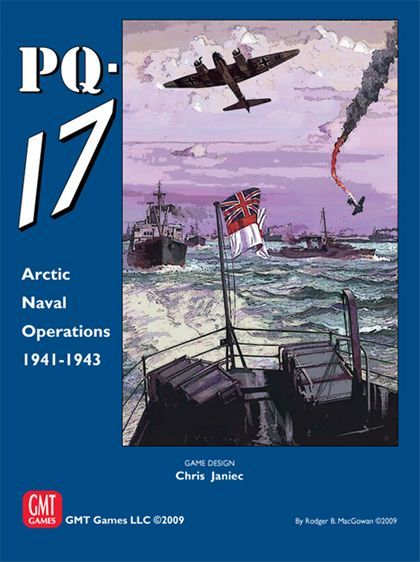
PQ-17: Arctic Naval Operations 1941-1943
2009
A tense two-player World War II simulation of Arctic convoy operations, hidden forces, air power, fuel limits, and extreme weather.
210
minutes
2 - 2
player(s)
Heavy

About this board game
PQ-17: Arctic Naval Operations 1941-1943 is a two-player World War II air-naval game with an approximately 210-minute playing time, covering convoy operations in the Barents and Norwegian Seas.
The Allied player must move convoys to and from north Russia while facing determined Axis opposition, severe weather, limited fuel, and the challenges of Arctic navigation. The game focuses on operational decisions rather than tactical ship placement, using hidden forces and an abstract Combat Display to resolve battles.
Players maneuver concealed blocks across a map stretching from Greenland and Ireland to Kiel and the Kara Sea. Each block may represent surface ships, submarines, or other forces—or be a dummy. Reconnaissance is essential: successful searches reveal intelligence of varying accuracy, while lost contact can create fresh uncertainty.
- Individual capital ships and cruisers, plus groups of smaller ships, submarines, and merchant vessels
- More than 100 air units representing RAF, Fleet Air Arm, Luftwaffe, VVS, and selected USAAF forces
- Fuel restrictions and Task Force Display markers that limit endurance without tedious bookkeeping
- Combat procedures for submarine attacks, antisubmarine warfare, bombing, aerial torpedo attacks, air-to-air combat, antiaircraft fire, and surface actions
Environmental conditions are central to PQ-17. Seasonal daylight and darkness, shifting polar ice, and dangerous weather affect movement, searches, combat, and ship safety, making summer and winter operations play very differently.
Nine historical scenarios cover major actions including the attack on Tirpitz, the destruction of convoy PQ-17, PQ-18, the Battle of the Barents Sea, and the 1943 Battle of North Cape. Secret special conditions give each operation additional requirements, restrictions, or opportunities, while a random 1942 scenario and a campaign scenario add uncertainty and longer-term strategic demands.
/pic7182955.jpg)
