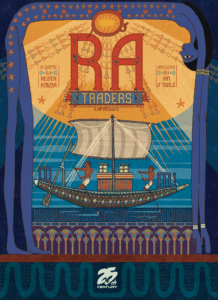
Ra
1999
A tense auction and set-collection game where suns buy valuable tiles before each epoch ends.
60
minutes
2 - 5
player(s)
12+
Medium


About this board game
Ra is an auction and set-collection board game for 2–5 players that plays in about 60 minutes. Set across 1,500 years of Egyptian history, it challenges players to expand their power and fame through carefully timed bids and valuable tile collections.
Each turn, players can use their bidding tiles, or suns, to purchase lots of tiles. Once a player has used all of their suns, the remaining players continue until they have done the same. This can create a tense situation in which a single uncontested player is still able to bid before the epoch ends.
The round may finish before everyone has won their three lots for the epoch, so timing and risk are central to every decision. Players must judge when to bid, when to hold back, and how much each lot is worth as the available opportunities change.
The tiles offer different kinds of benefits. Some provide immediate points, while others protect players from negative points for missing particular tile types at the end of an epoch. Still others award points after the final round, creating goals that remain important throughout the game.
- Influence Pharaohs
- Build monuments
- Farm on the Nile
- Pay homage to the Gods
- Advance the technology and culture of the people
Ra lasts for three epochs, or rounds, and is designed to be easy to learn. Across the game, players choose whether to take risks for great rewards, combining auctions and set collection in pursuit of power, fame, and the glory of the Sun God Ra.

Board Game Rules for
Ra
Introduction
More than 4,000 years ago, in Ancient Egypt, civilization is bustling. Artists are throwing pottery, engraving clay tablets, and painting idyllic scenes on papyrus. Workers are pulling stone from the ground and using it to create towering monuments that will last for millennia. Priests are praying, entreating the gods from their fire-lit temples. The Nile swells and recedes, and with each season, farmers look to the gods for blessings of fertility and growth. Each pharaoh is busy ruling his people while also looking to the future, making plans which will not come to fruition for centuries. With each day, Egyptian culture is growing stronger.
As a pharaoh’s reign ends, a new pharaoh rises. Each epoch brings new opportunities for growth and development. The monuments, paintings, statues, and stories of the past provide each new ruler with a rich history of those who have come before, a history which spans thousands of years.
Many gods hold sway over the lives of the Egyptian people, but none more powerful than Ra. The god of the sun brings life and light to the land; his power is unquestioned. Throughout the years, many gods fall in and out of favor, but Ra is the sun god, and the sun is the true ruler of Egyptian life.
The game of Ra allows you to view the whole of Egyptian history as a royal advisor whose bloodline spans generations. Enrich civilization through art, religion, astronomy, writing, and agriculture. Build monuments to greatness which will endure through the ages. Implore the gods to bestow their favor upon you. Above all, immerse yourself in the wonders of Ancient Egypt and the power of Ra!
Components

- 1 Game Board
- 1 Ra Statue
- 1 Cloth Bag
- 5 Scoring Reference Cards
- 16 Sun Disks
- 8 God Tiles
- 30 Ra Tiles
- 25 Pharaoh Tiles
- 2 Funeral Tiles
- 25 Nile Tiles
- 12 Flood Tiles
- 2 Drought Tiles
- 5 Gold Tiles
- 5 Fortress Tiles
- 5 Obelisk Tiles
- 5 Palace Tiles
- 5 Pyramid Tiles
- 5 Temple Tiles
- 5 Statue Tiles
- 5 Step Pyramid Tiles
- 5 Sphinx Tiles
- 2 Earthquake Tiles
- 5 Agriculture Tiles
- 5 Art Tiles
- 5 Astronomy Tiles
- 5 Religion Tiles
- 5 Writing Tiles
- 4 War Tiles
- 10 1-Point Tablets
- 14 2-Point Tablets
- 20 5-Point Tablets
- 10 10-Point Tablets
Game Setup

To set up a game of Ra, perform these steps:
- Place Game Board: Place the game board in the center of the play area.
- Place Ra Statue: Place the Ra statue next to the game board.
- Mix Tiles: Place all 180 tiles in the cloth bag and thoroughly mix them.
- Distribute Starting Tablets: Each player takes two 5-point tablets and places them facedown in front of him. Then, place all remaining tablets faceup near the game board to create the supply.
- Sort Sun Disks: Place the sun disk numbered “1” on the sun space in the center of the game board. Then, sort the remaining sun disks into groups according to the number of players as shown in the table below.
Note: For a two-player game, use only sun disks 1–9. For either a three- or four-player game, use only sun disks 1–13. For a five-player game, use all sixteen sun disks.

- Distribute Sun Disks: Randomly distribute one group of sun disks to each player. Each player places his sun disks faceup in front of him.
After completing these setup steps, players are ready to begin the game.
Game Overview
Ra is played over three rounds called epochs. During each epoch, players take turns performing actions to either place tiles on the board or take tiles from the board.
At the start of each epoch, the player with the highest-numbered sun disk takes the first turn. Players continue taking turns in clockwise order until the epoch ends.
During an epoch, each player can take multiple turns, and it is possible for one player to take multiple turns in a row if he is the only remaining player who has at least one faceup sun disk.
Over the course of each epoch, a player uses his sun disks during auctions, which occur after specific actions.
Tile & Disk Organization
Players must keep all of their tiles faceup in front of them at all times. Each player must keep his tiles organized in a manner which allows his opponents to easily determine what tiles he currently has. Any sun disks that have not yet been used during the current epoch must also remain faceup. Players cannot fully stack or otherwise cover their tiles or sun disks.

Actions
Actions allow players to draw, place, and take tiles. If a player does not have any faceup sun disks, he does not take a turn, and play proceeds to the next player in clockwise order. On his turn, a player must perform exactly one of the following actions:
 Draw a Tile
- Invoke Ra
- Spend God Tile(s)
When a player has completed his action, his turn ends.
Draw a Tile
The player draws one tile from the bag and places it faceup on the next open space of its track on the game board:
- If a Ra tile is drawn, it is placed on the Ra track.
- If any other tile is drawn, it is placed on the auction track.
If the auction track is full, a player cannot perform the Draw a Tile action.
Ra Tiles
The first Ra tile drawn in each epoch is placed on the Ra track on the starting space indicated by the number of players in the game.

Each subsequent Ra tile drawn this epoch is placed on the Ra track in the next empty space to the right. After placing a Ra tile on the board, the player takes the Ra statue. Then, an auction occurs.
If the Ra tile is placed in the final space of the Ra track, no auction occurs, and the epoch ends.

Invoke Ra
The player says, “I invoke Ra,” and takes the Ra statue. Then, an auction occurs.
Spend God Tile(s)
If a player has a god tile, he may spend it to take one non-god tile from the auction track. When a player spends a god tile, he returns it to the game box; the tile is not used for the rest of the game. Then, the tile he takes from the auction track is placed faceup in front of him. If it is a disaster tile, resolve it immediately.
A player may spend one or more god tiles per action, taking one tile from the auction track for each god tile he spends. If tiles taken from the auction track leave empty spaces, tiles drawn during later turns can be placed there.
Auctions
There are two ways an auction can occur: when a Ra tile is drawn or when a player performs the Invoke Ra action.
- When a Ra tile is drawn, the player who drew it becomes the Ra player for this auction. He takes the Ra statue to indicate this, and the auction begins. During this auction, all players may pass; if all players pass, the tiles remain on the auction track.
- When a player performs the Invoke Ra action, he becomes the Ra player for this auction. He takes the Ra statue to indicate this, and an auction begins. During this auction, if all other players pass and the auction track is not full, the Ra player must bid. If the auction track is full, all players may pass; if all players pass, discard all tiles on the auction track to the game box.
After an auction ends, play continues with the player to the left of the Ra player, regardless of the auction’s outcome.
Bidding with Sun Disks
During an auction, each player takes a turn bidding with his sun disks. The winner will take all tiles on the auction track as well as the sun disk currently on the sun space.
Bidding in each auction begins with the player to the left of the Ra player and continues clockwise. When it is a player’s turn to bid, he may bid one of his faceup sun disks by placing it on the edge of the board. Each player may only bid (or pass) once; bidding ends with the Ra player.
The first bid of each auction can be a sun disk of any value. Each subsequent bid must be a sun disk of a higher value than the current bid. If a player cannot bid one of his sun disks, or if he chooses not to bid, he may pass, and bidding proceeds to the next player. Each auction ends with the Ra player.
Note: The Ra player is required to bid only if he performed the Invoke Ra action while the auction track was not full and all other players have passed.
Winning an Auction
The highest bidder takes all tiles on the auction track and places them faceup in front of him. He also takes the sun disk from the sun space and places it facedown in front of him. Facedown sun disks cannot be used for the remainder of this epoch.
Next, the highest bidder places the sun disk he used for the winning bid faceup in the sun space on the board, where it can be won during the next auction. The remaining sun disks placed at the edge of the board as bids are returned faceup to the players who bid them.
Finally, the highest bidder resolves any disaster tiles taken in the auction.
Disasters
Disasters are the black-bordered, cracked tiles that force a player to discard tiles. There are four types of disaster tiles:
- A war affects civilization tiles.
- A funeral affects pharaoh tiles.
- A drought affects river tiles.
- An earthquake affects monument tiles.
After a player takes a disaster tile, he must discard some of his tiles to the game box. For each disaster tile, he discards two corresponding tiles (in addition to the disaster tile itself).
If a player takes a disaster tile and has fewer than two corresponding tiles, he must discard as many corresponding tiles as possible.
When resolving a drought disaster tile, the player must discard his flood tiles first. For all other disasters, the player may choose which of his tiles to discard.

Disaster Discarding Example
Anna wins an auction that includes an earthquake tile, a war tile, and a drought tile.
- The earthquake forces Anna to discard two of her monument tiles. She chooses the obelisk and a sphinx, and discards them along with the earthquake.
- The war forces Anna to discard two civilization tiles. Since she has fewer than two civilization tiles, she discards her single agriculture tile along with the war.
- The drought forces Anna to discard two river tiles, and she must discard all flood tiles before discarding any Nile tiles. She discards her only flood and one Nile tile along with the drought.
End of an Epoch
Each game of Ra contains three epochs. At the end of an epoch, each player gains or loses points based on the tiles in front of him. After scoring at the end of the third epoch, the game ends.
There are two ways an epoch can end:
- When all players’ sun disks are facedown.
- When a Ra tile is placed in the final space of the Ra track.
Each of the above conditions ends an epoch immediately. The Ra tile placed on the final space of the Ra track does not begin an auction.
When an epoch ends, discard all tiles from both the Ra track and the auction track to the game box. The sun disk currently on the sun space remains on the board.
At the end of an epoch, each player scores points based on his tiles and takes or returns the appropriate number of tablets. Then he flips all of his sun disks faceup.
Finally, each player discards all of his tiles that do not have a scarab icon  to the game box. Tiles that have a scarab icon stay in front of a player for the entire game.
The player with the highest-numbered sun disk in front of him takes the first turn of the next epoch.
Scoring
At the end of an epoch, each player scores points based on his tiles. Then he takes the appropriate number of tablets from the supply to track his score. The scoring reference cards provide a quick and easy way to help players determine their scores.
Tablets
Players track their scores using tablet tokens, which display a point value. At the start of the game, each player has two 5-point tablets.
As a player gains or loses points throughout the game, he can make change from the supply so that the total value of his tablets matches his score. A player’s tablets are always kept facedown, hidden from his opponents. If a player’s score would be reduced to less than zero, his score is zero instead.
End of Each Epoch Scoring
At the end of each epoch, players score points based on their tiles as explained below. After scoring, players discard each tile that does not have a scarab icon to the game box. Players keep tiles with the scarab icon for the entire game.
Pharaohs
- The player with the most pharaoh tiles gains 5 points. If two or more players tie for highest, each tied player gains 5 points.
- The player with the fewest pharaoh tiles loses 2 points. If two or more players tie for highest, each tied player loses 2 points.
- If all players have the same number of pharaoh tiles, no points are gained or lost.
Gold
A player gains 3 points for each of his gold tiles.
Gods
A player gains 2 points for each of his unspent god tiles.
River
There are two types of river tiles (Nile and Flood):
- If a player has at least one flood tile, he gains 1 point for each of his river tiles.
- If a player has zero flood tiles, his Nile tiles are not worth any points.
Civilization
There are five types of civilization tiles (Agriculture, Art, Astronomy, Religion, Writing):
- A player with zero civilization tiles loses 5 points.
- A player with three different types of civilization tiles gains 5 points.
- A player with four different types of civilization tiles gains 10 points.
- A player with five different types of civilization tiles gains 15 points.
If a player has multiples of one type of tile, he does not gain additional points for those tiles.
End of Third Epoch Scoring
Players score points based on their sun disks and monument tiles only at the end of the third epoch as explained below.
Sun Disks
Each player adds the values on his faceup and facedown sun disks to obtain his total.
- The player with the highest total gains 5 points. If two or more players tie for the highest, each tied player gains 5 points.
- The player with the lowest total loses 5 points. If two or more players tie for the lowest, each tied player loses 5 points.
- If all players have the same total, no points are gained or lost.
Monuments
There are eight types of monument tiles: Fortress, Obelisk, Palace, Pyramid, Sphinx, Statue, Step Pyramid, Temple.
A player gains points by collecting different types of monument tiles and for collecting multiple monument tiles of the same type, as follows:
- Each group of three identical monument tiles is worth 5 points.
- Each group of four identical monument tiles is worth 10 points.
- Each group of five identical monument tiles is worth 15 points.
- If a player has six or fewer different types of monument tiles, he gains 1 point for each type.
- If a player has seven different types of monument tiles, he gains 10 points.
- If a player has all eight types of monument tiles, he gains 15 points.

Monuments Scoring Example
Anna ends the third epoch with four pyramids, three temples, two fortresses, and one sphinx. She gains 4 points for having four different types of monument tiles. Then she checks for identical tiles in groups of three or more. She gains 10 points for having four pyramids, and 5 points for having three temples. This gives her a total of 19 points gained for her monument tiles.
Winning the Game
After scoring at the end of the third epoch, the player with the highest score wins. If two or more players are tied for the highest score, the tied player with the highest-numbered sun disk wins the game.
Credits
- Game Design: Reiner Knizia
- Producer: Molly Glover with Jason Walden
- Technical Writing: Adam Baker, Steven Kimball, and Alexandar Ortloff
- Rules Consultant: Christopher Dearlove
- Editing & Proofreading: Richard A. Edwards, Sean O’Leary, and Heather Silsbee
- Graphic Design: Edge Studio and Monica Helland
- Windrider Senior Graphic Designer: Samuel R. Shimota
- Graphic Design Manager: Brian Schomburg
- Cover Art: Leonardo Borazio and Zachary Graves
- Board & Interior Art: Edge Studio
- Managing Art Director: Andy Christensen
- Plastics Sculpting: Niklas Norman
- Production Management: Jason Beaudoin and Megan Duehn
- Licensing Specialist: Amanda Greenhart
- Quality Assurance Coordinator: Zachary Tewalthomas
- Publisher: Steven Kimball
- Playtesters: Susanne Armbruster, Samuel W. Bailey, Michael Bernabo, Chris Bowyer, Donald Bubbins, Christopher Dearlove, Emeric Dwyer, Dave Farquhar, Walburga Freudenstein, Nick Glover, Martin Higham, Markus Huber, Sandra Huber, Ross Inglis, Kevin Jacklin, Christine Jilke, Jose Lapini, Mark Larson, Chris Lawson, Pedro Miranda, Julio Nardone, Jeremy Rainbow, Kendra Rainbow, Amanda Ressler, Marlus Silva, Ivan Towlson, Darrell Ulm, Emily Ulm, Michael Walsh, Ben Wilson, Dominik Wagner, and David Withington
Introduction & Components
Introduction
More than 4,000 years ago, in Ancient Egypt, civilization is bustling. Artists are throwing pottery, engraving clay tablets, and painting idyllic scenes on papyrus. Workers are pulling stone from the ground and using it to create towering monuments that will last for millennia. Priests are praying, entreating the gods from their fire-lit temples. The Nile swells and recedes, and with each season, farmers look to the gods for blessings of fertility and growth. Each pharaoh is busy ruling his people while also looking to the future, making plans which will not come to fruition for centuries. With each day, Egyptian culture is growing stronger.
As a pharaoh’s reign ends, a new pharaoh rises. Each epoch brings new opportunities for growth and development. The monuments, paintings, statues, and stories of the past provide each new ruler with a rich history of those who have come before, a history which spans thousands of years.
Many gods hold sway over the lives of the Egyptian people, but none more powerful than Ra. The god of the sun brings life and light to the land; his power is unquestioned. Throughout the years, many gods fall in and out of favor, but Ra is the sun god, and the sun is the true ruler of Egyptian life.
The game of Ra allows you to view the whole of Egyptian history as a royal advisor whose bloodline spans generations. Enrich civilization through art, religion, astronomy, writing, and agriculture. Build monuments to greatness which will endure through the ages. Implore the gods to bestow their favor upon you. Above all, immerse yourself in the wonders of Ancient Egypt and the power of Ra!
Components
- 1 Game Board
- 1 Ra Statue
- 1 Cloth Bag
- 5 Scoring Reference Cards
- 16 Sun Disks
- 8 God Tiles
- 30 Ra Tiles
- 25 Pharaoh Tiles
- 2 Funeral Tiles
- 25 Nile Tiles
- 12 Flood Tiles
- 2 Drought Tiles
- 5 Gold Tiles
- 5 Fortress Tiles
- 5 Obelisk Tiles
- 5 Palace Tiles
- 5 Pyramid Tiles
- 5 Temple Tiles
- 5 Statue Tiles
- 5 Step Pyramid Tiles
- 5 Sphinx Tiles
- 2 Earthquake Tiles
- 5 Agriculture Tiles
- 5 Art Tiles
- 5 Astronomy Tiles
- 5 Religion Tiles
- 5 Writing Tiles
- 4 War Tiles
- 10 1-Point Tablets
- 14 2-Point Tablets
- 20 5-Point Tablets
- 10 10-Point Tablets
Setup
Game Setup
To set up a game of Ra, perform these steps:
- Place Game Board: Place the game board in the center of the play area.
- Place Ra Statue: Place the Ra statue next to the game board.
- Mix Tiles: Place all 180 tiles in the cloth bag and thoroughly mix them.
- Distribute Starting Tablets: Each player takes two 5-point tablets and places them facedown in front of him. Then, place all remaining tablets faceup near the game board to create the supply.
- Sort Sun Disks: Place the sun disk numbered “1” on the sun space in the center of the game board. Then, sort the remaining sun disks into groups according to the number of players as shown in the table below.
Note: For a two-player game, use only sun disks 1–9. For either a three- or four-player game, use only sun disks 1–13. For a five-player game, use all sixteen sun disks.
- Distribute Sun Disks: Randomly distribute one group of sun disks to each player. Each player places his sun disks faceup in front of him.
After completing these setup steps, players are ready to begin the game.
How to Play
Game Overview
Ra is played over three rounds called epochs. During each epoch, players take turns performing actions to either place tiles on the board or take tiles from the board.
At the start of each epoch, the player with the highest-numbered sun disk takes the first turn. Players continue taking turns in clockwise order until the epoch ends.
During an epoch, each player can take multiple turns, and it is possible for one player to take multiple turns in a row if he is the only remaining player who has at least one faceup sun disk.
Over the course of each epoch, a player uses his sun disks during auctions, which occur after specific actions.
Tile & Disk Organization
Players must keep all of their tiles faceup in front of them at all times. Each player must keep his tiles organized in a manner which allows his opponents to easily determine what tiles he currently has. Any sun disks that have not yet been used during the current epoch must also remain faceup. Players cannot fully stack or otherwise cover their tiles or sun disks.
Actions
Actions allow players to draw, place, and take tiles. If a player does not have any faceup sun disks, he does not take a turn, and play proceeds to the next player in clockwise order. On his turn, a player must perform exactly one of the following actions:
- Draw a Tile
- Invoke Ra
- Spend God Tile(s)
When a player has completed his action, his turn ends.
Draw a Tile
The player draws one tile from the bag and places it faceup on the next open space of its track on the game board:
- If a Ra tile is drawn, it is placed on the Ra track.
- If any other tile is drawn, it is placed on the auction track.
If the auction track is full, a player cannot perform the Draw a Tile action.
Ra Tiles
The first Ra tile drawn in each epoch is placed on the Ra track on the starting space indicated by the number of players in the game.
Each subsequent Ra tile drawn this epoch is placed on the Ra track in the next empty space to the right. After placing a Ra tile on the board, the player takes the Ra statue. Then, an auction occurs.
If the Ra tile is placed in the final space of the Ra track, no auction occurs, and the epoch ends.
Invoke Ra
The player says, “I invoke Ra,” and takes the Ra statue. Then, an auction occurs.
Spend God Tile(s)
If a player has a god tile, he may spend it to take one non-god tile from the auction track. When a player spends a god tile, he returns it to the game box; the tile is not used for the rest of the game. Then, the tile he takes from the auction track is placed faceup in front of him. If it is a disaster tile, resolve it immediately.
A player may spend one or more god tiles per action, taking one tile from the auction track for each god tile he spends. If tiles taken from the auction track leave empty spaces, tiles drawn during later turns can be placed there.
Auctions & Disasters
Auctions
There are two ways an auction can occur: when a Ra tile is drawn or when a player performs the Invoke Ra action.
- When a Ra tile is drawn, the player who drew it becomes the Ra player for this auction. He takes the Ra statue to indicate this, and the auction begins. During this auction, all players may pass; if all players pass, the tiles remain on the auction track.
- When a player performs the Invoke Ra action, he becomes the Ra player for this auction. He takes the Ra statue to indicate this, and an auction begins. During this auction, if all other players pass and the auction track is not full, the Ra player must bid. If the auction track is full, all players may pass; if all players pass, discard all tiles on the auction track to the game box.
After an auction ends, play continues with the player to the left of the Ra player, regardless of the auction’s outcome.
Bidding with Sun Disks
During an auction, each player takes a turn bidding with his sun disks. The winner will take all tiles on the auction track as well as the sun disk currently on the sun space.
Bidding in each auction begins with the player to the left of the Ra player and continues clockwise. When it is a player’s turn to bid, he may bid one of his faceup sun disks by placing it on the edge of the board. Each player may only bid (or pass) once; bidding ends with the Ra player.
The first bid of each auction can be a sun disk of any value. Each subsequent bid must be a sun disk of a higher value than the current bid. If a player cannot bid one of his sun disks, or if he chooses not to bid, he may pass, and bidding proceeds to the next player. Each auction ends with the Ra player.
Note: The Ra player is required to bid only if he performed the Invoke Ra action while the auction track was not full and all other players have passed.
Winning an Auction
The highest bidder takes all tiles on the auction track and places them faceup in front of him. He also takes the sun disk from the sun space and places it facedown in front of him. Facedown sun disks cannot be used for the remainder of this epoch.
Next, the highest bidder places the sun disk he used for the winning bid faceup in the sun space on the board, where it can be won during the next auction. The remaining sun disks placed at the edge of the board as bids are returned faceup to the players who bid them.
Finally, the highest bidder resolves any disaster tiles taken in the auction.
Disasters
Disasters are the black-bordered, cracked tiles that force a player to discard tiles. There are four types of disaster tiles:
- A war affects civilization tiles.
- A funeral affects pharaoh tiles.
- A drought affects river tiles.
- An earthquake affects monument tiles.
After a player takes a disaster tile, he must discard some of his tiles to the game box. For each disaster tile, he discards two corresponding tiles (in addition to the disaster tile itself).
If a player takes a disaster tile and has fewer than two corresponding tiles, he must discard as many corresponding tiles as possible.
When resolving a drought disaster tile, the player must discard his flood tiles first. For all other disasters, the player may choose which of his tiles to discard.
Disaster Discarding Example
Anna wins an auction that includes an earthquake tile, a war tile, and a drought tile.
- The earthquake forces Anna to discard two of her monument tiles. She chooses the obelisk and a sphinx, and discards them along with the earthquake.
- The war forces Anna to discard two civilization tiles. Since she has fewer than two civilization tiles, she discards her single agriculture tile along with the war.
- The drought forces Anna to discard two river tiles, and she must discard all flood tiles before discarding any Nile tiles. She discards her only flood and one Nile tile along with the drought.
Epoch End & Scoring
End of an Epoch
Each game of Ra contains three epochs. At the end of an epoch, each player gains or loses points based on the tiles in front of him. After scoring at the end of the third epoch, the game ends.
There are two ways an epoch can end:
- When all players’ sun disks are facedown.
- When a Ra tile is placed in the final space of the Ra track.
Each of the above conditions ends an epoch immediately. The Ra tile placed on the final space of the Ra track does not begin an auction.
When an epoch ends, discard all tiles from both the Ra track and the auction track to the game box. The sun disk currently on the sun space remains on the board.
At the end of an epoch, each player scores points based on his tiles and takes or returns the appropriate number of tablets. Then he flips all of his sun disks faceup.
Finally, each player discards all of his tiles that do not have a scarab icon to the game box. Tiles that have a scarab icon stay in front of a player for the entire game.
The player with the highest-numbered sun disk in front of him takes the first turn of the next epoch.
Scoring
At the end of an epoch, each player scores points based on his tiles. Then he takes the appropriate number of tablets from the supply to track his score. The scoring reference cards provide a quick and easy way to help players determine their scores.
Tablets
Players track their scores using tablet tokens, which display a point value. At the start of the game, each player has two 5-point tablets.
As a player gains or loses points throughout the game, he can make change from the supply so that the total value of his tablets matches his score. A player’s tablets are always kept facedown, hidden from his opponents. If a player’s score would be reduced to less than zero, his score is zero instead.
End of Each Epoch Scoring
At the end of each epoch, players score points based on their tiles as explained below. After scoring, players discard each tile that does not have a scarab icon to the game box. Players keep tiles with the scarab icon for the entire game.
Pharaohs
- The player with the most pharaoh tiles gains 5 points. If two or more players tie for highest, each tied player gains 5 points.
- The player with the fewest pharaoh tiles loses 2 points. If two or more players tie for highest, each tied player loses 2 points.
- If all players have the same number of pharaoh tiles, no points are gained or lost.
Gold
A player gains 3 points for each of his gold tiles.
Gods
A player gains 2 points for each of his unspent god tiles.
River
There are two types of river tiles (Nile and Flood):
- If a player has at least one flood tile, he gains 1 point for each of his river tiles.
- If a player has zero flood tiles, his Nile tiles are not worth any points.
Civilization
There are five types of civilization tiles (Agriculture, Art, Astronomy, Religion, Writing):
- A player with zero civilization tiles loses 5 points.
- A player with three different types of civilization tiles gains 5 points.
- A player with four different types of civilization tiles gains 10 points.
- A player with five different types of civilization tiles gains 15 points.
If a player has multiples of one type of tile, he does not gain additional points for those tiles.
End of Third Epoch Scoring
Players score points based on their sun disks and monument tiles only at the end of the third epoch as explained below.
Sun Disks
Each player adds the values on his faceup and facedown sun disks to obtain his total.
- The player with the highest total gains 5 points. If two or more players tie for the highest, each tied player gains 5 points.
- The player with the lowest total loses 5 points. If two or more players tie for the lowest, each tied player loses 5 points.
- If all players have the same total, no points are gained or lost.
Monuments
There are eight types of monument tiles: Fortress, Obelisk, Palace, Pyramid, Sphinx, Statue, Step Pyramid, Temple.
A player gains points by collecting different types of monument tiles and for collecting multiple monument tiles of the same type, as follows:
- Each group of three identical monument tiles is worth 5 points.
- Each group of four identical monument tiles is worth 10 points.
- Each group of five identical monument tiles is worth 15 points.
- If a player has six or fewer different types of monument tiles, he gains 1 point for each type.
- If a player has seven different types of monument tiles, he gains 10 points.
- If a player has all eight types of monument tiles, he gains 15 points.
Monuments Scoring Example
Anna ends the third epoch with four pyramids, three temples, two fortresses, and one sphinx. She gains 4 points for having four different types of monument tiles. Then she checks for identical tiles in groups of three or more. She gains 10 points for having four pyramids, and 5 points for having three temples. This gives her a total of 19 points gained for her monument tiles.
Winning the Game & Credits
Winning the Game
After scoring at the end of the third epoch, the player with the highest score wins. If two or more players are tied for the highest score, the tied player with the highest-numbered sun disk wins the game.
Credits
- Game Design: Reiner Knizia
- Producer: Molly Glover with Jason Walden
- Technical Writing: Adam Baker, Steven Kimball, and Alexandar Ortloff
- Rules Consultant: Christopher Dearlove
- Editing & Proofreading: Richard A. Edwards, Sean O’Leary, and Heather Silsbee
- Graphic Design: Edge Studio and Monica Helland
- Windrider Senior Graphic Designer: Samuel R. Shimota
- Graphic Design Manager: Brian Schomburg
- Cover Art: Leonardo Borazio and Zachary Graves
- Board & Interior Art: Edge Studio
- Managing Art Director: Andy Christensen
- Plastics Sculpting: Niklas Norman
- Production Management: Jason Beaudoin and Megan Duehn
- Licensing Specialist: Amanda Greenhart
- Quality Assurance Coordinator: Zachary Tewalthomas
- Publisher: Steven Kimball
- Playtesters: Susanne Armbruster, Samuel W. Bailey, Michael Bernabo, Chris Bowyer, Donald Bubbins, Christopher Dearlove, Emeric Dwyer, Dave Farquhar, Walburga Freudenstein, Nick Glover, Martin Higham, Markus Huber, Sandra Huber, Ross Inglis, Kevin Jacklin, Christine Jilke, Jose Lapini, Mark Larson, Chris Lawson, Pedro Miranda, Julio Nardone, Jeremy Rainbow, Kendra Rainbow, Amanda Ressler, Marlus Silva, Ivan Towlson, Darrell Ulm, Emily Ulm, Michael Walsh, Ben Wilson, Dominik Wagner, and David Withington