
Rails of New England
2011
Develop 19th-century businesses, connect them to major markets, and use cards, routes, subsidies, and forecasting to build the greatest fortune.
180
minutes
2 - 5
player(s)
13+
Medium Heavy

About this board game
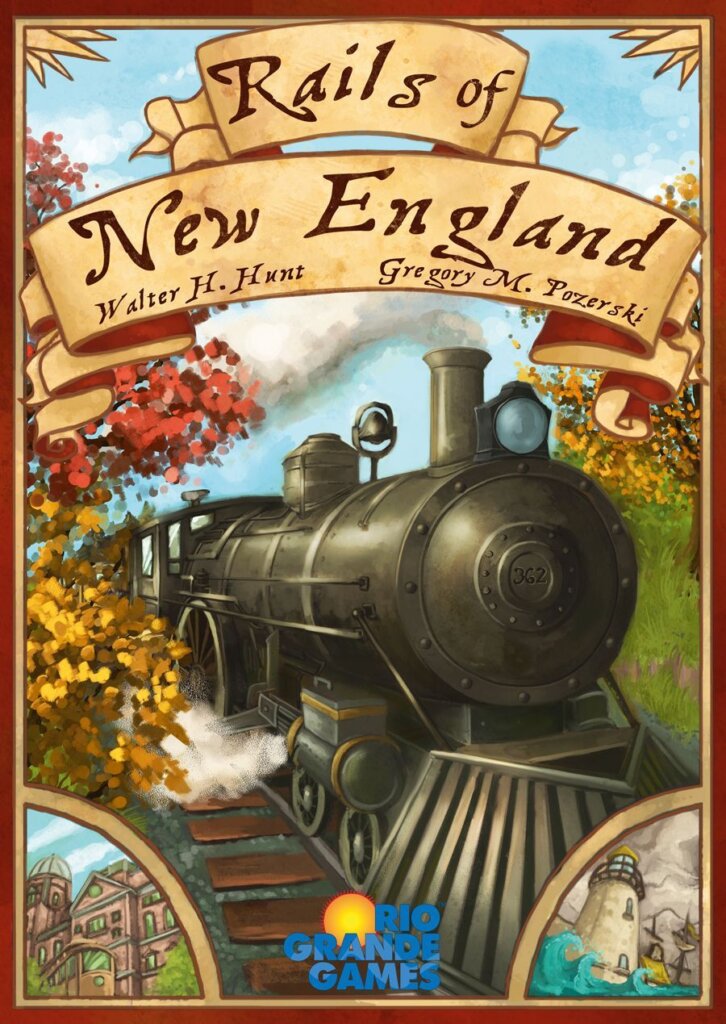
Rails of New England is a 2–5 player strategy game about developing businesses and rail connections across 19th-century New England, with games lasting about 180 minutes. Players compete to finish with the most valuable combination of cash, businesses, special routes, and state subsidies.
Each player represents a state and begins with two or three businesses under their control. Over a maximum of 16 rounds, players forecast a future economic condition—depression, normal, or prosperity—then respond to historical and randomized events. These events can introduce opportunities such as improved bridge-building techniques, or setbacks such as floods, snow, and declining demand for wool.
Players draft a business or action card each round. Cards can start new businesses, provide special actions, claim income-producing routes, secure state mail contracts, or award valuable subsidies, including benefits such as a free depot. Players may also pay to play a drafted card immediately and gain a free action.
During development, players take two actions, choosing between building and playing cards. Building depots and track connects businesses to the major markets of New York, Boston, and Montreal. Connections increase income by allowing businesses to supply larger, richer markets, although building multiple depots in one action costs more.
- Advance through periods featuring different businesses, from crafts and farms to industrial enterprises such as shoe and textile production.
- Manage up to eight businesses while deciding which older ventures should become obsolete.
- Compete for six state mail contracts, state subsidies, and special routes.
- Forecast economic conditions and adapt to changing events throughout the game.
When the game advances to a new period, players must make some existing businesses obsolete, creating room for more profitable opportunities. The game ends when all mail routes, subsidies, and special routes have been claimed, or after round 16. In Rails of New England, the richest player wins.
/pic7182955.jpg)
