
Red7
2014
Play seven changing games with rainbow cards, staying ahead at the end of each turn to remain in contention.
30
minutes
2 - 4
player(s)
9+
Medium Light


About this board game
Red7 is a card game for 2–4 players with an approximately 30-minute play time, built around seven different games and a simple challenge: be winning when your turn ends.
In the game of Red, the highest card wins. However, Red is only one of the seven games featured in Red7, so the current way to win can change as play continues. The central pressure remains constant: if you are not winning the current game at the end of your turn, you are out.
The last person standing wins the round. This creates a brisk, high-stakes experience in which every turn matters, while the rules remain easy to understand. A hand takes just a couple of minutes, making it simple to play a quick hand or fit several rounds into a longer session.
- Players: 2–4
- Play time: approximately 30 minutes
- Deck: 49 cards
- Cards: seven colors of the rainbow, numbered 1 to 7
- Core rule: stay winning at the end of your turn or leave the round
First released in 2014, Red7 keeps its card set focused and distinctive. The rainbow-colored deck supplies every card used in play, with each color represented by numbers from 1 through 7. That compact structure supports fast hands and a clear visual identity.
Whether you are introducing a group to the basic highest-card rule or exploring all seven games, Red7 offers a concise card-game format centered on survival. Watch the current game, make your turn, and try to be the last player standing.
Mechanics
Designers
Illustrators
/pic7182955.jpg)

Board Game Rules for
Red7
2 – 4 players • 5 – 10 minutes
The rules of Red are simple: Have the best card! But will you still be playing the same game when your turn ends? If you’re not winning the current game at the end of your turn, you’re out, and the last person standing wins the round.
Card Values & Colors
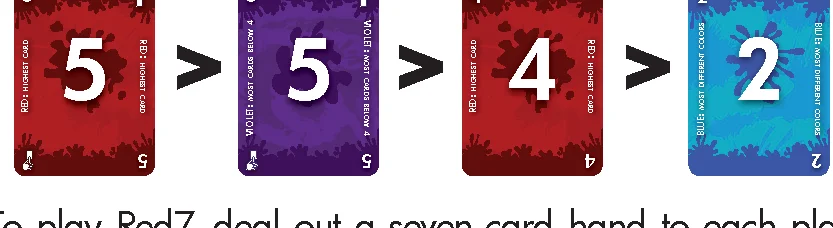
The deck consists of 49 cards, numbered 1-7, in each of seven rainbow colors. A 7 is always higher than a 6, but when comparing two 6s, a Red 6 is higher than an Orange 6, and so on down the color spectrum (Red, Orange, Yellow, Green, Blue, Indigo, Violet).
Setup
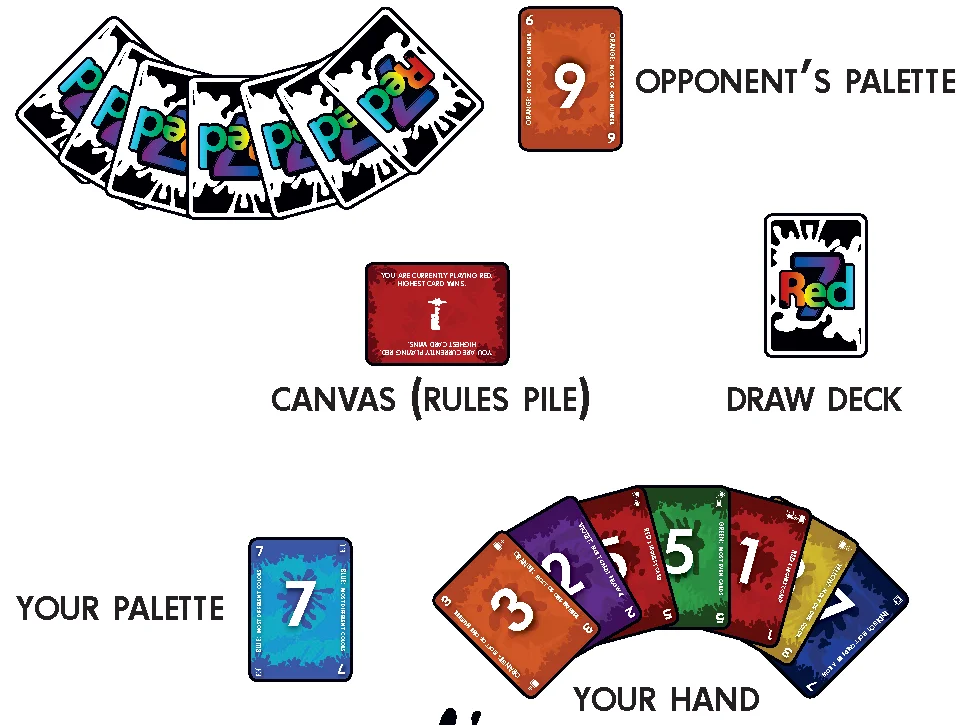
To play Red7, deal out a seven-card hand to each player, and then deal one more card faceup in front of each player to start their Palette.
First Turn Setup
Start a Canvas pile with the You are Playing Red card. The top card of the Canvas pile determines what the rules are. The player with the highest card on their Palette is currently the best at Red, so the player to that player’s left goes first.
Your Turn
On your turn, you must take one of the following actions:
- Play a card faceup from your hand to your Palette.
- Discard a card from your hand to the Canvas to change the game to the rule listed on the card. You must be winning the new game after you do this. (see right)
- Play a card from your hand to your Palette AND THEN discard a card to the Canvas. You must be winning the game after you do this.
- Do nothing, and lose. You might want to do this intentionally when playing Advanced Red7 to limit the number of points an opponent will score. If your hand is empty, you must do this.
Winning the Current Rule & Elimination
You are winning a game if your Palette contains more cards that meet the Canvas rule than any other player. Ignore the other cards in your Palette. In case of a tie, whoever has the highest card of those following the Canvas rule (following color order if necessary) is winning. One card is always enough for any of the rules.
If you are not winning the game at the end of your turn, you lose and are out of the round. Place your hand cards and Palette cards facedown. If you have no cards in your hand at the start of a turn, you lose and are out of the round. If you start your turn and you’re the only player left, you win the round!
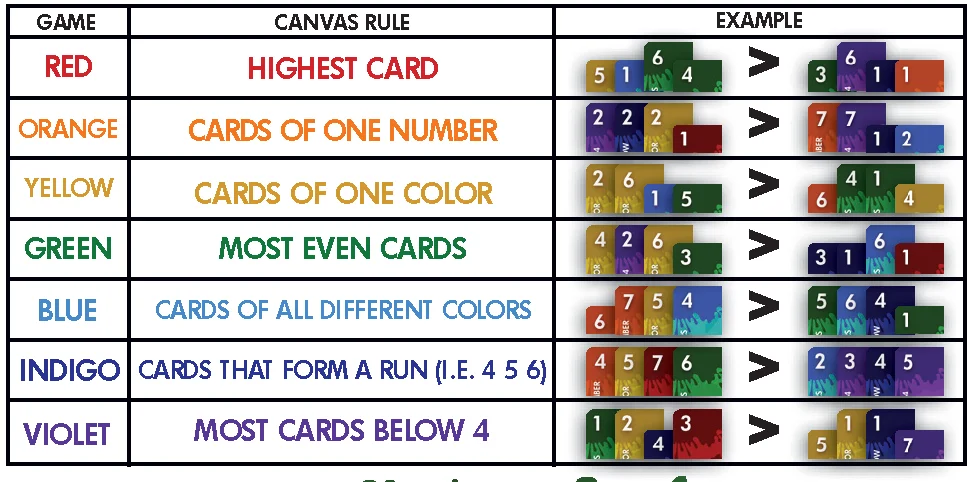
Examples are to the right for each rule.
Advanced Red7
Once you’ve played Red7 a few times, you might be ready for some advanced rules, and scoring between rounds! Advanced Red7 has two additional rules.
- When you discard a card to the Canvas, if the number on that card is higher than the total number of cards in your Palette, you may draw an additional card from the Draw Deck (unless the Draw Deck is empty).
- The winner of a round scores points. See next page for scoring structure.
Scoring
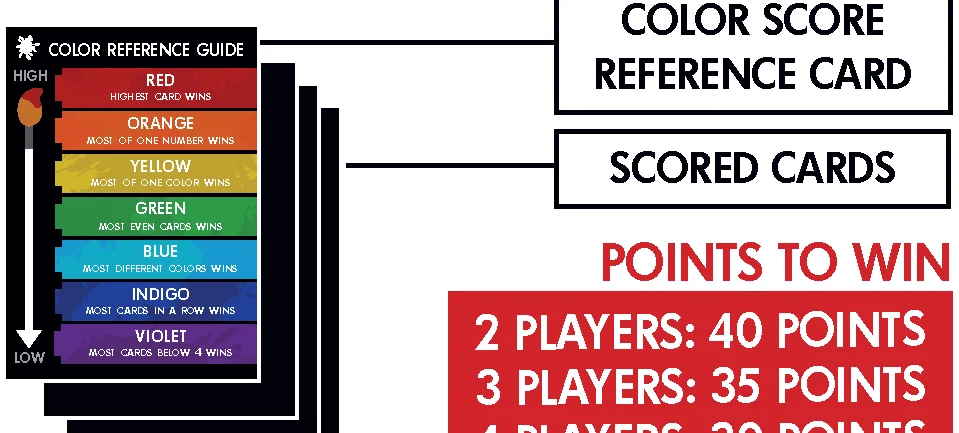
If you win a round, take all the cards from your Palette that meet the current rule and place them under your reference card. For example, if you won Blue by having the most differently colored cards on your Palette, take the highest card of each color from your Palette and place them under your reference card. The next hand is dealt without those cards, as they are now your score pile. Cards are worth their face value in points. If there aren’t enough cards to deal out a new hand to each player, the game ends and the player with the highest score wins.
Points to Win
- 2 PLAYERS: 40 POINTS
- 3 PLAYERS: 35 POINTS
- 4 PLAYERS: 30 POINTS
You might also notice that the four odd-numbered cards have icons in their corners. These represent an optional rule for actions, meant for experienced Red7 players. They can be mixed with either Basic or Advanced Red7. By these rules, when you play a 1, 3, 5, or 7 to your Palette, you MUST perform that card’s action if you can.
 Discard one other card from your Palette to the Canvas. It must be a valid discard, as it becomes the new rule. This means you must be winning the new color’s game.
 Play another card from your hand to your Palette. You can still discard to the Canvas if you wish after you’ve finished playing to your Palette this turn.
 Draw a card from the Draw Deck if you can.
 Take a card from another player’s Palette, and place it face down on top of the Draw Deck. You may not discard that player’s only Palette card.
Created by: Carl Chudyk & Chris Cieslik
Graphic Design: Alanna Cervenak
Playtested by: Lindsay Garside, Kat Dutton, Julia Urquhart, Shuai Li Fang
Editing: Tanis O’Connor
Inspired by 7Deck by Andrew Greene & Denis Moskowitz
Rules v1.1
©Asmadi Games, 2014
Overview & Setup
2 – 4 players • 5 – 10 minutes
The rules of Red are simple: Have the best card! But will you still be playing the same game when your turn ends? If you’re not winning the current game at the end of your turn, you’re out, and the last person standing wins the round.
Card Values & Colors
The deck consists of 49 cards, numbered 1-7, in each of seven rainbow colors. A 7 is always higher than a 6, but when comparing two 6s, a Red 6 is higher than an Orange 6, and so on down the color spectrum (Red, Orange, Yellow, Green, Blue, Indigo, Violet).
Setup
To play Red7, deal out a seven-card hand to each player, and then deal one more card faceup in front of each player to start their Palette.
First Turn Setup
Start a Canvas pile with the You are Playing Red card. The top card of the Canvas pile determines what the rules are. The player with the highest card on their Palette is currently the best at Red, so the player to that player’s left goes first.
How to Play
Your Turn
On your turn, you must take one of the following actions:
- Play a card faceup from your hand to your Palette.
- Discard a card from your hand to the Canvas to change the game to the rule listed on the card. You must be winning the new game after you do this. (see right)
- Play a card from your hand to your Palette AND THEN discard a card to the Canvas. You must be winning the game after you do this.
- Do nothing, and lose. You might want to do this intentionally when playing Advanced Red7 to limit the number of points an opponent will score. If your hand is empty, you must do this.
Winning the Current Rule & Elimination
You are winning a game if your Palette contains more cards that meet the Canvas rule than any other player. Ignore the other cards in your Palette. In case of a tie, whoever has the highest card of those following the Canvas rule (following color order if necessary) is winning. One card is always enough for any of the rules.
If you are not winning the game at the end of your turn, you lose and are out of the round. Place your hand cards and Palette cards facedown. If you have no cards in your hand at the start of a turn, you lose and are out of the round. If you start your turn and you’re the only player left, you win the round!
Examples are to the right for each rule.
Advanced Red7 & Scoring
Advanced Red7
Once you’ve played Red7 a few times, you might be ready for some advanced rules, and scoring between rounds! Advanced Red7 has two additional rules.
- When you discard a card to the Canvas, if the number on that card is higher than the total number of cards in your Palette, you may draw an additional card from the Draw Deck (unless the Draw Deck is empty).
- The winner of a round scores points. See next page for scoring structure.
Scoring
If you win a round, take all the cards from your Palette that meet the current rule and place them under your reference card. For example, if you won Blue by having the most differently colored cards on your Palette, take the highest card of each color from your Palette and place them under your reference card. The next hand is dealt without those cards, as they are now your score pile. Cards are worth their face value in points. If there aren’t enough cards to deal out a new hand to each player, the game ends and the player with the highest score wins.
Points to Win
- 2 PLAYERS: 40 POINTS
- 3 PLAYERS: 35 POINTS
- 4 PLAYERS: 30 POINTS
Action Rule (Optional)
You might also notice that the four odd-numbered cards have icons in their corners. These represent an optional rule for actions, meant for experienced Red7 players. They can be mixed with either Basic or Advanced Red7. By these rules, when you play a 1, 3, 5, or 7 to your Palette, you MUST perform that card’s action if you can.
- Discard one other card from your Palette to the Canvas. It must be a valid discard, as it becomes the new rule. This means you must be winning the new color’s game.
- Play another card from your hand to your Palette. You can still discard to the Canvas if you wish after you’ve finished playing to your Palette this turn.
- Draw a card from the Draw Deck if you can.
- Take a card from another player’s Palette, and place it face down on top of the Draw Deck. You may not discard that player’s only Palette card.
Credits
Created by: Carl Chudyk & Chris Cieslik
Graphic Design: Alanna Cervenak
Playtested by: Lindsay Garside, Kat Dutton, Julia Urquhart, Shuai Li Fang
Editing: Tanis O’Connor
Inspired by 7Deck by Andrew Greene & Denis Moskowitz
Rules v1.1
©Asmadi Games, 2014
