Rolling Stock
2011
A deep card game of auctions, stock trading, corporate control, dividends, and expanding transportation networks—from Prussia to space.
240
minutes
3 - 5
player(s)
Medium Heavy

About this board game
Rolling Stock is a pure card game for 3–5 players that takes about 240 minutes, focused on stock trading, company acquisitions, and corporate control.
Players begin as investors buying private companies through auctions. These companies can later enter an IPO and become corporations, or be sold to existing corporations as subsidiaries. The central challenge is deciding when to transform a company, when to trade it, and how to build value through ownership.
The majority shareholder of a corporation controls its actions. A corporation may issue new shares, pay dividends, or acquire additional subsidiaries from other corporations, from players, or from an ominous foreign investor. Every decision affects control, company ownership, and the book value held by investors.
- Buy private companies in auctions and manage their changing value.
- Turn companies into corporations through IPOs or sell them as subsidiaries.
- Use majority control to issue shares, pay dividends, and make acquisitions.
- Benefit from synergies between geographically adjacent subsidiaries in the same corporation.
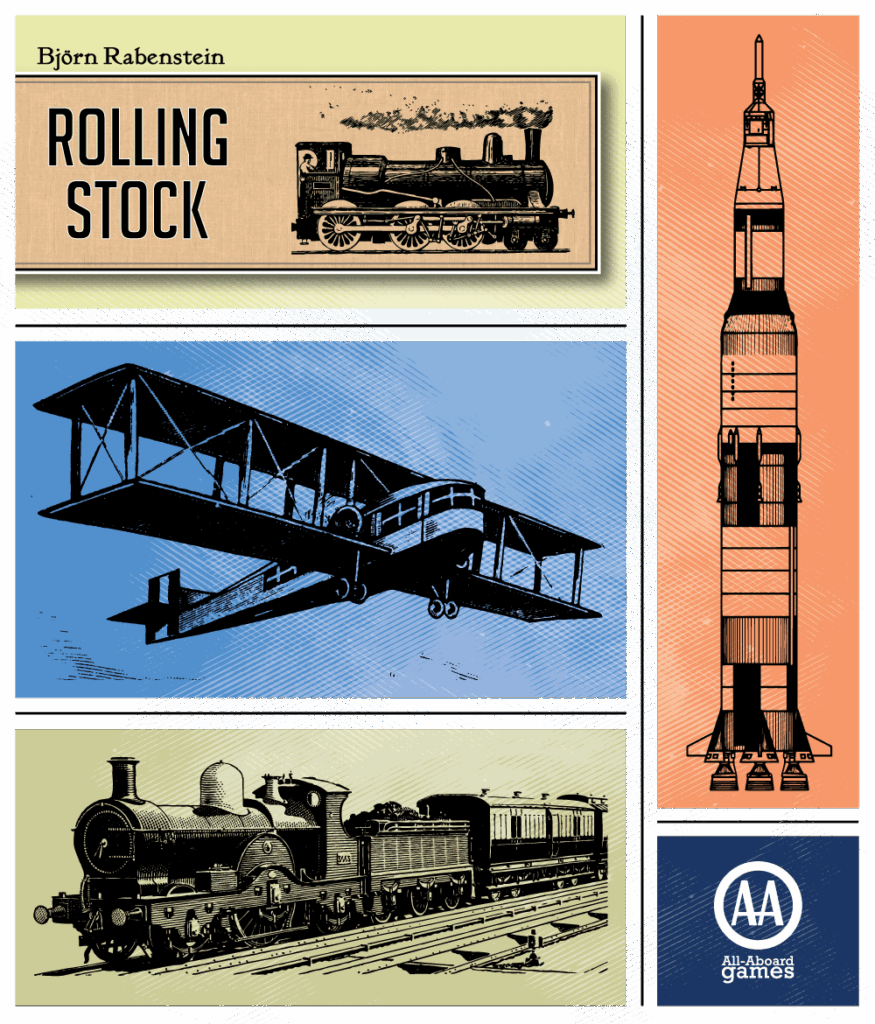
The transportation theme expands throughout the game. It begins with the early Prussian railroad, grows across Germany and Europe, and ultimately reaches space. As the scope expands, older companies become less profitable and may eventually need to be written off, severely reducing their owner’s book value.
There is no board for simulating transportation routes. Instead, networking effects are represented through synergies between adjacent companies, leaving the focus firmly on trading stocks and companies. Rolling Stock is vaguely inspired by the 18xx series, but it is not part of that series: track building is absent, and its stock market works in fundamentally different ways.
The rules are extremely simple compared with 18xx games, yet the strategic possibilities are deep and complex.
/pic7182955.jpg)
