
Rome: Imperium, Circus Maximus, Hannibal vs Rome
2001
Explore Rome's rise through three distinct Knizia games: strategic conflict, political influence, and tactical chariot racing.
45
minutes
2 - 5
player(s)
8+
Medium Light

About this board game
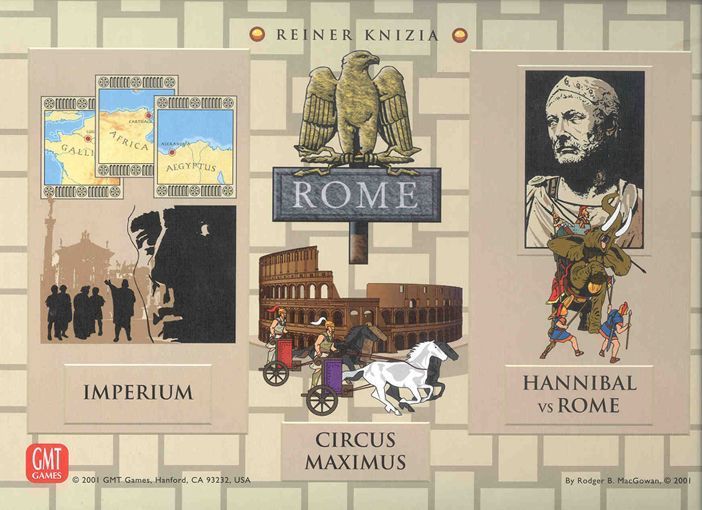
Rome: Imperium, Circus Maximus, Hannibal vs Rome is a collection of three Reiner Knizia games for 2–5 players, with a listed play time of 45 minutes. Together, they explore three very different aspects of Ancient Rome: military conflict, imperial politics, and spectacular chariot racing.
In Hannibal versus Rome, two players recreate the initial struggle for supremacy between Rome and Carthage during the Second Punic War. The Western Mediterranean is the setting for a contest involving Legions, Fleets, and card-driven conflicts. Hannibal’s advance across the Alps and victory at Cannae form part of the historical backdrop, while Scipio’s campaign moves the fighting toward Spain and Africa before the defeat of Carthage at Zama.
Imperium focuses on Rome’s political and territorial expansion during the Imperial period. From two to five players distribute markers across areas of the Empire, with control of one area decided each round. Success depends on placing the right influence at the decisive moment while also planning for long-term development.
Circus Maximus brings the action into Rome’s famous arena. Each player controls a team of three chariots and receives five movement cards each turn, assigning them among the chariots as desired. The first player to bring all three chariots across the finish line wins the race and the laurel wreath.
- Hannibal versus Rome: a two-player card-based struggle for Mediterranean dominance.
- Imperium: a game of influence, control, planning, and timing for 2–5 players.
- Circus Maximus: tactical chariot racing for 2–5 players.
With three compact designs in one box, Rome: Imperium, Circus Maximus, Hannibal vs Rome offers varied ways to experience the ambitions, rivalries, and public spectacle of the Roman world.
/pic7182955.jpg)
