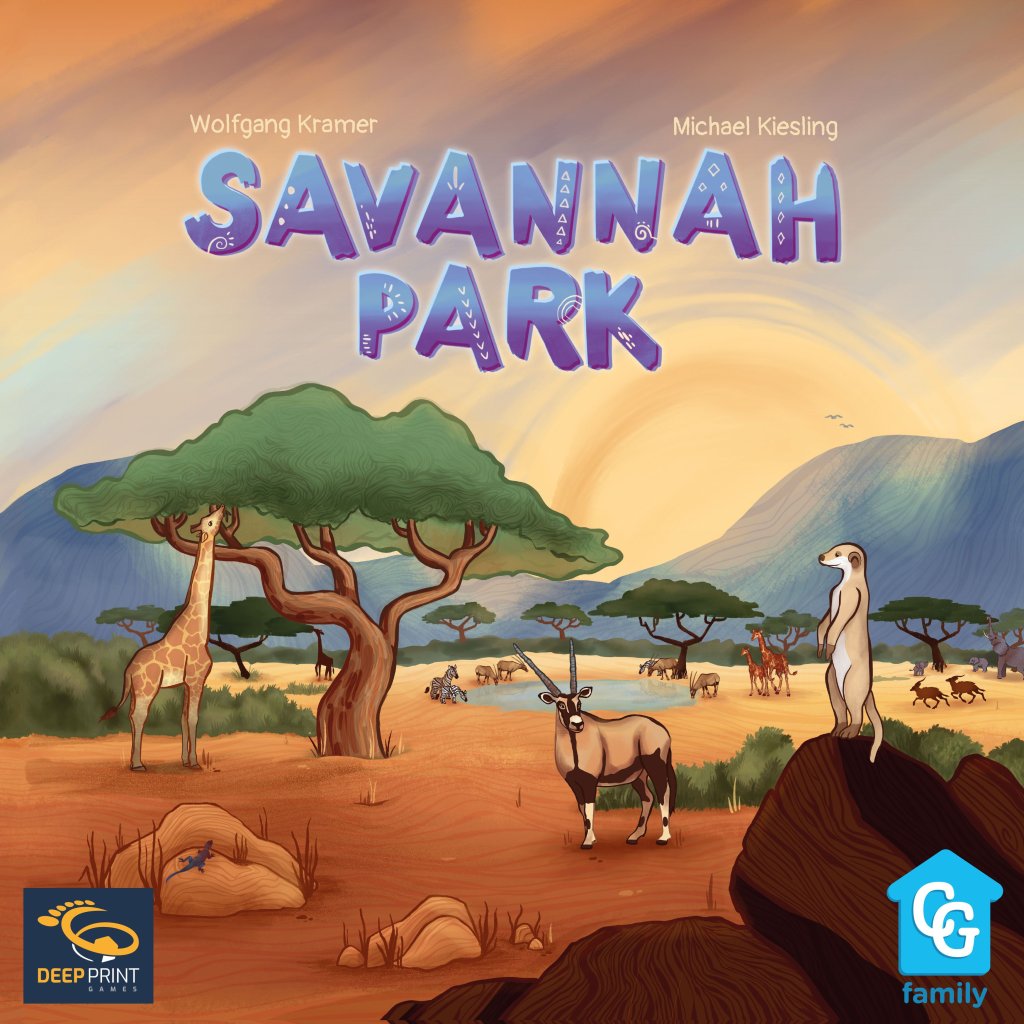
Savannah Park
2021
Group wildlife, uncover valuable terrain, and grow the strongest herds while every player shares control over what moves next.
40
minutes
1 - 4
player(s)
8+
Medium Light

About this board game
Savannah Park is a wildlife park game for 1–4 players, with games lasting about 40 minutes. Each player arranges the same set of 33 unique animal tiles in a personal park, then tries to create valuable groups of matching animals.
The challenge is that players do not freely choose their own moves. On each turn, one player names a specific face-up tile, and everyone must pick up that tile, flip it face down, and move it to a different empty space in their own park. Once a tile has been flipped, it cannot move again, so every decision affects the shape of your final wildlife park.
Each park contains three permanently empty bush-fire spaces and one rock space. Six tree spaces and four grass spaces begin empty, waiting to be uncovered as animals are relocated.
- Move matching animal tiles into larger herds.
- Manage the shared choice of which tile moves next.
- Plan around bush fires, trees, grass, and water holes.
When all tiles have moved, scoring begins. Tiles beside bush fires are removed if they show as many animals as the number of fires on that space. Players then score for each grass and tree uncovered on their board, followed by points for each of the six animal species.
For each species, the size of its largest herd and the number of water holes it contains determine its score. A herd of five rhinos with three water holes, for example, scores 15 points. The player with the most points wins.
Savannah Park also includes a solo mode, a setup variant for placing bush fires and trees freely, and a scoring variant that rewards bumping a lion out of the animals’ way.
Thematics
Mechanics
Designers
Illustrators


Board Game Rules for
Savannah Park
Wolfgang Kramer & Michael Kiesling
For 1 to 4 players, aged 8 and up
Setting and Object of the Game
In the heart of Africa lies a paradise of incomparable beauty. These endless expanses are home to the continent’s largest land animals and present the visitor with breathtaking views.
You are rangers, each running your own wildlife park in this beautiful part of the world. Help your animals to gather with others of their kind in the largest herds possible by moving them to new spaces. Secure precious watering holes that increase your park’s value and protect against bush fires. The more shady trees and lush grass in your park the better, too.
Once all animals have been moved, the game ends with a scoring round. The ranger with the most points wins.
Components


- 4 folding boxes
- 4 parks (1 for each player, front and back):
- sand space
- tree space
- grass space
- meerkat burrow
- bush fire
- rock
- grass and tree scoring reference
- animal placement reference

- 168 tokens (33 animal tokens, 6 tree tokens and 3 bush-fire tokens per player)


- 1 score board (front and back):
- score track
- evaluation category
- starting hut
- 100-point spaces
- watering-hole multiplier reference
- back: for the “variable setup” variant


- 4 meerkats (1 in each color)
- 4 rangers (1 in each color)
- 4 lions (for a variant)
Player & Board Setup
- Choose a color and take the folding box with that color’s frame. Keep your game pieces here.
- Take the park with the meerkat burrow in your color and place it face up in front of you.
- Take all tokens whose backs show your color:
- Place your 3 bush-fire tokens
 and your 6 tree tokens
 into your folding box. They’re only needed for a variant.
- Place your 33 animal tokens face up in easy reach.
- Place your 3 bush-fire tokens


Note: Animal Combinations
There are 6 animal species: antelope, zebra, rhino, elephant, giraffe, ostrich.


Each species comes in the following combinations (here are the zebras as an example):
- one zebra
- two zebras
- three zebras
- zebra and watering hole
- zebra and elephant
- zebra, ostrich, antelope, watering hole
- watering hole with all animals
Each of the 33 animal tokens is unique and each combination occurs only once. Each player gets the same 33 combinations.
Park Preparation
You all now simultaneously prepare your parks by placing your animal tokens on them:
- Shuffle your 33 animal tokens and stack them atop each other face up.
- Take your top animal token and place it face up in the top left sand space of your park. Then, from top left to bottom right, fill all your sand spaces this way with one token each. Leave the bush-fire spaces and the rock space as well as the tree spaces and grass spaces empty for now.
- Place your 2 remaining animal tokens face up in any 2 of the 6 grass spaces.


Final Setup Steps
- Place the score board in the middle of the table.
- Each player places the ranger in their color on the small hut beside space 0 of the score track.
- Each player places the meerkat in their color on its burrow in the upper right corner of their park.
- Place one lion beside the score board for later.
- Return any unused folding boxes, parks, tokens, rangers, meerkats, and lions to the game box.


The game is played over several rounds. In each round, the starting player chooses the animal token which everyone must move in their own park, then the next round starts. Whoever most recently fed an animal is the first starting player, and each round the next player in clockwise order becomes the next starting player.
Each round has these 2 steps:
- The starting player chooses the token that everyone must move.
- Everyone moves the chosen animal token in their park.
Step 1: Choose and Identify Token
As the starting player, choose a face-up (yellow side showing) animal token in your park. Pick it up, identify it clearly to the other players and put your meerkat on the space you took it from.
Then each of the other players must pick up the identical token from their park and place their meerkat on the vacated space.
Step 2: Relocate and Flip Token
Now everyone simultaneously moves their token within their park according to the following rules:
- Turn your animal token over and place it with its back facing up on a new space of your choice.
- The new space must be either:
- an empty sand space, or
- an empty tree space, or
- an empty grass space.
Note: Each sand, grass and tree space can hold only one animal token. The rock space and the bush-fire spaces can’t hold any tokens.
Afterwards, return your meerkat to its burrow. (The meerkats only serve as a reminder that you are not allowed to place your animal token on the space you took it from).


Round Example
Lin is the starting player and chooses the face-up animal token showing a rhino and a watering hole. She identifies it clearly to her opponents, picks it up and places her meerkat in the vacated space. Then her opponents Malik and Amber pick up their animal tokens showing a rhino and a watering hole and fill the vacated spaces with their meerkats.
Then each of them flips their token over and places it in a new, free space of their choice.
Finally, all meerkats return to their burrows and Malik becomes the starting player in the next round.

The game ends when all animal tokens have been turned over and moved. Now work out the scores. Place the lion on the first category (small bush fire) in the center of the score board and evaluate this category for each player, starting with anyone and going clockwise. Then move the lion to the next category (medium bush fire) and evaluate this category for each player. Proceed this way until all 11 categories have been evaluated.
The 11 Categories
The first 3 categories deal with bush fires. If there are certain animal tokens in the six spaces bordering each bush fire, these tokens must be removed.
1) Small bush fire
The small bush fire drives away all animal tokens adjoining it that show a single animal, including single animals at watering holes. Remove any such animal tokens.
2) Medium bush fire
Medium bush fires drive away adjoining animal tokens showing exactly 2 animals, be they of the same species or not. Remove all such animal tokens.
3) Big bush fire
Big bush fires drive away adjoining tokens showing exactly 3 animals, be they of one species or more, with or without a watering hole. Again, remove all such animal tokens.

4) Grass
You get 1 point for each of your empty grass spaces. Mark your score by moving your ranger on the score track.
5) Trees
You get 3 points for each of your empty tree spaces, including those that were emptied by a bush fire.
6 to 11) Animal species
For each species, you score your most valuable herd.
A herd is composed of all animals of one species whose tokens form a contiguous group. It doesn’t matter what other animals are on those tokens, as long as at least one animal of the species to be scored is present. The bigger the herd the better. However, herds are only worth points if they contain watering holes.
Work out the points for each of your herds by multiplying the number of animals in it by the number of watering holes in it:
- 1 watering hole = number of animals × 1
- 2 watering holes = number of animals × 2
- 3 watering holes = number of animals × 3
Herds with no watering holes are worth nothing.
Important: Each player can only score one herd per species. If you have several herds of a species, just score the most valuable one by recording its points on the score track.

This herd of elephants is comprised of 10 animals and contains 3 watering holes. So it is worth 10 × 3 = 30 points.
Determining the Winner
Once all categories have been evaluated, the player with the most points wins. Ties are broken in favor of the player with the most free grass spaces.
Note: If your score exceeds 100, put your meerkat on one of the 100-point spaces in the middle of the score board. There’s a space here for all the meerkats.
Scoring Example
Lin scores as follows:
- Small bush fire: The small bush fire drives away the token showing an ostrich and a watering hole, so Lin must remove that token from her park.
- Medium bush fire: The token showing 2 elephants is threatened by the medium bush fire and must be removed.
- Big bush fire: Lin doesn’t have to remove anything here.
- Grass: 5 grass spaces are empty in Lin’s park, she gets one point for each. Lin moves her ranger five steps forward on the score track.
- Trees: 2 tree spaces are empty, giving her 3 points each. Lin moves her ranger 6 steps forward.

- Giraffes: Lin was able to unite 10 giraffes into a herd with access to 3 watering holes, and so gets 30 points (10 giraffes × 3 watering holes). The giraffe that isn’t in this herd is worth nothing.

- Elephants: Sadly, Lin had to remove the token with 2 elephants from the park, so the large herd has no watering hole and is worth no points. The smaller herd gives her 4 points (2 elephants × 2 watering holes).

- Rhinos: The upper herd would give Lin just 3 points, so she scores the lower herd and gets 7 points (7 rhinos × 1 watering hole).

- Zebras: Lin scores the largest zebra herd. For these 8 zebras with 2 watering holes she gets 16 points.

- Antelopes: Lin has done very well here – all her antelopes are in one herd. She gets the maximum points (11 antelopes × 3 watering holes).

- Ostriches: For her largest ostrich herd, Lin gets 8 points (8 ostriches × 1 watering hole).

Altogether, Lin gets 109 points from her park.
Solo Mode
Setup
Set up as in the base game.
Playing the game
The rules are the same as in the base game. As you’re playing alone, you choose each round which animal token to move.
End of the game
The game ends and is scored as in the base game.
How many points did you get?
- < 80: Better visit the zoo again!
- 80+: Oops, try again!
- 100+: Well, there’s always next time!
- 120+: One round of applause!
- 140+: With the grace of an antelope!
- 160+: The strength of an elephant!
- 180+: Extraordinary! You are the envy of all!
- 200+: Incredible! The king of animals!
Variable Setup
Setup
Place your park with its back facing up in front of you. In addition to the usual pieces, you’ll each need your 6 tree tokens and 3 bush-fire tokens.
Before placing your animal tokens as usual, place your tree tokens and bush-fire tokens in empty sand spaces. They will be your park’s tree and bush-fire spaces for this game. Which sand spaces doesn’t matter, just make sure all of you fill the same spaces with the same tokens. Find some suggestions on the back of the score board, but feel free to come up with your own ideas too. The rest of the setup is the same as in the base game.
For more suggestions and special events, visit us at: www.deep-print-games.com
Playing the game
Play according to the base rules.
End of the game
The game ends and is scored as in the base game.


Variant for Children
If you’re playing with younger children, leave out trees and bush fires and ignore the rules about watering holes and grass.
Setup
Place your park with its back facing up in front of you. Just as in the base game, shuffle your 33 animal tokens, stack them atop each other and place them face up on your sand spaces. However, as shown in the picture to the right, leave the 7 sand spaces in the center and the grass spaces empty.
Playing the game
Play as in the base game, except that you can only place animal tokens on sand spaces, never grass spaces.
End of the game
As soon as all animal tokens have been turned over and moved, the game ends and scoring takes place. Put the lion on the giraffe category and let the youngest player begin: Count how many giraffes you have in your biggest herd of giraffes and record your points with your ranger. The other players do the same. Then move the lion to the elephant category, score your biggest elephant herd and so on. Once all species have been scored, the player with the most points wins. In the case of a tie, all tied players win together.
Remember: Unlike in the base game, watering holes and grass have no effect.

Variant: The Lions Are Loose!
Setup
In addition to the pieces of the base game, you’ll each need a lion. After setting up according to the base rules or a variant, place your lion on one of your tree or grass spaces.
Playing the game
Follow the rules of the base game. Whenever you move an animal token to the lion’s space, pick up the lion first and score one point per animal shown on the animal token you are placing. Move your ranger on the score track accordingly. Afterwards, move the lion to a new space of your choice according to these rules:
The lion moves to either:
- an empty sand space, or
- an empty tree space, or
- an empty grass space.
End of the game
The game ends and is scored as in the base game.
You can of course combine the variants too.

Example:
Amber’s lion is on a sand space. She wants to place her token showing 3 animals and a watering hole there.
She picks up the lion and places the animal token in the space where the lion was.
Amber gets 3 points. Then she chooses to place the lion on a tree space.
Game design: Wolfgang Kramer, Michael Kiesling
Artwork: Annika Heller
Development: Peter Eggert, Viktor Kobilke
Rule book: VEB Spielekombinat Katja Volk
Translation: Neil Crowley
© 2021 Deep Print Games GmbH, Sieglindestr. 7, 12159 Berlin, Germany. All rights reserved.
www.deep-print-games.com
Capstone Games, 2 Techview Drive, Cincinnati, OH 45215.
www.capstone-games.com
Overview & Components
Wolfgang Kramer & Michael Kiesling
For 1 to 4 players, aged 8 and up
Setting and Object of the Game
In the heart of Africa lies a paradise of incomparable beauty. These endless expanses are home to the continent’s largest land animals and present the visitor with breathtaking views.
You are rangers, each running your own wildlife park in this beautiful part of the world. Help your animals to gather with others of their kind in the largest herds possible by moving them to new spaces. Secure precious watering holes that increase your park’s value and protect against bush fires. The more shady trees and lush grass in your park the better, too.
Once all animals have been moved, the game ends with a scoring round. The ranger with the most points wins.
Components
- 4 folding boxes
- 4 parks (1 for each player, front and back):
- sand space
- tree space
- grass space
- meerkat burrow
- bush fire
- rock
- grass and tree scoring reference
- animal placement reference
- 168 tokens (33 animal tokens, 6 tree tokens and 3 bush-fire tokens per player)
- 1 score board (front and back):
- score track
- evaluation category
- starting hut
- 100-point spaces
- watering-hole multiplier reference
- back: for the “variable setup” variant
- 4 meerkats (1 in each color)
- 4 rangers (1 in each color)
- 4 lions (for a variant)
Setup
Player & Board Setup
- Choose a color and take the folding box with that color’s frame. Keep your game pieces here.
- Take the park with the meerkat burrow in your color and place it face up in front of you.
- Take all tokens whose backs show your color:
- Place your 3 bush-fire tokens and your 6 tree tokens into your folding box. They’re only needed for a variant.
- Place your 33 animal tokens face up in easy reach.
- Place your 3 bush-fire tokens
Note: Animal Combinations
There are 6 animal species: antelope, zebra, rhino, elephant, giraffe, ostrich.
Each species comes in the following combinations (here are the zebras as an example):
- one zebra
- two zebras
- three zebras
- zebra and watering hole
- zebra and elephant
- zebra, ostrich, antelope, watering hole
- watering hole with all animals
Each of the 33 animal tokens is unique and each combination occurs only once. Each player gets the same 33 combinations.
Park Preparation
You all now simultaneously prepare your parks by placing your animal tokens on them:
- Shuffle your 33 animal tokens and stack them atop each other face up.
- Take your top animal token and place it face up in the top left sand space of your park. Then, from top left to bottom right, fill all your sand spaces this way with one token each. Leave the bush-fire spaces and the rock space as well as the tree spaces and grass spaces empty for now.
- Place your 2 remaining animal tokens face up in any 2 of the 6 grass spaces.
Final Setup Steps
- Place the score board in the middle of the table.
- Each player places the ranger in their color on the small hut beside space 0 of the score track.
- Each player places the meerkat in their color on its burrow in the upper right corner of their park.
- Place one lion beside the score board for later.
- Return any unused folding boxes, parks, tokens, rangers, meerkats, and lions to the game box.
How to Play
The game is played over several rounds. In each round, the starting player chooses the animal token which everyone must move in their own park, then the next round starts. Whoever most recently fed an animal is the first starting player, and each round the next player in clockwise order becomes the next starting player.
Each round has these 2 steps:
- The starting player chooses the token that everyone must move.
- Everyone moves the chosen animal token in their park.
Step 1: Choose and Identify Token
As the starting player, choose a face-up (yellow side showing) animal token in your park. Pick it up, identify it clearly to the other players and put your meerkat on the space you took it from.
Then each of the other players must pick up the identical token from their park and place their meerkat on the vacated space.
Step 2: Relocate and Flip Token
Now everyone simultaneously moves their token within their park according to the following rules:
- Turn your animal token over and place it with its back facing up on a new space of your choice.
- The new space must be either:
- an empty sand space, or
- an empty tree space, or
- an empty grass space.
Note: Each sand, grass and tree space can hold only one animal token. The rock space and the bush-fire spaces can’t hold any tokens.
Afterwards, return your meerkat to its burrow. (The meerkats only serve as a reminder that you are not allowed to place your animal token on the space you took it from).
Round Example
Lin is the starting player and chooses the face-up animal token showing a rhino and a watering hole. She identifies it clearly to her opponents, picks it up and places her meerkat in the vacated space. Then her opponents Malik and Amber pick up their animal tokens showing a rhino and a watering hole and fill the vacated spaces with their meerkats.
Then each of them flips their token over and places it in a new, free space of their choice.
Finally, all meerkats return to their burrows and Malik becomes the starting player in the next round.
End of the Game & Scoring
The game ends when all animal tokens have been turned over and moved. Now work out the scores. Place the lion on the first category (small bush fire) in the center of the score board and evaluate this category for each player, starting with anyone and going clockwise. Then move the lion to the next category (medium bush fire) and evaluate this category for each player. Proceed this way until all 11 categories have been evaluated.
The 11 Categories
The first 3 categories deal with bush fires. If there are certain animal tokens in the six spaces bordering each bush fire, these tokens must be removed.
1) Small bush fire
The small bush fire drives away all animal tokens adjoining it that show a single animal, including single animals at watering holes. Remove any such animal tokens.
2) Medium bush fire
Medium bush fires drive away adjoining animal tokens showing exactly 2 animals, be they of the same species or not. Remove all such animal tokens.
3) Big bush fire
Big bush fires drive away adjoining tokens showing exactly 3 animals, be they of one species or more, with or without a watering hole. Again, remove all such animal tokens.
4) Grass
You get 1 point for each of your empty grass spaces. Mark your score by moving your ranger on the score track.
5) Trees
You get 3 points for each of your empty tree spaces, including those that were emptied by a bush fire.
6 to 11) Animal species
For each species, you score your most valuable herd.
A herd is composed of all animals of one species whose tokens form a contiguous group. It doesn’t matter what other animals are on those tokens, as long as at least one animal of the species to be scored is present. The bigger the herd the better. However, herds are only worth points if they contain watering holes.
Work out the points for each of your herds by multiplying the number of animals in it by the number of watering holes in it:
- 1 watering hole = number of animals × 1
- 2 watering holes = number of animals × 2
- 3 watering holes = number of animals × 3
Herds with no watering holes are worth nothing.
Important: Each player can only score one herd per species. If you have several herds of a species, just score the most valuable one by recording its points on the score track.
This herd of elephants is comprised of 10 animals and contains 3 watering holes. So it is worth 10 × 3 = 30 points.
Determining the Winner
Once all categories have been evaluated, the player with the most points wins. Ties are broken in favor of the player with the most free grass spaces.
Note: If your score exceeds 100, put your meerkat on one of the 100-point spaces in the middle of the score board. There’s a space here for all the meerkats.
Scoring Example
Lin scores as follows:
- Small bush fire: The small bush fire drives away the token showing an ostrich and a watering hole, so Lin must remove that token from her park.
- Medium bush fire: The token showing 2 elephants is threatened by the medium bush fire and must be removed.
- Big bush fire: Lin doesn’t have to remove anything here.
- Grass: 5 grass spaces are empty in Lin’s park, she gets one point for each. Lin moves her ranger five steps forward on the score track.
- Trees: 2 tree spaces are empty, giving her 3 points each. Lin moves her ranger 6 steps forward.
- Giraffes: Lin was able to unite 10 giraffes into a herd with access to 3 watering holes, and so gets 30 points (10 giraffes × 3 watering holes). The giraffe that isn’t in this herd is worth nothing.
- Elephants: Sadly, Lin had to remove the token with 2 elephants from the park, so the large herd has no watering hole and is worth no points. The smaller herd gives her 4 points (2 elephants × 2 watering holes).
- Rhinos: The upper herd would give Lin just 3 points, so she scores the lower herd and gets 7 points (7 rhinos × 1 watering hole).
- Zebras: Lin scores the largest zebra herd. For these 8 zebras with 2 watering holes she gets 16 points.
- Antelopes: Lin has done very well here – all her antelopes are in one herd. She gets the maximum points (11 antelopes × 3 watering holes).
- Ostriches: For her largest ostrich herd, Lin gets 8 points (8 ostriches × 1 watering hole).
Altogether, Lin gets 109 points from her park.
Variants
Solo Mode
Setup
Set up as in the base game.
Playing the game
The rules are the same as in the base game. As you’re playing alone, you choose each round which animal token to move.
End of the game
The game ends and is scored as in the base game.
How many points did you get?
- < 80: Better visit the zoo again!
- 80+: Oops, try again!
- 100+: Well, there’s always next time!
- 120+: One round of applause!
- 140+: With the grace of an antelope!
- 160+: The strength of an elephant!
- 180+: Extraordinary! You are the envy of all!
- 200+: Incredible! The king of animals!
Variable Setup
Setup
Place your park with its back facing up in front of you. In addition to the usual pieces, you’ll each need your 6 tree tokens and 3 bush-fire tokens.
Before placing your animal tokens as usual, place your tree tokens and bush-fire tokens in empty sand spaces. They will be your park’s tree and bush-fire spaces for this game. Which sand spaces doesn’t matter, just make sure all of you fill the same spaces with the same tokens. Find some suggestions on the back of the score board, but feel free to come up with your own ideas too. The rest of the setup is the same as in the base game.
For more suggestions and special events, visit us at: www.deep-print-games.com
Playing the game
Play according to the base rules.
End of the game
The game ends and is scored as in the base game.
Variant for Children
If you’re playing with younger children, leave out trees and bush fires and ignore the rules about watering holes and grass.
Setup
Place your park with its back facing up in front of you. Just as in the base game, shuffle your 33 animal tokens, stack them atop each other and place them face up on your sand spaces. However, as shown in the picture to the right, leave the 7 sand spaces in the center and the grass spaces empty.
Playing the game
Play as in the base game, except that you can only place animal tokens on sand spaces, never grass spaces.
End of the game
As soon as all animal tokens have been turned over and moved, the game ends and scoring takes place. Put the lion on the giraffe category and let the youngest player begin: Count how many giraffes you have in your biggest herd of giraffes and record your points with your ranger. The other players do the same. Then move the lion to the elephant category, score your biggest elephant herd and so on. Once all species have been scored, the player with the most points wins. In the case of a tie, all tied players win together.
Remember: Unlike in the base game, watering holes and grass have no effect.
Variant: The Lions Are Loose!
Setup
In addition to the pieces of the base game, you’ll each need a lion. After setting up according to the base rules or a variant, place your lion on one of your tree or grass spaces.
Playing the game
Follow the rules of the base game. Whenever you move an animal token to the lion’s space, pick up the lion first and score one point per animal shown on the animal token you are placing. Move your ranger on the score track accordingly. Afterwards, move the lion to a new space of your choice according to these rules:
The lion moves to either:
- an empty sand space, or
- an empty tree space, or
- an empty grass space.
End of the game
The game ends and is scored as in the base game.
You can of course combine the variants too.
Example:
Amber’s lion is on a sand space. She wants to place her token showing 3 animals and a watering hole there.
She picks up the lion and places the animal token in the space where the lion was.
Amber gets 3 points. Then she chooses to place the lion on a tree space.
Credits
Game design: Wolfgang Kramer, Michael Kiesling
Artwork: Annika Heller
Development: Peter Eggert, Viktor Kobilke
Rule book: VEB Spielekombinat Katja Volk
Translation: Neil Crowley
© 2021 Deep Print Games GmbH, Sieglindestr. 7, 12159 Berlin, Germany. All rights reserved.
www.deep-print-games.com
Capstone Games, 2 Techview Drive, Cincinnati, OH 45215.
www.capstone-games.com