
Sleuth
1971
Question opponents, uncover information, and eliminate possibilities to identify the hidden gem before anyone else.
45
minutes
3 - 7
player(s)
10+
Medium

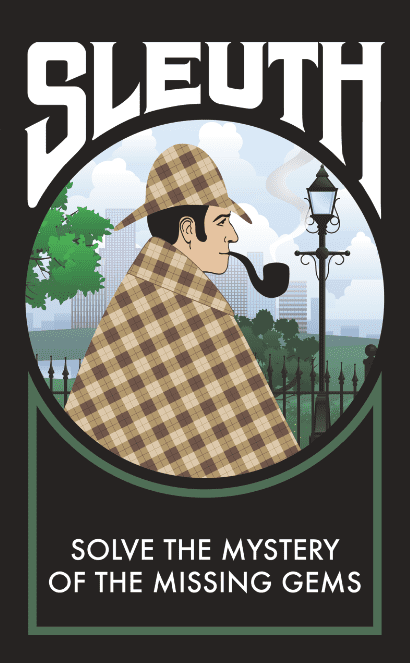
About this board game
Sleuth is a deduction game for 3–7 players, played in about 45 minutes, in which you investigate clues to identify one hidden gem card. Originally released in 1971, it challenges players to reason from both what they learn and what remains unknown.
Before play begins, one of 36 gem cards is hidden. Each gem card shows 1–3 diamonds, pearls, or opals in one of four colors. The remaining cards are dealt among the players, with any leftover cards placed face up, giving everyone useful information about what the missing card cannot be.
On your turn, choose one of your four face-up search cards and ask an opponent how many cards they hold matching its element. Questions can concern broad categories, such as pairs, or more specific details, such as red diamonds or blue opals. For a specific question, the opponent reveals the number of matching cards and lets you inspect them in secret; broader questions provide a number without showing which cards qualify.
- Track positive and negative information on a score pad.
- Use 54 search cards featuring one or two elements.
- Ask questions, compare answers, and eliminate possibilities.
- Make a guess at any time, or ask one unrestricted question on your turn before guessing.
A wrong guess does not immediately remove you from the game, but from then on you may only answer questions. A correct guess wins, making every deduction and every question matter. The simple rules conceal a demanding puzzle: sometimes you see cards, while other times you receive only a count.
In Sleuth, careful notation and flexible reasoning help transform scattered clues into a single solution. It reimplements The Case of the Elusive Assassin, using its core mechanisms without the board, movement, or player proximity.
Designer
Useful links
 View board game on
Board Game Geek
Board Game Rules for
Sleuth
SLEUTH is a fascinating detective game for 3 to 7 players. Through skillful questioning of his opponents, each player gathers evidence and then, using his powers of deduction and logic, attempts to discover the identity of the missing gem!
The Cards
Sleuth is played with two special decks of cards:
- Gem Deck: Consists of 36 cards, each featuring a different combination of three elements:
- Gem: diamond, pearl or opal
- Type: solitaire, pair or cluster
- Color: red, blue, green or yellow

Gem: Opal
Type: Cluster
Color: Blue
- Search Deck: Consists of 54 small cards which are used for gathering evidence from other players:
- Each one-element card features a gem, a type or a color.
- Each two-element card features a combination of any two of these elements.
- Deck also contains “Free Choice” cards (see PLAY).
Each player receives an Information Sheet used to keep track of evidence gathered during the game. Each sheet will serve for two games. Players keep evidence secret by folding the sheet in half. The blank surface on the top may be used for additional notes.
Dealer shuffles the Gem Deck and removes one card, placing it where no player may accidentally see it. This becomes the “missing gem.”
The following number of cards are then dealt face down to each player:
- 3 players: 11 cards
- 4 players: 8 cards
- 5 players: 7 cards
- 6 players: 5 cards
- 7 players: 5 cards
Remaining Gem Cards (if any) are placed face up in center of table. On their Information Sheets, all players record the identity of cards in center of table. (These cards are then set aside for the remainder of the game.) After picking up his hand, each player secretly records the identity of his cards.
Example: In five-player game, Player A was dealt the following cards: Red Diamond Cluster, Blue Diamond Pair, Green Diamond Pair, Green Pearl Pair, Green Pearl Cluster, Blue Opal Pair and Yellow Pearl Cluster. He recorded the identity of these cards on his Information Sheet as shown at right.

The Search Deck is shuffled and four cards are dealt face up to each player (as illustrated on back cover of game box). The remaining cards are placed face down in center of table to form the drawing deck.
Play begins with player to dealer’s left and rotates clockwise.
During the game, players obtain clues to the identity of the missing gem by interrogating other players. During each turn, a player may interrogate one opponent. To do so, he places one of his Search Cards in the center of the table. He may use either a one-element, a two-element or a “free choice” card as follows:
One-Element Cards

When using a one-element card, a player may interrogate any opponent by asking him to state how many Gem Cards he holds which feature that element. The chosen opponent must announce the number to all players.
Example: Search Card used reads “Pairs” and chosen opponent holds the Blue Diamond Pair, the Yellow Pearl Pair and the Green Pearl Pair. He must announce that he has three pairs.
Two-Element Cards

When using a two-element card, the interrogator may ask any opponent to pass him all Gem Cards he holds featuring that combination of elements. Opponent passes him the cards, face down, at the same time announcing the number to all players. Interrogator records the identity of the cards and returns them to the opponent.
Example: The Search Card reads “Blue Opals” and opponent has the Blue Opal Solitaire and Blue Opal Cluster. He passes these cards to the interrogator, at the same time announcing that he is passing two cards. Interrogator returns both cards after recording their identity on his Information Sheet.
Free Choice Cards

There are two kinds of “Free Choice” cards. Either may be used as a one- or a two-element card. If used as a two-element card, interrogator may not combine two similar elements (two gems, two types or two colors).
- When using the kind of card shown at left, the interrogator may choose any element or combination of two different elements.
- When using the kind of card shown at right, the interrogator must use the element featured on the card. If he uses it as a two-element card, he may choose an element to combine with the one featured on the card.
Example: The Search Card “Free Choice Blues” may be used to ask an opponent the number of Blue cards he holds or to see his Blue Diamonds or his Blue Clusters, etc.
Exchanging Search Cards
Instead of interrogating an opponent, a player may use his turn to exchange his Search Cards. To do so he places all four cards in center of table and replaces them with cards from the Search Deck.
End of Turn
At the end of his turn, the interrogator draws a Search Card from the deck to replace the one used and play rotates clockwise. If the drawing deck is depleted, the Search Cards are reshuffled and placed face down in center of table.
If a player believes that he can identify the missing gem without further interrogation, he may do so at any time, not having to wait for his turn. If, however, he believes that interrogating a certain opponent will enable him to identify the missing gem, he may, on his turn, ask any question of that opponent regardless of the Search Cards he has before him; he must then attempt to identify the gem.
To identify the missing gem, the player circles the corresponding space on his Information Sheet and announces that he has solved the mystery. Play immediately stops; no other player may announce that he has solved the mystery until the first player has verified his solution.
To verify his solution, the player secretly checks the “missing gem” card:
- If correct: he turns the card face up for all to see and is declared the winner.
- If incorrect: he replaces the “missing gem” and the game continues. This player is now out of the game but must continue to answer any interrogations.
The game ends when one player correctly identifies the missing gem.
Playing for Second, Etc.
Prior to the game, players may decide to play until there are two (or more) winners. In this case, the winner does not reveal the identity of the missing gem. Instead, he replaces the “missing gem” and announces that he was correct. The game continues with the winner answering any interrogations but not otherwise participating in the game.
As he gains expertise, each player will develop his own methods of recording evidence and other pertinent data on his Information Sheet. It is essential to record who has a particular card and who cannot possibly have a certain card (such as when a player announces he has no “Blue Pearls”).
Every time a player is interrogated all players gain information from the number of cards announced. A piece of information which is useless at the time it is received may become crucial in combination with later evidence.
Example: A player asks for an opponent’s Pearl Clusters and has two cards passed to him. You have the Blue Pearl Cluster in your hand and the Yellow Pearl Cluster was in the center of table during Setup. Since there are only four Pearl Cluster cards, you know the two passed cards must be the Red Pearl Cluster and the Green Pearl Cluster and record this information as evidence.
- ADDITIONAL MISSING GEMS. When three or four play, the game can be made more challenging by removing two (or three) Gem Cards. The play of the game is the same except that, to win, a player must correctly identify all missing gems.
- ADDITIONAL INTERROGATIONS. During his turn, each player may interrogate one or two opponents. If he interrogates two opponents, he must use a one-element card to interrogate one opponent and a two-element card for the other.
- SUPERSLEUTH VERSION. This variation is played in the usual manner except that cards are never passed. When a two-element Search Card is used, the opponent simply answers with the number of such cards that he holds.
Overview & Components
SLEUTH is a fascinating detective game for 3 to 7 players. Through skillful questioning of his opponents, each player gathers evidence and then, using his powers of deduction and logic, attempts to discover the identity of the missing gem!
The Cards
Sleuth is played with two special decks of cards:
- Gem Deck: Consists of 36 cards, each featuring a different combination of three elements:
- Gem: diamond, pearl or opal
- Type: solitaire, pair or cluster
- Color: red, blue, green or yellow
Gem: Opal
Type: Cluster
Color: Blue
- Search Deck: Consists of 54 small cards which are used for gathering evidence from other players:
- Each one-element card features a gem, a type or a color.
- Each two-element card features a combination of any two of these elements.
- Deck also contains “Free Choice” cards (see PLAY).
Setup
Each player receives an Information Sheet used to keep track of evidence gathered during the game. Each sheet will serve for two games. Players keep evidence secret by folding the sheet in half. The blank surface on the top may be used for additional notes.
Dealer shuffles the Gem Deck and removes one card, placing it where no player may accidentally see it. This becomes the “missing gem.”
The following number of cards are then dealt face down to each player:
- 3 players: 11 cards
- 4 players: 8 cards
- 5 players: 7 cards
- 6 players: 5 cards
- 7 players: 5 cards
Remaining Gem Cards (if any) are placed face up in center of table. On their Information Sheets, all players record the identity of cards in center of table. (These cards are then set aside for the remainder of the game.) After picking up his hand, each player secretly records the identity of his cards.
Example: In five-player game, Player A was dealt the following cards: Red Diamond Cluster, Blue Diamond Pair, Green Diamond Pair, Green Pearl Pair, Green Pearl Cluster, Blue Opal Pair and Yellow Pearl Cluster. He recorded the identity of these cards on his Information Sheet as shown at right.
The Search Deck is shuffled and four cards are dealt face up to each player (as illustrated on back cover of game box). The remaining cards are placed face down in center of table to form the drawing deck.
Play begins with player to dealer’s left and rotates clockwise.
How to Play
During the game, players obtain clues to the identity of the missing gem by interrogating other players. During each turn, a player may interrogate one opponent. To do so, he places one of his Search Cards in the center of the table. He may use either a one-element, a two-element or a “free choice” card as follows:
One-Element Cards
When using a one-element card, a player may interrogate any opponent by asking him to state how many Gem Cards he holds which feature that element. The chosen opponent must announce the number to all players.
Example: Search Card used reads “Pairs” and chosen opponent holds the Blue Diamond Pair, the Yellow Pearl Pair and the Green Pearl Pair. He must announce that he has three pairs.
Two-Element Cards
When using a two-element card, the interrogator may ask any opponent to pass him all Gem Cards he holds featuring that combination of elements. Opponent passes him the cards, face down, at the same time announcing the number to all players. Interrogator records the identity of the cards and returns them to the opponent.
Example: The Search Card reads “Blue Opals” and opponent has the Blue Opal Solitaire and Blue Opal Cluster. He passes these cards to the interrogator, at the same time announcing that he is passing two cards. Interrogator returns both cards after recording their identity on his Information Sheet.
Free Choice Cards
There are two kinds of “Free Choice” cards. Either may be used as a one- or a two-element card. If used as a two-element card, interrogator may not combine two similar elements (two gems, two types or two colors).
- When using the kind of card shown at left, the interrogator may choose any element or combination of two different elements.
- When using the kind of card shown at right, the interrogator must use the element featured on the card. If he uses it as a two-element card, he may choose an element to combine with the one featured on the card.
Example: The Search Card “Free Choice Blues” may be used to ask an opponent the number of Blue cards he holds or to see his Blue Diamonds or his Blue Clusters, etc.
Exchanging Search Cards
Instead of interrogating an opponent, a player may use his turn to exchange his Search Cards. To do so he places all four cards in center of table and replaces them with cards from the Search Deck.
End of Turn
At the end of his turn, the interrogator draws a Search Card from the deck to replace the one used and play rotates clockwise. If the drawing deck is depleted, the Search Cards are reshuffled and placed face down in center of table.
Identifying the Missing Gem & End of Game
If a player believes that he can identify the missing gem without further interrogation, he may do so at any time, not having to wait for his turn. If, however, he believes that interrogating a certain opponent will enable him to identify the missing gem, he may, on his turn, ask any question of that opponent regardless of the Search Cards he has before him; he must then attempt to identify the gem.
To identify the missing gem, the player circles the corresponding space on his Information Sheet and announces that he has solved the mystery. Play immediately stops; no other player may announce that he has solved the mystery until the first player has verified his solution.
To verify his solution, the player secretly checks the “missing gem” card:
- If correct: he turns the card face up for all to see and is declared the winner.
- If incorrect: he replaces the “missing gem” and the game continues. This player is now out of the game but must continue to answer any interrogations.
The game ends when one player correctly identifies the missing gem.
Playing for Second, Etc.
Prior to the game, players may decide to play until there are two (or more) winners. In this case, the winner does not reveal the identity of the missing gem. Instead, he replaces the “missing gem” and announces that he was correct. The game continues with the winner answering any interrogations but not otherwise participating in the game.
Strategy Tips
As he gains expertise, each player will develop his own methods of recording evidence and other pertinent data on his Information Sheet. It is essential to record who has a particular card and who cannot possibly have a certain card (such as when a player announces he has no “Blue Pearls”).
Every time a player is interrogated all players gain information from the number of cards announced. A piece of information which is useless at the time it is received may become crucial in combination with later evidence.
Example: A player asks for an opponent’s Pearl Clusters and has two cards passed to him. You have the Blue Pearl Cluster in your hand and the Yellow Pearl Cluster was in the center of table during Setup. Since there are only four Pearl Cluster cards, you know the two passed cards must be the Red Pearl Cluster and the Green Pearl Cluster and record this information as evidence.
Variations
- ADDITIONAL MISSING GEMS. When three or four play, the game can be made more challenging by removing two (or three) Gem Cards. The play of the game is the same except that, to win, a player must correctly identify all missing gems.
- ADDITIONAL INTERROGATIONS. During his turn, each player may interrogate one or two opponents. If he interrogates two opponents, he must use a one-element card to interrogate one opponent and a two-element card for the other.
- SUPERSLEUTH VERSION. This variation is played in the usual manner except that cards are never passed. When a two-element Search Card is used, the opponent simply answers with the number of such cards that he holds.
