Sprawlopolis
2018
Build a city together from just 18 cards, balancing four zone types, road costs, and changing scoring goals in a 20-minute challenge.
20
minutes
1 - 4
player(s)
8+
Medium Light


About this board game
Sprawlopolis is a cooperative city-building game for 1–4 players that plays in about 20 minutes. Using only 18 cards, players work together to build a new city from the ground up while trying to meet a dynamically generated minimum score.
Each turn, players play one card from their hand into the growing city. The goal is to develop large areas in each of the four zone types, but success depends on careful planning and cooperation. Players must communicate and coordinate their decisions without revealing the cards in their own hands.
The scoring system changes from game to game, so every new city presents a different challenge. Alongside the current scoring requirements, players must consider the cost of the road network: the city hates paying for road maintenance, and each road costs points at the end of the game.
- 1–4 players
- 20-minute play time
- Cooperative card-based city building
- 18 cards and variable scoring
- Four zone types to develop
When all the cards have been placed, the city is complete and the team checks its final score. Can the planners satisfy the officials’ demands, create an effective urban layout, and reach the target set for this particular game?
Released in 2018, Sprawlopolis turns a small set of cards into a continually changing urban planning puzzle. Every decision affects the shared city, making communication, efficient development, and road management essential to building the ultimate civic center.

Board Game Rules for
Sprawlopolis
1-4 Players | 15 Minutes | Ages 8+
You and your fellow city planners have been hired to develop the ultimate sprawling metropolis! Together you must build a city that keeps the officials happy… and they’ve got some pretty specific requirements. You’ll need to plan carefully if you want to meet their lofty expectations!
Components
- 18 cards with blocks and scoring conditions
- Shuffle the cards and randomly set 3 off to the side with their scoring conditions face up. These 3 cards show the specific conditions that apply to this game. Ignore the scoring conditions on the backs of all other cards. Each of the scoring condition cards has a unique number on it. Add these three numbers together. This gives the Target Score (the total points your team must reach or exceed in order to win).
- Choose a start player and deal them 3 cards, keeping their “blocks” side face down. Deal 1 face-down card to all other players. Take your card(s) into your hand without revealing the “blocks” side to your fellow builders.
- Set the remaining cards off to the side with the “blocks” side face up to form the draw deck. Note that this gives all players a preview of the top card in the deck.
- Place the top card of the deck into the Build Area to start your city.
- Play begins with the start player and continues clockwise.

About Blocks
A “block” is defined as a rectangular quadrant in one of four zone types:
- Commercial (blue)
- Park (green)
- Industrial (grey)
- Residential (orange)
Each card has four blocks in each of the four zone types.
About Roads
Each card contains either one or two roads. A “road” is defined as a continuous stretch of roadway that may be as short as one block long (before it dead ends at a block edge or the edge of the city) or several blocks long. Roads play an important role in your final scoring, as well as certain scoring conditions.
Building the City
If you are the start player, choose 1 of your 3 cards in hand, reveal it and add it to the city with the block side face up. After playing your card, pass your 2 remaining cards to your left neighbor. They now have 3 cards in hand and become the start player for the next turn.
Finally, draw the top card from the deck so that you have 1 card in hand. If there are no more cards in the deck, continue playing with an empty hand. If you have fewer than 2 cards to pass when your turn is over, pass the remaining cards you have.
Continue until all 15 cards have been added to the city.
Placement Rules
On your turn, you must place a card so that at least one block edge meets an existing block edge OR you may place your card so that it overlaps or covers a block (or multiple blocks) with your new card.
- You may NOT tuck a card under a card in your city.
- You may NOT place a card so that it only connects to your city by a corner.
- When placing a card, you may rotate it 180 degrees, but you must place the card horizontally.
- Creating an open space or gap in your city is allowed, so long as you adhere to the above placement rules.


Table Talk
Discussing cards is not only legal, but encouraged! Players may discuss anything they want, but they can’t show their hand to anyone. Once you choose your card and reveal it, you must play it. But feel free to discuss placement!
Final Scoring
When all 15 cards have been played, your city is complete! Tally your team’s final score:
- BLOCKS: Your team scores 1 point per block in your largest group of each zone type. A “group” is a cluster of matching blocks connected by at least one edge. Only your largest group of each type is scored. If 2 or more groups of the same type are tied for your largest, you choose which group to score.
- ROADS: Your team subtracts 1 point from your total score for each road in your city. Remember, a “road” is defined as a continuous stretch of a roadway.
Scoring Conditions
In addition to your base scoring, you also score points for each of the 3 cards you placed off to the side. Each has a unique scoring condition. It is possible to lose points rather than gain points with some conditions.
Add the total of your block groups, subtract the total of your roads, and add/subtract any points earned from your scoring condition cards to get your final score. If this final score equals or exceeds the combined value of your 3 scoring condition cards, you win!

Scoring Example
- The block groups would score: Commercial 2, Industrial 2, Parks 4 and Residential 3 for a total of 11 points for BLOCK scoring.
- You have 7 roads for a total of -7 points for ROAD scoring. This leaves you 4 points as your base score (11 – 7 = 4).
Next, tally all points from your three scoring conditions and add this to your base score to get your final score. If it equals or exceeds your Target Score, you win!
Solo Play
Play is identical to the cooperative game, except you have one hand of 3 cards to work with each turn. After placing a card, draw a new card so that you have 3 cards and take your next turn. If there are no more cards in the deck, play until you run out of cards.
Scaling Difficulty
- Easier Game: Do not lose points for roads.
- Harder Game: You only score for the largest block group of one zone type.
Design: Steven Aramini, Danny Devine & Paul Kluka
Cover Art: Loïc Billiau
Card Art: Danny Devine
Rules Editing: Travis D. Hill
2019 Quined Games
Overview & Components
1-4 Players | 15 Minutes | Ages 8+
You and your fellow city planners have been hired to develop the ultimate sprawling metropolis! Together you must build a city that keeps the officials happy… and they’ve got some pretty specific requirements. You’ll need to plan carefully if you want to meet their lofty expectations!
Components
- 18 cards with blocks and scoring conditions
Setup
- Shuffle the cards and randomly set 3 off to the side with their scoring conditions face up. These 3 cards show the specific conditions that apply to this game. Ignore the scoring conditions on the backs of all other cards. Each of the scoring condition cards has a unique number on it. Add these three numbers together. This gives the Target Score (the total points your team must reach or exceed in order to win).
- Choose a start player and deal them 3 cards, keeping their “blocks” side face down. Deal 1 face-down card to all other players. Take your card(s) into your hand without revealing the “blocks” side to your fellow builders.
- Set the remaining cards off to the side with the “blocks” side face up to form the draw deck. Note that this gives all players a preview of the top card in the deck.
- Place the top card of the deck into the Build Area to start your city.
- Play begins with the start player and continues clockwise.
Card Anatomy
About Blocks
A “block” is defined as a rectangular quadrant in one of four zone types:
- Commercial (blue)
- Park (green)
- Industrial (grey)
- Residential (orange)
Each card has four blocks in each of the four zone types.
About Roads
Each card contains either one or two roads. A “road” is defined as a continuous stretch of roadway that may be as short as one block long (before it dead ends at a block edge or the edge of the city) or several blocks long. Roads play an important role in your final scoring, as well as certain scoring conditions.
How to Play
Building the City
If you are the start player, choose 1 of your 3 cards in hand, reveal it and add it to the city with the block side face up. After playing your card, pass your 2 remaining cards to your left neighbor. They now have 3 cards in hand and become the start player for the next turn.
Finally, draw the top card from the deck so that you have 1 card in hand. If there are no more cards in the deck, continue playing with an empty hand. If you have fewer than 2 cards to pass when your turn is over, pass the remaining cards you have.
Continue until all 15 cards have been added to the city.
Placement Rules
On your turn, you must place a card so that at least one block edge meets an existing block edge OR you may place your card so that it overlaps or covers a block (or multiple blocks) with your new card.
- You may NOT tuck a card under a card in your city.
- You may NOT place a card so that it only connects to your city by a corner.
- When placing a card, you may rotate it 180 degrees, but you must place the card horizontally.
- Creating an open space or gap in your city is allowed, so long as you adhere to the above placement rules.
Table Talk
Discussing cards is not only legal, but encouraged! Players may discuss anything they want, but they can’t show their hand to anyone. Once you choose your card and reveal it, you must play it. But feel free to discuss placement!
Scoring & Game End
Final Scoring
When all 15 cards have been played, your city is complete! Tally your team’s final score:
- BLOCKS: Your team scores 1 point per block in your largest group of each zone type. A “group” is a cluster of matching blocks connected by at least one edge. Only your largest group of each type is scored. If 2 or more groups of the same type are tied for your largest, you choose which group to score.
- ROADS: Your team subtracts 1 point from your total score for each road in your city. Remember, a “road” is defined as a continuous stretch of a roadway.
Scoring Conditions
In addition to your base scoring, you also score points for each of the 3 cards you placed off to the side. Each has a unique scoring condition. It is possible to lose points rather than gain points with some conditions.
Add the total of your block groups, subtract the total of your roads, and add/subtract any points earned from your scoring condition cards to get your final score. If this final score equals or exceeds the combined value of your 3 scoring condition cards, you win!
Scoring Example
- The block groups would score: Commercial 2, Industrial 2, Parks 4 and Residential 3 for a total of 11 points for BLOCK scoring.
- You have 7 roads for a total of -7 points for ROAD scoring. This leaves you 4 points as your base score (11 – 7 = 4).
Next, tally all points from your three scoring conditions and add this to your base score to get your final score. If it equals or exceeds your Target Score, you win!
Solo Play & Variants
Solo Play
Play is identical to the cooperative game, except you have one hand of 3 cards to work with each turn. After placing a card, draw a new card so that you have 3 cards and take your next turn. If there are no more cards in the deck, play until you run out of cards.
Scaling Difficulty
- Easier Game: Do not lose points for roads.
- Harder Game: You only score for the largest block group of one zone type.
Credits
Design: Steven Aramini, Danny Devine & Paul Kluka
Cover Art: Loïc Billiau
Card Art: Danny Devine
Rules Editing: Travis D. Hill
2019 Quined Games
Expansions for
Sprawlopolis
Combopolis: Expansion Collection
2023
Three crossover expansions bringing together three acclaimed city-building games.
15
minutes
View expansion
Combopolis II
2023
Blend urban planning with natural features in a fast, compact card-drafting puzzle.
15
minutes
Light

View expansion
Sprawlopolis: Roadwork
2023
Add challenging road cards and keep your city moving.
20
minutes
Light
View expansion
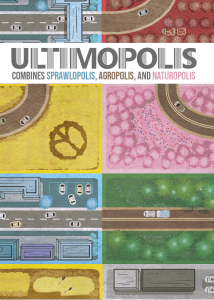
Ultimopolis
2023
Combine three terrain decks in a streamlined, card-drafting city puzzle.
15
minutes
Medium Heavy

View expansion
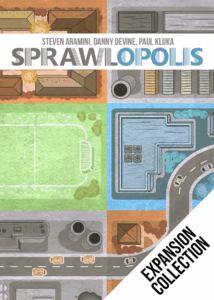
Sprawlopolis: Expansion Collection
2023
Six expansions, including the new Roadwork addition, in one collection.
20
minutes
Light
View expansion
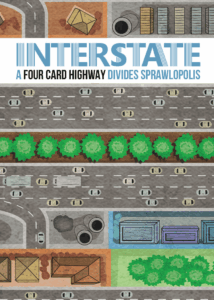
Sprawlopolis: Interstate
2020
Build a divided city where the interstate changes every decision.
20
minutes
Medium Light
View expansion
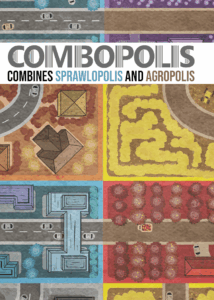
Combopolis
2021
Combine two city-building puzzles into one fast regional planning challenge.
15
minutes
Medium

View expansion
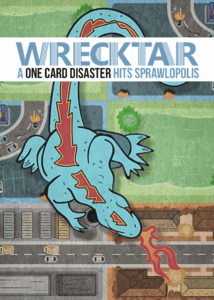
Sprawlopolis: Wrecktar
2018
A rampaging monster brings a punishing one-card disaster to the city.
20
minutes
Medium Light
View expansion
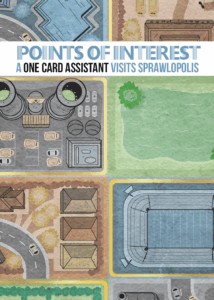
Sprawlopolis: Points of Interest
2018
Add a point of interest and shape scoring with surrounding block types.
20
minutes
Medium Light
View expansion
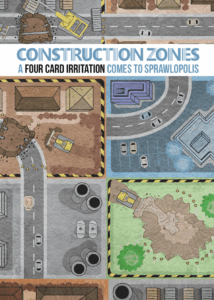
Sprawlopolis: Construction Zones
2018
Manage construction, complete your city, and avoid costly unfinished blocks.
20
minutes
Medium Light
View expansion
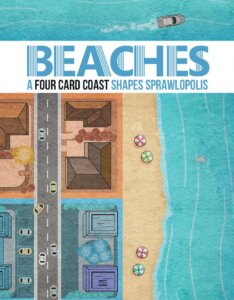
Sprawlopolis: Beaches
2019
Shape a seaside city within new coastal borders.
20
minutes
Medium Light
View expansion