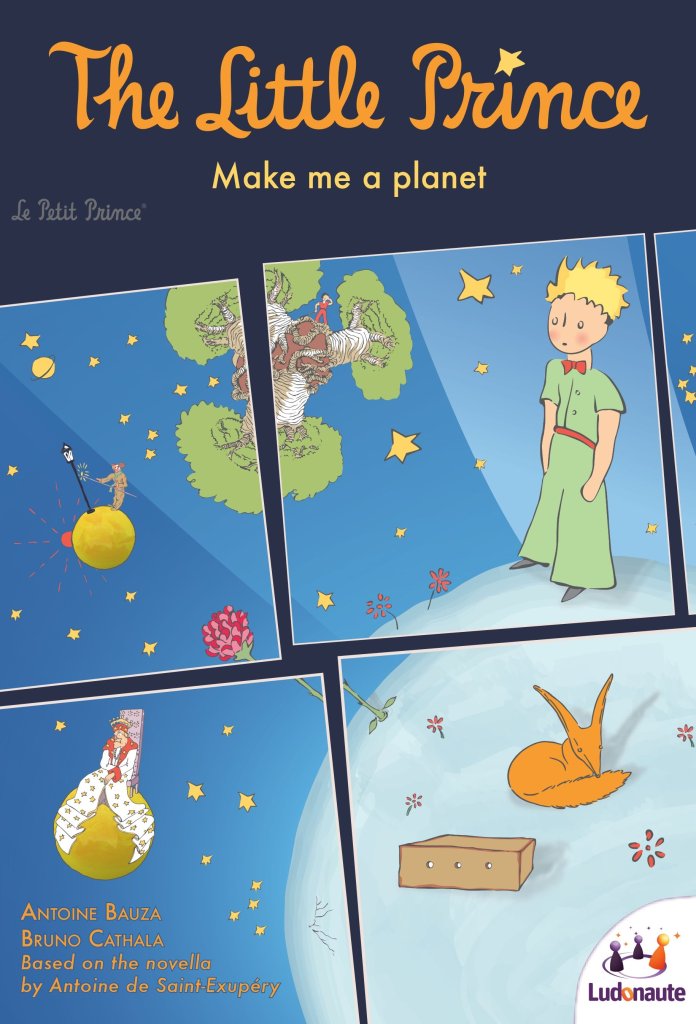
The Little Prince: Make Me a Planet
2013
Choose tiles to create a home for The Little Prince’s animals—but watch your baobabs and volcanoes before they cost you points.
25
minutes
2 - 5
player(s)
8+
Medium Light

About this board game
The Little Prince: Make Me a Planet is a tile-selection game for 2–5 players that plays in about 25 minutes. Each player builds a personal planet, creating a beautiful home for the fox, sheep, elephant, and snake from The Little Prince.
Each round, the start player selects one of four tile stacks and takes a number of tiles equal to the number of players. After choosing one tile, that player appoints someone else to choose the next tile. Selection continues until everyone has taken a tile, while the player who receives the final remaining tile becomes the start player for the next round.
This choice-driven system makes every tile selection matter. You must decide which planet features to take while considering what may be left for the other players and how each tile will contribute to your finished world.
- Build a personal planet by collecting and arranging tiles in front of you.
- Manage baobab trees: if your planet reaches three, the three tiles bearing them are turned face down and their items will not score.
- Welcome four characters around your planet, with each one awarding points based on the items present.
- Beware volcanoes: the player with the most loses points equal to the number of volcanoes on their planet.
By the end of the game, the characters surrounding each planet score according to its contents. However, an attractive planet can still be costly if it contains too many baobabs or volcanoes, so every choice carries a risk.
With its simple selection sequence and distinctive Little Prince theme, The Little Prince: Make Me a Planet challenges players to balance scoring opportunities against troublesome features. The player with the highest final score wins.

Board Game Rules for
The Little Prince: Make Me a Planet
This game contains 80 tiles and 5 tokens.
- 2–5 players
- 8+ years
- 25 min
- Choose your tile.
- Assemble your planet.
- Assess its value.

Designers: Antoine Bauza & Bruno Cathala
Artwork: Antoine de Saint-Exupéry
Layout: Ludonaute
Translation: Andrew MacLeod
The designers wish to thank Françoise Sengissen, Mikaël Bach, Michaël Bertrand, Frédéric Vuillet and Émilie Pautrot.
Setup
Shuffle the 4 stacks of tiles separately and place the 4 stacks face down in the middle of the table.
- Planet Center
- Uphill edge
- Downhill edge
- Character

If there are only 4 players, remove four tiles from each stack without looking at them. If there are just 3 or 2 players, remove eight tiles from each stack. These tiles will not be used in the game. Put them aside, again without looking at them!
That’s all! You can now start the game!
Building Rules
- Each planet is made up of 16 tiles: 4 Centers, 4 Edges of each of the two types, and 4 Characters. No more, no less.
- The 16 tiles must be in a 4×4 square-shape, forming a round planet, with the 4 Character tiles at the corners of the square (see over).
- The planets can be built in any order: e.g., during the first 4 rounds, a player can place the 4 Characters [the corners].
- While your planet is being built, the planet pieces don’t have to be joined together: during the game, there can be gaps between the tiles in a player’s planet. They will be filled by the end of the game.
- A player is allowed to have more than one Character of the same type.
Round Structure
There are 16 rounds in a game. The youngest player is the Start Player.
- The Start Player chooses one of the 4 stacks and takes as many tiles as the number of players, e.g. in a 4-player game, the Start Player takes 4 tiles.
- These tiles are placed face-up on the table, so that everyone can see them properly.
- Then the Start Player chooses one face-up tile and places it in front of him to start building his planet.
- Now the Start Player appoints a different player to choose another tile from those that the Start Player had revealed.
- This new player takes the tile and starts building her own planet in front of her. Then she appoints another player, and so on, until every player gets a tile.
The last player must take the only tile that is left. To make up for that, this player becomes the Start Player for the next round. Play continues with Step 1 above, as the new round begins.
The game goes on until each player has in front of them a whole planet made up of 16 tiles laid out in a 4×4 square shape.

Hazards: Baobabs and Volcanoes
Beware of the Baobab trees!
On some tiles, Baobab trees are growing. Too many Baobabs are bad!
If a player’s planet has no more than 1 or 2 Baobab trees, everything is all right. However, if a third Baobab tree is added, all 3 of the player’s Baobab tiles would have to be turned face down. The items on those tiles won’t score you points at the end of the game!
Once these 3 tiles are turned over, the player can now place new Baobab trees; but if the planet gets another 3 Baobab trees, the player will have to turn over the 3 new tiles, as well.

Beware of the Volcanoes!
The player who has the highest number of Volcanoes at the end of the game suffers a penalty by losing as many points as the number of Volcanoes on the planet. If there is a tie between players, all of them suffer the penalty.
The game ends when all the players have finished building their planets.
Now, each player adds up how many points have been scored by the four Characters around that player’s planet (you can use the score track on the back of the box).
If a player has more than one Character of the same type, each one will score.
The player who has the highest score is congratulated by the Little Prince and wins the game. In case of a tie, the winner is the player with the smaller number of Volcanoes. If the planets of the tied players have the same number of Volcanoes, these players share the victory.
Example of Scoring

- Bruno has 14+12+12+7 = 45 points:
- Hunter: Fox, Elephant, Snake and Sheep = 12 points
- Gardener: 2 Baobab trees = 14 points
- Businessman: 6 white Sheep = 12 points
- King: 2 Roses = 7 points
- Antoine has 9+9+13+10 = 41 points:
- Geographer: 9 tiles with no Volcano = 9 points
- Drunkard: 3 face-down tiles = 9 points
- Little Prince: white, grey and brown Sheep plus 4 Boxes = 13 points
- Businessman: 2 brown Sheep = 10 points
Bruno has 45 points but his planet has got the highest number of Volcanoes (6 Volcanoes). Thus, his final score is 45-6=39 points. So Antoine wins the game!

The Vain Man scores 4 points per Snake.

The Geographer scores 1 point for each tile of the planet with no Volcano.
Tiles turned face down because of Baobabs count as tiles with no Volcano. Character tiles do not count as tiles for the Geographer.

The Astronomer scores 2 points per Sunset.

The King scores 14 points if there is only 1 Rose on the planet, 7 points if there are exactly 2 Roses on the planet, and no points if there are three or more Roses on the planet.

The Lamplighter scores 1 point per Lamppost.

The Hunter scores 3 points for each species of animal (Fox, Elephant, Snake and Sheep) present on the planet.
Having one of the 3 types of Sheep is enough to score the 3 points for the Sheep species…

The Drunkard scores 3 points for each tile that has been flipped because of Baobab trees.

The Businessman scores either 2, 3, or 5 points for each individual Sheep of the colour shown on his tile (white, grey or brown).

The Gardener scores 7 points per Baobab tree. (Note: there cannot be more than 2 Baobab trees on a planet.)

The Turkish Astronomer scores 1 point for each Large Star.
All the Large Stars count for this scoring, even the ones on Character tiles.

The Little Prince scores 3 points for each type of Sheep (white, grey and brown) and 1 point per Box.
Rules for 2 Players
In a two player game, the game is played as follows:
The youngest player starts. He is Player A.
- Player A chooses one of the 4 stacks and takes 3 tiles.
- He looks at these 3 tiles secretly. He chooses 2 of them and places them face up in the center of the table, while the third tile is placed beside them face down.
- Player B takes one of these 3 tiles (he can choose the face down tile but he cannot look at it beforehand).
- Then Player A takes one of the 2 remaining tiles. The last tile is discarded, face up.
Another round then begins, with Player B choosing from which stack to take 3 tiles, and placing two face up and one face down. Play continues in this way, with the players changing their roles each round, until their planets are finished.
«Hidden» Characters Variant
When a player chooses a Character tile, it is kept secret from the other players, unlike the planet tiles, which are placed face up in front of the player. The players don’t know which Characters belong to their opponents anymore.
Overview
This game contains 80 tiles and 5 tokens.
- 2–5 players
- 8+ years
- 25 min
- Choose your tile.
- Assemble your planet.
- Assess its value.
Designers: Antoine Bauza & Bruno Cathala
Artwork: Antoine de Saint-Exupéry
Layout: Ludonaute
Translation: Andrew MacLeod
The designers wish to thank Françoise Sengissen, Mikaël Bach, Michaël Bertrand, Frédéric Vuillet and Émilie Pautrot.
Setup & Planet Building
Setup
Shuffle the 4 stacks of tiles separately and place the 4 stacks face down in the middle of the table.
- Planet Center
- Uphill edge
- Downhill edge
- Character
If there are only 4 players, remove four tiles from each stack without looking at them. If there are just 3 or 2 players, remove eight tiles from each stack. These tiles will not be used in the game. Put them aside, again without looking at them!
That’s all! You can now start the game!
Building Rules
- Each planet is made up of 16 tiles: 4 Centers, 4 Edges of each of the two types, and 4 Characters. No more, no less.
- The 16 tiles must be in a 4×4 square-shape, forming a round planet, with the 4 Character tiles at the corners of the square (see over).
- The planets can be built in any order: e.g., during the first 4 rounds, a player can place the 4 Characters [the corners].
- While your planet is being built, the planet pieces don’t have to be joined together: during the game, there can be gaps between the tiles in a player’s planet. They will be filled by the end of the game.
- A player is allowed to have more than one Character of the same type.
How to Play
Round Structure
There are 16 rounds in a game. The youngest player is the Start Player.
- The Start Player chooses one of the 4 stacks and takes as many tiles as the number of players, e.g. in a 4-player game, the Start Player takes 4 tiles.
- These tiles are placed face-up on the table, so that everyone can see them properly.
- Then the Start Player chooses one face-up tile and places it in front of him to start building his planet.
- Now the Start Player appoints a different player to choose another tile from those that the Start Player had revealed.
- This new player takes the tile and starts building her own planet in front of her. Then she appoints another player, and so on, until every player gets a tile.
The last player must take the only tile that is left. To make up for that, this player becomes the Start Player for the next round. Play continues with Step 1 above, as the new round begins.
The game goes on until each player has in front of them a whole planet made up of 16 tiles laid out in a 4×4 square shape.
Hazards: Baobabs and Volcanoes
Beware of the Baobab trees!
On some tiles, Baobab trees are growing. Too many Baobabs are bad!
If a player’s planet has no more than 1 or 2 Baobab trees, everything is all right. However, if a third Baobab tree is added, all 3 of the player’s Baobab tiles would have to be turned face down. The items on those tiles won’t score you points at the end of the game!
Once these 3 tiles are turned over, the player can now place new Baobab trees; but if the planet gets another 3 Baobab trees, the player will have to turn over the 3 new tiles, as well.
Beware of the Volcanoes!
The player who has the highest number of Volcanoes at the end of the game suffers a penalty by losing as many points as the number of Volcanoes on the planet. If there is a tie between players, all of them suffer the penalty.
End of the Game & Scoring
The game ends when all the players have finished building their planets.
Now, each player adds up how many points have been scored by the four Characters around that player’s planet (you can use the score track on the back of the box).
If a player has more than one Character of the same type, each one will score.
The player who has the highest score is congratulated by the Little Prince and wins the game. In case of a tie, the winner is the player with the smaller number of Volcanoes. If the planets of the tied players have the same number of Volcanoes, these players share the victory.
Example of Scoring
- Bruno has 14+12+12+7 = 45 points:
- Hunter: Fox, Elephant, Snake and Sheep = 12 points
- Gardener: 2 Baobab trees = 14 points
- Businessman: 6 white Sheep = 12 points
- King: 2 Roses = 7 points
- Antoine has 9+9+13+10 = 41 points:
- Geographer: 9 tiles with no Volcano = 9 points
- Drunkard: 3 face-down tiles = 9 points
- Little Prince: white, grey and brown Sheep plus 4 Boxes = 13 points
- Businessman: 2 brown Sheep = 10 points
Bruno has 45 points but his planet has got the highest number of Volcanoes (6 Volcanoes). Thus, his final score is 45-6=39 points. So Antoine wins the game!
Characters Reference
The Vain Man scores 4 points per Snake.
The Geographer scores 1 point for each tile of the planet with no Volcano.
Tiles turned face down because of Baobabs count as tiles with no Volcano. Character tiles do not count as tiles for the Geographer.
The Astronomer scores 2 points per Sunset.
The King scores 14 points if there is only 1 Rose on the planet, 7 points if there are exactly 2 Roses on the planet, and no points if there are three or more Roses on the planet.
The Lamplighter scores 1 point per Lamppost.
The Hunter scores 3 points for each species of animal (Fox, Elephant, Snake and Sheep) present on the planet.
Having one of the 3 types of Sheep is enough to score the 3 points for the Sheep species…
The Drunkard scores 3 points for each tile that has been flipped because of Baobab trees.
The Businessman scores either 2, 3, or 5 points for each individual Sheep of the colour shown on his tile (white, grey or brown).
The Gardener scores 7 points per Baobab tree. (Note: there cannot be more than 2 Baobab trees on a planet.)
The Turkish Astronomer scores 1 point for each Large Star.
All the Large Stars count for this scoring, even the ones on Character tiles.
The Little Prince scores 3 points for each type of Sheep (white, grey and brown) and 1 point per Box.
Variants & 2-Player Rules
Rules for 2 Players
In a two player game, the game is played as follows:
The youngest player starts. He is Player A.
- Player A chooses one of the 4 stacks and takes 3 tiles.
- He looks at these 3 tiles secretly. He chooses 2 of them and places them face up in the center of the table, while the third tile is placed beside them face down.
- Player B takes one of these 3 tiles (he can choose the face down tile but he cannot look at it beforehand).
- Then Player A takes one of the 2 remaining tiles. The last tile is discarded, face up.
Another round then begins, with Player B choosing from which stack to take 3 tiles, and placing two face up and one face down. Play continues in this way, with the players changing their roles each round, until their planets are finished.
«Hidden» Characters Variant
When a player chooses a Character tile, it is kept secret from the other players, unlike the planet tiles, which are placed face up in front of the player. The players don’t know which Characters belong to their opponents anymore.