
Thebes
2007
Travel, learn, and excavate across five ancient civilizations while every action advances the clock in this competitive archaeology game.
60
minutes
2 - 4
player(s)
8+
Medium

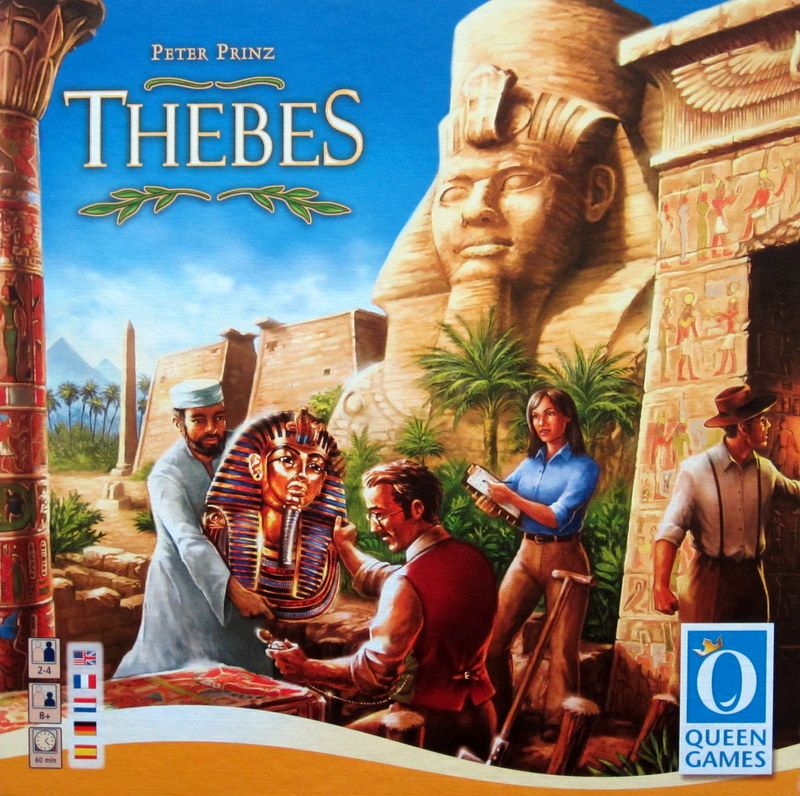
About this board game
Thebes is a competitive archaeology board game for 2–4 players, played in about 60 minutes. Over two or three years, archaeologists travel across Europe, northern Africa, and the Middle East to gain knowledge and excavate valuable artifacts.
Players build knowledge about five ancient civilizations: the Greeks, Cretans, Egyptians, Palestinians, and Mesopotamians. They then use that knowledge to dig at the corresponding historical sites, hoping to recover the most valuable treasures and earn recognition through exhibitions.
Time is the central resource in Thebes. The board features a track of 52 spaces, and every action advances a player’s token by a number of weeks. Traveling between cities, gathering knowledge, and excavating all take time, so turns are taken by the player who is furthest behind on the time track.
This creates a constant balance between acting quickly and investing in more powerful actions. A lengthy excavation may produce more artifact tiles, but while that archaeologist waits for time to catch up, opponents can take several actions of their own.
- Travel between locations to gather archaeological knowledge.
- Excavate sites connected to five ancient civilizations.
- Draw artifact tiles from bags that also contain worthless dirt.
- Claim exhibitions by collecting treasures from the required civilizations.
Excavation is never guaranteed: artifact bags contain dirt alongside valuable finds. Dirt is returned to the bag after being drawn, changing the chances of future draws and adding uncertainty to every dig.
The archaeologist who learns the most, claims the highest-valued artifacts, and collects the most exhibitions wins. With its time-based turn order and push-your-luck excavations, Thebes makes every journey and dig part of a carefully timed race.

Board Game Rules for
Thebes
Goal
The players travel as archaeologists around Europe in order to acquire the necessary knowledge for their excavation expeditions. With the aid of assistants, players get needed equipment and services for their expeditions. Once properly equipped, the players head off to Egypt, Crete, or Mesopotamia to dig at the sites there for valuable artifacts, which will bring them fame and enhance their reputations in the form of victory points. Players who can arrange exhibitions and visiting congresses will add to their reputations (victory points). But all this costs time and time is, of course, a limited resource. Who best uses his time for planning excavations and exhibitions, will score the most victory points and win the game.
Contents
- 1 rule book and 1 summary sheet
- 1 game board – with 12 places (7 cities in Europe and 5 excavation sites in the area of the Mediterranean) connected by a transportation network

- 4 archeologists – in the 4 player colors
- 4 time markers – in the 4 player colors
- 1 year marker

- 85 researcher cards – including knowledge cards, various support cards, and 9 congress cards

- Each researcher shows…
- … The city where a player can get the card.
- … The number of weeks a player must invest to get the card.
- … Its effect in the game. (This card gives its owner 3 points of specialized knowledge in Egypt (yellow).)
- 10 exhibit cards – 5 small exhibits worth 4 victory points and 5 large exhibits worth 5 victory points.

- 5 summary cards – shows the layout of each excavation site

- 4 time wheels – each consists of two disks and two plastic rivets. Before the first game, carefully assemble them as shown below.

- 4 sets of excavation permissions – 1 for each player for each area (1 set = 5 permissions)

- 155 excavation tokens – each excavation area has 15 items to find: 13 artifacts, 1 specialized knowledge item for another excavation area and 1 general knowledge item. The remaining tokens are worthless debris. Set one value 1 artifact token from each area aside. Place all remaining tokens in the bags for their colors.
- 5 cloth bags with colored tops – each filled with the excavation tokens of the matching color: to start each bag has 14 of the 15 items to find and 16 worthless debris tokens.

Preparation
- Each player takes:
- set of excavation permissions
- 1 archeologist
- 1 time marker
- 1 time wheel in the color of his choice.
- Remove the 10 exhibition cards from the card deck, shuffle the remaining cards, draw 4 cards from this deck and place them face up in the space provided for them on the board.
- Divide the remaining cards into three equal face down stacks. Shuffle the 5 small exhibition cards into the second stack and the 5 large exhibition cards into the third stack. Note: with 2 players, shuffle all exhibition cards into the second stack.
- Now place the first stack on top of the second stack to form the card supply.
- Place the third stack aside. It will be used when the card supply is exhausted.


- Place the year marker on space “1901” with 2 and 3 players and on space “1902” with 4 players.
- Place the time markers for all players in a stack on the start space (with 2 or 4 players). With 3 players, place the time markers on space 16.
- Place all archeologists on Warsaw.
- Place the five summary cards next to the board.
- Place 4 researcher cards on the board to begin the game.
- Place the value 1 artifact tokens that were set aside earlier on the appropriate excavation areas on the board.
- Each player places his excavation permissions and time wheel in his play area.
Game Duration
Depending on the number of players, the game is played over:
- 3 years with 2 players,
- about 2 1/2 years with 3 players, and
- 2 years with 4 players.
1. Player Order
The players choose a starting player and place his time marker on top of the stack of time markers on the game board. Henceforth, the player whose time marker is last (lowest number) on the time track is the player who takes his turn. If several time markers are stacked on the last space on the time track, the player whose time marker is on top of the stack takes his turn.
Thus, it is possible for a player to take several turns in a row when his time marker is last and continues to be last after taking turns.

Note: when a player moving his time marker lands on a space with other time markers, he places his on top.
2. Movement
On his turn, a player moves his archeologist on the game board along the broken lines from place to place and executes an action after moving. The player may move his archeologist to a space with other archeologists. Several archeologists may occupy the same place. The movement of the archeologist and the execution of actions use weeks of time, which are marked on the time track by the player moving his time marker.
Moving the archeologist from one place to a neighboring place costs 1 week. The time costs for the actions are described in the descriptions of the actions below.

Example: Blue moves his archeologist from London through Berlin to Warsaw (2 steps) for a cost of 2 weeks. The following action (exchange the 4 cards displayed) costs 1 week, so his total turn costs 3 weeks.

- Note: by using the researcher card “auto”, a player may shorten a move, which lasts 3 or more weeks, by 1 week.
- By using the researcher card “zeppelin”, a player may shorten any long journey to 0 weeks. This card is discarded after a single use.
3. Action Overview
On his turn, a player executes one of the following actions:
 take a researcher card …in Berlin, London, Moscow, Paris, Rome or Vienna
 exchange the 4 cards displayed …in Warsaw
 execute an excavation …in Greece, Egypt, Crete, Palestine or Mesopotamia
 execute an exhibition …in Berlin, London, Moscow, Paris, Rome or Vienna
NOTE! A player must always execute an action on his turn! Moving and stopping without executing an action is not permitted!
Take a Researcher Card
The player chooses one of the face up researcher cards on the board, moves his archeologist to the city indicated on the card, and places the card face up in his play area. If the player‘s archeologist is already in the city shown on the card, the player has no movement cost.
If the player‘s archeologist is not in the city shown on the card, the player moves his time marker along the time track as many spaces needed to reach the city shown on the card from the city where his archeologist was.
As long as a researcher card is in a player‘s play area, he may use its advantages.
After the player has taken the card and moved his archeologist (if necessary), he draws the top-most card from the card supply and places it face up in the empty researcher card space on the board.

When an exhibit card is drawn
When an exhibition card is drawn, it is placed face up on space (a) for exhibition cards on the board, instead of on a space for researcher cards. If there are already exhibition cards in the exhibition card display, they are shifted from (a) to (b) to (c). If a card was on space (c), it is discarded.
A new card is drawn
After the exhibition card is placed, the player draws another card from the supply to fill the empty space on the researcher card display.
When the card supply is exhausted
When the card supply is exhausted for the first time, shuffle the discards together with the third stack set aside during preparation and place the combined stack face down as a new supply.
If the card supply is again exhausted, shuffle the discards and place them face down as a new card supply.
Exchange the 4 Cards Displayed
If the player does not like the 4 researcher cards displayed on the board, he moves his archeologist to Warsaw (or leaves him there if he is already in Warsaw), takes the 4 cards from the display, and places them on the discard stack. Then, he draws the top-most 4 cards from the supply and places them in the display. If he draws an exhibition cards, he handles it as described above.
Finally, the player moves his time marker along the track 1 space for the action and as many spaces as necessary to pay for the movement of his archeologist.
Special case: if a player takes a second turn immediately after exchanging the cards (no other player took a turn between the player‘s turns) and chooses to do this again, he pays 2 weeks for the second exchange action. Of course, he pays no movement cost, as his archeologist is still in Warsaw.
If he continues to take consecutive turns and continues to choose this action, each subsequent action costs an additional week (e.g. third time is 3 weeks, 4th is 4 weeks, etc.).
Execute an Excavation
If the player fulfills the requisites below, he can execute an excavation.
The minimum requirement
- The player has a valid excavation permission for the area.
- The player has at least 1 point of specialized knowledge for the excavation area, either from a researcher card or found item.
The player moves his archeologist to the area (if it is not already there), paying the appropriate movement cost, and executes the excavation action for that area. He draws excavation tiles from the bag corresponding to the area.
The number of tiles drawn depends on the amount of time the player chooses to spend and the amount of knowledge he has (the number of knowledge points he has for that excavation area).

Determining knowledge points
The number of knowledge points a player can apply to an excavation is:
- Special knowledge
- technical books matching the excavation area (by color)
- rumors and legends from the people in the excavation area (by color)
- assistants (number for each excavation area)
- as well as: General knowledge
- from books (opened books count for all areas)
Each symbol (opened book, colored technical book, or note) gives 1 point of knowledge.

- Note: 2 assistants count for 1 point of special knowledge; 3 assistants count for 2 points of special knowledge.
- If a player has only one assistant, he may use this single card for 1 point of special knowledge for an excavation. However, the card is discarded immediately after the excavation in this case.
- Note: using the card “legends from the people” adds 2 points of special knowledge for the area. This counts only for the duration of the excavation. Afterwards, the card is discarded.


Note: although it generally takes more time to acquire general knowledge, it may be used on any excavation.
First, the special knowledge for the excavation area is counted (technical books, assistants, and notes). Then the general knowledge points are added (1 point per book).
A player may not use more points of general knowledge than he uses of special area knowledge. If the player has more general knowledge than special knowledge for the area being excavated, the extra general knowledge is not used.

Example: the player has a total knowledge of 8 points for his excavation on Crete (of the 5 points of general knowledge only 4 points count).
Using the time wheel – the number of tokens to draw
Move the time wheel to display the amount of current total knowledge (special plus general). To do this, turn the front of the wheel until the number appears at the top (white number on blue background). Now the player decides how many weeks he wants to dig. The weeks are represented by the black numbers from 1 to 12 next to the slot in the wheel. To the left of the number of weeks is a red number indicating how many excavation tokens the player draws from the bag. The player must choose a number of weeks such that the red number is greater than 0. The player states clearly aloud how many weeks he will dig.
The player moves his time marker along the time track the number of spaces equal to the number of weeks he chose to dig.

- Note: if the total knowledge exceeds 12, the player chooses 12 on the time wheel.
- Note: by using two “shovel” researcher cards, a player may draw an additional token from the bag during an excavation. By using three “shovel” researcher cards, a player may draw two additional tokens from the bag during an excavation. If a player has just one “shovel” researcher card, he may use it to draw one extra token from the bag, but must discard the “shovel” afterwards.

The excavation: finding useful items or useless debris
The player now draws as many tokens from the bag corresponding to the area he is excavating as is shown on the time wheel for this dig. After drawing all tokens allowed, the player returns any debris tokens to the bag. He places useful items drawn face up and visible in his play area.
Players may never look into the bags! After the player begins to draw tokens from the bag, he may not change the number of weeks he wants to dig.

Example: the player drew 5 tokens from the bag. Three were useful and earned him 8 victory points. The other two were debris, which he returned to the bag.
Ending the excavation
The player‘s excavation is complete. He turns over the excavation permission he used to display the side with an “X”.
The player may dig again in this area only next year (after his time marker has passed week 52 on the time track).


Note: if the player has the “special excavation” researcher card, he may excavate in the same area a second time in a year. The player discards this card after using it.
Bonus for the first excavation in an area
The first player to excavate in an area gets the token (value 1) that was placed on the game board for that area during preparation.

Execute an Exhibition
In the course of the game, exhibition cards will be placed in the spaces provided for them on the game board.
If a player wants to execute one of those shown on the cards on the board, he moves his archeologist to the city shown on the card that interests him. If his archeologist is already in that city, he need not move him.
Each exhibition card shows how many artifacts from each area the player must have in order to execute the exhibit. The value of the artifacts is not considered when determining if the player has the correct number to execute the exhibit.
The player shows the other players he has the necessary artifacts. If he does, he takes the exhibition card from the board and places it face up in his play area. He keeps the artifacts after the exhibit.
The player moves his time marker along the time track to “pay” for the weeks required to move to the city (if he moved his archeologist) and for the execution of the exhibit (the number is shown on the card).

Example: the player moves his archeologist to London to execute the exhibit there. He can do so because he has at least 1 orange and 2 yellow artifacts.
Note: found items, which are books (technical or general) are not artifacts and may not be used in exhibits.
A Year is Ended
When a player‘s time marker crosses space 52, a new year begins for that player. That player immediately turns all his excavation permissions to the valid side, allowing him to once again execute excavations at those sites.
When the last player‘s time marker crosses space 52, the player moves the year marker to the next year.

Game End
When playing in 1903 and a player moves his time marker across week 52, he stops it on space 1. He can execute no more actions, as he can use no more weeks.
When all players‘ time markers have reached space 1 after year 1903, the game ends and the final scores are calculated.

Example: the red player‘s time marker is on space 48 (in year 1903). The player has 5 weeks left, which he can use to execute an excavation in Greece. He could not, however, spend 6 or more weeks on the excavation!
Note: if a player has nothing more he wishes to do, he can move his time marker directly to space 1 when he is in year 1903.
Opmerking: Het tijdspoor kan een handig hulpmiddel zijn bij het tellen van de overwinningspunten. Hou er wel rekening mee, dat dit spoor 52 velden telt.
Final Scoring
Each player now sums his victory points:
- for each artifact: the player scores the points shown on the artifact
- for each exhibition: the player scores the points shown on the exhibition
- for the congress cards: the total points depends on the number of cards the player has as shown on the cards
- for the most special knowledge in each area: the player scores 5 points; if players tie for the most in an area, each scores 3 points. All books and found items are color-coded to the area where they should be considered for scoring.
Note: when determining the most special knowledge in each area, assistants, notes, and cards with general knowledge are not counted.
The player with the most victory points is the winner!
Congress Cards Scoring
Note: the more congress cards a player has, the more points he scores for them. The table below shows how many points a player scores, depending on how many congress cards he has. A player may not score more than 28 points for congress cards.

Example of Scoring
The player earns 67 victory points:
- 13 artifacts worth a total of 39 points
- 3 exhibitions worth a total of 13 points
- 5 congress cards worth a total of 15 points
- no majorities in special knowledge 0 points
(In this example, the player has special knowledge, but not the majority in any of the 5 areas)

Overview & Components
Goal
The players travel as archaeologists around Europe in order to acquire the necessary knowledge for their excavation expeditions. With the aid of assistants, players get needed equipment and services for their expeditions. Once properly equipped, the players head off to Egypt, Crete, or Mesopotamia to dig at the sites there for valuable artifacts, which will bring them fame and enhance their reputations in the form of victory points. Players who can arrange exhibitions and visiting congresses will add to their reputations (victory points). But all this costs time and time is, of course, a limited resource. Who best uses his time for planning excavations and exhibitions, will score the most victory points and win the game.
Contents
- 1 rule book and 1 summary sheet
- 1 game board – with 12 places (7 cities in Europe and 5 excavation sites in the area of the Mediterranean) connected by a transportation network
- 4 archeologists – in the 4 player colors
- 4 time markers – in the 4 player colors
- 1 year marker
- 85 researcher cards – including knowledge cards, various support cards, and 9 congress cards
- Each researcher shows…
- … The city where a player can get the card.
- … The number of weeks a player must invest to get the card.
- … Its effect in the game. (This card gives its owner 3 points of specialized knowledge in Egypt (yellow).)
- 10 exhibit cards – 5 small exhibits worth 4 victory points and 5 large exhibits worth 5 victory points.
- 5 summary cards – shows the layout of each excavation site
- 4 time wheels – each consists of two disks and two plastic rivets. Before the first game, carefully assemble them as shown below.
- 4 sets of excavation permissions – 1 for each player for each area (1 set = 5 permissions)
- 155 excavation tokens – each excavation area has 15 items to find: 13 artifacts, 1 specialized knowledge item for another excavation area and 1 general knowledge item. The remaining tokens are worthless debris. Set one value 1 artifact token from each area aside. Place all remaining tokens in the bags for their colors.
- 5 cloth bags with colored tops – each filled with the excavation tokens of the matching color: to start each bag has 14 of the 15 items to find and 16 worthless debris tokens.
Setup
Preparation
- Each player takes:
- set of excavation permissions
- 1 archeologist
- 1 time marker
- 1 time wheel in the color of his choice.
- Remove the 10 exhibition cards from the card deck, shuffle the remaining cards, draw 4 cards from this deck and place them face up in the space provided for them on the board.
- Divide the remaining cards into three equal face down stacks. Shuffle the 5 small exhibition cards into the second stack and the 5 large exhibition cards into the third stack. Note: with 2 players, shuffle all exhibition cards into the second stack.
- Now place the first stack on top of the second stack to form the card supply.
- Place the third stack aside. It will be used when the card supply is exhausted.
- Place the year marker on space “1901” with 2 and 3 players and on space “1902” with 4 players.
- Place the time markers for all players in a stack on the start space (with 2 or 4 players). With 3 players, place the time markers on space 16.
- Place all archeologists on Warsaw.
- Place the five summary cards next to the board.
- Place 4 researcher cards on the board to begin the game.
- Place the value 1 artifact tokens that were set aside earlier on the appropriate excavation areas on the board.
- Each player places his excavation permissions and time wheel in his play area.
Playing the Game: Turn Order & Movement
Game Duration
Depending on the number of players, the game is played over:
- 3 years with 2 players,
- about 2 1/2 years with 3 players, and
- 2 years with 4 players.
1. Player Order
The players choose a starting player and place his time marker on top of the stack of time markers on the game board. Henceforth, the player whose time marker is last (lowest number) on the time track is the player who takes his turn. If several time markers are stacked on the last space on the time track, the player whose time marker is on top of the stack takes his turn.
Thus, it is possible for a player to take several turns in a row when his time marker is last and continues to be last after taking turns.
Note: when a player moving his time marker lands on a space with other time markers, he places his on top.
2. Movement
On his turn, a player moves his archeologist on the game board along the broken lines from place to place and executes an action after moving. The player may move his archeologist to a space with other archeologists. Several archeologists may occupy the same place. The movement of the archeologist and the execution of actions use weeks of time, which are marked on the time track by the player moving his time marker.
Moving the archeologist from one place to a neighboring place costs 1 week. The time costs for the actions are described in the descriptions of the actions below.
Example: Blue moves his archeologist from London through Berlin to Warsaw (2 steps) for a cost of 2 weeks. The following action (exchange the 4 cards displayed) costs 1 week, so his total turn costs 3 weeks.
- Note: by using the researcher card “auto”, a player may shorten a move, which lasts 3 or more weeks, by 1 week.
- By using the researcher card “zeppelin”, a player may shorten any long journey to 0 weeks. This card is discarded after a single use.
3. Action Overview
On his turn, a player executes one of the following actions:
- take a researcher card …in Berlin, London, Moscow, Paris, Rome or Vienna
- exchange the 4 cards displayed …in Warsaw
- execute an excavation …in Greece, Egypt, Crete, Palestine or Mesopotamia
- execute an exhibition …in Berlin, London, Moscow, Paris, Rome or Vienna
NOTE! A player must always execute an action on his turn! Moving and stopping without executing an action is not permitted!
Actions in Detail
Take a Researcher Card
The player chooses one of the face up researcher cards on the board, moves his archeologist to the city indicated on the card, and places the card face up in his play area. If the player‘s archeologist is already in the city shown on the card, the player has no movement cost.
If the player‘s archeologist is not in the city shown on the card, the player moves his time marker along the time track as many spaces needed to reach the city shown on the card from the city where his archeologist was.
As long as a researcher card is in a player‘s play area, he may use its advantages.
After the player has taken the card and moved his archeologist (if necessary), he draws the top-most card from the card supply and places it face up in the empty researcher card space on the board.
When an exhibit card is drawn
When an exhibition card is drawn, it is placed face up on space (a) for exhibition cards on the board, instead of on a space for researcher cards. If there are already exhibition cards in the exhibition card display, they are shifted from (a) to (b) to (c). If a card was on space (c), it is discarded.
A new card is drawn
After the exhibition card is placed, the player draws another card from the supply to fill the empty space on the researcher card display.
When the card supply is exhausted
When the card supply is exhausted for the first time, shuffle the discards together with the third stack set aside during preparation and place the combined stack face down as a new supply.
If the card supply is again exhausted, shuffle the discards and place them face down as a new card supply.
Exchange the 4 Cards Displayed
If the player does not like the 4 researcher cards displayed on the board, he moves his archeologist to Warsaw (or leaves him there if he is already in Warsaw), takes the 4 cards from the display, and places them on the discard stack. Then, he draws the top-most 4 cards from the supply and places them in the display. If he draws an exhibition cards, he handles it as described above.
Finally, the player moves his time marker along the track 1 space for the action and as many spaces as necessary to pay for the movement of his archeologist.
Special case: if a player takes a second turn immediately after exchanging the cards (no other player took a turn between the player‘s turns) and chooses to do this again, he pays 2 weeks for the second exchange action. Of course, he pays no movement cost, as his archeologist is still in Warsaw.
If he continues to take consecutive turns and continues to choose this action, each subsequent action costs an additional week (e.g. third time is 3 weeks, 4th is 4 weeks, etc.).
Execute an Excavation
If the player fulfills the requisites below, he can execute an excavation.
The minimum requirement
- The player has a valid excavation permission for the area.
- The player has at least 1 point of specialized knowledge for the excavation area, either from a researcher card or found item.
The player moves his archeologist to the area (if it is not already there), paying the appropriate movement cost, and executes the excavation action for that area. He draws excavation tiles from the bag corresponding to the area.
The number of tiles drawn depends on the amount of time the player chooses to spend and the amount of knowledge he has (the number of knowledge points he has for that excavation area).
Determining knowledge points
The number of knowledge points a player can apply to an excavation is:
- Special knowledge
- technical books matching the excavation area (by color)
- rumors and legends from the people in the excavation area (by color)
- assistants (number for each excavation area)
- as well as: General knowledge
- from books (opened books count for all areas)
Each symbol (opened book, colored technical book, or note) gives 1 point of knowledge.
- Note: 2 assistants count for 1 point of special knowledge; 3 assistants count for 2 points of special knowledge.
- If a player has only one assistant, he may use this single card for 1 point of special knowledge for an excavation. However, the card is discarded immediately after the excavation in this case.
- Note: using the card “legends from the people” adds 2 points of special knowledge for the area. This counts only for the duration of the excavation. Afterwards, the card is discarded.
Note: although it generally takes more time to acquire general knowledge, it may be used on any excavation.
First, the special knowledge for the excavation area is counted (technical books, assistants, and notes). Then the general knowledge points are added (1 point per book).
A player may not use more points of general knowledge than he uses of special area knowledge. If the player has more general knowledge than special knowledge for the area being excavated, the extra general knowledge is not used.
Example: the player has a total knowledge of 8 points for his excavation on Crete (of the 5 points of general knowledge only 4 points count).
Using the time wheel – the number of tokens to draw
Move the time wheel to display the amount of current total knowledge (special plus general). To do this, turn the front of the wheel until the number appears at the top (white number on blue background). Now the player decides how many weeks he wants to dig. The weeks are represented by the black numbers from 1 to 12 next to the slot in the wheel. To the left of the number of weeks is a red number indicating how many excavation tokens the player draws from the bag. The player must choose a number of weeks such that the red number is greater than 0. The player states clearly aloud how many weeks he will dig.
The player moves his time marker along the time track the number of spaces equal to the number of weeks he chose to dig.
- Note: if the total knowledge exceeds 12, the player chooses 12 on the time wheel.
- Note: by using two “shovel” researcher cards, a player may draw an additional token from the bag during an excavation. By using three “shovel” researcher cards, a player may draw two additional tokens from the bag during an excavation. If a player has just one “shovel” researcher card, he may use it to draw one extra token from the bag, but must discard the “shovel” afterwards.
The excavation: finding useful items or useless debris
The player now draws as many tokens from the bag corresponding to the area he is excavating as is shown on the time wheel for this dig. After drawing all tokens allowed, the player returns any debris tokens to the bag. He places useful items drawn face up and visible in his play area.
Players may never look into the bags! After the player begins to draw tokens from the bag, he may not change the number of weeks he wants to dig.
Example: the player drew 5 tokens from the bag. Three were useful and earned him 8 victory points. The other two were debris, which he returned to the bag.
Ending the excavation
The player‘s excavation is complete. He turns over the excavation permission he used to display the side with an “X”.
The player may dig again in this area only next year (after his time marker has passed week 52 on the time track).
Note: if the player has the “special excavation” researcher card, he may excavate in the same area a second time in a year. The player discards this card after using it.
Bonus for the first excavation in an area
The first player to excavate in an area gets the token (value 1) that was placed on the game board for that area during preparation.
Execute an Exhibition
In the course of the game, exhibition cards will be placed in the spaces provided for them on the game board.
If a player wants to execute one of those shown on the cards on the board, he moves his archeologist to the city shown on the card that interests him. If his archeologist is already in that city, he need not move him.
Each exhibition card shows how many artifacts from each area the player must have in order to execute the exhibit. The value of the artifacts is not considered when determining if the player has the correct number to execute the exhibit.
The player shows the other players he has the necessary artifacts. If he does, he takes the exhibition card from the board and places it face up in his play area. He keeps the artifacts after the exhibit.
The player moves his time marker along the time track to “pay” for the weeks required to move to the city (if he moved his archeologist) and for the execution of the exhibit (the number is shown on the card).
Example: the player moves his archeologist to London to execute the exhibit there. He can do so because he has at least 1 orange and 2 yellow artifacts.
Note: found items, which are books (technical or general) are not artifacts and may not be used in exhibits.
End of Year & Game End
A Year is Ended
When a player‘s time marker crosses space 52, a new year begins for that player. That player immediately turns all his excavation permissions to the valid side, allowing him to once again execute excavations at those sites.
When the last player‘s time marker crosses space 52, the player moves the year marker to the next year.
Game End
When playing in 1903 and a player moves his time marker across week 52, he stops it on space 1. He can execute no more actions, as he can use no more weeks.
When all players‘ time markers have reached space 1 after year 1903, the game ends and the final scores are calculated.
Example: the red player‘s time marker is on space 48 (in year 1903). The player has 5 weeks left, which he can use to execute an excavation in Greece. He could not, however, spend 6 or more weeks on the excavation!
Note: if a player has nothing more he wishes to do, he can move his time marker directly to space 1 when he is in year 1903.
Opmerking: Het tijdspoor kan een handig hulpmiddel zijn bij het tellen van de overwinningspunten. Hou er wel rekening mee, dat dit spoor 52 velden telt.
Final Scoring
Final Scoring
Each player now sums his victory points:
- for each artifact: the player scores the points shown on the artifact
- for each exhibition: the player scores the points shown on the exhibition
- for the congress cards: the total points depends on the number of cards the player has as shown on the cards
- for the most special knowledge in each area: the player scores 5 points; if players tie for the most in an area, each scores 3 points. All books and found items are color-coded to the area where they should be considered for scoring.
Note: when determining the most special knowledge in each area, assistants, notes, and cards with general knowledge are not counted.
The player with the most victory points is the winner!
Congress Cards Scoring
Note: the more congress cards a player has, the more points he scores for them. The table below shows how many points a player scores, depending on how many congress cards he has. A player may not score more than 28 points for congress cards.
Example of Scoring
The player earns 67 victory points:
- 13 artifacts worth a total of 39 points
- 3 exhibitions worth a total of 13 points
- 5 congress cards worth a total of 15 points
- no majorities in special knowledge 0 points
(In this example, the player has special knowledge, but not the majority in any of the 5 areas)